Expert: "The delivery of the Mace to the army is a hasty decision and will be dangerous for the fleet"
19 121 70
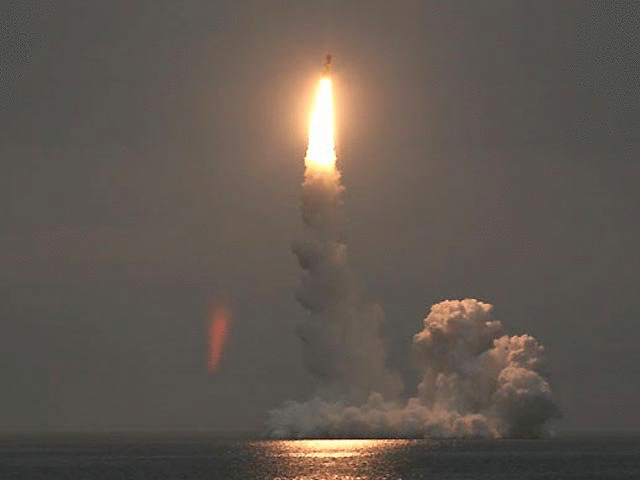
According to the former head of the press service of the Ministry of Defense, military observer Viktor Baranets, the Russian authorities rushed to adopt the Russian naval strategic nuclear forces into service rocket complex "Bulava". The expert said that Nikolai Makarov, Chief of the General Staff, made experts "neigh like horses" with his statements about how the missile will be delivered to the army. At the same time, other military analysts do not agree with Baranets, who criticizes the haste of the decision regarding "Bulava".

Alexander Sukhorukov, First Deputy Minister of Defense of the Russian Federation, reported on the upcoming adoption of the Bulava missile complex for the armament of the Russian army. According to him, Russian President Dmitry Medvedev has already prepared a corresponding decree.

Baranets said that since the creators of the Bulava initially went on an adventure, trying to unify the Topol land complex to the sea-launched missile system, problems began immediately with the rocket. The reason for this, in his opinion, was the constructive flaws, which were aggravated by the "human factor". However, Chief of the General Staff Nikolai Makarov, giving comments about the failures with the launch last weekend, referred to the “human factor”. He said that, to a greater extent, the reasons for the failed missile tests "were in the human factor, where a person did his work unprofessionally."

As a result, the Bulava missile was never properly developed, and now, according to the military expert, it may “fly in the wrong direction or not fly at all.” Baranets noted with bitter irony that the Russian fleet will be more afraid of the Bulava than a foreign one.

Recall that the tests of the Bulava missile system, developed by scientists of the Moscow Institute of Thermal Engineering, began in the 2004 year and for a long time were unsuccessful. The rocket was launched from the submarines "Yuri Dolgoruky" and "Dmitry Donskoy" - from the underwater and surface position. After the fifth unsuccessful launch, during which the rocket self-destructed in the twentieth second of the flight, Yuri Solomonov, who had previously been the director and general designer of the institute developer, resigned.

Changes have occurred since 2010, when there were several successful launches in a row. From 18, the Bulava perfect launches 11 were successfully completed according to the planned scenario.

Last December, the last salvo launch of the Bulava missiles from the nuclear submarine “Yuri Dolgoruky” from the waters of the White Sea took place. After that, Russian President Dmitry Medvedev made a statement about the adoption of the rocket into service, without naming, however, the exact dates.
Earlier, the Ministry of Defense reported that the Borei-class submarines, which are equipped with the Bulava, will enter service with the Russian Navy this summer.

According to Viktor Barantz, the Bulava missile system is in a hurry to adopt before the presidential elections take place, since the employees of the Ministry of Defense are afraid of losing their posts after the arrival of the new head of state. A military analyst stated that story with Bulava is the purest adventure, dictated by the pre-election conditions and the fact that in such an electoral atmosphere some ministers, designers, admirals seek to consolidate their positions so that the new Russian authorities do not punish this story. The expert said that the head of the General Staff even went so far as to say that the rocket would be introduced in parts, which caused “horse neighing” in the ranks of specialists. At the same time, Baranets added that the rocket was “raw” and, in this form, it would be more of a threat to the Russian army itself than to the armed forces of the enemy.

At the same time, Vladimir Yevseyev, an expert on rocket armament, does not agree with Baranz’s opinion. He believes that if we approach the preparation with full responsibility, there is nothing to be afraid of. According to Yevseyev, it’s impossible not to put the Bulava missile system into service with the Russian army, since 2 Borei-type submarines, for which the missile was designed, remain to this day without weapons.

According to the expert, the most serious problems with the Bulava have been resolved, as evidenced by the series of successful launches. The remaining minor flaws can be overcome with proper support of the rocket. And for this you need to on the submarine, which is equipped with a "Bulava", for some time were representatives of the developer.
70 comments
Information
Dear reader, to leave comments on the publication, you must sign in.
  1. 0
    21 February 2012 09: 08
    . Baranets noted with bitter irony that the Russian fleet would be more afraid of the "Mace" than a foreign one.

    But foreigners "are not afraid" of their weapons:
    Attention! You do not have permission to view hidden text.

    Better break in, of course, would not hurt ..
    PS: Makarov as a substitute .......
    1. +3
      21 February 2012 12: 27
      The "experts" are laughing like horses when they hear such belated statements from absolutely irresponsible people, like the subject. This bullshit would have been relevant for journalists two years ago, but not now. This person with a characteristic surname is absolutely not aware of the directions in which unification was carried out and, accordingly, does not back up his statements with anything. The R-30, together with the carrier, has undergone a full range of tests and confirmed all its characteristics specified in the technical specifications. In general, on behalf of everyone who deals with this topic, works at military-industrial complex enterprises, razr. Complex, I would gladly punch this devil in the face.
      1. 0
        21 February 2012 15: 47
        I agree with you. Only a "loser" journalist could say something like this, but not an expert. Only emotions and not a single word on the topic. This is not a serious article at all. For housewives and office orange hamsters who have never even held a hammer in their hands.
        1. Indigo
          0
          21 February 2012 21: 18
          These are the mouthpieces of the Ministry of Defense that were sent packing, and now the "enlightened" (but who had previously been eating military bread) expert (in what and on what military matters?) is starting to throw shit at the liberal fan.
          Low and mean! there is no respect for this ....
      2. abyss 8
        -3
        21 February 2012 19: 43
        "And in general, on behalf of everyone who deals with this topic, works at enterprises of the military-industrial complex, licensed complex, I would gladly punch this devil in the face." - and the problem is solved very easily: promptly and to the maximum possible extent inform taxpayers about where and on what their financial resources are spent! Like in the notorious America!.. and there will be no misunderstandings.. how much longer can everything be "classified"?
        1. +1
          21 February 2012 20: 03
          abyss 8,
          I'm afraid that in the notorious America, everything is also not as informed
      3. -2
        21 February 2012 23: 08
        Quote: Varnaga
        This person with a characteristic surname is completely unaware of the areas in which unification was going and, accordingly, does not support his statements in any way.
        - this guy with a characteristic surname has already made his mark here along with other Russian military observers with very characteristic Russian surnames: Feotgen, ugh, you can’t pronounce the surname, and A. Golts: http://www.inosmi.ru/politic/20120221/186481114.html#comm
        Rate what is called. There are my ratings under the same nickname.
        1. -1
          22 February 2012 06: 18
          So, in general, it reaches a ridiculous one; every near-swimming amphibian among the rubbish-lamer debris considers himself entitled to talk about topics that target research institutes are involved in.
  2. Eugene
    +5
    21 February 2012 09: 15
    Not a single argument in the case why the mace is "not a cake".
    And the number of successful launches speaks for itself. Recently, everything has been successful.
    1. +5
      21 February 2012 19: 21
      If I'm not mistaken, 2 successful launches - successful. I'm going off topic, but close to it. Recently, Phobos-Grunt was lost. There were many explanations and speculations, and they were given by very responsible and competent (at least they are considered to be) people. Let me remind you. Starting with solar activity, in between, the Americans deliberately shot it down with their radar station, then - unsuitable microcircuits, then - the design, etc. were looked through. But the most interesting statement - We will not fire anyone. There is no one to work in their place. That is, we will continue to ruin everything.
      1. Eugene
        -1
        21 February 2012 23: 15
        18 starts, 10 successful, 2 more partially successful.
        based on the wiki.
        1. 0
          26 February 2012 21: 45
          And 6 more where have gone?
  3. Dimitrxnumx
    +4
    21 February 2012 09: 20
    In my opinion, it is already easier to create a Bulava-2 missile than to endlessly bring the Bulava to quality
    1. itr
      -1
      21 February 2012 11: 09
      I agree enough to suffer is not known for anything
      1. +2
        21 February 2012 17: 07
        Have you personally been greatly exhausted? And the fact that the last launches were all completely successful does not mean anything?
        1. itr
          +1
          22 February 2012 09: 56
          It's still not a shell
          And if this pipe flies into its territory or explodes at takeoff
          and the latest launches don't mean anything 60% is not the right place to take risks
    2. +1
      21 February 2012 15: 49
      Do you personally have experience in creating something that looks like a rocket? Do you have any idea how rockets are "created"?
      You, forgive me, but on this score IA Krylov remarked well: "judge, friend, not higher than a boot" (c). No offense.
    3. -3
      21 February 2012 17: 08
      Take care ....
  4. Brother Sarych
    +3
    21 February 2012 09: 21
    The situation with the Mace is clearly dark - in my opinion, a gamble on a gamble ...
    It is a pity that if there are real arguments for and against, then we will hear them only after many years ...
    In the meantime, they will only feed us with various well-paid rumors - too much loot is on the map, and the characters in these disputes think less about the country's real defense ...
    1. +3
      21 February 2012 17: 11
      Quote: Brother Sarich
      In the meantime, they will only feed us with various well-paid rumors

      In fact, all these conversations are appropriate only among specialists. And what we (ordinary people) think about the adoption of this or that missile system into service is of no interest to anyone. And this is actually correct. Otherwise, it will come to the point that "let's use a nationwide vote" to lamely choose what to adopt into service and what not.
      1. +5
        21 February 2012 23: 15
        How long can this topic be muxed already there is a presidential decree on the adoption of this "product". http://news.yandex.ru/yandsearch?cl4url=www.ria.ru%2Fdefense_safety%2F20120219%2
        F569508597.html
        Today, Medvedev, while visiting the Tatishchevsky rd, confirmed this. By the way, they put the sixth regiment of the Topol-M mine on the database. The question is closed.
        And who was Baranets? A talking head for a glass of tea gossip collected. An insider ...
  5. +5
    21 February 2012 09: 40
    Head of the press service of the Ministry of Defense, military observer Viktor Barents
    And whoever doesn’t do weapons analysis with us can all of them go to the constructor!
  6. grizzlir
    -1
    21 February 2012 09: 43
    Yes, all experts, including those in the Ministry of Defense, understand that Bulava is still very, very raw. Not from a good life there was a modernization of the Sineva Liner. Only a person who has read advertising articles can admire Bulava, so these articles appeared during the first successful launches. And then it flies, then crashes. I can’t recall a single combat system that had so many failures in testing and that later this system proved to be good in the army. Now, for testing, a missile is tested and verified thousands of times, if only soared, and what will happen with mass production. Given that there is no definite answer why so many launches of the Bulava failed.
    1. +6
      21 February 2012 12: 45
      What is it raw, dear? At what stage, ACS, BB or something else? Have you decided to become like your idol in “tanks” and rush with unsubstantiated phrases? So I work for NPO Avtomatiki im. Semikhatov and I admire the R-30, do you think I have read advertisements or not? Further, once again for particularly gifted-criteria test launches are substantially ex. From the criteria for combat training. This is such an obvious axiom that people who do not understand this can automatically be ranked as animals without reason. About check and double-check. They tested pre-production rockets, but after all, as you can see from the essence of the posts, the dense lamer, this does not say anything, does it? And finally, a couple of questions for self-development: how much time has passed from R-29 to R-29MU and how were things with the R-39 test at least on the ground stand?
      1. grizzlir
        -3
        21 February 2012 13: 57
        Quote: Varnaga
        So I work for NPO Avtomatiki im. Semikhatova

        Now it’s clear now thanks to whom there are so many unsuccessful launches, thanks for enlightening us.
        So maybe explain to me the dense lamer, your brightest megamind, why out of 19 tests of the product that you admire so much, 7 simply failed, and the very first test ended not with a weak explosion at the factory, and 2 tests are called conditionally successful, which in a combat situation equates to missed combat mission?
        1. 0
          22 February 2012 06: 44
          “So you can explain to me the dense lamer, your brightest megamind, why out of 19 tests of the product that you admire so much, 7 just failed, and the very first test ended not with a weak explosion at the factory, and 2 tests are called conditionally successful, which equates to a battle situation to failure to fulfill a combat mission? ”

          Lamer is such a lamer, hehe. What impassable stupidity? Why the hell to equate test launches with combat training ???
          Well, on the P-39, more than half of the launches from the ground stand were unsuccessful, while MIT at the similar stages showed much better results, and at the same time with the least number of missiles. Or, since you already do not have enough skills to google with five minutes, the story of the R-29 tests.

          “The third phase of the tests consisted of missile launches from a submarine. On September 22, 1964, a resolution of the Council of Ministers was issued according to which a project for the modernization of submarines pr.658 in submarines pr.701 for testing missiles and a project for the modernization of all submarines pr.658 to place the D-9 complex on them should be developed. For re-equipment, at the end of 1964 was allocated PLRB pr.658 K-145. During the modernization, six launchers 4C-75-1 were mounted on it. Despite the fact that by the end of March 1971 the boat had finished factory tests, there were no missile launches, since ground tests were completed only in November of that year. The first launch from the boat took place on December 25, 1971. Since the White Sea was covered with ice, the launch was carried out from the surface. During the fifth launch, a rocket exploded when leaving the mine. The boat was damaged and went for repairs to the Northern Machine-Building Enterprise, where it was until August 3, 1972. ”
          “On December 19, 1976, the K-145 modernized according to Project 701 became part of the Navy. The remaining submarines pr.658, it was decided not to upgrade. At the same time, according to the same decree of the Council of Ministers at Design Bureau “Malachite”, the design of the DPLRB pr.601 was underway. The project provided for the re-equipment of submarines pr.629. complex D-9. According to this project, only one K-118 submarine was converted, six R-29 missiles were placed on it. K-118 modernized by project 601 became part of the Navy on December 28, 1978. On December 27, the first SSBN pr.667B K-279 became part of the Navy. ”


          Those. I explain, in order to remake the old boat in Spanish. It took 12 years, and this is during the heyday of the USSR. Is there any need to explain where the asshole would be? A wheelbarrow would be rolled in Magadan. But then even more interesting.

          “Missiles were supposed to equip Project 667B submarines (according to NATO classification -“ Delta-I ”). The boat pr.667B carried 12 missiles against 16 on the SSBN pr.667A. But despite the decrease in the number of missiles, combat effectiveness, according to experts, increased 2.5 times. Until 1977, 18 SSBNs of Project 667B were built. In the future, the D-9 complex, in order to increase the firing range, was modernized. In 1978, the D-9D complex with R-29D missiles was created. The firing range was 9100 km. This complex was installed on parts of submarines of projects 667B and 667BD. ”

          Those. I explain again for the gifted: after taking into service, it took another 4 years to finalize the rocket. Well and so on, while I ask you to note that this is not the R-29RM. Well, pace? And at the same time, already a fairly well-developed product, managed to periodically fail:

          “On October 1, 1999, an Northern Fleet submarine missile carrier of project 667 BDR, under the command of Captain 2nd Rank Tagir Kayayev, launched the RSM-50 missile from the Barents Sea. The purpose of the launch was to study the possibility of extending the life of missiles of this type. According to the press service of the Navy, the RSM-50 was blown up at the estimated height, however, according to experts, the missile explosion was caused by technical problems. ”

          "Recall that several high-profile scandals are associated with the Sineva missile system, in which the top officials of the state were involved. Thus, during the security-2004 strategic exercises, in which, while in the Northern Fleet, then Russian President Vladimir Putin, the K-407 Novomoskovsk submarine, failed to launch two Sineva sea ballistic missiles. The Supreme Commander-in-Chief of the Russian Armed Forces, who was aboard the TK-17 Arkhangelsk nuclear submarine, waited in vain for a report on the successful launch - it was never The missiles simply did not come out of the mines. ”Such a scandal in our Navy has never happened in the entire history of the NSNF.
          The next day, a failure occurred with another missile carrier of Project 667BDRM: during combat training, the Karelia was supposed to launch two RSM-54s at the Kura range. The first rocket launched began to deviate from the course and at the 98th second of the flight was destroyed by the triggered emergency detonation system. After that, the second launch of RSM-54 was not carried out, the submarine was ordered to follow to the base. "


          Well, already about volley launches in general, you can be silent. In general, the general conclusion: you do not even know anything about the history of SLBMs, you have no idea about this topic and are very lazy to even google for half an hour. In general, a worthy admirer of vyser sabzh of this article.
    2. +4
      21 February 2012 15: 58
      "... I can't remember a single combat system ...". So if you don't know anything from the history of missile systems testing, then don't remember anything. And no fantasy is needed here. And "experts" - journalists - the same is not needed.
      Do you know, for example. that on a test of one of the ICBMs, Artillery Marshal Nedelin was killed. And a lot more people. And that rocket later showed itself perfectly. And she was on duty for a very long time. And how many falls and failures with other missiles - and do not tell. You don't need to think about anything. THE WHOLE life cycle of ANY rocket is constant improvements, improvements, upgrades. And nothing special in the fact that there were problems at the initial stage - no. The well-known "Satan" did not fly at once. It was just that then it was not customary to make noise about it, because in this case an extra philistine noise is not needed. "The trouble is, if the shoemaker starts to bake the pies, and the cake-maker sharpens his boots" (c)
      1. grizzlir
        -1
        21 February 2012 17: 41
        Quote: ikrut
        Do you know, for example. that on a test of one of the ICBMs, artillery marshal Nedelin was killed.

        It is well known that he remembers all the soldiers who died then at Baikonur. Only if you know the cause of that accident was not the rocket itself, but the depressurization of the filling pipeline.
        Yes, indeed, then there were a lot of catastrophes with missiles, but you can not compare those catastrophes with unsuccessful launches of, say, Bulava. At that time, rocketry in the USSR took only the first steps, there were a lot of completely new technologies, and now we can not launch an analogue of a rocket which is already is in service in the Strategic Missile Forces.
        1. prunx
          +2
          21 February 2012 20: 12
          Well, yes, why, then, during the tests of the R-36M2 Voevoda, out of 43 launches, only 36 were successful, and everyone slept peacefully at home and did not fight in hysterics, as you are now? Maybe because the profane journalist who do not understand anything about this, and the hamsters who read the opuses of these "representatives of the press" and "publicists" should not meddle in their own business? By the way, Viktor Barantz, although he is a military man and a former head of the press service of the Ministry of Defense, has absolutely nothing to do with rocketry! Another pseudo-expert who decided to promote himself on a pseudo-sensation.
          1. Igor
            0
            22 February 2012 07: 17
            Quote: prunx
            Well, yes, why, then, during the tests of the R-36M2 Voevoda, out of 43 launches, only 36 were successful, and everyone slept peacefully at home and did not fight in hysterics, as you are now?


            To compare the "Voevoda" and "Bulava", then you need to fire the "Bulava" 43 times and see how many successful launches there will be.
    3. 0
      21 February 2012 17: 17
      Quote: grizzlir
      I can’t remember a single combat system that had so many test failures

      Do you know how many launches were carried out before the adoption of the missile systems at the Union? Only all this was done in working order, without the attention of journalists, but with the attention of special. services.
      1. 0
        22 February 2012 06: 47
        He doesn't know anything. Another sofa "expert".
    4. gradient
      +3
      22 February 2012 08: 15
      grizzlir,
      I can’t recall a single combat system that had so many failures in testing and that later this system proved itself in the troops on the good side

      And how much do you remember if not a secret laughing
      So, for example, and enlightenment (though at the expense of enlightenment without much hope), the result of the first ten tests of R-39, the previous solid-fuel SLBM
      28.12.80/XNUMX/XNUMX - accident - error in the technical documentation ("confusion" of the pyrotechnics circuits);
      04.04.80 - accident - destruction of the seat of the injection valve of the engine of the first stage
      17.06.80/XNUMX - accident - failure of the onboard cable network,
      03.10.80 - accident - failure of an onboard power source of the second stage,
      03.12.80/XNUMX/XNUMX - accident –– failure of the control system at the site of operation of the first stage
      27.12.80/XNUMX - successful
      27.01.81/XNUMX/XNUMX - partially successful - one combat unit was not found
      01.04.81/XNUMX/XNUMX - accident-explosion when the second-stage engine is turned on
      22.04.81/XNUMX/XNUMX - accident - deviation from the course at the stage of operation of the first stage
      27.11.81/XNUMX/XNUMX - partially successful - one combat unit was not found.

      .Not from a good life came the modernization of the Sineva Liner.

      When the macemakers learn the truth about this epic modernization, the crackle of patterns in their brains is deafening
      "... EXPERIMENTAL DESIGN WORK" LINER "

      In the experimental design work of Liner, a new warhead was linked to the on-board control system and missile. The new unit was adopted as part of the Topol-M — Yars land missiles; intended for installation on the Bulava-30 offshore missiles under development; in the tactical and technical task for the development of this unit provides for its use on missiles R-29RMU; Lead developers of the combat unit (nuclear munition): Moscow Institute of Heat Engineering, All-Russian Research Institute of Technical Physics.
      On the R-29RMU2.1 ("Liner") missile, a new combat unit is installed without any design changes due to the use of cable inserts and adapters, as well as a specially designed individual mounting platform, interfaced with the regular missile seat. In the process of development, the interaction between the onboard control system and the ammunition automation system was implemented and worked out, the software and mathematical support of the ship's digital computer system was improved. The planned volume of ground-based experimental testing was completed (five mock-ups, eight complex experiments), including the experience of separating the unit on a unique vacuum-dynamic bench in conditions of simulating weightlessness and in the absence of atmosphere. The results of ground experimental testing are confirmed by flight tests.
      Cit. by:
      Marine strategic missile systems. - M.: “Military Parade”, “GREC Makeeva”, 2011. - 268 pp.; silt.
      ISBN-5 902975-25-0


      So Taranis Baranets, log in laughing
  7. +4
    21 February 2012 09: 54
    grizzlir,
    There were failures when testing other missiles, we just don’t know about them.
  8. +3
    21 February 2012 09: 57
    The whiner got caught.
    "the former head of the press service of the Ministry of Defense, military observer Viktor Baranets"
    He is the head of the press service - his business with the press is chatting.
    What an expert in the bath. It is necessary to ask the opinion of really knowledgeable and understanding people who know the mace "from the inside".
    1. grizzlir
      +3
      21 February 2012 10: 07
      You don’t know the biography of Viktor Barents. A person is very well versed in many weapons systems, it’s always interesting to read his articles. There’s only calculation and no populism. Moreover, he has good knowledge in many weapons industries. Once I listened to his radio talk about tank problems, I how a tanker was struck. Barents not only talked about problems and prospects, but also described the real design of the machines and the problems of their operation.
      1. Eugene
        +3
        21 February 2012 12: 09
        The fact that he understands BTT does not mean that he is also an expert on ICBMs.
      2. gradient
        0
        22 February 2012 08: 45
        The interests of comrade Barents are well illustrated by his blazik in the Komsomol member, which consists of a little less than completely from naked girls and comrade Stalin. That's the fact that he is an expert in girls (although obviously already a theorist) willingly believe. But in the rockets ...
  9. Volka
    +2
    21 February 2012 10: 12
    Everything new, with rare exceptions, is very difficult to get to work normally even more so after the 90s, and accidents were with other carriers, although they were not so frequent. With the union, everyone checked on the stands in the metal, and now they model on the computer, although not all!
  10. dodil
    +4
    21 February 2012 10: 51
    We look forward to hearing from the distinguished Murano! For me, so Baranets hardly understands more in this matter than Solomonov. I saw an interview with Solomonov. Well, he doesn't look like a liar and a poser, he doesn't look like !!! The Bulava flew. Enemies bang, we rub our hands pretty laughing
  11. Nechai
    +4
    21 February 2012 12: 08
    The Bulava concentrates unique scientific and design solutions. In addition to money, there are other interests here... of "probable friends". The creation of a unified land and sea carrier by one design bureau is not without controversy. But the idea itself had already been implemented in the USSR. Yuzhmash and Makeyevka, when creating their solid fuel carriers, implemented significant unification of both engines and control systems. This information seems to be off topic, but in my opinion it is typical for our defense industry now. Yesterday, in Karaulov's program on St. Petersburg's "5" channel, honestly by chance (Karaulov is quite the popularizer), I came across a story about the Nizhny Novgorod Massstroy Plant, part of Almaz-Antey. Former Grabinsky Artillery Plant No. 92 ('New Sormovo'). Producing all the "platforms" for the S-300, S-400. With a capacity of 150 sets per year for this position. Reconstruction is currently underway there. Metallurgical production has long been stopped, now it's the turn of the forging and pressing. Everything that is part of the construction site is fearlessly demolished. Unique specialists are being fired en masse or they themselves leave. The staff is being replenished from Deribaska from the Volgovsky production that has folded. The director is a person who knows the production of armored personnel carriers from Arzamas very well. The plant is in debt, like a flea-bitten mongrel. Due to the constant sale of finished products to the general customer - Almaz-Antey below cost price (!!!). This is the refrain. And at the exit, in the dry residue, the planned volume of production is reduced THREE TIMES! That is, after the successful development of funds for modernization, production costs are reduced on the new equipment. The owner's profit increases. And so that it does not fall as long as possible, and the option of growth is possible, the volume of production is reduced. "If it is true, well, at least by a third! There is only one thing left ..." who must die! The IDEA of ENRICHMENT by any means and in the shortest possible time, which is now carefully cultivated in society, must die! Grab it with your mouth and ...! It must become like in the joke:
    Did you know Abram that you lived on against a city prison?
    Yes, and who knew?
    So, now he lives in front of his house!
    And who is he eating there?
    Black bread and water ....
    Come on! Who couldn’t eat this at home ?!
    And widely covered in the media "House-2-prison" and "House-3-deprived" (all acquired by "excessive" labor). “2” is about the life of the main “hero”. "3" on joint work in the field of returning to the society the stolen, his relatives and friends. Indeed, in the event of a divorce, his madame would claim half of the JOINTLY DRIVEN, and the heirs were lusted to share the inherited! Well, the inheritance can be different. So to speak, without acceptance .... Kohl on the hundred that they drank on the ships together, ate and e ... whether. Return one hundred rubles for the construction of ships!
    PS Karaulov promised to send a report to Rogozin. If this is not a disinformation, a boom is waiting for decisions.
    1. +3
      21 February 2012 15: 51
      Nechai,
      Creating a unified land and sea carrier with one design bureau is not without a controversial decision.
      do not enlighten where is the unification?
      Producing all the “platforms” for the S-300, S-400. With a capacity of 150 sets per year for this position.
      EMNIP AA in Nino produces only final assembly and debugging. But not the production of platforms.
      and their platforms
      Ural-532301;
      RMZKT-7930.
      BAZ-64022 or on the MAZ-543M chassis
      And at the output, in the dry residue, the planned volume of production is reduced THREE!
      Proof please, otherwise it's populism. Moreover, the number of produced systems correlates not even with the state order, but with the retraining of the regiment at once. Imagine removing, for example, TWO regiments from the VKO. Then conduct divisional coordination and test launches at Ashuluk.
      And don't forget that AA produced for SA, and it was 3 times larger than the current one.
      And everything else is just emotions
  12. -4
    21 February 2012 13: 50
    Dimitrxnumx,
    the mace had a minimum of 3 different modifications about it even Wikipedia writes
  13. 0
    21 February 2012 14: 46
    It always amazed and outraged when various paper assistants to commanders were given an analysis of the state of technology and advice on its operation, who had an idea of ​​equipment and weapons exclusively from the words of someone or from articles and popular comics. Similar statements on behalf of a journalist who in the recent past was the "face" and "voice" of mines. defense can be equated with the state. change at least. In general, of course - superficiality of the highest degree. Ugh at him.
  14. 0
    21 February 2012 15: 37
    What are you breaking spears ... campaign is unfair competition .... anti advertising. And the mace went through a volley launch, successful by the way and recorded by objective control systems ...
    1. 0
      21 February 2012 15: 41
      viruskvartirus,
      and where is the competition?
      Makeevtsy sawing Liner and a new slurry for the Strategic Missile Forces
      MIT Yarsi and Clubs.
      Southern Design Bureau is Ukraine.
      And given the unification of goals on the liner and the mace wink
      And it’s even more interesting to see what omerikanchegov with the production of Triden. laughing
      1. -1
        21 February 2012 21: 10
        The competition can be different and take different forms ... not necessarily competition between firms ... maybe just between people ... for example, Yu. S. Solomonov said that a new slurry sucks .... that’s arrived ...
      2. -1
        22 February 2012 06: 49
        leon-iv, even more interesting is that for the ancient rubbish they have as land ICBMs laughing
  15. 755962
    +1
    21 February 2012 15: 44
    The Russian Ministry of Defense buys technology abroad due to the inability of the Russian electronics industry to manufacture the necessary parts and microcircuits for the production of weapons.
    This was announced on the air of the radio station Echo of Moscow, "Deputy Defense Minister Vladimir Popovkin.

    "Yes, we have a ban on the use of imported hardware components in strategic nuclear forces (SNF), but in all other respects, if we start installing our hardware components, our missiles will not reach," Popovkin said. According to him, the Ministry of Defense allows the use of imported components, but an import substitution program is being created for them.

    By this, he explained the need to purchase a batch of unmanned aerial vehicles in Israel, he gave a similar explanation to the possible purchase of a helicopter carrier of the Mistral type in France.

    Popovkin also linked the latest unsuccessful launches of the Bulava sea ballistic missile with problems in technology. "Technological discipline, mistakes are not in design," he said, and therefore a commission of independent experts was created. Popovkin said that the next flight tests of Bulava will take place only after the commission's conclusions about the rocket's readiness.
  16. 0
    21 February 2012 17: 26
    Quote: 755962
    This was announced on the air of the radio station Echo of Moscow, "Deputy Defense Minister Vladimir Popovkin.

    From what time are these statements?
    Quote: 755962
    Popovkin also linked the latest unsuccessful launches of the Bulava sea ballistic missile with problems in technology.

    In fact, the last one, if sclerosis does not change me, was a salvo launch of two Bulava missiles from an underwater state. As we all know, everything went well. This is the latest information.
    Yes, and about the impact of domestic UAVs - also just around the corner.
  17. +1
    21 February 2012 18: 44
    Barents, to the ministers of defense! Oh, this giant of thought, seasoned expert will be able to solve all problems at once ... He would only have to break out into strategic space ...
  18. +2
    21 February 2012 19: 02
    "According to Yevseyev, it is impossible not to put the Bulava missile system into service with the Russian army, since two Borei-class submarines, for which the missile was developed, remain without weapons to this day. "... i.e. the main argument for Bulava is not that it has been brought to mind... but that the submarines have been riveted. The situation is like in a comedy... or a registry office, or a prosecutor... All this is bullshit, the reality is even more unknown... how will it withstand transportation.... how will it be stored... and what to do if it catches fire, this is not Topol, run 2 meters and lie down with your feet next to the installation... there is water all around. After all, the liquid one will simply explode, and this infection will burn even under water.
    1. 0
      21 February 2012 21: 15
      it's all rhetoric — MUST withstand transportation .... should be stored ... and should not light up just like that .... it all starts with those assignments ....
  19. -2
    21 February 2012 19: 18
    Strashila,
    my friend and go to MIT. They will give you a good sn.
    In the meantime, explain the submarine production cycle of 5-6 years for the lead ship. That is, based on your ideas, we need to accept the missile and then wait another 5 years for the carrier?
    PS do not explain what prevents you from launching (without launching the first stage) from the rocket shaft in the event of an emergency.
  20. +3
    21 February 2012 19: 34
    Strashila, hopefully, the experience of recent disasters have been taken into account. Yes, and the boats are new, probably taken into account in terms of security. This is a question for experts.
    And the rest is anti-advertising, they design and run for a long time. And to the question to catch the elections, so how many were there? With such alleged speed for the elections, it was possible to report 2004, and even in 2008. Recent years have nevertheless stirred. Starts are successful. What should I say. We wish her a successful flight.
  21. matvey.z
    +4
    21 February 2012 20: 22
    Why are you all so worked up?
    Well, the man expressed his opinion. Refute it, but not with quotes from newspapers and trash from the Internet.
    We need to find out the opinions of those who were at the launches and those who will "serve next to" Bulava....
    The fact is that MIT was not involved in sea-based ICBMs.
    The fact that Sergeyev I.D. GRC V.P. Makeev was "further" than the 4th Central Research Institute of the Ministry of Defense (Vladimir Dvorkin) is also a fact.
    And these "shoals" got out with deadlines and unsuccessful launches and resignations.
    There are submarines, but ICBMs are only just approaching.
    1. -2
      22 February 2012 06: 56
      blablabla, here basically adequate people just speak the language of factology, if cho.
      The fact is that MIT, in the conditions of the collapse of the military-industrial complex, gave a brilliant result and the prospects of the complex are very great in a variety of parameters, such as the dilution stage, BB, KPP PRO, duration of the auth, dilution parameters, etc., etc.
      1. matvey.z
        +1
        22 February 2012 13: 51
        Quote: Varnaga
        blah blah blah
        -? That's for me?
        1. -1
          22 February 2012 14: 42
          Of course, but if you want, you can start a more substantive conversation than rubbing the chewed phrases, the adequacy of which is in great doubt.
          1. matvey.z
            +5
            22 February 2012 22: 45
            ESmb for delay (hospital, procedures, crutches).
            objectively, so objectively.
            Let me make a reservation right away: I am not a specialist in turbojet engines - the level of the basics that were taught at the institute, liquid-propellant rocket engines are my specialty, and I have probably forgotten everything over the past 20 years. But I have communicated with single-threaded engines (and still partially communicate).
            What is the grinding of chewed phrases (for me)? If so, try not chewed:
            1. Sergeyev I.D., despite the fact that he graduated from the ChVVMU, was never associated with the Navy, especially with sea-based ICBMs. His entire career was on land, in the Strategic Missile Forces. He had (in my opinion) his own, but relatively weak, opinion about the maritime specifics.
            Moreover, this does not diminish his real merits in the Strategic Missile Forces and the Ministry of Defense, but if he visited the Navy, it was only on representative visits, as well as in the combat zone in the North Caucasus.
            All his scientific works, and they are under the stamp, are "not engineering" topics, although he did.t.n.
            He was a "popularizer", one could say a fan of the Strategic Missile Forces, in fact, "Topol" came into being thanks to him.
            Sergeev's reputation is almost impeccable, especially when you consider at WHAT time and with WHAT environment he worked. "Surviving" 3 (!) Government resignations is an indicator.
            However, with him:
            The catastrophic dismissal of military personnel into civilian life in the 90s - without NOTHING, almost naked.
            Including the Aerospace Forces into the Strategic Missile Forces is a pointless undertaking.
            State Housing Certificates (know-how B. Nemtsova)
            "UES of Ukraine" (G. Oleynik, charged under Article 286, Part 3, paragraph "b" of the Criminal Code of the Russian Federation)
            "murky" story about a dacha near Anapa.
            "commercial" activities of the son in the Vlasikh garrison
            I will not judge, I was not present, I was not, I did not participate, but "no smoke ...".
            The last link (the topic "son") is especially noteworthy, which suggests, with a reasonable degree of probability, the "validity" of transferring the development of a new ICBM for nuclear submarines not to the 28th NII, but to NII-1.
            It is not serious to deny the acquaintance and good relations between Dvorkin and Sergeyev; they (in my opinion) crossed paths in their work more than once.
            There seems to be nothing “terrible” about this, but the 4th Central Research Institute and Research Institute-1 never supervised or worked (accordingly) with ICBMs (or missiles in general) of underwater launch.
            It's understandable from a human perspective, probably anyone would have done the same, ESPECIALLY at THAT time. But from the point of view of "Statehood" - this decision is essentially wrong.
            Moreover, these "rakes" come with enviable regularity (we have for some reason): Korolev (N1) -Mishin / Kuznetsov-Glushko (Energy), Pogosyan (Su) - MiG-UAC, shipbuilding, tank building, well, etc.
            The personal wins the reasonable (objective)
            2.
            Quote: Varnaga
            h blablabla ... then MIT, in the conditions of the collapse of the military-industrial complex gave a brilliant result
            .
            According to the turbojet engine, we (the USSR and the Russian Federation) initially and almost always lagged behind the United States. There are several reasons:
            1) In Peenemünde it was not possible to "capture" the TTRD, technologies and specialists. For a banal reason, the Germans had these works in the "rudiments", there was no TTRD.
            Regarding liquid propellant rocket engines, all our technologies, industry, control systems, materials, layout, ignition systems, etc. (Nordhausen Institute, Rabe Institute, Montania Plant, Sonderhausen Plant, Vorwerk-Mitte Test Base in Leesten and MOST IMPORTANTLY PEOPLE (specialists)/TECHNICAL DOCUMENTATION) are based on German ones.
            RD-2 - 0,6 tf thrust (experiments), A-4 engine - 25 (!) tf (SERIAL PRODUCTION), Korolev saw it, didn’t sleep that night.
            Liquid propellant rocket engines before RD-103 and rockets before R-3, de facto modifications of German developments
            RD-110 from OKB-456 V.P. Glushko, this is the result of scaling A-4
            and only the R-5, one might say, "left" from the typical V-103 scheme, although the RD-4 (forced A-2) and the automatic stabilization, control system, gas and aero rudders, the essence of V-XNUMX.
            And again, 16 years later, Korolev (for some reason) according to the 11A52 project, refuses the supporting tanks and returns (in fact) to the V-2 layout, which led to an increase in the launch weight and parasitic mass of the structure. Probably the "German influence" on minds and technology was very strong + the technological backwardness of the USSR industry had an effect.
            There is nothing wrong with that, and ours are no stupider than them (each country would take advantage of the fruits of victory)
            I am reporting all the above "blah-blah" only in order to move (smoothly) to point 2
            2) regarding the TTRD - almost all developments are ours, our own, well + what the knights of the cloak and dagger helped with.
            But, based on objective factors, we (in terms of TTRD) lagged (and probably still lagged) behind the same America.
            Caused by: weakness of the chemical industry (composition of mixed fuels, composition of materials for the body, erosion-resistant materials of the combustion chamber and nozzle), weakness of machine tool manufacturing (3D structure of the winding of the shell, formation of an optimized (specified) combustion surface area, catalysis channels, etc.)
            And if the composition of the mixed solid fuel could be "borrowed" from overseas former ones and recreated (with difficulty, but possible), the combustion surface (shape, figure, change parameters (if required), etc.) can be calculated and is not difficult, but to reproduce it in the material, to create a nozzle with an erosion-resistant coating, with the existing level of the technological base - is unlikely. Example: "Polaris", "Minuteman"
            The fact that shows the technological capabilities of the country is the F-1 engine, we still cannot reproduce this masterpiece (a jacket made of PROFILED tubes, the cross-section of which changes depending on the required degree of cooling). The same goes for the technological limitations in the production of turbojet engines.
            And it is not caused by (mental) retardation, but by banal reasons, starting from the lack of decent production of means of production. To understand this, it is enough to visit the "PROGRESS" plant in Arsenyev.
            ITALIAN and GERMAN machines look great in the production of RUSSIAN combat helicopters of the Ka series.
            3) Moreover, taking into account 1) and 2), there was no point in giving submarine-based ICBMs to MIT instead of SKB-385.
            Most technologies are not only calculation documentation, but also empirical data, the engineer’s “nose”, intuition, etc., and all of this cannot be conveyed by a target instruction of the Politburo or a Resolution of the Government of the Russian Federation.

            MIT did not work with launches in environments different from atmospheric ones, with back pressure, features of pre-launch preparation, the first stage of launch, etc.
            I remember how much the head of the specialty of the GTU told me, telling how they were messing around on the platforms, with the first testing of the launches of submarine-based ICBM engines, at least on the Black Sea, and not in the Barents Sea.
            The work is done yes, I agree, but I do not agree that it is "brilliant". But behind the scenes the question is: HOW MUCH did it cost? How much wasted (people's) budget money?
            And how much did we (the Russian Federation) lose by refusing the R-39UTTH, due to the lack of “financial and production capabilities of the Russian Federation” (letter from Ya. Urinson, I. Sergeev to the government from 1997).
            and starting (from SCRATCH) the development of the Bulava?
            The crazy idea of ​​a unitary ICBM for the Strategic Missile Forces and submarines, from a technical point of view, from an operational, production, strategic point of view, does not stand up to any criticism, this is the "swan" song of an economist of our Russian variety. If this idea had been submitted by Chubais, it would be understandable, but for Sergeev...
            Such statements are, well, akin to what A. Ilyin "sings" about the 1144 "Orlan" project: the presence of a nuclear power plant and 2 auxiliary oil steam boilers in one hull is unique, no one in the world has anything like this...
            Nobody needs to carry ballast, it’s the same story as with the BTR-70 (nobody has TWO engines either), and there are no unified ICBMs.
            4)
            Quote: Varnaga
            MIT, in the context of the collapse of the military-industrial complex gave a brilliant result
            ... well, only if it is in the conditions of decay, brilliant.
            And if they continued to work on the R-39UTTH? Would he (the result) be less brilliant? In my opinion, just the opposite.
            What makes it "brilliant"? Due to unification with 15Zh55, according to official data, it loses to: UGM-133A, M51 and of course 3M37. Something close to JL-2?
            A simple calculation of launch mass/volume of the missile = 0,2215 (Bulava), versus 0,316 (UGM-133A), or 0,216 (M-51), or 0,31 (R-39) shows a suspiciously low weight for a useful volume.
            What is this? New fuel? Mythical hypersonic maneuvering warheads? "Solid" hydrogen fuel? or is it LESS throw weight (which is closer to reality).
            At the same time, suddenly, out of nowhere, appeared..., i.e. the active section SHRINKED, WITH LESS ENERGY EFFICIENCY.
            Possibility of launch on a flat trajectory? With a turbojet engine, which has practically NO ability to regulate the thrust of the turbojet engine?
            And at what range? (when laying)

            5)
            Quote: Varnaga
            the prospects for the complex are very large in a variety of ways
            I'm out of luck here. Can you enlighten me?
            What are the prospects? How big are they? I'll be happy to read it.
            (If everything is in the vulture, well, at least in hints.
            Such statements are very similar to "The iPhone killer has been created" or, closer to the topic, such insinuations (after the first flight of the PAK FA): "it will tear that shitty F-22 to shreds, it (the T-50) is an order of magnitude cheaper, two times more advanced, three times cheaper to maintain... And so on.
            It was after the first flight.

            I hope not tired.
            1. +2
              24 February 2012 09: 30
              Thank you for your reply. But to the point, you know, all the talk about MIT winning the R-30 competition only thanks to lobbying in the government, although not without foundation, in no way reflects the true picture of things. Maybe you are not aware, but the competition was held 2 (!) times, and the results were summarized by the relevant research institutes of industry and the Ministry of Defense, accredited for these purposes. The reasons are simple - the results were so blatant that they were simply not believed (in particular, the payload was not 1, 10, but about 100 kg). Thus, this was a completely justified decision of the organizations evaluating, first of all, design and technological, organizational and financial and economic solutions. And as time and comparative analysis with the State Research Center, with the R-39 have shown, this decision has fully justified itself. For example, after the first launches, it was absolutely clear that the PAD, 1,2 stages (9 first launches, before the factory defect) were functioning absolutely normally, while the MIT achieved this result IMMEDIATELY with the submarine (the collapse of the complex in Nenoksa played a significant role in this), while the GRC conducted at least 16-20 launches from a land stand, for the reason that it was simply dangerous to launch them from a submarine. All claims about the MIT not being a specialist are simply crossed out by the first launches of the R-30 with DD. Almost all problems with launches were connected precisely with the cooperation of the GRC due to the same component and this is also an indisputable fact.
              About TTRD. The issue on the turbojet engine is interesting and, of course, very multifactorial. For example, the close dimension of Topol-M, Yarsov and Mace is due in no small part to the fact that the greater dimension requires completely different equipment, those. process, specialists who were lost after the collapse of the USSR. With new equipment and old manufacturing processes, it will be necessary to make the manufacturing process purely empirically tailored for exactly this equipment, which, of course, will entail huge costs both in time and cost. At the same time, it is worth considering that the cost of a turbojet engine, with an increase in dimension, does not grow linearly, but exponentially. In general, the mythical lag behind amers in fuel and, in general, in material science, is nothing more than mythical. Roughly we caught up with them by the end of the 70s. And surpassed in some characteristics. In particular, the introduction of hexogen as an oxidizing agent in combination with octagen into the mixed fuel composition made it possible to significantly surpass American fuels, both in specific impulse of thrust and in fuel density. There is one interesting detail here, on promising SSBNs the USA and England will use common CMS missile silos of a larger diameter than for the D-5 (0,8 m.). This can indicate both progress in terms of the diameter of the turbojet engine and regression, which indicates the transition to the layout with side starting steps. I am more inclined to the second option, given the total degradation of amers both in technology and with the loss of specialists. The only thing in which we lagged behind amers is in the field of non-destructive testing and, accordingly, in equipment for diagnosing the state of a rocket. Ahead of the amers in this area allows them to shift the fuel balance towards greater energy, rather than increasing the guaranteed storage periods, which led to the lower energy levels of our turbojet engines.
              Next, about unification. First of all, this concerns TT, I think it is clear that the joint production of fuel components for land and sea-based ICBMs significantly reduces the cost of ICBMs, while creating a reliable basis for further development (plus fuel and materials for turbojet engines are more and more widely used range of weapons). Also, the unification touched the platform of military equipment, BB, KSP PRO, many separate units (steering gears, nozzle units, etc.). At the same time, of course, the sad experience in the design, production and operation of the R-39 was learned. In general, I didn’t talk about the pure unification of MIT, it was about reducing costs and reducing development time.

              As for the terms, I, in my opinion, already wrote about this above, I ask you to familiarize yourself with the example of R-29, and, of course, you are probably aware of the history of the development of D-19, the actual failure of the program, which led to a change in the parameters of the original TK, in the direction of deterioration and, as a result, work on D-19U. That is, they brought RSM-52 to the appropriate level for almost 15 years, issuing funds from the customer.
              Regarding simple calculations. You do not take into account at all that the R-30 has a huge modernization potential, first of all, in terms of overcoming missile defense systems, both existing and prospective. At the same time, it was possible to simultaneously lay down a concept that reflects, for example, the current state of the Aegis system, without taking into account its further development. However, it is obvious that this is absolutely hopeless. In general, the modernization potential consists of many parameters (the logic of the functioning of the ICBM on the OUT, the interface of the missile defense control system with the ICBM, based on the development of missile defense systems), but let's touch on the mass. Namely, the presence of a certain mass (directly tied to energy capabilities) allows us to solve the problems of overcoming missile defense systems of a modernized nature in the long term. Here, in accordance with a clear definition of missile defense threats, the OUT parameters come to the fore, such as the speed of the missile, which is primarily influenced by such parameters as the number of stages, the specific impulse of the engines' thrust, the coefficient of filling the missile with fuel. Increasing this coefficient is necessary to increase the missile speed, with a given launch mass, which can be achieved by reducing the payload mass, or by reducing the mass of the engines themselves. At the same time, for a turbojet engine, the ratio of the fuel mass to the second consumption is relevant, and it is by this parameter that the perfection of the missile should be assessed. Further, objects are hit not by the payload, but by quite real BBs, and many parameters play a role in assessing their effectiveness. The key ones are the breeding parameters, CEP. Obviously, with a smaller CEP (while the CEP of the R-30 is significantly less than the CEP of the D-5, due to new-generation gyroscopes with a much shorter drift time (an order of magnitude), accelerometers, which are much more accurate in measuring the throwing speed), less power is needed, which allows for comparable or greater damage with a smaller payload mass. Further, the tasks of the Strategic Nuclear Forces of the Russian Federation and the USA differ significantly. For the Americans, it is much more relevant, due to the concept of using nuclear weapons, to use 0,5 Mt per object (silo), than, for example, 2x0,1 Mt. The task of distributing small BBs among cities without a pronounced concentration is relevant for us, while, naturally, the mass of the payload will be somewhat smaller. And here the parameters of BB distribution play one of the key roles. The R-30 delivers its 9300 BBs at a range of 6 km without problems, while the BB distribution area does not decrease in any way, which allows hitting a wide range of targets and ensures an increase in the effectiveness of the RK due to prompt retargeting. In general, as can be seen from the above, a “simple” count is clearly not sufficient here.
              There is a lot more that can be written on this topic, but honestly, I think this is quite enough.
              Regards, Varnaga.
              1. matvey.z
                +4
                24 February 2012 18: 36
                Hello. Thank you too, detailed and interesting.
                About the competition and why MIT won it - this was the preface with a description of the probable factor that played a role, which was reported.
                It is impossible to deny the possibility of "interest". I repeat: I was not there, I did not stand, I did not receive. Only my opinion, based on the media (and there is nothing else).
                I didn't know that the competition was held 2(!) times. Is that true?

                "while MIT achieved this result IMMEDIATELY with the nuclear submarine" -?
                What about ground stands and launches?
                (below)


                And the data on the first launch?
                5500 km (during testing, White Sea - Kura, Kamchatka). Flight time - 14 min
                It seems impossible to say that "I achieved this result RIGHT AWAY"? This is far from the technical task.

                Is there any factual data on the impact of "cooperation with the State Rocket Center" on launch failures? (Please provide information, if it is not classified).

                Well, I wrote about the geometric component, and I think it is wrong to use the same "landing" dimensions for ICBMs of sea and land complexes. This is ineffective from all points of view, except economic. However, taking into account the time when all this happened, it is accepted. Only again, this will 100% affect the future: modernization, increase in performance characteristics, capabilities, etc.

                Regarding the fact that we have surpassed the US in impulse/thrust, due to the use of
                I disagree. Both we and they use ADNA. The point here is different, used (by both sides) finely dispersed metal powder, but in shape (sphere with a given % deviation) and size they are superior to us, again this is caused by technological problems (ours).
                +catalysts for curing binders, +corrosion inhibitors for metal powder, +additives that reduce the light output of the torch, +density stabilizers throughout the charge structure, + , +well, there are a lot of problems.
                in D-2 TT (Class 1.1), based on NEPE
                In terms of thrust and specific impulse (UGM-133A versus 3M30): 91 kgf versus “about” 170.
                True in terms of thrust, but should we take into account the difference in launch weight with comparable range? And in terms of specific thrust?
                with 36 (37) tons of starting weight, the active section will naturally be shorter. The "hot" mode of stage separation used in the "Bulava" (to reduce the AUT) is good. And what is the error from disturbances to the aiming point?
                Probably, if you dig deeper, the Americans worked on it in the same way.
                I have already given the indicator of the ICBM layout density (weight/volume) above, and below one of the "eagles" (a certain Gradient) has already criticized me, however, without reason (it seems he did not understand (or did not want to) what I was talking about), of course, this is not an indicator of the perfection of the turbojet engine, but an indicator of the engineering quality of the product (layout density).

                RDX (we) is inferior to HMX (they) in all respects (density, speed, heat, stability, heat resistance, etc.).

                regarding remote control - everything is correct, and it couldn't be any other way, considering the element base. But this same element base plays a decisive role in control systems!!
                There are not only functional factors of possibilities here
                (speed, floating point operations, etc.), but also the specific weight of the SU (weight/occupied volume). For ICBMs, grams, "squeezed" into a unit of volume are important. How can one not recall the dimensions (I will keep silent about the cost) of GLONASS and GPS chips/

                I don't know anything about shelf life, maybe. But it seems to me that this value is inversely proportional to the energy efficiency of the turbojet engine.
                Ie (in simplification): the energy sector is worse, the "weaker" fuel - the shelf life is longer (as we and you confirm this).
                Energy is "better", shelf life is shorter, like theirs, for example "peacemaker".

                "the cost of the TTRD, with the growth of the dimension, does not grow ... exponentially" - I do not agree with this.
                Basically, if you do not suffer from "gigantism" (which is not technically feasible), after 20 tons of starting weight, and about 60 -linear.
                And also some processes and, accordingly, technological methods of their solution, for a starting mass of 50 tons are solved easier and cheaper than for 20 tons (Launch, "predictability" of changes in the combustion surface, the final part of charge burnout, thrust release, etc.)
                This is my opinion (at the level of 1993, perhaps now it is not so.

                on CMS, read the same. Of course, there is no regression in the turbojet engine (and it cannot be). Most likely this may be due to:
                1. new warheads (a kind of super-maneuverability, as we like to write hypersonic, in the final section), causing an increase in the diameter of the warhead and fairing, and as a consequence, in order not to breed “freaks” like Ariane.
                2. Reduction of the length of the launch vehicle (dimensions, for the use of a smaller class of submarine), with a simultaneous increase (within reasonable limits +0,8 m) of the diameter of the launch vehicle, using new opportunities to reduce the size of the launch vehicle, container (shaft).
                3. Unification of the ICBM silo for a promising cruise missile and for autonomous underwater vehicles
                Most likely here: 1+2+3, although 2 and 3 are more realistic.

                It is very unlikely that a packet scheme will be used, since it is not typical of US rocket engineering, and 0,8 (0,9)/2 = 0,4 (0,45) is somehow not "aesthetically pleasing". They do not like to use such a scheme in combat, and it contradicts the results of the work on SICBM.
                I am hearing about the total degradation of the USA in the area of ​​TTRD for the first time! Is there any data? I thought the opposite, everyone is in good shape, and we are falling further and further behind. Or?
                I will try to justify:
                1. use of water (ice) in a turbojet engine (though this is not relevant for the defense industry), more for "promising" flights around the solar system
                2. Solid fuel ramjet (Aerojet, WA98052), Messerschmitt-Bolkow-Blohm (BRD), Aerospatiale (France)
                3. All work on the combustion of TT in a hypersonic flow, even theoretical, turned out to be practically “closed”.
                4. Raytheon is "blooming and smelling", judging by the financial reports and quotes (although this is not about ICBMs), and the rest of "Martin Marietta" and "Boeing" are not complaining, we cannot know the details of R&D, we are not on the board of directors, but they are going full speed ahead.
                ATK Thiokol and Hercules Inc. have also not lost their specialists, and are even increasing their staff and expanding their production capacities.
                5. The work they did on the XMGM-134A hasn't disappeared, has it? I assume that it will be easily resumed as needed, and even with a "+". Its characteristics (in terms of launches) are very impressive.
                True, this is not a sea-based facility, but it is not the dimensions that are important here, but the fuel and the organization of the combustion process.

                And why did you decide that the 3M30 has a LESS CEP? 300-350m (Bulava-45 / Bulava-47) versus 90-120m (UGM-133A), 120-150 requested, but NOT ACHIEVED yet! (unless you take the word of domestic media)
                Range: - 8000 km (possibly more than 9000 according to the project, "Bulava-30") - 8300 km (according to Western data) with a throw weight of 1150 kg, versus 11300 km for 2800 kg?
                Perhaps they meant "Bulava-45" / "Bulava-47"? But for now these are just rumors.
                In terms of performance characteristics, the 3M30 is closer to the S-4 (but of course surpasses it), falling short of the D-2. I am judging only by official data.

                About missile defense overcoming systems (hypersonic maneuvering when approaching a target). There is no reliable data yet, except for the cries in the media. After all, the transition to a lower trajectory of a BB or a platform with a BB 1.112005 can be considered a maneuver (at a speed of 5.5 km/s). However, knowing the basics of gas dynamics, the problems of entering the atmosphere at high speeds, and also taking into account the limited energy (weight) of the BB platform (or BB), it is difficult to expect an effective maneuver.

                I won't judge the difference in approaches to the required nuclear warhead power. And the effectiveness of our and their nuclear weapons. I'm not in the know. It was enough for me to just read the USSR Civil Defense analysis (1983), on the forecast of the results of a US preemptive strike on Moscow... Brrrr.
                Metro-2033, utopia, within the Moscow Ring Road, practically zeroing out, not immediately, but in the near future....

                These are my modest thoughts. I would be happy to read explanations or refutations. (It is really interesting to know, I repeat, perhaps I am no longer in the subject, since I am almost 20 years old and "not standing nearby")
                Best,
                1. gradient
                  -2
                  24 February 2012 23: 24
                  RDX (we) lose to the octogen (they), in all respects (density, speed, heat, stability, heat resistance, etc.).

                  Octogen in mixed fuels appeared in our mid-80s (OPAL MS-II M) and has not gone anywhere since then. The fact that work on octogen fuels continues can be judged at least from this:
                  http://frpc.secna.ru/hems/hems-2004.php
                  Not only functional factors of opportunity here
                  (speed, floating point operations, etc.), but also the specific weight of the control system (weight / per occupied volume). For an ICBM, grams "crammed" into a unit of volume are important.

                  http://www.oborona.ru/includes/periodics/defense/2011/0421/18016013/detail.shtml

                  In December 1998, at a meeting in NPOA, it was decided to start the ROC on the topic of "Mace". MIT for the first time led the creation of SLBMs, while practically preserving the cooperation of the developers of ship's missile systems that has developed around the GRTS them. Academician V.P. Makeeva. NPOA became the lead developer of the control system in cooperation on a set of command instruments with the Scientific and Production Center AP.
                  The difficulty in developing the “Mace” was the need to minimize the mass characteristics of the product, while preserving the range and accuracy indicators achieved in previous complexes with SLBMs.
                  During the creation of the Bulava SLBM control system, a number of fundamentally new technical solutions were adopted, which made it possible, in comparison with previous developments, halve the mass of the control system as a whole and halve the mass of the command instrument complex in particular.

                  How can one not recall the dimension (I’ll keep silent about the cost) of GLONAS and GPS / chips

                  The UGM-133A is made on the element base of the mid-80s, compared to the Bulava, just the dawn of motoring.
                  And you took it from the midpoint that 3M30 has LESS QUO? 300-350m ("Bulava-45" / "Bulava-47") versus 90-120m (UGM-133A), 120-150 requested, but not yet REACHED! (Unless you believe "on the word" of the domestic media)

                  And excuse me, does the courier bring the data on KVO to you?
                  Range: - 8000 km (possibly more than 9000 according to the project, "Bulava-30") - 8300 km (according to western data) with a throw weight of 1150 kg, against 11300 km for 2800 kg?

                  Here you have a complete mess. The maximum range of the Trident demonstrated during tests is in no way connected with the maximum throw-weight demonstrated during tests declared within the framework of the START. For the Bulava, as a new type of SLBM, the throw-weight is generally calculated, and at 9500 km.
              2. +1
                25 February 2012 17: 07
                Class ... very interesting ... write more, otherwise the screamers "everything is gone and everyone drank" am
            2. gradient
              +1
              24 February 2012 11: 45
              A fact showing the technological capabilities of the country is the F-1 engine, so far we cannot reproduce this masterpiece

              The fact that the Americans fly for some reason not on this masterpiece, but on our collective farm RD-180 ... The betrayal of American furniture makers is probably ...

              MIT did not work with the launch in environments other than atmospheric, backpressure, features of prelaunch preparation, the first stage of launch, etc.

              In fact, the underwater launch support systems for the D-30 complex were made by Makeeva mall if laughing
              Simple calculation of starting weight / per rocket volume = 0,2215

              Have you ever been called to the fourth Central Research Institute of the Ministry of Defense of the Russian Federation? Deputy Director for Arithmetic? Evaluate the perfection of rockets by dividing mass by volume?

              What is it? New fuel? Mythical hypersonic maneuvering warheads? "Solid" hydrogen fuel? or it is LESS throw weight (which is closer to reality).
              At the same time, suddenly, from where, do not worry, appeared ..., i.e. The active site has DECREASED, AT LESS ENERGY Efficiency.
              Ability to start on a flat path? With a turbojet engine, in which there is practically no possibility to regulate the thrust of the taxiway?

              Yes, what is it ... stuffed with tough matches sad
              http://www.oborona.ru/includes/periodics/defense/2011/0418/13035997/detail.shtml

              At present, the Federal State Unitary Enterprise FTsDT Soyuz is completing the development of charges and hulls of marching stages, special-purpose engines, and mortar launch pad of a promising sea-based complex. For this complex, the fifth generation of fuels with active binders has been developed: high-energy for marching stages and low-temperature for deep regulation engines.
              The technology developed by FSUE FTsDT Soyuz for manufacturing large-sized charges from a new generation of fuels with an active binder with high-enthalpy nitramines has been introduced at serial plants in the industry.
              For multi-mode engines with adjustable thrust, the Soyuz FTsDT has created a series of low-temperature fuels of a new generation with a high dependence of the burning rate on pressure. To this end, the Soyuz FTsDT, together with a number of industry organizations, institutes of the Russian Academy of Sciences and higher education, developed physicochemical and mathematical models of the combustion of such fuels, including under non-stationary conditions, and based on them a new scientific and methodological approach to the formulation of special low-temperature fuels with a unique set of characteristics.


              I hope not tired.

              What are you, what are you, write more.
              1. matvey.z
                -1
                24 February 2012 14: 55
                Comrade ....
                not written to you, excuse me.
                If you want to fast, it's better in the sandbox.
                To compare the "collective farm" RD-180 and F-1, you need to at least visually examine the difference.
                And they buy MI-17, what next? We are talking about technology, not about economics. The discussion is about something completely different.
                Sorry if that is wrong ....
  22. nordfog
    +1
    21 February 2012 22: 14
    MIT specialized in the production of land-based missiles. Makeyev's GRC specialized in the production of sea-based ballistic missiles. There is a huge difference. If you are good at making trucks, it does not mean that you will successfully make Mercedes. That is why significant funds were spent on solving problems that could have been solved at a lower cost. There will still be many problems with the Bulava. This was confirmed by the ongoing modifications to the R-29 RMU (Sineva, Liner, which also cost money). In a word, the roads and fools have not gone anywhere. And as a result, national security suffers and colossal funds go down the drain that could have been spent on developing other weapons and building ships.
    1. +3
      22 February 2012 07: 12
      Well, here's another lamer pulled himself up with hackneyed phrases. What is the problem then? MIT brilliantly fulfilled its task, while the complex finished and fully meets the characteristics specified in the TOR, this is a fact. At the same time, due to, for example, the use of modern SAE systems, design time and cost (due to excl. Many types of tests) decreased by several times compared with the same state center that developed the R-39. At the same time, lamers do not take into account such trifles as, for example, the collapse of the cooperation of the State Regional Center for the development and production of turbojet engines. And yet, the GRC also fully participated in the development and testing of the R-30. Next to me sits a design engineer with a state center (recently moved to us), developed ship equipment related to the launch wink
      1. postman
        0
        24 February 2012 01: 36
        Sorry, but there is data that
        Quote: Varnaga
        the complex is completed and fully meets the specifications specified in the statement of work
        ?
        Just don't use
        Quote: Varnaga
        hackneyed phrases
        from the run-up of the tabloid press!
        Ask
        Quote: Varnaga
        next to YOU ​​SITTING DESIGN ENGINEER WITH GRZ
        !!!
        PLEASE!
        I then, according to your classification, the same
        Quote: Varnaga
        another lamer

        (I don’t pretend to be more).
        You are clearly a HACKER! OR A COFFEE MAKER?
        Lamer (from the English. Lame - crippled, lame) - on computer slang they call a person, poor computer skills, incapable or fundamentally unwilling to master computer work well. Used in relation to a professional computer specialist, this word is offensive. Often this term is used to contrast the concepts of "hacker", "computer guru." In Russian, instead of the word "lamer", the word "teapot" is often used in the meaning "inexperienced person".
        1. -1
          24 February 2012 09: 31
          Read above, dear.
          1. postman
            +1
            24 February 2012 10: 41
            and what to read (above)?
            about lamers (dummies) and hackers (coffee pots)?
            There are questions, but no answers...
  23. serg792002
    0
    21 February 2012 23: 49
    Accepted and accepted, will be brought with time. If a series of successful launches has passed, then there are no constructive jambs. Not the first rocket that did not fly immediately and not the last to learn from mistakes.
  24. DEATH UWB
    -2
    22 February 2012 10: 18
    “According to Viktor Barantz, the Bulava missile system is in a hurry to be put into service before the presidential election, as the employees of the Ministry of Defense are afraid of losing their positions after the arrival of the new head of state. a gamble dictated by the pre-election conditions, and the fact that in such a pre-election atmosphere some ministers, designers, admirals seek to consolidate their positions so that the new Russian authorities do not punish this story. ”The expert said that the head of the General Staff even went as far as saying, that the missile will be introduced in parts, which caused a "horse neigh" in the ranks of specialists. At the same time, Baranets added that the missile is "raw" and in this form it will pose more of a threat to the Russian army itself than to the enemy's armed forces. "

    there is only one question, does the ram have the power to judge this topic or not?
    1. 0
      22 February 2012 11: 09
      According to the former head of the press service of the Ministry of Defense, military observer Viktor Baranets, the Russian authorities hurried up with the adoption of the Bulava missile system for the Russian strategic nuclear forces. Expert told


      I don’t presume to judge whether this decision is hasty or not, but I don’t understand why the humanities journalist is considered an expert in missile weapons

      this is what Baranets himself writes about himself
      “I was a one-sided student: the humanities were easy for me and only somehow accurate.
      In short, the "poet" was half C grade. "
  25. 0
    22 February 2012 12: 30
    Well, as I understand it, "those working in this system" did not laugh at the statement of the Chief of the General Staff about the phased introduction of the rocket "into action." The reason I see only in one - "stigma in the gun." As with those who gave the go-ahead for the construction of submarine cruisers for a non-existent missile. How is it ... there are boats, but the weapons are still in doubt. But not from the developers.

    "... Accepted and accepted, will bring it over time. If a series of successful launches have passed, then there are no constructive jambs. It is not the first rocket that did not fly right away and it is not the last to learn from mistakes ..."
    What can I say? You can only wish that the author of these lines or his closest relatives were part of the crew, which in the future can pay for someone else's mistakes.
    1. gradient
      0
      23 February 2012 13: 14
      How so ... there are boats, and weapons are still in doubt.

      You are just like an old woman who lived on the mezzanine in a crow's settlement. Her electricity was in doubt (she did not trust him), so she burned a kerosene. laughing
      I'll reveal a terrible secret right now, Typhoon head went for two years without missiles after testing. And now there are more questions about Borey than about Bulava. And by the way, what can happen to the crew? He will never see her (Bulava), she lives in the transport and launch container all her life, she has a mortar start, that is, the engine starts after leaving the water and everything that can happen to her has no effect on the boat. ...
  26. MURANO
    0
    23 February 2012 13: 52
    Quote: Gradient
    And by the way, what could happen to the crew?

    That's right.
  27. -1
    23 February 2012 21: 25
    Guys, get the BJRK back! Just give it back! How much money was ditched to the Mace and how much more was lost ... Just return what the USSR has already invested in its time.
    1. 0
      24 February 2012 09: 33
      So tell us how much, preferably with a comparison with the GRC, with their P-39.
    2. gradient
      -1
      24 February 2012 11: 17
      And return me youth, so that the sky is blue, the sun is golden, and the persian friends are resilient laughing
      Comrade, to return the BZhRK (I don't know where you'll get them, maybe they were buried in a vegetable garden in 88) to the current general-use railways - I don't even know how to say it, delirium in general... To do this, we need to return the MPS in particular and the USSR in general. By the way, recently the casings of the RT-23 steps (they were carried on these BZhRK), which were lying around in the Pavlograd machine plant in Ukraine since Soviet times, were sold to businessmen. They will store potatoes in them and extract biogas from shit.
  28. +1
    28 February 2012 23: 56
    when I get drunk my trajectory is so unpredictable that ....
    I propose to train several people like me, to drink and .... shove it into a rocket
    no computer in the world can predict the flight path !!!
  29. coast
    0
    2 March 2012 00: 20
    according to the FORMER head of the press service. How tired I am of these scribblers just to tarnish people's work. And in addition, the offended scribbler, now it is clear who brought the information to light