Liberators. Airborne troops
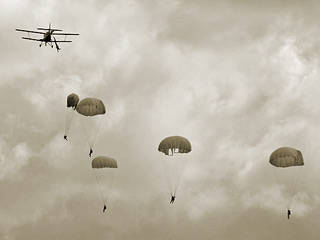 The winged infantry, a new branch of the USSR Air Force, was born in 1930. First in the world stories The parachute detachment was created in the Leningrad Military District and consisted of 480 paratroopers with 18 aircraft. Before the war, the country already had 5 airborne corps, in which about 50 thousand paratroopers served.
The paratroopers received their real baptism of fire at the beginning of 1942, participating in the Vyazemskaya operation. On the night of February 23, 7 thousand paratroopers were to seize the Vyazma-Kirov railway and reach Vyazma, Dorogobuzh, Yukhnov. And in the rear, new landing units were already being formed. The soldiers learned to fold a parachute and jump from an airplane, overcoming fear and mastering emergency situations that arose in the air. In parallel, the paratroopers were engaged in physical training, studied hand-to-hand combat, mastered the art of using cold and small arms. weapons... A real paratrooper had to be able to do everything and shoot from any type of weapon - be it a native PPSh or a German MP.
In the fall of 1943, the Red Army had to cross the Dnieper on the move. Watercraft were being prepared, artillery was being pulled up. At the airfields near Sumy and Kharkov, in Lebedin, Smorodino and Bohodukhov, the last preparations were made for loading into aircraft. 138 aircraft took part in the first wave of the landing.
A separate chapter of the series tells about the history of the Order of the Red Star.
Information