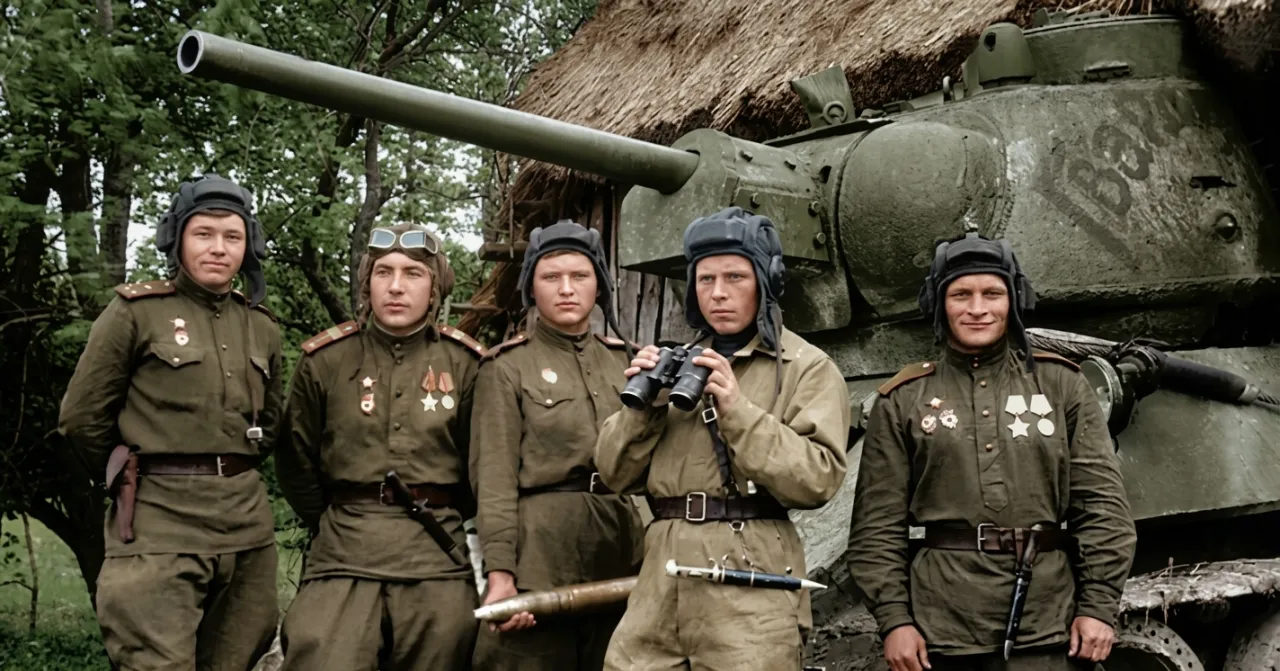
Liberators. Tank crews

4 384 9
Liberators. Tank crews


Elegant dress uniform, formidable fighting unit танк, possessing speed, power, and invulnerable armor, shaped an image of courage and invincibility. But the outbreak of war proved a far more severe test for tank crews and their vehicles than expected.


By the end of the autumn of 1941, over half of the tanks in service with the Red Army had been lost. Tank crews suffered from a lack of combat experience, vehicles caught fire, armor failed to resist hits, and a significant number were simply abandoned without fuel or ammunition, or due to technical malfunctions. By the end of December 1942, when the industry relocated to the Urals began producing new vehicles, an opportunity arose to turn the tide in armored forces.

By that time, Germany's armored formations had been reinforced by a "menagerie" of "tigers" and "panthers" armed with powerful artillery systems. A confrontation between the T-34 and the Panther or Tiger in open terrain could have been fatal for the Soviet tank. The series details crew training, the various tank modifications used by the USSR and Germany, and the features of the renowned T-34-85, the pride of the Soviet army.

However, the main characters in the series are tankers. Their stories explore combat techniques and moments of respite, the nuances of service, and their participation in the Battle of Kursk, the clashes at Prokhorovka, and the capture of Berlin. A separate narrative is dedicated to stories Order of Suvorov.

9 comments
Information
Dear reader, to leave comments on the publication, you must sign in.
  1. +4
    April 1 2026 06: 42
    The cover photo shows tankers from the 30th Ural Volunteer Tank Corps, or the Black Knife Division as the Germans called it. The Zlatoust Tool Factory made each volunteer a 1940 model army knife—an NR-40 or NA-40—but unlike the standard ones, it was made in black.
    1. +1
      April 1 2026 09: 52
      Judging by the fact that they're wearing guards' badges, the 30th Corps had already been renamed the 10th Guards Corps, meaning the photo was taken no earlier than late spring or summer 1944—the trees are green. Two of them don't have knives—apparently they were replacements.
  2. The comment was deleted.
  3. +1
    April 1 2026 07: 28
    Elegant uniform

    Not a universal uniform, but the pre-war dress uniform was elegant, with a tie, only for pilots and tankers, and this was a clever psychological trick.
  4. 0
    April 1 2026 08: 33
    Dyuzhev turned out to be 3 meters tall in this movie
    They could have taken them to Kubinka, they are using the budget in an interesting way...economists and businessmen.
    A pretentious movie. And that same myth about sloped armor... the thick-headed armor-piercing shell turned and entered normally.
  5. -1
    April 1 2026 09: 48
    On the left is the tank commander, an officer. Next up is clearly the senior sergeant major, the driver, with goggles—the others in the crew have no use for them, and he's driving the tank with the hatch open, swallowing dust and flies. The third is a young guy with a shell—clearly the loader. But it's hard to tell which of the remaining two is the gunner and which is the radio operator/gunner. Most likely, the gunner is the one with binoculars; he's the only one besides the commander who can lean out the hatch and look through them (though it would be more logical for the commander to have binoculars). By process of elimination, the last one is the radio operator/gunner. Judging by his awards, he's a distinguished man, albeit a private. Judging by the presence of black N-41 knives on the belt and the guards' insignia, this is the 10th Guards Ural Volunteer Tank Corps (30 before receiving the title of Guards on October 26, 1943), the "black knife division." Actually, tankers don't seem to need such large knives.
    1. +1
      April 1 2026 10: 52
      On the left is the tank commander, an officer. Next up is clearly the senior sergeant major, the driver, with goggles—the others in the crew have no use for them, and he's driving the tank with the hatch open, swallowing dust and flies. The third is a young guy with a shell, clearly the loader. But it's hard to tell which of the remaining two is the gunner and which is the radio operator/gunner. Most likely, the gunner is the one with binoculars—he's the only one besides the commander who can lean out the hatch and look through them (though it would be more logical for the commander to have binoculars).

      A group portrait of the crew of a T-34 tank nicknamed "Guard" from the 2nd Battalion of the 63rd Guards Chelyabinsk Tank Brigade in Ukraine. From left to right: tank commander Lieutenant A.V. Dadonov, gunner/radio operator Sergeant Major Aleksandr Porfiryevich Marchenko (1913–1944), loader N.I. Melnichenko, battalion commander P.V. Chirkov, and driver-mechanic Sergeant Major Fyodor Pavlovich Surkov (1913–1971).
      1. +1
        April 1 2026 10: 58
        Tank commander Dadonov, radio operator Marchenko, and loader Melnichenko were killed near Lviv's town hall. Driver Surkov was burned and suffered a concussion.

        On July 21, 1944, a tank platoon of three T-34/76 tanks was ordered to break through to the city center and raise a flag on Lviv City Hall. Two tanks of the lead mobile outpost were almost immediately destroyed, and only the "Gvardia" tank, commanded by Lieutenant A. V. Dodonov, maneuvering, waiting in cover, and engaging in fire duels with enemy tanks, managed to reach the city hall on July 23. A battle ensued on Market Square. Over six days of fighting in the city, the crew killed over 100 enemy soldiers and officers, burned eight tanks, several enemy guns and mortars, and an ammunition depot. However, the Nazis managed to set a Soviet tank ablaze. In the fierce clash with the enemy, Dodonov, Marchenko, Terentyev, and medical orderly Rozhdestvensky were killed, and Melnichenko was seriously wounded. The surviving Fyodor Surkov took the gun commander's place, alone in the burning tank, making his final stand. Fighting off the advancing enemy, the driver destroyed about a platoon of infantry, one anti-tank gun, and one "Telle tank" (a Goliath self-propelled mine). The immobilized "Gvardeets" was fired upon at point-blank range by two German guns and a Panther. The ammunition in the burning T-8 detonated. According to Guards Captain Malofeev, deputy battalion commander, "Comrade Surkov, in serious condition, burned, was thrown to the ground by the blast and picked up by local residents. He and the wounded Melnichenko were handed over to our scouts and taken to the hospital." Fyodor Surkov was awarded the title Hero of the Soviet Union, and the remaining crew members were awarded medals.
        In the 90s, the streets of Lviv named after tank heroes were renamed, and the tank was removed from its pedestal and sent to the scrap yard.In Chelyabinsk, the street names "Marchenko," "Rozhdestvensky," "Surkova," and "Geroev Tankograda" remain intact, and on Kirov Street, where the Ural Corps was sent off to the front, a monument to "Volunteer Tankers" has been erected.


        https://www.chitalnya.ru/work/2560459/
        Bandera's scum are trying to destroy our memory.
      2. +1
        April 1 2026 11: 08
        It turns out it's the battalion commander's tank, since he's the gunner, there's no extra space in the tank. It was hard to figure out who the battalion commander was, even though he has a distinctive knife, an officer's sling, and binoculars. But why the radio operator needs glasses is really hard to figure out. You can't see anything through his machine gun port even without protective glasses, so it's no wonder I mistook him for the driver.
        63rd Guards Chelyabinsk Tank Brigade

        It was part of the 10th Guards Tank Corps.
  6. +1
    18 May 2026 11: 02
    We had a professor at our university, Vitaly Antonovich Topchiy. Structural mechanics of ships. Basically, strength of materials applied to three-dimensional ship structures. Complete differential calculus. A terrifying subject. Strength of materials squared. Vitaly Antonovich was a man without compromise. He was responsible for a time when only two people remained in a group after his exam. And the dean's office was powerless.
    The VA would enter the classroom and immediately begin explaining the subject, walking between the rows of desks. Without stopping for a second, he'd approach the board and write down two numbers. How many were present and how many should be present... The class monitors would immediately bury their heads in their registers. It was impossible not to note the absentees.
    We were terrified of his exam. Our group was lucky; the VA was sick, and someone else was taking it.
    Time passed, no one lives forever, and Vitaly Antonovich was gone. It was only at his funeral that we learned he'd fought in the war, burning twice in a tank. He ended the war as a major, if I remember correctly.
    A fit, very strong man, albeit an elderly man. For me, he remained the epitome of a true veteran. Especially compared to others, who were always demanding benefits and going to schools instead of working. While their duties were being performed by others.
    I can't speak for Vitaly Antonovich's awards. I haven't seen them myself. They said they were significant.
    Solid. Somehow genuine. You don't see many like that.