The Empire's "Golden" Overload

8 708 240
The Empire's "Golden" Overload
Russian coastal defense battleships of the Admiral Ushakov class (including Admiral Ushakov, Admiral Senyavin, and General-Admiral Apraksin) in Port Said on March 11, 1905, en route to the Far East during the Russo-Japanese War.


Disclaimer: This article is inspired by the fact that discussions again and again return to the shameful results of the Russo-Japanese War, especially in navyIn this article, I would like to explain my opinion and approach to the pre-war period and the construction of those troughs that were sent to be drowned under the guard of the ZPR. This is the result of my research. Much has been omitted, and no references will be provided. Historians have long known all the material, even without my involvement.


An analysis of the causes of the tragedy of the Russo-Japanese War and the Battle of Tsushima still divides researchers into two camps. Some tend to justify the leadership of the Marine Technical Committee (MTC) by the current circumstances, arguing that in 1904, the agency operated under severe time and resource constraints, trying to save factories from idleness. Others accuse the MTC of systemic inertia, a lack of interest in innovation, and rampant corruption.

However, if we look at the pre-war shipbuilding of the Russian Empire through the prism of dry physics, weight control and missed engineering opportunities, it becomes clear: the navy lost the war on the slipways.

Systemic defect of the MTK: acceptance by "cast iron" and calibrated overload


The main problem with Russian shipbuilding at the turn of the 19th and 20th centuries was the flawed system of departmental oversight and payment. The domestic MTK accepted main propulsion plants (MPPs) by weight, not by specific power, without any bonuses for the lower specific weight of a given plant. This applied to both the crane manipulator and the weight distribution of the main battery turrets and other ship systems.

Essentially, a certain "reference weight" was incorporated into the preliminary design, which then served as the basis for subsequent acceptance. This weight was already over-specified, as it came from current (excessive) solutions based on empirical formulas, taking into account the poor quality of the casting and the excessive safety factor (×5).

The logic that followed was completely absurd: mechanisms were paid for based on the product's weight, with a "planned" excess of up to 2-3% allowed, while bonuses for lightening the product and improving its specific parameters... were completely absent. It turned out that the heavier the mechanism delivered by the factory, the more it was paid for. This completely destroyed the incentive to lighten and improve designs.

The situation was exacerbated by a hidden technological factor—the discrepancy between the metric and imperial measurement systems when copying foreign (French, German) designs and installing purchased equipment. When drawings of French or German ships reached domestic factories, they had to be recalculated to Russian rolled metal standards. For strength reasons, the dimensions of metal sheets, angles, and channels were rounded up. This forced substitution resulted in several percent of net, "design" overload of the hull even before equipment installation began. Strict weight control similar to the German one would have allowed for the "shaking off" of 300 to 500 tons of net weight on each large ship, in favor of armor and artillery.

This type of overload can be called "design-based" because it was factored in at the design stage, both in the form of excess design weight, excess safety margins, and increased component sizes when converting to metric systems. This means that the ships' displacements were already designed with a design overload of 300–500 tons at the preliminary and detailed design stages!

Cauldron drama: the French lobby against Russian inventions


The crisis of ideas manifested itself most clearly in the MTK's persistent insistence on heavy and archaic Belleville water-tube boilers. By 1900, their use had become a sign of blatant technical stagnation. The price for their supposed maintainability came in the form of colossal weight and enormous boiler room volumes.

Comparison of the specific weight of boilers (kg per 1 hp):
  • Thornycroft-Schultz (cruisers Novik, Askold): 16,5–19 kg
  • Yarrow boilers: 22–25 kg
  • Belleville boilers (Borodino-class battleships): 35 kg

On the armored cruisers Rossiya and Gromoboy, the crane unit weight ratio exceeded 120 kg/hp due to their 32 heavy Belleville boilers. By comparison, the German cruiser Askold, with its Thornycroft boilers, had a crane unit weight ratio of 53,8 kg/hp. And on the armored deck Novik, the crane unit weight ratio was a record-breaking 44,4 kg/hp. Operational experience has shown that the crane units on both cruisers proved reliable, which completely invalidates the argument in favor of the Belleville boilers.


The Russian armored cruiser Gromoboy, photographed in 1901.

The British Admiralty recognized the futility of Belleville boilers after the infamous parliamentary "Battle of the Boilers" and officially abandoned them in March 1901, switching to the Babcock & Wilcox and Yarrow systems. In Russia, however, Belleville boilers were dragged along by the ears until the very end. The ministry's attempts to force Dolgolenko-Belleville boilers onto Black Sea light cruisers continued until the end of 1913! The reason was simple: the French firm Delaunay-Belleville charged a hefty license fee for every square meter of heating surface, ensuring a steady flow of kickbacks into the pockets of the "wedding admirals."

At the same time, MTK completely ignored domestic developments. The great Russian engineer Vladimir Shukhov patented a horizontal, sectional water-tube boiler back in the 1890s. Shukhov's boiler was an improved and simplified version of the Babcock & Wilcox system, but had a phenomenally low metal consumption (approximately 70 kg per square meter of evaporating surface—half the weight of French counterparts). Its modular design allowed for damaged sections to be replaced while underway in the ship's workshop, and its straight tubes made cleaning easier. But MTK didn't even consider the 1896 Russian patent, which was widely used in the civilian sector.
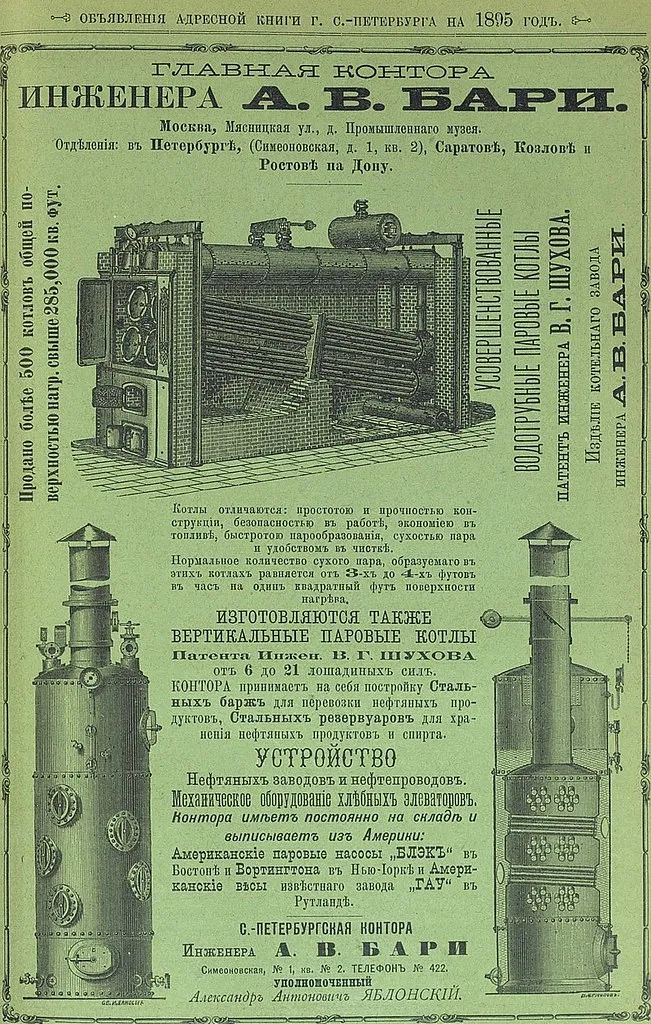

An advertising page from the "Address Book of St. Petersburg for 1895," dedicated to the activities of the Main Office of engineer Alexander Veniaminovich Bari. Products and inventions: Improved water-tube steam boilers designed by engineer V. G. Shukhov (horizontal and vertical, with a capacity of 6 to 21 horsepower).

So, in Russia, there was a factory producing horizontal boilers with parameters similar to the Thornycroft-Schulz triangular boilers. They, like the Nikloss boilers, could be repaired practically "on the fly." Nevertheless, the Moscow Technical Committee persistently advocated the use of Belleville boilers, even citing their ease of repair, although they were difficult to repair! It was pure fantasy.

The drawing crisis and the tragedy of the Borodinsky


In late 1904, when the Naval Ministry decided to clone the obsolete Bayan-class cruisers, it encountered an unexpected obstacle: a lack of working drawings. When ordering the lead ship, the GUKIS, in an effort to save money, failed to stipulate in the contract the provision of complete working documentation. The French design bureau demanded enormous sums for the working drawings, and the MTK received only scattered, general plans. As a result, domestic factories were forced to draw the components themselves, which led to colossal "independent" initiatives and inconsistencies in the production.

The lack of strict quality control within the MTC and at the factories led to catastrophic weight chaos. The true scale of the disaster became clear with the example of the last battleship in the series, the Slava. Acceptance trials recorded the actual construction overload of iron was 899 tonsA commission led by engineer Parenago issued a verdict: to restore the ship to its design stability, 1320 tons of equipment (including the medium-caliber turrets) must be removed. All four Tsushima submarines set out on the voyage with a similar overload, not counting the coal, which predetermined their immediate capsizing when they sustained damage.

And this is only the construction overload, which was added to the design 300-500 tons!

"The Ultimate Cruiser": A Missed Alternative


What Russia could build with a reasonable approach and strict weight controlBased on actual technologies from 1895–1900, it's possible to design a "cruiser of the ultimate parameters" that would radically alter the balance of power in the Far East. The preliminary design would take a year, and construction could begin in 1896.

It's worth remembering here that the 1882 naval construction program didn't provide for a division of cruisers into classes as such, as the classes themselves hadn't yet been fully established. The program assigned cruisers a number of tasks:
  • Destruction of hostile maritime trade (raiding) — conducting autonomous cruiser warfare on the enemy's ocean lines of communication, destroying or capturing their merchant ships to undermine their economy. That is: speed and range.
  • Diversion of large enemy forces from the shores of Russia - forcing the enemy (primarily Great Britain) to disperse its linear forces across the globe to protect its own trade routes, colonies and convoys. That is: speed, armor and support for landing troops if necessary.
  • Disruption of the enemy's strategic communications — interception of cable ships, destruction of underwater telegraph cables and capture of enemy coal stations.
  • Long-range strategic reconnaissance — carrying out deep reconnaissance in the interests of battleship squadrons and timely detection of the main forces of the enemy fleet. And again: armor, range, speed and armament comparable to the enemy's main guns.
  • Protecting our own bases and coastline — destruction of light forces, destroyers and cruisers of the enemy on the distant approaches to their naval bases (Kronstadt, Vladivostok). And again about speed, armor and armament.
  • Display of the flag and protection of diplomatic interests — carrying out stationary service in strategically important regions of the world (primarily in the Far East and the Mediterranean Sea) to exert political pressure. It also had to be "beautiful".
  • Providing operational communications - maintaining communications between isolated detachments of ships and bases in the absence of wireless telegraph. And once again – speed at any cost.

Summarizing the requirements for the program's cruisers, it is possible (which was done) to divide the functions into several types of cruisers, but We could try designing a universal unit with a variable payload depending on the mission. Speed ​​is a primary factor in all program points. Secondarily, range and endurance are essential, and thirdly, armor and armament are essential to engage the enemy's main forces and take advantage of its speed: either to maintain a long range or to evade pursuit.

It follows that speed cannot be defined simply as an advantage of one or three knots over the main forces of the enemy (England). The requirement should be formulated as follows:maximum possible speed with minimum crane weight"The proportion of crane manoeuvres in the total displacement was to be limited to 20–25% of the total displacement. The typical specific weight of crane manoeuvres by 1895 (the initial recognition of the impending war with Japan) was in the region of 90 kg/hp, with the best figures being 65–76 kg/hp on Norman and Babcock boilers, respectively.

Therefore, keeping in mind Shukhov and his patent, we can factor in 76 kg/hp for the entire crane manipulator unit for the first series and reward factories for reducing the specific weight of the units.

No less intriguing is the question of a cruiser's aspect ratio, which directly affects its maximum speed. The Argentine cruiser Buenos Aires (designed 1893–1895) had an aspect ratio of 8,53.


The Argentine armored cruiser ARA Buenos Aires in dry dock at the Wallsend Slipway and Engineering Company in the UK, circa 1896.

What is the final result if we take 25% of the VI per crane manoeuvre with an extension of at least 8 and a maximum machine power of 18,000 hp in a two- or three-shaft installation?

KPP-1895: Displacement of 5500–6000 tons, design waterline dimensions of 116 × 14,5 × 6,5 m, speed of 22,5–23 knots, main helm armor of 75 mm (stern) — 100 mm (bow) — 152 mm (citadel 50% of the length) with a height of 2,5 m + 51 mm armored deck, armament of 12 six-inch Canet guns. Fuel capacity of 540 tons, additional cargo capacity of up to 600 tons depending on the task. Not bad. Such cruisers could have been ordered in a series of four ships and laid down by 1900, possibly with the involvement of German shipyards, although their own slipways were sufficient.

During this time, Thornycroft-Schulz boilers and engines similar to those installed on the Novik armored cruiser were developed, and the British also tested a hydraulic release clutch. Ultimately, the standard dropped to 44–54 kg/hp, allowing for the construction of a second series of larger armored cruisers with a strict requirement: the crane unit's specific gravity would not exceed 50 kg/hp (the actual level of the Novik and Askold). Thornycroft-Schulz boilers could have been installed in the hulls of the Rossiya or Gromoboi, both with a displacement of approximately 12,100 tons.

To achieve high reliability and flexibility, a three-shaft installation with a capacity of 30–35 horsepower could be used. Twin lightweight steam engines (similar to the Novik engines, which had a specific gravity of only 4,5 kg/hp) could be mounted on each shaft. To connect additional engines without stopping the ship, Murray couplings with hydraulic cylinders, which were then known, could be used, chamfered ends of the pins, and spring-loaded pins. When connecting the second (bow) engine, the stern engine could slow to a minimum of 15–20 rpm, and the bow engine could also start at minimum speed. This would result in a very small speed difference of 1–3 rpm (>20 sec/revolution!), and the hydraulic cylinder would automatically insert the pin into the groove upon alignment due to its spring load and chamfered ends. The difference in speed would eliminate extremely high shock loads, and the oil in the clutch could act as a damper. Yes, this would require R&D, which the MTK was required to carry out throughout its development.

Final performance characteristics of the alternative cruiser:
  • Displacement: ~12,100 tons.
  • Speed: 25,5 knots (according to Papmel, with a clipper stern to prevent sinking at high Froude numbers).
  • Cruising range: 8000+ miles (using oil fired boilers).
  • Armor: main belt 152–178 mm (Krupp cemented armor), upper side 100 mm, lightweight armor deck 30–50 mm.
  • Armament: 4 × 12"/40-mm main caliber guns in two lightweight turrets weighing up to 550 tons each (with an increased elevation angle of up to 30–35° for firing at 100+ cable lengths), secondary caliber - 12 × 6" Canet + 20–24 anti-mine Hotchkiss and a pair of TA.
  • Load capacity for the task: up to 1000 tons additionally.

Such a ship would combine the firepower of a squadron battleship, armor protection from 6-8-inch shells, and the speed of a modern cruiser, and could be specialized for a task: additional fuel for double the range, landing forces for landing, mines for mining, space for prizes for raiding, and even mini-submarines for sabotage in enemy ports.

Instead of the 300 kilotons wasted, practically in vain, up to 24 ships (based on displacement!) of a similar class could have been built. Okay, the Russian Imperial Fleet needs front-line ships (and here too, eliminating the design and construction overload allows the Borodinets-class ships to carry six main guns!), let's say only half—12 ships—are left for cruisers (and 150 kilotons for 10 squadron battleships!). Taking into account the construction of the first batch of four cruisers of a smaller VI, only eight ships will remain by 1904 and even earlier, since the keel-laying of a new hull can begin immediately after the launch of the previous one.

And by 1904 it would have been possible to have a better design with a displacement of about 10 kilotons.

Conclusion


But the MTC worked differently. Instead of a continuous design cycle (where improvements to the first project are immediately incorporated into the next), the committee waited, collected a pile of chaotic "wants," and only then began to think. By 1905, there was nothing left to build except the outdated Bayan and overloaded Borodinets.

At the head of this system was General-Admiral Alexei Alexandrovich, the Tsar's uncle (nicknamed "seven pounds of august flesh"). Under his rule, kickbacks to foreign firms when signing contracts amounted to up to 10% of the transaction amount. Enormous budget funds were siphoned off abroad, ending up in Parisian galleries, where the Grand Duke himself hastily retreated immediately after Tsushima.

If we look back further into the past, historical the bifurcation point will be 1877 yearWhen, under pressure from the Anglophile Finance Minister Reutern, Russia introduced gold customs duties. This dealt a crushing blow to the burgeoning technological alliance with Germany. The tsarist elite persistently viewed the Germans as enemies, failing to understand that Britain, the island nation, had a vested interest in fomenting wars on the continent. Germany could have become Russia's ideal "pilot plant," and the Russian Empire a platform for mass production. Instead, the navy purchased a ragtag collection of foreign prototypes (Varyag, Askold, Bogatyr), one at a time, turning supply and repairs into a nightmare.

Russia couldn't refuse to impose this tax, having managed to borrow several annual budgets from Rothschild banks, but it could have significantly mitigated the situation for Germany, which bore the brunt. I have no doubt that Reutern, when introducing the gold tax, intended to hit Germany first. Witte later carried the reform to its logical conclusion, but he was only a follower.

Unfortunately, this historical lesson was not understood at the time and was repeated in both 1914 and 1941. Alas, it will continue to be repeated until both countries learn it.
240 comments
Information
Dear reader, to leave comments on the publication, you must sign in.
  1. +8
    4 November 2026 11: 00
    Under him, kickbacks for foreign companies when concluding contracts amounted to up to 10% of the transaction amount.

    By today's enlightened standards, he even took it a bit modestly... what
    1. +7
      4 November 2026 11: 18
      Quote: paul3390
      he even took it somewhat modestly

      It would have been 100% possible to write this without providing links :)
      1. +2
        4 November 2026 11: 50
        So, without references, literally for a while there were kickbacks of 30% to 50%. I think it's unlikely that such percentages would be possible in RI. what
      2. +1
        4 November 2026 12: 59
        Quote: Andrey from Chelyabinsk
        It would have been 100% possible to write this without providing links :)

        If I could, I would have written about it. Are you aware of what was going on there and the size of the kickbacks, particularly regarding the 1908 Sevastopol events and the attempted procurement of the Garibavldites? I think I read about that 10% as the norm in your articles.
        But... as I understand it, you have no objections to the rest of the article about the utter stupidity of wedding admirals, and thanks for that.)
        1. 0
          4 November 2026 13: 37
          Sorry, it turns out there is, and even a double) Answered in the first one.
        2. +1
          4 November 2026 13: 45
          Quote: Arhat109
          It seems that I read in your articles about these same 10% as the norm.

          In general, a lot of things seem different to you, as I see it.
        3. +2
          4 November 2026 19: 43
          Dear Vladimir, thank you for the article. Much of what you present is controversial and requires further examination. But one point in your comment caught my attention:
          and attempts to purchase Garibavlditsev,

          There's official confirmation or a directive for this information, and many are writing about this purchase. But the fact is, the Italians themselves haven't mentioned Russia when considering the sale of future Nissin and Kasuga vehicles.
          1. +1
            4 November 2026 21: 41
            I don't remember where or from whom I read about regular kickbacks of 10%. But in fact, the famous 7 poods transferred more than enough money abroad, and the fact of emigrating to Paris immediately after Tsushima is too striking for that time. Now we're used to it.
  2. 0
    4 November 2026 11: 14
    Every master of his own destiny and Blacksmith of his own business!
    If we hadn't gone this way, we wouldn't have had anything.
    Well, the war was lost due to the lack of will and pride of the Tsar-Emperor and his courtiers.
    Ah, the people were strong, desperate and proud.
    Yes, and right now we could sink a couple of Japanese frigates that are brazenly encroaching on our economic zone. Especially since we're at war with them. And we have no will either!
    However, we will stand firm even now.
    On this stood, stands, and will stand the land and state of Russia! 🇧🇬❤️
  3. +5
    4 November 2026 11: 17
    What's that garbled mess on the screensaver?
    1. +2
      4 November 2026 12: 51
      Quote: Grossvater
      What's that garbled mess on the screensaver?

      Apparently the fruit of the labors of a newfangled AI, his fantasy is not the subject of the Borodinites. wassat
      1. +2
        4 November 2026 12: 57
        I was especially impressed by the portholes on the SC towers. laughing
    2. +3
      4 November 2026 13: 00
      Editorial correction. I didn't have a single picture. Thanks to the editor for adding to the article.
  4. +5
    4 November 2026 11: 25
    Thank you for the article...

    As the author correctly pointed out: “Historians have known all the material for a long time and without my participation.”
    Moreover, a historian, unlike a political scientist, must know that reducing all processes to individual, albeit outstanding, individuals, to the peculiarities of their character or their behavior, is a major methodological error.
    This also applies to Finance Minister Reutern and Witte...
    As for the mistakes of 1914 and 1941, it is unlikely that they can be attributed to both sides (!), just as today.
    The development or underdevelopment of capitalism (as one prefers) in Germany pushed it to solve problems through aggression, of which Russia became the victim. Whether Germany had options is more likely than not. Whether Russia had them, no.
    So where are the ships of the Russian Empire, and where are the expansionist aspirations of Germany.
    1. +2
      4 November 2026 13: 06
      Quote: Eduard Vaschenko
      The development or underdevelopment of capitalism (as one prefers) in Germany pushed it to solve problems through aggression, of which Russia became the victim. Whether Germany had options is more likely than not. Whether Russia had them, no.

      Russia became a victim (1914) after Reutern introduced the gold tax, which led to a trade war between Germany and Russia just a couple of years later. The main reason was the "bullying" of the Russians. This victim was far from accidental, precisely because of the Anglophilia of the ministers and the economic bloc as a whole, and even of the royal family itself, despite the Romanovs' "German" origins.
      That's why the imperial ships and Germany's aspirations are there. But (!) during all the "thaws" (including under Stalin), Germany was repeatedly "Russia's pilot plant," and Russia a factory for mass production for Germany. This "lesson" has not been learned to this day. The Russia-Germany alliance cements the entire continent, leaving England no chance, either then or now. Alas, it has not been learned.
  5. +7
    4 November 2026 11: 27
    Unfortunately, the article doesn't hold up to scrutiny. It would take a dozen articles to refute it...
    The domestic MTK practiced accepting main power plants (MPPs) by weight, not by specific power, without any bonuses for the lower specific weight of a particular plant.

    Incorrect. The MTK demanded a certain power output and a certain weight from the power plant manufacturer—dividing one by the other yields the specific power. So, in fact, the author's claim is unfounded.
    Moreover, the author resolutely fails to consider what would happen if MTK introduced a weight-reduction bonus. And that's easy—they'd try to build the vehicles as light as possible, earning a bonus for it. As for the reduced service life and reliability—well, the sailors will manage somehow...
    This concerned both the crane manoeuvre and the balance of the main battery turrets and other ship systems.

    This is incorrect, as the MTK approved the drawings of all such units. At the same time, weight was given significant consideration, something the author might have known if he had studied the turret deliveries to the Borodino team.
    Comparison of the specific weight of boilers (kg per 1 hp):

    Thornycroft-Schultz (cruisers Novik, Askold): 16,5–19 kg
    Yarrow boilers: 22–25 kg
    Belleville boilers (Borodino-class battleships): 35 kg

    The comparison is completely inappropriate, as it compares the propulsion systems of ships of different classes. If the author had wanted to demonstrate the true backwardness of the Russian Empire, he would have compared the specific power of the propulsion systems of domestically and imported ships of the same class and laid down in approximately the same years.
    And so it is - the entire text, every statement of the author...
    1. +3
      4 November 2026 11: 54
      Quote: Andrey from Chelyabinsk
      Incorrect. The MTK required the power plant manufacturer to supply a certain power and a certain weight—dividing one by the other yields the specific power.

      That's right!
      I wonder if the author has read even one contract for the supply of power plants or towers?
      1. +2
        4 November 2026 13: 23
        I read about the ordeals of the Borodino towers and even tried to independently assess their design overload.
        1. -1
          4 November 2026 13: 44
          Quote: Arhat109
          and even tried to independently assess their design overload.

          And did you count a lot of overload?:))))
          1. +1
            4 November 2026 15: 16
            Quote: Andrey from Chelyabinsk
            And did you count a lot of overload?:))))

            About 250t per tower.
            1. 0
              4 November 2026 17: 23
              Quote: Arhat109
              About 250t per tower.

              The value of such calculations cannot be underestimated.
              As a result, the Metal Plant's weight was greater than the French one.
              at the forward 12-inch turret - 105,3 tons
              at the stern - by 59,9 tons.
              The Putilov's discrepancies were even smaller. But the point is that the increased weight was traded for a better rate of fire and better protection of the feed pipes.
              1. +3
                4 November 2026 17: 34
                The requirement to improve (and make) the turrets heavier to increase the rate of fire (and safety) arose later than Skvortsov's design. The turrets simply have a suboptimal shape, which accounts for the excess weight, as well as the oversized diameter of the barbettes, also due to their shape. The excess weight at the top necessitates the extra weight of the barbettes themselves and additional reinforcement of the hull structure.
                It's all so banal and simple. And yet again you're appealing to what "was," even though it was bad, seeing only the difference between a project and its improvements. That's not how it works with project overload.
                1. -1
                  4 November 2026 22: 42
                  Quote: Arhat109
                  The towers simply don't have the optimal shape, which is why there is excess weight, as well as the overly large diameter of the barbettes... and also because of the shape

                  Don't think that people back then were dumber than us. We probably don't know what they knew. If it had been possible to make the turrets and barbettes more compact, you can be sure they would have done so.
                  1. +2
                    4 November 2026 22: 43
                    It depends on who we're talking about... this doesn't apply to the MTK Wedding Admirals, which is what I tried to show in the article.
                    1. 0
                      4 November 2026 22: 44
                      Quote: Arhat109
                      Depends on who we're talking about.

                      You started talking about tower projects.
                      to the Wedding Admirals of the MTC

                      It certainly wasn't the admirals who designed the tower.
                      1. +1
                        4 November 2026 22: 50
                        I might be wrong here, but I admit it. I based my design on simplified turrets—closer to rectangular with sloped armor plates. The Borodinets have elliptical turrets with straight sides, including the front. This significantly reduces the weight of the turret itself and its armor (simply less metal). Consequently, the barbette diameter can be reduced, it can be stepped (precisely with the transfer table), and the barbette thickness can be reduced, taking into account the side armor.
                        The lighter weight of the tower requires less weight of reinforcements.
                        Do not agree?
                      2. 0
                        4 November 2026 23: 01
                        Quote: Arhat109
                        I took as a basis a simplified tower shape - closer to rectangular with inclined armor plates

                        Do you have a diagram? I don't really know what you mean.
                        The Borodinites have elliptical towers with straight walls.

                        I understand why they did it. Do you?
                        and the barbette can be narrowed in diameter

                        Will it fit the mechanism for feeding shells and charges?
                        The lighter weight of the tower requires less weight of reinforcements.
                        Do not agree?

                        This is logical
                      3. 0
                        4 November 2026 23: 07
                        Quote: rytik32
                        Do you have a diagram? I don't really know what you mean.
                        It's somewhere, on an old laptop that died, but the hard drive is still working. That was about three years ago. I need to look.

                        Quote: rytik32
                        I understand why they did it. Do you?

                        Why are the turrets "elliptical"? Well, the curvature of the turret, which increases the engagement angle at any traverse angle during combat, seems to be an argument. Why are the sides straight? I don't know. The plates are mounted on a steel base (30mm?) anyway, so I don't see any difference. Why not mount them at an angle, lowering the center of gravity and increasing the engagement angle at the same time?
                      4. 0
                        5 November 2026 00: 00
                        Quote: Arhat109
                        I don't see any difference, why not put it at an angle?

                        I don't see your diagram, so I don't understand the essence of your proposal.
                        If you propose to tilt the three front curved slabs, this will not give a gain: you will gain in volume at the front, but you will lose at the sides.
                        If you propose making a rectangular tower, it will only be heavier. The corners will absorb more weight than the gain from the slope of the front plate.
                  2. +2
                    5 November 2026 10: 26
                    I completely agree. Without reviewing archives, project proposals and supporting documents with calculations, minutes of numerous committee meetings, reports on the topic, and so on—what's commonly referred to as bureaucracy—it's impossible to get even a balanced view of the problem.
      2. +1
        4 November 2026 13: 35
        Quote: rytik32
        That's right!

        So, you claim that the preliminary design, say, Borodintsev's, had advanced solutions for the specific weight distribution of the elements and you can PROVE this with documents?
        To the studio.
        1. 0
          4 November 2026 22: 37
          Quote: Arhat109
          Are you claiming that the preliminary design, say, by Borodintsev, had advanced solutions for the specific weight distribution of the elements, and can you PROVE this with documents?

          No, you are attributing other people's statements to me.
    2. +2
      4 November 2026 13: 23
      Quote: Andrey from Chelyabinsk
      Incorrect. The MTK required the power plant manufacturer to provide a certain power output and a certain weight—dividing one by the other yields the specific power.

      You're bluffing: the MTK required a certain power output at its design weight, which ALREADY had a design overload of up to 30%. This is what the article describes. As a historian, you know this better than I do (how the preliminary design was developed by the factory design bureaus), but you've engaged in blatant distortion, wanting to whitewash the nepotism and corruption of the Russian admiralty.

      Quote: Andrey from Chelyabinsk
      Moreover, the author resolutely fails to consider what would happen if MTK introduced a weight-reduction bonus. And that's easy—they'd try to build the vehicles as light as possible, earning a bonus for it. As for the reduced service life and reliability—well, the sailors will manage somehow...

      But here, it doesn't matter, "would have been a hindrance." The article demonstrates that MTK took NO measures to lighten the ship's components, even "in theory." What "would have been" and HOW MTK could have combated the reduced reliability is a question that can neither be posed nor answered. You're appealing to a nonexistent argument. Is that a coincidence?
      Quote: Andrey from Chelyabinsk
      This is incorrect, as the MTK approved the drawings of all such units. At the same time, weight was given significant consideration, something the author might have known if he had studied the turret deliveries to the Borodino team.

      It "accepted and fought" so well that the Slava's overload was nearly 900 tons, including the turrets. Thanks for making me laugh. And the SK turret concept simply didn't hold up to scrutiny, either then or now, simultaneously reducing its rate of fire, not just its stability. Pretty cool "tracking," huh?
      Quote: Andrey from Chelyabinsk
      The comparison is completely inappropriate, as it compares the propulsion systems of ships of different classes. If the author had wanted to demonstrate the true backwardness of the Russian Empire, he would have compared the specific power of the propulsion systems of domestically and imported ships of the same class and laid down in approximately the same years.

      A typical technique, used more than once. The boiler's relative weight to its steam output, divided by the PM's power, is the very "relative" characteristic that equates different classes of units. Thanks, that was funny.
      However, I've long understood your position: flaunting the RIF's assets, trying hard to show that they're quite "on par" with their classmates (3-5 years of construction, forgetting about it in passing), is the main thing to distract readers from the stupidity and arrogance of the RIF's admirals, the economy bloc, and its Anglophilia. They were right when they wrote to you: "With patriots like you, you don't need enemies." I already agree, but still, thank you for reading my first article. Maybe I'm being harsh, and maybe you're right in wanting to whitewash the admirals to some extent... the truth, as usual, lies somewhere in the middle.
      1. +1
        4 November 2026 13: 43
        Quote: Arhat109
        You're bluffing: MTK required a certain power at the design weight, which ALREADY had a design overload of up to 30%.

        Incorrect. For example, the "Borodino" ships were built with propulsion plants equal in weight to the "Tsarevich." Where does that 30% figure come from? From your calculations, which, unfortunately, are difficult to underestimate.
        Quote: Arhat109
        But here, it doesn't matter, "it would get in the way." The article shows that the MTK took NO action to lighten the ship's components, even "in theory."

        Incorrect. MTK was actually trying to reduce weight, which is clearly evident in the competitions it held, where it sought to produce power plants of minimal weight—all abroad. As for the fact that a domestic manufacturer couldn't design and build first-class steam engines from scratch, on par with the French—well, the Russian Empire was never considered a technical leader. But they managed to reproduce the machines of the Tsarevich, for example.
        Quote: Arhat109
        .. it "accepted and fought" so well that the Slava's overload was almost 900 tons, including the turrets... thanks for making me laugh

        I won't even ask where the nearly 900-ton overload came from. I'll simply point out that the overload on our ships was largely due not to weight discipline, but to design improvements during construction, which you "forgot" to mention. And let me remind you that overload was a widespread problem in those years—it was present, for example, on the Japanese battleships built in England.
        Quote: Arhat109
        And the concept of the SK towers did not stand up to any criticism, either then or now.

        Incorrect. At the time, there were many arguments in favor of a tower-based design. It became clear in retrospect that it was rushed.
        Quote: Arhat109
        A typical technique, used more than once. The boiler's relative weight to its steam output, divided by the PM's power, is the very "relative" characteristic that equates different classes of units. Thanks, that was funny.

        That is, you undertake to write articles about propulsion plants without even bothering to study the differences between installations for different classes of ships.
        I would find it funny, but I feel sad.
        Quote: Arhat109
        The main thing is to distract readers from all the stupidity and arrogance of the RIF admirals

        Which you imagine due to your technical illiteracy and lack of understanding of historical processes.
        Quote: Arhat109
        As a historian - you

        I am not a historian
        1. +4
          4 November 2026 15: 12
          Quote: Andrey from Chelyabinsk
          Incorrect. For example, the "Borodino" ships were built with propulsion plants equal in weight to the "Tsarevich." Where does that 30% figure come from? From your calculations, which, unfortunately, are difficult to underestimate.

          The problem is converting millimeters to inches and using thicker rolled stock due to the lack of the required material. No one would roll a 100mm pipe with an inch pitch (which is still the case in pipe rolling). At 18 atm, you'd get not a 100mm outer diameter, but a full 108mm, even this one.

          True. That's what the whole article is about: design and construction overloads and the ITC's approach to them.
          What's up with the turrets of the prototype, the Tsarevich? Unfortunately, there's no detailed data online on either the Tsarevich or Skvortsov designs, including Melnikov's. Silence. How much Skvortsov laid down, why the Aleksandrovsky Shipyard's turrets turned out significantly thicker... silence. The most interesting bits have been omitted by historians. And they know full well that Skvortsov reworked the Lagan' design almost simultaneously with the construction of the Tsarevich, converting millimeters to inches accordingly. Moreover, the Baltic Shipyard's recalculation of the Tsarevich resulted in 13887.5 tons instead of 12900. That is, +7.6% to the displacement. CTD, thank you.

          However, NO ONE denies the fact that the products were accepted by weight. Neither does the fact that the figures received from plant engineers were included in the project.
          Quote: Andrey from Chelyabinsk
          Incorrect. MTK was actually trying to reduce weight, which is clearly evident in the competitions it held, where it sought to produce power plants of minimal weight—all abroad. As for the fact that a domestic manufacturer couldn't design and build first-class steam engines from scratch, on par with the French—well, the Russian Empire was never considered a technical leader. But they managed to reproduce the machines of the Tsarevich, for example.

          Thank you, I'm writing about exactly the same thing in my article: "We should have been friends with the Germans and learned from them," instead of "bullying" by introducing a gold tax, having first borrowed from the Rothschilds.
          Well, yes, they "repeated" it, but the French crane manipulator itself was far from "sophisticated" at the time, and, alas, the Baltic Shipyard never achieved its design capacity. And even Melnikov doesn't publicly disclose the crane manipulator's exact scales.
          Quote: Andrey from Chelyabinsk
          Which you imagine due to your technical illiteracy and lack of understanding of historical processes.

          You think the opposite because you're plucking out a contextual plot (the same old, repetitive, repetitive cliches) without delving into the underlying reason, "well, that's just how it happened." But in fact, it turns out that "it happened" because no one thought about it beforehand, and that's fine, the English have done it that way, and so on.
          "A herd of patients spent a long time drinking heavily and ended up on the operating table, and now we're urgently looking for a prescription... using their own efforts."
          Quote: Andrey from Chelyabinsk
          I am not a historian

          In the comment to your article, you wrote exactly the opposite. The ability to change your tune on the fly is certainly commendable, but it's not interesting. You don't have to comment further; you've made it all clear, thank you.
          1. +1
            4 November 2026 15: 31
            Some crap got mixed up in my reply. My apologies, but the editing time ran out. I couldn't find a way to reread the reply before publishing.
          2. 0
            4 November 2026 17: 36
            Quote: Arhat109
            In the comment to your article you wrote exactly the opposite.

            Let's pretend you're forgetful. Otherwise, we'll have to accuse you of lying—I've never, anywhere, called myself a historian.
            Quote: Arhat109
            From the conversion of millimeters to inches and the use of rolled products thicker than required due to the lack of the required ones.

            First, you should know that our metallurgical plants operated in the metric system, not the imperial system. Second, you should know that the "Tsarevich" powerplant's designs were used to build a powerplant for the "Borodino," which was practically the same weight as the French one.
            Quote: Arhat109
            Moreover, the Baltic Shipyard's recalculation of the Tsarevich resulted in 13887.5 tons instead of 12900. That is, +7.6% to the displacement. ChTD, thank you.

            You've proven only one thing with this—your complete incompetence in the matter you've taken on. Let it be known that the initial recalculation was based on general assumptions about the weight of the mechanisms, which we allocated over 2000 tons for. And the towers were originally planned to be normal, not like those of the Franks. That's all.
            It was later, when they learned the weight distribution of francs by the EU, that they started making the same ones—and they did, which is typical. If I remember correctly, the Borodino one even turned out a bit lighter than the French EU.
            Quote: Arhat109
            Well, yes, they did "repeat" it, but the French CMU itself was far from "ice" at that time,

            Show me which foreign one was better. On battleships.
            Quote: Arhat109
            and, unfortunately, the Baltic Shipyard never managed to achieve its design capacity.

            Actually, it worked.
            Quote: Arhat109
            But in fact, it turns out that it "worked out" because they didn't think about it before, and that's fine, the British have already done it... and so on.

            We often borrowed from the English what they didn't do. And I've given countless examples of this. But... They don't fit into your worldview, so to hell with them, these examples.
            Quote: Arhat109
            You don't have to comment further, everything is clear with you, thank you.

            I may not comment. Or I may comment. Do you think I'm answering for your sake? :))))
            1. 0
              4 November 2026 18: 27
              Quote: Andrey from Chelyabinsk
              Let's pretend you're forgetful. Otherwise, we'll have to accuse you of lying—I've never, anywhere, called myself a historian.

              In your article "On the Construction of the Armored Cruiser Admiral Makarov..." I asked you specifically: "You seem to be a historian... well, ok:", to which you responded: "I seem to be..."
              It's you who's forgetful here, and you even change your tune on the fly: "I'm not a historian" ))) Decide already who you are: a scribbler or a historian. )
              Yes, this is my first article in general, where I outlined my vision of the "only and main problem of the Russian Empire" at the time of the Russian Revolution and its shameful defeat.
              Quote: Andrey from Chelyabinsk
              Firstly, you should know that our metallurgical enterprises worked in the metric system, not the inch system.

              That's a lie. Pipe rolling is still done in inches. Is your water and heating system metric? Oh, yeah.
              Quote: Andrey from Chelyabinsk
              Secondly, let it be known to you that, based on the drawings of the "Tsarevich" power plant, a power plant for "Borodino" was built, practically of the same weight as the French one.

              Is this your personal opinion, a conclusion drawn from an analysis of the drawing album at the Russian State Archives of the Navy? Or are you simply speculating? Melnikov has nothing on the subject.
              Quote: Andrey from Chelyabinsk
              Actually, it worked.

              Can you tell me which "Borodinets" you used? As far as I've seen and the AI ​​(design - testing) reports:
              Tsarevich: 16300 - 16500
              Borodino: 16300 - not reached
              Eagle: 15800(!!!) - 14176.5(!!!)
              Alexander: 15800 - no data (there is information about 16300, but the estimated or achieved figure is not indicated)
              Glory: 15800 - 16377 (completed later)
              There is no actual built weight of the KMU series anywhere, so it is not a fact that this is still with a solid overload, but you continue to pass off the design performance characteristics as real ones... the same for all ships of the series, it is more convenient that way.
              Quote: Andrey from Chelyabinsk
              You've proven only one thing with this—your complete incompetence in the matter you've taken on. Let it be known that the initial recalculation was based on general assumptions about the weight of the mechanisms, which we allocated over 2000 tons for. And the towers were originally planned to be normal, not like those of the Franks. That's all.

              So far, you yourself are demonstrating the "complete inconsistency" (as in the discussion about the Nichols boilers). Skvortsov designed the project based on the Tsarevich's plans, immediately incorporating existing data on the weapons and mechanisms.
              Quote: Andrey from Chelyabinsk
              Show me which foreign one was better. On battleships.

              Were you banned from search? Okay then:
              Italy, Regina Margherita 1488t, 20600hp; England Duncan 1605t 18262hp, for example.
              Quote: Andrey from Chelyabinsk
              We often borrowed from the English what they didn't do. And I've given countless examples of this. But... They don't fit into your worldview, so to hell with them, these examples.

              They fit quite well, but you can remind me, I am "forgetful")
            2. +2
              4 November 2026 18: 43
              Well, here's the AI's response:
              "There is no direct indication in the sources found of the system (metric or inch) in which the Aleksandrovsky Metallurgical Plant produced its rolled steel for RIF ships before 1905. However, based on indirect evidence, it can be confidently concluded that the plant operated in the traditional Russian (arshin-pound) system of measurement, not the metric system, and its products for the navy were measured in poods and inches."
              The metric system was introduced everywhere only in 1918.
              A curtain. tongue
              1. 0
                5 November 2026 16: 17
                Well, I've been clear about you for a long time now. And for those reading this correspondence, I'll tell you:
                According to the metric system: The order for shipbuilding steel for the Borodino-class submarine was processed in accordance with the approved "Russian Standard Metric Assortment of Shaped Iron," which was used by Russian metallurgical plants. For example, the order included 150x15x20 mm angle steel and 180x70 mm box steel.
                A.R. Kudryavsky "Squadron battleship Borodino T1"
                According to the State Power Engineering University: The contractual weight of the Borodino propulsion system with water was 1,430 tons (87,301.6 poods). The actual weight of the mechanisms, at which they were accepted into the treasury, was less and amounted to 1,420.1 tons (86,695.5 poods). A.R. Kudryavsky "Squadron battleship Borodino" T2
                By the power of mechanisms: With a nominal power requirement of 15,800 hp, the Alexander III achieved 16,265 hp during testing. A.R. Kudryavsky, "Squadron battleship Emperor Alexander III" T1
                The squadron battleship Slava, with the same planned rating (15,800 hp), showed 16,365 hp.
                The Borodino, Oryol, and Kgyaz Suvorov did not undergo a full testing cycle, so their engine power is unknown (factory tests at reduced power were counted as official tests). Consequently, there is no reason to claim that the Borodino engines failed to achieve any results.
                Well, briefly about individual remarks
                Quote: Arhat109
                Skvortsov made a project based on the Tsarevich’s design, immediately incorporating the available data on the weapons and mechanisms.

                This project was no longer a copy of the Tsarevich, but incorporated design changes requested by the MTC. These changes, even in the midst of these changes, increased the Borodino's displacement by 365 tons compared to the Tsarevich. At the time of the order, the displacement was estimated at 13,516 tons.
                Quote: Arhat109
                Were you banned from search? Okay then:
                Italy, Regina Margherita 1488t, 20600hp; England Duncan 1605t 18262hp, for example.

                It would be a good idea for the author to standardize these figures: ensure that the weight reports match in composition (for example, whether they include boiler water, etc.) and provide the nominal power of the machines. I could, of course, do this for the author, but I am not the author of this article.
                Well, and personally from me - to the author:
                Quote: Arhat109
                I asked you specifically: "You seem to be a historian... well, ok:", to which you answered: "I seem to be..."

                Literally it was like this

                Quote: Andrey from Chelyabinsk
                Quote: Arhat109
                You seem to be a historian... well, ok:

                I think so. But you definitely don't, otherwise you would know that...

                In my opinion, it's more than obvious from the context that "I'm supposedly a historian" should be read ironically. But it's not obvious to you. So, I'll explain who is who.
                Historian A historian is someone who writes works in accordance with the rules of historical scholarship. These include formatting requirements (footnotes, bibliography) and, most importantly, approach. A historian must present facts, but not their own interpretation of those facts or their own attitude toward them. The purpose of historical work is to discover new facts, which is why archival research, fieldwork (excavations), and so on are conducted.
                I am, of course, not a historian.
                Publicist A publicist is a person who studies and summarizes facts obtained by historians. Unlike a historian, a publicist has far more right to express their opinions, hypotheses, and attitudes toward certain historical facts. However, a publicist is obligated to adhere to historical facts, verify and re-verify them, ensure accurate comparisons, and clearly indicate to the reader when they are dealing with facts and when with the publicist's hypotheses. This is especially true when the publicist disagrees with generally accepted interpretations of historical facts.
                I am a publicist.
                Pisak A scribbler is someone who lacks solid knowledge on the subject but is often convinced that their point of view is the only correct one. They don't bother cross-checking facts or making accurate comparisons—for them, the goal of publishing isn't an attempt to establish historical accuracy, but rather to either make money or promote their point of view to the masses. Modern scribblers rely heavily on AI—and they can't even comprehend how ridiculous they look doing it.
                I consider this discussion to be over.
                1. -1
                  5 November 2026 16: 24
                  Do you always write in doublets or did it just happen that way?
              2. +1
                5 November 2026 16: 17
                Well, I've been clear about you for a long time now. And for those reading this correspondence, I'll tell you:
                According to the metric system: The order for shipbuilding steel for the Borodino-class submarine was processed in accordance with the approved "Russian Standard Metric Assortment of Shaped Iron," which was used by Russian metallurgical plants. For example, the order included 150x15x20 mm angle steel and 180x70 mm box steel.
                A.R. Kudryavsky "Squadron battleship Borodino T1"
                According to the State Power Engineering University: The contractual weight of the Borodino propulsion system with water was 1,430 tons (87,301.6 poods). The actual weight of the mechanisms, at which they were accepted into the treasury, was less and amounted to 1,420.1 tons (86,695.5 poods). A.R. Kudryavsky "Squadron battleship Borodino" T2
                By the power of mechanisms: With a nominal power requirement of 15,800 hp, the Alexander III achieved 16,265 hp during testing. A.R. Kudryavsky, "Squadron battleship Emperor Alexander III" T1
                The squadron battleship Slava, with the same planned rating (15,800 hp), showed 16,365 hp.
                The Borodino, Oryol, and Kgyaz Suvorov did not undergo a full testing cycle, so their engine power is unknown (factory tests at reduced power were counted as official tests). Consequently, there is no reason to claim that the Borodino engines failed to achieve any results.
                Well, briefly about individual remarks
                Quote: Arhat109
                Skvortsov made a project based on the Tsarevich’s design, immediately incorporating the available data on the weapons and mechanisms.

                This project was no longer a copy of the Tsarevich, but incorporated design changes requested by the MTC. These changes, even in the midst of these changes, increased the Borodino's displacement by 365 tons compared to the Tsarevich. At the time of the order, the displacement was estimated at 13,516 tons.
                Quote: Arhat109
                Were you banned from search? Okay then:
                Italy, Regina Margherita 1488t, 20600hp; England Duncan 1605t 18262hp, for example.

                It would be a good idea for the author to standardize these figures: ensure that the weight reports match in composition (for example, whether they include boiler water, etc.) and provide the nominal power of the machines. I could, of course, do this for the author, but I am not the author of this article.
                Well, and personally from me - to the author:
                Quote: Arhat109
                I asked you specifically: "You seem to be a historian... well, ok:", to which you answered: "I seem to be..."

                Literally it was like this

                Quote: Andrey from Chelyabinsk
                Quote: Arhat109
                You seem to be a historian... well, ok:

                I think so. But you definitely don't, otherwise you would know that...

                In my opinion, it's more than obvious from the context that "I'm supposedly a historian" should be read ironically. But it's not obvious to you. So, I'll explain who is who.
                Historian A historian is someone who writes works in accordance with the rules of historical scholarship. These include formatting requirements (footnotes, bibliography) and, most importantly, approach. A historian must present facts, but not their own interpretation of those facts or their own attitude toward them. The purpose of historical work is to discover new facts, which is why archival research, fieldwork (excavations), and so on are conducted.
                I am, of course, not a historian.
                Publicist A publicist is a person who studies and summarizes facts obtained by historians. Unlike a historian, a publicist has far more right to express their opinions, hypotheses, and attitudes toward certain historical facts. However, a publicist is obligated to adhere to historical facts, verify and re-verify them, ensure accurate comparisons, and clearly indicate to the reader when they are dealing with facts and when with the publicist's hypotheses. This is especially true when the publicist disagrees with generally accepted interpretations of historical facts.
                I am a publicist.
                Pisak A scribbler is someone who lacks solid knowledge on the subject but is often convinced that their point of view is the only correct one. They don't bother cross-checking facts or making accurate comparisons—for them, the goal of publishing isn't an attempt to establish historical accuracy, but rather to either make money or promote their point of view to the masses. Modern scribblers rely heavily on AI—and they can't even comprehend how ridiculous they look doing it.
                I consider this discussion to be over.
                1. -1
                  5 November 2026 16: 23
                  And special thanks for this. I couldn't find this information online.
                2. -1
                  5 November 2026 16: 52
                  P.S. Thanks even more for the class division, as I don't make a living writing. This is my first and only attempt to explain the reasons for the RYA failure—the role of the entire MTK and RIF leadership, starting with that same Alexey Alexandrovich about seven poods. As an alternative, I've compiled my own ideas, based on the best achievements of the time. These are the ones they should have been "looking at," encouraging implementation and conducting research and development, not paying for every square meter of Belleville grate. Yes, it might not have worked out exactly like in KPP-1900, but it would have turned out better than conservative British shipbuilding. Especially if they hadn't been bullying and had made friends with the Germans. A strategic mistake that hasn't been corrected to this day.
    3. 0
      5 November 2026 19: 16
      Quote: Andrey from Chelyabinsk
      The comparison is completely inappropriate, as it compares the propulsion systems of ships of different classes. If the author had wanted to demonstrate the true backwardness of the Russian Empire, he would have compared the specific power of the propulsion systems of domestically and imported ships of the same class and laid down in approximately the same years.

      Class armored cruiser of the 1st rank.

      "Gromboboy" (1897-1900) KMU 32 Belleville boilers, three four-cylinder triple-expansion steam engines, design capacity 14500 and hp, test capacity 15496 and hp. Weight of mechanisms 1988 tons. 128,3 kg per and hp.

      "Bayan" (1899-1902) KMU 26 Belleville boilers, two four-cylinder triple-expansion steam engines, design capacity 16500 and hp, test capacity 16,848 and hp. Main machinery and boilers with water 1390 tons. 82,5 kg per and hp.

      The specific gravity of the Gromoboy crane manipulator was 1,55 times higher than the specific gravity of the Bayan crane manipulator manipulator.
  6. -4
    4 November 2026 11: 27
    Unfortunately, the article doesn't hold up to scrutiny. It would take a dozen articles to refute it...
    The domestic MTK practiced accepting main power plants (MPPs) by weight, not by specific power, without any bonuses for the lower specific weight of a particular plant.

    Incorrect. The MTK demanded a certain power output and a certain weight from the power plant manufacturer—dividing one by the other yields the specific power. So, in fact, the author's claim is unfounded.
    Moreover, the author resolutely fails to consider what would happen if MTK introduced a weight-reduction bonus. And that's easy—they'd try to build the vehicles as light as possible, earning a bonus for it. As for the reduced service life and reliability—well, the sailors will manage somehow...
    This concerned both the crane manoeuvre and the balance of the main battery turrets and other ship systems.

    This is incorrect, as the MTK approved the drawings of all such units. At the same time, weight was given significant consideration, something the author might have known if he had studied the turret deliveries to the Borodino team.
    Comparison of the specific weight of boilers (kg per 1 hp):

    Thornycroft-Schultz (cruisers Novik, Askold): 16,5–19 kg
    Yarrow boilers: 22–25 kg
    Belleville boilers (Borodino-class battleships): 35 kg

    The comparison is completely inappropriate, as it compares the propulsion systems of ships of different classes. If the author had wanted to demonstrate the true backwardness of the Russian Empire, he would have compared the specific power of the propulsion systems of domestically and imported ships of the same class and laid down in approximately the same years.
    And so it is - the entire text, every statement of the author...
    1. +2
      4 November 2026 13: 24
      Double? See the answers above. (Yes, short.)
  7. 0
    4 November 2026 11: 41
    Another kindergarten, completely ignoring the changing strategic goals of the state, the different requirements for the propulsion systems of ships of different classes, and the rapid technological progress of the time (such as comparing the propulsion systems of ships of different classes laid down six years apart).
    F-f-firebox.
    1. +3
      4 November 2026 13: 33
      Quote: Evgeniy SP
      Another kindergarten, completely ignoring the changing strategic goals of the state, the different requirements for the propulsion systems of ships of different classes, and the rapid technological progress of the time (such as comparing the propulsion systems of ships of different classes laid down six years apart).

      1. There were no changes in strategic goals after the inevitability of war with Japan (1895) was recognized. The goal was one: to ensure a full-fledged military presence in the Far East. I have provided the cruiser goals and objectives of the 1882 program for this purpose in full detail. Nothing has changed there. You are wrong.
      2. Different types of cruisers didn't yet exist at the time of the 1882 program. They appeared later, and then very gradually, and were revised several times. The article clearly states "can be divided into different classes," but (!) one could try to design a "universal" cruiser with additional cargo capacity for the task. That's precisely the point.
      3. The entire article is about rapid technological progress, which was completely ignored by the ITC. Thank you.
      1. -1
        4 November 2026 14: 23
        1) You are confused. You don't understand the difference between the 1895 Program and the 1898 Program.
        2) What does the 1882 Program have to do with this?
        3) This is a person writing who tries to compare the 12 KT ocean raider's KMU, laid down in 1893, with the 3 KT short-range reconnaissance vessel's KMU, laid down in 1898, and conclude that the raider's KMU is "irrational"?
        This isn't even funny - it's really sad.
        1. +1
          4 November 2026 15: 21
          Quote: Evgeniy SP
          2) What does the 1882 Program have to do with this?

          Despite the fact that it was in this program that all the cruiser missions were fully formulated and recorded, the programs were later adopted as adjustments, without changing the goals and objectives, but only the number of units.

          Quote: Evgeniy SP
          This is a person writing who tries to compare the 12 KT ocean raider's KMU, laid down in 1893, with the 3 KT short-range reconnaissance vessel's KMU, laid down in 1898, and conclude that the raider's KMU is "irrational"?
          This isn't even funny - it's really sad.

          The sad thing here is that there is a complete lack of understanding of the scalability of steam engine cranes and the role of specific crane parameters in technology.
          1. 0
            4 November 2026 18: 15
            1) What does the 1882 Program say about reconnaissance cruisers attached to the squadron?
            2) A complete lack of understanding that scaling within different classes does not take place.
            1. +1
              4 November 2026 18: 32
              1. It's said. This requires an armored ash-carrier with high speed and a decent main gun. What's wrong with my options?
              2. Who told you this, can you justify it?
              1. -2
                4 November 2026 19: 08
                1) It's all wrong. For service with a squadron of 12 KTs, crap at the price of an EBM is completely unnecessary. The same goes for squadron combat.
                2) Justify that the specific power of the crane manoeuvres of light ships is higher than that of heavy ships? First, try reading something on the topic.
                1. 0
                  4 November 2026 21: 35
                  Quote: Evgeniy SP
                  1) It's all wrong. For service with a squadron of 12 KTs, crap at the price of an EBM is completely unnecessary. The same goes for squadron combat.

                  That's what you think. Can you explain why this is "crap" and unnecessary for a squadron?
                  Quote: Evgeniy SP
                  2) Justify that the specific power of the crane manoeuvres of light ships is higher than that of heavy ships? First, try reading something on the topic.

                  Well, the cube-square law explains exactly the opposite: a large boiler has better specific power than a small one. Are you trying to argue with physics or with me?
                  1. -1
                    4 November 2026 21: 59
                    1) It's all wrong. For service with a squadron of 12 KTs, crap at the price of an EBR is completely unnecessary. The same goes for squadron combat.

                    That's what you think. Can you explain why this is "crap" and unnecessary for a squadron?
                    In essence, it has already been written - it is too large for any reconnaissance and too weak for squadron combat at a price close to the price of an EBR

                    Justify that the specific power of the crane manoeuvres of light ships is higher than that of heavy ships? First, try reading something on the topic.
                    ))))
                    Well, the cube-square law explains exactly the opposite: a large boiler has better specific power than a small one. Are you trying to argue with physics or with me?

                    I am trying to explain to you that the crane manipulator is not just a boiler, and the specific power (which is much higher in light ships) is calculated not by the boilers, but by the weight of the crane manipulator (power plant) as a whole.
                    I hope so you understand?
                    1. 0
                      4 November 2026 22: 03
                      Quote: Evgeniy SP
                      I am trying to explain to you that the crane manipulator is not just a boiler, and the specific power (which is much higher in light ships) is calculated not by the boilers, but by the weight of the crane manipulator (power plant) as a whole.
                      I hope so you understand?

                      You are WRONG. There is NO correlation between the specific gravity of a crane and the displacement of a ship, whether it's large or small. Physics dictates the opposite.
                      1. -1
                        4 November 2026 22: 11
                        I don't know what physics requires from you personally🤦, but in fact, lighter and faster ships had a lighter crane manipulator (higher specific power) at the expense of lower reliability.
                      2. 0
                        4 November 2026 22: 13
                        That's not true. Research the issue further. The lower reliability of small ships is due to the requirement for high speed, for which power increases far from linearly according to hydrodynamics. However, crane manipulator power generally follows the cube-square law: power increases as the cube, and weight as the square. That is, the more powerful the unit, the lighter it will be, all other things being equal. You're arguing not with money, but with the physics of size.
                      3. -1
                        4 November 2026 22: 18
                        I'm trying to argue with the nonsense you wrote in your article when you criticized the Rossiya's crane manipulators based on the specific capacities of the Askold and Novinka crane manipulators—more modern ships of a different class and purpose.
                      4. 0
                        4 November 2026 22: 19
                        Your argument is completely irrelevant. Russia is a trough built to Alexey Alexandrovich's specifications, with the sole purpose of lobbying for Belleville and nothing more. The Cabinet of Ministers is a complete failure.
                        PS. Actually the article is about this.
                      5. 0
                        4 November 2026 22: 24
                        Sorry, but this is complete nonsense.
                        As, in fact, is the whole article.
                      6. 0
                        4 November 2026 22: 26
                        So there's no justification, but Baba Yaga is against it. Got it, back off. laughing
                      7. +2
                        5 November 2026 05: 39
                        the capacity of the crane manipulator as a whole obeys the cube-square law

                        Hey!
                        Don't get too excited, though. There's no such direct correlation. I'm telling you as a current employee of the Special Boiler Design Bureau (SBKB). Much more important are the amount of fuel burned on the grate, the volume of the firebox, and the diameter of the tubes. You can use the boiler's mass as a power of two-thirds of its volume, but only for rough estimates.
                      8. 0
                        5 November 2026 09: 12
                        I agree it's not a direct explanation, but there's no inverse relationship, as the opponent asserts. Yes, it's more complex, but it's perfectly acceptable as an explanation, in my opinion.
                    2. 0
                      4 November 2026 22: 05
                      Quote: Evgeniy SP
                      In essence, it has already been written - it is too large for any reconnaissance and too weak for squadron combat at a price close to the price of an EBR

                      Once again we need JUSTIFICATION:
                      What does "too big" mean? Can you say "in grams" and not in the abstract?
                      Cruisers DO NOT engage in squadron combat according to the 1882 program. Clarifications were adopted later, and there's nothing about missions there. Who told you a cruiser is required to engage in "squadron combat"? Being attached to a squadron doesn't mean going into battle with it. Reconnaissance is also "attached to the squadron."
                      1. -1
                        4 November 2026 22: 14
                        So, are you proposing to build cruisers in 1895, guided by the requirements of the 1882 Program? 🤦 I have no questions. laughing

                        You can read the justification in the 1887 Program.
                      2. -2
                        4 November 2026 22: 15
                        Read in the 1898 Program
                      3. 0
                        4 November 2026 22: 25
                        What's "new" there?
                        The tasks of cruisers according to the 1898 program:
                        Squadron reconnaissance and patrol - it was there in 1882;
                        Fighting enemy cruisers is the same;
                        Fighting against landings is similar (defending your own coast);
                        Containing the enemy fleet is the same;
                        Squadron Service (Fight in Single Formation) -- my option for 12100 tons with 152mm armor and 4x12"/40 guns, with a speed of 25+ knots, is more suitable than the old-fashioned accordions. But... You're against it. laughing
                      4. -2
                        4 November 2026 22: 31
                        My version of 12100t with 152mm armor and 4x12"/40, with a speed of 25+ knots, is perfect for this purpose, even better than the old-fashioned accordions. But... you're against it.
                        It's not me who's against it.
                        Medicine.
                        Greetings from the diesel-powered Deutschlands with their 80-100mm armor.
                      5. 0
                        4 November 2026 22: 33
                        Like many others, you confuse "what was" with "what could have been built." The latter, unfortunately, only comes with "would," which never happens in history. The article explains why this "could have" wasn't and couldn't have been realized.
                      6. -1
                        4 November 2026 22: 34
                        This article is about how, without knowing the subject at all, there's no point in criticizing your ancestors.
                      7. 0
                        4 November 2026 22: 38
                        This isn't criticism of "ancestors," except perhaps of yours specifically. This is criticism of the wedding admirals who (as has already been commented on) built a fleet for parades, but unfortunately had to fight.
                        However, History dealt each of us a hat in 1917.
                      8. -2
                        4 November 2026 22: 41
                        There is no need to bring history here and hide behind 1917 - your project is a matter of alternative reality.
                      9. 0
                        4 November 2026 22: 44
                        Of course, what else? The problem is that it's only partially solvable for 1895-1900.
                      10. The comment was deleted.
                      11. -2
                        4 November 2026 23: 08
                        It is solvable only in your imagination.
                        Which has nothing to do with reality.

                        "01.06.2025
                        The user with the nickname VladimirF has been given the "read-only" mode.
                        P.S. It's a pity that I can't provide any pearls from the "admin panel" (Tsushima forums).
                      12. 0
                        4 November 2026 23: 10
                        I can only regret it, alas. I'm not going to argue any further, as there's nothing to argue about.
                      13. +1
                        4 November 2026 23: 12
                        Yes, I also regret that I didn’t immediately realize that you were VladimirF from Tsushima - I would have saved a lot of my time.
                      14. +2
                        5 November 2026 09: 33
                        Quote: Evgeniy SP
                        Yes, I also regret that I didn’t immediately realize that you were VladimirF from Tsushima - I would have saved a lot of my time.

                        UPDATE: I read the comments up to "Cruiser of Limit Parameters" and remembered the pleasant reading of that hilarious discussion.
                        I read it with pleasure... (c)
                      15. +2
                        5 November 2026 09: 24
                        Quote: Evgeniy SP
                        P.S. It's a shame I can't share any gems from the admin panel (Tsushima forums).

                        What's there? What's there?.. (c)
                        At least in general?
                      16. The comment was deleted.
                      17. -1
                        5 November 2026 09: 37
                        Only the admin who banned him knows about this – a very polite and patient person 🤷
                      18. +3
                        5 November 2026 09: 22
                        Quote: Evgeniy SP
                        Greetings from the diesel-powered Deutschlands with their 80-100mm armor.

                        The German "battleships" were victims of Versailles and Admiral Zenckenro, which is why they turned out the way they did.
                      19. +2
                        5 November 2026 09: 26
                        This is understandable.
                        The point is that the performance characteristics of the "alternative cruiser" of 1898 proposed by the author of the article did not fit into 12:kt even after 30 years and with the presence of a diesel power plant.
                        That is, the article is pure nonsense on all points.
                      20. 0
                        4 November 2026 22: 18
                        Unfortunately, there was no other program for the Kreire tasks, including from 1887.
                      21. -2
                        4 November 2026 22: 22
                        Haven't you heard anything about the reconnaissance cruisers of the 1898 Program?
                        Pechalka
                      22. -1
                        4 November 2026 22: 28
                        What's wrong with them? 25+ knots with a range of nearly 8000 miles—what's wrong with a reconnaissance aircraft?
                      23. -2
                        4 November 2026 22: 32
                        Too big. 6-7 CT is quite enough
                      24. 0
                        4 November 2026 22: 36
                        Perhaps as a specialized intelligence officer, and so on. A justification is needed, which I've been writing about for the past few years, but you apparently don't have one.
                        My article examines the UNIVERSAL design, which isn't suitable for just one specific task but covers the entire range of cruiser functions. Building and operating universal cruisers (if there's a solution) is cheaper than having a dedicated zoo of ships. So what if there was a Novik with 25 knots? Nothing.
                      25. -1
                        4 November 2026 22: 39
                        The combination of 4 12/40 with 6" armor and a 25 knot speed of 12 kt in 1898 is complete nonsense. I don't need any other justification.
                        And you can continue drawing your paper boats - they will have no relation to Reality or common sense.
                      26. -1
                        4 November 2026 22: 41
                        It's your right. Ignorance of the achievements of our ancestors and the designs of that time doesn't change the situation.
                        Anyway... thank you. A worthy argument, MTK. laughing
                      27. +1
                        4 November 2026 23: 13
                        Quote: Arhat109
                        Ignorance of the achievements of our ancestors and the designs of that time does not change the situation.
                        Anyway... thank you. A worthy argument, MTK.

                        At that time, there were design regulations based on weight distribution standards for battleships, armored cruisers, cruisers, torpedo boats, and so on. The design process began with determining the weight of the armament and ammunition, which was then used to determine the displacement of the future ship. If I understand correctly, you rely on the crane manipulator to determine the ship's parameters. That's not how it was done; determine the weight of your project's armament and ammunition, and then you can determine the approximate displacement, and only then begin determining the remaining parameters. I can tell you right away that you won't achieve a speed of 25 knots.
                      28. -1
                        5 November 2026 09: 09
                        Thank you. The article is precisely about how things were done and how they could have been done differently.
                      29. +1
                        5 November 2026 09: 48
                        The armament and armor proposed by the author are the 13 kt British 18 knot Canopus and the Italian 20 knot Benedetto Brin.
                        Apparently, these parameters were also set by the Russian MTK.🤦
                        The author proposes in 1898 to cram all this into 12 kt and accelerate to 25 knots.
                        Medicine is powerless. 🤷
                      30. -1
                        5 November 2026 10: 16
                        I completely agree with you. Medicine is powerless against fanaticism. There are no arguments other than the MTK's "it can't be" and "nonsense"... I try not to argue with believers, it's pointless.
                      31. -1
                        5 November 2026 10: 27
                        You are confusing those who know and those who believe. laughing
                        And people who know you, once they really get to know you a little better, try not to talk to you. hi
                      32. The comment was deleted.
                      33. +1
                        5 November 2026 10: 34
                        Quote: Evgeniy SP
                        The armament and armor proposed by the author are the 13 kt British 18 knot Canopus and the Italian 20 knot Benedetto Brin.
                        Apparently, these parameters were also set by the Russian MTK.🤦
                        The author proposes in 1898 to cram all this into 12 kt and accelerate to 25 knots.

                        Evgeny, an opinion is an opinion, and you can't stop expressing it. But the article itself is very similar to articles published by the French Jeune École between 1894 and 1899. Representatives of this school proposed installing torpedo-boat boilers on battleships and cruisers to achieve a speed of 28–30 knots. However, French naval engineers clearly explained that such a thing was only possible in the books of Jules Verne. So the author was being modest.
                      34. 0
                        5 November 2026 11: 24
                        This isn't the first time the subject has been pushing his technical alternatives, and he's been repeatedly told their inadequacy with figures.
                        So you can't blame it on ignorance.
                        And this time, comrade, based on his crooked alternatives, "provided an ideological basis" about stupid engineers, bribe-taking admirals, the loss of the war, and drew a parallel with modern times.
                        That is, he didn’t just put forward a technical alternative, but decided to “push a policy,” and a clearly false and Russophobic one at that.
                        And "you have to answer for your words."
                      35. -1
                        5 November 2026 13: 12
                        Quote: Evgeniy SP
                        That is, he didn’t just put forward a technical alternative, but decided to “push a policy,” and a clearly false and Russophobic one at that.
                        And "you have to answer for your words."

                        Russophobic policies are precisely yours. Don't attribute your dreams to me.
                      36. The comment was deleted.
                      37. 0
                        5 November 2026 14: 15
                        Am I here squeezing out false articles with unsubstantiated accusations of stupidity, inertia, and bribery against Russian admirals and engineers?
                        Or is it you? negative
                      38. 0
                        5 November 2026 16: 20
                        Quote: Evgeniy SP
                        Am I here squeezing out false articles with unsubstantiated accusations of stupidity, inertia, and bribery against Russian admirals and engineers?
                        Or is it you? negative

                        Wasn't that how machines, boilers, and mechanisms were accepted "by weight"? Didn't Alexey Alexandrovich run off to Paris immediately after Tsushima? Was it sheer cleverness that made what happened happen? I showed what could have been.
                        But you, by supporting the wedding admirals, indirectly acknowledge the deaths of thousands of sailors as a normal outcome of Tsushima and the entire Russian Navy, trying to whitewash those responsible for all of this. This is the true Russophobia you're trying to attribute to me. Look in the mirror, please.
                      39. 0
                        5 November 2026 16: 35
                        P.S. I can well suspect that the specific performance characteristics of the KPP-1900g might not have been achieved, but so far the armor cut and installed on the model has matched the design weight to 2 grams, and on the lighter side. Yes, the vehicles will be made of brass instead of cast iron, and the guns will also be cut from brass; my machine tool can't handle steel. Yes, the boilers will be electric instead of Thornycroft and heavier (that's the construction overload of the model!), but that's all.
                        Only the PM calculation showed 20,000 hp per shaft, not 6 khp with the same pair at 14 atm. 60 khp is actually 28 knots.
                        Nevertheless, the model is quite lively and easily fits within the design displacement.
                      40. 0
                        5 November 2026 18: 18
                        What happened in reality in terms of technical solutions was from a normal mind, and your frankly delusional alternatives cannot in any way prove the opposite.
                      41. 0
                        6 November 2026 11: 09
                        Quote: Evgeniy SP

                        So, the overloading of the Borodino submarines, with the main armor belt sinking under water and the death of thousands of sailors in Tsushima - you think this is "from a normal mind" and this is NOT Russophobia (do you think the sailors sank)?
                        Thank you.
                      42. -1
                        6 November 2026 11: 33
                        I have good news for you - your latest lie about the Boorodino crew's lower armor belt being submerged in water and their death as a result is completely at odds with all (!) known facts. laughing
                      43. 0
                        6 November 2026 11: 47
                        Really? What kind of a lie? Was Kostenko lying too? And Slava's overload—was that a lie too?
                        So far, I've only read lies and Russophobia from you. Of the other commenters, no one has dared to refute the fact that the "Borodin" ships were overloaded. But go ahead with your Russophobia. The deaths of a thousand sailors are nothing, am I right?
                      44. 0
                        6 November 2026 13: 57
                        No, not right.
                        As always, you've got it all twisted. laughing
                        The death of thousands of sailors has nothing to do with the overload of the Borodino ships.
                        The construction (!) overload of the Borodinsky ships under normal load could not have caused the lower belt to sink into the water and the ships to perish.
                        The operational overload at the time of the battle at Kostenko is indicated incorrectly.
                        The example of "Slava" at the beginning of WWI is not at all indicative.
                        Conclusion: you haven't read Kostenko, you don't know the circumstances of the death of the Borodino men, and all your "knowledge" on the subject is based solely on Novikov-Priboy's "Tsushima," and therefore you are lying through your teeth.
                        Medicine is powerless 🤷
                      45. -1
                        6 November 2026 14: 01
                        Quote: Evgeniy SP
                        The death of thousands of sailors has nothing to do with the overload of the Borodino ships.

                        Well, yes, exactly. They went there themselves on self-propelled boats and jumped overboard. Enough of this blatant clowning and lying! There are plenty of reasons for the drowning, each one individually, but the main reason was there earlier, and it's the PRIMARY one.
                        You continue to insist on your Russophobia.
                        Kostenko was lying, of course, and the fact that Slava was confirmed to have an even greater overload is "irrelevant." Semenov and Krylov are also outright liars, in your opinion. Have you even READ anything?
                        Medicine is truly powerless here, that is the only correct thesis.
                      46. 0
                        6 November 2026 14: 27
                        I've read Kostenko himself and Russian-language monographs on the Borodino men and "The Tsarevich." Everything is laid out quite clearly there.
                        Therefore, here is a question for you to test your knowledge: provide here the heights of the Borodinets' upper and lower armor belts at the midships and their depth in the water under normal load.
                        Until you do this, there is no practical point in discussing this with you.
                        Well, maybe sadistically entertaining. laughing
                      47. 0
                        6 November 2026 14: 29
                        I've already cited this above, including from Semenov, who apparently also lied, in your opinion. But, oh, the trouble is, there's a comment there that indicates an overload from normal displacement.
                        There's no point in "checking" me. All comments about me are fed into a couple of AI models, and sources are searched for that either confirm or refute the statement.
                        You haven't read anything, as is evident from your texts.
                      48. -1
                        6 November 2026 14: 33
                        The fact that it is useless for adequate people without specialized medical education to examine you has long been clear to all your interlocutors.
                        But I'll repeat the question to test your knowledge: - Please provide here the heights of the Borodinets' upper and lower armor belts at the midships and their depths in water under normal load.
                      49. 0
                        6 November 2026 14: 34
                        After switching to outright insults - to the bathhouse.
                      50. 0
                        6 November 2026 14: 39
                        Question about the height at the midship of the upper and lower armor belts of the Borodinets and the depth in the water under normal load turned out to be an unbearable burden for you.
                        CTD
                      51. +2
                        6 November 2026 10: 10
                        Quote: Arhat109
                        But you, by supporting the wedding admirals, indirectly acknowledge the death of thousands of sailors as a normal result of Tsushima and the entire Russian Navy.

                        IMHO, you're trying to pit a "horse and a timid doe" against each other. By your logic, the Borodino-class ships were poorly designed and poorly built (after all, three of the four were lost in the Battle of Tsushima). But then you'd do well to prove that the Borodino-class submarines had such-and-such shortcomings, which arose for such-and-such reasons, and these reasons were due to incompetence, bribery, and so on. But not just empty assertions, but with documentary evidence, since your remark that "7 pounds of august meat" rolled off to Paris after Tsushima proves nothing.
                      52. 0
                        6 November 2026 11: 02
                        Quote: Macsen_Wledig
                        IMHO, you are now trying to harness "a horse and a trembling doe" into one team (c). Based on your logic The Borodino-class submarines were poorly designed and poorly built (after all, three of the four were lost in the Battle of Tsushima), but then you wouldn't hurt to prove that the Borodino-class submarines had such-and-such shortcomings, which arose for such-and-such reasons, and that these reasons were due to incompetence, bribery, etc., etc. But not just empty words, but with documentary evidence, because your phrase about "7 pounds of august meat" sailing off to Paris after Tsushima proves nothing.

                        Good heavens, how could that be? They'd write dissertations on the Borodinets overload! Everything there is through the anus. "The main armor belt sank underwater"... and it only stuck out 30-50 cm during testing. The question is: why install heavy armor that doesn't work because it's underwater? That's the only way to save money. laughing
                        Only the lazy haven't written about corruption and the 7 poods, starting with Krylov and maybe even earlier! A host of investigations were initiated, but... they were shelved because they were "turning on themselves," starting with Alexei Alexandrovich, who immediately took off for permanent residence in Paris. Chubais is a repeat of this invention.
                      53. +1
                        6 November 2026 11: 22
                        Quote: Arhat109
                        Have mercy, how is this possible!

                        Solid demagoguery and clever manipulation. :)
                      54. 0
                        6 November 2026 11: 45
                        Well, excuse me, I just wrote my opinion. Yours may be different. For example, the "Borodinites" are simply a wonderful retelling of the Tsarevich, and their drowning is the problem of assembling the 2TOE for the campaign and the stupidity of the ZPR, who considered all the other commanders "idiots," as many people write. And the deaths of thousands of Russians are trivial; "women will give birth to more."
                      55. 0
                        6 November 2026 14: 28
                        It's more of a medical issue..🤦
                      56. +1
                        6 November 2026 11: 54
                        Quote: Arhat109
                        "The main armor belt sank underwater"... and it only stuck out 30-50 cm during testing. Question: why install heavy armor that doesn't work underwater?

                        According to the standards and views of the time, the main armor belt was supposed to be 0,5 meters above the waterline. Above the main armor belt, an additional (upper) belt was installed to protect against high-explosive shells. Behind this belt, cofferdams were installed to protect against penetration by armor-piercing shells. The system could have different designs depending on the country on whose ships it was used.
                      57. 0
                        6 November 2026 12: 44
                        Was this "standard" actually introduced based on the Tsarevich and the Borodino ships? And what did the world, including conservative British experience, say? Oh, from 1.7 to 1 m above water... for example, the same HMS Hood of 1891. The American Kearsage of 1900 = 1.2 m. And even Peresvet - 0.9 m.
                        And it's okay that the sea waves easily exceed 1m... When and who set your "norm"? laughing
                      58. +1
                        6 November 2026 12: 47
                        Quote: Arhat109
                        And it's okay that the sea waves easily exceed 1m... When and who set your "norm"?

                        Look at White, Carnot, and other design engineers. There are plenty of works on ship designs from that period online.
                      59. -3
                        6 November 2026 12: 48
                        So, I've given you the names of the ships. Let me repeat: WHEN and WHERE was the 0.5 meter standard established? Don't lie. am
                      60. +1
                        6 November 2026 13: 10
                        Quote: Arhat109
                        So, I've given you the names of the ships. Let me repeat: WHEN and WHERE was the 0.5 meter standard established? Don't lie.

                        1894 year.
                      61. +1
                        6 November 2026 13: 12
                        Read the comments carefully.
                        The system could have different designs depending on the country on whose ships it was used.
                      62. -1
                        6 November 2026 14: 07
                        1894 year.

                        Quote: 27091965i
                        Read the comments carefully.
                        The system could have different designs depending on the country on whose ships it was used.

                        I already asked you when and by whom was a 0.5-meter elevation for the main pipeline approved as sufficient? What about Peresvet, Oslyabya, Rossiya, and Gromoboi, according to the 0.79-0.86-meter design?
                        Why insist on your mistake?
                      63. +1
                        6 November 2026 14: 15
                        Quote: Arhat109
                        I already asked you when and by whom was a 0.5-meter elevation for the main pipeline approved as sufficient? What about Peresvet, Oslyabya, Rossiya, and Gromoboi, according to the 0.79-0.86-meter design?
                        Why insist on your mistake?

                        How many ships with an armor belt were built in different countries and the height of the armor belt varied from 50 mm to 120 mm?
                        In 1894, it was determined that the minimum permissible height of the armor belt could be 50 mm above the waterline, without any error. Further design decisions depend on the ship's intended purpose and the tactical views of the naval leadership of a given country. On the battleship "Sans Pareil," the armor belt height is specified as 0,7 meters above the waterline.
                      64. -1
                        6 November 2026 14: 16
                        Quote: 27091965i
                        In 1894, it was determined that the minimum permissible height of the armor belt could be 50 mm from the waterline, there is no error.

                        By whom, when, and in what RIF document? Don't dodge the question.
                        AI:
                        The statement that “in 1894 the minimum permissible height of the armour belt above the waterline was set at 50 mm” is not confirmed in available open sources. It most likely represents a confusion of specific design parameters with the official standard, or is an erroneous interpretation of some project of that period.
                      65. +1
                        6 November 2026 14: 20
                        Quote: Arhat109
                        By whom, when, and in what RIF document? Don't dodge the question.
                        AI:
                        The claim that "in 1894, the minimum permissible height of the armor belt above the waterline was set at 50 mm" is not supported by available open sources. It most likely represents a confusion of specific design parameters with the official standard, or is an erroneous interpretation of a design from that period.

                        I'm writing about the global shipbuilding practices of the time, not about the Russian Imperial Fleet. I'm not dodging a question that's not my style.
                      66. -1
                        6 November 2026 14: 38
                        So, once again: who, and when, approved the permissible half-meter elevation of the main platform above the water level in the Russian Institute of Fisheries? Is this a source or a lie, because I've already shown you that such a document didn't exist, and Russian engineers criticized the French approach.
                        Be consistent, now you have a choice: either reveal the source or deliberately lie. Choose for yourself; I'll accept either option.
                      67. -2
                        6 November 2026 14: 41
                        Quote: 27091965i
                        I'm writing about the global shipbuilding practices of the time, not about the Russian Imperial Fleet. I'm not dodging a question that's not my style.

                        Wonderful! But what do these "views" actually have to do with the overloading of the Borodino tanks and the submergence of the main armor belt?! Who cares about them, especially since the Russian school criticized this and sought to design a higher belt?
                        Well, reread it thoughtfully, don’t be like those who are completely illiterate and write nonsense for the sake of argument and insults!
                      68. 0
                        6 November 2026 13: 46
                        "Le blindage des flancs, en France, ne monte pas à plus de 50 centimèlres audessus de la flottaison a 45-25 centimètres d'épaisseur; c'est insuffisant pour arrèter des projectiles tirés à petile distance, mais on admet que la probabilité des coups atteignant normalement la flottaison, même à courte distance est très faible ; cette opinion s'appuie sur des expériences et sur des combats livrés à plusieurs reprises par la marine."
                        This is just a quick thought for you.
                        And never write;
                        Do not lie.

                        Without having complete information on the topic.
                      69. -2
                        6 November 2026 14: 10
                        A theory from a Frenchman. However, as it turns out in reality:
                        However, the advent of rapid-fire medium-caliber artillery and high-explosive shells in late 1880s completely destroyed this logic: high-explosive shells began to tear apart the unarmored sides above the narrow French belt, depriving the ships of stability, even if the belt itself was not penetrated.
                        and second:
                        This quote was very often cited by Russian naval engineers (old comrades of M. I. Kazi or S. O. Makarov) as an example of the “vicious French view” on ship protection, which ultimately led to the vulnerability of the belts.
                      70. +1
                        6 November 2026 14: 18
                        Quote: Arhat109
                        This quote was very often cited by Russian naval engineers (old comrades of M. I. Kazi or S. O. Makarov) as an example of the “vicious French view” on ship protection, which ultimately led to the vulnerability of the belts.

                        I think you should study the effects of armor-piercing and high-explosive shells on armored and unarmored parts of the hull. And most importantly, don't draw conclusions based on hindsight, but rather judge based on the views of the time.
                      71. -1
                        6 November 2026 14: 19
                        I think you should study the theory and history of shipbuilding, at least with the help of Dipsik to find original articles.
                        And the main thing is not to draw conclusions about things you don’t understand.
                      72. +1
                        6 November 2026 14: 23
                        Quote: Arhat109
                        And the main thing is not to draw conclusions about things you don’t understand.

                        Before this comment I was still in doubt, but now I think I agree with the opinion of Evgeniy SP and Macsen_Wledig.
                      73. -1
                        6 November 2026 14: 27
                        And you are one group of illiterate commentators. See for yourself:
                        You offered your (erroneous) opinion about the half-meter standard. I showed you that such a standard did NOT EXIST, and even cited examples from ships from both the Russian Imperial Navy and other countries. You cited the French school of 1880, apparently forgetting to mention that it was vigorously criticized even by Russian engineers!
                        So who's being their own evil Pinocchio here? You have to admit, it's interesting to see how many real Russophobes there are on this site. tongue
                      74. +1
                        6 November 2026 14: 42
                        Quote: Arhat109
                        And you are one group of illiterate commentators.

                        laughing
                        You offered your (erroneous) opinion about the half-meter standard.

                        White and Corno at your service.
                        You referred to the French school of 1880, apparently forgetting, without mentioning that it was actively criticized even by Russian engineers!

                        White 1893, Carnot 1894.
                        Agree, it's even interesting how many real Russophobes there are on the resource.

                        Againconspiracy theories".
                        That's all for this exchange."pleasantries".
                      75. 0
                        6 November 2026 12: 54
                        And further: 2200 tons of coal were loaded onto Borodinsky vessels at Dakkar via Semenov. This represents an overload of at least 850 tons, or approximately 75 cm over the draft.
                        Your "normal" reading of 50 cm indicates that the main belt has submerged. Even if the fuel consumption at 9 knots for 216 miles is 100 tons, it still raises the side by no more than 10 cm. That's -16 cm underwater. (The CTD is missing.)
                        And there, some specimens were only 30 cm.
                      76. +2
                        6 November 2026 14: 13
                        Quote: Arhat109
                        In Dakar, 2200 tons of coal were loaded onto Borodinsky vessels via Semenov. This represents an overload of at least 850 tons, or approximately 75 cm over the draft.

                        This is an overload of 1050 tons over the enhanced reserve (which was 1150 tons) and 1420 tons over the normal (780 tons accepted).
                      77. 0
                        6 November 2026 14: 15
                        True. And no more than 100 tons were spent on the 216-mile voyage. That is, the main armor belt, even theoretically, simply HAD to remain underwater.
                        Thank you.
                      78. +2
                        6 November 2026 14: 22
                        Quote: Arhat109
                        Right.

                        Why are you putting an owl on a globe?
                        In Dakar, coal was loaded for an ocean voyage, not for battle.
                        On Russian EBRs, coal pits did not provide additional protection, unlike, for example, on German ones.
                      79. -1
                        6 November 2026 14: 44
                        What owl? You yourself wrote that the Borodino crew overloaded the VI by 1420 tons compared to the normal weight. The fact that the armor belt wasn't high enough to begin with is a matter of Wikipedia. As a result, it submerges completely, and even with some reserve.
                        Why ZPR burdened the Borodinites so much is something you can read about in his defense in court. The actual consequences are also well known. Where's the "owl and globe" in all of this?
                      80. +2
                        6 November 2026 15: 02
                        Quote: Arhat109
                        You yourself wrote that the Borodinites overloaded the vehicle by 1420 tons from the normal VI.

                        You are slightly mistaken: I wrote 1050 tons.
                        UPD. There were actually two numbers. :)

                        Quote: Arhat109
                        Why ZPR burdened the Borodinites so much - you can read his justification in court.

                        But here is where you are committing a forgery: you are talking about reloading coal before a long voyage, hinting that there was the same amount of coal before the battle.
                        The magazine "Morskaya Voina" (Naval Warfare) No. 1/2008 contains a good article, "The Battleship Oryol in the Battle of Tsushima," written with reference to domestic and foreign documents. It contains a wealth of interesting discussion on the topic: some of your questions will be answered as you read.
                      81. 0
                        6 November 2026 15: 48
                        Quote: Macsen_Wledig
                        You are slightly mistaken: I wrote 1050 tons.
                        UPD. There were actually two numbers. :)

                        Thank you. I was working from an even lower figure of 800. Your amendment only makes the situation worse.
                        Quote: Macsen_Wledig
                        But here is where you are committing a forgery: you are talking about reloading coal before a long voyage, hinting that there was the same amount of coal before the battle.

                        I admit I could be wrong, but it's definitely not a forgery. A simple calculation of the fuel consumption for 216 miles yields 80 at 9 knots. I even added up to 100 for the consumption to Tsushima. There's no way the GP could physically escape the water from my 800, or your 1050 adjusted figures!
                        I did some research. Indeed, we had a practically normal coal reserve at the start of the Battle of Tsushima, around 850-900 tons, since the Japanese discovered 750 tons of coal on Orel when it was being delivered. Roughly, it should have consumed about 100 tons before the delivery.
                        In total, the elevation of the main gun above the water with a normal load (787 t) according to the design is 50 cm: Orel, Borodino, Alexander had 19-21 cm above the water (-30 cm), Suvorov up to 15 cm.
                        If a hit occurs and the side is penetrated above the main deck, we experience wave flooding, the accumulation of these 30 cm on the armored deck, and the discharge of the accumulated material into the hold by the emergency crew (if capable), resulting in a loss of stability to varying degrees. So, even if the EBRs weren't overloaded with coal for Tsushima, according to Danilov, the overloading of the ship's structure still played a role, unfortunately.
                        Thanks for the material, I have it.
                      82. +2
                        7 November 2026 06: 15
                        When hitting and penetrating the side above the main gun, we get flooded with waves

                        The upper branch of the main gun could not be penetrated even by Japanese armor-piercing shells, and its height was 1,5 meters at the midships.
                      83. The comment was deleted.
                      84. The comment was deleted.
                      85. The comment was deleted.
                      86. The comment was deleted.
                      87. The comment was deleted.
                      88. The comment was deleted.
                      89. The comment was deleted.
                      90. -1
                        5 November 2026 13: 16
                        Quote: 27091965i
                        But the article itself is very similar to articles published between 1894 and 1899 by the French Jeune École. Representatives of this school proposed installing torpedo boat boilers on battleships and cruisers to achieve a speed of 28–30 knots. However, French naval engineers clearly explained that such a concept was only possible in the books of Jules Verne. So the author was being modest.

                        Thank you, I didn't know something like this was suggested. Unlike [the previous sentence], I'm NOT proposing installing destroyer boilers on cruisers, but rather using them as a basis and recalculating for a larger rated power output. The boiler scales quite well; the limitations for a coal-fired boiler are the grate area and the stoker's throw limit. For an oil-fired boiler, things are somewhat simpler. At that time, the Russian Empire didn't know what to do with the amount of oil it was producing. Later, Nobel profited handsomely from supplying Baku oil to Britain. My proposal is an oil-fired boiler, with the option of partially firing coal. A mixed type.
                        The second option was a Shukhov boiler adapted for ships. However, it seems the MTK was unaware of it.
                      91. -1
                        5 November 2026 13: 23
                        And yes, triangular (vertical) boilers take up significantly less space than horizontal Belleville boilers. Take a close look at the same longitudinal cross-section of Rossiya and Askold. The lighter weight of the crane allows for more armor and armament to be crammed in. That's the magic wand.
  8. + 10
    4 November 2026 11: 55
    How long can we dwell on the "reasons" for the navy's defeat in the Russian Navy? Veselago's words from the "Naval Collection" have been quoted here more than once, when he grew tired of digging into these "reasons" and put an end to it with the words: "The navy preparing for the 'Highest Reviews' lost to a navy preparing for war." What other "reasons" are needed?
    By the way, the same thing is happening now, in our time, don’t you think?
    1. +3
      4 November 2026 13: 26
      Exactly. I support this idea in the article – the lack of understanding that "weight matters" in war. At parades, it's fine as is. During trials, you can throw out what's necessary, bringing it up to full weight.
    2. +1
      5 November 2026 11: 28
      How long can we dwell on the "reasons" for the navy's defeat in the Russian Navy? Veselago's words from the "Naval Collection" have been quoted here more than once, when he grew tired of digging into these "reasons" and put an end to it with the words: "The navy preparing for the 'Highest Reviews' lost to a navy preparing for war." What other "reasons" are needed?
      Real reasons, so as not to repeat ourselves, and not loud, meaningless empty talk.
      By the way, which Veselago are you talking about?
      For the stigma in the cannon.
      1. +1
        5 November 2026 12: 03
        Mikhail Gerasimovich Veselago, Admiral of the Fleet... And yes, "his snout is in the cannon." Yes
  9. +4
    4 November 2026 11: 56
    Russia lost a war it didn't need. Very soon, Russia no longer needed those who had drawn it into that war.
    1. +3
      4 November 2026 13: 27
      I completely agree. The Empire didn't need this war. It wasn't those who got involved that became unnecessary, but those who followed the organizers (the English women).
      1. +1
        4 November 2026 16: 30
        What do the British have to do with this? Was it the British who wanted Yellow Russia and the Korean forests?
        1. +1
          4 November 2026 16: 47
          And then we have to look at why they (yet again!) in the Russian Empire rejected Japan's proposal for a division of spheres of influence. They could have easily agreed and gotten Yellow Russia, and there's plenty of their own timber in the taiga to this day.
          1. +1
            5 November 2026 05: 25
            This has long been answered: they wanted crazy profits from the colonies. And then there's the racism against *slant-eyed Japanese macaques." The full imperialist package. Only they didn't have the strength to hold on to the colonies.
  10. +6
    4 November 2026 12: 25
    This dealt a crushing blow to the burgeoning technological alliance with Germany.

    Today, it's the same old story. Just when we start to improve economic relations with the Germans, the English meddle in and start making trouble.
    1. +4
      4 November 2026 13: 28
      ...and the reason for this couldn't be clearer. Only one question arises: where do these Anglophiles in Russia come from, century after century?
      1. +5
        4 November 2026 14: 12
        I disagree with the "Englishwoman who is causing trouble" and nothing more. The whole problem lies in our eternal worship of "the Foreign World," our arrogance, our inability to choose allies and build international relations guided by pragmatism rather than emotion, the eternal weakness of our Foreign Ministry, which has never learned to work in the international arena, and, of course, the monstrous corruption of those responsible for international relations. Blaming "the Englishwoman" is easiest, omitting the most important thing—the "Englishwoman" simply skillfully uses all of the above to her own advantage. The main problem lies within ourselves, but we don't even want to think about it—it's easier to look for someone else to blame for all the problems. Moreover, we, for the most part, have created and continue to create these problems for ourselves. Yes
        1. +3
          4 November 2026 15: 02
          "an Englishwoman who shits"
          - it's a mess, it's a mess, but we ourselves are to blame, or rather, those who make decisions...
        2. +1
          4 November 2026 16: 36
          Quote: Monster_Fat
          "The Englishwoman" simply skillfully uses all of the above to her advantage
          This is practically the same as "the Englishwoman is screwing us." Of course, you're right about "it's our own fault," but you could also turn it around and say, "the Englishwoman is screwing us, and we're willing to play along." It's one side of the same coin, don't you think?
        3. -1
          5 November 2026 12: 15
          What "these problems"?
          All countries periodically face a variety of problems and they solve these problems.
          And only in Russia does the cry and groan begin that we, such and such, have created our own problems.
          Maybe we shouldn't constantly belittle ourselves and "sprinkle our heads with ashes"?
      2. +4
        4 November 2026 16: 55
        Quote: Arhat109
        Where do Anglophiles come from in Russia from century to century?

        Those bastards know how to work with people. They "charm" the weak, those who don't know history, or don't want to know. The oldest constitution, the "rule of law," tea five times a day, wigs in parliament and the courts, and similar nonsense can make an impression. Especially if you don't know their dark essence. hi
        1. +3
          4 November 2026 17: 19
          Quote: South Ukrainian
          Especially if you don't know about their black insides.

          How could you not know? No island state can develop as well as a mainland one, due to both limited resources and arable land. It's blatantly obvious that the only solution is diplomacy—pardon the pun—denigration and discord with neighbors on the mainland.
          Is this difficult to understand? belay
  11. +2
    4 November 2026 13: 52
    That's the thing: theoretically, an alliance between Germany and Russia would have overthrown the Anglo-Saxons. But then, Germany, with enviable persistence, sees Russia only as an enemy, and back then, they weren't eager to be allies, and they're not even now—look at Merz. Which of the two countries, the Russian Empire or the German Reich, is the bigger idiot? Think twice about that.
    1. 0
      4 November 2026 14: 52
      Why do you think Germany needs an alliance with Russia? In a 1:1 war, Germany defeated both France and Russia.
      1. +2
        4 November 2026 15: 03
        Who knows where this talk about an alliance with Germany comes from; in Germany they considered Russia a potential colony and nothing more.
      2. 0
        4 November 2026 15: 06
        Remind us of Germany's victories over Russia?
        1. -2
          4 November 2026 15: 14
          First, remind me when Germany fought Russia 1:1.
          1. 0
            4 November 2026 15: 18
            First, remind me when Germany fought Russia 1:1.
            - never
            1. -1
              4 November 2026 17: 28
              And then, when Germany concentrated 2/3 of its forces against Russia, Russia had a hard time.
              1. +2
                4 November 2026 17: 58
                Germany alone? Or with the industrial and human potential of the captured states?
                1. -3
                  4 November 2026 18: 07
                  In 1915, there was only Germany. Belgium didn't count.
                  1. -2
                    4 November 2026 18: 35
                    And what was "oh so hard" for the Russian Empire, if you don't count the "revolutionary sabotage" and subsequent events? Russia was actually winning WWI, only Ilyich got in the way.
                    1. 0
                      4 November 2026 19: 03
                      You haven't heard of the Great Retreat. I'm not surprised.
                    2. +4
                      4 November 2026 19: 04
                      What does Ilyich have to do with it? The army's collapse began immediately with the overthrow of Nicholas II. The blame lies with Kerensky, Guchkov, and their ilk. Bolsheviks were a mere sliver in the units back then, while Socialist Revolutionaries, anarchists, and other freedom-loving individuals were plentiful.
                      The British didn't want Russia on the list of winners; I recall that Nicholas II's cousin, Georgie, refused to accept the royal family...
                      1. +4
                        4 November 2026 19: 36
                        Here we need to ask Kerensky, Guchkov and others like them

                        First and foremost, we must hold Colonel N.A. Romanov accountable. As Commander-in-Chief, he deserted his post, withdrawing from both command of the army and the governance of the country. Everything that followed this act is the fruit of his decision to plunge the power entrusted to him into chaos, anarchy, and fratricidal war in the face of a powerful enemy.
                        And stop prattling on about a victory that was stolen from us. You don't win with the kind of circus our country threw in 1917, so our defeat in that war was inevitable.
                      2. +2
                        4 November 2026 19: 40
                        He is fit to sit on the throne, but is not capable of leading Russia.
                        - M.I. Dragomirov...
                      3. 0
                        4 November 2026 20: 38
                        Quote: Victor Leningradets
                        who, being the Commander-in-Chief, deserted from his post, withdrawing from command of the army
                        Well, thanks to him for that. I think if he'd tried to boss us around, things would have been even worse.
                    3. +4
                      4 November 2026 19: 56
                      Quote: Arhat109
                      Only Ilyich interfered..

                      Actually, he was migrating to Switzerland at the time and wrote and told his students, "We old people won't live to see the socialist revolution in Russia, but you young people might get lucky" (roughly equivalent). The empire was killed in the back by the Februaryists, under the watchful eye of British MI6 and French intelligence. They didn't want to share the fruits of their future victory.
                      And the Bolsheviks (as was later written) simply raised the power that was lying in the mud after the February coup (revolution, in French) when complete chaos ensued and the empire began to fall apart.
                      1. +3
                        4 November 2026 21: 47
                        I completely agree, I was hasty with my answer.
                  2. +2
                    4 November 2026 19: 50
                    Quote: Evgeniy SP
                    In 1915, there was only Germany. Belgium didn't count.

                    Have you forgotten Austria and Turkey?
                    1. 0
                      4 November 2026 20: 47
                      No. In the same way, Germany used barely half of its forces against Russia in 1915, and the Russian army rolled east.
                      1. 0
                        4 November 2026 22: 40
                        Because in 1914, the Russian Army was thrown into battle without having completed its mobilization deployment. The core of the regular army was practically destroyed in the fighting in the first months. And then, for the mobilized command staff, there weren't enough shells, rifles, or machine guns. Remember the shell shortage? The lessons of the Russian Yamal-Nenets Autonomous Area were not learned. And it hadn't really regressed that far, compared to 1941 and 1942.
                        And don't forget that we also had a southern front, with Turkey, which also required forces and resources, and we were on the offensive there. My classmate's great-grandfather, Yudenich, commanded it.
                      2. -1
                        4 November 2026 22: 58
                        In 1941-42, the Germans did not have a Western Front, but the USSR maintained a sizeable force in the Far East (5 times larger than the Russian Empire against Turkey) and against Finland.
                        The fact that they screwed up in 1914 and in preparation for the war just shows that in 1914-15 Russia could not have pulled off a 1:1 war with Germany.
                      3. +1
                        4 November 2026 23: 37
                        Quote: Evgeniy SP
                        In 1941-42 the Germans had no Western Front,

                        But there was a threat of it. That's why they had about two-thirds of their troops on the Eastern Front. They also had Rommel having fun in North Africa. But they didn't attack the USSR alone – Finland, Romania, Hungary, then Italy, and a bunch of volunteers in entire units from all over Europe. So, for the largest and most difficult part of the war, the USSR fought Germany alone against the coalition.
                        Quote: Evgeniy SP
                        But the USSR maintained a sizeable force in the Far East (5 times larger than the Russian Empire against Turkey) and against Finland.

                        Don't forget about Iran, we brought our troops there from the north (and England from the south) and held them there for the entire war.
                        Quote: Evgeniy SP
                        In 1914-15, Russia could not survive the war with Germany 1:1.

                        Well, if it had only been a 1v1, we probably would have pulled it off. Germany may have kept roughly/no more than 50% of its troops on the Eastern Front, but we were up against Austria and Turkey. So, overall, they definitely compensated for the other half of the German army. Both world wars were wars of coalitions, and to be honest, we didn't need that war at all. The Russian Empire had no economic, territorial, or strategic needs or goals. The goal with the Straits was invented for the Russian Empire by the English and the Franks as a decoy, since otherwise it was impossible to explain to the People and Society why the hell Russia was getting involved in this European get-together. Well, to start the war, they came up with the idea of ​​starting with Serbia, because they hoped that Russia would intercede and allow itself to be provoked. And they did. Although, to calm internal unrest in the event of a refusal to actively intervene, they could have simply allowed Russian volunteers to go fight on the Serb side. And stop there. Then Russia would have won that war without fighting, growing stronger and richer through trade while the European countries were ruining themselves, and calmly preparing its own army for the opportunity to intervene in the final stages and get everything it wanted. Incidentally, this is exactly what smart people advised long before WWI, which was inevitable in Europe, but absolutely unnecessary for us.
                      4. -1
                        7 November 2026 08: 21

                        Well, if it had only been a 1v1, we probably would have pulled it off. Germany, although it had about/no more than 50% of its troops on the Eastern Front, was up against Austria and Turkey.
                        Well, let's say they could compensate for a third of the German army on the Eastern Front in terms of quantity, but they certainly couldn't in terms of quality. The RIA constantly defeated the Turks and the Austrians, but essentially never defeated the Germans in WWI. Therefore, if Germany had thrown even two-thirds of its forces against Russia, the outcome would have been disastrous for Russia.
                        And this, by the way, is the reason for Russia's entry into the war - the understanding that if one side of the Entente is defeated, the other is doomed.
                      5. -1
                        7 November 2026 09: 09
                        Quote: Evgeniy SP
                        This, by the way, is the reason for Russia's entry into the war - the understanding that if one side of the Entente is defeated, the other is doomed.

                        There were no such clever reflections there. At least not among the Tsar, who, at the demand of the Creditor (the French Rothschilds), threw an unmobilized peacetime army into an offensive to "save Paris." Into East Prussia and Austria. And destroyed them with this offensive, because the reserves were only just undergoing mobilization and combat coordination. With such a Tsar, there is no need for enemies. We and the Russian Revolutionary Army lost because of his insanity.
                        Quote: Evgeniy SP
                        If one side of the Entente is defeated, the other is doomed.

                        Did Germany have a goal of attacking Russia back then? Look at the map.
                        Bite off Ukraine? For Austria?
                        Or the Baltics? And then?
                        While having captured France, he (the Kaiser) immediately received its colonial heritage and the entire remnants of its fleet. What would he have chosen?
                        Should Germany immediately begin exploiting the wealth, colonies, and assets of the defeated, rich country after a quick victory, or... engage in a bloodbath on the Eastern Front with England and its navy at its back? Understanding that even if it won, all the colonies would go to England. And the French inheritance was vast and very, very attractive to Germany. Moreover, a quick victory in the land war would have given the entire French fleet to the Kaiser, intact, as a contribution. And then things would have been worse for England.
                        After finishing with France, German troops could have taken Gibraltar through Spain (where a German dynasty ruled) and closed/complicated the passage of English ships and vessels through it. But probably not right away; new possessions needed to be established and developed. And a High Seas Fleet needed to be built. And in French shipyards too. By mastering French ships and recruiting (even partially) French sailors, the Kaiser, with the sum of his potential, would have had a navy roughly the same strength as England's. Plus, albeit small, but still a navy of Austria. And in such a scenario, Italy certainly wouldn't have acted out but would have either sided with Germany or remained neutral. And then – closing Gibraltar to English shipping, together with the Austrian, and perhaps Italian, fleet – taking control of Suez and... Are you thinking of a turn towards Russia?
                        And who will develop the colonies?
                        Firstly, French ones.
                        And secondly, the English ones. And there's wow, what riches, warmth, and a pleasant climate. Trade that for getting lost in the Russian steppes, forests, and swamps? Or make Russia an ally for this period and a reliable rear and raw materials base?
                        This is exactly what they thought in Germany.
                        And for the Russian Empire, an alliance with Germany against England was preferable to abandoning the peacetime army to "save Paris" without carrying out mobilization.
                        Quote: Evgeniy SP
                        if Germany had thrown at least 2/3 of its forces against Russia,

                        If it were a 1v1 war, it's also unlikely that anything would have worked. Some advancement would certainly be possible, but a rout would not have happened. We have a broader mobilization base. Again, if it had been a 1v1 war. But spherical horses don't graze in a vacuum, so it happened as it did, but it could have been as I described. Only while Germany would have been fighting France and taking its inheritance, consolidating its fleet and seizing control of the Mediterranean, the Russian Empire would not have wasted its time either – deploying (not fighting!) an army, rebuilding its economy, and receiving preferential trade benefits. Believe me, France's African possessions and its Indochina are far more attractive to Germany than the delights of the Russian north. Moreover, England would have had to seriously back France, organize a naval blockade and... bring in the US to help. Which, perforce, would have been forced to enter WWI earlier. These are not my thoughts, this is what the smartest people of the empire thought at the time and tried to convey this to the tsar. They failed.
                        Germany was not, and never was, a natural adversary for us. On the contrary, the Kaiser tried his best to persuade Niki II to form an alliance, specifically a defensive one. And this was advantageous to us. Russian wisdom says: "Don't look for enemies near, and friends far away." But that's exactly what Niki II did, plunging headlong into the Entente. After that, when the Russian Empire joined the anti-German coalition, war between us became almost inevitable. But there was still a chance to stop at the last moment.
                        Nikolka didn't take advantage of it.
                        He destroyed his father's empire.
                      6. 0
                        7 November 2026 10: 20
                        Regarding IN2, while not a fan of his, I'll note that it wasn't he who concluded the alliance with France against Germany, but his father, the "Peacemaker." And yes, the French loans had to be repaid with the blood of Russian soldiers. Regarding the Russian Revolutionary War, IN2 isn't entirely to blame—the war was wasted on Alekseeva and the ZPR, who failed to send reinforcements to the Far East, and on Kuropatkin, who failed to understand the strategic importance of the P-A and traded it for the distraction of Japanese forces.
                      7. 0
                        7 November 2026 10: 26
                        Regarding Germany's goal to attack Russia in 1914-18, it may not have existed, but that doesn't matter - "it's not intentions that are assessed, but potentials" (c).
                        As for Germany's possible seizure of French colonies and navy, the experience of Scapa Flow and World War II does not support this theory – Britain had sufficient strength to stop Germany's oceanic encroachments even without France. Japan would have been helpful even without the United States.
                      8. 0
                        7 November 2026 10: 32
                        And if Germany had failed with the French colonies and even divided them with England, then by 1916 it could well have turned to Russia.
                        And most likely the border would have shifted to the level of 1939, or even mid-July 1941. And the greater mobile potential of the Russian Empire would have been completely neutralized by German large-caliber artillery.
                      9. 0
                        7 November 2026 11: 48
                        Quote: Evgeniy SP
                        I would like to point out that it was not he who concluded the alliance with France against Germany, but his father, the "Peacemaker."

                        That treaty was time-limited and expired in the mid-00s, and Al-3 had no intention of renewing it. He used the alliance with France to attract investment and loans, technology, including for the construction of a modern navy. This was known and later reported and discussed by his associates, generals, and General Staff officers. In other words, if we had promised Germany such an alliance after the expiration of the alliance with France, along with insurance for its trading enclave in China, during the preparations for the Russian Nuclear War, that would have been enough. Then Germany would have been building ships for our Pacific Fleet on the eve of the Russian Nuclear War, with all its might, without any restrictions or prohibitions on building armored ships for export.
                        Quote: Evgeniy SP
                        and yes, French loans had to be paid for with the blood of Russian soldiers.

                        So that's the price of an alliance with France. They did everything they could to slow down the construction of the Bayan and the Tsarevich—they arrived in Arthur right on the eve of the war.
                        Quote: Evgeniy SP
                        As for the Russian Air Force, IN2 is not very guilty - the war was wasted by Alekseeva and the ZPR, who failed to send reinforcements to the Far East, and by Kuropatkin, who did not understand the strategic importance of the P-A and exchanged it for the distraction of Japanese forces.

                        One could talk about this at length, but in short, Niki-2's culpability in the failure of preparations for the Russian Navy is decisive. He literally, practically, and even physically squandered it. He didn't provide funds for the deployment of additional units, their training, and their transfer to the Far East by sea; he forbade preemptive deployment; he cancelled the purchase of a license to manufacture machine guns and organize their production in the Russian Empire; he didn't provide funds for the construction of the required number of ships by mid-1903; he didn't provide funds for the production of new-style shells for the Pacific Fleet, which had already been produced in a pilot batch and tested at ranges and were "very good." He forbade ordering the required number of ships from foreign shipyards; only prototypes were produced. Much more could be listed. He didn't give money for strengthening Arthur, or for purchasing coastal and naval artillery in sufficient quantities. "You'll ruin me with your shells, fight with whatever you have!" - those were his words.
                        And how is he not guilty?
                        In any company or firm after the Crash, the leader is always to blame – he determines strategy, issues commands and orders, approves plans, and oversees implementation. It cannot be otherwise. The blood of millions of Russian soldiers in two senselessly lost wars is solely his fault.
                        And who's his doctor, that he didn't listen to smart advice, but always reacted to stupidity and provocation like dyR@40k to a candy wrapper. And it doesn't really matter whose voice he sang from anymore. With his "song," he ruined his father's empire.
                        Quote: Evgeniy SP
                        "It's not intentions that are assessed, but potentials"

                        Well, that's what you should have done. First and foremost, consider YOUR potential, interests, and needs. And not follow the French lender's lead and run to his call like a puppy to its master.
                        Quote: Evgeniy SP
                        Scapa Flow experience

                        Well, that was already the end. Germany was planning to fight France on land, and the naval base and the French fleet could be taken as trophies or as reparations after victory. And then it would be possible to talk about combining potentials, but that would take time. Gibraltar could also be taken from land, and then reinforced by the fleet. And also not immediately, but after France's capitulation and the proper execution of all the paperwork. It's quite possible that the Kaiser would simply have placed his relative on the French throne and thus restored the monarchy. Incidentally, that's exactly what Spain did even without a war – they simply invited... or accepted the offer.
                        Quote: Evgeniy SP
                        By 1916 it could well have turned towards Russia.

                        In principle, it could... but why?
                        She still has to develop the French colonies, supply them with garrisons, and dump "surplus population" there. This requires a lot of effort, money, military, and human resources. It's interesting, profitable, and prestigious, and doesn't require a difficult war in uncomfortable conditions. Or is it just "for the sake of fighting"?

                        Quote: Evgeniy SP
                        The greater mobile potential of the Russian Empire is completely offset by the German large-caliber artillery.

                        Well, besides, in 1916-1918 the Russian Empire could have had plenty of its own heavy artillery. But tanks didn't exist back then; they were born of trench warfare in Europe.
                        In its subsequent confrontation with England, Germany needed an alliance with Russia—to have a reliable supplier of raw materials and food in its rear, along with those goods that are in short supply during the war. We could have gutted the British Empire between the two of us. We could have entered India through the Hindu Kush and driven out the British. Indian princes regularly came to us with petitions, urging the Russian Tsar to take them under his wing and drive out the British. What could have been better? And the raging Anglo-Boer War, which had rallied all Europeans against England, could have become both a pretext and a symbol for such an alliance with Germany back then. Wilhelm was seething with rage and wanted to send his army to help the Boers... but he didn't know how. There were many positive scenarios for the development of events at that time, but a child tsar sat on the throne of the Russian Empire.
                      10. 0
                        7 November 2026 12: 29
                        The validity of the French-Russian military convention of 1892 was limited to the duration of the Triple Alliance, so it was in effect at least until Italy entered the war on the side of the Entente.

                        The negative role of IN2 personally in the preparations for the Russian Nuclear War is greatly exaggerated - Witte was holding back the money, but he too was ready to cave in if the military put the squeeze on him.

                        But the main thing is that no additional funds or purchases were required to concentrate a Russian fleet in the Far East by the end of 1903, no smaller than the Japanese fleet, including the Garibaldians! Admirals Alekseev and ZPR only needed to moderate their arrogance and stubbornness a little.

                        As for the Russian shells, they were quite decent, and if the accuracy of Russian artillerymen had been at least a third worse than the Japanese (and not 2-3 times worse, as in reality), then the outcome of the naval battles (and the entire war) could have been much better for the Russians.
                      11. +1
                        8 November 2026 10: 25
                        Quote: Evgeniy SP
                        The negative role of IN2 personally in the preparation for the RYAV is greatly exaggerated

                        Quite the opposite. Otherwise, why would the investigative materials on the causes of the defeat in the Russian Yamal-Nenets Autonomous Region have been so carefully and tightly classified? And scapegoats were appointed as a distraction—saying, "It just happened," "the generals are stupid," "the admirals screwed up," "the ships were of the wrong type." The reason, in fact, lies in the quality of the State Administration during that very period (spring 1898 – late 1903). And during the Russian Yamal-Nenets Autonomous Region. And right up until the February coup.

                        Quote: Evgeniy SP
                        Witte was holding back the money, but he too was ready to cave in if the military put pressure on him.

                        No. He was the one who pushed them, driving the weak-willed and feeble-minded Niki-2 to the point of complete hysteria. How could some finance minister, whose position was purely technical, executive, and shadowy, ruin the entire war preparation plan, postpone the fleet and naval base readiness deadlines, the coastal artillery, and the timely conscription of recruits, so as to have a sufficient force in the Far East before the war began? How could he and dare not provide funds for dredges to deepen the exits from Arthur's Harbor at any time, not just at high tide? For ship construction? To reshape the shipbuilding program at his own will. to push through his "absolutely reliable information" that Japan would not be ready for war before 1905? Who did this upstart rely on if he had no right to such behavior and actions? Only on the Tsar, whose favorite he was. Whom he twisted around like a rag doll. But the blame always and only lies with the head of state when a catastrophe of such a scale occurs. Witte was no longer in Russia in February 1917, and this "genius on the throne" had already whistled away his father's Empire. In the midst of the war. On the eve of the general offensive. This time, who was his doctor?

                        Quote: Evgeniy SP
                        But the main thing is that no additional funds or purchases were required to concentrate a Russian fleet in the Far East by the end of 1903, no smaller than the Japanese fleet, including the Garibaldians! Admirals Alekseev and ZPR only needed to moderate their arrogance and stubbornness a little.

                        The debate on this site for over 10 years about how the Russian Empire could have assembled a sufficiently powerful navy in Arthur has been ongoing. All the conclusions have been drawn, all the materials have been reviewed. But none of this was achieved for a simple reason: the state was led by an incompetent "child-tsar," who was manipulated by various (at various times) crooks.
                        Quote: Evgeniy SP
                        As for the Russian shells, they were quite decent.

                        The MSh and MTK didn't think so, so they developed a new line of shells, ordered and received a new production line from France, manufactured a pilot batch, and fired them at the range. And they did it all on time. All that was left was to start production, and the Far East fleet would have received much better shells (range, accuracy/accuracy, weight, and explosive charge strength).
                        Was the tsar simply saving money?
                        With squeals of "You will ruin me with these shells, fight with whatever you have!"?
                        And in order to shoot more accurately, gunners need not just to be taught (theory), but trained with practical shooting, so that they never leave the firing range.
                        Shooting of barrels?
                        So, additional barrels need to be ordered to be replaced with new ones by the spring-summer of 1903. But for the gunners to know how to shoot and hit their targets, there's an old sniper's adage: "To learn to shoot, you have to SHOOT."
                        And for firing practice, not only replacement barrels are needed, but also training ammunition. They also skimped on this, especially for the 2nd Squadron. Rozhestvensky only received training ammunition in Madagascar, even though requests for them were submitted on time.
                        Did the Tsar save money?
                        Did Witte suggest this?
                        Why did you listen? What were you thinking about? Why did you listen to him and not to Admirals and Kuropatkin? Are they sure they advised the "wrong"?
                        This is what was revealed during the commission's investigation. But after the war had been completely lost, when the First Russian Revolution was already raging in Russia.
                        And so this boy reigned on the throne. That's why his reign was nicknamed "Nikolka's Kingdom"—with contempt and disgust. That's why no one regretted his overthrow; on the contrary, there was rejoicing. Such antics and tricks could never have happened under his father. In principle. So, "the role of the individual in history" is DETERMINING. It is individuals who move History forward. Or destroy their father's Great Empire for no apparent reason.
                        That war might never have happened if Arthur hadn't been leased. They should have simply built a railway, populated and developed Manchuria, and only after establishing a reliable industrial and economic rear base there should they move "to the warm seas."
                      12. +1
                        8 November 2026 10: 48
                        That's right, responsibility always lies with the person doing the work. Every pro@b has their own full name. And the higher that name, the broader the scope of responsibility, the more "mere mortals" below will suffer. And the more heroes it takes to shut down a pro@b.
                        The role of excess in History is always decisive. Those who don't believe this simply don't want to take responsibility for their actions. It's like a litmus test.
                      13. 0
                        8 November 2026 10: 54
                        The admirals there also screwed up big time, as the article points out. Accepting ship components by weight, allowing 2-3% excess weight as the norm, excluding allowance for construction overload, insisting on poor but "proven" solutions, appealing to ease of maintenance that virtually no other powers had, turning a blind eye to excess dimensions and thicknesses (Oslyabya's armor plate was a centimeter thicker, wasn't it? I can't remember)... all of this is replaced by the simple phrase: "it'll do." Managing the entire fleet from Paris, lobbying for boilers and licensing royalties. Ordering the Tsarevich from the French while reading criticism of their own engineers in magazines... What kind of thing is that?
                        Nika-2's guilt is "collective"—cowardice, childish naivety, or simply "a special child," as is now fashionable. The guilt of all his admirals and ministers is on display. A king is made by his retinue.
                      14. +2
                        8 November 2026 11: 39
                        Quote: Arhat109
                        Ordering a Tsarevich from the French while reading criticism of your own engineers in magazines... what the hell is that?

                        Even with its Bellevilles, the Tsarevich was a pretty good battleship, boasting a number of innovations that were later widely used. Even in that form, two of them should have been (and were) ordered. Just like Kramp. Even if not a single new battleship had been built and shipped on time at their own shipyards, four foreign-built units would already have been there. And together with the Oslyabya (which was supposed to sail from Suez to Artur, not Kronstadt), they would have provided 10 battleships in the Far East by the end of 1903. And the Sisoes and Navarin would have been left there—all 12 plus the Bayan (of which four were supposed to be built).
                        And if, having received the "Caesar" project and seen its advantages and disadvantages, they simply ordered:
                        - straighten the sides,
                        - remove the side turrets of the VK and install a casemate battery from the Potemkin, like on the Retvizan,
                        - lengthen the ship's hull by several frames, as was done for the Retvizan, which had already begun construction, and thereby increase the reserves of coal and supplies without increasing the draft,
                        then the project would meet all the requirements even with overweight boilers.
                        Four battleships are always better than two, especially when there aren't enough ships for a war. But for that, ships must be ORDERED and PAID for. Not skimping on shells, machine guns, coastal artillery, ships, and deploying the necessary number of troops in the theater of operations. And no matter how you look at it, the Tsar is to blame for everything. It doesn't matter whether he was born that way or "some sorcerer spoiled him." He listened not to the admirals, the Military Staff, or the General Staff, but exclusively and exclusively to his favorite.
                        Such a person on the throne always leads to the death of the Empire. And it did.
                      15. +1
                        8 November 2026 13: 17
                        Yes, I agree. There are countless options for what and how to build, especially if you've been friends with the Germans since 1877. It could have been completely different, with Vulcan engines and Thornycroft boilers. And the main engine would have risen above the water not half a meter, as in the French school, but the same meter as many German and Russian ships.
                        In fact, Niki2 isn't the only one at fault (though he is certainly guilty). You're downplaying the phrase "a king is made by his retinue." Infiltrating the retinue with infiltration agents is no less effective.
                      16. +1
                        8 November 2026 13: 55
                        Well, I’ve been writing about this for at least 3 years.
                      17. The comment was deleted.
                      18. 0
                        8 November 2026 13: 19
                        It's terrifying, but interesting. Overall, I don't really understand the purpose of the upvote and downvote rating system here, other than to confirm or disagree with a post without making up anything in response. All these "titles" are just bullshit for the uneducated but overly envious Pinocchios, in my opinion. laughing
                      19. +1
                        8 November 2026 14: 00
                        Well, at first it was interesting and stimulated discussion on the forum. And it still works well. Incidentally, swarms of trolls frolic on other resources as well, especially when discussing sensitive topics, including historical ones.
                        This is my fourth registration on the site, although it was a long time ago.
                      20. 0
                        8 November 2026 16: 02
                        I have experience implementing a rating system in a commodity-price aggregator between 2010 and 2013. In fact, a bunch of self-righteous individuals with diminished self-esteem formed and started spewing nonsense in concert. We removed it.
                        P.S. But there it's sales, and therefore money. But why here? laughing
                      21. +1
                        8 November 2026 16: 44
                        Quote: Arhat109
                        And then why?

                        Well, ratings are used in many places (balance of pluses and minuses), but shoulder straps were only invented here.
                      22. The comment was deleted.
                      23. 0
                        8 November 2026 12: 30
                        You have too many "ifs" and conspiracy theories and not enough real facts.
                        In fact, Russian shells were better than Japanese ones - with the same number of hits, they caused more damage.
                        Without any additional loans, it would have been possible to concentrate additional forces in the PA, consisting of IN1 (Alekseev did not want it), Virenius’s detachment without MN (it was slowed down by ZPR) and IA3 (by slightly redistributing funds to speed up its completion or eliminating defects on the way to the Far East).
                        These forces were sufficient to balance the Japanese fleet even with the Garibaldians.
                        And yes, the Japanese trained their artillerymen without changing the main and secondary gun barrels.
                        So you can wish for the ideal and criticize the Ministry of Finance for not issuing funds for the ideal, but if you don’t take advantage of the opportunities available, then it’s not the Ministry of Finance or the Tsar who are to blame.
                        Although I agree that IN2 is to blame for not being able to give a "life-giving kick in the pants."
                      24. +1
                        8 November 2026 12: 55
                        Quote: Evgeniy SP
                        You have too many "ifs"

                        I've shown you the options and possibilities available at the time. There were more, but I've already outlined and substantiated them. Enough of harping on about an old lost war; its outcome couldn't have been different, because the one who was sitting on the throne was the one who shaped his entourage, choosing whom to listen to and whom to "kick out." The outcome is predictable, and there are simply tons of opportunities to win. No one was planning to use that truckload. So the topic is closed; it's been dismantled to the last molecule in 10 years.
                      25. +1
                        8 November 2026 13: 45
                        There are always more hypothetical opportunities with additional financing than real ones.
                        You reproach the VPR RI for not using hypothetical opportunities, but I believe that this was not necessary, since they were unable to wisely manage those that actually existed.
                        We are unlikely to reach a consensus, but it was interesting to discuss hi
                      26. 0
                        8 November 2026 14: 09
                        When money isn't allocated on the eve of war, not only for new ships, but also for high-quality shells, machine guns, and fortifying naval bases, it means it's not being allocated. The Russian Empire had enough money; there's no point in blaming the budget alone.
                        Quote: Evgeniy SP
                        They were unable to effectively manage the resources they actually had.

                        They simply drastically cut funding, delayed payments on already allocated funds, changed contract terms, and substituted silver for gold as payment, causing them to suffer colossal losses. But that's a separate issue. This could only happen when an empire is falling apart and no one but its favorite crooks is in charge.
                      27. 0
                        7 November 2026 12: 38
                        Since 1890 (even before the Franco-Russian alliance), Germany has always viewed Russia not as a source of goodies, but as a threat and has sought to neutralize this threat.
                        Therefore, your rational economic logic does not work here - as soon as Germany had the opportunity to take out Russia, it immediately took advantage of this opportunity.
                        The roots of June 1941 stem precisely from this irrational fear, since Germany had no rational reasons at the time for starting a war on two fronts.
                        And if France had been ousted in 1914, then 1941 would have begun in 1915-16, and the division and development of the French colonies would have been postponed until later.
                      28. +1
                        8 November 2026 10: 28
                        Quote: Evgeniy SP
                        if France had been taken out in 1914,

                        What if they'd completed the mobilization first, gotten the troops in order, and set out at least a month later? What do you care about Paris? Our main creditor was sitting there; let him write off his debts under German shells. And we'd have thought about whether it was worth it or not.
                      29. 0
                        8 November 2026 12: 33
                        And if by the time the RIA mobilization was completed, the Franks had capitulated, what would you have thought - worth it/not worth it?

                        And yes, I recommend learning more about the military convention of 1892 - what was written there about the quantity and timing
                      30. 0
                        8 November 2026 13: 00
                        Quote: Evgeniy SP
                        And if by the time the RIA mobilization was completed, the Franks had capitulated, what would you have thought - worth it/not worth it?

                        First of all, I would consider whether Russia should join the Entente. England is its main enemy and the culprit behind the defeat in the Russian Nuclear War. It built the Japanese navy, trained sailors, and provided generous funding (there was a brilliant article about this on this site, "Comrades Maltsev") and used every means to counter Russia's preparations for war.
                      31. +1
                        8 November 2026 13: 47
                        Emotional arguments (like - they did us a disservice before) don't work in big geopolitics - geopolitics is always focused on the future.
                      32. 0
                        8 November 2026 14: 12
                        Quote: Evgeniy SP
                        Emotional arguments

                        Absolutely no emotion - just a dry statement.
      3. +2
        4 November 2026 15: 14
        France - yes, but Russia?)))
        Pissy, below it says that the Germans didn't need it, they considered it a colony. So what was I talking about? They were idiots. They considered it, that's why they lost two World Wars, and now it's a shameful occupied colony, terrified to the point of trembling.
        1. +2
          4 November 2026 16: 38
          That's right, because the lesson of History remained unlearned, and in a state of vassalage, like Japan after WWII, this is generally problematic.
  12. +5
    4 November 2026 14: 56
    Some are inclined to justify the leadership of the Marine Technical Committee (MTC) by the current situation, arguing that in 1904 the agency operated under conditions of severe time and resource shortages, trying to save factories from downtime.

    Two mutually opposite statements in one sentence.
    If there is a time crunch, orders are placed where they can be completed faster, rather than trying to save factories from downtime.
    Again, it was obvious to everyone that a war was about to break out in the Far East, and it would seem that it was necessary to concentrate specifically on this direction, and not scatter forces, but, as practice showed, no one did this.
    In the first place in all Russian policy during the first half of the reign of Emperor Nicholas II, issues of the Far East stood – the “great Asian program”: during his meeting in Reval with Emperor Wilhelm II, the Russian autocrat directly stated that he considered the strengthening and expansion of Russia’s influence in East Asia as a task specifically for his reign.

    At the end of December 1903, the General Staff summarized all the intelligence information received in a report to Nicholas II: it followed that Japan had fully completed its preparations for war and was only waiting for a convenient opportunity to attack.

    https://ru.wikipedia.org/wiki/Русско-японская_война
    It would seem that under such conditions, every effort should be made to prepare the fleet for war in the Far East. But we're seeing nothing of the sort. Let's look at the construction of the Bogatyr-class cruisers as an example.
    The first cruiser was designed and built by the Germans—the Vulcan company. The project was approved, and it seemed like all it took was ordering a couple more hulls from the Germans for the Pacific Fleet—the work would be smooth, they'd be done quickly, and the price set. The Japanese are fully prepared for war, and everyone knows it.
    By 1895, when Russia's new political focus on the Far East was determined, its naval position was favorable: the Russian fleet significantly outnumbered the Japanese naval forces. At that time, in addition to light forces, Russia had four battleship squadrons and five armored cruisers ready for action in the Baltic and Pacific Oceans, while four battleships and one armored cruiser were in the works. Japan possessed only light cruisers and one old battleship, the Chin Yen, captured from the Chinese.

    But after finishing the war with China, Japan, immediately after the conclusion of peace, energetically set about increasing its naval forces, adopting a large shipbuilding program, with the expectation of its implementation by 1903. This program included the creation of an armored squadron of 6 battleships and 6 armored cruisers.

    The expansion of the Russian fleet was invariably delayed. Only in 1898, after Japan began construction of the aforementioned squadron, which gave it superiority in the Far East, did Russia respond with an extensive shipbuilding program, the completion of which and the concentration of the newly built vessels in the Pacific Ocean were scheduled for 1905.

    The “design programs,” compiled in great haste, were sent out to Russian and foreign factories in April 1898. The conditions for receiving a contract were determined if the specified characteristics were met: a construction period of 28 months and a cost of 4 million rubles[9].

    It would seem that the common sense approach has triumphed! Let's get the ships moving faster!
    But instead, they are starting to keep domestic shipyards busy, while the issue of the looming war and the Pacific Fleet's lack of readiness for it fades into the background.
    As a result, besides the German-built cruiser, only one other unfinished cruiser arrived in the Far East. The rest either burned on the slipway or were unfinished by the start of the war—that's just how our industry worked at the time. Moreover, some of the cruisers under construction weren't even intended for the Far East; the Black Sea factories simply needed to be filled with something. We rushed to find a suitable design, and when we received it, we forgot the reason for the rush and focused on "keeping the factories busy," lest the contractors end up broke.
    A logical question arises: was the operation of shipyards an end in itself? Or was the goal to have a combat-ready fleet, and the factories were needed precisely to ensure this goal? Do we have a fleet to keep the shipyards busy, or do we have shipyards to ensure the combat readiness of the fleet? Apparently, the former option was chosen, so the results of the Russo-Japanese War are entirely logical. :((
    1. +1
      4 November 2026 16: 53
      That's right. In the article, I tried to show what Russia could have produced with the purchase of crane manipulators from Germany or the use of Shukhov boilers. But... did MTK even know about them? I'm seriously afraid they didn't, just like they didn't know about the American patent for a fully balanced tandem compound from 1883, which eliminated first-order vibration "at the root" (and that meant lighter foundations!). The company is still alive and well, part of the Babcock & Co. concern, and manufactured its PMs for the yachts of bigwigs and river vessels. But... why would MTK be interested in advanced solutions? :(
  13. +2
    4 November 2026 16: 18
    However, if we look at the pre-war shipbuilding of the Russian Empire through the prism of dry physics, weight control and missed engineering opportunities, it becomes clear: the navy lost the war on the slipways.
    In my opinion, the main problem with the "RIF v RYAV" was that the Japanese hit far more often, and when ours did hit, the shells often didn't explode. And the Japanese were lucky, yes. For example, a golden shot would hit the magazines, and water from the adjacent compartment would flood the gunpowder, but there would be no explosion.
    Displacement: ~12,100 tons.
    This is no longer a cruiser, but a battleship.
    20–24 Hotchkiss mine countermeasures
    Why? The Russian Nuclear Forces (RYaV) have become convinced that guns of a caliber smaller than 100 mm are insufficient for mine countermeasures. It would be better to increase the number of 6 mm guns.
    and a pair of TA.
    Experience has shown that on heavy-gun ships, their own torpedoes cause damage to the ship itself more often than to the enemy. Why repeat that mistake?
    The tsarist elite stubbornly saw the Germans as enemies, not realizing that insular Britain had a vested interest in sparking wars on the continent.
    The Germans had become close friends with the Austrians, who were our enemies. It was all obvious to the elite.
    1. 0
      4 November 2026 17: 09
      Quote: bk0010
      In my opinion, the main problem with the "RIF v RYAV" was that the Japanese hit far more often, and when ours did hit, the shells often didn't explode. And the Japanese were lucky, yes. For example, a golden shot would hit the magazines, and water from the adjacent compartment would flood the gunpowder, but there would be no explosion.

      This is a consequence of the lack of training for these haphazardly assembled crews. Only Suvorov's rangefinder specialist could use a rangefinder at Tsushima relatively well. Firing at random is the main consequence of this lack of training, as demonstrated so well in the Varyag's battle before Tsushima. After the Yellow Sea, where, as he wrote in his memoirs, he nearly abandoned the battle, he trained his crews to the hilt, not sparing their guns or live ammunition. Unlike ZPR, who only conducted firing exercises at Magadaskar for the record.
      Quote: bk0010
      This is no longer a cruiser, but a battleship.

      Russia, Gromoboy still disagrees with you.)
      Quote: bk0010
      Why? The Russian Nuclear Forces (RYaV) have become convinced that guns of a caliber smaller than 100 mm are insufficient for mine countermeasures. It would be better to increase the number of 6 mm guns.

      This was only confirmed in the Russian Navy. My examples can be built from 1896 to 1904, all the way back to the Russian Navy. And again, it depends on where this "mine-proof" caliber is placed. For example, on the bridges of the fore and aft conning towers, 14-16 meters from the water. This gives a decent field of view, and the firing angle doesn't ricochet off the water (<16°) like in the lower belt, and the range is greater. There were solutions.
      Quote: bk0010
      Experience has shown that on heavy-gun ships, their own torpedoes cause damage to the ship itself more often than to the enemy. Why repeat that mistake?

      Cruiser missions aren't about escorting heavy artillery units in a line. They're completely different. A pair of torpedoes is useful for sinking corvées during raids. It's easier to launch a single torpedo and drown a civilian than to fire at them with main or secondary guns.
      The range of tasks is wide, and it pushes towards the "cargo bay", loaded according to the task or for loading valuables from the captured caravan:
      Raiding: additional fuel and we have a doubled range of up to 12-15 thousand miles and autonomy.
      To split the enemy's forces (let them chase our cruisers), we need decent-sized main battery artillery, both to harass ports and the coast (otherwise, who needs this Joe) and to reliably harass those same main forces during their retreat, who will come to figure out "what kind of dentist is this?" And with such a hunt, you can easily get ambushed—a main battery comparable to an EBR is very useful here. It could be smaller, but if it fits, then why not?
      Quote: bk0010
      The Germans had become close friends with the Austrians, who were our enemies. It was all obvious to the elite.

      Was Austria an "enemy," or did the Russian Empire make it one, battling over the Balkans? The Germans took Austria into their protectorate, under their protection. But things could have been resolved differently, without antagonizing Germany. But alas.
      Bullying was highly respected in the Russian Empire... in favor of the Englishwoman.
  14. -2
    4 November 2026 16: 32
    It could be written much more succinctly: the navy is not our thing! Our entire history demonstrates this. As does the automotive industry, by the way. 🤷‍♂️
    1. +3
      4 November 2026 17: 14
      Thank you, I wanted to clarify with my article: the navy is not for the faint of heart. )
    2. +1
      5 November 2026 10: 22
      Quote: Vadim S
      It could be written much more succinctly: the navy is not our thing! Our entire history demonstrates this. As does the automotive industry, by the way. 🤷‍♂️

      To put it mildly, that's not true. We can't build a fleet now, but we could during the Soviet era (after 1945), although even then there were some problems. (Take, for example, the overreaction to submarines, as well as the replacement of aircraft carriers with aircraft-carrying cruisers carrying inadequate aircraft. Of course, in the early 80s they came to their senses and started building a proper aircraft carrier, but never finished it. And as for the ability to build ships, look how long the ships built in the USSR have served, and are still serving, and without proper maintenance and repairs!!!) And cars were quite world-class up until the 60s, but then it became "WHAT'S THE POINT?" (if they'll buy them anyway), and this "why?" continues with full force.
      1. +2
        6 November 2026 21: 59
        This kind of reasoning can even lead us to the Spanish! But they had a huge armada!!! Let alone everyone else. And what about the British, and even the Greeks before that?! Stop dreaming about the past; we have nothing now! I wouldn't be surprised if we start buying Chinese ships soon, just like cars. It really isn't long before that happens, if you think about it 🤷‍♂️
        1. +1
          7 November 2026 23: 50
          Quote: Vadim S
          This kind of reasoning can even lead us to the Spanish! But they had a huge armada!!! Let alone everyone else. And what about the British, and even the Greeks before that?! Stop dreaming about the past; we have nothing now! I wouldn't be surprised if we start buying Chinese ships soon, just like cars. It really isn't long before that happens, if you think about it 🤷‍♂️

          I'm not fixated on the past, I just don't like it when they say this isn't ours, that isn't ours. Did they even build cars in China before the 1960s? Or modern ships? Absolutely not. And look at what they're doing now!!! It's just that CAPITALISM, especially in its compador form, which is incapable of producing ANYTHING decent in Russia. That's why I quoted the "WHY" said by the VAZ owner. The same applies to ships. They can build them, but why? After all, you have to work hard, train the staff (pay them a decent salary so they don't run away), and then you ask again "WHY" when you can buy them abroad with petrodollars, etc., etc. So, decent cars can be made in Russia, just like ships, but what's needed isn't effective managers, but ENGINEERS with a capital "E" in those managerial positions!!! And the state, like during the Third Reich, needs to force capitalists to invest their profits back into industry instead of spending them abroad or on luxury goods. But the liberals in power and the Central Bank won't allow that (they'll lay down their lives, but) And the fact that everything is falling apart—am I arguing? And what about the great Spanish... laughing ) of the armada, almost all of its cannons were imported, primarily from England. And the situation was exactly the same as in Russia before the Great Patriotic War (there's gold, so WHY bother with industry? If everything can be bought abroad??? However, if the armada's commander had been a proper admiral, and not a king's protégé who only boarded the ship occasionally, the outcome of the battle might have been different, but that's not what history says.)
  15. +1
    4 November 2026 17: 15
    I can't seem to figure out the specific gravity.
    Comparison of the specific weight of boilers (kg per 1 hp):
    Thornycroft-Schultz (cruisers Novik, Askold): 16,5–19 kg

    On the armored deck Novik, the specific gravity of the entire crane manipulator was a record - 44,4 kg/hp.

    (like the Novik machines, which had a specific weight of only 4,5 kg/hp)

    The first number refers to the boilers, the second to the assembled crane, the third to the machines alone...
    It seems to me that there is some kind of mistake.
    Looking further back, the historical bifurcation point is 1877, when, under pressure from the Anglophile Finance Minister Reutern, Russia introduced gold customs duties.

    The key date here is 1877. The war with Turkey, for which we were traditionally unprepared. As far as I understand, the introduction of gold duties at that time saved our finances. The alternative was raising internal taxes. Incidentally, it was in 1877 that Reutern was dismissed.
    To some extent, this is where the harsh protectionist policy began, for which we traditionally praise Alexander III.
    1. 0
      8 November 2026 11: 09
      Quote: Senior Sailor
      The first number refers to the boilers, the second to the assembled crane, the third to the machines alone...

      The KMU includes not only boilers and machines, but also all auxiliary components: condensers, pumps, distillate storage tanks, desalination units, fans, shafts and shaft lines, propellers, and even, I read somewhere, smoke stacks. Everything that enables the energy of coal to be converted into motion.
      Quote: Senior Sailor
      The key date here is 1877. The war with Turkey, for which we were traditionally unprepared. As far as I understand, the introduction of gold duties at that time saved our finances. The alternative was raising internal taxes. Incidentally, it was in 1877 that Reutern was dismissed.

      True. But the background to this issue begins with loans from Rothschild banks, beginning with the time of Catherine II, who borrowed heavily from the Dutch (I think), who were later bought out by the Rothschilds. Reutern continued this practice of borrowing from the Englishwoman.
      The lesson that no island nation can survive without fighting and squabbling on the mainland was not learned by anyone.
      By 1877, the introduction of the salary tax was already inevitable, as I noted. Loans exceeded three annual budgets, and their servicing reached 20% of annual income. This was bondage. But! When introducing the salary tax, it was possible to consider and predict whose trade would be hit first (I'm sure this was done!). Germany, which accounted for almost 40% of all import/export transactions, was particularly vulnerable. But... there was no understanding of the lesson. And who cares? We'll continue to bully and introduce "protectionist policies," falling behind in everything, and essentially having only grain and agricultural products as export perks.
      In this specific period of time, it was precisely the transition to protectionist policies that played its negative role, resulting in 1914.
      Or it would have been possible to take into account the volume of trade with Germany and provide concessions for it, while maintaining the gold duty for England and France. Trade with Germany could have been supported, for example, by developing joint ventures: machine building in the Russian Empire, agricultural processing in Germany, and reciprocally. Yes, taxes would have had to be raised, but not as dramatically as eliminating the duty altogether. However, mutual penetration and increased production would have mitigated the financial problems fairly quickly: 2-4 years. I conducted various assessments with the 2nd Industrial Union—the benefits would have been greater overall than those from the wage bill.
      It was necessary to befriend the Germans. Throughout the history of the Russian Empire and the USSR, whenever this friendship emerged, the Russian Empire experienced colossal growth. Stalin's Industrial Revolution was based on German machine tools and supplies.
      1. +2
        8 November 2026 12: 45
        It took you a long time to get ready))
        Quote: Arhat109
        The crane manipulator system includes not only boilers and machines, but also all auxiliary products:

        That's understandable. But it's still a bit much... By the way, water should definitely be classified as "reserves."
        However, I'm not an expert here. request
        Quote: Arhat109
        But the background to the issue begins

        From the Pechenegs)))
        In fact, Reutern spent his entire ministry promoting open markets, which (and not only that, but also other things) nearly destroyed domestic industry. However, this wasn't just his position, but also the result of the defeat in the Crimean War. We often lament the demilitarization of the Black Sea and Bomarsund, but the real loss was the abandonment of protectionism.
        In this sense, an indirect increase in duties is a step in the right direction.
        And since duties were raised for everyone, and not just for Germany, the accusation of working for the British is groundless.
        Quote: Arhat109
        In this specific period of time, it was precisely the transition to protectionist policies that played its negative role, resulting in 1914.

        And this already belongs to Alexander III.
        Quote: Arhat109
        It was necessary to be friends with the Germans.

        Sorry, but that's utopian. Even before unification, the Germans saw us as nothing more than a dysfunctional raw materials appendage and a market. And after unification, they saw us as nothing more...
        Quote: Arhat109
        Stalin's Industrial Revolution was based on German machine tools and supplies.

        I didn't know Ford was German...
        Kidding)
        Economic cooperation between the two then-pariah states, the USSR and Germany, was uncontested. The only problem was that it ended on June 22, 1941.
        And there is no way to avoid this...
        Therefore, friendship with the Germans is only possible if they're given a good beating first. Otherwise, no matter how mutually beneficial it may be, the Germans will still become our enemies. Which is exactly what we're seeing right now.
        Colleague, I understand your theses, but unfortunately, I cannot accept them.
        Therefore, I suggest not to continue. hi
        1. +1
          8 November 2026 13: 24
          Thank you, I agree with your clarifications. That's why I'm writing that the "lesson" hasn't been learned on either side, and I fully admit that it's more so on the German side.
    2. 0
      8 November 2026 11: 15
      1877 is a key year, because it was here that the shift from an independent Russian Empire to an English one occurred, through agents of influence. The role of personality in history is colossal. Only someone with a finger in the coffin themselves can deny this. Every screw-up has a name. And the higher up the chain of command, the more responsibility they've accumulated, the more heroes are needed to correct it. It's all banal and simple. A director's mistake can't be compared to a cleaning lady's. Not at all.
  16. +2
    4 November 2026 18: 21
    The author of the article asks how it was possible to send ships to the Far East that are not only outdated in concept, but also in design. Sending long-outdated BBOs across the oceans speaks of complete imbecility, like when two and a retinue...
  17. +1
    4 November 2026 18: 58
    Thank you, Vladimir, for the article.
    Whatever it is, congratulations.
    The fact that we do not have unanimity on the issues under discussion is good; thought loves to fly.
    Now let me, as an ancient Russian engineer, ask you a few questions:
    1. Do you really think that one of the priority tasks of a SQUADRINAL cruiser is
    conducting an autonomous cruiser war on the enemy's ocean communications, destroying or capturing his merchant ships to undermine the economy
    ?
    2. How do you intend to provide for such diverse tasks as long-range strategic reconnaissance and the protection of your own bases and coastline.
    3. When describing the designs of the developed types, do you place the main emphasis on their boiler-engine installation, believing that the main component of a ship's combat power - its armament and fire control system - a priori correspond to the advanced world level?
    Well, in conclusion:
    As a rule, if an innovative development lacks a prominent figure, such as Admiral John Fisher or Yuzuru Hiraga, then the whole hodgepodge of innovations is doomed to spectacular failure.
    Who and how should lead this truly revolutionary work in a stagnant, poorly educated country?
    1. +1
      4 November 2026 20: 29
      Thanks for the support, yes, this is my first opus, alas, it is harsh, tongue-tied even after the article was polished by the AI ​​and edited by the moderator (the original is worse).
      Quote: Victor Leningradets
      1. Do you really think that one of the priority tasks of a SQUADRINAL cruiser is

      Of course not. The 1882 program actually explicitly stated that a cruiser was not for squadron use; squadron ships were separate, cruisers were separate. That's a loose paraphrase.
      But reconnaissance for the squadron, including long-range reconnaissance, was considered the cruisers' job. Therefore, to spy on enemy squadrons, one must have speed (and sustained speed), range, fuel reserves, and, consequently, endurance.
      Quote: Victor Leningradets
      2. How do you intend to provide for such diverse tasks as long-range strategic reconnaissance and the protection of your own bases and coastline.

      As I wrote in the article: additional (calculated) cargo capacity for various tasks. Approximately as in the longitudinal section – a cargo compartment for a 12-kt variant up to 1000 t (additional draft 0.5 m, speed -1.5 knots) 18 m long with a folding side and retractable cranes. Allows:
      1. Load the prizes from the cow hunts and raiding, pre-loading with coal for range or split in half. There's plenty of space. Speed, armament, and armor resolve the issue of ocean communications.
      2. A 12" main gun, 6" armor, and a speed of 25+ knots, mines in the cargo hold, or a mini-submarine like a scaled-down SOM (50-60 t VI) allow for both coastal defense against small craft and cruisers and the terrorization of enemy shores. A 1000-ton landing force from four cruisers is already a truly formidable force.
      3. Yes, because a cruiser is primarily about speed. The weight-rigidity of the crane control system plays a key role here. The cruiser's firepower and armor are secondary.

      Quote: Victor Leningradets
      As a rule, if an innovative development lacks a prominent figure, such as Admiral John Fisher or Yuzuru Hiraga, then the whole hodgepodge of innovations is doomed to spectacular failure.

      That's exactly what the article is about. True. For something innovative to be implemented, you need an active implementer(s), which didn't and couldn't exist in the Russian Empire at that time. We often glorify Admiral Makarov. But surely he should have given the order to sweep the channel, seeing the Japanese destroyers (he should have given the order)... but no. It was he who charged at Petropavlovsk with his sword drawn, allowing himself to be lured into a convenient location for the Japanese. Was the explosion of Petropavlovsk really as accidental as we like to portray it? As for the others, it's enough to read the debate between MTK and Rodionov.
      No one could. Wedding admirals are not capable of such a thing.
      1. +1
        4 November 2026 21: 24
        Thank you, I understand you.
        I hope for a continuation, God willing, regarding the development of domestic naval construction programs before the First World War!
        1. +1
          4 November 2026 21: 49
          Nope. There won't be a sequel. I'm not a historian, just an amateur and a rather mediocre modeler, because in my humble opinion, a ship model should be sailable, and I've never had the patience to shave off microns for the sake of perfect authenticity, so the quality is mediocre, something like this:
          1. 0
            4 November 2026 21: 58
            This is the very same "Maximum Parameter Cruiser" named "Kashchei," with a displacement of 12100 tons. While construction is halted, I can't seem to recover from my February illness, other than typing on the keyboard. A unique steam engine was developed for it, based on a US patent from 1883, but alas, it has already been heavily redesigned using modern concepts and the CAD. The specific gravity of the steam engine at 14 atm is about 1 kg/hp without a condenser, and the specific volume is 1.5 liters/hp. There was an attempt to make a model for this Kashchei, but... I ran into the impossibility of assembling it (I'm not much of a technologist). But now the steam engine has been completely redesigned and recalculated. Now this:
            An opposed tandem compound high-pressure cylinder inside a low-pressure cylinder, similar to the Wulff design, without a regenerator, on a Scottish mechanism instead of a crank mechanism with clamps on rails and a slider on roller bearings, eliminating any sliding friction. I'll repeat my sketch of the cross-shaft cross-section across the cylinders and the calculation table:
            1. 0
              4 November 2026 22: 00
              There are two low-pressure cylinder piston rods, as per the 1883 patent, symmetrical to the high-pressure cylinder piston rod. Separate steam distribution is provided in the cylinder heads. The Scottish mechanism on micro-bearings is an imitation. The entire assembly is "bulk-assembly."
          2. +1
            5 November 2026 06: 14
            This is called a functional diagram, usually done in 3D.
            The running model, as a rule, does not carry parts and superstructures, and serves only to determine the maneuverability and running elements.
            1. 0
              5 November 2026 09: 17
              That's possible. Or you could make a scale model, but a "real" one—one that works. It's clear that microscale isn't enough; water and air don't scale. For me, it was practically impossible to assemble a PM measuring 5 cm long, 8 cm high, and 2.5 cm wide. A 9 mm high-pressure cylinder, a 1.6 mm piston rod—that's about the limit for my half-blind eyes. And that one turned out to be "unassemblable" due to a manufacturing error: the low-pressure cylinder piston stroke was 6 mm, with a 2 mm shaft diameter. The two holes for the pin and the shaft overlapped—the cheek couldn't be drilled. And the low-pressure cylinder rod, with its right-hand thread, couldn't be screwed into both the piston and the clamp at the same time. Never thought of it.
  18. -1
    6 November 2026 15: 16
    Let me summarize the discussion. Thank you to everyone who participated in any way. The article was written in a provocative style, to invite comments and to identify errors, assumptions, etc.
    Yes, you can reduce the problems in the RI to individual "moments" and say, "otherwise, beautiful Marquise, everything is fine," but let's work from the opposite direction:
    1. Who overloaded the EBR with coal, so much so that the main battleship sank 16-30 cm? ZPR (MTK), citing the transition as the reason, and completely ignoring the future Tsushima. Did they want to "slip through"? Naive, stupid, or an excuse for a different goal.
    Well, okay, I didn't overload it, but it still wouldn't have saved me from getting beaten up, because:
    2. Who banned the use of radio for communication? I don't understand the reason for the ZPR (MTK), but oh well, since even that wouldn't have helped because:
    3. Who didn't conduct meetings, staff games, tactics and strategy exercises, including during the loss of a flagship, and generally considered commanders "idiots"? ZPR. But... and this again is beside the point, because:
    4. What's the point of conducting them when no one can properly determine the range, shoot, or maneuver? ZPR. And the fact that he "conducted" them is only good as an excuse in court, alas. But even that would have been of little help, because:
    5. Poor shells, damp pyroclysine. Oh, and the ZPR was in charge of preparing the 2TOE again! But even that doesn't help much, because:
    6. After the fall of Port Arthur, ZPR clearly understood the hopelessness of ferrying ships (and the rear admiral was incapable of anything else!), but he was sent to Vladik anyway. Who? Oh, like Nicholas II himself. However, when examining the issue, the figures of Alexander Mikhailovich, Alexei Alexandrovich, and Landsdorf (Ministry of Foreign Affairs) come to mind. And again, the leadership's ears stick out.
    7. OK. Let's assume the first five points are excluded: the teams trained the entire mission, the commanders worked through all the scenarios, the ammunition is operational, there's no overload. Would this save the 2TOE? No, because:
    8. The EBRs were built in a hurry, accepted with a terrible construction (and design) overload and, in fact, were inferior to the Togo ships, especially the cruiser composition and 3TOE did not save the situation in any way.
    Each pro@test has its own full name.
    Who built such ships and bought them abroad? Oops. MTK again, including turning a blind eye to the poor quality (Oslyabya), overloading, and adding new demands only made things worse.
    The article itself is about the last point - the reason for the overload: a design method and acceptance of the result with corruption.
    Summarizing all the points, we come to the banal conclusion that no matter where you look, there is a wedge around, and this wedge is in the ITC and 7 poods, who managed this whole mess primarily from Paris.
    There is one reason, not many failures.
    1. 0
      6 November 2026 15: 51
      Point 1, according to Danilov, is unacceptable, but structural overload plays exactly the same role, only permanently. -30 cm from the 50 cm specified by the GP project above water is very bad in combat.
  19. +1
    6 November 2026 21: 31
    Belleville boilers were quite modern, no need to talk nonsense. Half the world used them, and the "backward" Russian navy was even ahead of the British in their use. And they had a very obvious specialization—capital ships, while Yarrow boilers were installed on destroyers at the time. And no one would have immediately allowed Yarrow boilers to be used on battleships until operational experience had been accumulated. They wanted to install the tried-and-true Belleville boilers on the Sevastopol-class battleships, but then the navy's engineers met, discussed it, and decided that Yarrow boilers could be used on battleships as well—and the decision was carried out, without any setbacks.
    By comparison, all British battleship classes from Canopus to Duncan had Belleville boilers. Even the King Edward 8 and 7 class were supposed to have Belleville boilers, but then the British decided to conduct a large-scale experiment, using all available boilers on this class and finding that Babcock and Wilcox were superior. Could Russia afford such experiments on the Borodino-class battleships? Obviously not. Furthermore, it's important to understand that adopting a new boiler system inevitably degrades the ships' reliability initially, until naval engineers have fully mastered them.
    And here's the situation: the Belleville boilers were just installed, less than five years have passed, and war with Japan is looming. Let's replace them and install God knows what. It's utter nonsense, and the author is some kind of schizo-patriot who sees bribes and kickbacks everywhere. Even where there's absolute necessity.