Delayed Reusability: Russia's Orel Misses Space

The projected "Eagle"
Roundtrip
One of the main challenges facing modern space exploration is reusable spacecraft. This isn't about reusable aircraft-type vehicles like Buran or the American Shuttle, but rather reusable capsules that can be reused after return. This is a cheap and practical solution: less preparation time for a second launch, lower cost of delivering cargo to orbit, and less environmental impact. In this area, Russian space exploration lags behind the rest of the world—Soyuz spacecraft return to Earth only once. While this isn't critical, it does have a significant impact on the competitiveness of the domestic space industry.
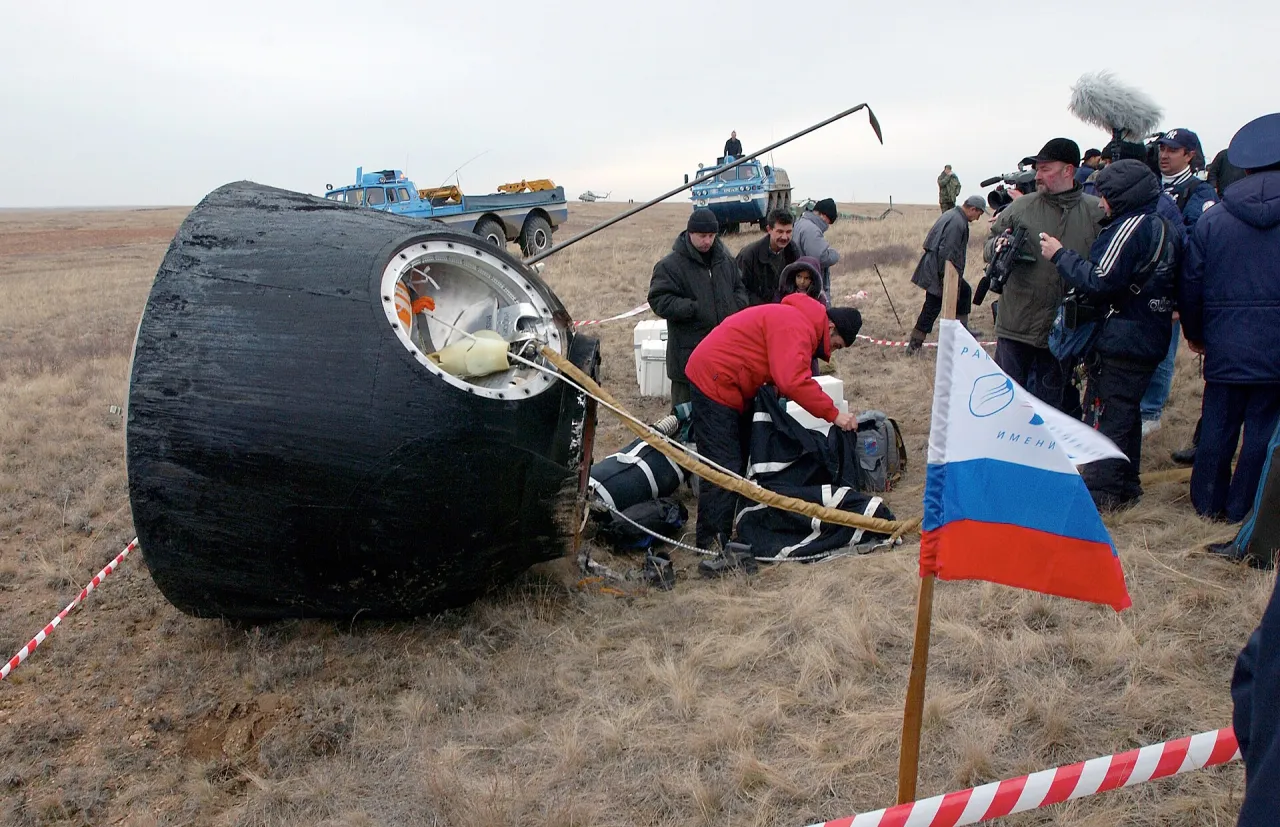
The two main drawbacks of the Soyuz are that it is cramped and disposable.
The most capable modern reusable spacecraft is SpaceX's Crew Dragon. The four-meter-diameter capsule has been flying crewed missions since 2020 and has completed more than ten manned missions in five years. Its reusability is simple: all key systems, including the toxic-fueled Draco attitude control thrusters and the highly powerful SuperDraco abort systems, are housed within the reusable capsule, so the spacecraft requires minimal recovery after landing.
From 2014 to 2017, SpaceX seriously developed a controlled, powered landing—one with helicopter-like precision—but abandoned it under pressure from NASA, deeming certification for manned flights too complex. Ultimately, Dragon splashes down in the ocean using parachutes, like the Mercury and Apollo spacecraft half a century ago. A side effect became apparent in the fall of 2024, when the Crew-9 crew was unable to return to Earth for several weeks due to poor weather in the landing zone. Russian Soyuz spacecraft, which can land on the ground, lack this drawback.
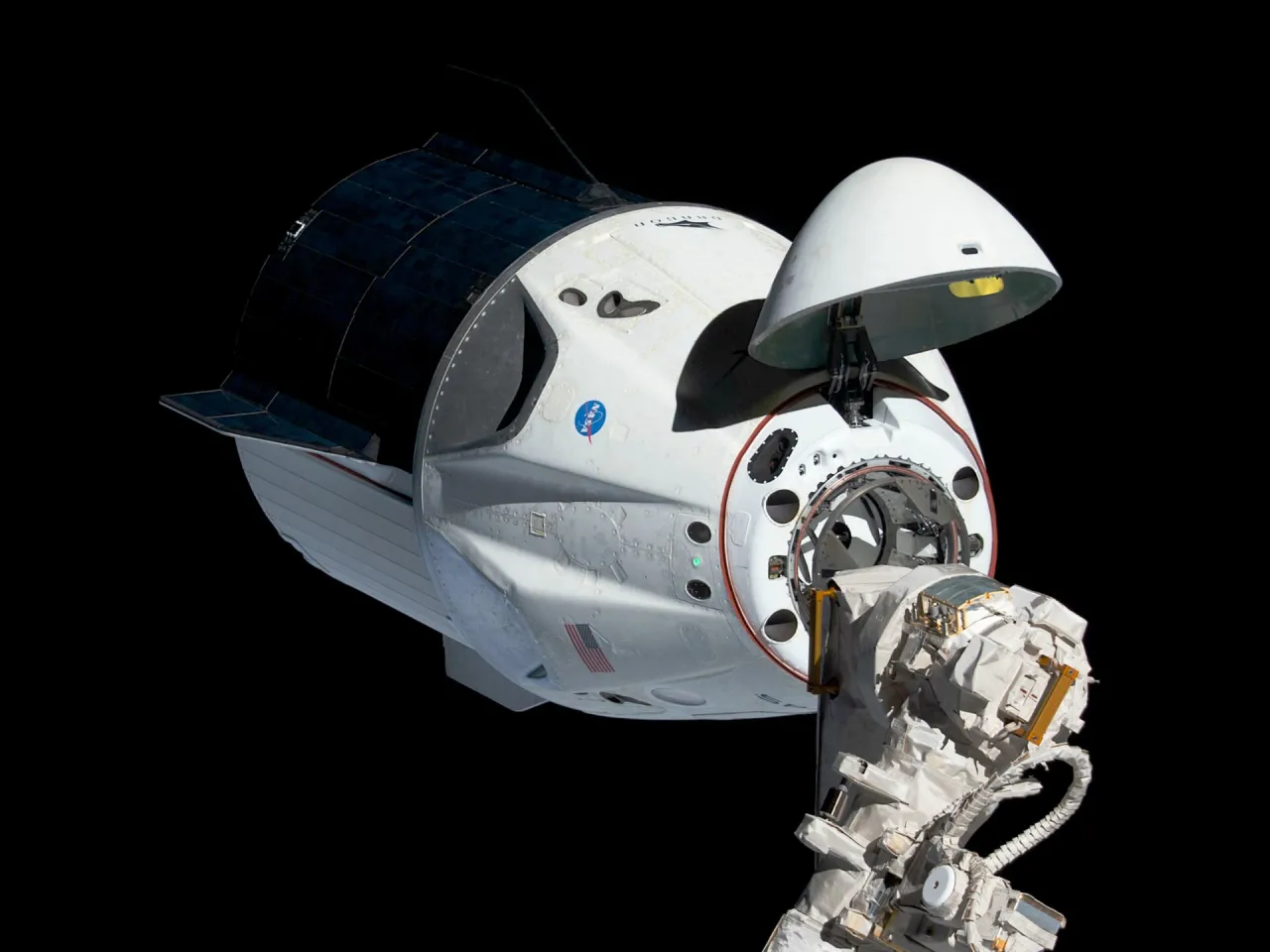
Crew Dragon
Blue Origin's New Shepard represents a completely different class—a fully reusable, single-stage system for commercial suborbital tourism and scientific research. The system consists of a reusable hydrogen-oxygen booster and a pressurized passenger capsule designed for six people. During an eleven-minute flight, Rocket takes the capsule to an altitude of over one hundred kilometers, providing tourists with about four minutes of weightlessness, after which the booster automatically lands vertically "on its tail." The capsule has the largest portholes in stories The cosmonauts return using a three-dome parachute system, and a split second before touching the ground, soft-landing powder engines are activated under its bottom, completely reducing the speed.
In addition to those mentioned, the following programs are at varying stages of completion: SpaceX's Starship (fourteen unmanned launches), Boeing's Starliner (one unmanned and one crewed flight), NASA and Lockheed Martin's Orion (two unmanned missions and one crewed mission), China's Mengzhou (one unmanned flight), and India's Gaganyaan (suborbital tests). Russia, in this category, can only offer test rigs and a history—albeit a rather instructive one.
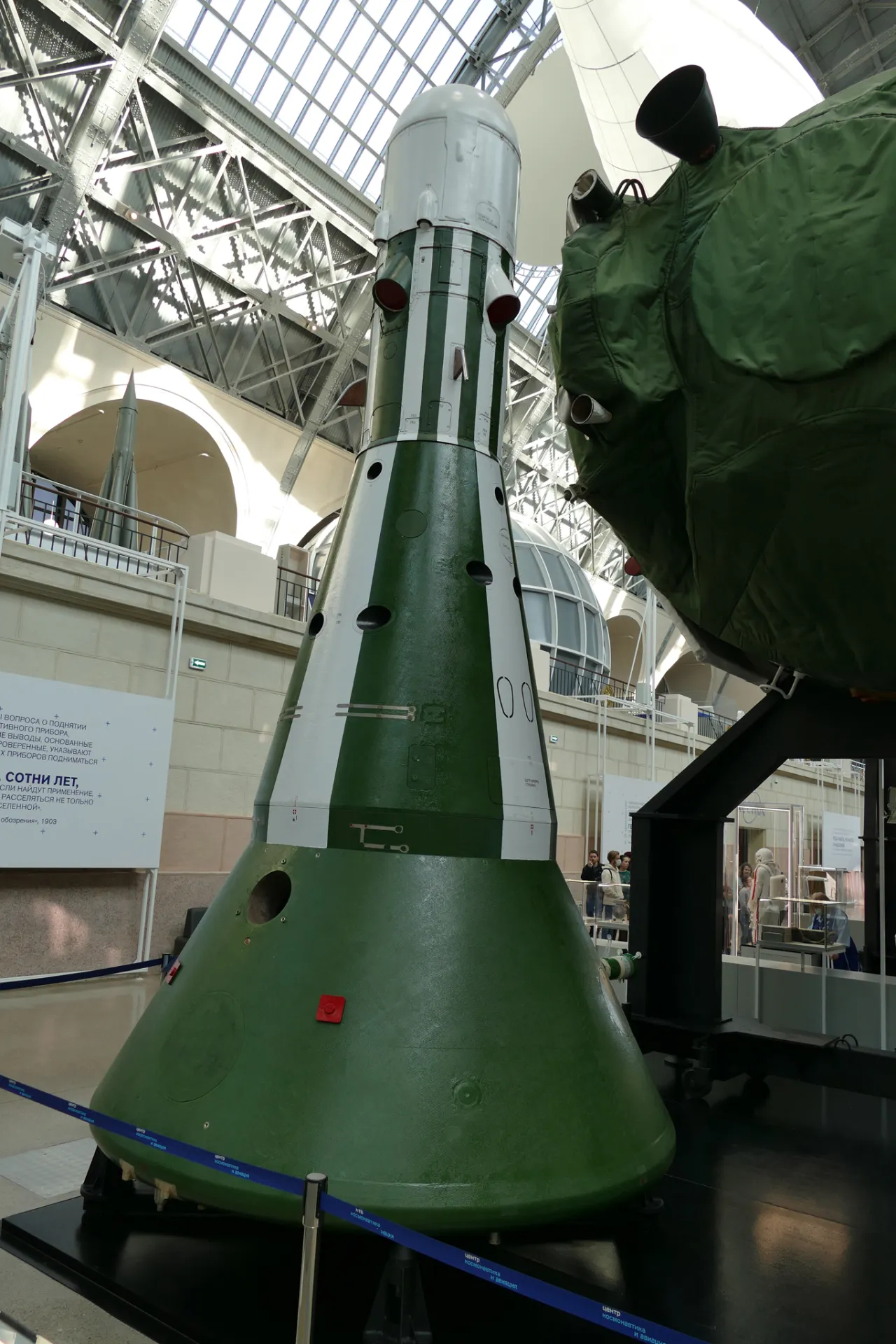
The return vehicle of the transport supply ship (VATKS). Photo by Yuri Pasholok
Interestingly, forty years before Crew Dragon, the USSR had its own reusable reentry project, and it wasn't Buran. It was the 11F74 reentry vehicle of the Transport Supply Ship (TAS), designed to service the Almaz military orbital stations. The sealed, cone-shaped vehicle, designed by Vladimir Chelomey, could accommodate three cosmonauts and had the unique ability to reuse the reentry capsule by simply replacing the outer layers of heat protection.
During the landing phase, the capsule utilized a unique parachute system and retractable booms with solid-fuel motors that deployed just below the ground, reducing the landing speed to zero. During closed-door tests from 1976 to 1985, under the designation "Cosmos" satellites, individual prototypes of the capsule successfully flew into space and returned to Earth two or three times. However, due to the program's closure, the VA TKS never became a manned mission.
"Federation", "Orel" and PTK NP
Since 2009, RSC Energia has been developing Russia's first reusable spacecraft, which has had various names over the years: initially, the project was called PTK NP, then from 2016 to 2019, it was called "Federation," and then it received its current name, "Orel." Let's set aside the cumbersome acronym and refer to the spacecraft simply as "Orel"—especially since the name was chosen in honor of Peter the Great's first naval sailing ship and also as a reference to Korolev, who called cosmonauts "little eagles." PTK NP sounds dry and formal in this context.
However, the Orel isn't being built out of thin air: it's built on a solid Soviet foundation. In the mid-1980s, the USSR began seriously considering replacing the Soyuz spacecraft: on January 27, 1985, the CPSU Central Committee and the USSR Council of Ministers issued a decree launching the development of the reusable manned transport spacecraft Zarya. The preliminary design was approved in late 1986, presented at the Scientific and Technical Council of the Ministry of General Machine Building in 1987, and by May 1988, all the issues had been addressed—the spacecraft was moving toward implementation at almost the same pace as military programs of the era.
Zarya was a bold design for a fifteen-ton, reusable spacecraft, five meters tall and 4,1 meters in diameter, to be launched on a Zenit rocket. The capsule could accommodate up to six to eight people and 2,5 tons of cargo, and was protected from atmospheric combustion by reusable quartz tiles, similar to those on the Buran rocket. Its key feature was a fully propellant landing: a powerful propellant system reduced the speed of the landing, eliminating the need for parachutes. However, the customers criticized the designers for the risk involved—the crew would find themselves surrounded by hundreds of liters of fuel.
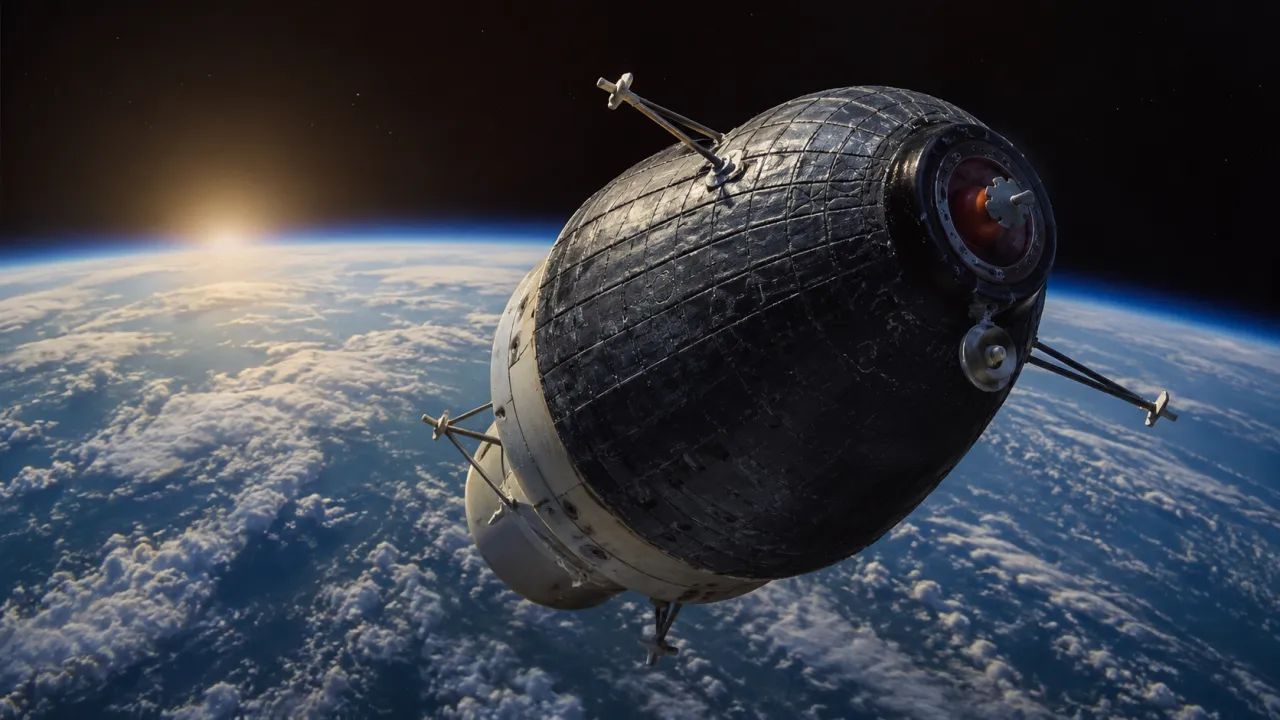
This is what the reusable Zarya spacecraft might have looked like.
In January 1989, work was inevitably curtailed due to funding cuts. The idea, however, didn't die: in 1995–1996, Energia, along with Rockwell International and the Khrunichev Center, proposed to NASA an eight-person rescue spacecraft based on Zarya, capable of remaining near the ISS for up to five years, but the Americans chose the Soyuz-TM.
Since 2000, RSC Energia has been developing the Clipper, a reusable spacecraft with a "lifting body" design for six people and 700 kilograms of cargo, using its own funds, to be launched on the same Zenit rocket. Unlike conical capsules, this gliding vehicle entered the atmosphere horizontally and carried a jettisonable propulsion module. In 2004, the project was included in the Federal Space Program, and soon the European Space Agency (ESA) expressed interest, requiring an airfield landing—thus giving the Clipper fixed wings and a chance at foreign funding.
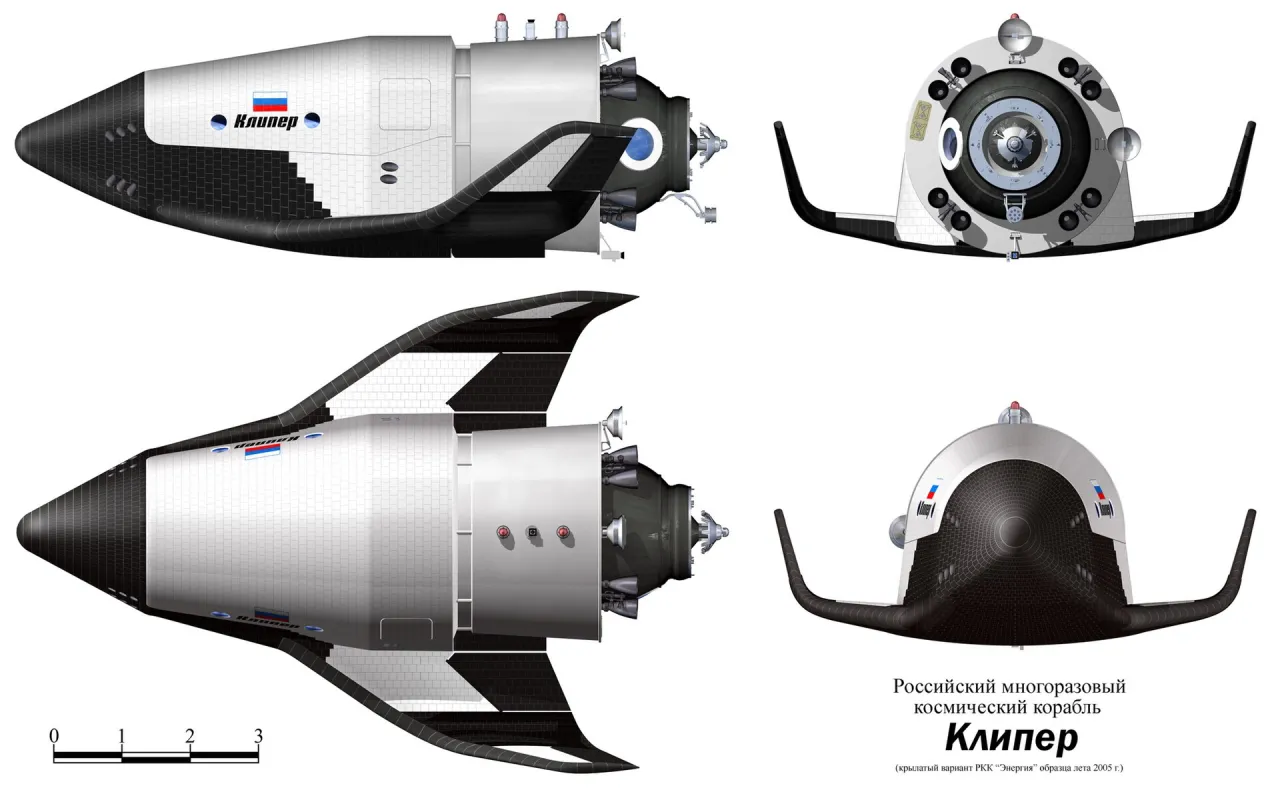
In November 2005, Roscosmos announced a competition for a new spacecraft, which deemed the Clipper design technically and economically unfeasible. In June 2006, RSC Energia quietly canceled the project. Europe also withdrew, choosing a simple, disposable ATV truck, while Korolev's associate, Boris Chertok, attributed the Clipper's cancellation to Russia's technological lag, particularly in electronics. In 2009, Energia won a new competition with the PTK NP design—the very same spacecraft we know today as the Oryol.
Catch-up cosmonautics
The project is already seventeen years old, but it has yet to undergo flight testing. In 2023–2024, Russia's lunar plans were postponed, and the Orel will be adapted for transporting crews to the prospective Russian Orbital Station (ROS). According to official data as of March 2026, the first unmanned flight is planned for 2028, with the next stage being helicopter drops of a mockup to test the parachute system. Three missions are planned for the first flight prototype: one unmanned launch with docking to the ROS and two manned flights in 2029–2030. The Orel will be launched into orbit by an Angara-A5P heavy-lift rocket from the Vostochny Cosmodrome, although the schedule is now over thirteen years behind initial plans.
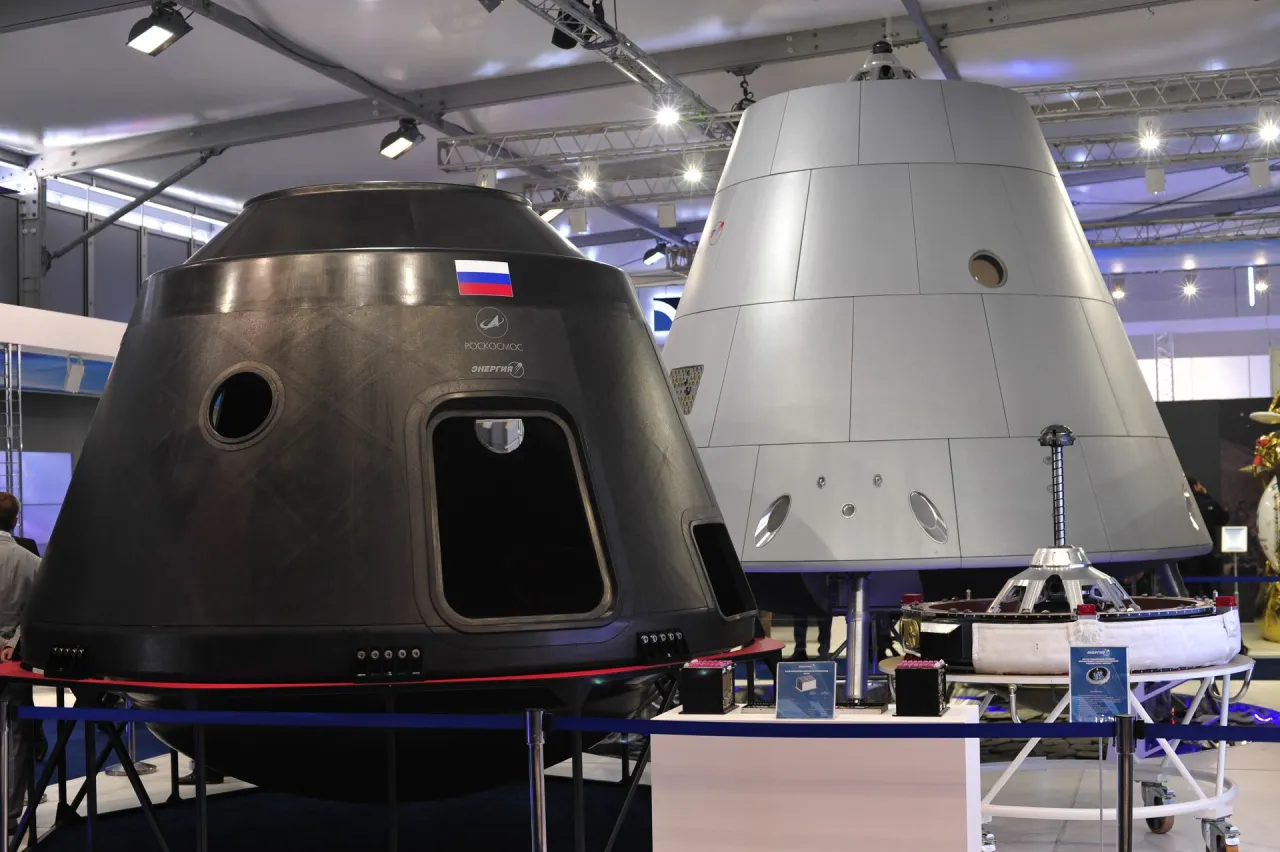
Models of the Russian reusable spacecraft at MAKS-2013
The spacecraft's technical development is in its final stages: back in 2023, Roscosmos produced a static mockup for strength testing and launched production of vibration and helicopter prototypes. By April 2024, the agency's leadership confirmed that construction had entered the final stage. Meanwhile, peripheral systems are undergoing successful testing: the MVSK02 propulsion system has reached its seven-year service life, the thermal protection designed for re-entry at escape velocity is undergoing qualification, and the navigation system has been verified via Luch satellite relays.
The program's most challenging milestone remains the full-scale helicopter drops of the return vehicle, which must prove the reliability of the complex landing system: three domes with a total area of 3600 square meters, soft-landing propellants, and four retractable landing legs. This landing system, using shock-absorbing struts instead of the traditional inflatable bags, is the project's key technological innovation, ensuring the capsule's stated reusability for ten space flights.
The program's financial and infrastructure aspects remain chronically challenging. The initial budget for the first flight prototype was 57,56 billion rubles, but in 2019, RSC Energia requested an additional 18 billion for key systems not covered by the original estimate: emergency rescue (2,7 billion), descent actuators (2,2 billion), and navigation (524 million). Ground infrastructure has traditionally been a bottleneck: deadlines were delayed due to the unpreparedness of the assembly and test facility at Vostochny, the Angara launch complex, and the crew search and rescue systems, despite Roscosmos leadership assuring that the project would not become an endless, protracted undertaking.
A site in the Belyaevsky District of the Orenburg Region has been selected for the capsule's landing. Thanks to the navigation technologies of the Topol and Yars defense systems, the landing radius will be only five to seven kilometers. A separate contract worth 1,88 billion rubles has been allocated for the creation of the landing system and initial servicing of the vehicle in 2021. Objectively, the program has already passed the nadir of uncertainty: the budget and schedule have been agreed upon, the airframes and onboard equipment for the first vehicle are being manufactured, and the test facility is ready. Nevertheless, there are still approximately two years remaining before the first launch, which will include the most critical stages: assembly of the flight vehicle, helicopter drops, testing of the rescue system, and aligning the schedules with the deployment of the ROS.
Even under the best-case scenario, manned operations of the Orel spacecraft won't begin until 2030, when its predecessor, the Soyuz, will have celebrated its sixtieth anniversary. While Russia struggles to launch a capsule designed to early 2010s standards into orbit, its global competitors are far ahead: China's Mengzhou plans to land humans on the Moon by 2030, India is preparing a manned launch of the Gaganyaan for 2027, and the American Crew Dragon will have completed several dozen missions with multiple capsules by 2028.
The Orel's stated 10-flight reusability will only become a reality by the mid-2030s—at which point SpaceX may cancel the Dragon program in favor of Starship. The project's main risk is that Orel will fly on time only according to its own internal, constantly shifting calendar, but will be hopelessly late according to the global calendar. The spacecraft, designed to reclaim technological leadership, risks becoming a symbol of space exploration playing catch-up, obsolete even before its debut.
Information