Permitting in parts: How Washington issued licenses for KAMAZ machine tools

The KAMAZ foundry housed an American-made molding line: 280 carts carrying flasks—frames for sand casting molds—moved in a closed circuit. Each mold cast two diesel engine cylinder blocks. Leonid Zaster, former head of the equipment department, recalled that worn links in this chain later had to be manufactured in Naberezhnye Chelny.
The foundry's staffing also depended on Washington's decisions. American firms sought orders, while the US War Department feared that the new facilities would supply the Soviet army. Ultimately, the White House reached a compromise: allowing individual companies to participate without opening the entire project to them.

A rally to mark the release of the first KamAZ trucks. Naberezhnye Chelny, February 16, 1976. Photo: Viktor Akhlomov, Izvestia archive
The plant was built before they had time to order the machines.
On August 14, 1969, construction of a complex with a capacity of 150 trucks and 250 diesel engines per year was approved. On December 13, 1969, excavator operator Mikhail Noskov removed the first bucket of earth in Naberezhnye Chelny. Lev Vasiliev was appointed director. Giproavtoprom and Kamgesenergostroy were to create six plants: a foundry, a forging plant, a press and frame plant (for stamping frames and cabins), an engine plant, an automotive plant, and a repair and tool plant.
The buildings were erected without waiting for all the projects to be approved, and the presses and lines were still being selected to suit the design of the engine, transmission, and frame.
The prototype ZIL-170, developed under the supervision of Anatoly Krieger, formed the basis of the future family. The diesel engine was developed in Yaroslavl. The USSR did not purchase the blueprints of an American truck, but rather the machines for mass production of its own vehicle. Western companies were selling Soviet industry primarily time: creating their own automated production lines would have taken years.
Technology historian George Halliday saw KamAZ as an example of such collaboration: its own design did not yet mean that it had the equipment for a large-scale production run.
Seven hundred and fifty million that didn't turn into a contract
In May 1969, the United States blocked the sale of foundry equipment. In January 1970, Secretary of State William Rogers proposed relaxing the ban, lest orders go to European competitors. Defense Secretary Melvin Laird objected, claiming the plant could eventually supply the military.
On May 18, 1971, Mack Trucks signed a letter of intent with the Soviets, providing for extensive participation in the project. According to White House documents, the package of potential services and equipment was valued at $750 million. Mack renegotiated the terms but never received overall approval. However, the amount of the letter of intent was not payment for supplies or part of the three foundry bids.
On August 2, 1971, Kissinger sent the president a memo regarding three requests—all related to foundry production. The document listed various types of work:
$13,5 million - Swindell-Dressler. Technical services for foundry production.
$37 million - CE Cast. Molding machines and equipment for the production of foundry cores.
$125 million – Jervis B. Webb. Conveyors and other equipment of the foundry.
Some bids competed with each other: these amounts cannot be combined and used as the cost of completed deliveries. At the time, the CIA projected the cost of the complex at three billion dollars, including a billion for foreign equipment and technology.
On August 5, Nixon approved all three applications. Kissinger instructed Commerce Secretary Maurice Stans to communicate the decision as usual. The approvals applied to the foundry, not the entire KamAZ plant; subsequent applications were to be submitted to the White House separately.
On September 15, Mack announced the termination of the preliminary agreement: the required approval had not been received by that deadline. However, on December 22, a contract was signed with Swindell-Dressler—an American firm, according to KamAZ Museum materials published in KAMAZ News, became the general designer of the foundry. Washington approved some operations, while leaving others pending.
From permits to factory floors
In his publication "Machine Tools for KAMAZ from Around the World," V. Kalinin cites data on 90 American companies that supplied over 2500 units of equipment for the foundry and engine plant. Among them were Swindell-Dressler, CE Cast, and Ingersoll. Another 150 companies from Germany supplied over 3700 machine tools and units for the entire complex, including equipment from Liebherr and Hüller. Lines and presses also came from Italy and Japan.
According to a Vnesheconombank review, the company installed 20 units of production equipment worth over two billion rubles; approximately half was imported. The 2500 American units were distributed among just two plants, while the 3700 West German units were distributed across the entire complex. Using this data to calculate the respective countries' shares of supplies would be a mistake.

Commissioning of the 100th machine tool in the KAMAZ forge shop. 1974. Photo: KAMAZ PJSC archive.
Deliveries followed the licensing decisions. By the end of 1972, KAMAZ was already installing equipment, and in 1973, the main foreign purchases were completed and the first-stage buildings were ready for operation. Foundations were erected for the presses, and power and utilities were installed. Forge plant director Alexey Subbota secured the replacement of some hammers with presses and automated production lines, which required reworking the project already underway.
Boris Kuznetsov, a participant in the foundry's development, described the challenges of automation in his book "Birth of a Flagship." The IBM project included monitoring metal inventories and furnace schedules, but far from everything was achieved. Soviet specialists had to integrate the work of individual sections into a unified production rhythm.
Zaster also recalled a clause in the contract for the American molding line: the supplier was obligated to provide the plant with the necessary spare parts. This clause was revisited when relations between the two countries sharply deteriorated.
The conveyor starts
In 1974, the first engines were assembled in the experimental workshop, and in November, installation of the main assembly line began. While the regular production lines were being established, some operations were performed using temporary tooling.
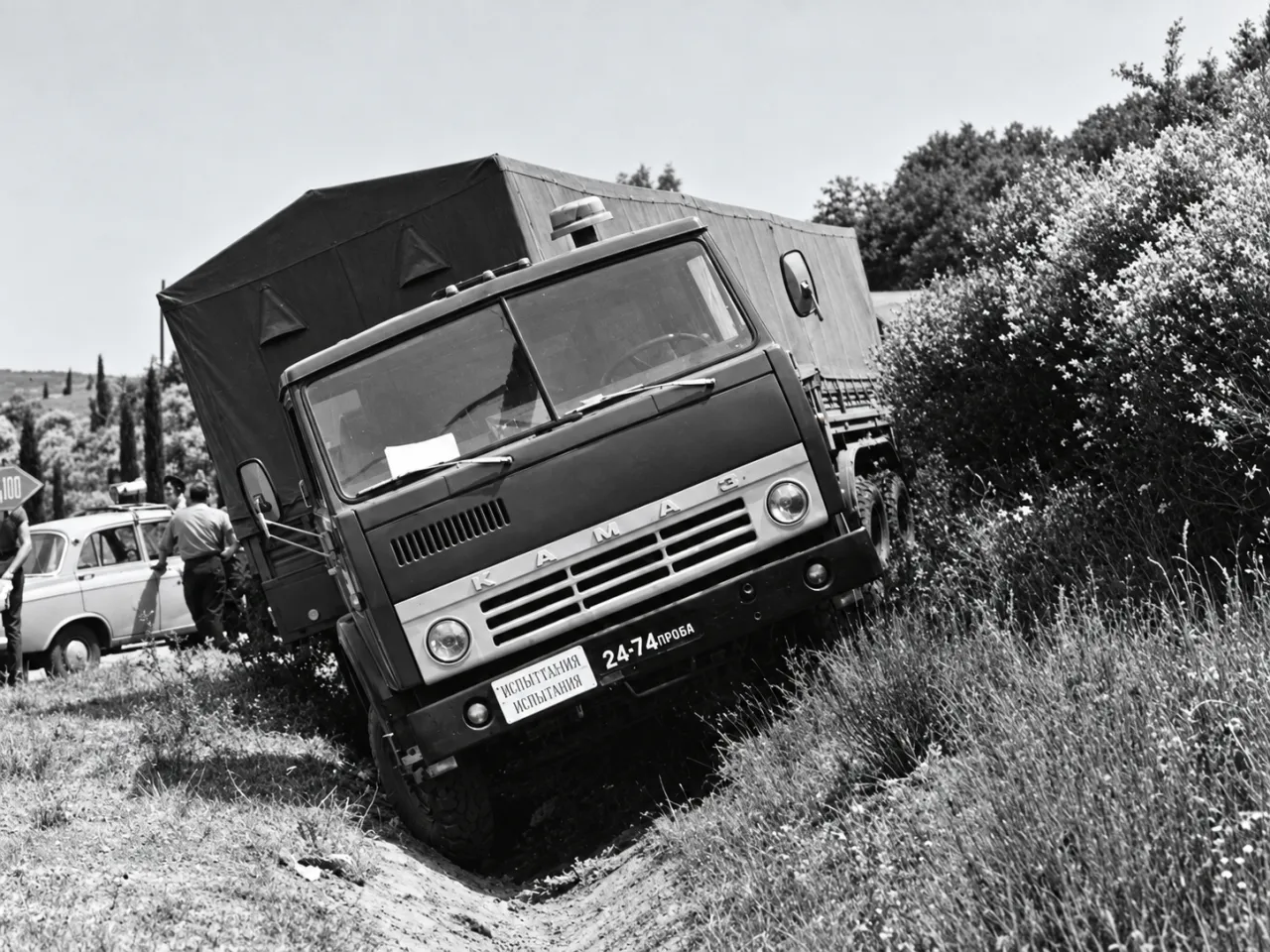
On February 16, 1976, the first KamAZ-5320 rolled off the assembly line. Test driver Valery Peretolchin was at the wheel. The truck was sent to the 25th Congress of the CPSU. The commissioning of the first stage was signed on December 29—ten months after the first truck.
In 1977, approximately 22,000 vehicles were produced, and in 1978, over 40,000. In June 1979, the 100,000th truck since the start of production rolled off the assembly line. Imported and Soviet production lines collaborated to produce a domestically produced design.
Why did the military argue?
American experts who studied the project in 1971 did not classify the future three-axle KamAZ road trucks as tactical military vehicles, although they allowed for their service in the armed forces. The KamAZ-5320, with its 6x4 wheel arrangement, met this assessment, but Laird was concerned about the capabilities of the entire plant.
ZIL had already developed a three-axle, all-wheel-drive system with tire pressure regulation. One of the prototypes was designated the KamAZ-E43101; the production vehicle was designated the KamAZ-4310. Its many years of development were described by technology historian Evgeny Kochnev.
Testing the experimental KamAZ-E43101, the predecessor of the KamAZ-4310 family. 1974. Photo: KamAZ Museum
On January 20, 1981, the first KamAZ-4310 rolled off the assembly line under the control of Valery Peretolchin. According to the museum, 35 vehicles were produced in 1981, and 16,166 in 1988.
American approvals didn't apply to the KAMAZ-4310 design: they helped equip the engine and component production facility, which later also served military orders. It was precisely these capabilities of the large plant that Laird feared. History families: "Tactical Tri-Axle: The Birth of the KamAZ-4310".
The price of a large construction project
While the debate over who needed such a plant and why was raging, its accounting was also taking shape. The bill for the creation of KamAZ consisted of construction, procurement, and financing. From 1970 to 1981, capital investments amounted to 4,2 billion rubles, 1,8 billion of which were for construction and installation work. Imports were paid for through the Soviet Vneshtorgbank; some equipment was purchased on credit from foreign banks, some of which was repaid with the output of the future plant.
The banking review lists approximately 200 million rubles in loans expected to be raised from abroad, and approximately 500 million rubles in foreign funds overall. The composition of the latter amount is not disclosed in detail. The billion dollar figure in the 1971 CIA forecast referred to potential foreign purchases, not loans. A final currency estimate is not available in available sources.
When chain links were needed
After the Soviet invasion of Afghanistan, relations with the United States worsened. According to Zaster, spare chain links for the molding line were delayed at the port of departure. Worn parts could have prevented the casting of cylinder blocks.
According to Zaster, Minister Viktor Polyakov organized the production of spare parts in the USSR. The KAMAZ repair and tooling plant mastered the process, and, in Zaster's estimation, the domestic parts were even better than the American ones.
In 1981, KAMAZ produced approximately 85 trucks. The molding line continued to operate: a chain of 280 bogies was now connected by links manufactured in Naberezhnye Chelny. After the supply stopped, KAMAZ had to maintain the imported lines internally.
Contents of the series "The Price of Détente: How the USSR Bargained with the Enemy"
- Part 1. The failure of the grand deal between the USSR and the USA
- Part 2. The Golden Price of Détente: Where Thousands of Tons of Soviet Gold Went
- Part 3. American machine tools for the Soviet KamAZ: detente and the defense industry
- Part 4. Gas in exchange for pipelines: How the USSR and Germany built an energy union
- Part 5. Soviet factories for an American ally: How the USSR armed and industrialized the Shah's Iran
- Part 6. When Trade Became a Weapon: How the US Tried to Limit the USSR's Economic Opportunities
Information