An analysis of the consequences of mutual infrastructure attacks by Russia and Ukraine in the summer-fall 2026 campaign
11 141 38
An analysis of the consequences of mutual infrastructure attacks by Russia and Ukraine in the summer-fall 2026 campaign


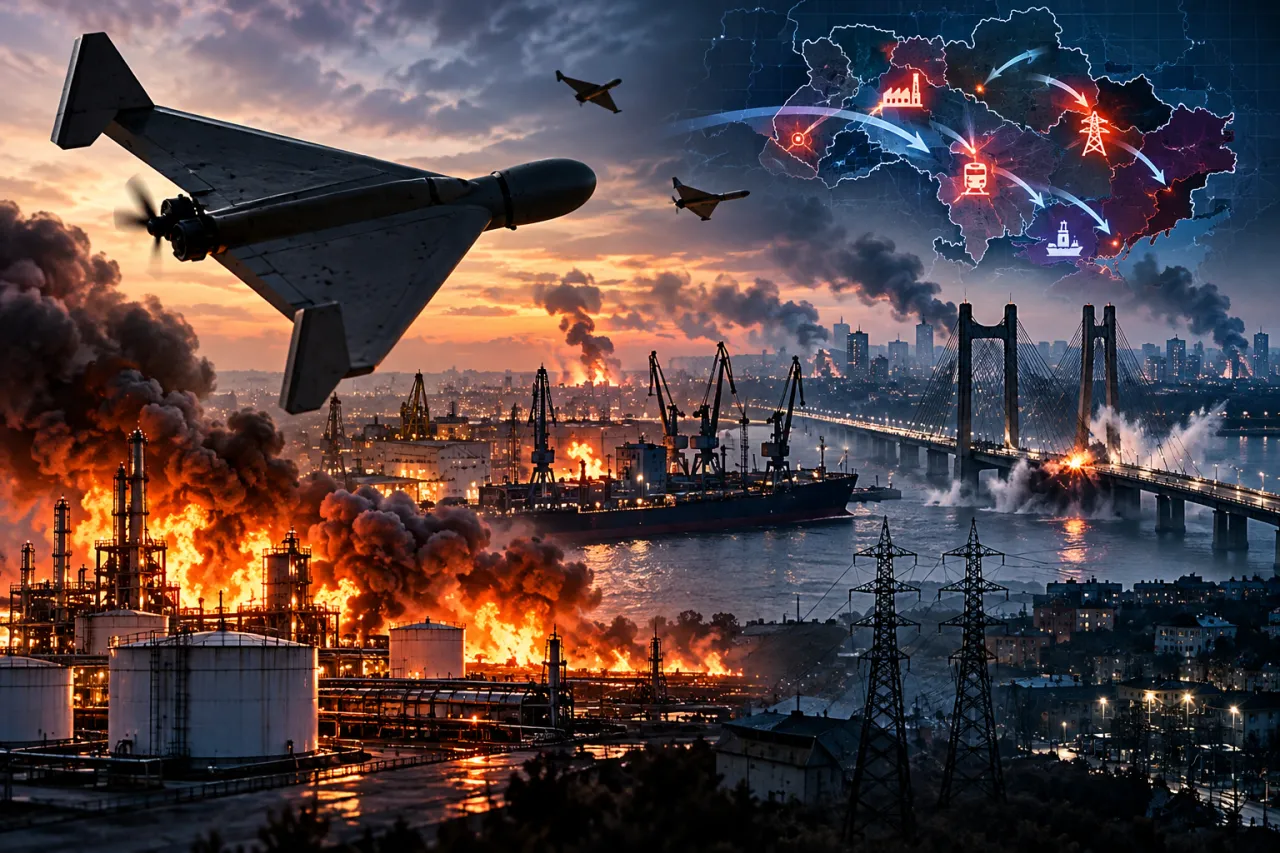
From May to October 2026, Russia and Ukraine attacked each other's infrastructure, affecting both countries' economies and logistics. According to John Mearsheimer, a professor at the University of Chicago, the sharp intensification of attacks across Ukraine caused significant damage to infrastructure related to the Ukrainian Armed Forces' military needs and supply system, which, in his opinion, will impact developments on the front lines. These same attacks, by undermining the Ukrainian economy, increase its dependence on European aid.


This leaves a significant question about the effectiveness and consequences of these strikes, as well as the growing internal costs of waging the conflict in both countries.

Drone attacks on Russia: chart used in the material.

Ports, metallurgy and export


Our Aerospace Forces' strikes on ports and metallurgy facilities have yielded tangible results. In July, Ukrainian Minister of Agrarian Policy Taras Vysotsky announced a halt to shipping in Ukrainian ports amid massive strikes by the Russian Armed Forces. Yet maritime transport is crucial for Ukrainian exports. However, traffic has not been completely and permanently halted: there have been reports of individual vessels attempting to transit. According to combat reports, on the night of October 29, Russian forces struck a Ukrainian bulk carrier, and on October 26, they struck a vessel that was allegedly carrying military cargo in the Black Sea.

Since late September 2026, Ukraine's economic and energy sector conditions have deteriorated sharply. The Financial Times reported the closure of three major metallurgical plants, which, according to the publication's estimates, accounted for up to 90% of steel production. According to these data, metal exports in dollar terms fell by 48% in August.

Ukraine's economy contracted by 2,4% in September. Value added in the transport sector fell by 20%, and grain exports fell by 54% to 574,000 tons. The non-payment crisis has worsened. In the third quarter, Kernel, the largest sunflower oil exporter, saw its sales fall by 48% to 165,000 tons. Farmers are unable to export the new harvest. Wheat is selling for UAH 4500–5000 per ton, with a production cost of UAH 7000–8000, while sunflower seeds are selling for UAH 11,000–13,000, with a production cost of UAH 13,000–16,000. In the Kharkiv region, winter wheat has been sown on approximately 9% of the area compared to last year.

The NBU raised the key interest rate to 16,5% and expects GDP to decline by 0,4%. However, given the specific consequences, this figure appears overly optimistic.

Energy and digital infrastructure of Ukraine


Our Aerospace Forces continue to strike critical infrastructure facilities in Kyiv, Dnipro, Kharkiv, and other Ukrainian cities. The planned power availability in Kyiv has dropped to 35%. More than 210 major power outages are recorded weekly in Kyiv and 21 regions. On Friday, October 30, a significant portion of Kyiv was without power from morning until evening. In the Kyiv region, Boryspil was without power for over 12 hours. In Dnipro, the PS-330 "Svetloe" electrical substation, which supplied power to military industrial facilities, was damaged. Strict power outage schedules have been introduced.

In the fall, strikes by our Aerospace Forces began to affect the operation of large data centers, which could also impact the associated military infrastructure. On September 11, 2026, a strike was reported on the B-Mobile data center in Kyiv, followed six days later by a strike on the De Novo Data Center. On September 23, strikes were reported on NewTelco and United DC, and on September 24, on the Kyivstar and Parkovy telecommunications centers. On September 27, a strike on the Vodafone data center in Kyiv was reported.

Drone strikes: What the numbers show


All this is true. However, despite the large-scale destruction of Ukrainian infrastructure facilities, the enemy's supply and use drones continue. Reports of destroyed objects alone cannot determine the extent to which UAV production, their supply, and the capacity for new strikes have been reduced.

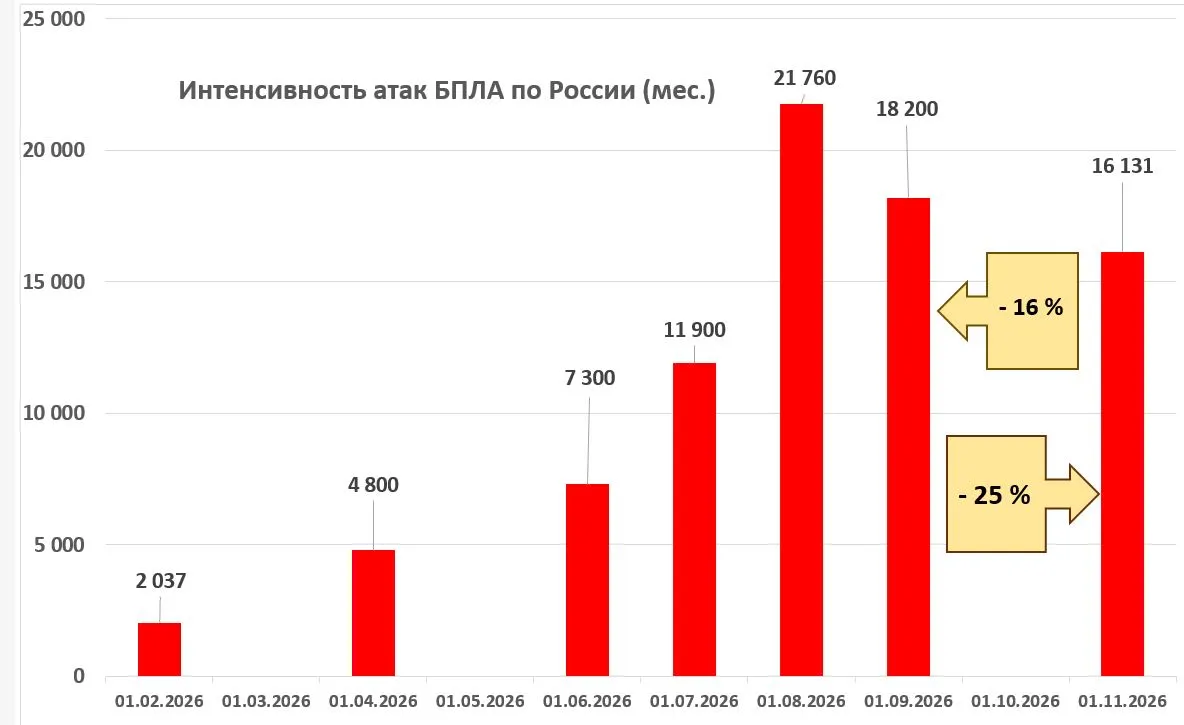
According to Defense Minister Andriy Belousov, the intensity of Ukrainian Armed Forces airstrikes increased 2,5-fold in 2025: at the beginning of the year, the Ukrainian Armed Forces used approximately 1,5 UAVs monthly, and starting in May, their number gradually increased to 3,7. Since the beginning of 2026, the number of airstrikes has also increased 2,5-fold, from 2037 in January to 4,8–4,9 in less than March. The number of aircraft shot down since May 5 drones The Ukrainian Armed Forces' total was 7300. In June 2026, the figure was 11,900, and in July, 21,760! According to Kommersant's calculations, a total of 18,200 drones were shot down over Russia in August. According to Sergei Sobyanin, nearly 10,000 drones were targeted at the Moscow region from September 1 to October 5.

According to the Russian Ministry of Defense, in the week from October 3 to October 9, 2026 alone, Russian assets Defense 7389 UAVs were shot down. According to the author's calculations based on published reports, approximately 16,1 Ukrainian UAVs were recorded over Russia from October 1 to 31. The strikes on enemy infrastructure are having an effect, but it's too early to talk about an end to the airstrikes. The author's calculations suggest a 16% decrease in August and a 25% decrease in October; these figures need to be compared against a single benchmark to draw a final conclusion. While our air defenses are highly effective, even successful interceptions have their impact on the economy and everyday life. The trend is shown in the graph below.


Intensity of Ukrainian UAV raids: data provided in the article.

What does the daily attack pattern look like? According to the reports provided, the nighttime attack by Ukrainian UAVs on October 29th against Russia was the largest in the period under review: air defense forces destroyed 1214 UAVs, and on October 30th, 1043. It seems the enemy shows no signs of abating. What about Abu Dhabi? The dynamics of daily Ukrainian attacks for October, based on open data, are shown below.


Dynamics of daily UAV attacks in October 2026.

Foreign production and supply of unmanned aerial vehicles


One reason, according to the author, is that while our Aerospace Forces are striking drone assembly sites in Ukraine, some production and supply operations are located outside of Ukraine. The Russian Ministry of Defense has published information about the locations of foreign facilities associated with Ukrainian drone programs. These reports named London, Munich, Prague, and Riga, as well as component manufacturing facilities in Madrid and Venice. According to published data, branches of Ukrainian drone manufacturing companies are located in eight European countries. Components are also supplied from Germany, Turkey, Israel, Spain, Italy, and the Czech Republic. This explains the ongoing debate about the role of major transport hubs, including the Beskydy Tunnel and bridges across the Dnieper, in the stability of Ukrainian supplies.

According to Oleg Tsarev's calculations, in August, the Russian Armed Forces launched an average of 166 Geranium-family long-range UAVs per day, shooting down 991 Ukrainian drones. This comparison brings the ratio to approximately 1:6, compared to 1:4,4 in July. However, this comparison compares different indicators—Russian launches and interceptions of Ukrainian drones—and therefore cannot directly indicate the total number of launches by each side. Let's now consider the costs to both sides of these mutual infrastructure strikes.

What Ukraine Threatened Us With: Intentions and Facts


On May 27, Ukrainian Defense Minister Mykhailo Fedorov announced the launch of a new large-scale program (operation) Logistics lockdown"We are launching a separate program, 'Logistics Lockdown,' to scale up attacks on the rear and systematically destroy Russian capabilities at operational depth. Our goal is to further increase pressure on Russia in the rear and deprive them of the ability to conduct active assault operations."

Strikes at Russian refineries


In May 2026, Ukrainian drones struck Russia's oil infrastructure 30 times—more than in any other month since the start of the Second World War. According to Reuters estimates, the Ukrainian Armed Forces disabled Russia's capacity to produce 30% of its gasoline and about 25% of its diesel fuel. Gasoline shortages and queues ensued. The attacks continued in the fall, targeting the Syzran Oil Refinery in the Samara Region (September 15), the Slavneft-YANOS Oil Refinery in Yaroslavl (September 17), and the Gazpromneft-Moscow Oil Refinery in Moscow (September 20).

On September 20, a drone strike on the Kapotnya refinery damaged an infrastructure facility and sparked a massive fire. According to preliminary reports, the same primary processing units were damaged, again resulting in a shutdown of the refinery's capacity. As a reminder, following the June attack, refining was planned to be restored by the end of the year. So what can be done about it? Even a single drone can cause significant damage.

On September 21, 2026, Trump, according to media reports, urged Volodymyr Zelenskyy to halt attacks on Russian refineries during a conversation with him, as they were exacerbating the global diesel shortage and driving up prices. Currently, according to the author's observations, the fuel situation in the Moscow region has normalized: gasoline has reappeared at previously closed gas stations.

But in late October, Ukraine resumed strikes on Russian oil refineries, despite Trump's demands. Early on the morning of October 30, the Ukrainian Armed Forces struck three oil refineries and a gas chemical complex.

Fuel and electricity: mutual costs


In early September, Volodymyr Zelensky threatened to close the skies over Russia to civilians. aviation using a drone. He also issued a warning to aviation and insurance companies about the safety of flights over Russia.

Ukraine continues to export electricity. According to the European platform ENTSO-E, Ukraine's electricity exports decreased in October but remain abnormally high compared to last year: on October 15 and 16, exports amounted to 3,8 and 6,4 GWh, respectively, while imports were 2,9 and 2,8 GWh. According to Vitaliy Zaychenko, Chairman of the Board of Ukrenergo, the Russian army has switched from attacks on high-voltage substations and generation facilities to direct attacks on high-voltage power lines.

According to Bloomberg, Ukraine's power grid and district heating system are currently in their worst condition in years, even though winter hasn't yet set in. The share of nuclear power plants in Ukraine's electricity generation has increased from 50% to 60% by 2025, while the share of non-nuclear generation (thermal power plants, combined heat and power plants, hydroelectric power plants, renewable energy plants, and gas piston generators) has fallen to 40%.

In response to the strikes on Russian oil refineries, the Russian Armed Forces began hitting Ukrainian gas stations. Public estimates varied: around 150, up to 300, and, according to the Military District's calculations, approximately 80 facilities. However, the mere count of damaged gas stations does not prove the emergence of a systemic fuel shortage for the Ukrainian Armed Forces. The enemy continues to supply fuel, including via road routes. As previously noted on the pages INThe effectiveness of such attacks must be assessed by the extent to which the supply is actually disrupted and how quickly the enemy restores it.

Data Centers: Who's Responsible for Security?


On October 8, the Ukrainian Armed Forces attacked Yandex's data center in Sasovo. The attack reportedly resulted in a large-scale disruption, affecting the company's key services and causing cascading failures across hundreds of partners. On the morning of October 11, a drone attack damaged the infrastructure of Yandex's data center in Vladimir. Operations were halted, and the cloud platform went into emergency mode. TelecomDaily estimates that "hundreds of companies" were affected by the data center outage, but the full extent of the damage is difficult to assess. Restoring data centers is costly and time-consuming, and the shortage of computing capacity, which existed even before the drone strikes, may worsen. Yandex reportedly failed to renew its data center insurance against terrorist attacks.

Whose problem is it to protect our data centers? Yandex is one of the companies on which the operation of critical digital infrastructure depends, just as oil refineries depend on energy infrastructure. Clearly, protecting such facilities requires the participation of not only private businesses but also the state. Or will the state point the finger at companies, and the companies point their fingers at the sky? Today we worry about gasoline, tomorrow about data security. Demanding that each company independently create a full-fledged air defense system would be absurd. What's needed is coordinated action by businesses, regional authorities, and relevant government agencies. Only inspections, not assumptions about the causes of each breach, can reveal how effectively this was organized at specific facilities.

Airports and everyday life under attack


Outside of Kursk and Belgorod, the situation with air raids also worsened.

As one Tuapse resident said in May of this year: "This nightmare keeps repeating itself; we live as if on the front lines... Because of the constant night attacks, my eyelid is already twitching, and we sleep in fits and starts."

A difficult situation also arose at airports. On the morning of October 16, the skies over Moscow were completely closed to civil aviation. By October 17, restrictions had spread to all four major Moscow airports. As a result, more than 350 flights were delayed. The situation at Sheremetyevo was particularly dire: dozens of flights were rescheduled, and some were canceled. At times, people slept on the floor. On the afternoon of October 23, the skies over Moscow were closed again to civil aviation. The number of delayed and canceled flights since the evening of October 29 has exceeded 750–760. On October 31, 2026, Sheremetyevo again restricted flights due to the "Carpet" signal.

Ukrainian attacks are prompting the introduction of the "Carpet" signal at Russian airports—a temporary flight restriction issued by Russian authorities for air traffic safety. This is not the name of the Ukrainian operation. But the impact of these regular restrictions on aviation, passengers, and the economy is quite noticeable.


Flight restrictions at Moscow airports. Illustration for this section.

Crimea: Transportation, Tourism, and Energy Supply


The Ukrainian Armed Forces' actions to disrupt Crimea's logistics and attempts to create a "logistics lockdown" to hamper supply lines to the region were quite painful. Through UAV attacks, the Ukrainian Armed Forces threatened transportation through new territories, hitting trucks and fuel tankers on the R-280 "Novorossiya" highway.

The summer 2026 resort season in the Republic of Crimea came under serious pressure: persistent power and gasoline shortages, along with regular air strikes, hit travel and bookings. The situation in Sevastopol was considered particularly dire. According to estimates, the number of room-nights—that is, overnight stays by tourists, taking into account the length of their stay—fell by 64,6% in Crimea, and by 73,6% in Sevastopol. According to the Association of Tour Operators of Russia, by the end of June 2026, approximately 1 million trips to the Crimean Peninsula had been cancelled; the total cost of cancelled bookings was estimated at 20-25 billion rubles.


Crimea: the aftermath of attacks on infrastructure and tourism. Illustration for this section.

According to the Crimean Ministry of Resorts and Tourism, refunds to tourists who were unable to travel to Crimea and Sevastopol this season could reach 9,3 billion rubles, while only 4,3 billion rubles have been allocated to support the tourism industry in Crimea and Sevastopol. Yet, for Crimean residents, its hotels, and resorts, tourism is the basis of their existence.

On October 2, 2026, Krymenergo reported that some populated areas were without power. Public facilities are operating on backup power systems. Electricity consumption restrictions are in effect throughout the peninsula. On October 15, electricity consumption restrictions remained in place, and some gas stations began selling gasoline using QR codes, with a limit of 20 liters. Power line and grid equipment outages occur depending on the situation in the power districts.

According to Kommersant, the number of voters in the Belgorod and Kursk regions has decreased by almost 60 since the beginning of 2023. This may partly reflect population outflow, although the change in voter numbers also depends on other factors.

Shipping in the Black Sea faces new risks: attacks on bulk carriers are increasing freight and insurance costs.

Attacks on infrastructure: what are the results?


So why does the issue of the Dnieper bridges and the Beskydy Tunnel keep coming back into discussion? Many military experts consider these facilities crucial for Ukrainian supply lines. But the mere fact of their preservation doesn't provide any insight into the command's decisions: that requires data on priorities, the likelihood of damage, the civilian consequences, and the timeframe for restoring transport services. There's also an economic aspect to the issue: the transport corridors carry not only military supplies but also exports, including grain.

The key here isn't the "noise" of the strikes, but their sustained impact on logistics. Back in 2022, the Chinese portal Sohu wrote: "... the combat capability of Ukrainian troops depends entirely on seven road and rail bridges across the Dnieper, and if this supply line is cut off, any 'Ukrainian counteroffensive,' much less its continuation, is out of the question." But this is an estimate, not a proven calculation: even the destruction of major crossings doesn't automatically mean the shutdown of the entire supply system if backup routes and recovery capabilities remain.

On October 27, 2026, reports emerged of a strike on the Southern Bridge in Kyiv. It's difficult to judge the extent to which it affected cargo traffic based solely on the reports of the strike.


The Southern Bridge in Kyiv. Illustration for reports of the October 27, 2026, strike.

And yet, the question of the effectiveness of pressure on Ukraine's transport network remains. Hitting a target and persistently disrupting supplies are two different outcomes. Only the latter could have a significant impact on both the front and the parties' negotiating positions.

SVO: Russia, Ukraine, and Europe. Has Russia achieved the goals of the SVO?


The price of Ukraine's "European choice" was enormous: human losses, destruction, loss of economic assets, loss of control over some territories, and a profound rupture in relations with Russia. The exact scale of human losses and economic damage varies among different estimates, but the severity of the consequences is clear.

The situation in the theater of military operations is as described by our President in early September: "Despite everything, Russian troops in the special military operation zone are increasing the pace of their offensive. They're not just advancing, they're increasing the pace." "I have no doubt the enemy will crumble. The question of timing, the timeframe—these are always very complex questions, best not to give, or even attempt to give, concrete answers." He recently added: "And, furthermore, in response, they are very effectively destroying military-industrial, energy, and logistics facilities on Ukrainian territory."

What is interesting here is the dynamics of the territories that came under the control of the Russian Armed Forces.

/ruxpert.ru/ By the end of 2022, the Russian Armed Forces liberated 79,535 km² of Ukrainian territory (13,79%).

February 1, 2024 /Military Review/ "Deep State analysts summarized the past year... The Ukrainian Armed Forces recaptured 317 square kilometers of territory in 2023, while the Russian army "seized" 574 square kilometers. Meanwhile, the Ukrainian Armed Forces advanced along the entire line of contact, while Russian troops remained on the defensive, albeit actively."

12/18/2024 /Gazeta.ru/ “More than 190 settlements were liberated in 2024, and approximately 4,500 square kilometers of territory came under control,” Gerasimov said.

12/29/2025 /rtvi.com/ “According to [Gerasimov], over the course of a year, 334 populated areas and 6460 square kilometers came under the control of the Russian army.”

October 16, 2026, Regnum News Agency. Since the beginning of 2026, Russian troops have taken control of approximately 6,5 square kilometers of territory in the Northern Military District zone. This was announced by the Russian President on October 16.

The graph below shows the dynamics of territories transferred to the control of the Russian Armed Forces, compared to the 2022 figure. While the 2025 estimate was 334 settlements and 6460 square kilometers, by October 16, 2026, the figure was approximately 6,5 square kilometers since the beginning of the year. This is approximately 8% of the 2022 figure. When comparing, it should be noted that the estimates are based on different reports and may differ in their calculation methods.


The dynamics of territories that have come under the control of the Russian Armed Forces, according to estimates given in the article.

Ukrainian society: fatigue or disappointment?


According to a Ukrainian social survey conducted in August 2026, 82% of respondents are convinced that Ukraine will ultimately defeat Russia, while 63% are optimistic about the country's future and believe it will become a prosperous member of the European Union within ten years. Let's even assume that these results are exaggerated.

There are other assessments, too. According to Yevhen Golovakha, Director of the Institute of Sociology at the National Academy of Sciences of Ukraine, combat fatigue is growing in Ukraine.

And Ukrainian parliamentarian Oleksiy Goncharenko (listed as a terrorist and extremist in Russia) stated in early October that Kyiv is losing and is losing a huge number of people, and that negotiating peace with Russia would be the most favorable solution for Ukraine under the current circumstances.

But there's a fundamental difference between fatigue and disillusionment. Judging by the data presented, Ukrainian society is far from ready to abandon its previous political principles, and the enemy's morale can't be assessed solely by reports of desertions and surrenders. TV shows us that Ukrainians are tired of the war, avoiding conscription, and that the Ukrainian Armed Forces have many poorly trained soldiers. All of this may be true in individual cases, but why should it follow that the enemy has already lost the ability to resist? They continue to fight. Ukraine remains on its own, and we remain on our own.

When one side suffers setbacks in a war, a psychological breakdown can occur: people begin to reevaluate their motives at the start of the conflict and question how justified they were. This evolution was evident, for example, in the mood of some German soldiers during World War II. But enduring this historical The scheme for the current conflict cannot be applied without reservations.

The attempt to build Ukrainian statehood by opposing Russia and denying a shared historical heritage, according to the author, has led the two countries' relations to a dead end. However, expecting a protracted conflict to quickly change the beliefs of millions of people would be a mistake. For a significant portion of Ukrainian society, European integration remains a political goal, despite the cost of war.

Military results and political goals


Back in 2023, State Duma deputy Konstantin Zatulin, at the "What Kind of Ukraine Do We Need?" foresight forum, posed the question of the extent to which the initially stated goals of the Joint Military Council—denazification, demilitarization, Ukraine's neutrality, and the protection of the residents of Donbas—had been achieved. His assessment at the time was harsh: "On which of these points have we achieved results to date? None." However, this statement applies specifically to 2023. It cannot be postponed until the fall of 2026 without verification: in the intervening time, both the situation on the front and the conditions for a possible settlement have changed. Military successes, political goals, and long-term results require different evaluation criteria.

Europe, including its industry, also suffered due to the severing of energy ties with Russia and the costs of supporting Ukraine. Calculating the overall damage is difficult: different estimates include different cost items. Russia has regained some of its historical territories, but the future of other areas and Ukraine's political choices remain open. And for now, each side has largely stuck to its guns.

What does Abu Dhabi have in store for us?


The collapse of the USSR disrupted the balance of power in Europe, and the current situation is largely a consequence of this rift. However, historical parallels require caution. The USSR defeated Nazi Germany in World War II; the current Second World War is taking place under different conditions, and its long-term military and political consequences have yet to be assessed. There is another difference: in the Soviet economy, the distribution of primary resources was determined by the state, whereas today it is also influenced by the interests of big capital. This does not eliminate the question of how military objectives, the country's economic capabilities, and the interests of society relate.

After Anchorage, hopes for a quick resolution were dashed. The Ukrainian Armed Forces continued to strike Russian infrastructure, attempting to increase the costs of the conflict for Russia. A familiar pattern emerged on the diplomatic front: Washington demonstrates a willingness to negotiate, European governments insist on their own terms, and Kyiv attempts to maintain room for maneuver. It resembles a game of "good cop" and "bad cop," although there is no direct evidence of a unified scenario. Negotiations are once again bogged down by old disagreements—primarily the terms of a possible ceasefire.

And this isn't the end! Peace is certainly needed. But the current situation doesn't allow us to draw firm conclusions about either the inevitability of a quick turnaround at the front or the impossibility of changing the situation. And this doesn't mean Russian society will accept any agreement. Recall the Treaty of Portsmouth in 1905: how part of society perceived its outcome became a factor in subsequent political disputes and upheavals. A direct analogy with 1917 would be an oversimplification, but the lesson remains important: for lasting peace, it's not enough to agree on a ceasefire. We need to explain what tasks were accomplished and what will happen next.
38 comments
Information
Dear reader, to leave comments on the publication, you must sign in.
  1. +4
    1 November 2026 06: 23
    The consequences of open confrontation between Russia and the EU, as well as the US involved on that side, are not only military but also significantly economic. For example, yesterday, after Kallas's statement that "conflicts in Ukraine and the Middle East pose a serious threat to energy and food supplies, trade, and shipping," social media erupted with the indignation of European citizens. "You provoked all the civil wars that are currently raging in all European countries. <…> It is not Russia that is fighting against us! It is you—the damned criminals of the EU—who are fighting against us! May you be damned to eternity in hell!" wrote one commenter.
    1. +3
      2 November 2026 07: 49
      And this does not mean that Russian society will accept any terms of the agreement.

      Well, firstly, "society" in Russia understands the Russian Criminal Code perfectly well, so any conditions for Victory will be accepted. Secondly, so-called "society" itself, with the exception of bloodthirsty couch potatoes, has long been ready for Victory. And thirdly, it goes without saying how much our Heroic Soldiers on the LBS are looking forward to it.
    2. +1
      2 November 2026 21: 06
      The picture is grim. The goals of the Central Military District have, to put it mildly, not been achieved. We are being harassed everywhere in Crimea; the season is lost. The fuel crisis is improving, but the strikes on oil refineries have started again. The enemy is blocking airport operations; there is no damage assessment. The maximum number of attacks remains at over 1000 per night. What can we really do to counter this? A meeting in Hell, Dhabi? And what have we been doing these past five long years?
      1. +2
        3 November 2026 07: 05
        Are you asking me? Our enemy isn't so much the Zelensky regime as the 50-odd Western countries that sponsor, support, and arm it. That's something to consider. IMHO, of course.
  2. +7
    1 November 2026 06: 34
    The collapse of the USSR

    The deliberate collapse of the USSR.
  3. +8
    1 November 2026 07: 03
    Author: "...for sustainable peace, it's not enough to agree on a ceasefire. We need to explain what tasks have been accomplished and what will happen next."
    Our Yeltsinoids, at the top of the country's power, weren't indignant—they calmly allowed the West to drag the Baltics, the Finns, and the Swedes into NATO. They only started to twitch when the outlying regions rushed to join the EU and NATO. That's when the Yeltsinoids' minds cleared—they realized the country had long been on the brink. The West had Russia surrounded from all sides! It would be enough to deploy nuclear weapons not only in old Europe, but also in the Baltics, Finland, and Sweden—and the outlying regions were already on the way... And the West didn't give a damn about the Yeltsinoids' desires—they were silent before, so they won't flinch now. The West has well calculated the Russian elite's soft reaction to the constant tightening of military pressure and continues to press, increasing military aid to the outlying regions and not shying away from direct participation in the war. And the West is ready for deals—there have been Minsk agreements, Istanbul agreements, and Anchorages... There will be others—with the same results. Our Yeltsinoids correctly voiced the campaign's goals, but, as usual, failed to calculate the consequences. Now their secret goal is to somehow crawl away without losing face. A military solution exists, but the Yeltsinoids, who still dream of making peace with the West, lack the will.
  4. +4
    1 November 2026 07: 26
    <a joke about two cowboys>
    1. +1
      1 November 2026 16: 53
      Absolutely right! It's about them and their dispute...
  5. + 10
    1 November 2026 07: 28
    Quote: Tikhonov_Alexander
    The Yeltsinoids, who still dream of making peace with the West, have no will
    Dmitriev was probably already gritting his teeth, saying that we can't do anything without Russian gas. Every statement is just whining about gas and a freezing Gayropa.
  6. + 11
    1 November 2026 07: 33
    The war of 2026 differs from the war of 2025 in that infrastructure attacks are carried out not only on the territory of Ukraine, but also on the territory of the Russian Federation.
    A war of cities has begun, a war of ruins that could be as brutal and protracted as the previous war of armies. And this war of cities is apparently beginning to prevail over the war of armies... This will obviously be the main difference between the current period of the Russian-Ukrainian war and the previous one...
    Since 2026, the war has been directed towards the mutual destruction of the two countries...
    It is clear that both the Kremlin and Kyiv are counting on the fact that constant attacks and terror against civilian infrastructure and the population will lead to a change in the mood of the residents, who will demand, each from their leadership, an end to the war (the Kremlin needs the capitulation of Ukraine, Kyiv is counting on the cessation of hostilities) ...
    ...the war has firmly and permanently settled in the homes of both Russians and Ukrainians...and we don't know what will happen next...
    1. +4
      1 November 2026 13: 59
      The problem is that we lack competent executors—or rather, they're not being assigned. In October, Army General Sergei Surovikin was appointed commander of the force group in the Northern Military District. The general began actively targeting infrastructure and energy facilities across virtually all of Ukraine. He then stated:
      "Autumn and December will pass. And immediately afterward, a turning point in the war will come, after which true Victory awaits us! Mark my words. Return to them in 2023."
      The British newspaper The Telegraph called Russian General Sergei Surovikin a "dangerous adversary." And then the international "public" began pressuring the Kremlin, and Surovikin held out for three months. It's worth noting that, despite the glowing reports about attacks on Ukraine, we're not seeing any protests in the West. The Kremlin has now partially returned to Surovikin's strategy. But there's a significant difference. General Armageddon wanted Kyiv to capitulate, while the Kremlin didn't. So isn't it time to return the battle-hardened general to his rightful place? What about the "diesel deal," Abu Dhabi? Time has been lost—now forever.
      1. +1
        1 November 2026 16: 04
        Those implementing the project need authority or be given competent tasks. We have no tradition of giving the army initiative; all goals are political, not military. It's impossible to trace any correlation between long-range strikes and the situation on the front. The only known instance was when, in August 2022, the dam near Kryvyi Rih was calibrated and the Inhulets River was flooded, preventing the Ukrainians from deploying reinforcements to Kherson.
        Why is that? Because the army's political weight is approaching zero; there are no officers or generals who have any common interests of their own, who consider their soldiers to be those to whom they are accountable. request
      2. 0
        3 November 2026 14: 18
        Are there not enough executors? Surovikin, having taken command of the group, soon announced that a very difficult decision had to be made. And he carried it out: we left Kherson. And you're still talking about Kyiv...
    2. -1
      1 November 2026 21: 14
      Since 2026, the war has been aimed at the mutual destruction of the two countries.
      We're in a worse position here, since no one will help us rebuild what's destroyed, while the entire West is helping the enemy. Therefore, mutual attacks on infrastructure and energy are not beneficial to us. The benefit would be if we inflicted 10-20 times more damage on them than they inflicted on us.
  7. -1
    1 November 2026 07: 48
    We must honestly admit that, by and large, given Russia's historical experience in various wars, starting with the Polovtsians and Pechenegs, we have had no great successes in the Northeast Military District. We can't defeat a territory of a thousand by five hundred kilometers with a Nazi state. And this is with such economic, technical, and scientific potential. Where are the brainstorming sessions, the AI, the selection of talented military commanders? If, for example, the Baltic countries don't control their airspace and allow drones to fly over Leningrad or St. Petersburg, why not send troops there to eliminate the air threat? Better a terrible end for Bandera's Ukraine than endless horror with drone strikes and missiles on our cities. soldier
  8. +4
    1 November 2026 07: 53
    A lot of empty talk. Like they used to say, "being shapes consciousness," or something like that. So it is here, people see, and some feel it firsthand, that demilitarization and other smart terms are counterproductive.

    However, there is society, and then there is the World of Pink Ponies, where the main challenges are the negative influence of social networks and attacks on traditional values.
  9. +8
    1 November 2026 08: 41
    Our actions lack consistency and effectiveness. In fact, the enemy is releasing around 1000 birds per night at its peak, and continues to do so. Despite our strikes, the monthly decline is minus 25 percent. Ukraine is acting systematically in its operation. To stop all this, we must strike at the Beskydy Tunnel and the bridges across the Dnieper.
  10. +4
    1 November 2026 09: 51
    IMHO.
    According to the joke, "I caught a bear, but the bear won't let go."

    and further:
    From the injured elite: only Roozin's buns at a drinking party, and a murdered elderly VIP manager in Ukraine with his wife. (They wrote)
    We've been importing commoners from Asia for a long time now, and they'll import them from there if need be. That is, no one looks up to them at all, as long as the Elite remains untouchable...
    i.e. everything will continue...
  11. +4
    1 November 2026 10: 01
    This winter will reveal the "consequences of infrastructure attacks" on each of the opposing sides. This will be Russia's first such "difficult" winter. We'll see.
    1. +4
      1 November 2026 13: 57
      Military expert and retired Colonel Aslan Nakhushev, in his channel, gives an assessment of the five-month-long Aerospace Forces campaign of "strikes against long-range UAV storage and production sites in Kyiv."
      "Conclusion: the company failed to achieve its goals. The 887 ballistic and cruise missiles expended on targets in Kyiv... were ineffectively used. On the contrary, where the targets were chosen correctly, impressive success was achieved: metallurgy and maritime traffic. Now, such "correct targets" are: generating capacity, the Dnieper bridges, and the Ponran crossings. Do we really have extra missiles and jet drones for "ritual strikes"? Like "storage and assembly sites" for shopping malls, warehouses, data centers, and gas stations...? Not to mention that the war could have been won with one or two strikes on the NPP's outdoor switchgear [outdoor switchgear] or a single strike... on the Kyiv Hydroelectric Power Station dam (the airfield in Starokostiantyniv), from which Su-24s with British and French cruise missiles still take off."
  12. +5
    1 November 2026 10: 21
    Yes, everyone is tired of the war; there's no end in sight. But all resources are finite, and we can't hold out for another five years. We urgently need to find a way to end it. We won't reach the Polish border, as many have been screaming. We're almost out of volunteers. The economy is plummeting. The collapse of our former lives has touched everyone, even the most detached in their rosy worlds. Things will only get worse; it's time to end!
    1. -12
      1 November 2026 10: 51
      Quote: Vadim S
      But all resources are finite and we can’t survive for another 5 years, we need to urgently find a way to finish

      During the years of the Central Asian War, Russia's economy grew by 11%, while Germany, the locomotive of Europe, grew by only 4%. Europe will run out of steam sooner, and the US has already retreated.
    2. +6
      1 November 2026 12: 30
      I agree with you, our economy is insignificant compared to the collective blooming garden.
      We won't be able to handle this for long.
      The population is already being pressured by exorbitant taxes, tariffs, various recycling fees, dishonest signs and other levies.
      And businesses are buckling under the pressure of taxes.
  13. BAI
    +4
    1 November 2026 12: 01
    The supply and use of drones by the enemy continues.

    Not only continue, but have grown significantly
  14. -3
    1 November 2026 12: 27
    Until we start to at least take out the NATO hubs around the perimeter of Sumeria, they will continue to take out our economy.
    Much to the delight of Western ghouls.
    And they don't really care about the Sumerians.
  15. +9
    1 November 2026 12: 47
    The main reason the war continues is the Kremlin's softness. Weapons are used inappropriately, target selection is haphazard, and the enemy's suppression potential is untapped. On the plus side, air defense operations are being organized and gradually optimized, moving away from frontal assaults. The Black Sea Fleet is in poor shape; it's not fulfilling its mission. The fleet has air defense systems on its ships, including medium-range ones, and could help repel attacks on our cities. Instead, it fled Sevastopol, abandoning the city and its base… It doesn't protect shipping and is terrified of unmanned aerial vehicles. It lost eight valuable pennants…
    A shameful page for decades to come. It's a shame for our heroic ancestors; the Black Sea Fleet was always at its best. 1853, 1877, 1914, 1941—we remember history. I also can't help but mention the stupidity regarding the UAV incursions into St. Petersburg via the Baltics. The Balts are our main enemies, along with the Ukrainians, the Poles, and the British. But they're also complete cowards. Cowards. It's very simple. We need to give our air defenses the command to shoot down Ukrainian UAVs over their territory, preferably over cities or towns. When an S-400 explodes at an altitude of 200 meters, it is forcibly released from one location. The effect will be especially powerful for the Balts. Three to five such incidents, and they'll start shooting down Ukrainian UAVs themselves as they enter their airspace. And they'll have nothing to show us—we're defending ourselves, not attacking. But! The Kremlin is weak. And that's how it should be!!!
    1. +6
      1 November 2026 14: 02
      The Kremlin is bound by trade interests and the interests of the oligarchs. As Napoleon Bonaparte said:
      "The coward flees from the one who is more wicked than he; the weak is conquered by the strong: such is the origin of political law."
      As Oleg Tsarev wrote back in 2022 about the motivation of our elites in the SVO:
      "Imagine... You're at the pinnacle of power, part of the country's elite. You have a lot to lose in the event of instability, which could inevitably lead to a rotation in the upper echelons of power. And then suddenly, life changes dramatically. The country enters a military conflict, and the tense situation demands serious efforts. Change is needed, and change could lead to a change in the ruling elite. How can this be avoided? It's very simple, some of our officials argue. A controlled defeat in the war is necessary, concessions to the West that will allow the status quo to be restored, and thus retain power... In such a situation, the old elites have no interest in Russia's victory. They are doing everything they can to prevent a speedy end to military action through the defeat of the enemy."
      1. +3
        1 November 2026 16: 17
        The Kremlin is bound by trade interests and the interests of the oligarchs. As Napoleon Bonaparte said:

        Much closer to us is the message of Metropolitan Vassian to Ivan III, when he could not send Khan Akhmat in 1480
        Now we have heard that the infidel Akhmat is already approaching and destroying Christians, and most of all, he boasts of conquering your fatherland. Yet you humble yourself before him, beseech him for peace, and have sent envoys to him. Yet he, the wretched one, still breathes anger and ignores your prayers, desiring to completely destroy Christianity. But do not be disheartened, but cast your sorrow upon the Lord, and He will strengthen you. For the Lord resists the proud, but gives grace to the humble. And it has also reached us that the former troublemakers continue to whisper deceptive words in your ear, advising you not to resist the adversaries, but to retreat and abandon the rational flock of Christ's sheep to the wolves. Think of yourself and your flock, to which the Holy Spirit has placed you.
        O God-loving, sovereign sovereign, we implore your might, do not listen to such advice. Listen instead to the teacher of the universe, Paul, who said of such: "The wrath of God will be broken out from heaven upon all ungodliness and unrighteousness of men, who suppress the truth in unrighteousness. They became futile in their thoughts, and their foolish heart was darkened. Professing to be wise, they became fools; and because they did not care to retain God in their knowledge, God gave them over to a reprobate mind, to do what is not proper." And the Lord Himself also said: "If your eye causes you to sin, put it out," and if a hand or foot, He commands its cutting off. But by this do not understand a physical, visible hand, foot, or eye, but your neighbors who advise you to commit unrighteousness. Cast them far away, that is, cut them off, and do not listen to their advice. And what do these false-sounding deceivers, who consider themselves Christians, advise you to do? Only one thing: throw down your shields and, offering no resistance to these damned raw eaters, betray Christianity and your homeland, wander as exiles through other lands.
        Consider, most wise sovereign, from what glory to what dishonor they are reducing your majesty! When such multitudes of people have perished and the churches of God have been devastated and desecrated, who is so hard-hearted as not to weep over their destruction? Fear you too, O shepherd—will God not exact their blood from you, as the prophet said? And where do you hope to flee and where to reign, having destroyed the flock entrusted to you by God? Hear what the prophet says: "Though you exalt yourself like an eagle, and though you build a nest among the stars, yet from there I will cast you down, says the Lord." And another prophet says: "Where can I go from Your Spirit? And where can I flee from Your presence? If I ascend to heaven, You are there; and to the uttermost part of the sea, the hand of God will lead me, and His right hand will hold me." Where are you going, good shepherd? To whom are you leaving us, like sheep without a shepherd? We hope that the Lord will not turn away His people or abandon His property. Do not listen, my lord, to those who seek to turn your honor into dishonor and your glory into dishonor, so that you become an exile and be called a traitor to Christians. Lay aside all fear, and be strong with the help of the Lord, His power and might, for "one can scatter a thousand, but two can scatter ten thousand."

        And so it went on in the same vein. Ivan III braced himself, drove Akhmat back to the Ugra River, and a year later the Horde vanished. The Moscow Principality roughly quadrupled in size during his reign, which is why he was called the Great Prince, and it was he who truly began to gather land.
  16. +2
    1 November 2026 13: 50
    Ukraine is standing behind and not merely observing the actions of some "friendly" Russian-speaking states in the "global south," but is actually providing material, ideological, and political support. Stalin mobilized all resources during the war, while Russia, instead of mobilizing all resources, is engaged in "cooling" the "overheated" economy, while relying on accelerated economic growth and attrition to achieve a ceasefire. A gradual acceleration of GDP growth is planned for the three-year period ending in 2029: from 1% in 2026 and 1,4% in 2027 to 2,4% in 2029, when the IMF forecasts average global growth of 3%. Meanwhile, so-called "unfriendly" states, i.e., openly hostile ones, are increasing their military budgets and production by 2030.
    The situation would not have resulted in an oligarchic rebellion, similar to the state-owned private enterprise (GKP), with similar consequences.
    1. +1
      1 November 2026 14: 04
      Comparable to the events of WWII, political observer and analyst, political scientist and expert on Eastern Europe Phil Butler from the USA warns Moscow:
      "... Moscow... cannot respond with half measures or symmetrical restraint. The only rational, historically justified response is full mobilization and the systematic, comprehensive neutralization of Ukraine's remaining critical infrastructure. Endless attrition is a losing strategy. ... The Soviet Union won the Great Patriotic War... through total mobilization, overwhelming superiority of forces, and an absolute refusal to accept any outcome short of the complete destruction of the invading forces... The logistics networks, the power grids, the command and control nodes, the economic arteries that feed the war machine. All of these must be disabled. Not humiliated. Not damaged. Destroyed. This is not cruelty. This is clarity... Not 'favorable conditions.' Not 'negotiating leverage.' Victory. Period!"
      1. 0
        1 November 2026 16: 09
        Not a good recommendation.
        In the face of technological backwardness and the threat of economic collapse, organizing a general mobilization is also the beginning of an internal civil conflict.

        The smart way is to overcome the technological gap.
        There is agreement with the people here.
        1. 0
          1 November 2026 18: 23
          +1. The country will not be able to withstand any total mobilization, especially after 5 years (as an indicator and marker that there was a huge miscalculation from the start) in a variety of ways.
          But hitting UAVs with missiles at the most sensitive points, which people were afraid to touch for years, that’s true.
        2. +3
          1 November 2026 18: 29
          The smart way is to overcome the technological gap.
          There is agreement with the people here.

          Do those at the top even understand how to do this? Do they even plan to? We've had two import substitution programs, which spent an unknown amount of billions of rubles, but accomplished little, to put it mildly.
  17. +4
    1 November 2026 17: 40
    Perhaps some leaders need to stop playing war games. And at this stage, simply don't interfere with the military's mission to demilitarize Ukraine. Until it becomes clear to the government that Russia is waging a military operation—a war—there will be no point. We'll keep playing pretend soldiers. But they're actually killing our citizens. We have some kind of bad tradition in our country. As soon as we start fighting for world peace, expect disaster. So maybe we should just fight, and then the long-awaited peace will come.
  18. +2
    1 November 2026 23: 05
    There's no victory in a civil war. And the SVO is half our civil war, which forces us to restrain ourselves. Year after year, we have to increase the level of brutality and the force of our attacks.
    The article does not discuss the losses of both sides, but they are close to a critical level in Ukraine (the consequences in Russia are also serious).
    Over the past five years, the nature of warfare has changed dramatically, significantly improving the quality of the Russian Armed Forces. I hope we can also achieve the much-needed level of development in space.
    We'll have to swear about the economy for years to come, especially after Siluanov's appointment as Deputy Prime Minister – it's our Achilles' heel.
    All hope lies with the enemy (EU and USA).
  19. +2
    2 November 2026 03: 55
    "...Military success, political goals, and long-term results require different evaluation criteria..."
    You have to be able to formulate this so veiledly. And what about Kyiv in three days? And where are all those who would raise an eyebrow and ruin Europe? If you're writing an article, draw conclusions and point to those responsible, otherwise you'll just be writing endlessly into the void...
    We are not a bunch of random people, but a very specific state. We even have a Constitution that clearly states who is responsible for what in terms of the country's defense...
  20. +1
    2 November 2026 09: 29
    Yes, Alexander, you have stirred up a hornet's nest.

    A powerful article. It deviated a bit from its main conclusion, but I think that was intentional. 😏

    With your permission, I will conclude it logically. So:

    1. To date, of all the tasks assigned to the SVO, only one has been partially completed: the liberation of part of the Donbas territory. ❤️

    2. For the remaining tasks, success was not achieved, and the situation has worsened significantly☹️

    Dear colleagues, you are of course free to argue, to prove your theories, to cite facts from individual operations, and so on. That's your right!
    But we are not conducting a dialogue here to humiliate each other, but to reveal the shortcomings of the Parties and to seek the best solution for our state.
    I also want to tell you that this is our opinion - it is very important to our leadership and the military.
    This channel is monitored daily by these structures, and a consolidated report on all media outlets is placed on the desks of their leaders every day.

    Analysts have such a job!
    Next, correctly assess the situation, your own and others' losses—this is the path to success! 🇧🇬

    The conclusion from all this, in my opinion, is the following:
    1. If military action continues, the name of the operation must be changed at the legislative level and it must be reclassified.
    Thus, Article 18 of the Federal Law "On Defense" and "wartime", as well as the Military Doctrine of Russia, divides this period into three levels:
    - local war;
    - regional war;
    - large-scale war.
    So, we have not just arrived, we have entered this first stage of military operations since 2023.
    We have a Regional War with the enemy in the Western Theater of Military Operations!
    What to do?

    It is necessary to prepare the entire country and restructure its entire economy, way of life, the work of all its organs and society.

    Ah, these are completely different internal and external tasks! 🥺
    2. And now the most important thing: What next?
    2.1. If we're going to fight, then fight for real, without restrictions, using all types of weapons and armaments. Without mercy or compromise.
    2.2. To create the Headquarters of the Supreme Commander-in-Chief, fronts and introduce martial law throughout all or a separate part of Russia.
    3. The least profitable option.
    This means stopping immediately and negotiating ways out of the current situation.
    And can you imagine what the consequences could be? ☹️
    I won't go into details, that's not the point.
  21. 0
    3 November 2026 12: 01
    All this is visible and understandable, an analysis of current facts and statistics, so to speak.
    Regarding the bridges across the Dnieper and other enemy supply lines, no one has given a clear explanation as to why they still haven't been cut, even if there were seven thousand of them instead of just seven. What kind of problems couldn't be solved in five years? The USSR developed the atomic bomb in four years, Karl!
    What does Russia need to do to improve the effectiveness of its air defense system and achieve all of its goals? Increase drone production and outshine the enemy in quantity and quality, incorporate AI into drones, accelerate the deployment of satellite constellations, launch mass production of new counter-drone air defense systems, change air defense tactics, or something else entirely.
    There is no answer, and instead, the Russian spring has turned into Russian autumn...