Russian ships under the Japanese flag: from Tsushima to the ransom

4 090 58
Russian ships under the Japanese flag: from Tsushima to the ransom
The former Russian battleships General-Admiral Apraksin and Admiral Senyavin, flying Japanese flags, enter Sasebo.


Capturing enemy ships is a common occurrence in any naval war. But it's one thing to capture an enemy ship in battle, and quite another to years later buy your own ship from a former enemy, which he raised from the seabed, repaired, and used as part of his own fleet. fleet.


This is exactly what Russia had to do in 1916. Moreover, it had to buy ships from Japan, with whom it had fought a war just eleven years earlier, ending in a crushing defeat.

But the Russian navy story started out completely differently.

On May 7 (18), 1703, at the mouth of the Neva, detachments under the command of Peter I and Alexander Menshikov captured two Swedish vessels—the shnyava "Astrild" and the galliot "Gedan." For his participation in this operation, Peter was awarded the Order of St. Andrew the First-Called, becoming the sixth recipient.


L. D. Blinov. "The Capture of Swedish Ships at the Mouth of the Neva." 1890.

During the Northern War, Russian sailors captured ten Swedish ships, including the Elephant, in the Battle of Gangut, and four Swedish frigates in the Battle of Grengam.

Two centuries later, the situation changed to the opposite.

Ships that the Japanese raised from the seabed


During the Russo-Japanese War of 1904–1905, the Russian fleet suffered enormous losses. However, not all of the sunken ships remained on the seabed or were turned into scrap metal.

The Japanese organized large-scale salvage operations and restored some of the Russian ships. This included not only small destroyers but also large battleships and cruisers, built through years of hard work by Russian shipbuilders.

Four squadron battleships were raised in Port Arthur:
  • "Peresvet", which received the Japanese name "Sagami";
  • "Victory" became "Suo";
  • "Poltava", renamed "Tango";
  • "Retvizan", transformed into "Hidzen".

There, the Japanese raised two cruisers: the armored Bayan, which received the name Aso, and the armored deck Pallada, which became Tsugaru.

In Chemulpo, the Japanese raised the famous Varyag, which had been scuttled by its crew after the battle of January 27 (February 9), 1904. The Japanese navy named the cruiser Soya.

Another trophy was the cruiser Novik, sunk after the Battle of Korsakov Outpost on Sakhalin. The Japanese restored it and commissioned it under the name Suzuya.

But the list doesn't end there.

The Japanese fleet acquired the destroyer Silny, raised in Port Arthur and renamed Fumizuki, as well as the minelayers Vsadnik and Gaidamak, which became Makikumo and Shikinami, respectively.

A separate story concerns the destroyer Reshitelny, captured by the Japanese in August 1904 in the neutral Chinese port of Chefoo, today's Yantai. The Japanese incorporated it into their fleet under the name Akatsuki, later renaming it Yamabiko.

Finally, after the Battle of Tsushima, the Japanese captured five more warships that surrendered to the enemy.

According to the calculations of the Japanese Institute of Defense Studies, published on August 25, 2026, the total number of ships included in the Japanese Imperial Navy was 21 ships, captured during the Russo-Japanese War. Of these, twelve were cruisers, battleships, and coastal defense ships.

You'll agree, these aren't just individual trophies. This is an entire formation of warships that the enemy captured as a result of the war.

Moreover, the Japanese didn't limit themselves to renaming the ships. Some ships had to be raised from the seabed, towed to docks, have their hulls repaired, and have their machinery, boilers, and armaments replaced.

Tsushima: four battleships and one cruiser lost


The surrender of Rear Admiral Nikolai Nebogatov's ships occupies a special place in the history of Japanese trophies.

On May 15 (28), 1905, the day after the main Battle of Tsushima, the remnants of the Russian squadron found themselves facing the significantly superior forces of Admiral Togo.

Under Nebogatov's command were the squadron battleships Emperor Nikolai I and Oryol, the coastal defense battleships Admiral Senyavin and General-Admiral Apraksin, and the cruiser Izumrud.

Nebogatov decided to surrender.

As a result, the Japanese received four armored ships:
  • “Emperor Nicholas I” - the new name of “Iki”;
  • "Eagle" - "Iwami";
  • "Admiral Senyavin" - "Mishima";
  • "General-Admiral Apraksin" - "Okinoshima".

The Izumrud disobeyed the order to surrender. The cruiser managed to escape the encirclement, but subsequently ran aground in Vladimir Bay and was destroyed by its crew.


Rear Admiral N. I. Nebogatov

One clarification needs to be made here.

The destroyer Bedovy, which also fell into the hands of the Japanese after Tsushima and was given the name Satsuki, did not belong to Nebogatov’s detachment.

It carried the seriously wounded Vice-Admiral Zinovy ​​Rozhestvensky. The "Bedovy" surrendered separately, and the circumstances of its surrender were subsequently examined in a separate trial.

Nebogatov was responsible for the delivery of four armored ships.

After returning from Japanese captivity, the admiral and several officers were tried before a naval court. In December 1906, Nebogatov and three commanders of the surrendered ships were sentenced to death, with a petition to commute the sentence to ten years' imprisonment in a fortress. Nicholas II approved the commutation. Nebogatov was later pardoned.

The admiral's supporters pointed out that continued resistance left virtually no chance of victory and could have resulted in the deaths of thousands of sailors.

The opponents asked another question: why did the ships, still capable of staying afloat, fall into the hands of the enemy without any attempt at a final resistance?

After all, the coastal defense battleship Admiral Ushakov, lagging behind the main force, refused to surrender to the Japanese and was lost in battle. Of course, its position and technical condition differed from those of Nebogatov's ships. But this does not eliminate the very question of the boundaries of command responsibility.

The circumstances of the trial were already examined in more detail on the pages of Military Review in the article The Trial of Rear Admiral Nebogatov.

What did Peter I's Naval Regulations say?


In 1720, by decree of Peter I, the "Book of Naval Regulations" was published, defining the duties of naval commanders, officers, and lower ranks.

See our article The First Charter of the Russian Navy.

The Peter the Great Charter required the commander to fight courageously, set an example for his subordinates, and not surrender the ship to the enemy without legal grounds.

However, contrary to popular belief, the regulations did not prohibit surrender under absolutely all circumstances. They provided for exceptional cases where, in order to save lives, surrender could be permitted after a decision by an officers' council.

In other words, even under Peter the Great, it was understood that there were situations where further resistance would lead to the futile destruction of the crew. But at the same time, liability was established for surrender not prompted by genuine necessity.

Of course, Peter's 1720 charter cannot be automatically applied to the 1906 court case. However, the principle itself is important here: a commander had to not only make a decision but also be responsible for its validity.

This is why the controversy surrounding Nebogatov continues to this day.

The mere act of changing the flag signified the ship's transfer to enemy control. For Russian sailors, this was a painful symbol of defeat, but legally and according to naval custom, it signified surrender, not a change of faith on the part of the crew.

Much more importantly, the Japanese received ships that could still be of military use to them.

Russian battleships in the service of the Japanese Emperor


The Japanese used the trophies they obtained in different ways.

Some of the ships, after repairs, joined the fleet's combat complement, while others were reclassified as coastal defense ships, training vessels, or auxiliary vessels.

For example, the former Poltava, which received the Japanese name Tango, underwent a lengthy restoration after its recovery.

At the shipyard in Maizuru, the Japanese replaced damaged machinery and boilers, restored armament, and rebuilt artillery The ship's magazines and equipment were customized to suit their own needs. In 1909, the Tango was commissioned as a first-class coastal defense battleship and was also used for personnel training.

The fate of the Varyag is no less indicative.

It took the Japanese about two years to restore the cruiser after its salvage. In November 1907, the former Russian ship was accepted into the Imperial Navy as the Soya.

Subsequently, it was used primarily for cadet training. The ship participated in maneuvers, undertook long-distance training cruises, and underwent repairs.

Thus, one of the most famous symbols of the Russian fleet's heroism spent almost nine years in the service of its former enemy.

A detailed history of his Japanese service is given in the material "The Cruiser Varyag. Battle of Chemulpo. Part 20. Under the Shade of the Cherry Blossoms".

But the fate of other trophies is even more remarkable.

In August 1914, Japan entered World War I on the side of the Entente and began military operations against Germany.

During the operation against the German naval base of Qingdao, the Japanese used a whole group of former Russian ships.

The Second Fleet included the Suo (former Pobeda), Iwami (former Oryol), Tango (former Poltava), Okinoshima (former General-Admiral Apraksin), and Mishima (former Admiral Senyavin).

They took part in the blockade and shelling of German positions.

The resulting picture is remarkable: ships built for the Russian Imperial Navy, after Russia's defeat, continued their military service as part of the Japanese Imperial Navy and took part in the new war.

According to Japan's Institute of Defense Studies, these trophies weren't simply obsolete ships lying idle at dockside. In 1914, some of them still had combat value and were deployed in actual operations.

What does this say about the results of the Russo-Japanese War?

At the very least, the enemy received not only victory and political advantages, but also material reinforcement of its fleet, thanks to ships that Russia spent significant funds on building.

Admiral Togo and Russian cartoonists


Here it is worth remembering one more characteristic detail.

During the Russo-Japanese War, the Russian satirical press often portrayed the Japanese in a derogatory light. The caricatures attempted to portray the enemy as weak, stupid, and incapable of waging a serious war.

Particularly noteworthy is the caricature of Admiral Togo, published in issue No. 12 of the magazine "Alarm Clock" in 1904.
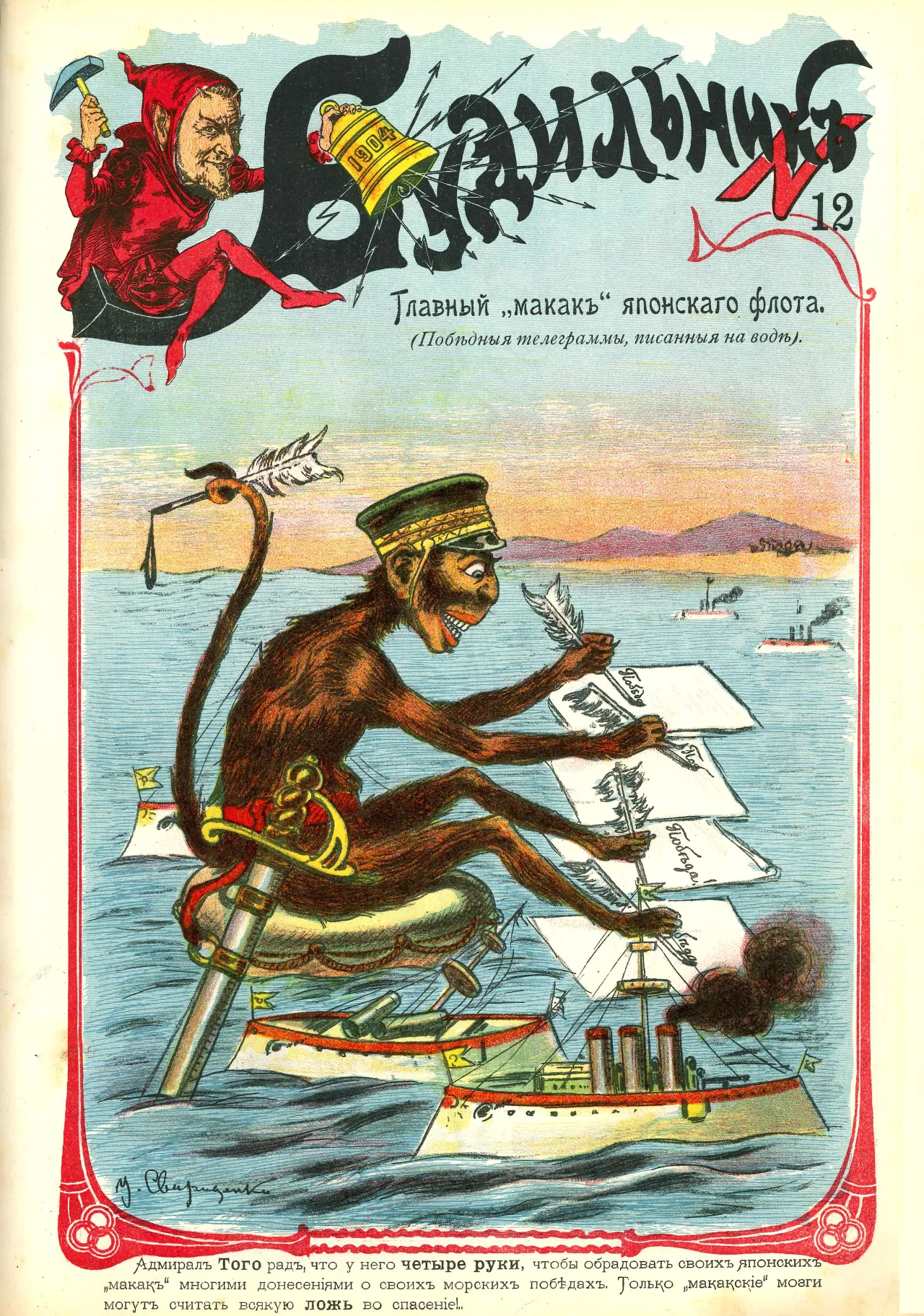

A caricature of Admiral Togo from the magazine "Alarm Clock", 1904, No. 12. An example of racist imagery in military satire of the time.

The admiral is depicted as a monkey, using four hands to write false reports about Japanese victories.

The author of the cartoon apparently believed that he was humiliating the enemy in this way.

However, even then there were people who understood how dangerous it was to underestimate the enemy.

On April 20, 1904, the newspaper "Vostochnoye Obozreniye" criticized such depictions. It reminded readers that Togo was an experienced and skilled admiral who should be taken seriously, and that vulgar jokes could "humiliate not the enemy, but oneself."

These words turned out to be prophetic.
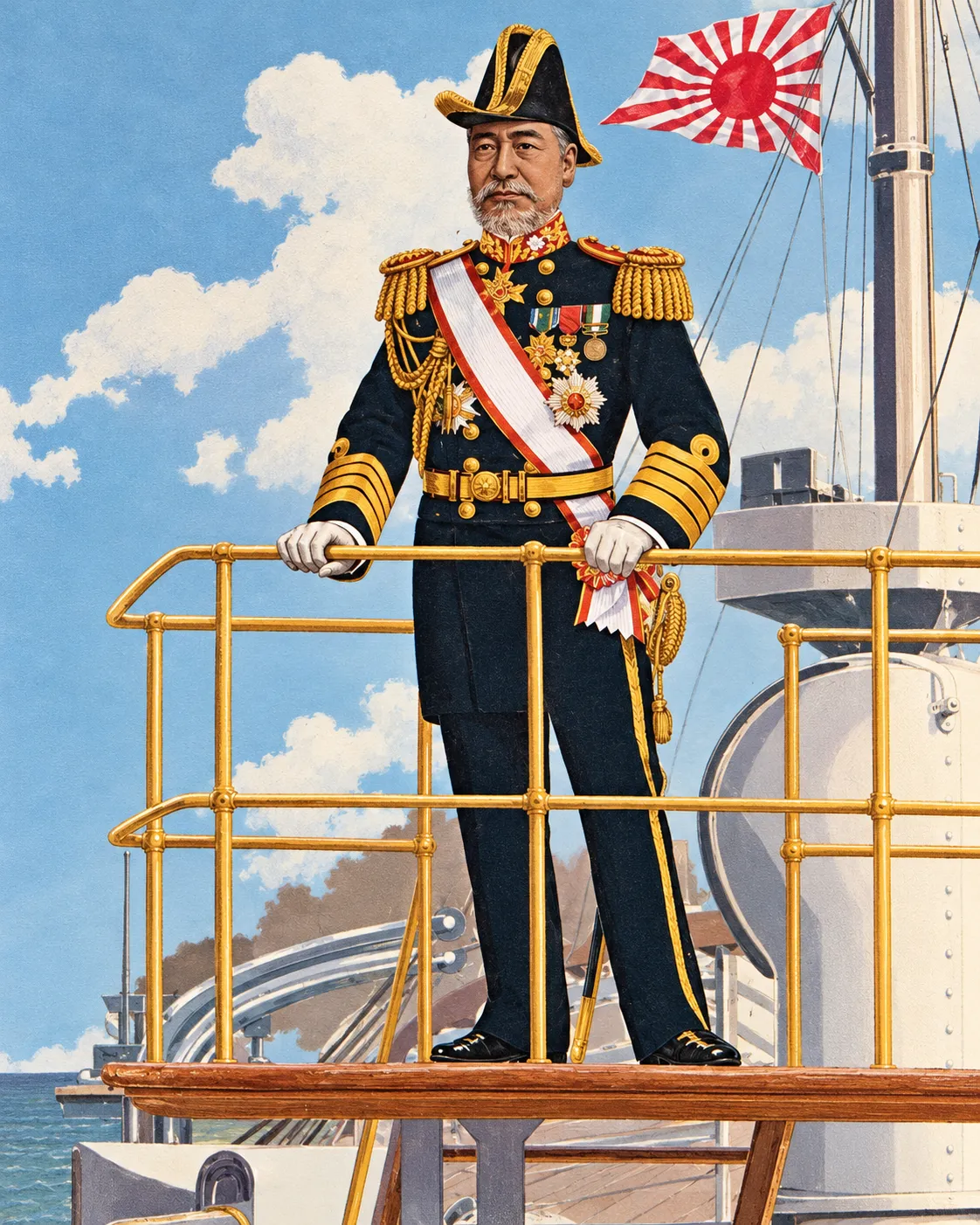

Admiral Togo Heihachiro on the captain's bridge.

The irony is that the admiral, whom the cartoonist portrayed as a comical creature, soon won a victory that determined the outcome of the war at sea.

Racist caricatures weren't the first manifestation of such prejudices in Russian society. But during the war, they became one of the ways to spread the image of a supposedly inferior enemy.

How useful is this attitude for a country preparing for war?

The results of the Battle of Tsushima allow us to answer this question without further discussion.

1916: Japan sells its own ships to Russia


The most unusual turn in the history of Russian trophies occurred eleven years after the end of the war.

In 1914, Russia and Japan became allies in the Entente. This opened the door not only to cooperation at sea but also to negotiate the transfer of warships.

By that time, Russia was experiencing a serious shortage of forces to protect its northern sea lanes. Vital allied cargo passed through Arkhangelsk and other northern ports, and warships were needed to protect them.

The Russian Naval Ministry has approached Japan with a request to purchase ships.

The Japanese agreed to sell three former Russian vessels:
  • battleship "Sagami" - former "Peresvet";
  • battleship "Tango" - former "Poltava";
  • Training cruiser "Soya" - former "Varyag".

The talk was specifically about the sale, not the gratuitous return of the trophies. Russia had to pay millions of yen for the ships.

In the spring of 1916, all three ships arrived in Vladivostok and were handed over to Russian crews.

Peresvet and Varyag were given back their previous names.

The Poltava, however, received a new name—Chesma. The reason was simple: by that time, the Baltic Fleet already had a new battleship, the Poltava.

An interesting detail: the former enemy not only retained some of the Russian ships, but also handed them over to Russia years later when the Russian fleet needed them again.

However, it is difficult to call this return a triumph.

The ships were old, their mechanisms were worn out, and their continued operation would require significant expenses. Russian specialists had already noted the need for major repairs during the initial acceptance.

For Peresvet, returning under the St. Andrew's flag turned out to be the last stage of service.

On December 22, 1916 (January 4, 1917, new style), while leaving Port Said, Egypt, the ship struck mines laid by the German submarine U-73 and sank.

The Varyag safely reached the Russian North in November 1916, but was soon sent to Great Britain for repairs. From there, the cruiser never returned to serve in the Russian Navy.

The Chesma arrived in the North in January 1917. Subsequently, the ship was used primarily for training and support purposes, fell into the hands of opposing forces during the Civil War, and was decommissioned in 1924 and scrapped.

Thus ended the story of three ships that were first lost by the Russian Empire, then restored and used by Japan, and then bought back by Russia.

Cost of defeat


When talking about the Russo-Japanese War, people usually recall Port Arthur, Mukden and Tsushima, the death of ships and sailors, and the trials of commanders.

But there was a less obvious side to the defeat.

Ships built and armed by the Russian state for its own navy ended up in enemy hands. After being restored, they continued to serve, and some even fought in the new war.

In 1907, Konstantin Balmont published the poem “Our Tsar,” which began with the words:

Our king is Mukden, our king is Tsushima...

The poet placed responsibility for the national catastrophe on Nicholas II.

Of course, the causes of the defeat were not limited to the actions of one individual. They included flawed military planning, deficiencies in training, the condition of the ships, the quality of naval command, and the decisions of individual commanders.

However, Nicholas II, as head of state and supreme leader of the armed forces, could not be completely separated from responsibility for the results of the military policy carried out under him.

And here it is useful to remember Peter I again.

The Russian Tsar, under whom the naval victory of 1703 became the basis for awarding the highest state order, attached great importance not only to personal bravery, but also to the creation of a fleet capable of victory.

Two centuries later, Russian sailors demonstrated many examples of courage. But the personal bravery of the crews could not compensate for the mistakes of command and the shortcomings of war preparation.

And the subsequent fate of the captured ships added another, very unpleasant detail to this defeat.

In 1905, the Japanese raised Russian battleships from the bottom of Port Arthur and introduced them into their own fleet.

In 1916, the Russian government paid Japan to return some of these same ships to the St. Andrew's flag.

This story, perhaps better than many loud political statements, shows how much the defeat at sea cost Russia.

Sources and Literature
  • Gribovsky V. Yu. Russian Pacific Fleet, 1898–1905. History of its creation and destruction. Moscow, 2004.
  • Suliga S. V., Balakin S. A. Squadron battleships of the Poltava type. Moscow, 2005.
  • Melnikov R. M. Cruiser "Varyag". 2nd ed. L.: Sudostroenie, 1983.
  • Kozlov I. A., Shlomin V. S. Red Banner Northern Fleet. Moscow: Voenizdat, 1983.
  • Likharev D. V., Tamura A. Russian memoirists and historians on the role of the human factor in the Battle of Tsushima on May 14–15, 1905 // History and Modernity. 2008. No. 2.
  • Vorobyova E. A. Transformation of the Image of the Enemy in the Russo-Japanese War of 1904–1905 // War in the Human Dimension: Ideology, Psychology, Everyday Life, Historical Memory. St. Petersburg, 2021.
  • Institute of Defense Studies of Japan. NIDS Commentary. No. 452. August 25, 2026.


See our article: On one of the reasons for the defeat in the Battle of Tsushima
58 comments
Information
Dear reader, to leave comments on the publication, you must sign in.
  1. +8
    4 November 2026 04: 00
    The admiral's supporters pointed out that continued resistance left virtually no chance of victory and could have resulted in the deaths of thousands of sailors.

    The supporters are being disingenuous, stretching the numbers by the ears, and engaging in demagoguery.

    94 people died on the Admiral Ushakov.
    About 200 people died on the Rurik.
    39 people died on the Varyag.
    167 people died on the Svetlana or from wounds in captivity.
    Four people died on the Novik, including those who were wounded.

    Thousands could have died only if the Japanese had refused to rescue anyone. But what reason did Nebogatov have to fear this?
    1. + 10
      4 November 2026 07: 44
      Quote: Comrade
      The supporters are being disingenuous, stretching the numbers by the ears, and engaging in demagoguery.

      It's impossible to disagree, dear colleague. The author writes
      After all, the coastal defense battleship Admiral Ushakov, lagging behind the main force, refused to surrender to the Japanese and was lost in battle. Of course, its position and technical condition differed from those of Nebogatov's ships. But this does not eliminate the very question of the boundaries of command responsibility.

      Moreover, it is obvious that if the technical condition of the Ushakov differed from the other ships of the 3rd TOE, it was only for the worse.
      1. +4
        5 November 2026 01: 16
        My respect, dear Andrew!
        Quote: Andrey from Chelyabinsk
        Moreover, it is obvious that if the technical condition of the Ushakov differed from the other ships of the 3rd TOE, it was only for the worse.

        Definitely, otherwise he wouldn’t have left behind.
    2. -6
      4 November 2026 12: 41
      Maybe Nebogatov managed to become rich, who knows)
  2. +5
    4 November 2026 06: 54
    An interesting question: why did the Japanese raise, repair, modernize, and incorporate into the fleet such outdated captured ships as the Nikolai I and the Poltava?
    In my opinion, the most logical explanation is to avoid unemployment and social unrest after demobilization. The Japanese simply found something else to do with their people...
    What other explanations are possible?
    1. +6
      4 November 2026 07: 35
      Well, compared to Fuso, Chin-Yen and other oldies, these are much more serious ships, and our sleepy goddess Pallas, renamed Tsugaru, suddenly stopped being sleepy...
    2. + 11
      4 November 2026 07: 42
      Quote: rytik32
      What other explanations are possible?

      It seems to me that many factors came together here:
      1) Psychology. It would be a sin to neglect the trophies of a great victory (and for the Japanese at that time, the victory was undoubtedly great).
      2) Successful experience of using obsolete ships in naval warfare (Itsukushima, Chin Yen and all that stuff)
      3) Domestic politics - the relationship between the army and navy in Japan has always been strange, but now the navy has an opportunity to draw money flows to itself and thereby increase its importance
      4) The fleet planned to expand and needed a large number of training ships
      5) You mentioned it yourself - to avoid unemployment and social tension after demobilization + development of our own production
      But that's just my opinion
      1. +6
        4 November 2026 19: 29
        The interior of Mikasa has a very good exhibition showing both the Battle of Tsushima and the respectful attitude of the Japanese towards the enemy.
        There is also a white flag raised on the "Bedovoye"... It breaks your heart when you walk there and see both the feat of our sailors and the weakness of our admirals...
        But the enemy doesn’t mock this.
        I am attaching a photo of our white flag...
    3. +2
      4 November 2026 08: 06
      REV extremely expensive The Japanese suffered a terrible price. The economy was on the brink of collapse, leading to mass unrest and political instability. If the war had dragged on for another six months or a year, Japan might have lost (though such a "victory" would have been Pyrrhic for Russia as well). So even such junk had real value for the Japanese (as was experimentally proven during WWI).
      1. +5
        4 November 2026 09: 45
        Again and again "if only"...And we gave them so much, so much, if only they had caught up with us...
        1. + 11
          4 November 2026 10: 13
          Quote: Grencer81
          Again and again "if only"...

          Well, the fact that we could have won this war on land is, in general, self-evident, given the state of the armies of the parties at the beginning of 1905.
    4. +5
      4 November 2026 17: 00
      Quote: rytik32
      An interesting question: why did the Japanese raise, repair, modernize, and incorporate into the fleet such outdated captured ships as the Nikolai I and the Poltava?
      An even more interesting question is why Russia bought them back? It became clear already in the Russian Navy that the ships weren't exactly top-notch. Then they were sunk, raised, and put into service. Ten years passed. Let me just remind you that within those ten years, the Dreadnought had become so obsolete that they didn't wait for her to be dismantled at Jutland. What was the point of buying back this scrap metal?
      1. +5
        4 November 2026 17: 33
        Quote: bk0010
        An even more interesting question is why did Russia buy them back?

        For the Northern Fleet, supplies from the Allies were no less important than during the Lend-Lease era, so they needed to have at least something to repel German cruisers.
      2. +1
        4 November 2026 20: 15
        What warships could the Russian Imperial Fleet transfer to the North?
        Corals from the Baltic and Black Seas?
        Ships from the Pacific Ocean?
        Buy from the British and French?
        1. +1
          4 November 2026 20: 41
          Quote: hohol95
          Buy from the British and French?
          Near South America.
          1. +2
            4 November 2026 20: 52
            Do you know which countries could offer new warships?
            Suitable for the waters of the Arctic Ocean.
            1. +2
              4 November 2026 20: 54
              Quote: hohol95
              Do you know which countries could offer new warships?
              As usual, Argentina, Brazil, and Chile. Google "South American dreadnought race." True, England managed to grab a lot of them, but some were built in the States; they could have been bought.
              1. +1
                4 November 2026 20: 56
                The question immediately arises of the construction time and the availability of money to pay for these ships.
                And we must remember that it takes time to select and approve a project!
                1. -1
                  5 November 2026 10: 27
                  Are the forty-eight tons of gold that Nikolai dumped at the Federal Reserve System enough to pay?
                  1. 0
                    5 November 2026 11: 19
                    By the time he purchased the ships from the Japanese, Nikolasha was already deeply in debt.
                    Nobody would build new ships for Russia.
                    There was no time for that anymore.
              2. +4
                5 November 2026 10: 55
                Quote: bk0010
                they could be bought.

                provided that they want to sell them.
    5. +2
      5 November 2026 01: 26
      Quote: rytik32
      What other explanations are possible?

      In addition to what the respected Andrey said, we can add prestige, of course.
      Then, loading the factories with orders, and also to raise the level of ship repair workers.
    6. +1
      5 November 2026 06: 15
      Dear Alexey! In my humble opinion, the reason is simple: Japan isn't a very rich country, it's deeply in debt, and every egg is precious here. The ship could be used for training or coastal defense, but it doesn't require any significant advantages there.
      "Poltava," by the way, isn't particularly outdated compared to "Nikolai." "Fuji," in the then-active Imperial Navy, was only two years younger, and that was a front-line ship. And the comments rightly pointed out the likes of "Fuso" and "Chin-Yen."
    7. +1
      6 November 2026 09: 00
      Quote: rytik32
      What other explanations are possible?

      Well, they didn't raise the Nebogatov ships... and they didn't suffer much damage...
      Well, the Port Arthur ones were fairly new (not counting the Poltava), and the sunken ships in the fairway were in the way of the base...
  3. +8
    4 November 2026 09: 35
    The author seems to have "forgotten" that Nicholas I, Apraksin and Senyavin, while in the service of the Japanese, took part in the capture of Sakhalin.
  4. BAI
    -1
    4 November 2026 10: 01
    However, the principle itself is important here: the commander had to not only make the decision, but also be responsible for its validity.

    The fate of the brig "Mercury" was decided by the ship's officer council, where the most junior in rank spoke first.
    The council unanimously decided to fight against the enemy's vastly superior forces.
    1. + 12
      4 November 2026 10: 13
      Quote: BAI
      The fate of the brig "Mercury" was decided by the ship's officer council, where the most junior in rank spoke first.

      Nope:))))) The commander has the right to convene a council of officers, has the right to listen to it, but the responsibility for the decision lies with him.
  5. Alf
    +2
    4 November 2026 17: 39
    A question for a maritime expert. When talking about the Varyag, everyone complains about the inability to achieve full speed and the constant engine breakdowns. But I once came across information that the cruiser, having been raised (!), sailed under its own power to Sasebo, then continued sailing without changing engines and accelerating to 22 knots. Is this true?
    1. +2
      4 November 2026 20: 17
      The cruiser SAM reached Sasebo under its own power.

      Yes, that's right. The boilers were cleaned, checked, and put in order. (Polutov has more details on page 371.)
      then he went without changing engines and accelerated to 22 knots.

      In Yokosuka, the ship was docked, where its worn-out equipment and mechanisms underwent major repairs. Afterward, it reached 22,71 knots during trials. (See page 373.)
      There's apparently no information about his top speeds while in the Japanese training squadron. Although, it's unlikely he set any records there.
      1. Alf
        0
        4 November 2026 20: 20
        Quote: Vagabung
        The cruiser SAM reached Sasebo under its own power.

        Yes, that's right. The boilers were cleaned, checked, and put in order. (Polutov has more details on page 371.)
        then he went without changing engines and accelerated to 22 knots.

        In Yokosuka, the ship was docked, where its worn-out equipment and mechanisms underwent major repairs. Afterward, it reached 22,71 knots during trials. (See page 373.)
        There's apparently no information about his top speeds while in the Japanese training squadron. Although, it's unlikely he set any records there.

        What I'm getting at is that it turns out that the Varyag's problems were mostly man-made. On the other hand, at Retvizan, which also had Nikloss boilers, no one complained about them. So, it wasn't the reel that was the problem...
        P.S. Thank you for your reply!
        1. +1
          4 November 2026 20: 34
          This is a rather controversial point. The fact is, the Japanese had few light, fast cruisers. The remaining couple of sterndrives were a stretch. Well, perhaps Otawa could have shown something in that area. And so, in this situation, they relegated Varyag to training status. If she could consistently pull more than 20 knots, their action would be illogical.
          1. Alf
            0
            4 November 2026 20: 35
            Quote: Vagabung
            The fact is that the Japanese had few light, fast cruisers.

            I would say that they didn’t build any six-thousanders at all.
            1. 0
              4 November 2026 20: 41
              They simply didn't need them; at that point, expansion into Korea and China was enough for them.
            2. +2
              4 November 2026 20: 55
              That's true, but in that situation, transferring (a high-speed cruiser?) to a training unit seems illogical. Until we see post-war documentation on the operation and repairs of the Varyag-Soya, it's impossible to answer definitively the question of why the cruiser's engines were destroyed.
              1. Alf
                +1
                4 November 2026 20: 57
                Quote: Vagabung
                That's true, but in that situation, transferring (a high-speed cruiser?) to a training unit seems illogical. Until we see post-war documentation on the operation and repairs of the Varyag-Soya, it's impossible to answer definitively the question of why the cruiser's engines were destroyed.

                May be..
                P.S. The minus is not mine.
        2. +4
          5 November 2026 05: 36
          Quote: Alf
          What I mean is that it turns out that the Varangian’s problems were mostly man-made.

          No. I wrote about this in detail at the time. The Varyag had technical problems. This is indirectly confirmed by the fact that the Japanese, having received such a fast and powerful cruiser, immediately relegated it to training ships.
          Quote: Alf
          On the other hand, at Retvizan, where Nikloss boilers were also installed, no one complained about them.

          The only attempt at full speed testing at the RIF ended in an accident with the deaths of the scalded stokers. Our crews never attempted full speed testing again.
          1. Alf
            0
            5 November 2026 19: 38
            Quote: Andrey from Chelyabinsk
            The only attempt at full speed testing at the RIF ended in an accident with the deaths of the scalded stokers. Our crews never attempted full speed testing again.

            I didn't know this, thanks for the info.
          2. +1
            6 November 2026 09: 14
            Quote: Andrey from Chelyabinsk
            No. I wrote about this in detail at the time. The Varyag had technical problems. This is indirectly confirmed by the fact that the Japanese, having received such a fast and powerful cruiser, immediately relegated it to training ships.

            In my humble opinion, Mr. I.M. Koksinsky, in his book "Armored Deck Cruiser 1st Rank Varyag," has raised and resolved all the questions about this cruiser... I recommend reading it.
            1. +1
              6 November 2026 09: 16
              Quote: Ragnar
              In my humble opinion, Mr. I.M. Koksinsky, in his book "Armored Deck Cruiser 1st Rank Varyag," has raised and resolved all the questions about this cruiser... I recommend reading it.

              Unfortunately, I haven't seen it online...
    2. -1
      4 November 2026 20: 23
      I'm no expert on marine matters, but I have one theory: how do they connect any new device in Rus'? First, they plug it in, then if something goes wrong, they start studying the manual. It's the opposite abroad. Any equipment requires strict maintenance according to the regulations, not haphazardly. Careful study of the instructions is essential. And now remember the educational level in the Russian Empire? Of course, the officers are literate, and some sailors are too, but the ability to read syllable by syllable and write your name in block letters doesn't equate to the level of education that provides an understanding of how to operate complex equipment.
      1. Alf
        0
        4 November 2026 20: 26
        Quote: faiver
        Now remember the educational level in the Russian Empire?

        And this was in the "blessed" year of 1913. And before that?
        1. 0
          4 November 2026 20: 35
          I don't really believe these percentages; officials have always loved to inflate figures in their reports...
          It remains to be seen what criteria were used to classify someone as literate. As I mentioned above, the ability to read syllables and write in block letters isn't the level needed to operate complex technology, but it does qualify someone as literate.
          1. Alf
            0
            4 November 2026 20: 41
            Quote: faiver
            I don't really believe these percentages; officials have always loved to inflate figures in their reports...
            It remains to be seen what criteria were used to classify someone as literate. As I mentioned above, the ability to read syllables and write in block letters isn't the level needed to operate complex technology, but it does qualify someone as literate.

            True. But if the 54% figure is inflated, it's scary to think how many there really are.
          2. +4
            4 November 2026 21: 25
            If you are interested in the fleet, then please:
            On conscripts to the Russian Imperial Forces in 1914 :
            77,1% literate, 12,6% semi-literate, 10,3% illiterate,
            on 1916 year — 82,6% literate, 11,5% semi-literate, 5,9% illiterate.
            Data from Garkavenko D.A. Social composition of sailors of the Russian fleet in the era of imperialism // History of the USSR. 1968. No. 5. P. 55.
            In the Russian Empire before WWI, the level of mass literacy had a rather characteristic pattern: the younger the conscript, the greater the chance of being literate. This means that there were more literate conscripts from, for example, peasant backgrounds than literate conscripts from their grandfathers' and even fathers' generations.
            The ability to read by syllables and somehow sign one's own name is a category of illiteracy.
        2. +1
          5 November 2026 08: 30
          Quote: Alf
          And this was in the "blessed" year of 1913. And before that?

          Not in terms of defense, but in terms of objectivity—when I see these percentages, one question always remains: was the population of European colonies also included in the literacy column? It's just that Russia also had vast territories in Central Asia and the Caucasus... Literacy there was a real disaster.
          1. Alf
            0
            5 November 2026 19: 40
            Quote: Trapper7
            There was a real problem with literacy there.

            There was no "trouble" there, there was "nothing"...
    3. +3
      5 November 2026 10: 59
      Quote: Alf
      But somehow I came across information that the raised (!) cruiser SAM reached Sasebo under its own power.

      What's so surprising about that? They didn't blow up his boilers.
      Quote: Alf
      then I walked without changing cars

      See above.
      Quote: Alf
      accelerated to 22 knots

      So he accelerated us to this speed too. Within a month after the six-month repair. And then all 16-17 and only on holidays.
      When the Japanese told us the same thing.
      and in Retvizan, where Nikloss boilers were also located, no one complained about them.

      but this is not true.
  6. -3
    4 November 2026 21: 33
    It's a shame about the Varyag. It should have been a museum, but after arriving in Britain in 1917, it was scrapped in 1920. A very sad end to a legendary cruiser...
    1. 0
      5 November 2026 03: 53
      He would have gone to the dogs in Russia too.
      1. -1
        6 November 2026 19: 01
        Why would that be? If after the Civil War they were collecting everything they could, and the EPRON program was still in effect, salvaging submarines and destroyers, then why would they throw an armored cruiser of the first rank on pins and needles? It would have served the country until WWII, at the very least. And then, if it had survived the war, they would have considered whether to decommission it as a museum or scrap metal...
        1. 0
          6 November 2026 19: 48
          Yeah, the newer armored ships Bayan-2, Admiral Makarov, and Rurik-2 were scrapped in the 20s, but the technically weak and inferior Varyag would have been left behind... bully
    2. -1
      5 November 2026 17: 05
      It should have become a museum, but after arriving in Britain in 1917, it went on needles in 1920.


      Firstly, after the Japanese repairs it was no longer the same Varyag.

      Secondly, the British sold it to the Germans; they didn't make needles out of it themselves. If the Varyag hadn't run aground en route to Germany, its steel could have become part of the armor alloys used in the tanks that invaded in 41.
      1. +1
        6 November 2026 03: 47
        Quote: Pavel Gusterin
        Firstly, after the Japanese repairs it was no longer the same Varyag.

        And the Aurora is far, far from being the same Aurora. And there's almost nothing "original" left of the Mikasa.
      2. 0
        6 November 2026 19: 12
        Of course, the Japanese modernized it, replacing the 75mm and 152mm guns, repairing the boilers, removing the topmasts, and much more. But the number of guns remained unchanged. The cruiser remained a raider. And she never was anything more. The Varyag had no luck with her repairs in Britain; had it remained in Russia, it's quite likely she would have served into her old age. Or perhaps even become a museum.
  7. -2
    6 November 2026 07: 36
    Quote: Comrade
    And the Aurora is far, far from being the same Aurora. And there's almost nothing "original" left of the Mikasa.


    The Japanese did not repair the Aurora.

    "Mikasa" was originally their ship, now a museum. What does that have to do with it?
    1. 0
      6 November 2026 09: 20
      Quote: Pavel Gusterin
      The Japanese did not repair the Aurora.

      "Mikasa" was originally their ship, now a museum. What does that have to do with it?

      There is very little native iron in them...
    2. -1
      7 November 2026 13: 54
      Quote: Pavel Gusterin
      The Japanese did not repair the Aurora.

      Valentin didn't say the Aurora was repaired by the Japanese. He merely noted that even without the Japanese, the ship didn't have many original components left. Specifically, the underwater section had been completely replaced.
  8. -2
    7 November 2026 20: 01
    Quote: Senior Sailor
    Valentin didn't say the Aurora was repaired by the Japanese. He merely noted that even without the Japanese, the ship didn't have many original components left. Specifically, the underwater section had been completely replaced.


    What does the "underwater part" have to do with museum exhibits?