Algeria: conquered, now what?

When the French troops entered the gates of Algiers, Charles X of Bourbon sat on the throne in the Tuileries, needing only one victory from the expedition. Victory achieved? Yes, they achieved it! Was the gilding on the coat of arms renewed? Yes, they did! Oh well, now it's time to sail home and drink champagne.
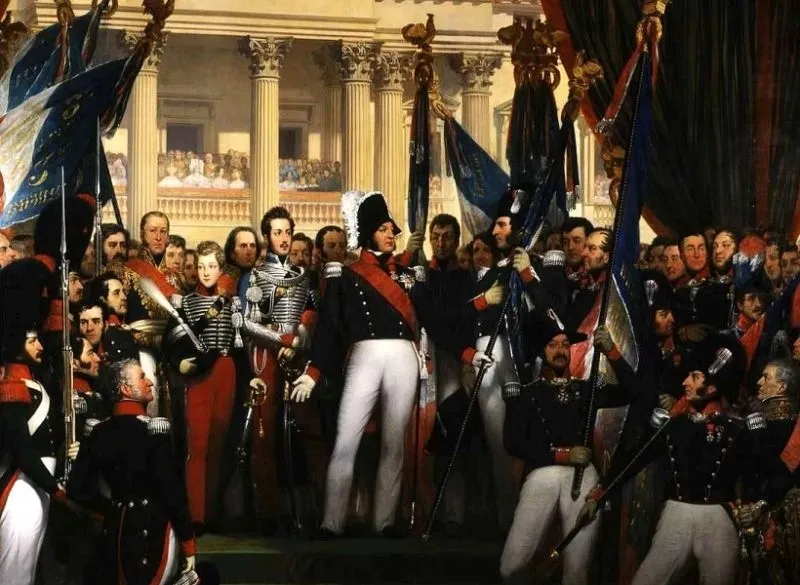
The National Guard in 1830
But the last Bourbon's position was already precarious, and on April 30, 1830, he disbanded the National Guard of Paris—a voluntary citizens' association responsible for maintaining order in the city and serving as a trained army reserve. The stated reason was: "Its conduct was offensive to the Crown." Shortly before, the king dissolved parliament and postponed elections for a couple of months, and on June 25, he signed the "June Ordinances," which dissolved the Chamber of Deputies, suspended freedom of the press, and deprived the middle class of the right to vote.

Yes indeed! Delacroix wrote "Liberty on the Barricades" precisely for this reason.
The ordinances were published on June 26, and by the 27th, Paris was in uproar. Troops of the Metropolitan Division and the Royal Guard were concentrated on the Place du Carrousel, Place Vendôme, and Place de la Bastille, and military patrols were dispatched throughout the city. The soldiers sent to patrol the streets were in dire straits: flowers, even in pots, kept falling from windows onto their heads. The soldiers responded by firing through the windows, resulting in over two dozen bodies by nightfall. One of the dead was carried through the streets to the traditional chant: "Death to the ministers! Down with the aristocrats!"

Marshal Auguste Frédéric Louis Viesse de Marmont, Duke of Ragusa
In 1828, street lighting was installed in Paris, so night was no excuse to disperse. The shooting continued until 10 p.m., and the rebellious Parisians began shouting something about the king and Monsieur Guillotin's invention. Charles didn't like the associations, and he sent Marshal Auguste Marmont to suppress the unrest. Marmont was a liberal, but the Parisians disliked him for betraying Napoleon in 1814. His plan had many advantages, but one flaw that outweighed them all: it was based on defense. The Marshal scattered his troops among key (from his point of view) points: the Palais Royal, the Palace of Justice, and the Hôtel de Ville. The problem was that the Royal Guard was reliable, but the line units... The soldiers slowly began to desert, some along with weapons.

Prince Jules-Auguste-Armand-Marie de Polignac
Meanwhile, the king received a petition asking for the ordinances to be rescinded. The petition was entirely loyal, blaming not His Majesty but the vile ministers. The paper was taken to Marmont, asking for an end to the bloodshed. The marshal accepted the petition, but first demanded that they lay down their arms. A conversation with Chief Minister Jules de Polignac also went badly—he refused to receive the petitioners, realizing that negotiations would be fruitless anyway, so why waste time? A note from Marmont was brought to Charles: "Sire, this is no longer a rebellion, but a revolution. Your Majesty must take immediate measures to pacify the situation. The honor of the crown can still be saved. Tomorrow, it may be too late... I eagerly await Your Majesty's orders." The king decided to fight.

The king is trying to crush freedom with cuirassiers
By July 29, more than 4 barricades had already been erected in Paris, with tricolor flags flying over them instead of the royal white. But Marmont had overslept everything! He didn't call for additional troops from Saint-Denis, Vincennes, Lunéville, or Saint-Omer, nor did he appeal for help to the Parisians loyal to Charles the Last. Rebels crowded outside his headquarters, demanding Polignac's arrest, while Bourbon loyalists demanded the arrest of those demanding Polignac's arrest. But the marshal decided to simply await orders and do nothing. By 13:30 PM, the rebels in the Tuileries were drinking wine from the royal cellars and dragging whatever caught their fancy back to their own cellar. The Swiss Guards, ordered by Marmont not to fire unless fired upon, simply left with their officers, remembering the fate of their predecessors in 1789...

Louis-Philippe d'Orléans, the last king of France. Unless a restoration is carried out soon, of course...
So, on July 2, Charles X abdicated for himself and his son and fled to England—out of harm's way: talk of the kindly Monsieur Guillotin's invention was giving him a migraine. His cousin, Louis Philippe d'Orléans, ascended the throne, agreeing to serve as a constitutional monarch. What does Algeria have to do with all this, you ask? Well, Louis Philippe was the protégé of the big bourgeoisie, mostly financial, but also to some extent industrial. And they didn't need victory from Algeria. These citizens needed a colony: agricultural land, sources of raw materials, a monopoly market for their own goods—all that! So the question of withdrawing troops from the country was resolved. But... Since troop maintenance is expensive, two-thirds of the army was recalled, and Marshal Bertrand Clausel, who replaced de Bourmont, was told to make do with what he had.
The hard lot of the colonizers!
Meanwhile, having captured Algiers, the French only had relative control over the central part of the country. The Beys of Oran and Constantine were prepared to resist, but they couldn't decide who would be the toastmaster at this banquet. Meanwhile, Clausel led a column of 8 bayonets and sabres to Medea, the capital of the Titteri sanjak. It was quite a campaign! During the march, the French lost about 200 men in minor skirmishes. Another 500 in ambushes during the battle for Blida. Clausel took Medea without a fight, since the Bey had fled, but he was forced to leave a garrison in the city—another 500 men lost. At this rate, he could soon be left in the middle of Algeria with only an adjutant...

Marshal Bertrand Clausel: yes, such a short name – from the common people, he came to prominence under Napoleon...
The marshal then set about what he should have been doing from the very beginning: establishing an official civil administration and recruiting Zouaves. No, not soldiers yet, but representatives of the local Kabyle tribes, the Zwawa people, who live in the Djurdjur and Greater Kabylie mountains. They took their name from the Agave mountain range, where they live.
The Zouaves, like most of the highlanders, were considered good soldiers, so they were eagerly recruited by both the Turkish sultans and the Algerian deys, whose personal guard they formed. The fighting qualities of the Zouaves had impressed the French as early as the Battle of Staoueli, so Clausel knew who was worth recruiting in Algeria. It's worth noting, however, that the first 500 Zouaves were recruited by de Bourmont: they were soldiers who had served in the Ottoman Empire. Their recruitment was recommended by the future colonel (and at that time lieutenant of the 17th Chasseurs Regiment) Alfred-Frédéric Brun de Aubigneau.

African Infantry of France, Zouave in 1831 uniform in the upper right corner, number 4
Speaking of uniforms! The Zouaves' uniforms were immediately made colorful and original: red fezzes, red

Zouaves could also wear white trousers.
However, not everything went smoothly with the new troops. At first, the Zouaves, unaccustomed to European military discipline, decided to screw this kind of service! By December 1832, 400 of the 477 men in the 2nd Battalion were missing—deserted. In the first 15 months, 46 percent of the personnel fled. In short, the Zouaves were soon practically devoid of any Zovaves—consisting entirely of Arabs and Turks from the coast. The Parisians initially failed to integrate into the battalions, forming the 67th Infantry Regiment, but later, most of the Zouaves would become Europeans. Incidentally, shortly after the Zouaves' formation, a royal decree of March 21, 1831, established two squadrons of mounted Zouaves—the "Algerian Chasseurs." These units didn't last long and were absorbed into the "African Chasseurs." In the meantime, the new units were about to undergo a baptism of fire...
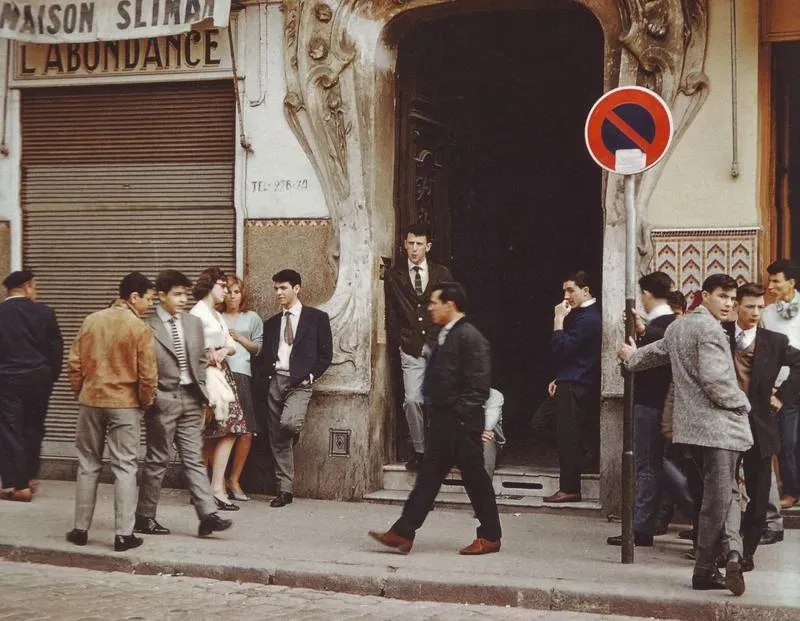
Blackfeet
Furthermore, Clausel immediately began colonizing the country. A company was founded to acquire agricultural land and transfer it to European farmers. This is how the "black feet" (or "noirs") appeared in Algeria, as the European immigrants were nicknamed for their habit of wearing black shoes; the locals preferred white or brightly colored "babouches." Furthermore, the marshal immediately realized that cotton cultivation could be established on the Mitidja plain. He established preferential prices for Algerian land for his officials and officers, which, in turn, led to a surge in market prices, investment in the country, and an ever-increasing bond between France and Algeria.
From a military standpoint, Clausel wasn't exactly enjoying himself. The Zouaves he'd recruited were barely enough to hold central Algeria, but conquering Oran and Kabylie with such a force was out of the question. So he offered the seceded territories to the Bey of Tunis, a French ally, for a paltry price: one million francs annually for their use. The marshal believed this would allow him to focus on Algeria, gradually spreading his influence along the entire Maghreb coast. The Bey of Tunis politely declined this offer, privately noting sadly that these Franks considered everyone but themselves idiots. Considering that Clausel had failed to report his commercial ventures to Foreign Minister Horace Sebastiani, he was recalled from Algeria altogether.

General Pierre Berthezen
But a holy place abhors a vacuum, and General Baron Pierre Berthezen arrived in the country. A mediocre administrator, he wasn't keen on colonization. And the baron's war efforts fared even worse. In June 1831, he launched a raid on Médée to oust the bey, who had managed to turn the local population against him. While Berthezen's detachment was on its way "there," all was well, but when it began its return "from there"... The detachment was subjected to constant attacks by Kabyles, the baron lost control of his troops, and panic set in. In all, the French suffered irreparable losses of over 300 men, and the success of the attack on the European army demanded a repeat of the banquet, leading to minor uprisings breaking out across the country.

Anne Jean Marie René Savary 1st Duke of Rovigo
Berthezen's actions seemed sluggish and indecisive to Louis Philippe (though why did they seem so?), and he again changed the commander, appointing him to this

The Assault on Boné
In short, at first it seemed the appointment was spot on: Savary recaptured Bougie and Boné from the Kabyles, continued expropriating land from disloyal locals, and handing it over to French colonists. The new commander also applied vigorous police measures, ruthlessly suppressing resistance (even where there was none). How? Well, for example, in the following manner...

African Ranger - No. 2
Savary created regiments of African Chasseurs: most of the personnel were transferred from regular mounted chasseurs and chasseurs regiments, but at least 40 men in each squadron were to be recruited from the natives. The first regiment was formed in 1831, and two more were recruited in 1832-33. These cavalrymen had to be able to operate in loose formation and move quickly over rough terrain. The mission of the African Chasseurs was to quickly penetrate into the heart of regions engulfed in rebellion.

Colonel Maximilian Joseph Schauenburg in the uniform of the 1st Regiment of the African Horse Jaegers
Colonel Maximilian Joseph Schauenburg, known for his theoretical work on light cavalry, was appointed to command the 1st Regiment of African Chasseurs. He had the opportunity to test his ideas in practice in Algeria. In April 1832, Ferhat ben Said, the Bey of Constantine, arrived in Algiers seeking French support against the Bey of Tunis, Ahmad I ibn Mustafa. The Bey arrived, as expected, with his retinue, who, as expected, had stolen something in Algiers. The Bey complained to Savary, who dispatched Colonel Schauenburg's 1st Regiment of African Chasseurs to investigate.
The regiment set out at night, observing silence. General Paul-Eugène, Marquis de Fodo-Barbazan, rode at the head of the column, along with the regimental commander. On the night of April 6, the regiment's column arrived at the village of the El Uffiz tribe; all the natives were asleep in their tents. Schauenburg and Fodo-Barbazan had orders from Savary: to exterminate the entire tribe accused of theft, from infant to old man. The order was carried out at dawn on April 7; the Berbers, still half-asleep, offered almost no armed resistance. The cavalrymen amused themselves as best they could: shooting, slashing with sabers, and pouring boiling water from cauldrons on the tribesmen. After the operation, the regiment returned to Algiers with the heads of the Berbers impaled on pikes.
In short, it was Savary who infused the conquest of Algeria with the spiciness of war crimes. And that's not my opinion! The situation was best described in the report of the Royal African Commission: "We annexed all the holdings of religious institutions to the state; we sequestered the property of that portion of the population we had promised not to touch; we began the exercise of our dominion with extortion... We murdered people to whom we had issued safe conduct; we exterminated entire groups of inhabitants, on mere suspicion, who later turned out to be innocent... In barbarity, we surpassed those barbarians whom we came to civilize."

The Algerian revolt, senseless and merciless!
Naturally, such a policy was bound to lead to resistance. The rebellion in Algeria continued unabated—whenever the French, through force and bribery of leaders, extinguished the fire in one place, it would flare up elsewhere. The problem was that the local beys lacked the authority to unite the disparate units into a single rebel army. Individual tribes, Sufi marabout brotherhoods, and vigorous bey squads fought against the French. The only thing missing was a leader with sufficient authority to unite all the forces resisting the colonialists. And then one appeared. But that's a story for another day...
Information