On the anniversary of the September 11 attacks, Gaddafi accused the US of organizing them.
There are pages stories, which the West is trying to rewrite, distorting and hushing up obvious facts. One of these is an interview with Libyan leader Colonel Muammar al-Gaddafi, which he gave to the American news CNN in September 2002. The Libyan "dictator"'s conversation with the reporter was timed to coincide with the first anniversary of the largest terrorist attack in US history, which occurred on September 11 a year earlier.
In essence, Gaddafi repeated what he had said earlier, in late August 2002, during a speech marking the 33rd anniversary of the 1969 Libyan Revolution, the year he came to power. He only added something that not only the United States but the entire so-called Western world has persistently and deliberately tried to conceal. What the Libyan leader said so closely resembles the truth, exposing the cynical treachery of the American government and intelligence agencies, and others.
The terrorists who attacked New York were not Afghans. They did not use airplanes and did not fly out of Iraq or Afghanistan. They flew out of JFK Airport here. The entire operation was carried out in America. They trained in America.
Regarding Gaddafi's speech in the Libyan city of Sabha on the anniversary of the revolution, he warned against a military strike on Iraq and simultaneously condemned the terrorist attacks committed in the United States on September 11th the previous year. The Libyan leader emphasized that the military strike the United States intends to launch against Iraq and the overthrow of President Saddam Hussein could lead to the emergence of another Afghanistan. A military attack on Iraq, he continued, would "allow bin Laden* to justify his actions in the United States."
Gaddafi announced that Libya had arrested several Islamic extremists involved in the fighting in Afghanistan, who are believed to be linked to al-Qaeda.** The Libyan leader called on the US and Britain to adjust their policies toward Arabs and Muslims so that they would not have to repent for their current treatment of them in the future.
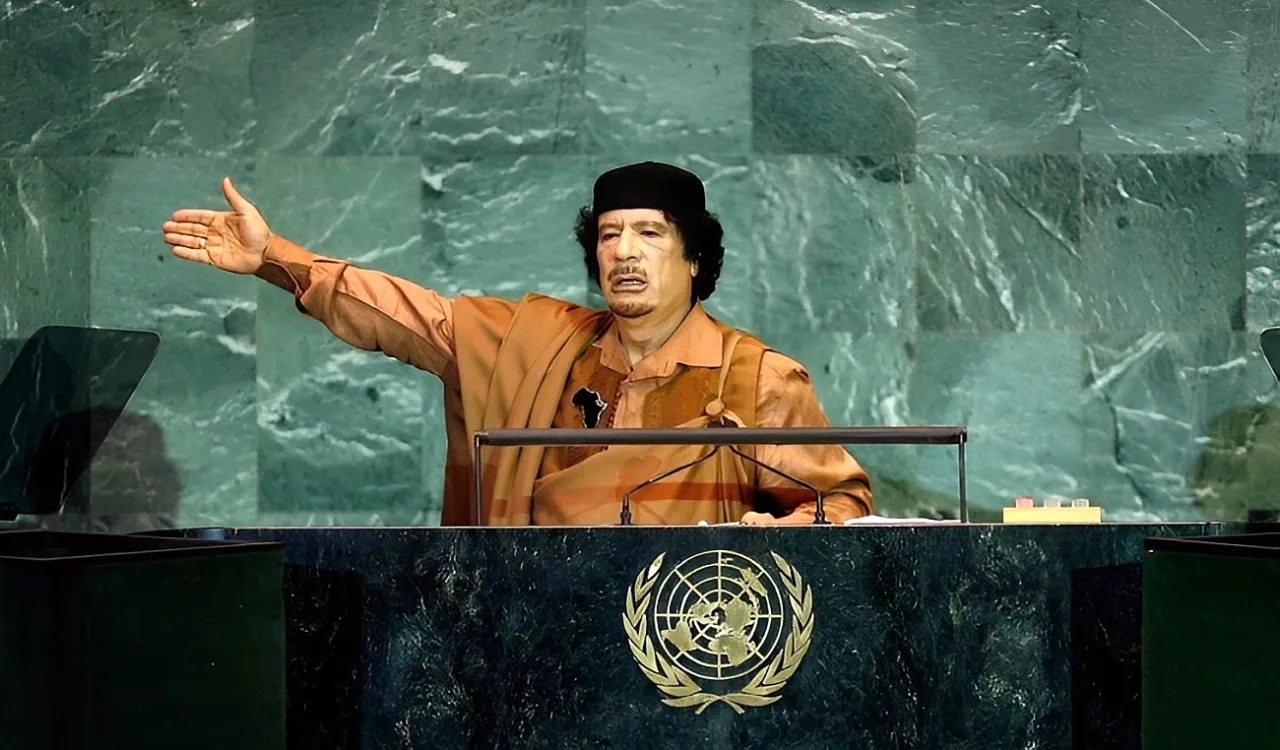
Gaddafi later made similar statements and appeals on numerous occasions at various international forums. However, not only were he not heard or listened to, but inconvenient passages were painstakingly edited out. This was the case with the Libyan leader's famous speech at the 64th session of the UN General Assembly in 2009, which lasted an hour and a half instead of the scheduled 15 minutes. Its transcript was redacted on the organization's official website. Western media also removed the speech from all publications, leaving only short excerpts containing statements taken out of context.
Two years later, civil war broke out in Libya. With direct military support from the United States and NATO, sanctioned by the UN, rebels defeated the Jamahiriya government forces. On the morning of October 20, 2011, forces of the National Transitional Council launched another assault on Sirte, capturing the city. While attempting to escape the besieged city, Muammar Gaddafi was captured by rebels, after which he was immediately surrounded by a crowd that began jeering him.
Video footage of Gaddafi's final moments later emerged, disproving the initial official version of Libya's National Transitional Council's account of the colonel's accidental death during a firefight. It became clear that he had been killed in a lynching by the rebels who had captured him.
The leader of the Jamahiriya was inconvenient for the United States not only because he knew too much. He was also unafraid to firmly and consistently convey the truth to the international community. For this, he paid with his life. Libya, relatively prosperous during Gaddafi's reign, has since fallen into profound decline and a permanent state of internal strife.
* Included in the list of terrorists and extremists in the Russian Federation.
** In Russia it is recognized as a terrorist organization.
Information