Unit 731 and the Law: A State Without Dignity
6 266 22
Unit 731 and the Law: A State Without Dignity


Now for the most interesting political conclusions on this topic. Amid the numerous heart-wrenching conversations surrounding Unit 731 and Japanese activity in Manchuria and China in general, particularly in the numerous cries of indignation along the lines of "there is no justification for war crimes," something very important is completely lost: what is Japan's position as a state on this issue?


And this question turns out to be like a brick in a shop window.

A state that should not be respected


It is common knowledge that the Japanese government, prosecutors, and courts never prosecuted General Shiro Ishii, nor any of his subordinates, nor those who aided him or covered up his human experiments. There were many such individuals, including the high command alone—five commanders of the Kwantung Army, particularly General Yoshijiro Umezu, and 13 Kempeitai commanders of the Kwantung Army, all holding the ranks of major general and lieutenant general. Although it was the Kempeitai who should have been the first to seize Ishii by the sleeve, nonetheless, all 13 Japanese military police commanders assisted Ishii throughout.

If we take into account other involved figures, such as War Minister Hideo Tōjō, we have a whole conspiratorial structure that largely seized command of the Army and the General Staff. And this structure engaged in almost openly flouting Japanese law for 13 years, which at that time was equivalent to an Imperial decree. Any law in Japan was, in essence, an Imperial decree or referred to one. Thus, by flouting the "Doctors' Law" he knew so well, Ishii was also deliberately flouting the Emperor's will, which had dictated what a Japanese doctor should do.

However, as is well known, neither Ishii, nor his aides, nor many others received any punishment, not even verbal censure, for their brazen, repeated, and clearly deliberate violation of Japanese law—that is, ultimately, the Emperor's orders. It follows, therefore, that Japan's position as a state on the Unit 731 case was essentially favorable toward those involved.

This is usually where hysteria begins, with cries of "revival of Japanese militarism" and the like. However, the conclusion is essentially simple, albeit indecent: Japan is a state without dignity. The state must not allow its laws and sacred objects to be trampled upon openly and with impunity, especially something as sacred as the Emperor and his will, which in pre-war times represented the core of Japanese life. It's understandable that Emperor Showa lacked the means to deal with the rampant militarists and the zaibatsu who supported them, who wielded real power and wealth. But in the post-war era, when the Japanese militarists were disarmed, this filth of disobedience to the Emperor's decrees and disrespect for the law could have been eradicated by the roots, and with the full approval of the victorious powers, particularly the American occupation administration.

Moreover, no one prevented the Japanese side, any Japanese parliament of any postwar convocation, or any Japanese government, of which there were many, from resolving this issue at any time. Even if the case did not involve the arrest and imprisonment of the defendants for any reason, the Japanese state could and, in general, should have given a legal assessment of all these actions in its own name. In Japan, the parliament could establish a special investigative commission, thoroughly investigate the entire case, and, based on its findings, issue a legal declaration declaring the actions of Ishii, his unit, and all those from the command and civil administration who supported and assisted him criminal and deserving of punishment, with all the necessary references to the relevant laws. Even a basic preliminary analysis reveals the presence of criminal elements in Ishii's actions, and if one delves into the matter in detail, the list of transgressions grows.

If this hasn't been done, let's note, despite the Khabarovsk and Tokyo trials that have passed 80 years ago, then it follows that in Japan, the actions of Ishii and his lieutenants are condoned at the state level; consequently, the deliberate, organized, and systematic violation of Japanese laws is condoned; consequently, in Japan, laws are worth less than the rice paper on which they are usually printed; consequently, the Japanese state, which condones the violation of its own laws, is a state without dignity, incapable of ensuring basic law and order. Such a state cannot be respected; all its obligations and agreements should be considered unsupported, and in relations with it, one should always keep one's holster unbuckled, so to speak, to avoid it.

Therefore, the question of the Japanese government's assessment of Ishii's actions, as well as those of other uniformed rebels who, pardon me, all but wiped their asses with imperial decrees, is a question of Japan's dignity and, consequently, its right to respect from others. There is currently no reason to respect this country.

The true ideal of the Japanese right


The most striking thing about this topic is that the postwar and contemporary propaganda hype surrounding Japanese war crimes has, in fact, worked most in favor of the Japanese right. Condemners and detractors of all stripes and shades have portrayed the Imperial Japanese Army, and indeed all of Japan, as a monolith, ready to carry out any order unquestioningly, selflessly, and with inhuman cruelty. This was the ideal of Japanese militarists in the 1930s and 1940s, fostered by the Cabinet Information Bureau, and it is also the ideal of today's Japanese right, which in many ways, almost entirely, has inherited the militarists' approach.

All of this worked to the Japanese right's advantage in three ways. First, from the Japanese right's perspective, Japan is still viewed with hostility, meaning the Japanese must be a monolithic mass that unquestioningly follows orders. Second, from the Japanese right's perspective, the Japanese are considered such a monolithic mass that unquestioningly follows orders, meaning the Japanese must indeed be like that. Third, from the Japanese right's perspective, the constant hype abroad about Japanese war crimes, especially the Nanjing Massacre, is an expression of the fact that foreign countries fear the Japanese as a monolithic, selfless, and cruel mass, meaning they must therefore be cruel to the extreme.

So, gentlemen condemners and indignant ones, you're essentially in cahoots with the Japanese right, helping them herd the Japanese into this mass of "national defense elite," thereby creating problems for yourselves. If the Japanese right succeeds in reviving Japanese militarism in the spirit of the 1930s, who will they try their hand at? Given the current balance of power in the region, the answer is quite obvious—Russia. Yes, the Kuril Islands, Sakhalin.

Why didn't I write "carry out any order of the Emperor"? Because an analysis of the exploits of Japanese militarists in Manchuria and China clearly shows that they couldn't care less about this Emperor. They needed him for purely utilitarian purposes—the Emperor's name made it easier to exact unquestioning obedience from soldiers and officers. Otherwise, they essentially decided for themselves what to do, had the opportunity to pressure the Emperor or simply ignore him; their actions often took the form of protracted rebellion and disobedience. If not for the cult of the Emperor, which had a very strong influence on the entire Japanese people, these militarists would have simply overthrown him. But their history They paint as if they were always loyal samurai to the Emperor, almost until their last breath. Incidentally, they were quite successful in this, and it's a very common view today.

This is about why we need to study the history of neighboring countries ourselves, why we need our own experts in the language, culture, and history of our neighbors—so that we are not simply deceived.

In fact, if you look at those whom the Japanese right-wingers extol, justify, and refuse to condemn, and what they did, it becomes clear that their ideal is an absolutely unlimited military dictatorship of a narrow circle of militarists and the military-economic magnates who have aligned themselves with them, unbound by any principles, laws, or obligations, achieving their goals by any means necessary, even inhuman cruelty, all the while cloaked in some decorative figure like the Emperor. In this sense, General Ishii is also their ideal. That's why they don't condemn him, although there's reason to.

The Nanking Massacre as an aid to the mobilization of Chinese armies


Now, regarding the Nanking Massacre. I have just one question for the indignant voices who, in every discussion of Japan of that era, inevitably bring up the Nanking Massacre, with hand-wringing and other theatrical flourishes: are you doing this for the yen, or just for the love of art? Because this is precisely what the Japanese right-wingers find most profitable, as a means of stirring up foreign hostility toward the Japanese, making it easier to re-form them into an unquestioningly obedient mass, and also as a means of self-exaltation: "Look, they're still afraid of us." If the indignant voices are so actively helping them, then the question of the yen arises.

Well, in general, I have noticed more than once that in conditions that do not require the observance of public decency, some people begin to smile sweetly when the conversation turns to this or that massacre, apparently considering it a manifestation of force.

Meanwhile, there's no valor in killing unarmed people who are clearly incapable of fighting back; it's sheer abomination. If you're so strong and brave, fight the enemy face to face, bayonet to bayonet and sword to sword. If Lieutenants Tsuyoshi Noda and Toshiaki Mukai had each cut down a hundred Chinese soldiers in bayonet attacks and hand-to-hand combat, it would have been an event worthy of note.
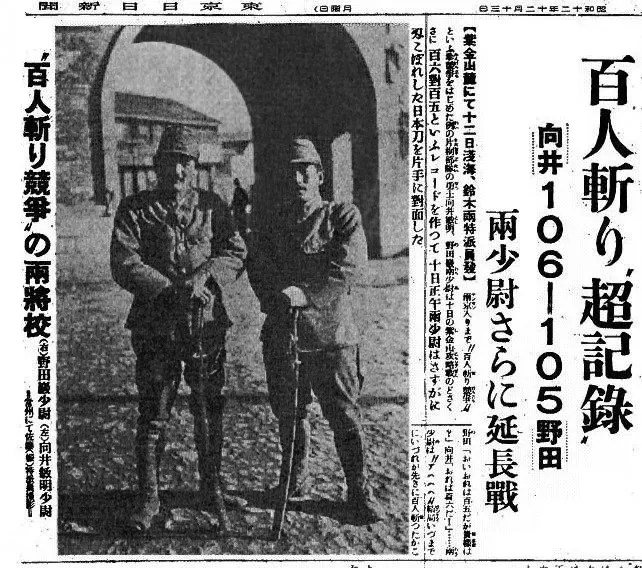

A page from the Tokyo Nichi Nichi Shimbun newspaper with a photograph of Lieutenants Noda and Mukai

On the other hand, the Nanking Massacre greatly damaged Japan and was clearly one of the most important factors in China's political defeat of the war. Because the Chinese exploited this theme to the fullest. Soon after the fall of Nanking, the Kuomintang created the Fifth Department of the Military Anti-Japanese Propaganda Committee; the CPC had similar structures. Both parties printed anti-Japanese posters, pamphlets, and newspaper articles. Dramatic plays depicting Japanese atrocities were staged for the illiterate rural population. The main and most frequently mentioned theme was the Nanking Massacre. The Chinese Communists used a simple but effective method: eyewitnesses of Japanese atrocities who managed to survive and escape spoke at village or military gatherings and recounted in detail what they had witnessed. All this was done to encourage people to join the army and give their all.

As a result, the anti-Japanese forces grew dramatically in numbers. In 1937, Chiang Kai-shek's National Revolutionary Army had approximately 1,8 million men (including approximately 500 in centrally controlled forces and the remaining 1,3 million in the militaristic forces that recognized Chiang's command). The Communists had approximately 90 men. In 1945, Chiang Kai-shek had a total of 5,7 million men, while Mao Zedong had up to 1,3 million in more or less regular troops, and another 2,5 million in local militia units. During the war, approximately 14 million men served in Chiang Kai-shek's army, and at least 4-4,5 million in Mao Zedong's army. In total, approximately 18-19 million people participated in the war. This is a lot - about 40% of China's theoretical mobilization contingent as of 1937.

During the war, the Nanjing Massacre trumped everything else: the military-technical superiority of the Japanese army, the political rift among the Chinese, large-scale collaborationism, and numerous economic development measures in the Japanese-occupied parts of China. The Japanese, in principle, had much to offer the Chinese, and they had a chance to overthrow the Kuomintang, establish a pro-Japanese government in China, and create their own "Eastern Prosperity Sphere." But after the Nanjing Massacre, these chances were completely lost, simply due to the arbitrary exercise of power and the abuse of authority by a number of military officials accustomed to their semi-rebellious freedom. Influenced by the impact of the Japanese massacre, people flocked to the armies of their choice; even those who initially resisted now found motivation to fight. The Chinese armies grew in number despite defeats and retreats, and even though poorly armed, they posed a serious and growing problem for the Japanese. The war became unsustainable and unwinnable for Japan, both from a military and political point of view.

And how can one describe all this? What foolishness—that's the only way. In fact, if you think about it, it's hard to fathom the petty reason for this phenomenal failure of the Japanese Empire's policy.

If the Japanese army had followed the laws of its own country, the Kempeitai of the 16th Division should have charged these two lieutenants with murder for looting or base motives (execution or life imprisonment), wanton violence against civilians (life imprisonment), and failure to obey orders (demotion, deprivation of officer rank, and imprisonment for up to 3 years).

In addition to these lieutenants, the following should also be tried for covering up crimes: General Iwane Matsui, commander of the Central China Army Group (hanged by the Tokyo Tribunal); Colonel Ono Hiroichi, head of the front-line Kempeitai (convicted by the Nanjing Tribunal, later released); Lieutenant General Prince Yasuhiko Asaka, commander of the Shanghai Expeditionary Army; Colonel Ueda Shigeru, head of the Kempeitai department at the Shanghai Expeditionary Army headquarters; Lieutenant General Kesago Nakajima, commander of the 16th Infantry Division; and Major Kato Masao, head of the divisional Kempeitai detachment. If Japan has failed to provide legal assessment of the actions of these individuals for nearly 90 years, it is an endorsement of actions that caused colossal harm to Japan, both then and subsequently. This is astonishing and does not inspire respect for this remarkable nation.
22 comments
Information
Dear reader, to leave comments on the publication, you must sign in.
  1. + 13
    3 October 2026 05: 14
    So, gentlemen condemners and indignant people, in essence, you are in the same line with the Japanese right

    Wow, the author got really mad. what
    Millions of people were put in the same line with Japanese murderers...heh heh, justifier.
    The Japanese emperor is supposed to be a white, fluffy, innocent angel who was disobeyed by evil, ungrateful right-wing samurai soldiers... I've never seen such absurdity and distortion of Japanese history. request
    With this logic, one can justify Hitler and place anti-fascists alongside Himmler’s SS.
    1. +6
      3 October 2026 05: 33
      Well, yes! It turns out that condemning the atrocities of Unit 371 and the Nanjing Massacre strengthens the militarism of today's Japan! No.
      1. +4
        3 October 2026 17: 53
        Quote: Uncle Lee
        Well, yes! It turns out that condemning the atrocities of Unit 371 and the Nanjing Massacre strengthens the militarism of today's Japan! No.
        That's exactly how it turns out, Vladimir Vladimirovich. hi And the author is most likely not the only one who thinks so.
        For example, Korea was under Japanese rule for about 50 years. Resistance was repeatedly suppressed during this time, including murders. There was also widespread and brutal forced labor, excruciating punishments, and deliberate famine, which, of course, led to death. And this continued for about 50 years straight!
        Accurate data on deaths caused by the Japanese NO Still! Sometimes they write about hundreds of dead, sometimes several thousand. I think it was possible to hide everything for 50 years. And there are authors who claim that it was precisely thanks to this occupation that industry and production began to develop in Korea. Productivity increased.
        1. +1
          4 October 2026 03: 34
          Quote: Reptiloid
          There is also information about the most brutal exploitation at work, painful punishments, and the deliberate creation of hunger.

          All the brothels for the Japanese army were filled with Korean women...
          Quote: Reptiloid
          and industry and production began to develop.

          All this began to develop when the USA brought in technology and investment!
          1. 0
            4 October 2026 12: 19
            The Japanese wanted to annex Korea back in the 19th century. They lacked territory and resources. There were attempts, penetrations, and attacks. However, Korea came under complete Japanese control in 1910, and the act of complete surrender was signed. The Japanese began to do what they wanted at home (but they lacked the territory and people): build railways, factories, and so on (now there are those who consider this a great advantage for Korea's development, saying the Japanese enriched it culturally). Of course, Koreans built and worked there. The exploitation was brutal. The Japanese took all the profits and goods. And this would have continued if Japan had not been defeated in WWII. In 1945. Incidentally, there were restrictions on language, names, and other matters. With the onset of WWII, young Koreans began to be taken to Japan and forcibly conscripted into their army. Sorry, Vladimir Vladimirovich, I have calls and emails, I'll finish writing later. Best regards. hi
    2. +5
      3 October 2026 07: 17
      Quote: The same LYOKHA
      The Japanese emperor is supposed to be a white, fluffy, innocent angel who was disobeyed by evil, ungrateful right-wing samurai soldiers... I've never seen such absurdity and distortion of Japanese history.

      Japanese patriots have a response to this accusation:
      "Emperor Showa simply didn't know! They were handing him distorted reports. These were all local excesses, personally committed by General Tojo, Ishii, and the saboteurs from the Kempeitai. As soon as Hirohito learned of violations, he took immediate action! You blame all the sins of the overzealous executors on the Akitsumikami.

      And what a time it was! Japan was surrounded by enemies! Encircled by hostile Anglo-Saxons, surrounded by Kuomintang spies, saboteurs, and an imperialist oil blockade. Without the Tenno's firm hand and strict discipline, the country would have been torn apart!

      Incidentally, the Emperor took over a country with bamboo spears and was able to build a navy with aircraft carriers, advanced military medicine, and industrialize Manchukuo. Yes, there were "necessary costs of modernization" and harsh excesses, but without them, survival in those conditions would have been impossible! Then the traitors blew it all.

      It's a working topic; if you really want to believe it, you will believe it.
    3. 0
      5 October 2026 09: 10
      Quote: The same LYOKHA
      Wow, the author got really mad.

      Judging by the article, the author suggests forgetting everything and pretending Japan never committed any war crimes. We already made that mistake once, burying Europe's participation in WWII on Hitler's side in the shadows. Nothing good came of it.
  2. +2
    3 October 2026 05: 24
    Everything described is 100% a carbon copy of today's Ukraine, which has long been called "so-called".
    The author writes about Japan, but means Ukraine?
    Is the author mistaken?
    1. 0
      3 October 2026 13: 23
      -The author writes about Japan, but means Ukraine?
      More likely Israel.
  3. +2
    3 October 2026 09: 23
    Alas, alas.
    All states cover their own.
    It's just that those who fight more have more precedents.
    The Japanese, the Americans, the English, the Germans, even the Russians and the Soviets have them... (remember the rehabilitation of those who died from repression, and their executioners, who did not suffer themselves, lived peacefully...)

    There are even proverbs, for example (this is close and familiar to us): “Putin does not betray his own.”
  4. +6
    3 October 2026 10: 39
    I read somewhere on the internet, "The Japanese were ejected from a flying saucer. For their strange behavior."
    But seriously, in their culture, anyone of lower rank is a victim, and killing them isn't considered a crime. So, given their mentality, the Nanking Massacre isn't considered a crime. They didn't undergo any "re-education" after World War II, so there's nothing surprising about that.
    And they're merciless to themselves, too. Let's recall that same "Narayama" and their custom of taking the elderly to the forest.
  5. +4
    3 October 2026 12: 19
    The article's facts and arguments are interesting, but its conclusions are unhelpful. We should really start from the premise that "We don't know the country [in which we live] Japan." Why did we decide that the state and power are the same thing? We know that in capitalist countries, the state is merely a screen behind which the true rulers of the country hide. How did things work in Japan 100 years ago? One thing is certain: not as we think they should. It's perfectly clear that the concepts of the state in Russia and Japan differ, and very significantly...
    The same goes for the emperor. The brutal figure of Peter the Great from the old black-and-white film is considered the model emperor. Such politicians no longer exist. And never have. Especially not in Japan. I, for example, have a vague idea of ​​the Japanese emperor's actual role in governing the country. Who can tell us about this?

    I don't think we should exaggerate the influence of passions—cruelty and especially stupidity—on events. I would offer a different explanation, based on the particular circumstances of the time.
    The Japanese were imitators of the West, rebuilding their country along Western lines. They saw, among other things, experimental science, colonialism, and racism. It was this imitation of these phenomena that gave rise to Unit 731 and all manner of massacres. The Japanese had their own racist, fanatical foundation, plus the fervent zeal of a neophyte—that's the result.
    They sharpened Western examples, stripped them of their hypocritical justifications, and took them to the extreme. That's all. For the Japanese, a Chinese person became what an American thought of an Indian, and so on. Naturally, they can be experimented on... And not only on them. Well, modern (meaning 100 years ago) scientists experimented on people, on themselves, for example. This was presented as an example of heroism, when a scientist inoculated himself with a disease to track and describe its progression... When Comrade Bogdanov gave himself dozens of blood transfusions until he finally kicked the bucket... Transfer these "tendencies" to Japan, consider the local racism, atheistic attitude toward human life, the adolescent desire to imitate and the lack of hypocrisy, the desire to outdo the teacher—and you'll get an explanation for their behavior...
  6. +1
    3 October 2026 13: 24
    There is a conspiracy theory that Hirohito avoided the gallows by handing over to MacArthur part of the gold looted in Southeast Asia, while the other part went towards the post-war reconstruction of Japan, which is what led to the country's rapid economic development in the 60s-80s.
  7. +1
    4 October 2026 10: 28
    Statecraft in wartime always requires timely preparation for potential disasters. For example, Japan had a worthy response to the American nuclear bombings: biological weapons.
  8. 0
    4 October 2026 16: 57
    A long time ago, I read a curious article about the Japanese by science fiction writer Kurt Vonnegut in the magazine "Rovesnik." He wrote that they will smile at you, they will bow to you—but deep down, they already despise you simply because you're a "gaijin"—an outsider. So there's nothing surprising about what they did in Manchuria and China, and elsewhere. It's only because everyone else is "gaijin" to them, with the exception of Koreans, whom they consider distant relatives.
    1. 0
      5 October 2026 00: 22
      It seems that the Papuans of the Oceanian islands were also considered distant relatives.
  9. 0
    5 October 2026 08: 34
    Quote: The same LYOKHA
    Wow, the author got really mad.

    Yes, there is! So what conclusions follow from this rampage?
    1. It's possible to remove feudalism from a society, but removing feudalism from a society is much more difficult. This is about the level of control of the Japanese Armed Forces. Incidentally, I believe this. The friction between the Japanese Army and Navy is no secret;
    2. Inhuman cruelty, reaching the point of cannibalism in the most direct sense, is an innate feature of the Japanese nation.
  10. 0
    5 October 2026 09: 03
    The declaration of war, which was printed in bold type in all the press, was made in the name of the Emperor of Japan:
    ...More than four years have passed since China, failing to understand the true intentions of our empire and recklessly pursuing trouble, disturbed the peace in East Asia and forced our empire to take up arms. And although the national government of China was restored there, with which Japan reached
    Having established good-neighborly relations and cooperation, the regime that remains in Chongqing, in the hope of receiving protection from the United States of America and Great Britain, continues its fratricidal resistance...

    "Fratricidal Resistance" is simply a pearl of Jesuitry.
    In general, it's cynical, but I will note that the Americans did the Japanese a great service in historical terms by dropping bombs on Hiroshima and Nagasaki, after which the Japanese became white and fluffy, innocent victims, like lambs.
    And all sorts of Nankings, the 731st detachment, comfort stations, Cabanatuans, the "Road of Death", well, that was it...
  11. 0
    5 October 2026 10: 59

    Quote: Aggle
    In general, it's cynical, but I will note that the Americans did the Japanese a great service in historical terms by dropping bombs on Hiroshima and Nagasaki, after which the Japanese became white and fluffy, innocent victims, like lambs.

    Yes!
  12. 0
    5 October 2026 11: 44
    But in the post-war times, when the Japanese militarists were disarmed, it was possible to eradicate this filth of disobedience to the Emperor's orders and disrespect for the laws, with the full approval of the victorious powers, in particular, the American occupation administration.

    Squeeze the zaibatsu "from within"—from within Japan itself? The very same zaibatsu that even the American occupation administration couldn't completely eradicate—because the Americans needed them and their industry?
    No, the zaibatsu were formally destroyed. But in reality, they simply "shed their tails," dismissing their official leadership—and were reborn as keiretsu, united around banks (with very familiar names) rather than a specific family.
  13. 0
    5 October 2026 11: 59
    The reason I didn't write "carry out any order of the Emperor" is because an analysis of the exploits of Japanese militarists in Manchuria and China clearly shows that they couldn't care less about this Emperor. They needed him for purely utilitarian purposes—the Emperor's name made it easier to enforce unquestioning obedience from soldiers and officers.

    Well, yes. "The Emperor's Will" at that time was merely a confirmation of the position of the group that had won the squabbles at the top. And on the ground, it was generally interpreted as "victors are not judged." The thugs from that same Kwantung Army almost dragged Japan into war with the USSR twice.
    The Japanese had, in principle, much to offer the Chinese, and they had a chance to overthrow the Kuomintang, establish a pro-Japanese government in China, and create their own "Eastern Prosperity Sphere." But after the Nanjing Massacre, these chances were completely lost, simply due to the arbitrary exercise of power and abuse of authority by a number of military officials accustomed to their semi-rebellious freedom.

    And then the same thing happened again during the attempt to gather the "eight corners of the world under one roof." The Japanese Foreign Ministry went out of its way to organize national governments of countries liberated from colonialism and their armed forces, which were supposed to stand shoulder to shoulder with the IJA... and then the army would come and disperse this entire structure, arresting national leaders. As a result, anti-Japanese resistance literally sprang up out of nowhere.
  14. 0
    7 October 2026 15: 59
    Bookmark this article. While there's a perception that Japan has transformed from a country of samurai into a club-footed cutie, I think that's misguided.