Prospects for the American Blackbeard missile system

Blackbeard product shown in August 2026.
Since 2023, a promising hypersonic missile has been developed by order of the Pentagon. rocket Blackbeard. In the foreseeable future, it should enter service with several branches of the US Armed Forces and impact their strike capabilities. The key to the project isn't speed (it's not exactly record-breaking), but rather an attempt to buy hypersonics for hundreds of thousands of dollars, not millions. Economics is the key here. weaponsThis is what the development should be judged by.
Development progress
The goal of the Blackbeard project is to create a cross-species hypersonic missile system that combines high combat performance and a limited cost. Development was entrusted to the California-based company Castelion. Founded in 2022 by SpaceX alumni, the company quickly attracted the interest of the Pentagon with its ideas and solutions.
In May 2023, the US Air Force Research Laboratory (AFRL) awarded Castelion its first contract for the system's development and demonstration of promising solutions. Later, the customer base expanded, with the Army and Navy expressing interest in "Blackbeard."
Along with the contracts came funding. In fiscal year 2024 alone, more than $118,7 million was spent on the Blackbeard project. The sum has grown since then: according to disclosed Pentagon contracts (AFRL, Army, Navy), it already exceeds $600 million. Additionally, loans and investments have been raised, including a $1 billion Series C round.
The developer conducted the first engine tests as early as August 2023. According to publicly available data, the prototype's maiden flight took place in Mojave in March 2024, and another flight test was conducted at Dugway Proving Ground in November 2025, as part of the next phase of development.
Castelion has now finalized the design. The completed missile was first unveiled to the public in August 2026. In this configuration, it is expected to undergo the remaining tests and enter service in the foreseeable future.
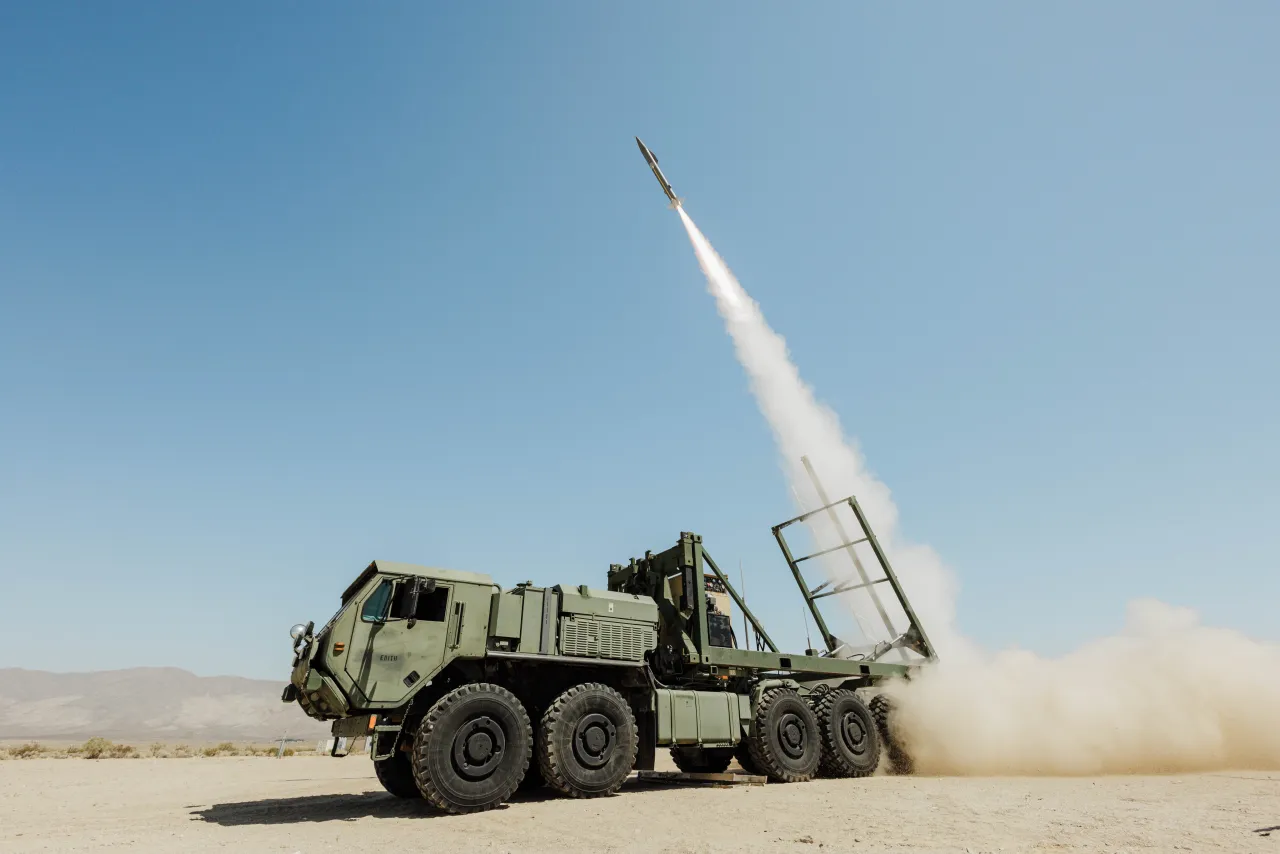
Launch of the technology demonstrator rocket from the CAML facility, June 2025.
Various deployment and use options for the missile are being explored. The AUR+C transport and launch container (TLC) has been developed; it is compatible with various platforms. In 2025, the CAML self-propelled launcher, capable of deploying missiles in such a TLC, was first demonstrated. Furthermore, integration of the AUR+C with the M142 HIMARS launcher was announced in FY2026; there is no word yet on its completion.
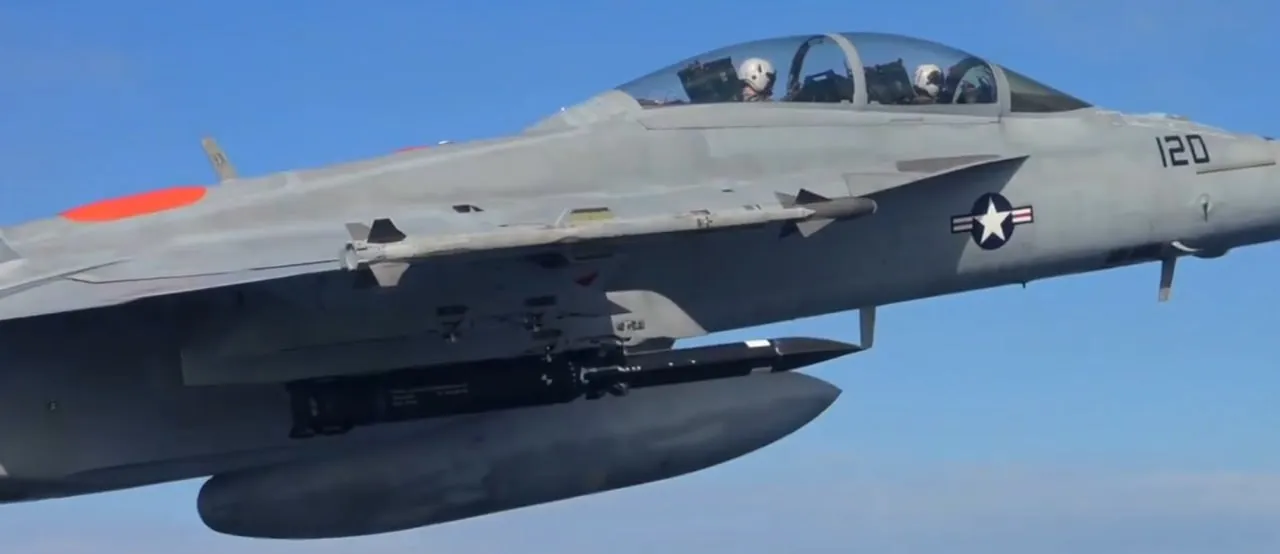
In late September 2026, the US Navy released a video. The footage captured an F/A-18E/F carrier-based fighter with a pair of Blackbeard missiles under its wing. This documented work already underway, not its beginning: the contract for integrating Blackbeard onto the Super Hornet was signed back in April 2026. The same contract also included the system's initial operational capability. Similar progress may be underway in developing weapons for the Air Force.
Plans for the future
Under existing contracts, Castelion still has several years to complete development. FY2026–27 is expected to be spent on the remaining development work. During this phase, the foundation for future serial production will also be laid.
The US Navy was the first customer for serial Blackbeard missiles. In June 2026, they signed a contract for 50 pre-production missiles. In mid-September, an order was placed for 444 serial units, valued at no more than $200 million. Open sources also mention a multi-year framework commitment to purchase at least 500 missiles annually after testing is completed. The figure is approximately 3,5 munitions for the naval aviation, which is found in individual retellings, has not yet been confirmed by direct sources.
The Air Force and Army are also interested in similar weapons, but have not yet placed any actual orders—they are continuing to monitor the trials. Depending on their success, a production contract could be awarded in 2026–27.
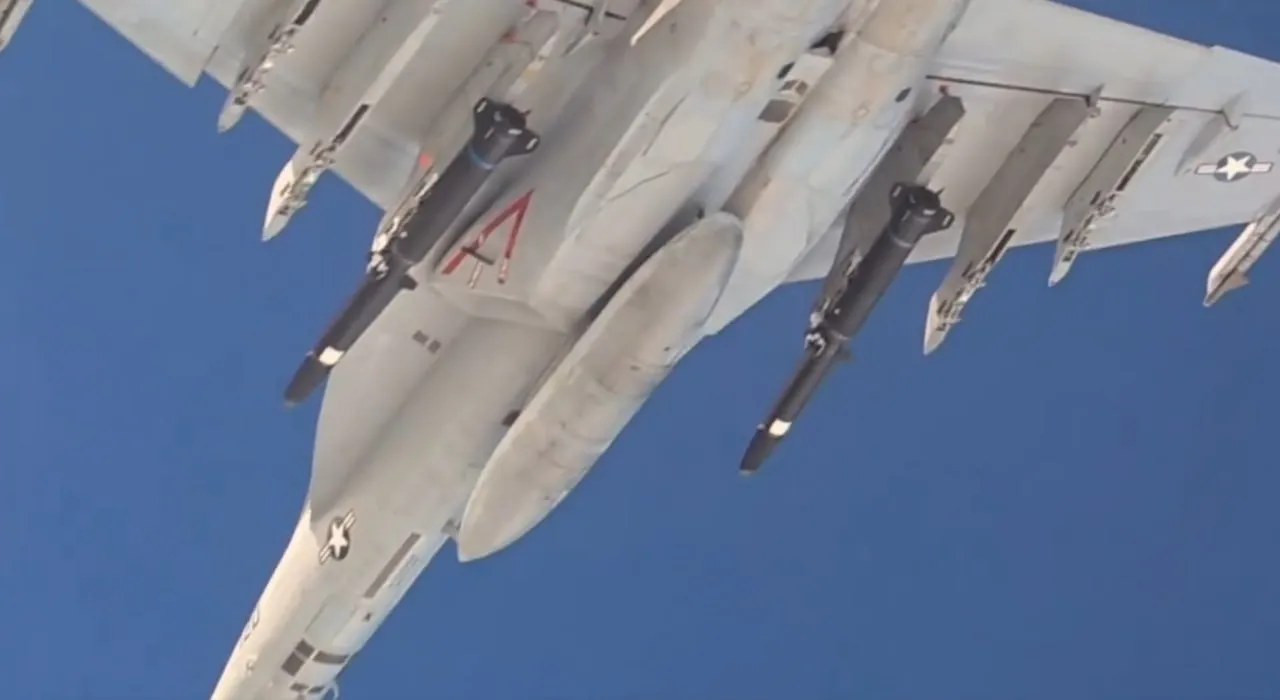
A pair of Blackbeard missiles under the wing of an F/A-18E/F fighter, September 2026.
Inexpensive hypersonic
The Pentagon and Castelion have already revealed the missile's design and some of its related developments. However, the bulk of the most interesting information remains classified.
The promotional materials place particular emphasis on cost. It is claimed that, thanks to a combination of technologies and materials, Blackbeard will be several times cheaper than other current American hypersonic developments. According to the Navy's latest order, the price of one missile is "no more than" $450. This is the ceiling: 444 units for up to $200 million. Another figure is also telling: the first tranche of the contract was $44 million, or approximately $99 per unit. The Navy and the developer deliberately list the ceiling and the actual price separately—they are different figures. However, even the upper estimate is an order of magnitude lower than the cost of other American hypersonic programs.
The missile is built using a two-stage design. The first stage is a cylindrical body with tail fins and a solid-fuel motor. It is responsible for acceleration and trajectory entry. The second stage is a hypersonic glide vehicle with a distinctive body shape and pronounced side edges. It also has tail fins.
The dimensions have not been officially disclosed. The published photographs lack a reliable scale reference, so the length is only tentatively known: it is estimated at 4–4,5 meters, with a diameter of 600–800 mm including the aerodynamic surfaces. The launch weight, according to the same estimates, could reach hundreds of kilograms.
The first-stage engine should propel the rocket to speeds in excess of Mach 5 (more than five times the speed of sound). Flight follows a boost-glide configuration: the combat stage maintains its previously achieved speed for most of its trajectory, maneuvering along its course and altitude. According to open sources, the launch range is approximately 500 miles, or approximately 800 km; some sources claim significantly less. There is no precise estimate: at exactly Mach 5, such a range requires high aerodynamic efficiency. Therefore, this figure remains a guideline rather than a precise value.
The Blackbeard's control system is unknown. It likely has an autopilot with navigation instruments; the possibility of installing a homing head has also been mentioned. There is also no information about its payload. Some sources mention a high-explosive fragmentation warhead weighing 35–45 kg, but this has not been confirmed. The warhead could also use kinetic energy.
So far, two launch options are known. The missile can be launched from a compatible ground launch vehicle with a standardized AUR+C transport and launch vehicle—either a modernized M142 or a new CAML-type vehicle. The aircraft use standard launch beams, but a software update is required.
Place among analogues
Blackbeard can only be accurately compared to systems in the same class. When comparing systems of different classes, price ranges are meaningless, so all ratings below are based on publicly available data:
- Blackbeard — boost-glide, air- and land-launched. Speed: Mach 5+, range: ~800 km. Price: ceiling: $450.
- AGM-183 ARRW — boost-glide, air-launched (USA). CBO estimates cost around $15–18 million per unit.
- AGM-158C LRASM — subsonic anti-ship (USA). Approximately $3,24 million (FY24).
- "Dagger" Kh-47M2 — aeroballistic, air-launched. Estimates: up to Mach 10, range 2–3 km.
- Zircon 3M22 — ramjet hypersonic cruise missile. Estimates: up to Mach 9, range 400–1500 km.
Open sources provide discrepancies regarding the Kinzhal and Zircon, so they cannot be cited as definitive. But the scale is clear: the Blackbeard is more than an order of magnitude cheaper than the American hypersonic programs.
How to deal with it
A boost-glide stage can't be shot down head-on using conventional methods: it's low, fast, and maneuverable. But boost-glide also has its weaknesses—and they lie not in its speed, but around it.
The first is detection and targeting. The missile relies on satellite navigation and external targeting. Jamming the GPS signal or the guidance channel has a greater impact on accuracy than on the flight itself. For a glide vehicle, loss of correction means a deviation from the target.
The second is the interception window. The transition from gliding to diving is short. Therefore, defenses rely on early detection and interception at the top of the trajectory—where the flight path is still predictable. The sooner the target is tracked, the more realistic the confrontation.
Third, saturation. A cheap missile is dangerous precisely because of its mass: the assumption is that the enemy's defenses won't be sufficient to deal with dozens of simultaneous targets. But this logic has a downside. Electronic warfare systems and decoys become cheaper as the missile gets bigger, meaning both sides—including the defender—can saturate.
New opportunities
What exactly the Pentagon gains from the project is already clear. The key factor is the combination of technical and economic characteristics. The Army plans to acquire a large number of relatively inexpensive missiles with high performance characteristics within a reasonable timeframe, and Blackbeard's cost compares favorably with other American hypersonic systems.
The project meets the needs of three branches of the armed forces simultaneously. They will receive a long-range weapon with a number of advantages and without the need for fundamentally new platforms and carriers: the missile is capable of attacking targets at greater ranges and complicates operations. Defense the adversary.
However, the economic model has its limits. The widespread use of cheap missiles is limited by the saturation of defenses and the improvement of weapons. EW, and their reliance on satellite navigation and external targeting makes them vulnerable to suppression. The cost advantage is a strength of the project, but it does not guarantee effectiveness in real-world countermeasures.
The missile's overall parameters attracted the Pentagon's interest, and the project received the necessary support. Whether the project will be able to maintain the pace and meet the deadline remains to be seen. The Defense Ministry and the developer are optimistic.
Information