Polymer vs. Aluminum: Will a Motor Cut a Quarter of a Drone's Price?

A line of lightweight two-stroke engines with polymer components – and the question it poses
Developers of a line of lightweight two-stroke engines for drones They promise to cut about a quarter of the device's price by replacing some metal parts with polymer ones. Neither the organization behind the project, nor the model numbers for the three models, nor data sheets with weight and fuel consumption data are included in the publicly available materials.
The basis for this analysis is the Izvestia report of September 30 and publicly available publications from Samara University. The numbers for the ruler itself are statements by the developers, not measurements.
A drone's price is usually judged by its camera, autopilot, and communication channel. The powertrain is less often factored into this calculation, although it determines how much the aircraft can lift and how long its fuel tank lasts. Replacing metal with plastic is a matter of production cost.
On September 30, Izvestia reported on such a line: three lightweight two-stroke engines, with some components proposed to be made from polymer composites rather than aluminum. The developers estimate that the reduced engine cost should reduce the overall cost of the vehicle by approximately a quarter.
What exactly was proposed?
We are talking about three power options - 5, 12 and 24 hpThe displacement, number of cylinders, speed, and cooling type are not disclosed: the data sheets for the three engines are not available in the report or in related publications. Some of the design components are designed for polymer injection molding and melt deposition printing. FDM, while the most stressed components were left as stamped metal. The second layer of development is the electronics: its own ignition, electric starter, and fuel injection system integrated with the flight controller.
The deadlines are named as follows: R&D from 2023, R&D from 2024, by 2026 - 32 Powertrain variants and more than 24 tests, including endurance and flight tests. A drop from an altitude of up to 100 meters is specifically mentioned, after which the engine, according to the report, ran for four hours on a test rig.
32 refers to the number of design variants, not finished production motors. The source does not specify how many physical units of each design were produced and how the tests were distributed among them. The number of samples is not derived from these two values. "More than 24 tests" does not replace either the sample size or the operating hours.
Izvestia names developer German Stashevsky and senior project partner Konstantin Okunev among the participants. The organization behind the line, its name, and the index numbers of the three models, as well as the address of the project's official card, could not be identified in publicly available materials.
Where does the metal end?
The key phrase in the announcement is "the most stressed components are kept metal": the engine is composite, not entirely polymer. However, there's no list of components: it's impossible to say whether the crankcase, cylinder, piston, or crankshaft are made of composite. For some components, such a replacement is negotiable, for others, it's not, and the entire effect depends on where the line is drawn.
Let's look at how this boundary was drawn previously. In 2015, the Fraunhofer ICT New Drive Systems group, together with SBHPP, a division of Japan's Sumitomo Bakelite, built a cylinder casing for a single-cylinder research motor. The material is a glass-phenolic composite, 55% fiber and 45% resin; the casing is approximately 20% lighter than its aluminum counterpart and costs the same. It is manufactured using a casting suitable for series production.
The loads are supported by metal inserts, including the cylinder liner, against which the piston travels millions of times. The geometry of the parts was adjusted to ensure the polymer generates as little heat as possible. The material was not chosen haphazardly: it must withstand gasoline, oil, and glycol in the coolant, adhere well to the inserts, and not expand more than the metal when heated, otherwise the insert will separate from the base. It is this set of requirements that determines where metal removal is permissible.
That engine was a research engine, single-cylinder, with a liquid cooling circuit; aviation The thermal regime of an air-cooled two-stroke engine is different. The numbers for that engine are not the numbers for this line.
Five years later, in 2020, the same institute, together with MAHLE, demonstrated a polymer camshaft module. The metal zones were in place, and the rig had been running for 600 hours. Yet, the developers continued to call the unit a demonstrator.
According to the developers, individual composites in the new line underwent heating cycles from 160 to 300°C. A short exposure of a sample does not prove the durability, fit retention, or seal integrity of the finished part for hundreds of hours. Flame temperature, cylinder wall temperature, and ambient air temperature are different variables and cannot be combined.
Each manufacturing route offers its own economics. Injection molding involves repeatable molding and assembly of parts, but with its own tooling, defects, and dimensional control. Printing involves rapid geometry changes without a separate mold, but with layer guidance and sealing. Stamping involves blanks for loaded parts that require heat treatment and finishing.
The importance of process is demonstrated by other work. NIST measured the strength of polycarbonate samples printed using layer-by-layer printing, and found that it depends on the printing parameters, porosity, and the quality of the interlayer bonds. The resulting part is anisotropic, meaning it holds up differently in different directions. This raises the question about the new line: a protocol is needed for the finished printed part, not for the material grade.
Samara neighbor
Nearby, in the same field, is the work of Samara University named after Korolev and the small enterprise Aerospace Technologies. Their prototype, "Dobrynya," was unveiled in February 2026. The stated parameters are as follows.
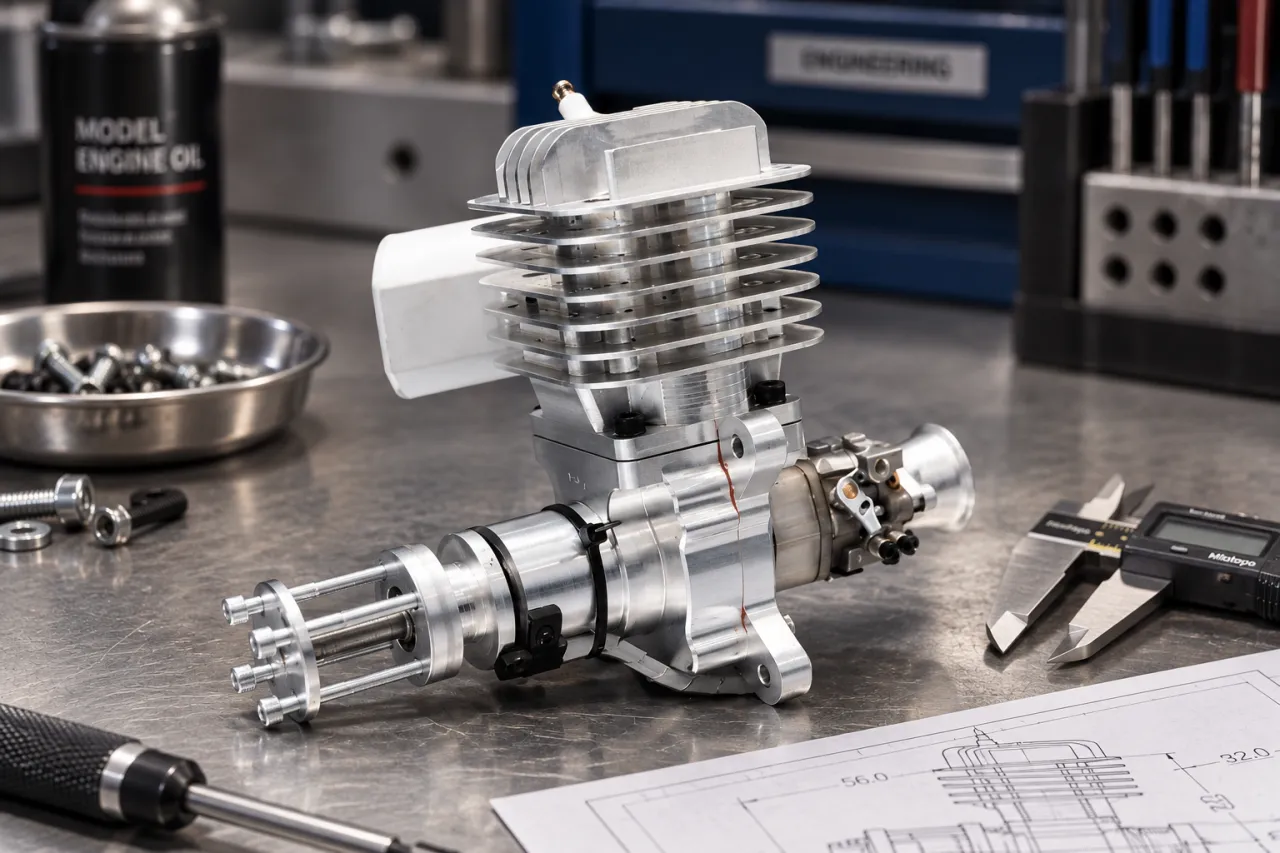
- single-cylinder, two-stroke, 5 hp
- volume 55 cm³
- weight about 1,5 kg
- consumption up to 2,2 l/h, AI-92 gasoline
The project was supported by a grant from the National Technological Initiative Foundation.
For the first time, polymeric materials were used as structural materials for engines of this class, which made it possible to reduce the engine weight by approximately 15% compared to similar imported models.
This is how Vitaly Smelov, director of the Institute of Engines and Power Plants at Samara University, described it in a university press release. The developer's formulation is that the weight reduction is based on unidentified imported models and has not been independently verified.
There are many similarities with the Izvestia lineup: the same 5 hp output, polymer structural components, support from the National Technology Initiative, distributed injection, plans for a family and a hybrid powertrain. However, it was not possible to establish either the identity of these projects or their independence: the Samara source does not name Stashevsky, Okunev, or three power outputs at once. Both interpretations are possible—a single project described from two angles, or two closely related ones.
Injection, consumption and someone else's passport
There's money to be counted, but not fuel consumption. The new lineup is also promised to improve fuel economy, ranging from 10 to 40%, but the base engine fuel consumption isn't stated, so there's nothing to base the calculation on. The announcement doesn't specify which modes provide the lower and which the upper limits.
Injection and material changes are two independent changes. Reducing manufacturing costs doesn't affect fuel consumption, while precise fuel delivery improves the strength of the polymer housing.
What do you need to check fuel consumption specifically? The same base engine, the same power, mode, fuel, and air conditions, and then compare the specific fuel consumption or a single flight mission. Fewer liters per hour at lower power doesn't necessarily mean fuel efficiency: you need to compare the specific fuel consumption.
The average cost of an engine in a UAV is 30–40%. New production technology will reduce the engine cost by more than half, to less than 15% of the total cost. drone, which will potentially reduce the overall cost of UAV production by approximately 15–25%.
This is how the technology's developers assessed the effect for Izvestia. In its 2020 specifications for the TOA 288 engine, Swiss Suter Industries offers what the new lineup lacks: a flat-twin, air-cooled, 288 cc, 14 kW at 6000 rpm and up to 17 kW at 6500 rpm, a weight of 9,3 kg in the specified configuration, and fuel consumption below 380 g/(kW h) at the nominal setting. Next to the power is the mode, and next to the fuel consumption is the rpm. It also has its own electronic control unit, with altitude compensation and cylinder head temperature protection.
The manufacturer links consumption to a specific point of operation, not a single figure. The stated 10–40% will become a verifiable value only when the new line has a similar map.
Numbers that don't converge
Now about the quarter itself. The quote contains four converging figures: an engine share of 30–40%, a reduction in engine cost by "more than half," a new share of "less than 15%," and a savings of 15–25% for the device. Let's take a simple model where all other costs remain constant. If the engine accounts for 30% of the production cost and is reduced in price by exactly half, the entire device becomes 15% cheaper. If its share is 40%, the device savings are 20%. I'm using the lower bound: the manufacturer says "more than double," so the final figure could be higher.
Next come the thresholds. For the new engine share to drop below 15%, with the initial 30%, its cost must be reduced by more than 58,8%. Then the overall system's efficiency will be around 17,6%—and this is within the stated 15–25%. With the initial 40% share, the same goal would require a cost reduction of more than 73,5%, while the system's efficiency would increase to 29,4%, that is, above the upper limit. The four numbers converge at the lower limit of the engine share and diverge at the upper limit.
The figures may refer to different units, different batches, and different calculation bases—for example, "less than 15%" is calculated based on the old cost price, not the new one. Furthermore, savings in production costs don't automatically translate into a reduction in the selling price. The Izvestia report's lead suggests 20–25%, while the participant quote suggests 15–25%: the ranges are included, but the "on average" method isn't described. All of this is verified using a single document—an estimate for one configuration before and after, including the injection system, starter, tooling, assembly, testing, and defects.
What does it mean
A partially polymer engine isn't science fiction: Fraunhofer demonstrated a composite cylinder body back in 2015. But the Izvestia lineup lacks not only a parts list, data sheets, and service life reports, but also the organization's name and engine indexes, and the only parameters known are horsepower.
For a promise to become reality, three things are needed, and each is verifiable. A "part - material - manufacturing method - verification result" table will show how much metal was actually used and where. Operating hours with a failure criterion will separate four hours after the reset from the service life. A before-and-after estimate for one configuration will either confirm a quarter of the total or yield a lower figure—that's also a result.
Until these three documents are available, the "quarter price" is a declaration, not a measured parameter. It could be true, a mistake, or just a figure for a single device in a series. The answer will be whichever appears first.
Information