Iva MANPADS: A New Russian Air Defense System with a Foreign Connection

A soldier with an Igla MANPADS. Still from the Vesti Nedeli television program.
The Russian army is armed with portable anti-aircraft guns. missile Several types of systems. Now, information has emerged about another product in this class—a system designated "Iva." According to a recent television report, it is already in service with mobile fire group personnel and is being mastered. The main question isn't the fact of its appearance, but rather its origin: its appearance almost immediately drew comparisons with Chinese and Iranian MANPADS. Let's examine what can be confirmed here, what remains speculation—and why the debate about "Chinese" and "Iranian" origins may, in reality, be about the same thing.
Complexes on the screen
On September 27, the Rossiya 1 television channel aired the latest episode of its news and analysis program, "Vesti Nedeli." The program included a report on the Rostov Region, its industry, economy, and other topics. Among the featured participants were members of the Mobile Fire Group (MFG), a unit involved in organizing the Defense region and intended to cover objects and combat air targets.
Soldiers with the call signs "Leshy" and "Modny" displayed examples of their unit's equipment. The footage featured machine guns and automatic rifles on both a fixed and mobile base, as well as a new portable anti-aircraft missile system.
The report's subjects demonstrated the seal containing the system's components, the MANPADS itself in combat-ready condition, and mentioned one of its characteristics—a launch range of up to 4 km. This figure was quoted by a serviceman; there is no independent confirmation in the open sources used for this article. The report did not show actual missile launches.
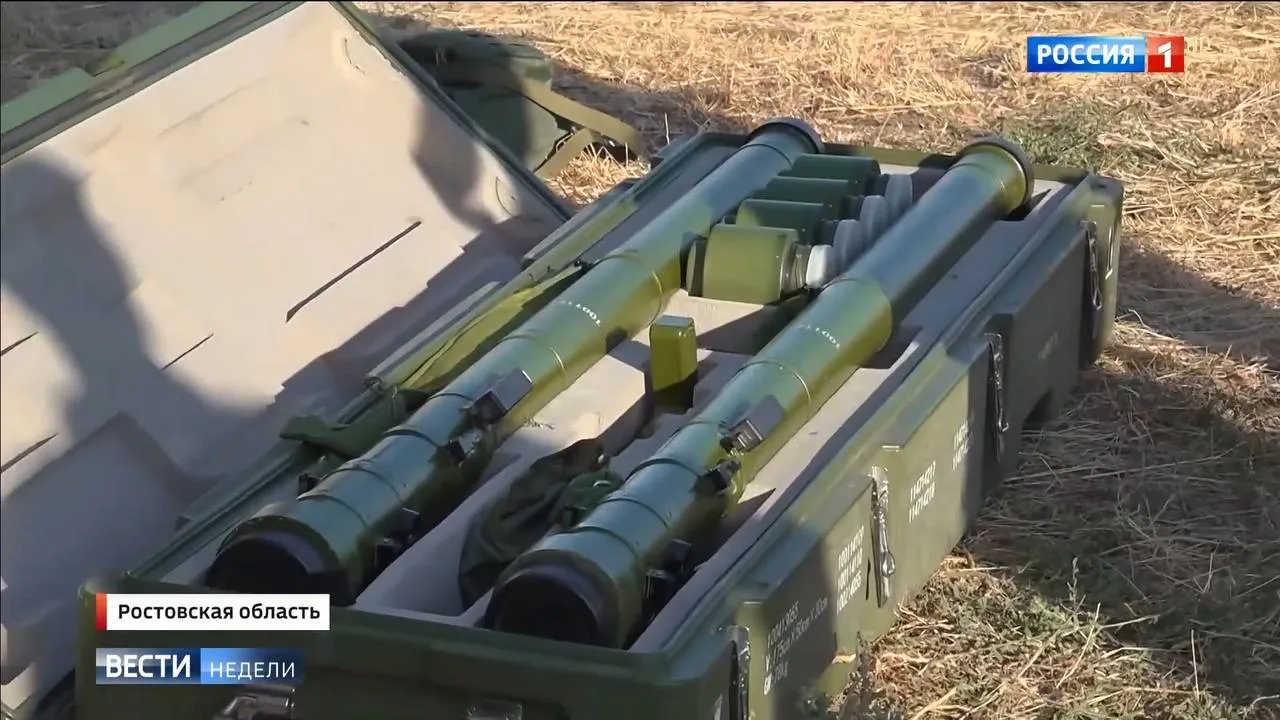
Transport and launch container (TLC). Still from the TV show "Vesti Nedeli"
It's worth immediately distinguishing between two terms that are easily confused. A TLC is a transport and launch container (TLC): it's where the missile is stored and launched. A casing (or crate) is a container for transporting and storing several TLCs and other components of the kit. We'll discuss the TLC and casing below.
The very designation "Iva" is intriguing. Previously, no confirmed information about either the project or the finished system with this name had been found in publicly available publications. A single television report makes it impossible to determine whether this is a production product, a prototype, a major upgrade of an existing system, or a system from a classified program. The report only indicates that the system is in the possession of one of the mobile fire teams and is shown as part of its equipment. The scale of deliveries, service life, and widespread use cannot be determined from such material.
Let's specifically note a detail that's rarely noticed. Domestic MANPADS traditionally bear plant-based names—"Strela," "Igla," and "Verba." "Iva" fits into the same category. This indirectly supports the theory that it was developed in Russia, although it doesn't prove it: the foreign system could well have been designated according to the same tradition when it was adopted.
Technical features
The Rossiya 1 television channel showed the Iva system assembled and in its transport packaging. This allows for a general overview of the system and its components, but does not provide insight into the missile's design or the characteristics of its guidance system.
In terms of its overall architecture, the Iva is similar to other portable anti-aircraft systems of domestic and foreign design. The kit shown includes:
- transport and launch containers with missiles;
- removable reusable trigger mechanism;
- four small cylinders or containers, the purpose of which is not revealed in the published footage.
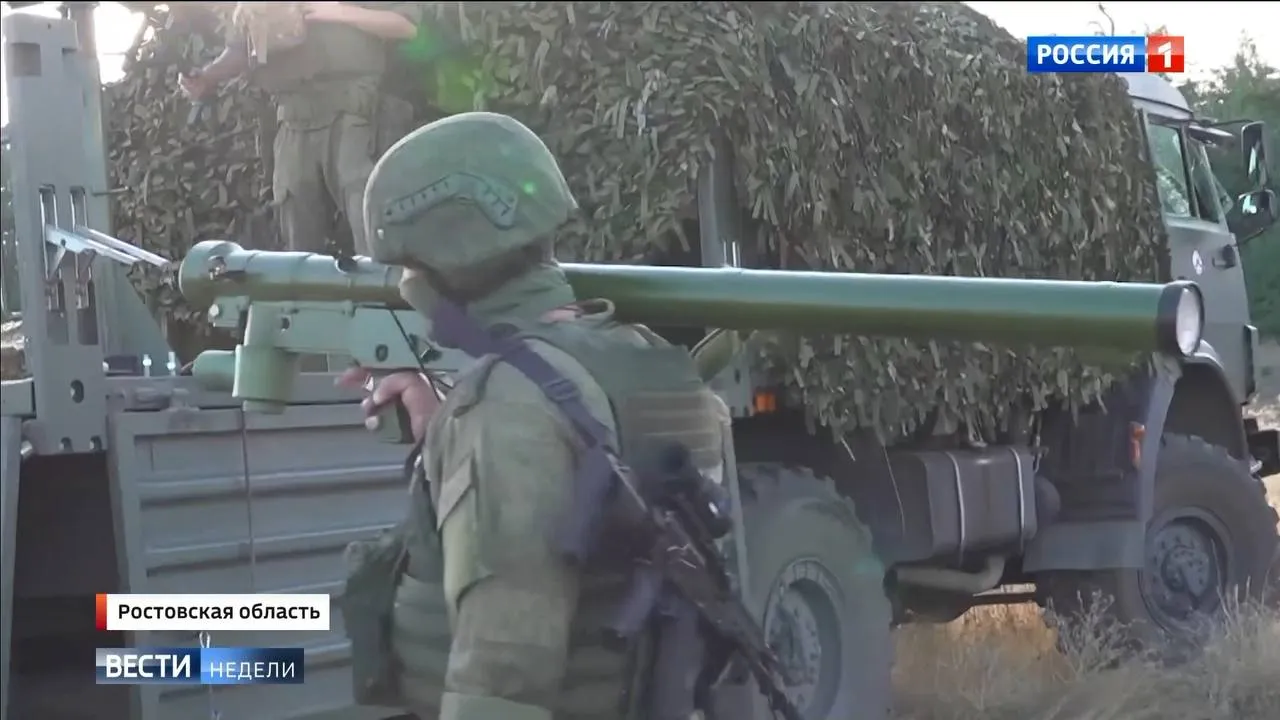
The operator is ready for use. Still from the TV program "Vesti Nedeli"
A single container contains two missile launchers, a launch mechanism, and four cylinders. This configuration is designed to carry several missiles and prepare the system for use directly at the unit. The exact time for container assembly and replacement was not announced, so it's not worth declaring this procedure "quick."
The missile itself wasn't shown in detail, so its design can only be speculated upon. However, the design itself is unlikely to differ much from the standard: MANPADS typically have an elongated cylindrical body, folding wings, and a solid-fuel motor. However, it's impossible to infer flight speed or trajectory profile from the presence of such a motor alone. The range of up to 4 km is currently known only from the words of a serviceman in the report.
For pre-targeting, the footage shows folding sighting devices on the missile launcher. If the Iva does indeed have an infrared homing head, the missile itself locks on to the target. However, the type of head, operating ranges, jamming immunity, and the need for external target designation are not disclosed.
Therefore, we cannot talk about guaranteed destruction of a wide range of targets - aircraft, helicopters, medium and heavy drones, as well as high-precision weapons With a hot exhaust – no. MANPADS with an IR warhead can, in principle, work against targets with a noticeable heat signature, but the actual result depends on the angle, range, background, weather, and the capabilities of the specific warhead. Operation on head-on and tail-on courses also requires confirmation by technical data.
Foreign footprint
Soon after the report, several theories about the Iva's origins circulated in publications and discussions. It was claimed that the system was virtually identical in appearance to Chinese Qianwei MANPADS, such as the QW-18 or QW-19. Similarities to the Iranian Misag-2 and Misag-3 were also reported, with the Iranian systems themselves being described as direct relatives of the Chinese systems, even licensed copies. Based on these theories, it was concluded that the Russian military was now purchasing MANPADS not only from its own companies but also from abroad. These theories are worth examining.
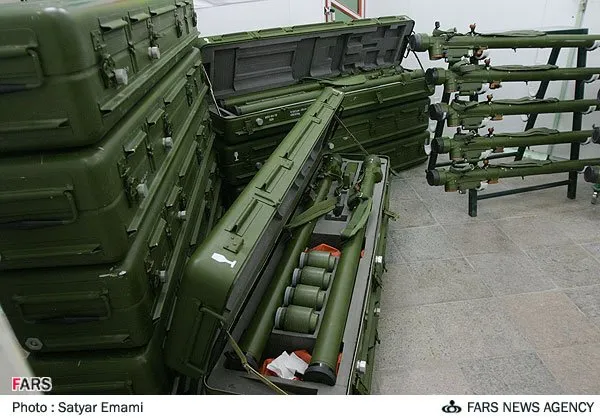
Iranian Misagh-2 MANPADS. The container with its distinctive component arrangement is striking. Photo by Fars News
Let's start with the obvious: the term "practically identical" requires caution. External similarity of individual elements does not necessarily prove the origin of the product. A similar layout could be explained by several scenarios:
- "Iva" is an independent Russian development with a similar layout;
- it uses individual technical solutions of foreign origin;
- it is a localized or modernized foreign product;
- the units received a ready-made imported complex;
- The similarity is limited to the container and the general layout, but the internal structure is different.
The dilemma is exactly the same here. It's important not to confuse different things: technological influence, copying, licensed production, and the supply of finished products are not the same thing. Without factory designations, serial numbers, or independent component analysis, it's impossible to make a definitive, conclusive choice.
Publications that pointed to a "Chinese connection" considered it less likely, citing Beijing's approach to military-technical cooperation with Moscow. However, this is an assessment, not proof of the absence of deliveries of a specific product. However, direct Chinese deliveries and the Chinese origin of a design should not be confused: even if finished systems were not shipped directly to Russia, this does not negate the Chinese origins of the system itself, which was transferred through a third country. Similarly, reports of Iran transferring drones do not, in and of themselves, confirm the delivery of Iranian MANPADS.
A word from the editor
If we must choose between the versions, the most economical explanation is a common design lineage, descended from the Chinese Qianwei family. Then the "Chinese" and "Iranian" versions are not alternatives, but rather one and the same, at different distances from the original design. Here, it's worth honestly weighing the strength of the arguments. A compelling one is Iran's reputation as a channel: finished products have been transported through it in open sources, while there have been no direct reports of Chinese arms deliveries. The similarity of packaging is a weak argument, exactly the same as the one we outlined above; by itself, it means nothing and merely complements the first. It is precisely the combination of the channel's reputation plus the similar layout that makes the Iranian version the most likely. We don't present this as established fact: the comparison was based on external appearance and open publications, not on components.
If we must choose between the versions, the most economical explanation is a common design lineage, descended from the Chinese Qianwei family. Then the "Chinese" and "Iranian" versions are not alternatives, but rather one and the same, at different distances from the original design. Here, it's worth honestly weighing the strength of the arguments. A compelling one is Iran's reputation as a channel: finished products have been transported through it in open sources, while there have been no direct reports of Chinese arms deliveries. The similarity of packaging is a weak argument, exactly the same as the one we outlined above; by itself, it means nothing and merely complements the first. It is precisely the combination of the channel's reputation plus the similar layout that makes the Iranian version the most likely. We don't present this as established fact: the comparison was based on external appearance and open publications, not on components.
The actual origins of the Iva, its country of manufacture, and its exact model are still unknown—available data neither confirms nor refutes this theory. The demonstration of a single system confirms its presence in a specific unit, but the scale of procurement cannot be determined. Official announcements and developer data could shed light on the matter.
On the reasons for the possible purchase
If the imported theory is ever confirmed, the question will arise: why does the army need foreign MANPADS? There are usually several reasons—replenishing stockpiles, the pace of domestic production, and the availability of components. But the mere fact of the Iva's appearance doesn't lead to the conclusion that domestic industry is failing to meet demand. Such a conclusion requires production figures for MANPADS and their missiles.
Russian air defense systems are constantly repelling drone attacks and consuming missiles, including those from man-portable systems. There is no precise data on consumption, stockpiles, or production, so this can only be a potential burden on the arsenal. A new system could increase the number of air defense assets in the military, but the extent to which it is needed for this purpose is unclear from open data. Another possible motive is studying foreign experience, and here, comparable characteristics, not appearance, are needed.
Bottom line: The Russian unit has acquired the Iva MANPADS, with a stated launch range of up to 4 km. Everything else is just speculation.
Information