Muzzle attachment: What the documents say about the 120mm mortar's protection limits

Kirill Aleksandrovich Nikolaev commanded a battery of 120-mm mortars, went through the war and remembered the main design flaw of his weapons as follows:
"There was no protection against double loading; it was only after the war that they came to their senses."
While he commanded the battery, not a single double loading occurred in it - but there was an incident in the division.
There's a gap between what a front-line soldier remembers and what documents record. The safety catch was developed before Nikolaev remembered it. And when he joined the military, official manuals clearly distinguished between what the safety catch covered and where its capabilities ended. These boundaries, defined by the Ministry of Defense's own instructions, will be discussed here. The material is rigorous in its source material: where the document is silent, it is stated directly, without speculation.
About the tragedy of June 1, 1967 at the Magdeburg training ground - one dead, two wounded, a mortar exploding at the position of the 243rd Guards Motor Rifle Regiment - we already toldThe investigators' version and the general principle of the safety device are also discussed there. The question here is different: what is recorded in the 1944 order, in the 1957 and 1980 manuals, and in the recollection of a participant in the Afghan operation regarding what the protection does and does not protect against.
"Senseless losses": Order No. 0330 of September 26, 1944
In the fall of 1944, First Deputy People's Commissar of Defense Georgy Zhukov signed Order No. 0330. The reason for this was not a single accident. The numbers in the text convey the scale: on the Leningrad Front alone, 64 120mm mortar explosions resulting in casualties were recorded in 1944; on the 4th Ukrainian Front, 25; on the former Separate Coastal Army, 17; on the Karelian Front, 6; on the 3rd Belorussian Front, 5; and so on. The list is incomplete: some explosions were attributed to enemy fire and not reported to command.
Zhukov's diagnosis was harsh: the culprit was declared to be "solely" the negligence of crews and commanders. In the majority of specially investigated cases, the cause was attributed to reloading or attempting to load a second mortar shell before the previous one had fired. The statement "no one is investigating the true causes and no action is being taken" is the rhetoric of the order itself: the document itself relies on special investigations, from which the cause was deduced. Front commanders were ordered to conduct special training sessions, check commanders, and explicitly prohibit loading mortars before the command.
Nikolaev explained from experience why the danger persisted so stubbornly. During artillery barrages, "there was such a roar that you couldn't talk. A real artillery barrage is a real earthquake. The ground shakes." The loader would cover his ears; a mine would impale the firing pin, and in the roar, he might not hear whether a shot had been fired. If he decided it was a misfire, the next mine would be fired into the barrel of the first. Two mines in a channel meant a detonation.
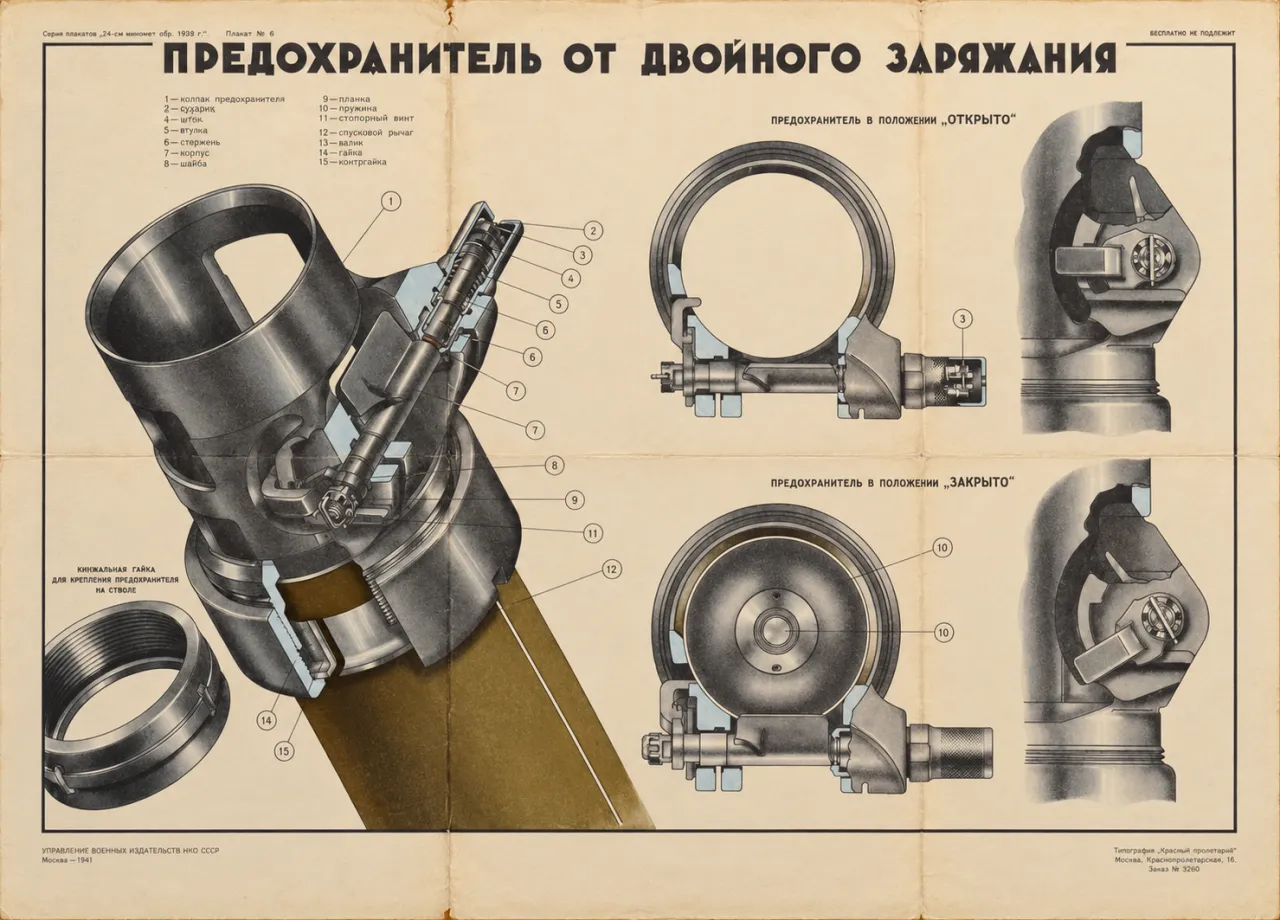
P-120: Mortar fuse, model 1938
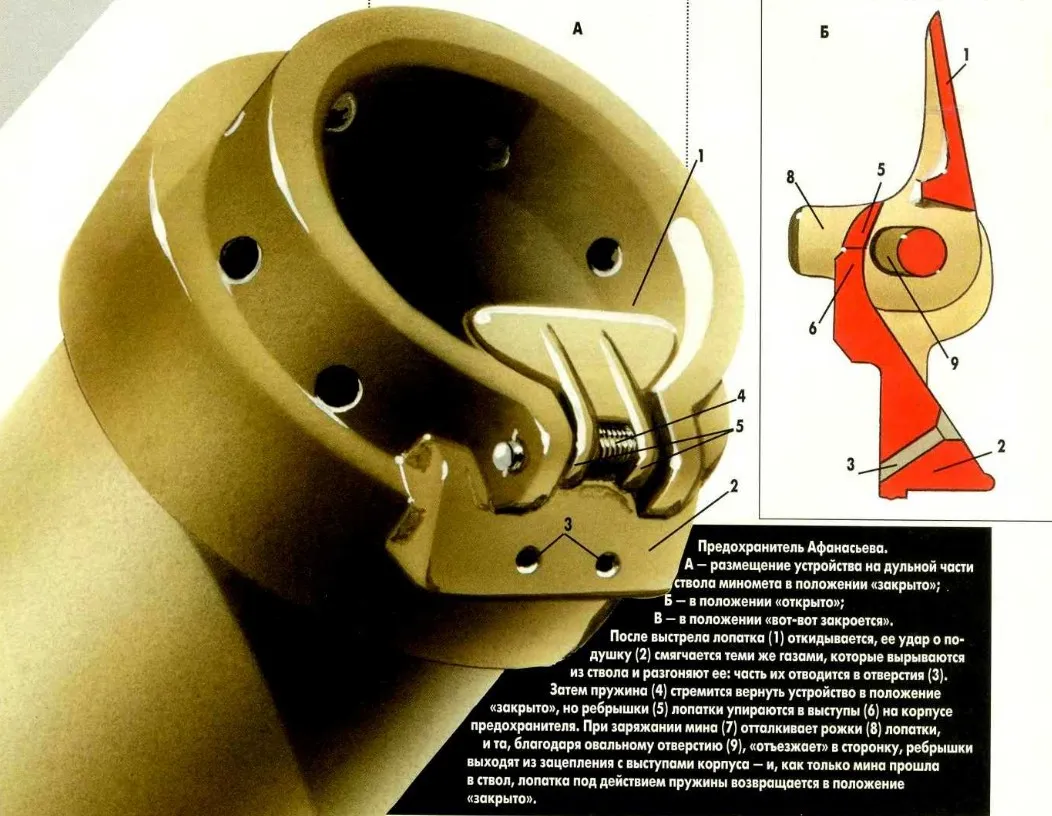
By that time, Nikolai Mikhailovich Afanasyev was working at a small arms and mortar weapons testing range near Moscow: he had been sent there after serving his conscription service on the Mongolian border, after his double-barreled machine gun design reached Zhukov. In 1943, Afanasyev developed a double-loading safety device for the 120mm mortar—a muzzle attachment that mechanically prevents the second round from being fed while the first remains in the barrel. According to a later Rostec statement, serial production began in 1944, including at the Tula Machine-Building Plant. Primary production documents are not publicly available, so the start date of mass deliveries to the troops cannot be determined from them.
Here's where the document and memory diverge. Nikolaev spoke about his battery, not the entire front, and dated the introduction of the protection to the post-war period. Perhaps the attachments were delivered unevenly to the troops, and his battery received them later. But this is merely a guess, aligning the release with his memory, not fact. According to the same Rostec report, the Americans were working on a similar task. Afanasyev himself later recalled that they tried to buy a license, and Stalin issued a "denial" order. The document was not presented, so story remains a memoir.
The 1957 edition of the 120mm Mortar Service Manual, Model 1938, describes the device under the index P-120 in Chapter 3. The introductory paragraph itself warns of a situation where the safety catch not Covers: If a second mine is brought to the muzzle at the moment of firing, both mines may collide at the muzzle and explode. This warning is part of the main description of the unit, not a footnote in fine print. The design protection works against one condition: the first mine is in the barrel, and the second is not yet at the muzzle. The instructions do not specify a general time limit—up to what point the attachment provides protection, and after what point it no longer does.
P-120M: The modernized unit and its limits
The 1980 service manual for the same 1938-model mortar describes the modernized P-120M safety catch. The manual doesn't specify exactly when the component was modernized or what details were changed: the year of the redesign isn't mentioned. The warning about the impact of mines at the muzzle is reproduced verbatim; the wording hasn't changed in over twenty years.
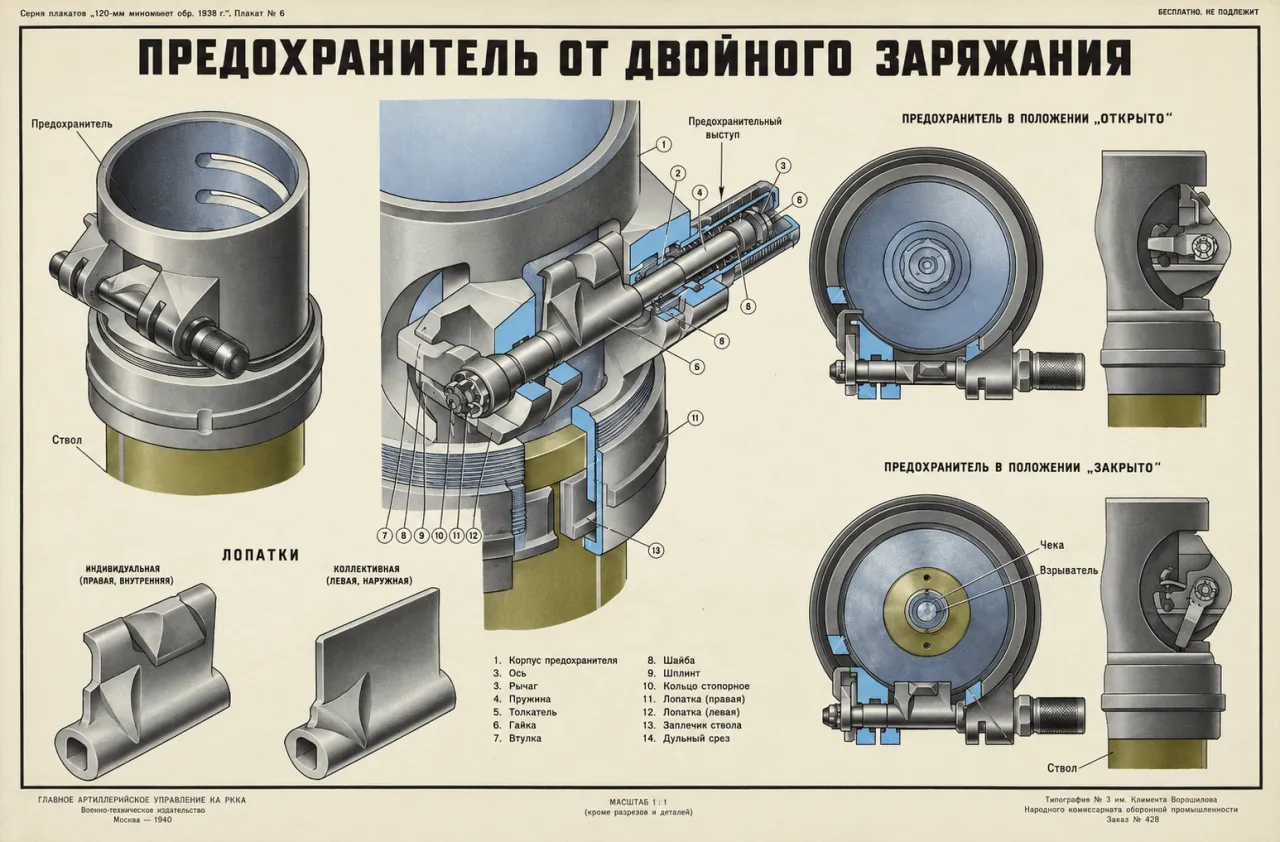
The manual also adds another caveat. Certain illumination and incendiary mines were handled differently: a standard safety catch was not installed, and safety was ensured by additional crew requirements. A specific risk during loading is also noted: if the mine is loaded at an incorrect angle, its stabilizer can open the closed blade of the loading unit, allowing double loading. This applies to specific types of ammunition and a specific loading error, not to the general inapplicability of the P-120M. Whether these restrictions apply to circumstances in 1967 or 1985 cannot be determined from publicly available documents.
April 1985: Double loading that was noticed
This episode demonstrates not the limits of the defense itself, but the limits of what can be documented in such a case. In the spring of 1985, an operation was underway to escort a large transport convoy to Maymana, in Faryab province. Mikhail Surovtsev, a participant in the operation, names Kuzin as the overall commander. The units in these memoirs are easily confused: the 1st Motorized Maneuverable Group was led by Major B.N. Filippov, Surovtsev himself served in the 2nd, and the mortar battery in his account was from the Far Eastern Motorized Maneuverable Group. According to him, during intense fire, they discovered a double charge in one 120mm mortar and managed to prevent its explosion.
Neither the mortar model nor the presence or functionality of the safety catch are mentioned in the story. The episode confirms that the danger of double loading persisted even decades later. Whether the barrel contained a functioning device, or even whether it existed at all, is a silent statement. In the same paragraph, Surovtsev recounts what he heard from veterans: that about a year earlier, the mortar had exploded, killing the entire crew. No date, no unit number, no list of the dead—this retelling is unsupported as corroborated evidence without independent verification.
What the three sources say together
Three sources of different nature illuminate different aspects of the same problem. Zhukov's 1944 order describes the scale of the accidents: dozens of registered explosions on just a few fronts, with incomplete records and an unknown total. Manuals from 1957 and 1980 document the device and its limitations. A participant's recollection from 1985 is evidence of a single, non-explosive episode, not a documentary continuation of the same story.
None of them, taken individually, determine the state of the safety catch on the mortar that exploded at the Magdeburg firing range on June 1, 1967. The manuals describe the ability to retract or open the safety catch when the mortar is improperly fed, but what's described in the instructions doesn't prove that a specific crew acted that way. Theories regarding this incident are discussed in previous material in the series; without an investigation file and a product form, the final answer remains open.
Regarding the device itself, the documents reveal exactly one thing—its intended purpose: the P-120 and P-120M blocked the feed of the second mine while the first was in the barrel, and yet the instructions themselves specified situations in which they were not applicable. The cited sources do not measure how often the attachment worked or how often it failed in service. This is not a condemnation of the design: the manuals did not conceal the limits of protection, but rather explicitly stated them.
Information