Expensive to launch – we'll drop it from a plane: Hermeus' Ramjet-X design

The development of high-speed aircraft requires solving specific problems and conducting specialized testing. One of the answers to these challenges is the Ramjet-X drone project by the American corporation Hermeus. It is being developed as a universal flying laboratory that will allow testing of various components for other applications. aviation techniques.
New platform
Since its founding in 2018, Hermeus Corporation has been pursuing the development of multi-role, high-speed, heavy-duty UAVs. Its long-term goal is hypersonic vehicles (the Quarterhorse series and future projects); to this end, the company has already built several experimental UAVs with various features. The Ramjet-X is a new product in this series, but in terms of speed, it is a supersonic, not a hypersonic, vehicle.
The corporation first announced the Ramjet-X project on September 9, 2026. Hermeus revealed the project's background, key features, and some specifications, and also published images showing the drones under the carrier's wing. However, much of the information remains classified, and the published figures are provided by the manufacturer, a stakeholder, and should be taken with a grain of salt.
The company noted that the development of supersonic and hypersonic technology faces inherent challenges. Increased performance increases the cost of building prototypes and organizing flight tests. Therefore, tests are conducted infrequently, and the developers exercise caution and limit the scope of innovations tested.
The solution proposed by Hermeus is a specialized unmanned aerial vehicle (UAV) used as a flying laboratory for testing individual components, primarily propulsion systems. According to its creators, the company has developed the concept for such a product and is fully developing it under the designation Ramjet-X.
The new UAV is designed to combine simple design, low production costs, and high performance. It will be able to carry various instruments and devices as a payload. The aircraft will be disposable, which is intended to reduce its cost.
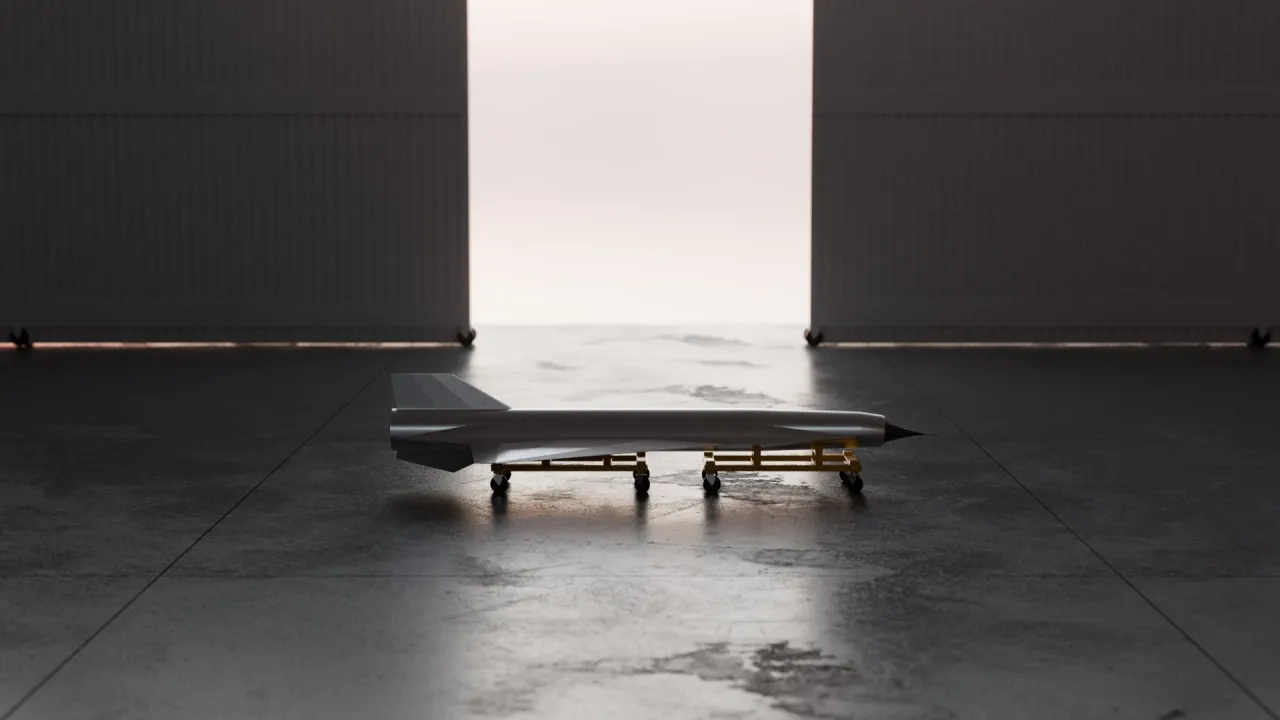
Ramjet-X UAV
The Ramjet-X's launch vehicle is the existing Quarterhorse UAV, previously developed at Hermeus. Promotional materials show the two drones together. In this combination, only the test vehicle remains disposable, while the launch vehicle is returned for subsequent missions after release. This explains the promised cost savings: the expensive upper stage required for each launch is replaced by a recoverable aircraft.
Commercial project
Hermeus is currently finalizing the design of the new UAV and has already begun rig testing of the standard ramjet engine. A fully functional prototype UAV is planned to be assembled and sent for testing in 2027. It is likely that one of the latest versions of the carrier, the Quarterhorse Mk2.2, will be used, expected between 2026 and 2027. A milestone has already been achieved: on July 30, 2026, the Quarterhorse ejected its payload in flight for the first time (at subsonic speed) through its aft ejection system; supersonic ejection is the next step toward Ramjet-X operations.
Following testing and refinement, a fully-fledged unmanned test aircraft system should be developed. Hermeus describes its application model as "Flight Test as a Service": the Ramjet-X flying laboratory receives a ramjet or other propulsion system from the customer, flies according to a specified program, and collects engine performance data.
The company is targeting customers who need testing but find it uneconomical to build their own base. Hermeus itself makes money from the platform and service. The funding context is also worth considering: in May 2026, the corporation expanded its contract with the Defense Innovation Unit (DIU) to $219 million for a high-speed flight demonstration for the US Department of Defense. So, the "commercial" platform is not being developed solely with private funding.
Technical features
The Ramjet-X is a medium-sized fixed-wing UAV with enhanced flight characteristics. Judging by its aerodynamic design and overall appearance, the project draws heavily on the developments of the Quarterhorse series of UAVs.
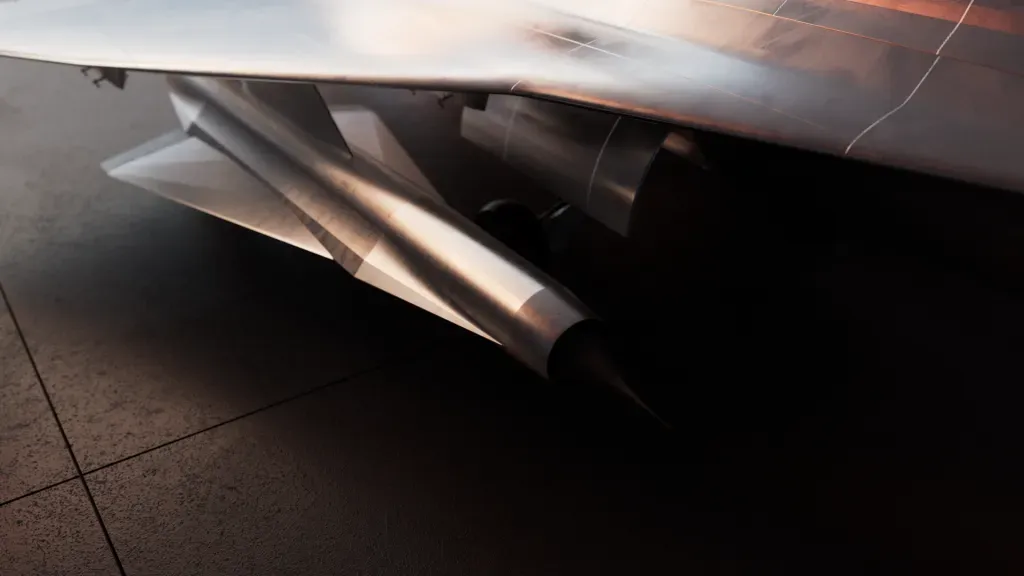
The glider is a tailless design: an elongated fuselage of variable circular cross-section, developed tail fins, and a delta wing. The tail assembly consists of only a vertical stabilizer and a ventral fin; there is no horizontal stabilizer.
The company has disclosed some dimensions: according to the head of Hermeus, the length of the apparatus is approximately 6,7 meters (22 feet), with a transverse dimension of approximately 2,1 meters (7 feet). Whether this refers specifically to the wingspan or the overall width is not specified. The launch weight has not been officially announced; it is estimated that for an expendable apparatus of this size, it could be hundreds of kilograms. The weight and exact dimensions of the Quarterhorse launch vehicle remain undisclosed.
The Ramjet-X has a frontal air intake with a conical central body. This is likely movable, allowing for variable airflow parameters. A ramjet of one model or another is installed in the tail of the fuselage: the design is designed to accommodate various engine types within the available compartment. The physics of the ramjet itself is important here: it has no compressor, and at launch, it does not generate thrust: air compression provides only dynamic pressure. This explains the entire launch vehicle design.
The drone cannot take off on its own. It will be assisted by a launch vehicle to ascend, reach its operational altitude, and accelerate to approximately Mach 3. After release, the Ramjet-X independently maintains and accelerates to Mach 3–4. Reaching Mach 5 hypersonic speed is not planned for the next version, but, according to the developer, it is identified as a future platform objective. Test flights can take place at altitudes of up to 100 feet (approximately 30,5 km).
The device must be equipped with an autopilot for flight according to a preset program; remote control is also possible. Onboard systems must fully control the operation of the propulsion system, regardless of its type. Monitoring and recording equipment or a system for transmitting telemetry to a ground station are required.
For myself and for others
Technically, the Ramjet-X doesn't offer any revolutionary solutions: its layout and performance are not unique. The fundamental difference lies in the concept itself and the company's plans. This drone is designed exclusively for research and will operate both for Hermeus itself and for third-party clients.

The Quarterhorse 2.1 experimental heavy UAV
With this new development, Hermeus hopes to establish a niche and offer a commercial flight testing service for components on a dedicated aerial platform. This offer is expected to be of interest to developers of ramjets and other components for supersonic and hypersonic vehicles—there are many of them, but not all have their own testing facilities.
It's hard to say, however, that there's a complete lack of competition. Stratolaunch already offers a similar service with its Talon-A, a reusable air-launched hypersonic test drone that, by July 2026, had completed more than ten hypersonic flights for government and commercial customers. Hermeus's approach emphasizes expendability and low cost, but the "test-as-a-service" market is no longer empty. However, the contrast itself shouldn't be oversimplified: Hermeus expends only the Ramjet-X itself, while the Quarterhorse launch vehicle is reusable and expensive. Rather, it's a competition between two approaches: a low-cost, expendable test vehicle on a reusable launch vehicle versus Stratolaunch's fully reusable platform.
If the Hermeus concept proves its technical and commercial potential, we can expect the emergence of new platforms and increased competition in this niche, followed by a reduction in service costs. Thus, in the next few years, the process of developing promising aviation and missile The technology landscape could change significantly. The future successes of Hermeus and its competitors will tell just how much.
Information