Flavius Belisarius: the Nika Revolt and the War with the Vandals
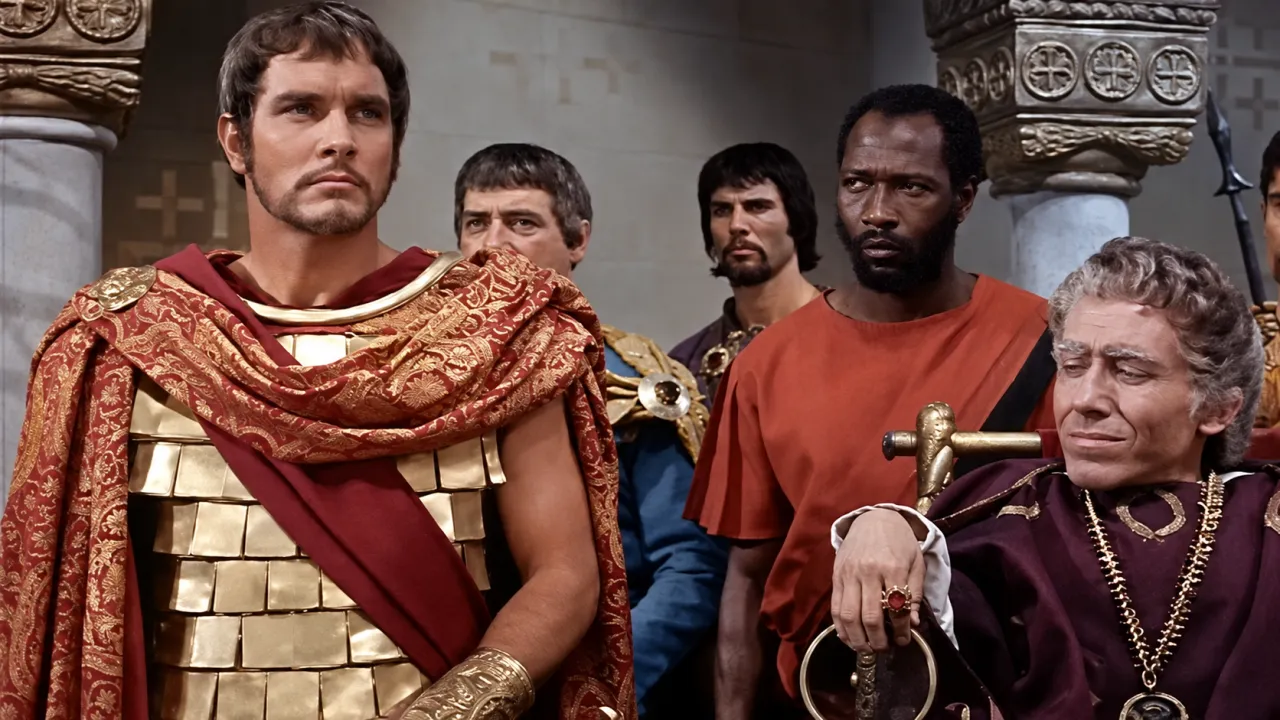
Lang Jeffries as Belisarius. Still from the film "Battle of Rome," 1968-1969.
В previous article We discussed the origins and early military career of the famous Byzantine commander Flavius Belisarius, his acquaintance with the future Emperor Justinian the Great, and his marriage to Empress Theodora's elder friend, Antonina. We concluded this article with a discussion of the causes and beginnings of the Nika Revolt. Today, we'll discuss how this rebellion was suppressed and how Belisarius crushed the North African Vandal Empire.
The Nika Revolt: Theodora and Belisarius
Recounting what happened at the very height of the uprising in the imperial palace, Procopius of Caesarea, who was openly hostile to Theodora, reports her speech at the imperial council as follows:
He who was born cannot help but die, but for one who once reigned, being a fugitive is unbearable. May I never lose this purple robe, may I never live to see the day when those I meet no longer call me mistress! If you wish to save yourself by flight, my lord, it is not difficult. We have plenty of money, the sea is nearby, and there are ships. But be careful that, having escaped, you do not have to choose death over salvation. I like the ancient saying that royal power is the best shroud.

Justinian and Theodora, a still from the film "Primordial Rus"
And this is how Procopius of Caesarea, who hated Justinian and Theodora, is presented in the same film:

Theodora is probably alluding to the words of the Carian ruler Artemisia, who, according to Herodotus, said to Darius before the battle at Salamis:
Royal power is the best shroud.
But perhaps she had in mind the tyrant of Syracuse, Dionysius the Elder, who, being besieged by rebellious citizens, declared (in 403 BC):
Tyranny is a beautiful shroud.

Silva Koscina as Theodora. Still from the film "Battle of Rome" (1968-1969).
The experienced commander Narses agreed with the empress and then, at the risk of his life, managed to enter the Veneti box at the Hippodrome and bribe many senators.
And Justinian made up his mind – he ordered Belisarius, John the Armenian, and Mundus, the Illyrian strategos, to attack the rebels gathered in the hippodrome. Procopius of Caesarea writes of this:
The basileus placed all his hopes on Belisarius and Mundus. One of them, Belisarius, had just returned from the war with the Persians, bringing with him, in addition to a worthy retinue of strong men, a multitude of spearmen and shield-bearers, seasoned in battle and the perils of war. After some thought, he decided to attack the crowd standing in the hippodrome—a countless throng, crowded together in complete disarray. Drawing his sword and ordering others to do the same, he charged at them with a shout. The disorganized crowd, seeing armored warriors renowned for their bravery and battle experience, striking without mercy with their swords, fled.
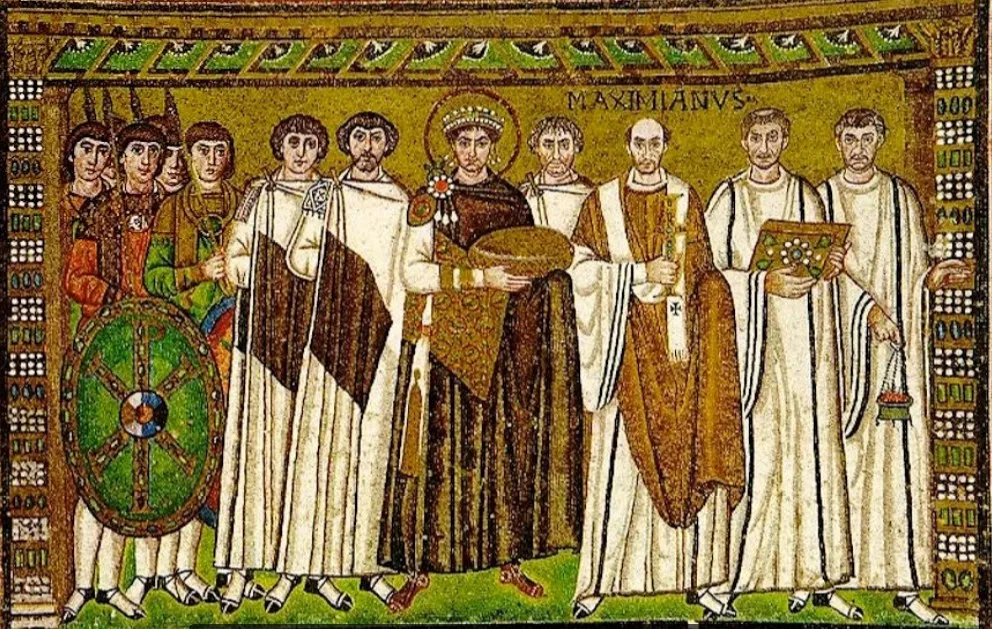
Justinian in the center, Belisarius to his right, Narses to his left, mosaic in the church of San Vitale
It all ended in a terrible massacre in which about 30 thousand people died.
In this picture you see the victorious Justinian, Theodora, Belisarius and Mundus (with a spear):

To atone for the massacre, Justinian announced the start of construction on a new church 40 days later—to replace the basilica erected by Emperor Theodosius II, which had burned down during the uprising. The workforce reached 10, and a sum equivalent to three annual imperial budgets was spent, but on December 27, 537, Patriarch Menas of Constantinople consecrated the new cathedral, Hagia Sophia.

Constantine and Justinian before the Virgin Mary, mosaic on the southern façade of Hagia Sophia:

And the hero of our article in 533 led the army sent by Justinian against the Vandals, who had created their own state on the territory of North Africa and Sicily.
Vandals
The first mention of the Vandals appears in the works of Pliny (1st century AD). Later, Tacitus and Ptolemy wrote about them. Paulus Orosius believed the Vandals were related to the Goths and Suiones (Swedes). The Byzantine historian Procopius of Caesarea, quoted repeatedly in the first article, asserts that the Vandals themselves considered the coast of the Sea of Azov their ancestral homeland and, on their journey north, annexed some of the Alans. Regarding the Vandals' appearance, he says:
They all have white bodies and light hair, they are tall and beautiful in appearance.

Vandals, reconstruction at the Krakow Museum

Vandal Horseman, Mosaic, Bordj Djedid City, circa 500
But Jordanes claimed in Getica that the homeland of the Vandals was Southern Scandinavia.
It is known for certain that from the 1st century AD the Vandals lived in the area between the Elbe and Oder rivers, but perhaps also near the Vistula; the name "Silesia" is derived from the Vandal tribe of the Silingi.
Incidentally, the mountain range separating Bohemia from Silesia was once called the "Vandalic Mountains".
Interestingly, beginning in the 8th century, some German authors began to equate the Vandals with the Wends. Around 990, Gerhard of Augsburg, in his Life of Saint Ulrich, called the Polish prince Mieszko I a Vandal. And the 11th-century chronicler Adam of Bremen claimed that the Slavs had previously been called Vandals. But in this case, we see only a similarity in the names.
The second half of the 2nd century saw the southward movement of another major Vandal tribe, the Silingi. They took part in the Marcomannic War of Germanic and Sarmatian tribes against Rome, and in 174 received permission from Marcus Aurelius to settle in Dacia. The peace treaty with Rome in 271 also recorded the presence of the Silingi. Between 331 and 337, the Vandals were driven out of Dacia by the Goths, and Emperor Constantine permitted them to move to Pannonia on the right bank of the Danube, where they remained for 60 years, supplying Rome with auxiliary troops. But in the 380s, under pressure from the Huns, the Vandals, having annexed some of the Suevi and Alans (who became allies rather than vassals), crossed into Gaul.
In the winter of 406–407, they attacked the Roman provinces, and their enemies blamed the famous general Flavius Stilicho for their invasion, on the grounds that he, the husband of the niece of the Eastern Emperor Theodosius the Great and father-in-law of the Western Emperor Honorius, was of Vandal descent. In 409, the Vandals and their allies crossed the Pyrenees and, within three years, conquered the lands of modern-day Spain and northern Portugal. Orosius reports that here they:
They exchanged their swords for plows and treated the other Romans favorably as friends and allies... There were some Romans among them who preferred the poor freedom among the barbarians to the tax burdens among the Romans.
The Romans did not have the strength for war, but they “set” the Visigoths against the Vandals-Silings and the Alans, in 418 the Gothic king Wallia:
He carried out a massive slaughter of barbarians in the name of Rome. He routed the Silingian Vandals in battle in Baetica. He destroyed the Alans, who ruled the Vandals and Suevi, so thoroughly that when their king, Ataxus, was killed, the few who survived forgot the name of their kingdom and submitted to the Vandal king of Galicia, Gunderic.
Gunderic occupied Baetica, which eventually became Andalusia. In 422, he managed to defeat the Roman army, which included Gothic troops.
The new king, Geiseric, Gunderic's brother, came to power in 428. Procopius of Caesarea writes of him:
Geiseric had an excellent knowledge of military affairs and was an extraordinary person.
Jordanes in his "Acts of the Goths" calls him secretive, taciturn, far-sighted and disdainful of luxury.

Gunderich, portrait by an unknown artist, 1513
It was during the 49-year reign of Geiseric that the Vandals captured and plundered Rome, built a huge fleet, with the help of which they captured Sardinia, Corsica, the Balearic Islands and Sicily, and founded their state on the territory of modern Tunisia, northeastern Algeria and northwestern Libya.

Geiseric made Carthage his capital, entering the Vandals without a fight—while almost all of its inhabitants were at the hippodrome watching the races. As you can see, Carthage wasn't destroyed by the Romans at all: the city only became deserted after the Arab conquest.
Official documents in the Vandal state were written in Latin, and the dominant religion was Arianism. The Vandals came to Africa at the invitation of the Roman governor Boniface, who had rebelled against the central authorities. They never returned to Spain; that territory fell to the Goths.

According to legend, the Vandals were summoned to Rome by Licinia Eudoxia, widow of the Emperor Valentinian (the murderer of the general Aetius) and wife of the new emperor, Petronius Maximus. The Vandal fleet entered the mouth of the Tiber, and from June 2 to 16, 455, Rome was under the victors' control.

Vandals and Moors in Rome in a sketch by K. Bryullov. We see King Geiseric on horseback.
Empress Eudoxia and her two daughters were taken to Carthage, where one of them (her mother's namesake, Eudoxia) married Geiseric's son, Gunaric. After 455, the Vandals occupied the last remaining Roman territories in Africa. In 468, they routed the combined fleets of the Western and Eastern Empires. In 475, the Byzantine Emperor Zeno the Isaurian concluded an "eternal peace" with Geiseric.
Eudoxia and Gunaric's son, Hilderic, favored an alliance with Byzantium and favored Orthodox Christians rather than the Arians. This displeased many, and in 530, Hilderic was deposed by his nephew Gelimer. Emperor Justinian seized on this palace coup as a pretext for an invasion. By this time, the Vandals had already lost their former bellicosity; Procopius of Caesarea, who is familiar to us, called them "the most effeminate" of all the barbarians the Byzantines had fought.
Belisarius against the Vandals

Depiction of Belisarius in the Nuremberg Chronicle, 1493.
This war had been going on since 530, but it was Belisarius who finally and forever defeated the Vandal state, annexing North Africa to Byzantine possessions.
He commanded only 10,000 infantry, about 5,000 cavalry, and a 1,000-strong contingent of federates, consisting of Hunnic cavalry and Herulian infantry. There were only 92 warships, and civilian vessels, crewed by Egyptians, Ionians, and Cilicians, were used to transport troops and equipment. Overall command of the fleet was exercised by Kalonymus of Alexandria.
At that time, a five-thousand-strong detachment of the best Vandal warriors, led by the new king's brother, Tsazon, successfully attacked Sardinia, defeating the Goth Goda, who had betrayed them.
King Gelimer, who was in Africa, made the mistake of attacking Belisarius's forces from three sides: his brother Ammatus's forces advanced from Carthage toward Decimus, with Gelimer's nephew Gibamund on their left, and the king himself deciding to outflank Belisarius's army. In September 533, the Vandals were defeated in battle near Decium (approximately 12 km from Carthage). Ammatus led his force to the city ahead of schedule and was routed by the Byzantine cavalry vanguard of John the Armenian (three hundred of the finest horsemen). Gibamund, who attempted to come to the rescue, was also defeated—his force was routed by the Huns. Among the others, both Vandal commanders were killed.
Unaware of the defeat and death of his relatives, Gelimer and his main forces repelled part of the Byzantine army. However, upon discovering the body of his dead brother in Decimus, he abandoned the pursuit and, immersed in mourning, began preparing for the funeral. Meanwhile, the retreating Romans were stopped by Belisarius, who, in a swift counterattack, routed Gelimer's army as well, and then occupied Carthage.
In December of that year, the Vandals were finally defeated near the village of Tricamere. Pursuing them, Belisarius captured Gelimer, and the African coast from Carthage to the Nile Delta came under Roman control. From the two thousand Vandal prisoners, Belisarius formed five cavalry regiments, known in Byzantium as the Vandali or Justiniani, which were sent to the Persian border. Some Vandals fled to the Gothic kingdoms or northern Algeria, where they gradually interbred with the local population. Many young women were married to Byzantine soldiers, not Romans, but barbarians.
In the next article, we'll continue the story and discuss Belisarius's wars against the Goths in Italy, as well as other battles of this commander. We'll also discuss the final years of his life.
Information