Secrets of an ancient connection

"Lights of Victory", 1931. N. Roerich
"I know what it is!" Alexid said excitedly. "It's a scytale!"
- What, what?
— A letter on a stick! That's how the Spartans communicate secret messages.
- But how do they do it?
— They wrap parchment or fabric, like this one, around a stick, turn after turn, like a bandage, and then they write what they need along the stick, and if you remove the strip, all the letters get mixed up, like here.
— And you can only read them if you wind the strip onto the stick again?
- That's right! On the same stick or on exactly the same one.
“But we don’t know what kind of stick was here,” Corinna said sadly and looked in confusion at the strip of fabric with the letters OANAENOPKTYNTYAYPOEYBPTEINLPURVGYACHLDIDI clutched in her hand.
"The Violet Crown" by Geoffrey Trease
History ancient innovations. History is an instructive thing, as everyone knows, even those who foolishly dismiss it as a science. But this story, which will be told in this article, is doubly instructive, both from a purely historical and informational perspective, and from an educational one. Many people here like to talk about raising children correctly, but what does "correctly" mean, how exactly "correctly," and what means can this "correctness" be achieved in practice? The answer is very simple: create an informational, developmental environment around the child, read books to them so they understand the joy of reading, provide them with interesting children's magazines, and play developmentally beneficial games with them. Clearly, this advice isn't for the majority of our citizens, but our site is full of smart people who wouldn't mind a little extra knowledge in this area—not all of them are teachers, after all.
And then this happens: it was either 1964 or 1966. I already subscribed to the magazines "Young Technician" and "Young Naturalist," but I hadn't yet gotten to the point of "Technology for Youth." Then, one day, I found myself near a newsstand on my way to buy bread and saw behind the glass an unfamiliar magazine, the cover of which featured a bathyscaphe and some kind of fantastical underwater "saucer." The magazine was called "Horizons of Technology for Children." When I bought it, I learned that it was published in Poland, but in Russian.
The magazine was thin, but very interesting. From then on, I bought it regularly, and what I didn't learn from it: about Roman baths, the first elevator, bell casting, the "Turtle" submarine, and the Westinghouse brake. And all of it was presented in literary form! And... there was an article about the Spartan cipher used in Sparta to send secret messages. And in another issue, another article was published, which told the story of... the first-ever ancient Greek water telegraph. Naturally, when we started studying "Ancient World" and ancient Greek culture in fifth grade, I immediately came up with an addendum, retelling the article from this magazine in detail, and, of course, got an "A," even though the teacher had never even heard of it and was very surprised where I learned it.
And this was precisely one of those stones that, even in childhood, lays the foundation of our future destiny. It's not for nothing that they say: sow an action and you reap a habit; sow a habit and you reap a character; sow a character and you reap a destiny. And so, for me, my destiny ultimately boiled down to a variety of creative work, and even more so—those very same articles from the old Polish magazine became the basis for today's historical material!

"The Messenger. One Tribe Rises Against Another." 1897. N. Roerich
So, how did they send and receive messages in Ancient Greece? Often, just like in the painting "The Marathon Man" by the French artist Luc-Olivier Merson (1846-1920), which depicts the moment when a warrior, having completed the "marathon race," falls dead, having only managed to say, "Rejoice! We have won!"

"The Marathon Runner", 1869. Private collection
But how could a message have been transmitted over a distance at that time without sending a messenger? By lighting fires on towers? By sending smoke signals? In any case, you couldn't convey much that way. However, the Greeks figured out how to do it, and thus invented the world's first telegraph, the name of which is composed of two Greek words: "tele" (distant) and "graphein" (writing). True, the Greeks themselves didn't call the device that. We know about this ancient telegraph from the "General History" of the historian Polybius (second century BC), who cited an earlier author, Aeneas Tacticus (a Hellenistic military theorist and author of "On the Art of War"), who was the first to describe it in detail, and perhaps even invented it himself. This point of view is also held.
The device was remarkably simple. Two clay or copper cylindrical vessels of equal length and diameter were used, each containing two pieces of cork wood, allowing them to slide freely vertically. These cork disks had a vertical stand with 24 divisions. Each division could represent an expected or significant event, often quite frequent, such as: "We see enemy ships approaching our shores," the second, "there are many of them," the third, "there are few of them," the fourth, "the ships are disembarking troops," and so on. At the very bottom of these vessels, there would be a drain hole with a tap, exactly the same size for each.

Antique water telegraph, 4th century BC. Reconstruction. Science Center and Museum of Technology, Thessaloniki, Greece
To begin telegraphing, the vessels had to be filled to the brim with water. One transmitted and the other received messages. Day and night, the transmitting station signaled the start of transmission by raising a torch. The receiving station signaled its readiness to receive the message in the same manner. The sender then lowered the torch and simultaneously opened the drain valve, and the receiver did the same. Water flowed out, and the float sank until the desired message, written on a tablet, was flush with the rim of the vessel. At this point, the torch rose again, after which the receiving station immediately closed the valve. Then, all that was needed was to observe the number on the float in the vessel and read the received text.
It was also suggested that the 24 marks actually represented 24 letters of the Greek alphabet, not 24 possible events. Moreover, such a telegraph could easily transmit up to 20 letters per hour. In 2024, experiments demonstrated that such a water telegraph was capable of transmitting up to 50 letters per hour. Moreover, if there were two vessels on each side, operating alternately, the transmission speed would increase even further and could easily reach 150 letters per hour.

A reconstructed model of a water telegraph, with messages attached to the rod. Science Center and Technology Museum, Thessaloniki, Greece
Interestingly, this telegraph was used not only by the Greeks but also by the Carthaginians during the First Punic War. They installed a network of transmitting and receiving stations on high ground and on ships in the Strait of Tunis, allowing for relatively rapid communication between Sicily and Carthage.
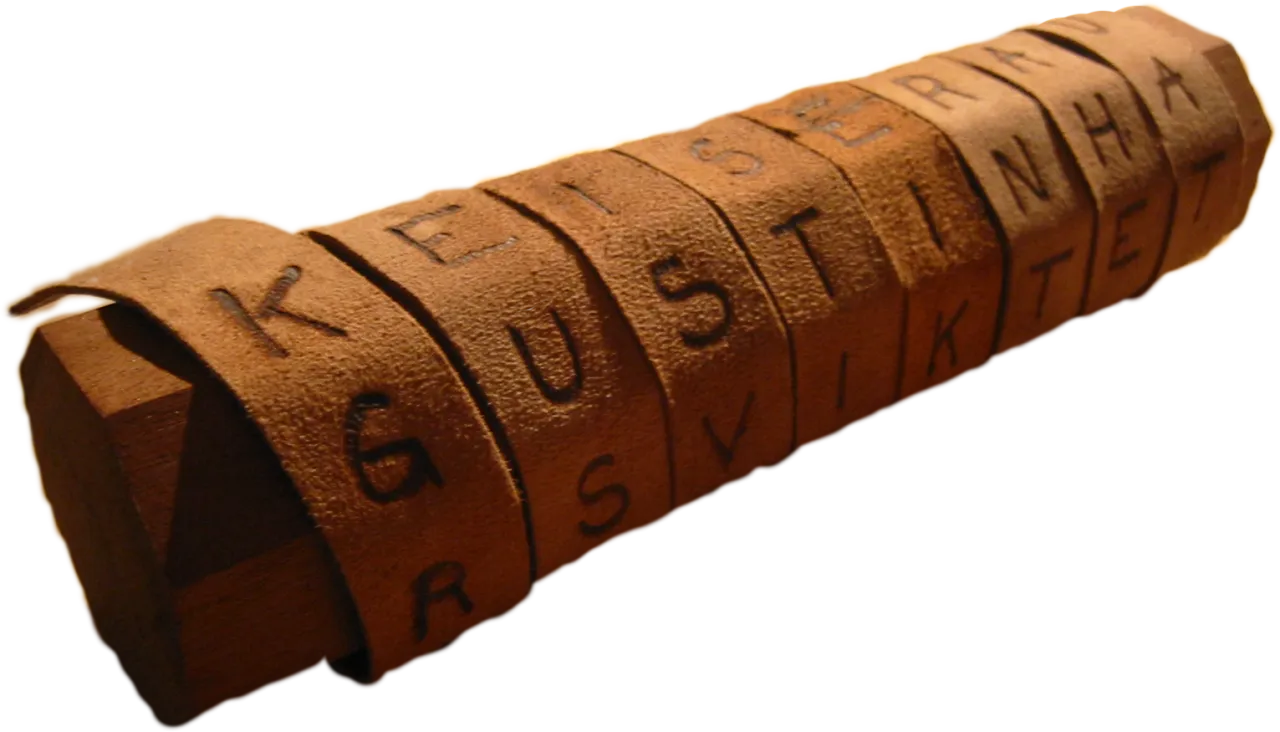
Spartan Scytale
But during war, it's not just necessary to transmit messages over long distances; one must also ensure the security of the messages sent by messengers, meaning encrypting them so that if they fall into enemy hands, they cannot read them. One such method was once again invented by the ancient Greeks – the Spartans, who created a uniquely simple cipher called the scytale ("rod"). In cryptography, it is called the Spartan cipher. Moreover, not only they, but also other ancient Greeks, are believed to have used this cipher during military operations to exchange messages.
The Spartans are believed to have invented it in the 3rd century BC. However, the first known written mention of the word dates back to 650 BC, to the Greek poet Archilochus. 175 years later, it was used by the poet Pindar. It later appears in the plays of the comedian Aristophanes ("The Birds" - 414 BC and "Lysistrata" - 411 BC) and Nikophon ("The Birth of Aphrodite"). The historian Thucydides, author of "The History of the Peloponnesian War," mentions scytale several times as a means of secret writing.

Thucydides. The original bust, a Roman copy (c. 100 CE) of a Greek original from the early 4th century BC, is housed at Holkham Hall in Norfolk, England.
Plutarch (50-120 AD) also describes how the scytales worked:
And this is what a wanderer is. Sending the chief to the duty station fleet When serving in a military or land force, the ephors take two round sticks of exactly the same length and thickness. They keep one for themselves and give the other to the departing soldier. These sticks are called scytales. When the ephors need to communicate an important secret, they cut a long, narrow strip of papyrus, like a belt, and wrap it around their scytale, leaving no gaps, so that the entire surface of the stick is covered by the strip. Then, leaving the papyrus on the scytale as is, they write on it what is needed. Once written, they remove the strip and send it, without the stick, to the general. Since the letters on it are scattered in disarray, without any connection, he can only read what's written by taking his scytale and winding the cut strip around it, arranging its twists in the same order so that, moving his eyes around the stick and moving from one to the next, he has a coherent message before him. The strip of papyrus, like the wooden stick, is called a "scytale," just as the object being measured is called by its measure.
— Plutarch, Parallel Lives (Lysander); trans. M. E. Sergeenko
A modern copy of an ancient bust of the writer Plutarch or the philosopher of the same name. Chaeronea, Greece
A drawback of the scytale was the relative ease of deciphering such cryptography. It was obvious that the strip of text was wound around a "stick" of a specific diameter, which could be neither too small nor too large. Therefore, the message could be deciphered by simply selecting "sticks" of different diameters. However, to do this, one had to have them on hand or roll a piece of leather into a tube, constantly increasing its diameter.
Information