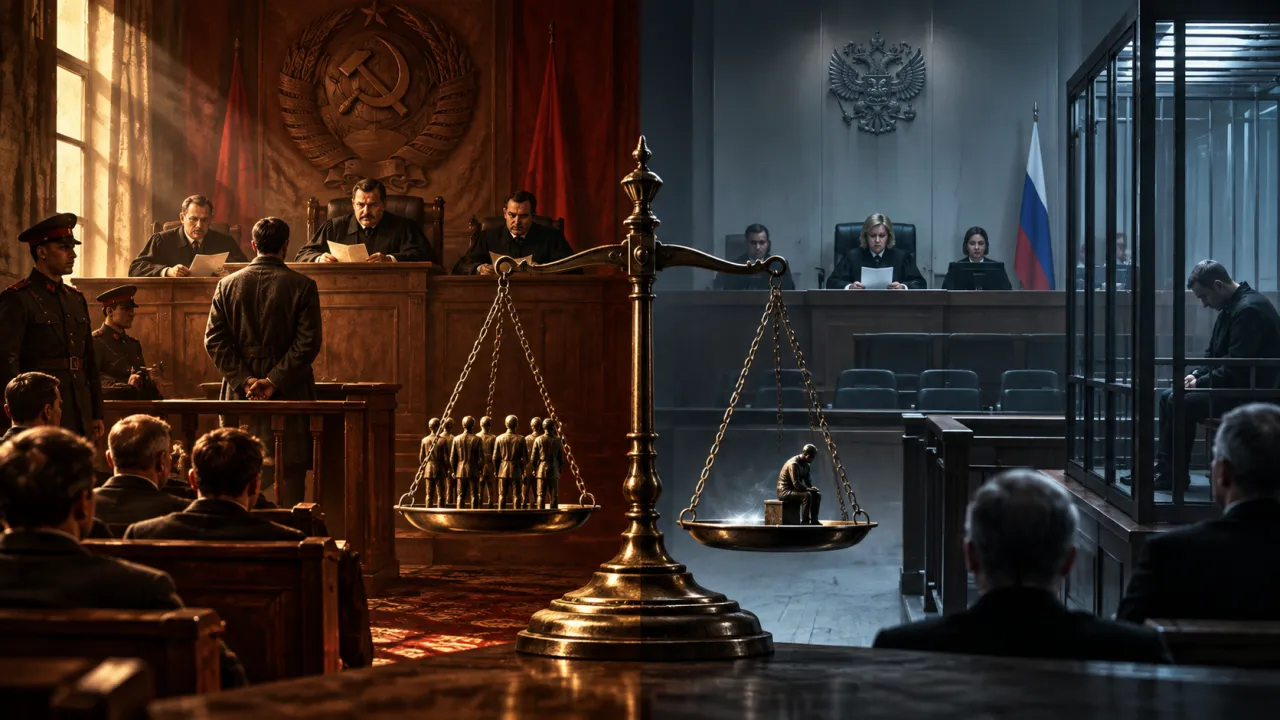
The 1937 paradox: why did the Soviet court acquit more often than modern ones at the height of the repressions?
6 899 75
The 1937 paradox: why did the Soviet court acquit more often than modern ones at the height of the repressions?

It was recently announced that the Supreme Court of Russia has prepared a proposal for jury trial reform. Specifically, this involves reducing the number of jurors to four and consolidating them into a single panel with a professional judge. The presiding judge will then be able to sit with the jurors in the deliberation room and explain the verdict process. Currently, in district and garrison military courts, the panel consists of six principal jurors, and in regional and equivalent courts, it consists of eight.

Interestingly, the institution proposed for significant overhaul already occupies a rather modest place in Russian criminal proceedings. In 2025, Russian courts heard 640,962 criminal cases, with only 643 involving juries—roughly one in every thousand. Even more interesting are other statistics. In the first half of 2025, juries ruled on 444 defendants: 300 were found guilty and 144 were acquitted. The acquittal rate, therefore, was approximately 32%.


In this regard, a completely logical question arises: why did an institution that hears approximately 0,1% of criminal cases, but stands out sharply from the rest of the judicial system in terms of the proportion of acquittals, become the subject of such a major restructuring?

Of course, the reform's initiators have their own explanations. Supreme Court Judge Sergei Zelenin, who presented the concept, says The need to simplify the process, reduce procedural errors, and improve the stability of verdicts. He stated that the current rigid separation between professional judges and jurors was largely borrowed from the Anglo-Saxon model, whereas the proposed system should be built on a unique "social partnership" between professional judges and representatives of society.

However, the very idea of ​​a professional judge's presence in the deliberation room has raised serious objections in the legal community. For example, Svetlana Volodina, President of the Federal Chamber of Advocates, indicates, that the independence of jurors presupposes their independent deliberation of factual issues, whereas the authority of a professional judge inevitably exerts influence on the other members of the panel. In her opinion, in such a case, under the same name, a different form of criminal proceedings is effectively emerging.

This is precisely why acquittal statistics are particularly important here. One of the most paradoxical features of modern Russian criminal justice is that an acquittal by a professional court is extremely rare. Political scientist and volunteer Alexei Zhivov, in particular, has drawn attention to this.

The Supreme Court is preparing a reform of jury trials, which will effectively eliminate them as an institution. Currently, the acquittal rate is 0.24% (zero point twenty-four percent) of all cases. Most of these acquittals were handed down by juries. Just for reference: During Stalin's Great Terror of 1937-38, the acquittal rate fluctuated between 10-13.5%.
- in particular, пишет he.

Following these figures, an interesting paradox emerges: the Soviet court, at the height of the repressions, acquitted more people than modern ones.

Of course, this fact says nothing about the humanity of the Stalinist system as a whole—a significant portion of the terror was carried out outside the scope of ordinary justice. However, it does raise the question of why acquittals have become such an exceptional phenomenon in modern judicial practice.

Where did Stalin's 10% come from?


The figures Zhivov cites for 1937–1938 are indeed not plucked out of thin air. A book by Soviet judicial historian Mikhail Kozhevnikov cites the following figures for the people's courts of the RSFSR: in 1935, acquittals accounted for 10,2% of the total number of those brought to trial, in 1936 – 10,9%, in 1937 – 10,3%, in 1938 – 13,4%, and in 1939 – 11,1%. The same data were later reproduced by researchers. stories Soviet judicial system. Thus, the formula "10–13,5%" itself is practically accurate.

But there's a crucial detail: these are statistics from the People's Courts of the RSFSR, not statistics from the Great Terror itself. Therefore, it might be misleading to believe that every tenth person arrested by the NKVD in 1937 was ultimately acquitted. Nothing of the sort occurred.

The Soviet system of those years existed in two parallel dimensions. On the one hand, ordinary people's courts remained in place, handling a wide range of criminal cases—theft, hooliganism, economic crimes, domestic violence, and other categories. These were the sources of those 10,3% and 13,4%. On the other hand, political repression was carried out through a completely different set of institutions: special NKVD troikas, the Special Conference, the Military Collegium of the Supreme Court, military tribunals, special collegiums, and other bodies. And the statistics there looked completely different.

According to data on the repressive activities of state security agencies, in 1937, decisions were made against 796,613 individuals. 5948 were released. 588,462 individuals were processed through special troikas, of which only 316 were released. In 1938, state security agencies recorded 558,583 decisions. Of these, 328,618 received capital punishment, and 4325 were released by prosecutors and the courts.

Even more revealing are the NKVD's internal statistics for the period from October 1936 to early 1938. The document lists 866,649 cases reviewed, 392,675 death sentences, and 10,193 acquittals—or approximately 1,2%. By comparison, for the previous period from January 1935 to September 1936, out of 234,334 cases reviewed, there were 28,742 acquittals.

Therefore, the claim that "during the Great Terror, 10-13% of defendants were acquitted" without further explanation is somewhat misleading. It's more appropriate to put it another way: in 1937-1938, ordinary people's courts of the RSFSR continued to acquit approximately one in ten defendants, despite the fact that a completely different system of mass repressions was operating in parallel.

And it is precisely this circumstance that makes the comparison with modern times interesting.

Two judicial realities


At first glance, a contradiction arises. How can a state that conducts mass repressions simultaneously maintain a relatively high acquittal rate in ordinary courts?

In fact, one does not contradict the other.

A significant portion of the cases heard by people's courts had nothing to do with political repression. These courts handled a vast array of ordinary crimes, economic violations, and domestic disputes. Furthermore, Soviet criminal proceedings in the 1930s were structured differently than they are today: the stages of the preliminary investigation, the role of the prosecutor's office, the procedure for referring a case to court, and the very structure of the judicial system were all different.

A peculiar duality emerged. On one level, the ordinary court continued to function, capable of returning cases, dismissing proceedings, and acquitting defendants. On the other, an extraordinary repressive apparatus operated, to which normal legal standards were practically inapplicable.

That's precisely why 10,3%, by itself, doesn't make the Soviet system of 1937 any more humane or freer. However, these figures nevertheless raise another question: why, after almost nine decades, does an acquittal in a regular professional court no longer occur in ten cases out of a hundred, but in about two out of a thousand?

Why modern courts almost never acquit


There is no clear answer to this question among Russian lawyers.

Moscow State University Professor Leonid Golovko, for example, cautions against drawing too blunt a conclusion about a "prosecution bias" solely from the acquittal rate. He points to the structure of the Russian criminal process: a large number of cases are eliminated before sentencing, a significant portion of defendants plead guilty, and special case-trial procedures and other procedures are used that effectively eliminate a full-fledged dispute over guilt.

The late Professor Ilya Petrukhin of the Institute of State and Law of the Russian Academy of Sciences, a renowned Russian expert on criminal procedure, cited the decline in evidentiary standards, shortcomings in preliminary investigations, the professional solidarity of various elements of the law enforcement system, and pressure from the prosecution on the court as reasons for the low number of acquittals. He continues to be frequently cited in modern legal literature.

Some lawyers attribute the low acquittal rate not to any one factor, but to the structure of the entire system—from the criteria for evaluating the work of investigators to the mechanisms for forming the judiciary and the nature of the court's interaction with law enforcement agencies.

There is also a simpler institutional explanation.

By the time a criminal case reaches court, it has already been reviewed by the investigator and prosecutor. An acquittal in such a situation effectively amounts to an admission that the charges, having undergone several stages of verification, were insufficiently proven. Legal researchers note that an acquittal inevitably raises questions about the quality of the preliminary investigation and the work of the prosecutor's office. This may be why the gap between 0,24% and 32% is so wide.

But even here, caution is warranted. Cases assigned to juries differ from the average criminal trial population in both the severity of the charges and the defendants' positions. Therefore, mechanically comparing the two figures and concluding that juries are "130 times fairer" would be inaccurate.

The gap shows something else: The decision-making mechanism between a professional judge and a panel of citizens produces fundamentally different results.

Conclusion


On the one hand, the Supreme Court has declared clear goals: to simplify the cumbersome procedure, address the jury shortage, reduce the number of overturned verdicts, and make verdicts more stable. Moreover, among the proposals is a measure directly aimed at protecting acquittals—reducing the grounds for overturning them. On the other hand, the professional judge must find himself back inside the very same deliberation room from which he has been excluded until now, precisely for the sake of jury independence. How the statistics will change in this situation—no one can reliably say today.

At the same time, as already noted, in modern Russia, jury trials account for approximately one in every thousand criminal cases. This tiny segment of the system also remains a place where the words "not guilty" are heard incomparably more often than in a regular criminal trial.

And in this sense, the historical comparison with 1937 takes on a somewhat different meaning than it might initially seem.

This doesn't prove that Stalin's justice system was more humane than today's. The paradox lies elsewhere. Even in a country experiencing one of the most repressive periods in its history, ordinary people's courts continued to deliver acquittals in approximately one in ten cases. In the modern system, such an outcome has become a statistical rarity.

There is currently no clear answer to the question “why did this happen?”
75 comments
Information
Dear reader, to leave comments on the publication, you must sign in.
  1. + 23
    1 October 2026 04: 41
    However, the jury will essentially be working under the supervision of a judge. Madhouse. But it's clear who's preparing this "reform" – the Supreme Court!!! If it's adopted, we won't have a jury trial; we'll have a judge and four nodders.
    1. + 19
      1 October 2026 06: 30
      There is currently no clear answer to the question “why did this happen?”

      The answers exist, and they were long ago provided by the author of the current jury trial law, Sergei Anatolyevich Pashin. Specifically, Sergei Anatolyevich has repeatedly emphasized in his numerous interviews that we don't have a judicial branch as such; we have a system of punishment, an element of which is the trial, where the judge and prosecutor are essentially parts of a single organism. To confirm this, it's enough to look at how many current judges come from the prosecutor's office or the Ministry of Internal Affairs, and how many, for example, from the bar. Moreover, for prosecutors, their time in the supervisory agency is also counted toward their overall length of service as a judge. But even if a judge isn't a blue-uniformed officer, they often nonetheless support the department's position, citing the fact that "they were working people," and also the fact that otherwise a conflict could arise between the court and the prosecutor's office, which, of course, no one wants. Therefore, it's simply more profitable for judges to satisfy the demands of the state prosecution than to try to get to the truth. Particularly moral judges, as Pashin asserts, seeing the inadequacy of the prosecution's position but unwilling or afraid to point it out to prosecutors, try to impose sentences below the minimum limit. However, this practice is far from universal. As a result, we have a situation where, thanks to this "symphony of powers," the presumption of innocence has been replaced in the courts by the presumption of guilt, where it is not the prosecutor who must prove the defendant's guilt, but the defendant who is forced to prove their innocence. By its very nature, jury trials, lacking such a close "fusion" with the oversight body, have thus far been at odds with this harmonious picture. Apparently, those at the top decided that, following the advent of parliamentarism, it was time to abolish this "misunderstanding" of the democratic reforms of the 90s, which so clearly undermined the traditional values ​​of silence and lawlessness. But since they cannot directly abolish jury trials, as that would mean publicly revealing their true nature, a decision was made to reform them, aimed at indoctrinating jury trials into the unified professional ethics of the modern Russian judicial system. This is all very sad, especially considering that one of the issues considered by juries was cases of excessive self-defense, meaning proving citizens' right to defend themselves, their families, and their homes will soon become even more difficult.
      1. -8
        1 October 2026 07: 13
        Quote: Dante
        but not wanting or afraid to point this out to prosecutors,

        A beautiful formula - but wrong request .
        The prosecutor's office has absolutely no leverage over the court—on the contrary, the court is undermining the prosecutor's office and the investigation. And the investigation is trying to determine the judge's position on a specific issue.
        1. +5
          1 October 2026 07: 41
          The prosecutor's office has absolutely no leverage over the court; on the contrary, it is the court that is damaging the performance of the prosecutor's office and the investigation.

          This is one connection, as of today...
          Dante (Kirill):
          that we don't have a judicial authority as such; we have a system of punishment, an element of which is the trial, where the judge and the prosecutor are, in essence, parts of a single organism.

          Exactly, nothing changes, but even this bothers someone...
          Therefore, it is simply more profitable for judges to satisfy the demands of the state prosecution than to try to get to the bottom of the truth.

          That's right, while some judges are overloaded with work, others keep rescheduling completely empty cases so that their "work" can be seen...
          1. -6
            1 October 2026 07: 50
            Quote: Dedok
            This is one connection, as of today..

            No. These are fundamentally different things, and there's a constant war between the courts and the prosecutor's office—higher courts overturn lower court decisions based on appeals from the prosecutor's office (which ranks second in terms of the number of appeals after individuals and legal entities).
            And the judges are faced with a large number of cancellations.
            And - significantly more often than not, investigators and prosecutors are hit by the courts.
            So to say that they are tied together is to talk about one bundle of "a man tied to a bear" (c)
            1. +4
              1 October 2026 07: 51
              No, these are different things.

              What I see in my region is the same thing...
              1. -9
                1 October 2026 07: 53
                Quote: Dedok
                No, these are different things.

                What I see in my region is the same thing...

                Do you know the number of cases dismissed by the prosecutor's office or cases dismissed by the court?
                If not, then this is a discussion at the level of "Neighbor Katya is a slut!!! Why??? She wears heels..." (C) from the old ladies in the entrance hall.
                1. +6
                  1 October 2026 07: 56
                  I have to go there, communicate, and the picture is bleak...
                  and % think others
                  1. -7
                    1 October 2026 08: 06
                    Quote: Dedok
                    I have to go there, communicate, and the picture is bleak...
                    and % think others

                    Communication between them ("Oh, hello, Comrade Prosecutor! You're looking good today...") and a reduction in bonuses or even resignation are two very different things.
                    And yes, the courts of Moscow/Krasnodar Krai and the courts of Uryupinsk are very different. Extrapolating Moscow to the entire country is like trying to stretch a globe onto an owl. lol
                    1. +5
                      1 October 2026 08: 15
                      Extrapolate Moscow to the entire country - it's like trying to pull a globe onto an owl

                      And who decides: "to be or not to be" - Uryupinsk???
                      1. -7
                        1 October 2026 08: 23
                        Quote: Dedok
                        Extrapolate Moscow to the entire country - it's like trying to pull a globe onto an owl

                        And who decides: "to be or not to be" - Uryupinsk???

                        So what? Moscow decides, but relations in the provinces are completely different.
            2. +4
              1 October 2026 11: 30
              Quote: your1970
              There is a permanent war between the courts and the prosecutor's office
              It turns out that establishing the truth is a secondary objective. The primary objective is war, apparently for power and money.
              Quote: your1970
              And the judges are faced with a large number of cancellations.
              According to you, the penalties aren't for unjustified cancellations, but simply for the sheer number of cancellations. Or perhaps, on the contrary, there are too few? Take the Dolina case, which speaks volumes about the low level of professionalism in the justice system.
              The author of the article so frequently mentions the "repressions" in Stalin's USSR that, given the low rate of acquittals, one might conclude that this is being done to launder the current justice system. Because it is precisely this system that is repressive. First and foremost, for ordinary citizens who do not serve this worthless, bourgeois or thieving regime.
              1. -5
                1 October 2026 11: 46
                Quote: VasAndr
                Take the Dolina case, which speaks to the low level of professionalism in the justice system.

                The Dolina case is extremely specific – for about a decade, courts have sided with people deceived by fraudsters.
                Now the situation will be reversed: citizens deceived by scammers in a civil case will go to hell. And the hope that the scammers will be caught and jailed is quite slim.
                Quote: VasAndr
                The author of the article so frequently mentions the "repressions" in Stalin's USSR that, given the low percentage of acquittals, one can conclude that this is being done to launder the current justice system.

                Have you tried reading the article? Author REVERSE PRAISE Stalin's times pointing to MORE the number of acquittals is higher than now
        2. +8
          1 October 2026 10: 08
          The prosecutor's office has absolutely no leverage over the court.

          The prosecutor's office does not have any legal leverage over the court, but it does have a wealth of extra-legal means, including the notorious "corporate ethics." It's not for nothing that I mentioned above the prevalence of former prosecutors in the judiciary over experienced lawyers, who thus constitute the second-largest category of judges (the first and largest (up to 60-65%) are those who came from the court apparatus itself, i.e., former judicial assistants, clerks, etc.). What can I say? Just remember where the current Supreme Court Chairman came from, and everything will become clear.
          The court - on the contrary, it is the court that spoils the performance of the prosecutor's office and the investigation

          What's wrong with that? 0.24% acquittal rate? That's not even funny; it's a statistical error. Although there's also the issue of issuing arrest warrants, choosing the measure and duration of pretrial detention, where, I admit, there may be some discrepancies. But the article and the discussion are still talking about the final number of upheld decisions, not the work that preceded them.
      2. +4
        1 October 2026 14: 11
        This is all very sad, especially when you remember that one of the issues considered by the jury was cases of excessive self-defense, which means proving citizens' right to independently defend themselves, their families, and their homes will soon become even more difficult.


        This is truly true. It's impossible to look at the modern justice system without sadness. The quality of work by supposedly independent investigators and prosecutors is simply depressing. And given today's resources, it's as if they recruit based on illiteracy, inability, and unwillingness to establish the truth.

        The debate over establishing objective, absolute truth has disappeared as such... now formal, legal truth reigns supreme... simply put, truth is what emerges as a result of the contest between the parties. And now guess who's calling the shots here... add to this the supposed immunity of attorneys and witnesses, medical and banking secrecy, and other advances...
      3. 0
        7 October 2026 09: 10
        Nowadays, a suspended sentence is considered an excuse.
    2. +6
      1 October 2026 06: 52
      To be honest and forthright, Russians have accumulated many questions not only for representatives of the right-left judiciary, but also for all other branches of government.
      The semblance of a campaign to combat corruption in the judiciary has been carried out over the past five years.
      One of the most high-profile corruption scandals in recent years in the Russian judicial system was the case of Viktor Momotov, Chairman of the Council of Judges of Russia and former judge of the Supreme Court of the Russian Federation.
      But all this is just the tip of the iceberg, which was revealed on September 24, 2025, with the appointment of former Prosecutor General I. Krasnov as Chairman of the Supreme Court of the Russian Federation, with whose arrival dozens of judges lost their judicial robes.
      1. +2
        1 October 2026 10: 07
        Quote: ZovSailor
        Russians have accumulated many questions not only for representatives of the right-left judiciary, but also for all other branches of government.

        Here is a relatively recent index of citizens' trust in Russian government institutions.
        https://wciom.ru/ratings/dejatelnost-obshchestvennykh-institutov/

        And this picture essentially confirms the collapse of the country's judicial system; no one believes in it and no one trusts it.
  2. +3
    1 October 2026 05: 00
    Yes, there were indeed some mistakes in the Soviet justice system before WWII. They sometimes lined up the wrong people against the wall, and clearly didn't line up enough. Look how many future policemen later joyfully welcomed the Germans and went to serve them. You say, "But what about the military?" Well, Stalin foresaw the possible emergence of biathlon on tachankas, in the cavalry, and on tanks, and launched a preemptive strike against the Red Army's generals...
    So then, after four years of fixing everything, they reached Berlin. And after WWII, the Soviet court sent to camps those who hadn't been sent before WWII. And it was as if they had predicted it! They were just waiting for the Germans and served the Germans throughout WWII.
  3. +9
    1 October 2026 05: 01
    Quote: ANIMAL
    But it is clear who is preparing this “reform” - the Supreme Court!!

    smile
    Are you sure?
    Behind the Supreme Court stand more senior comrades...whose names cannot be mentioned.
    I have accumulated very unpleasant questions about the Russian judicial system.
  4. 0
    1 October 2026 05: 44
    This topic is far from my understanding. I only know one thing: any trial must be under the watchful eye of the public. And when it comes to jury trials, the public plays a significant role. Any report of telephone or other communication between jury members and the defendants' families could result in the entire jury being dismissed. Good health to all.
  5. +7
    1 October 2026 05: 53
    In a state where power belongs to the people, at least on paper, a jury trial should be the right of every defendant. This provides at least some hope of an acquittal. The prosecutor will have to work hard to prove the defendant's guilt. The presence of a judge in the deliberation room will put pressure on the jurors and reduce their independence in decision-making.
    1. +2
      1 October 2026 07: 35
      This gives at least some hope acquittal.

      objective consideration...
      The presence of a judge in the deliberation room will put pressure on the jury and reduce their independence in making their decision.

      but as it is said:
      The presiding judge will be able to be with the jurors in the deliberation room and give them explanations regarding the procedure for rendering a verdict.

      I just want to say, yes, it’s better to let AI judge than this whole murky scheme....
      1. +3
        1 October 2026 08: 56
        An objective trial is only possible if the jury is completely impartial. This is only possible through a careful selection of candidates. First and foremost, it is necessary to ensure that the candidates do not have relatives or friends of victims of the crime being proven. Much, of course, will depend on the integrity of the juror candidates themselves.
        1. 0
          1 October 2026 11: 28
          The Sopranos series does a good job of showing how the mafia works with juries.
      2. +2
        1 October 2026 10: 56
        Quote: Dedok
        I just want to say, yes, it’s better to let AI judge than this whole murky scheme....

        I agree, aside from the Terminator movie, AI is present in Isaac Asimov's stories, and there, its functions are aimed precisely at the development of humanity, not its destruction. Primarily, it ensures the operation of laws. hi
        1. +1
          1 October 2026 11: 00
          Why did I write this? Some of the judges "don't listen to what's being said to them on the phone" and are receiving so many cases that their hearings are still going on until the evening of December 30th...
          and others "hear" and, to show their busyness, are busy with postponing matters that can easily be completed in one meeting...
  6. +6
    1 October 2026 06: 30
    [quote]According to data on the repressive activities of the state security agencies, in 1937 decisions were made against 796,613 people. 5948 were released. 588,462 people passed through special troikas, of which only 316 were released. In 1938, the state security agencies recorded 558,583 decisions. Of this number, 328.618 people received the death penalty, and 4325 people were released by the prosecutor's office and the courts.[/quote] It is imperative to once again launch the hackneyed myth about hundreds of thousands, etc., etc. So it turns out to be 328,618 thousand in 1938, and add 353.074 in 1937, which comes to 681.692 thousand. in two years. But in February 1954, Rudenko et al., in a report addressed to Khrushchev, cited the figure of 642,980 people sentenced to capital punishment (CMP) for the period from 1921 to February 1954!? Something doesn't add up here? But then things started to pile up, depending on who got more. Already in 1956, an MVD report listed 688,238 people executed not sentenced to CMP, namely, those executed from among those arrested on charges of anti-Soviet activity during the period 1935-40 alone. That same year, Pospelov's commission cited the figure of 688,503 executed during the same period. In 1963, the Shvernik Commission's report cited an even higher figure: 748,146 people sentenced to capital punishment for the period 1935-1953, 631,897 of whom were executed in 1937-38 by decision of extrajudicial bodies. In 1988, a KGB report presented to Gorbachev listed 786,098 people executed in 1930-55. Finally, in 1992, a report signed by the head of the Department of Registration and Archival Forms of the IBRF for 1917-90 reported information on 827995 people sentenced to capital punishment for state and similar crimes. Yeah, well, never mind, as one leading Nazi said [quote] "These gentlemen proceeded from the correct calculation that the more monstrous you lie, the sooner they will believe you. Ordinary people are more likely to believe a big lie than a small one. This corresponds to their primitive soul. They know that they themselves are capable of lying in small things, but they would probably be embarrassed to lie very deeply. A big lie simply would not even occur to them. That is why the masses cannot imagine that others are capable of such a monstrous lie, such a shameless distortion of facts. And even when it is explained to them that we are talking about a lie of monstrous proportions, they will still continue to doubt and will be inclined to believe that, perhaps, there is a grain of truth here. That is why virtuosos of lies and entire parties built exclusively on lies always resort to precisely this method. These liars know this characteristic of the masses very well. Just lie as deeply as possible - something of your lie will remain." [quote]It does not prove that Stalin's justice was more humane than today's[/quote] Perhaps it was not... but the fact is that the judges were called, people's judge Such and such. Judges in the USSR were elected by the population or by the respective Soviets of Workers' Deputies. This was the principle of socialist justice: judges at all levels of the judicial system and assessors were elected. Now judges are appointed. The procedure for appointing judges in the Russian Federation depends on the court's level. This is enshrined in Article 6 of the Law of the Russian Federation of June 26, 1992, No. 3132-1 (as amended on April 9, 2026) "On the Status of Judges in the Russian Federation." Judges of the Supreme Court of the Russian Federation are appointed by the Federation Council of the Federal Assembly of the Russian Federation upon the nomination of the President of the Russian Federation; nothing can be done about this. Judges of cassation courts of general jurisdiction, appellate courts of general jurisdiction, arbitration courts of districts, and specialized arbitration courts are appointed by the President of the Russian Federation upon the nomination of the Chairman of the Supreme Court. No comment. Judges of other federal courts of general jurisdiction are appointed by the President of the Russian Federation upon the nomination of the Chairman of the Supreme Court of the Russian Federation, which is sent to the President of the Russian Federation no later than 30 days from the date of receipt of the nomination from the chairman of the relevant court for the recommended person to the judicial position. Judges of arbitration courts are appointed by the President of the Russian Federation upon the recommendation of the Chairman of the Supreme Court of the Russian Federation, which is sent to the President of the Russian Federation no later than 30 days from the date of receipt of the recommendation from the chairman of the relevant court regarding the appointment of the recommended person to the judicial position. Judges of military courts are appointed by the President of the Russian Federation upon the recommendation of the Chairman of the Supreme Court of the Russian Federation, subject to a positive conclusion from the High Qualification Collegium of Judges of the Russian Federation. So, without the president's approval, a judge is not a judge, that's how it is. what
    1. -8
      1 October 2026 07: 39
      Quote: Unknown
      That judges were called "people's judges." Judges in the USSR were elected by the population or by the corresponding Soviets of Workers' Deputies. This was the principle of socialist justice: judges at all levels of the judicial system and assessors were elected. Now judges are appointed.

      You seriously Do you think so?
      Law of the RSFSR of July 8, 1981 On the Election of District (City) People's Courts of the RSFSR
      "Candidates for people's judges from work collectives are nominated at general meetings of work collectives, convened jointly by trade union committees and the administration of enterprises, institutions, and organizations. In large work collectives, meetings may be held by workshops, sections, departments, shifts, teams, and other divisions of enterprises, institutions, and organizations.

      Meetings of military personnel to nominate candidates for people's judges are convened by the military unit command. If it is impossible to hold a general meeting of military personnel, meetings are held by subdivisions.

      The regiment commander called his eagles together and said, "Nominate a candidate!!!" And the conscripts immediately nominated a candidate?

      And yes, the longevity of a state's existence directly depends on its system of government. Since the USSR perished, the system of government was crappy. MSG joined the party back in Stalin's time.
      1. +4
        1 October 2026 09: 43
        Quote: your1970
        Do you seriously think so?
        Law of the RSFSR of July 8, 1981 On the Election of District (City) People's Courts of the RSFSR

        Yes, I think so. and it corresponds to reality, because I myself participated in the voting for the selection of judges and I don’t remember anyone exerted pressure on me. And also, people's assessors of district and city people's courts were elected at citizens' meetings at their places of work or residence. by open vote As a juror, he has the right to express a dissenting opinion regarding the verdict in writing, stating specifically what he disagrees with. He also has the right to propose his own solution to the disputed issue. Judges were extremely reluctant to go against the opinion of one or both jurors, as their superiors looked askance, and higher authorities scrutinized the case more closely—I know what I'm talking about.
        Quote: your1970
        The regiment commander called his eagles together and said, "Nominate a candidate!!!" And the conscripts immediately nominated a candidate?
        It happened, but... a soldier will always find a way to get out of the service. And the commander could get a dressing down for such outrageous behavior.
        And yes, the longevity of a state's existence directly depends on its system of government. Since the USSR perished, the system of government was crappy. MSG joined the party back in Stalin's time.
        What a crappy system, we'll see, the best is yet to come. As for the hunchback, under Comrade Stalin, many leaders tried to join the party, Vlasov for example. But they ended their wretched lives in different ways: some on the gallows, some against the wall—that's the difference between now and then. good
        1. +4
          1 October 2026 10: 17
          Since the USSR perished, the system of power was crappy, MSG joined the party under Stalin.

          What a crap system...

          hi
          Yes.
          Fig
          the system was:
          the first human civilization in Mesopotamia,
          in Ancient Egypt,
          in Ancient Rome,
          in the Mayan civilization,
          Byzantium... laughing laughing laughing
          1. -1
            1 October 2026 11: 34
            Quote: Edward Vashchenko
            Since the USSR perished, the system of power was crappy, MSG joined the party under Stalin.

            What a crap system...

            hi
            Yes.
            Fig
            the system was:
            the first human civilization in Mesopotamia,
            in Ancient Egypt,
            in Ancient Rome,
            in the Mayan civilization,
            Byzantium... laughing laughing laughing

            They all existed for several hundred years—that's what makes the USSR so different from them. People who lived under the Tsar were already dying. AGAIN(!!!!) under capitalism.
            The neighbor in the communal apartment was born in 1904 and died in 1999.


            Quote: Eduard Vaschenko
            the system was:
            the first human civilization in Mesopotamia,
            in Ancient Egypt,
            in Ancient Rome,
            in the Mayan civilization,
            Byzantium..

            There, no one squealed or said, "But under KusiBok, socialism was already wrong and there were no more communists!!!! Eh" (c)
            If the USSR had lasted at least 200 years, your list would be more complete.
            Take the banal example of the USA - they have been "rotting" for at least 70 years, but they haven't really started rotting yet.
            Neither Bush Jr. nor Obama (who spent 4 times more time on the golf course than at his desk) were able to even slightly destroy the United States.
            And as usual, we are hanging over the abyss and wondering - will this ruler kill the country or not, will he be a good one for the next one - or just another "voluntarist with blood under his fingernails" (c)??!!
            But you can continue to consider the USSR a stable system capable of withstanding any adversity under any leader....
        2. -3
          1 October 2026 11: 18
          Quote: Unknown
          And the commander could have gotten a dressing down for such antics.

          Because the law provides for the nomination of candidates from military units?

          Quote: Unknown
          Yes, I think it is true,

          And you continue to think that if now Also, if the people elected judges through open voting, everything would have been fine?
          And yes, was a legal education a requirement for candidates, or could anyone just be nominated? I know that the assessors lacked legal training, but what about the judges?
          1. +2
            1 October 2026 12: 09
            For interfering in the elections, telling people who to vote for. I also served in the Soviet Army from 82-84, so don't tell me fairy tales. Yes, I think it would have been nice. The judges had legal training...but there were several candidates, the choice is yours.
            1. -3
              1 October 2026 12: 45
              Quote: Unknown
              The judges had legal education...but there were several candidates, the choice is yours.

              There were 4 law institutes in the entire country (one of them was correspondence) and 7 universities had law departments.
              And are you serious about several candidates or about knowing them - with such meager number of lawyers?
              They brought us a candidate from Saratov to the regional center, voted for him, and that's it - a people's judge is ready.

              Quote: Unknown
              For interfering in the elections, telling people who to vote for. He also served in the Soviet Army in 82-84, so don't tell me any fairy tales. belay narrate
              and where do I tell stories - if the law provided for it -
              Quote: your1970
              Meetings of military personnel to nominate candidates for people's judges are convened by the command of the military unit.

              1. +3
                1 October 2026 18: 05
                Quote: your1970
                There were 4 law institutes in the entire country (one of them was a correspondence course) and 7 universities had law departments.

                I'm convinced you're engaging in criticism—which often disguises itself as "concern" or "honesty." In the USSR, there were over 40 law faculties at state universities. That is, the network of legal education in the country was quite extensive.
                Quote: your1970
                and where do I tell stories - if the law provided for it -
                Quote: your1970
                Meetings of military personnel to nominate candidates for people's judges are convened by the command of the military unit

                Convened , and not by order, can you feel the difference or what?
                1. -2
                  1 October 2026 18: 16
                  Quote: Unknown
                  It is convened, and not by order, is there a difference or what?

                  Have you often seen Polkans? conveners meeting, and not by order of those sending them?
                  I haven't encountered anything like this in my 7 years of service in the army....

                  Quote: Unknown
                  In the USSR, there were more than 40 law faculties in state universities.

                  They talked me into it—that's why there were practically no people with legal training in the police department—mostly from police academy. There were lawyers everywhere...

                  Quote: Unknown
                  I'm convinced you're engaging in criticism, which is often disguised as "concern" or "honesty."
                  Let me remind you that in the USSR, lawyers were of no use to anyone—they weren't trained en masse. There were no law firms, no merchandisers, notaries were permanent fixtures, and organizations had no need for legal departments. Let me repeat:
                  Quote: your1970
                  There were 4 law institutes in the entire country (one of them was correspondence) and 7 universities had law departments.
                  1. +3
                    1 October 2026 21: 29
                    Quote: your1970
                    Have you often seen colonels calling meetings, rather than sending people to them by order?
                    I haven't encountered anything like this in my 7 years of service in the army....

                    I came across some during my two years of service.
                    Quote: your1970
                    They talked me into it—that's why there were practically no people with legal training in the police department—mostly from police academy. Lawyers were everywhere...
                    No need to talk nonsense, I have a good friend, a former cop, and he graduated from the law faculty of BSU and was not alone there.
                    Quote: your1970
                    Let me remind you that in the USSR, lawyers were of no use to anyone—they weren't trained en masse. There were no law firms, no merchandisers, notaries were permanent fixtures, and organizations had no need for legal departments. Let me repeat.

                    No need to repeat myself; apparently, you know life in the USSR from hearsay and post-Soviet myths. Every enterprise had its own legal consultants. Incidentally, there were plenty of notaries in Soviet times, and they had legal training, not to mention the legal profession, which also existed and was quite large. In the USSR, there were more than 40 law faculties in state universities.
                    1. -2
                      1 October 2026 22: 55
                      Quote: Unknown
                      I came across some during my two years of service.

                      You're lucky

                      Quote: Unknown
                      By the way, there were plenty of notaries in Soviet times, and they had a legal education.

                      Of course -
                      Quote: your1970
                      the notary sat in his place forever


                      Quote: Unknown
                      No need to repeat myself, apparently you know life in the USSR from hearsay and post-Soviet myths

                      Well, of course, you're right, it's purely based on hearsay and post-Soviet myths.
                      Exclusively.....

                      Quote: Unknown
                      Not to mention the legal profession, it also existed and was not small.

                      "In 1989, the number reached 27,7 thousand lawyers (the country's population was then about 286,7 million people).
                      That is, if in 1939 there was one lawyer for every 23,8 thousand residents, then by 1989 there was already one lawyer for every 10,4 thousand."
                      That is, on average, one lawyer per district - as it was in reality


                      Quote: Unknown
                      No need to talk nonsense, I have a good friend, a former cop, and he graduated from the law faculty of BSU and was not alone there.

                      January 1, 1989 87,4% investigators(!!!!) in the internal affairs agencies had a higher legal education.
                      1. +2
                        2 October 2026 01: 51
                        Quote: your1970
                        You're lucky

                        Share your "luck"? fellow
                        Quote: your1970
                        Well, of course, you're right, it's purely based on hearsay and post-Soviet myths.
                        Exclusively.....

                        And then ....
                        Quote: your1970
                        "In 1989, the number reached 27,7 thousand lawyers (the country's population was then about 286,7 million people).
                        That is, if in 1939 there was one lawyer for every 23,8 thousand residents, then by 1989 there was already one lawyer for every 10,4 thousand."
                        That is, on average, one lawyer per district - as it was in reality

                        What does this prove? That there weren't enough lawyers? Or that they didn't work as lawyers? Why even bother going off topic? They started talking about judicial elections and ended up talking about lawyers!? There were so many lawyers in the USSR. that's enough! It doesn't get through at all, you have to keep repeating your thoughts. The country had a network of legal consultations through bar associations, and legal advisers worked at enterprises. Every large institution or company had its own legal department.
                        Quote: your1970
                        As of January 1, 1989, 87,4% of investigators (!!!!) in the internal affairs agencies had a higher legal education.
                        Are you talking too much? lol But what about this?
                        They persuaded me - that's why there were practically no people with a legal education in the police department - mostly from police school. There were so many lawyers
                      2. -2
                        2 October 2026 07: 43
                        Quote: Unknown
                        Have we been talking too much? What about this?

                        I forgot to write the word "SARCASM".

                        Quote: Unknown
                        the country had a network of legal consultations of bar associations
                        I gave the number of lawyers in the cities BIG there were, all that was less - 1 lawyer per district center.

                        Quote: Unknown
                        They started talking about electing judges, but ended up choosing lawyers!? There were plenty of lawyers in the USSR!

                        Especially in every military unit - where your colonel politely said, "Comrade soldiers, let's go to a meeting to nominate a candidate for judge" -
                        Quote: your1970
                        Meetings of military personnel to nominate candidates for people's judges are convened by the command of the military unit.

                        You had lawyers in your military unit like dirt.
                      3. +2
                        2 October 2026 10: 46
                        Quote: your1970
                        I forgot to write the word "SARCASM"

                        So, they forgot...well, well. lol
                        Quote: your1970
                        I cited the number of lawyers - they were in BIG cities, in smaller cities - 1 lawyer per district center

                        Yeah, right... Hey, aren't you a mid-level official? He's talking about Foma, and you're talking about Yarema. We definitely need to change the subject.The discussion was about judges and lawyers in the country Do you understand the difference between a lawyer and a legal consultant?
                        Quote: your1970
                        Especially in every military unit - where your colonel politely said, "Comrade soldiers, let's go to a meeting to nominate a candidate for judge" -
                        If you don't know how the elections of judges in the Union were conducted, then don't bother with your fabrications. The conduct of elections political agencies were involved , and not the commander, he was the one who assisted.
                      4. -2
                        2 October 2026 10: 59
                        Quote: Unknown
                        If you don't know how the elections of judges in the Union were conducted, then don't bother with your fabrications. The elections were carried out by political agencies, not the commander; he assisted.

                        For you, I have provided a quote from the USSR Law:
                        Quote: your1970
                        Meetings of military personnel NOMINATION Candidates for people's judges are convened by the command of the military unit.

                        - Didn't manage to read it?

                        Quote: Unknown
                        If you don't know how the elections of judges in the Union took place, then don't bother with your fabrications.

                        I took part in them in 1988-1990.

                        And yes, such wonderful people's judges of the USSR issued a ton of unjust decisions.
                        But you keep moaning about how bad everything is now and how awesome it was then - to get a bullet instead of Chikatilo.
                      5. +2
                        2 October 2026 13: 33
                        [/ Quote]
                        Quote: your1970
                        For you, I have provided a quote from the USSR Law:

                        Russian or not? The principle of elective judges in the USSR was enshrined in law in the Constitution of the USSR, in the constitutions of the Union and Autonomous Republics, and in the "Fundamentals of Legislation on the Judicial System of the USSR, Union and Autonomous Republics."
                        Meetings of military personnel for the NOMINATION of candidates for people's judges are convened by the command of the military unit.

                        - Didn't manage to read it?

                        I don't get it, are you just pretending? Where can I vote for the right people and by order?
                        Quote: your1970
                        I participated in them in 1988-1990.

                        And I was from 82 to 91 years old.
                        Quote: your1970
                        And yes, such wonderful people's judges of the USSR issued a ton of unjust decisions.
                        But you keep moaning about how bad everything is now and how awesome it was then - to get a bullet instead of Chikatilo.

                        Yes, there have been and will always be miscarriages of justice.And what kind of judges were there in the USSR and which ones are on everyone's lips now? Examples include the case of former Krasnodar Regional Court judge Elena Khakhaleva, the case of Tatarstan Constitutional Court judge Rashid Gafiyatullin, the case of Asbest City Court judge Maxim Vinogradov in Sverdlovsk Oblast, and so on. These are just some of the well-known ones. And anyway, there's no need to prove anything. bureaucrat - it's uselessIt will always be a distraction; the pettifogging has become ingrained. First, the electoral system comes into question, then education, then the military comes into play, which leads to a shortage of lawyers in the agencies and the fact that they are not being trained enough because there aren't enough universities, and when it turns out there are enough of them suddenly it will become clear That there are a lot of them and they're being drawn back to the military. These bureaucratic somersaults, laced with blatant anti-Sovietism, are TIRED of us; we have enough of them in life, and now they're starting to happen. That's it, that's it, that's the end of the conversation.
                      6. -2
                        2 October 2026 14: 30
                        Quote: Unknown
                        I don't understand, are you pretending or what? Where is this? vote by order and for the right people?

                        Where did you see this "by order"?!
                        Quote: your1970
                        The regiment commander called his eagles together and said, "Nominate a candidate!!!" And the conscripts immediately nominated a candidate?
                        ?? fool

                        Quote: Unknown
                        What kind of judges were there in the USSR and which ones are on everyone's lips now?

                        Did the USSR have the Internet or newspapers?!!!
                        In our district center, there were judge elections in 1988 - because the previous one was imprisoned.
                        But about that WHY SOMETHING No one was shouting at the whole country.
                        They brought a candidate from Saratov, 250 km away—there weren't any lawyers closer—even though there were "as many of them as cockroaches in the USSR," yeah...


                        Quote: Unknown
                        because there are not enough universities, and when it turns out there are enough of them, it suddenly becomes clear

                        You still haven't provided a list of where you cooked.
                        I have indicated the quantity and can provide a list.
                        Therefore, your “suddenly” is just a random thought.

                        Quote: Unknown
                        seasoned with terry anti-Sovietism I'M TIRED OF IT
                        It's very convenient to scream about "everything is bad now" and "how great everything was in the USSR" - but only until you provide facts.
                        And then the hysteria begins - "anti-Soviet" and other nonsense.
                        Apparently you Ехххс32 bit....

                        Quote: Unknown
                        That's it, communication is over.
                        Have a nice one you too
      2. 0
        4 October 2026 01: 54
        Everything's fine in the calculations, but are you absolutely sure that everyone sentenced to capital punishment back then went through a trial? At least some kind of trial? And not through troikas, special meetings, and the like?
        1. 0
          4 October 2026 12: 17
          Quote: AllPhil
          Everything is fine in the calculations, but are you absolutely sure that everyone who was sentenced to capital punishment in those days went through the courts?

          Where did you see calculations and capital punishment in my post? The discussion was about the nomination of judges according to the law. 1981 (One thousand and eighty-one year!!!!)
          Quote: your1970
          Quote: Unknown
          That judges were called "people's judges." Judges in the USSR were elected by the population or by the corresponding Soviets of Workers' Deputies. This was the principle of socialist justice: judges at all levels of the judicial system and assessors were elected. Now judges are appointed.

          You seriously Do you think so?
          Law of the RSFSR of July 8, 1981 On the Election of District (City) People's Courts of the RSFSR
          "Candidates for people's judges from work collectives are nominated at general meetings of work collectives, convened jointly by trade union committees and the administration of enterprises, institutions, and organizations. In large work collectives, meetings may be held by workshops, sections, departments, shifts, teams, and other divisions of enterprises, institutions, and organizations.

          Meetings of military personnel to nominate candidates for people's judges are convened by the military unit command. If it is impossible to hold a general meeting of military personnel, meetings are held by subdivisions.

          The regiment commander called his eagles together and said, "Nominate a candidate!!!" And the conscripts immediately nominated a candidate?

          And yes, the longevity of a state's existence directly depends on its system of government. Since the USSR perished, the system of government was crappy. MSG joined the party back in Stalin's time.


          ???????????????? belay belay belay
  7. + 10
    1 October 2026 07: 31
    That is why 10,3% in itself does not make the Soviet system of 1937 either more humane or more free.

    Of course it does.
    1. -2
      1 October 2026 12: 50
      Quote: Edward Vashchenko
      That is why 10,3% in itself does not make the Soviet system of 1937 either more humane or more free.

      Of course it does.

      So what do they do with the rehabilitations of the 1940s and 1950s? Are they adding to the inhumanity and lack of freedom?
      1. +3
        1 October 2026 18: 33
        Quote: your1970
        So what do they do with the rehabilitations of the 1940s and 1950s? Are they adding to the inhumanity and lack of freedom?
        As our president likes to say, such was the situation.
        If we examine the issue from a legal and factual perspective, and what the court relied on when it handed down its verdict, the grounds for conviction were clear. Why, then, did I, occupying a position where I could exert influence in important matters, agree to their rehabilitation?

        I agreed because, in essence, it was not Pavlov who was to blame, but Stalin.
        Khrushchev said this.
  8. +4
    1 October 2026 07: 31
    Supreme Court Judge Sergei Zelenin, who presented the concept speaks of the need to simplify the process, reduce the number of procedural errors and increase the stability of verdicts.

    simplify what?
    The saying immediately comes to mind: "simplicity is worse than theft"...
    The courts, like the prosecutor's office, report on "sticks," so "simplify" means to make it easier to cut down a "stick"?
    where are we going...
    P.S. So maybe we should just "take down" all the judges and let the AI ​​do the judging?
  9. +6
    1 October 2026 09: 14
    1. Statistics on the work of the judiciary are also compiled based on the number of acquittals. Judges who have many of these are considered unreliable and their careers fail.
    2. If a judge acquits someone, it means the investigation did a poor job, and they'll get it. And 90%+ of our judges come from the prosecutor's office. So, they're setting up their own people.
    3. If a judge is principled and renders an acquittal, the prosecutor's office appeals 100% of the time; more than 50% of acquittals are overturned on appeal (and less than 3% of convictions are overturned).
    4. If a judge is principled and continues to issue acquittals, he is simply fired (see the story of Sergei Pashin).

    And most importantly, our judicial system is NOT INDEPENDENT.
    The entire judiciary is appointed by the executive branch, specifically by the president. Justices of the peace are appointed by regional legislators, but justices of the peace do not decide major matters.
    In our country, there's a historical dislike of delegating any decisions to society. And a jury trial is precisely that: random members of that same society are selected to decide on the guilt or innocence, the social danger of the accused, and so on.
    Jurors, under pressure from a professional judge, will not be able to pass unnecessary sentences.
    In countries with a developed jury system, professional judges are strictly prohibited from exerting any influence on jurors. They are strictly prohibited from accessing the deliberation room, etc.
    In the USSR, the court consisted of a judge and people's assessors, commonly known as "nodders." In fact, they've decided to reinstate this system. Because the vertical power structure is extremely uneasy about citizens challenging its decisions; citizens should know their place.
    1. +3
      1 October 2026 10: 19
      The entire judiciary is appointed by the executive branch, specifically by the president of the country.

      A small correction. The post of President doesn't belong to any branch of government; he's above them all, so to speak, and therefore rules over them all. Otherwise, I agree.
  10. +8
    1 October 2026 09: 47
    The jury acquitted the trainer who killed a drunken National Guard officer in self-defense, who had attacked him with a crowd and provoked a conflict, four times. Meanwhile, the prosecutor's office sought to overturn the acquittal and stubbornly wants to jail the man. That's probably why they need reform.
    1. +5
      1 October 2026 09: 51
      The jury acquitted the trainer who killed a National Guard officer in self-defense four times.

      The "servicemen" were drunk, and yet the prosecutors continue to defend the honor of the "uniform"...
      1. -5
        1 October 2026 13: 06
        Quote: Dedok
        The "servicemen" were drunk, and yet the prosecutors continue to defend the honor of the "uniform"...

        What relationship does the Ministry of Internal Affairs have with the Prosecutor's Office - to fight for THEIR "honor of the uniform" - given the regular communication between the Ministry of Internal Affairs and the Prosecutor's Office?
    2. +8
      1 October 2026 10: 23
      Quote: Vadim Golubkov
      The jury acquitted four times.

      Let me clarify, that's not exactly true. I'm following this case, just as I followed the Stopkham case, for example.
      The first jury acquitted the coach.
      The second team was dissolved, as the matter was moving towards a new acquittal.
      The third panel was disbanded because a video recording was released publicly in which one of the jurors (who turned out to be the son of one of the prosecutors) said that he was specifically infiltrated into the court to persuade it to convict.
      The fourth panel again returned an acquittal, and now the prosecutor's office is overturning it again. The overturning hearing will be held on October 4, 05.10.26.
      1. +2
        1 October 2026 10: 54
        Let me clarify, it’s not exactly like that.

        The first jury acquitted the coach.
        The 2rd composition was disbanded, because the matter was moving towards a new justification.
        The 3rd composition was disbanded, because a video recording was released publicly in which one of the jurors (and he turned out to be the son of one of the prosecutors) says that he was specifically infiltrated into the court to persuade him to convict.
        The 4th panel again returned a not guilty verdict.

        i.e. two jury panels were dismissed "just like that"?
        1. +2
          1 October 2026 11: 21
          https://sudnn.ru/vtoroy-sostav-prisyazhnyh-raspustili-pered-vyneseniem-prigovora-treneru-kukushkinu/
          The second team was disbanded "due to pressure on lawyers and the media," according to the official version presented in court.
          The version of the prosecutor's office that initiated the dissolution:
          The defense and journalists sympathetic to the coach have been covering the trial in excessive detail in the press and on social media. Due to the numerous media publications, the jurors are under psychological pressure and risk losing their impartiality."

          Unofficially, everyone is saying that the jury was again supposed to return an acquittal, and therefore decided to avoid an undesirable decision in this way.
          The third squad was disbanded for the reason I already mentioned above—it included a Cossack sent by the prosecutor's office. https://www.kommersant.ru/doc/8005242
          1. +3
            1 October 2026 11: 25
            The third team was disbanded for the reason I already mentioned above - it included a Cossack sent by the prosecutor's office.

            What methods are used to discredit someone is not important, what is important is that the person is acquitted...
            Many years ago, a friend's father-in-law was jailed - he was over 60: he was leaving a store when some thugs accosted him with the intention of taking his money, they got into a fight (the fact that he himself was injured didn't interest anyone), one of the harassers died in the hospital...
            They put him in jail for using excessive force in self-defense...
  11. -4
    1 October 2026 10: 15
    For those who think that jury trials are good, that's great.
    1. From history. The Zasulich case. As a reminder, this woman shot at the Governor-General of St. Petersburg, Trepov. She was caught with a smoking gun. The jury's verdict: not guilty. By the way, if you were a juror, what would you have decided?
    2. Present day. The case of the "Menshevik" Averyanov. Briefly. Failed businessman Averyanov racked up a mountain of debt, and bailiffs came to seize his property. It was clear from the start that the client was problematic, so they arrived with a private security company. Averyanov fired back with a Saiga, killing a private security guard "on duty." His lawyer presented the whole thing as a "collector's hit," and Averyanov was acquitted of murder in front of numerous witnesses.
    From "urban legends." During jury selection, a candidate bluntly declares, "I don't need evidence, I can see everything." The lawyer and prosecutor pick up their dropped jaws and simultaneously file a recusal notice against this candidate.
    Let's assume that jurors are people just like you, with all their quirks, quirks, and beliefs, and we're not professional lawyers or experts in all sorts of legal codes. In this case, the competition between defense and prosecution becomes a contest of artistry and eloquence, regardless of the evidence or lack thereof.
    1. +4
      1 October 2026 11: 00
      Let's assume that jurors are people just like you, with all their quirks, quirks, and beliefs, and we're not professional lawyers or experts in all sorts of legal codes. In this case, the competition between defense and prosecution becomes a contest of artistry and eloquence, regardless of the evidence or lack thereof.

      What can we say about the elections then? laughing
  12. +2
    1 October 2026 10: 34
    Why modern courts almost never acquit

    There is no clear answer to this question among Russian lawyers.

    Because gladiolus(c)
    These are troubled times these days.
  13. +3
    1 October 2026 11: 23
    In all countries with a continental judicial system with pre-trial investigation, the percentage of acquittals is extremely low.
    It's high under the Anglo-Saxon system, with its judicial investigation. When the parties reveal their cards only during the trial, and when any nonsense ends up in court.
    I'm not a lawyer, but as far as I understand, there, acquittal by the court is considered preferable to simply dismissing the case.
    By and large, we need to look at the statistics of pre-investigation terminations and refusals to initiate cases.
    1. 0
      2 October 2026 10: 02
      By and large, we need to look at the statistics of pre-investigation terminations and refusals to initiate cases.


      No, here we need to look at the number of cases in which there is a suspect, but it did not go to court because it was not possible to prove his guilt, and it was suspended (suppressed).
      If a case goes to court today, it's usually because the evidence is in perfect order. No investigator or prosecutor wants to "become a legend," but they will be if they receive an acquittal. Therefore, the case is dropped at the slightest doubt. And when confronted with the cries of an investigator who is putting his life on the line searching for the criminal, these guys usually respond calmly, "You need to work harder."
      And the high percentage of acquittals is a secret only for people who are far from the topic - jurors are not professionals, so it is easier for them to, how to put it... pollute their brains.
      It's impossible to count how much scum has found its way free thanks to this farce.
      I didn't want to write anything here, it's disgusting - people are out of the loop and are talking nonsense in the comments, you Grossvater one of the few who even tried to think through the problem.
      As the youth say - respect.
  14. +3
    1 October 2026 11: 38
    The conclusion is clear: the current judicial system, in terms of the number of acquittals, corresponds to an extraordinary repressive apparatus (troikas), in which normal standards of legal proceedings were practically not applied.
  15. +1
    1 October 2026 11: 52
    The answer to the question “why did this happen?” is that the judge is not responsible for his decisions.
    In this regard, I will recount a case that a woman who worked as a judge in the Novosibirsk region told me a long time ago. In 1942, she tried a teenager who, out of starvation, killed and ate his younger brother (his father was at the front, and his mother was absent). So she didn’t know how to judge him, and if she convicted him incorrectly, she herself would be imprisoned. She described this case as the most memorable in her practice.
  16. +2
    1 October 2026 13: 00
    hi
    A very good and balanced article, legally sound.
  17. +1
    1 October 2026 14: 15
    Quote: Dedok
    I just want to say, yes, it’s better to let AI judge than this whole murky scheme....

    Are you sure AI will be tuned for objectivity? And who will set these criteria? Today, more than half of court decisions are already generated by AI, and are they any fairer?
  18. 0
    1 October 2026 16: 07
    Quote: Glock-17
    An objective trial is only possible if the jury is completely impartial. This is only possible through careful selection of candidates.

    About once a year, I get letters from the court asking me to serve on jury duty. I ignore them. The first time this happened, I went to find out what it was and why. They asked me, "Are you really interested in serving?" I said no, and then they told me I could go home and ignore the letters. Which is what I've been doing ever since...

    And the compensation there is meager. To get the average salary, you have to get employment certificates and fill out paperwork. Is it even necessary?
  19. 0
    1 October 2026 21: 25
    Or maybe it’s all because there’s not enough money allocated for jurors, they can’t be recruited, they can’t be collected in time?

    The presence of the judge...
    When 5-10 people gather to discuss some issue related to their profession, without a "discussion manager" it can smoothly flow into memories and discussions of everything under the sun.
  20. BAI
    0
    2 October 2026 08: 28
    Why modern courts almost never acquit

    Because an acquittal = poor work by the investigation and the state prosecution (the prosecutor). And they can't make mistakes, otherwise their entire work would be called into question.
    And a judge is completely dependent on the state—salary, pensions, housing, benefits. These will only be paid to the judge they like; the one they don't like will be fired.
    That's all
    1. 0
      2 October 2026 08: 53
      One judge and a prosecutor plus four jurors equals six people. For comparison, in ancient Greece, the number of judges per session fluctuated between 201 and six thousand. Civil cases were heard by 201 people, more complex cases by 401 people, criminal and political cases by 1501 people. Socrates was tried by 501 people, Pistias by 2501 people.
  21. 0
    5 October 2026 19: 45
    There's another small nuance that must be taken into account when assessing the performance of the judicial system and its institutions, particularly the legal profession. This is the number of sentences involving actual imprisonment.
    It's one thing to get a real five years for something stupid, and quite another to get a suspended two years, which is enough for a normal person, often a teenager, to forever get rid of the temptation to stand on the corner or pass a package.
  22. 0
    7 October 2026 11: 49
    Today, the decision to hold someone in a pretrial detention facility is made by the court. So what if another judge, seeing a scam during the hearing, blames their fellow judges for holding a de facto innocent person in pretrial detention for a year, two, or three?