Air Bridges: Berlin and the Supply of Participants in the 1973 War

Cold War logistics. Two air bridges, civilian and military, are separated by a quarter of a century. Let's compare them along the same links.
The common idea of air bridges is limited to airplanes. The Berlin Airlift of 1948–1949 was won by pilots and Dakotas; in 1973, the US and USSR delivered Tanks and ammunition to the participants of the Yom Kippur War - that means, aviation It solves the logistical problems of war. The numbers seem to support this theory: 90-second intervals between landings, heavy transport aircraft carrying 70–80 tons per flight.
An airlift is a system. Infrastructure, political access, equipment compatibility, and labor organization determined the outcome no less than the payload capacity. Let's test this with two operations.
Infrastructure: airfield in 90 days and capacity
On June 24, 1948, the Soviet Union cut off land routes to West Berlin. 2,2 million people were cut off from coal, food, and electricity. The Western Allies opted for the airlift: Operation Vittles (USA) and Plainfare (UK). The first weeks of the C-47 aircraft Skytrain and C-54 Skymaster They delivered about 1800 tons of cargo per day—that was enough for the bare minimum. The average daily volume in April 1949 was about 7100 metric tons; the record day of April 15-16 yielded about 20,400 metric tons (12,941 short tons) in 1398 sorties. Intervals between landings were reduced from three minutes at the start of the operation to 90 seconds in the spring.

C-47 Skytrain

C-54 Skymaster
Over the 15 months of the air bridge, 2,1 million metric tons of cargo (2,3 million short tons) were transported, 67% of which was coal, or approximately 1,4 million tons, or approximately 640 kilograms per city resident. These figures would have been impossible without the infrastructure, which was in short supply in June 1948.
West Berlin had two airfields: Tempelhof (American) and Gatow (British). Their capacity quickly reached its limits. The French built a third airfield, Tegel. Construction began on August 5, 1948, and the airfield opened on December 1. French sappers and approximately 19 Berliners worked on the airfield, and the 2428-meter-long runway was the longest in Europe at the time. The peak of spring 1949 occurred after Tegel had been in operation for four months.
Airfields required not only runways but also unloading depots, roads to the city, coal yards, and maintenance. Each aircraft spent minutes on the ground: the crew remained in the cockpit, German loaders manually unloaded 18-23 kilogram sacks of coal, and then the aircraft took off. There were no containers, so loaders were used only partially.
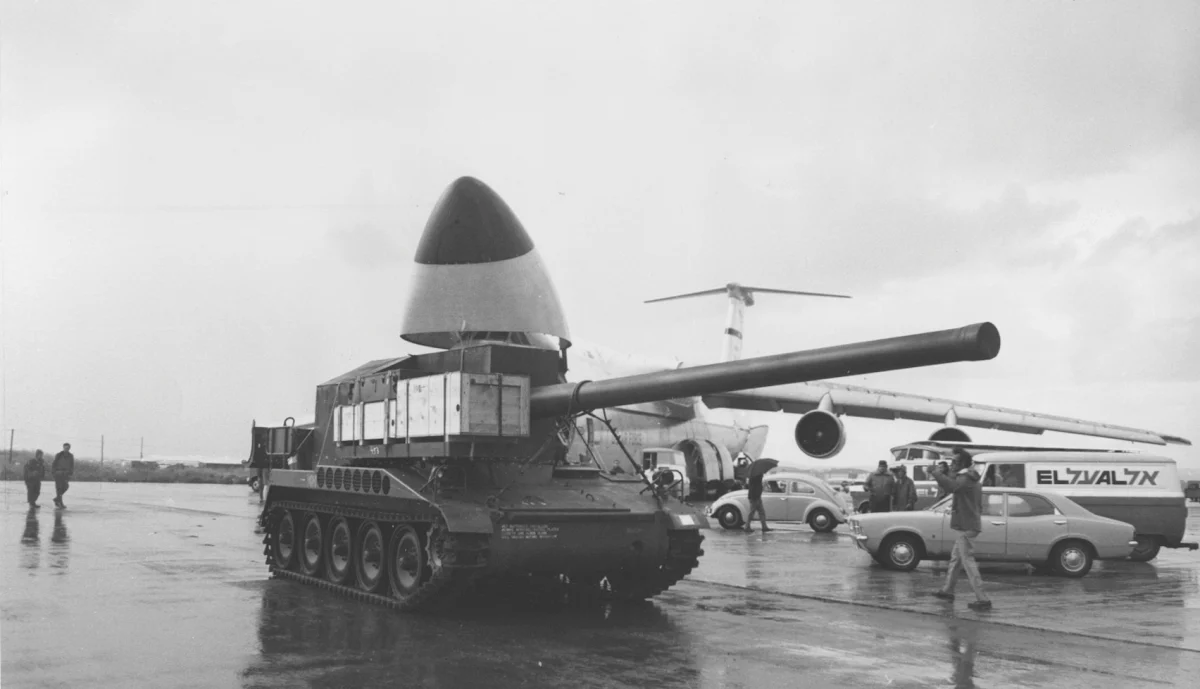
American 175mm self-propelled artillery An M107 mount being unloaded from a Lockheed C-5A Galaxy transport aircraft at Ben Gurion Airport (Lod), Israel, during Operation Nickel Grass in October 1973.
Twenty-five years later, in October 1973, the infrastructure challenge had changed, but not disappeared. The US delivered weapons to Israel during the Yom Kippur War: Operation Nickel Grass lasted from October 14 to November 14. According to GAO estimates, during this period, the US Military Airlift Command delivered 22,497 short tons - about 20,400 metric tons cargo: M60 tanks, artillery, ammunition, missiles TOW, radar.

C-5 Galaxy
The main work was carried out by C-5 Galaxy — the largest US carrier at that time, carrying an average of 73 tonnes per flight (passport capacity up to 118 tons, actual load depended on the distance and type of cargo). C-141 Starlifter took about 28 tons. The distribution of flights was determined by:
- the permitted number of landings of each type at Lod Airport
- nature of cargo and delivery time
- ground handling capabilities in Lod
- the capacity of the Lajes intermediate base in the Azores
Political Access: From Allied Consent to a Single Base
The Berlin air bridge was possible because three Western powers—the United States, Great Britain, and France—were entitled to air corridors to Berlin, as stipulated by the 1945 agreements dividing the occupation zones. The blockade did not affect them: the air corridors were regulated separately, and the USSR kept them open. Within the Western bloc, agreement also held: Great Britain and the United States acted in a coordinated manner, and France joined later and built Tegel.
The airlift was a demonstration of readiness to defend West Berlin. Airlifting coal was more expensive than overland. The USSR lifted the blockade in May 1949 without obtaining any concessions.
In 1973, the political landscape became more complex. Most of the US's European allies refused to provide their air bases for refueling and transshipment of cargo bound for Israel. Britain, West Germany, Italy, and Spain all said no, fearing an Arab oil embargo and worsening relations with OPEC. The only exception was Portugal, which provided a base. You are lying. in the Azores. The entire transatlantic bridge rested on this single point. Lajes ensured the required speed and payload: for the C-141, intermediate refueling was necessary, while the C-5 could fly nonstop, but with a reduced load.
The Soviet Union had been supplying Egypt and Syria since October 9, 1973. Both sides' routes were dependent on the decisions of other countries. The United States was denied access to European bases; the USSR relied on transit permits, including overflights over Turkey, and access to airfields in Syria, Egypt, and Iraq. The sources of these restrictions varied: Washington was denied landings by its allies, while Moscow depended on transit permits and on which airfields survived Israeli strikes.
Compatibility: from aircraft types to actual load
The Berlin airlift began with a C-47. Skytrain — a twin-engine transport aircraft capable of carrying approximately 3,5 tons of payload. It was the workhorse of World War II, reliable but slow and light-duty. By the fall of 1948, the bulk of the payload had shifted to the C-54. Skymaster: four engines, lifting capacity up to 10 tons, long range. The British used Avro York и Handley Page HastingsAll of these aircraft were suitable for Berlin airfields in terms of runway length, cargo dimensions (sacks of coal, crates of food, industrial equipment), and technical requirements, but each type required its own spare parts and maintenance.
In 1973, the same problem became more acute. C-5 Galaxy The C-141 carried an average of 73 tons per flight—seven times more than the C-54 in Berlin. Payload depended on the range: the more fuel, the less payload. It also depended on the runway conditions and how the specific cargo would fit on a specific aircraft. Starlifter It was lighter and more versatile, but only carried 28 tons.

An-22 "Antey"
The Soviet An-22 "Antey" had a nominal load capacity of approximately 60 tons. According to I. Rozin, military transport aircraft crews completed 78 flights on the An-22 and 725 on the An-12 to Egypt and Syria, transporting 8157 tons of cargo and 1700 passengers. Western estimates of Soviet deliveries reach as high as 15,000 tons.
Compatibility applied not only to aircraft but also to cargo. Berlin: coal in 18-23 kilogram sacks, manually. 1973: tanks, pallets, the beginning of containerization. Cargo capacity is a figure in the aircraft's data sheet. Actual efficiency depends on the suitability of the aircraft for the task, the cargo for the aircraft, and the availability of on-site unloading facilities.
Organization and accounting: manual labor and the path to computerization
The Berlin air bridge operated using manual labor. German loaders unloaded a C-54 in 10 to 15 minutes: the aircraft touched down, taxied to the unloading area, the crew remained in the cockpit, a team carried out sacks of coal and boxes, and the aircraft took off. Coordination relied on radio communication and dispatchers. The 90-second gap between landings wasn't the aircraft's technical limit, but an organizational achievement: every crew knew their window, every dispatcher could see the queue.
By 1973, accounting remained partially manual. Databases of various branches of the military—the Air Force, the Army, fleet — were incompatible, and the integration nodes were operators who rewrote the data manually.
What began in the 1970s unfolded later. The US Army implemented POMCUS (Prepositioning Of Materiel Configured in Unit Sets) - a program for stationing equipment and supplies in Europe so that troops could deploy without the transatlantic transport of heavy weapons. In 1976, a joint group was established to develop LOGMARS (Logistics Applications of Automated Marking and Reading Symbols) — a barcoding system for military cargo, analogous to the civilian UPC.
According to the GAO, the operation Desert Shield/Storm In 1990–1991, serious gaps in the accounting of container contents persisted: cargo was lost in the accounting system.
Price and speed
The Berlin airlift cost lives: according to a US Air Force study, 32 Americans and 39 British died; sources estimate the number of German fatalities at between 9 and 14, mostly loaders and crew members. It cost money: transporting coal by air was tens of times more expensive than by land. It cost physical labor: German workers unloaded planes by hand, in all weather conditions, day and night.
1973 demonstrated not the limits of logistics, but its most important characteristic: airlifting buys speed, not volume. The US supplied Israel via several channels simultaneously. The ocean route provided more cargo, but with a delay: the first ships arrived only a few days after the ceasefire on October 24, and by early December, approximately 90,000 tons had been delivered by sea—by sixteen vessels. During the fighting, only air support was available. Israel received a significant portion of its fighters not even in cargo holds: factory-made F-4s and A-4s were flown under their own power from St. Louis to Ben-Gurion, with aerial refueling. Eight airliners El Al made 170 trips and transported another 5500 tons.
According to Soviet data, the airlift transported 8157 tons and 1700 people; Western estimates of Soviet deliveries reach as high as 15,000 tons, but there is no single figure. Neither channel was a substitute for the other: the sea provided volume with a delay of weeks, the air provided speed, and no one else could match that speed.
Conclusions
Neither cargo capacity nor tonnage work alone—but neither does speed work without support. In Berlin, the result was achieved by two airfields and a third built in 90 days, manual labor, and disciplined intervals. In 1973, the airlift achieved what the sea could not: it delivered critical cargo during the fighting, not a month later, and it relied on the single Lajes air base and overflight permits. Each new technology—containers, computers, heavy transport aircraft—required standards, cranes, and prepared platforms. The system is more expensive than the tonnage figures suggest.
Mass shipping required the sea—and here the Cold War collided with another technology, one that also couldn't function without standards and cranes. The next article is about the container revolution and Malcolm Maclean.
Information