The Russian Navy in the Russo-Japanese War: Its Shortcomings and How to Correct Them

“…I saw the main reason (for the defeat) in the way we organized military affairs in Navy, in the absence of special bodies that would be engaged in preparing the Fleet for war…” (Admiral Kolchak. Meeting of the Extraordinary Investigative Commission, January 23, 1920)
When contemporary observers examine the causes of the defeat in the Russo-Japanese War, there are two extreme viewpoints. The first holds that the Russian command did everything correctly, and the defeat was an accident, and that if the war were replayed, the outcome would have been different. If anything needed to be changed, it would have been minor: reinforcing the armor on a particular cruiser, or moving it from Port Arthur to Vladivostok, or vice versa.
The opposite view is that the Russian admirals were incompetent, the sailors were good for nothing (both statements are false), and the Japanese would have won anyway.
Both of these opposing points of view agree on one thing: they don't need to look for the reasons for failure, since they already know the answer. This article is for those who fall between these extremes.
The need for a fleet construction concept
The construction of a strong navy began with its concept (in Japan - Yamamoto Gombei, in Germany - Tirpitz, in England - Fisher), which defined its opponents and tasks in relation to them, from which its structure and requirements for classes of ships followed, and only from these - the requirements for specific ships.
A ship successful for one navy might be unsuccessful for another. For example, the British navy needed "trade protectors" with long range, seaworthiness, endurance, and habitability, so Japanese armored cruisers, which had weakened all these qualities in favor of increased armament and armor, were unsuitable.
A fleet without a concept might contain good ships, but assembled haphazardly, they would not be effective as a whole, or in specific combat situations.
The Russian fleet defended three theaters, very different in their characteristics, and it lacked a concept for the Far East, therefore "We ended up with some kind of fantastic ships that appeared for some unknown reason." (Transcript of Kolchak's interrogation, January 21, 1920). Here Kolchak is viewed as a naval theorist who generalized the experience of this war, and his subsequent political activities are not touched upon.
The main classes of warships and their qualities
It's impossible to see the shortcomings of the Russian fleet of 1904 without turning to military theory. An article entitled "On the Types of Warships" was published in 1900, but it's not available online. Therefore, excerpts from Kolchak's 1908 report "What Kind of Fleet Does Russia Need" are provided below (emphasis mine).
The main and fundamental operation of naval warfare is a battle with the enemy's armed forces, and squadron battleship is being built...for this sole purpose...
Along with combat, naval art has advanced two more operations directly connected with it, preceding and accompanying it: these are reconnaissance, i.e., the search for the object of the battle and the determination of the strength of this object, and the exploitation of victory, i.e., the use of its results in the sense of pursuit with the goal of the final and complete destruction of the enemy...
The significance of these operations is determined by… the words of Nelson: a squadron that has no scouts and wants to engage in battle is always in error, but if it has reason to avoid battle, then it is in a dangerous position…
The Moltke school defined the importance of exploiting victory by stating that “a thorough pursuit is more fruitful than a new victory…
Reconnaissance...is divided into two operations: terrain coverage in the sense of searching for the enemy, which requires a number of scouts, and reconnaissance in force to determine...the strength of the intended battlefield...
The main requirement of reconnaissance is a long speed and a radius of action, and the separation of battleships for reconnaissance purposes, firstly, would tie up the main forces in terms of speed, which is obtained at such a high price and has not only tactical but also strategic significance; secondly, it would lead to the separation of the main forces and would contradict the principle of concentrating these forces at the beginning of the battle; and thirdly, it would affect the elements of attack and defense of the ships, since every ship is a compromise, and it is impossible to increase one of its elements without damaging the others... and would always contradict the requirement for the number of scouts - illuminators of the area...
Therefore, the strictly logical types of warships…are: the armored cruiser and the light reconnaissance cruiser…
An armored cruiser, having as its task reconnaissance in force, is part of the main forces of the squadron and takes part in a battle of the line, but not in the general formation of battleships, but in an independent line in order to use in battle the precious advantage of speed, an element that is dual from a tactical point of view, generally increasing the elements of attack and defense and to a certain extent compensating for the smaller number of guns and the weakness of armor...
A light reconnaissance cruiser is a special type of vessel, one in which offensive and defensive elements are entirely sacrificed for speed and range. The need for numbers naturally leads to a desire to limit the displacement of this vessel while preserving its superior seaworthiness. A light cruiser is a destroyer of enemy mine-laying vessels, for which purpose it is armed with a comparatively light artilleryLight cruisers are responsible for providing fire support to minelaying vessels, and for patrol and security duties at sea and when anchored in unfortified areas...
Thus, based on the principles of naval strategy, armed naval power is differentiated into four main types: squadron battleship, an armored cruiser, a light cruiser and a destroyer, the first two types being battle line vessels, while the second two are given an independent and extremely important role in reconnaissance and exploitation of victory.
I would like to draw attention to the words: “every vessel is a compromise, and it is impossible to increase one of its elements without damaging others.”
The vessel operated with characteristics such as artillery power, protection, speed, and range. Increasing one of these, while maintaining a fixed displacement, meant sacrificing others.
By strengthening one of them to the limit, all the others were critically weakened, and the ship became unbalanced. So, on a cruiser Novik everything was weakened for the sake of speed. On the cruiser Accordion For maximum protection, they sacrificed range. But a universal combat vessel was also impossible: it was impossible to find the perfect balance.
The objective of the fleet concept was to select the characteristics of its types of vessels so as to minimize their weaknesses and enhance their strengths in the process of joint action.
Moreover, she took into account the specifics of her theater and the characteristics of the enemy fleet. Just as fencers would look for each other's weaknesses and be prepared to exploit external factors, such as the position of the sun, here the external factors were the specifics of the theater, and by finding the enemy's weak point, they could defeat him.
Shortcomings of the Russian fleet in 1904
If a fleet is to consist of ships of different types, the question arises in what proportions they should be combined.
The larger the naval theater, the more cruisers were required, and the better their seaworthiness. Confined inland seas required fewer. For example, Sweden, a weak regional power, had no cruisers in the Baltic, then only one, and ironclads were used only for coastal defense. But the more powerful Austria-Hungary had a fleet in the Adriatic of all types and was well-balanced.
The composition of the navies in 1904
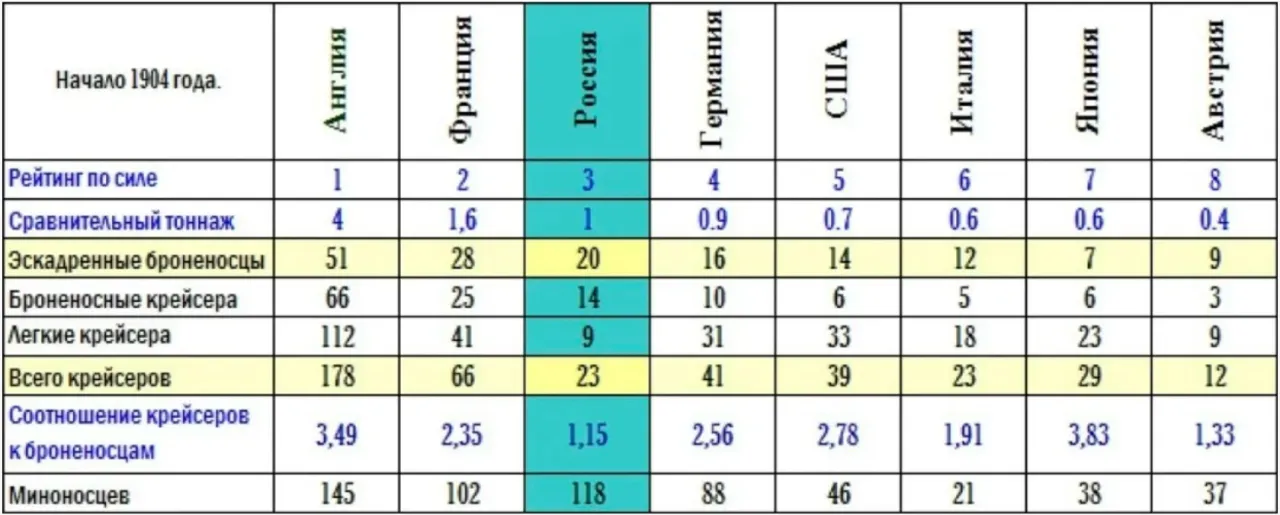
Source: Russia in the World War 1914–1918 (in figures). Page 95. Table 74
1) The table shows that the Russian fleet had the lowest ratio of cruisers to battleships, while 5 of the 7 other countries, including Japan, had a ratio more than twice as high as Russia's.
“Compared to other fleets, we have a higher percentage of battleships and destroyers and a small percentage of so-called cruisers” (Admiral Makarov).
This was contrary to the plans to wage a raiding war against England, for which they were needed in great numbers.
“It is better to send 4 cruisers of 3000 tons into the ocean than 1 of 12000 tons” (Admiral Makarov).
"We desperately need cruisers. Building only battleships is absurd. In the event of war, it's like an army without cavalry, meaning without eyes, not to mention the importance of special cruiser operations" (Captain 1st Rank, Grand Duke Alexander Mikhailovich).
The cruisers performed the following tasks:
- intelligence
- counter-torpedo warfare,
- support of their destroyers,
- protection of minesweeping forces,
- protection of bases and convoys,
- conducting raids, incursions and blockades,
- finishing off damaged ships,
- were used for pursuit,
- for patrol, messenger and rehearsal service,
- inpatient service,
- support of ground troops,
- retransmission of radio communications to increase its range (among the Japanese).
Moreover, cruisers-raiders (3 Rurik and 3 Diana) were poorly suited for all other tasks. To achieve high seaworthiness, they were built with high sides and increased displacement, but underarmed; to accommodate larger coal mines, their width was increased, reducing speed. "The construction of such expensive ships for the specific purpose of cruising is questionable." - Vice Admiral V.L. Alekseev believed in 1897.
Cruisers Svetlana и Diamond were built as yachts.
The lack of ships that could take on dangerous routine work exposed first-rank ships to increased danger from enemy mine-laying forces and made the fleet inflexible and blind.
After death Varangian и Boyarina In the 1st Pacific Squadron there were only 3 cruisers left capable of conducting reconnaissance: Bayan, Novik, Askold. FROM Diana и Pallas There were five of them against more than fifteen, and to protect them, destroyers were sent on reconnaissance missions. Due to a shortage of cruisers, patrol duty off Port Arthur was not conducted, and the protection of the outer roads was overstretched.
2) Except for one thing Bayana, there were no armored cruisers capable of conducting reconnaissance in force: with squadron, not raider, qualities. The cruiser Accordion The price for increasing the armor was the loss of range, which greatly limited its use.
3) Armored cruisers of 6000 tons were overkill for reconnaissance and impractical for building large numbers of scouts; they were poorly suited for defending the fleet from torpedo boats, lacking 100–120 mm caliber guns (the 75 mm caliber was weak and effective at close range, while the 152 mm was unwieldy and carried a smaller ammunition supply; as a general-purpose caliber, it could expend its ammunition before an enemy torpedo attack). Their thin armor and lack of heavy artillery prevented them from conducting reconnaissance in force.
4) Cruisers of 3000 tons Novik and its derivatives Pearl и Emerald At high speed, they had poor seaworthiness, an unstable gun platform, and weak "cigarette" armor, which made it dangerous to send them in pursuit of Japanese reconnaissance aircraft during the Battle of Tsushima: one stray hit could disable them or put them out of action in the face of a more numerous enemy. Together with Boyar, their armament was weaker than that of any of the Japanese cruisers, which were distinguished by their excessive artillery.
The emphasis on the high speed of cruisers was a sound strategy, allowing them to avoid or force combat, and to choose more advantageous positions during battle. All leading naval powers came to understand the importance of speed.
5) The battleships were of different types, which reduced the effectiveness of their use.
Battleships of the type Relight They were built for both line combat and raiding. For line combat, they were lightly armed and lightly armored, and their high sides made them easy targets. Their low speed prevented them from being used as squadron cruisers.
Here is what the magazine wrote about this in its article “On the Issue of Types of Military Courts” Marine collection1900:
Ironclads are the strong core of a squadron, and therefore everything in them should be directed primarily towards invulnerability and strong artillery for active operations; any diminution of these qualities for other purposes, i.e., either for very great speed or for an excessively large increase in the range of action, can result in death in battle.
6) The raiders, weak in combat, were intended to disrupt enemy trade, but this could not defeat a significantly superior fleet, which would eventually find and destroy them.
"Cruiser warfare cannot be carried on alone...Unless supported, a cruiser may...steer a short distance from home, and her blows, though painful, cannot be fatal" (Mahan, 1890).
“Cruiser operations, although based on bases – sea stations, but remaining without the assistance of a combat fleet, cannot be fruitful” (Rear Admiral F.V. Dubasov, 1896).
“…A single cruiser war or… actions against enemy trade,” wrote Captain 2nd Rank I. Zborovsky in the “Naval Collection” in 1898, “cannot count on the necessary success unless a squadron war is waged alongside them by entire fleets of battleships…”
“…In a war with a nation that has a large trade network,” Admiral Makarov believed, “it would be possible to send several…cruisers out to sea, consider them lost, and be content with the fact that before they fall into enemy hands, they will have time to divert part of his forces from the main objective of the operation.”
To stop Russian raiders, England only needed to blockade the Danish Straits and Vladivostok. Furthermore, Russia signed the Paris Declaration of 1856, which made it difficult to wage a cruiser war. Such actions undermined relations with countries trading with the enemy, even to the point of potentially leading to their entry into the war.
Pacific Fleet composition options
By 1895 the fleet had several battleships, a semi-battleship Admiral NakhimovAll the other cruisers were raiders, and there were no high-speed reconnaissance cruisers. At the same time, with the growth of the Japanese fleet, the question of the composition of the Pacific Squadron arose.

There was no unified vision for the navy's structure, lacking a naval general staff to develop one. Three admirals did not envisage the use of armored cruisers, but Admiral Alekseyev changed his mind by 1897 (bottom line).
Admiral Makarov was a proponent of unarmored cruisers—an idea conceived by the naval architect Armstrong. Of the five captains of the first rank, four favored armored cruisers, and two of them proposed replacing all battleships with them.
The 1897 versions of Chukhnin, Felkersam, and Alekseyev included all types of ships, with the last being the most balanced in terms of the ratio of light cruisers to other classes. (This version was influenced by French theory: 8 battleships, 8 armored cruisers, 8 large armored cruisers, 8 small cruisers. The 1500-ton cruisers were analogous to Japanese avisos.)
In 1895, VK Alexander Mikhailovich submitted a memo, "On the Desired Composition of the Fleet." In it, all first-rank cruisers were armored. Each fleet was assigned a structure appropriate to its theater of operations. For the Pacific Ocean, this structure was strong, but very expensive, and was designed for the long term: it was impossible to quickly build 20 armored cruisers, and for a fleet to be effective, its armored cruisers had to include not only raiders but also armored scouts.

However, at the "special meetings" of December 1897, only E. I. Alekseyev and P. P. Tyrtov spoke in favor of building armored cruisers of 8,000–10,000 tons. Admirals V. P. Verkhovsky, N. M. Kaznakov, I. M. Dikov, S. P. Tyrtov, S. O. Makarov, and F. K. Avelan (it's a shame that captains of the first rank weren't invited) were in favor of building long-range armored reconnaissance ships of 6000 tons.
For the Pacific Ocean, the following structure was chosen: 10 battleships, 4 armored cruisers, 10 armored deck cruisers of 6000 tons each, 10 small cruisers of 3000 tons each.
Shipbuilding programs
1. The state of the Japanese fleet
Japan is building 6 battleships (it also had an old battleship Chin-yen), as well as six powerful armored cruisers, whose strength, calculated at 0,65 times that of an armored cruiser, amounted to the equivalent of 10 armored cruisers. (Apparently, this is the source of the 10 armored cruisers planned for the theater by the Russian fleet.)
Chin-yen by 1904 it was completely outdated. His and an even older one Fuso can be considered as coastal defense battleships.
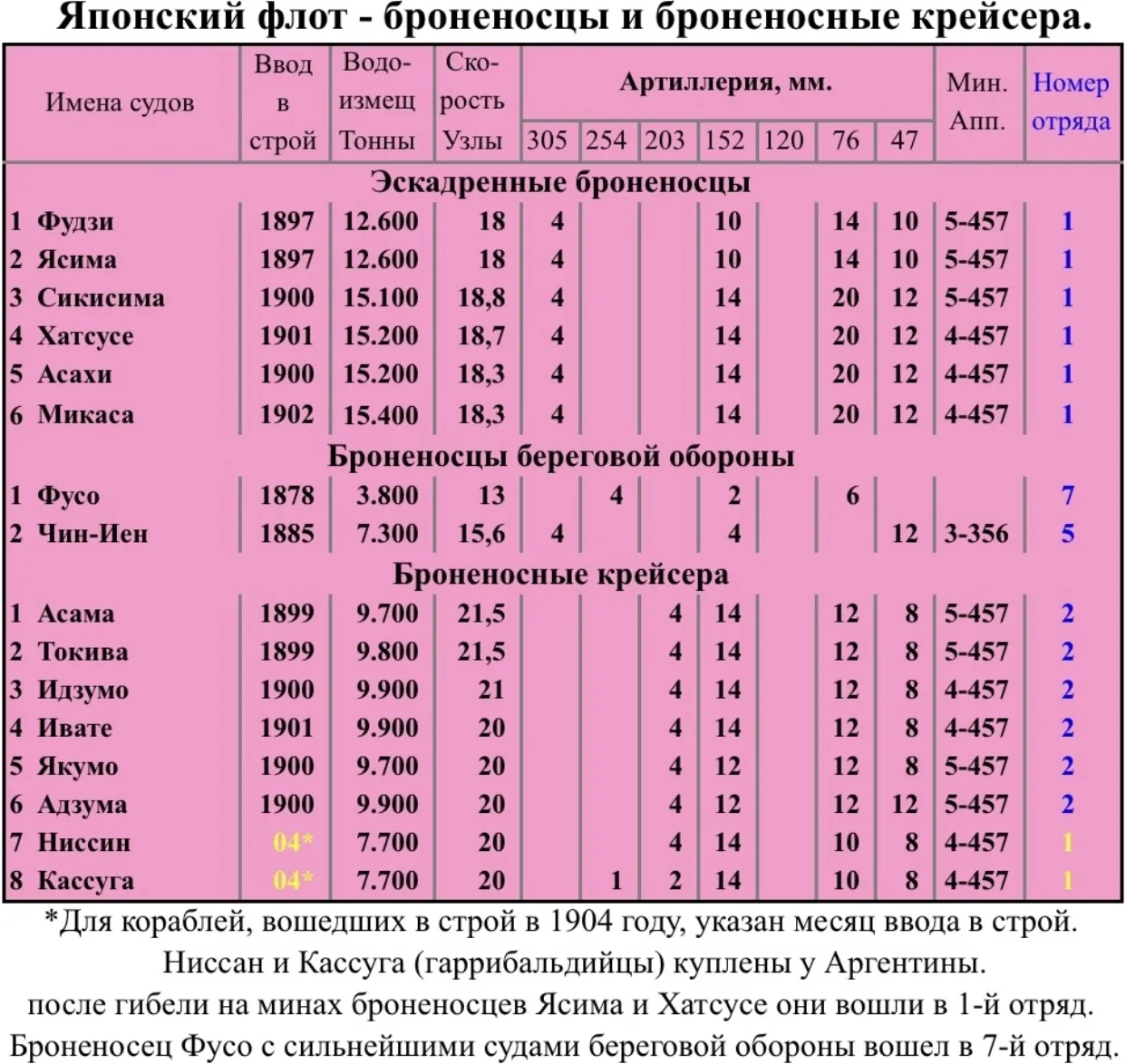
Japan is building eight light cruisers. It will have a total of 17 of them. They are heavily armed, having fought against battleships at the Yalu, but are unseaworthy, which reduces their speed and accuracy in rough seas. Their guns are closely mounted, making them more vulnerable in combat. The 203mm guns have a poor gun platform on these small ships, and on 3 Matsushima In addition, they are outdated and have too low a rate of fire, and are useless against fast ships.

2. Russian shipbuilding program
The final shipbuilding program of 1899 for 3 fleets included: 12 battleships, 1 coastal defense battleship, 14 1st rank cruisers, and 6 2nd rank cruisers.
Of these, the following were not built: 1 battleship, a coastal defense battleship (both for the Baltic), 2 1st rank cruisers and one 2nd rank cruiser.
Of the 1st rank cruisers, 2 were built as armored cruisers (Thunderbolt и Accordion).

Without taking into account the isolated Black Sea Fleet, there were 22 cruisers for every 17 battleships, 5 of which had a speed lower than that of the new battleships (Memory of Azov, Dm. Donskoy, Vl. Monomakh, Adm. Nakhimov, Adm. Kornilov), and therefore of limited use. Without them, the ratio of cruisers to battleships was 1:1.
But according to military theory, there should have been 2-3 cruisers per battleship (until the advent of large sea-going destroyers of 1200-1500 tons, which took over some of the tasks of light cruisers).
Therefore, a proposal from China to purchase five cruisers with a total displacement of 17,800 tons was considered. It was rejected due to the need for lengthy repairs in the Baltic and the replacement of British artillery, which would not have made it in time for the expected start of hostilities.
Composition of the Russian Pacific Squadron
According to Admiral Makarov, Japan's superiority in oceanic repair facilities required compensation in a more powerful Russian fleet. But with a reduced shipbuilding program, this could only be achieved by leaving the Baltic unprotected.
According to N. L. Klado's report on the strategic game "War with Japan in 1905", by the beginning of the war in the Pacific Ocean there should have been:
- 10 new battleships, including 3 types Relight, 2 of which, due to weakened main caliber guns, were no stronger in combat value than the Japanese armored cruisers,
- 5 armored cruisers (raiders) Thunderbolt, Russia, Rurik, scout Accordionold Dm. Donskoy as a training ship),
- 7 armored deck cruisers of 6000 tons (3 types Diana, Varyag, Bogatyr, Askold, Oleg),
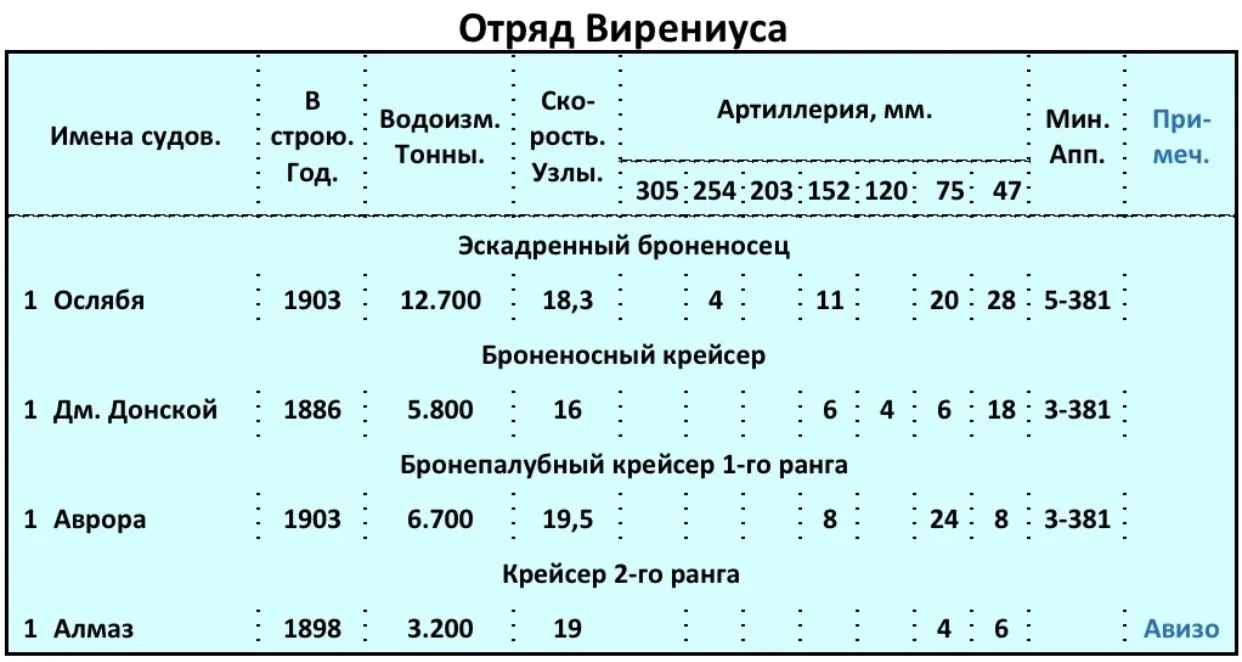
- 5 cruisers of 3000 tons (Novik, Boyarin, Pearl, Emerald, Diamond).
V. P. Kostenko in his report “Borodino-type battleships in the Battle of Tsushima” says that the distribution of forces was expected to be as follows: 7 Russian battleships against 6 Japanese battleships; 3 Overexposure and 3 armored raiders (Rurik, Russia, Thunderbolt) against 6 Japanese armored cruisers.
But Peresvets and the raiders lost in their diversity, in the rationality of their armor, in speed (the weakest and slowest among them was Rurik with 18 knots). Two Peresvetov The main caliber guns were weakened. Therefore, 6 Russian ships would be weaker than 6 Japanese ones. To them could be added Accordion, improving the balance of power.
3 raiders and Bayana The broadside only had two large 203mm guns. Sufficient for raiding, but Bayana - for reconnaissance, they were difficult to aim in a linear battle, so even with Bayan 7 Russian ships of 3 types would not have been stronger than 6 similar Japanese ones.
The Japanese fleet had its advantages:
- his battleships and armored cruisers were uniform in purpose, armament, speed and armor;
- his armored cruisers could participate in both line battles and cruiser operations, so they had to be taken into account in both;
- its repair capacity allowed for damage to be repaired many times faster;
- it had a larger number of bases (M.A. Petrov gives a list of 15), and their location was more convenient;
- He had a superiority in the number of 17 cruisers and in coastal defense vessels: 2 old battleships, 10 obsolete ships and 11 gunboats, against 7 Russian gunboats and 3 clippers.
The Russian fleet composition described above would have had one more battleship and four individually stronger and faster cruisers, which would have partially compensated for the smaller number of cruisers (12, including the yacht Diamond — against 17), and it was presented to the Tsar as superior to the Japanese, but taking into account the qualitative advantages of the Japanese fleet, which cannot be formalized in numbers, the superiority, if there was any, was small, and later purchased by Japan Nissin и Cassuga (the Garibaldians) would tip the balance of power in favor of the Japanese.
The Russian command correctly estimated the Japanese fleet's readiness, but Finance Minister Witte prevailed, claiming that his personal sources indicated the Japanese would not be ready before 1905. (So, it turns out the Finance Minister can have a personal intelligence service? — Whatever the case, it was either mistaken or misinformed.)
This delayed the Russian program. The Japanese intended to call off the attack if the Russians had 10 battleships in the theater by the time it began. But by 1904, there were 18 Russian ships in the Pacific Ocean, including seven battleships (of which only two were of the newest types, compared to four Japanese ones).

As can be seen, when the Vladivostok cruiser detachment was separated, there were only 7 cruisers for every 7 battleships, including Accordion, which was completely insufficient for full-scale combat operations (moreover, 2 of them died in the first days of the war).
Japan's purchase of two Garibaldians—replacements for battleships for poor countries—made its fleet stronger than the actual Russian Pacific squadron of early 1904 by a ratio of about 4:3, and this ratio was considered a condition for victory.
Another four Russian ships, including a battleship, were heading to the Pacific Ocean, but were returned after the Japanese attack.
Regarding the possibility of Russia purchasing the Garibaldians, Rozhdestvensky wrote that the condition for selling the Garibaldians was the consent of the previous owner, who was financially dependent on England, which did not want to sell them to Russia.
This was true: according to the terms of the treaty between Argentina and Chile, they were each to renounce two ships at a time, and four ships had to be purchased simultaneously to ensure that neither of the former adversaries gained superiority. The King of England became the guarantor of the sale, so a Russian purchase of the ships was ruled out. Russia's official refusal of the manufacturer's offer was a way to save time and effort, given the impossibility of a purchase.
But Russia still tried to purchase two battleships of the type Swiftsure, which, in her opinion, should have occurred late in their construction, so that England would not have time to counteract it. England itself purchased these ships to prevent them from falling into Russian hands and to help Japan acquire two Garibaldians, as Japan lacked the funds to purchase all four vessels.
The Chilean ironclads were conceptually unsuitable for the British navy and were clearly of no use to it. But they were purchased for political reasons.
Moreover, Russia could not buy up all the questionable ships to prevent their purchase by Japan, and a fleet composed in this way would only be formidable on paper.
In addition, 3 battleships left the Pacific Ocean for the Baltic at different times for repairs and modernization:Sisoes the Great, Navarin, Nicholas I), 4 armored cruisers (Memory of Azov, Admiral Nakhimov, Dmitry Donskoy, Vladyka Monomakh), and 1 armored deck (Adm. Kornilov).
The tasks of the fleet in the Pacific Ocean and the conditions of its basing
The fleet's objective was not formulated, but most admirals considered it to be countering the landing operation, thereby giving the initiative to the enemy.
It was believed that preventing a Japanese landing in the east and south of Korea was impossible, but on its western coast, even weaker Russian forces based in Port Arthur made such a landing impossible. Therefore, the navy could only partially accomplish this task.

Theater of operations of the Russo-Japanese War
This explains "a calm attitude toward the question of maintaining superiority in forces over the enemy. This was expressed in particular in the decision to send Chukhnin's detachment to the Baltic at the end of 1901—after which the question of Japanese superiority was… finally resolved. If the goal had been naval supremacy, then no sacrifice of the advantage we had initially, in 1895, would have seemed acceptable… in the spring of 1895, the question of superiority in forces was raised—our admirals wanted to field 150,000 tons against the Japanese 126,000 tons. However, the lack of a focus on fighting for naval supremacy made superiority in forces…"not necessary".
The location of the two bases was divided by the naval forces, and naval theorist M.A. Petrov wrote: “Port Arthur had…an outlet to the sea, accessible to ships only at high tide…This alone made it unsuitable as a base during the war.".

Plan of Port Arthur
The raiders based in Vladivostok could not cause serious harm to Japan, since all the sea routes important to it passed to the south and east.
Naval historian Corbett wrote that if the Russian fleet had chosen Vladivostok as its base, its unfavorable location meant it would have had to immediately seek battle, which would have required it to be stronger than the Japanese fleet. Otherwise, a Japanese army landing on the mainland, receiving reinforcements by sea, would have vastly outnumbered the Russian army, which was being transported along a single railway line. The Japanese army would then have cut the Chinese Eastern Railway and besieged the Russian naval base.
In reality, given the lack of forces, Admiral Vitgeft's naval war plan declared the main principle to be conserving the fleet's strength for as long as possible, leading to passivity and indecisiveness. (It was precisely the lack of forces that prompted his words, "We don't need to venture into the South Korean skerries.") But there's a saying: "When a fortress defends itself, it will surely fall."
Admiral Alekseev "Effectively tasked the fleet with delaying the deployment of the Japanese army...until the concentration of our troops was complete...this task was accomplished. The answer to the question of why our fleet didn't defeat the Japanese...should begin with 'no one wanted it or asked for it.'".
As can be seen, the defeat of the Russian fleet was caused by an underestimation of the enemy and a number of mistakes made.
What the Russian fleet lacked in the Pacific Ocean in 1904
There were two conditions for building a fleet: 1) its suitability for a specific theater and 2) its ability to resist (or defeat) a specific enemy – the Japanese fleet.
- The theater's conditions dictated an increase in the fleet's cruiser component to a ratio of no less than 2,5 cruisers per battleship, and preferably 3. This included armored cruisers whose combined strength was comparable to that of the Japanese. Otherwise, the initiative at sea would shift to the enemy.
- The Russian fleet in the Pacific Ocean had to be on par with the Japanese fleet. Given Japan's more advanced repair capabilities, it had to be stronger, especially since Japan could purchase additional ships beyond its program.
- It was necessary to develop the naval infrastructure on the ocean, because the situation in which English ships were delivering coal to the Russian fleet during the war was intolerable.
- Due to the theater's weak infrastructure, the navy was limited in the number of vessels. Its maximum possible size was likely no more than the original design: 10 battleships, 4 armored cruisers, and 20 armored deck ships.
- If repair capacity was insufficient, designs with increased reliability were to be selected. All other things being equal, designs requiring extended construction times were not to be selected. Designs requiring complex and labor-intensive repairs were not to be accepted—a reference to the popular battleships.
- The fleet's mission in the Pacific Ocean should have been defined by the words of the naval agent in Tokyo, Lieutenant I. I. Chagin, in September 1897: “Only by defeating or… destroying Japan’s main naval forces… will our fleet be able to engage exclusively in secondary operations, consisting of capturing transports with troops and supplies that risked going to Korea without a sufficient convoy.”.
- The changes were to begin no later than 1895.
Based on these conditions, several options for the composition of the Pacific Fleet were possible, depending on what Russia wanted to achieve on the ocean, in other words, on the desired path to victory: whether in a decisive general battle or by prolonging the war and attrition, and the associated risks, as well as the resources it was prepared to spend.
Used materials
- Kolchak, "What Kind of Fleet Does Russia Need?"
- Japanese Navy weapons programs
- Note by S. O. Makarov on the shipbuilding program for 1903–1923.
- Gribovsky, "The Formation of the Russian Pacific Fleet"
- V. Ya. Krestyaninov "Cruisers of the Russian Imperial Fleet"
- Battleships of the Wittelsbach, Braunschweig, and Deutschland classes. 1899–1945 (Collection of articles and documents). Collective authors. Shipbuilding program under the law of 1898.
- Fedechkin A.D. "Cruisers without the support of a significant squadron will not have a decisive influence on the course of the war"
- Articles naval_manual-livejournal:
- "Questions of Methodology. Petrov on the Necessity of Advantage"
- "Russo-Japanese War: Intuitive Defeat and Theoretical Victory"
- "We need more cruisers"
- "The Third Element: Aviso, Fuso, and Other Ships of the Japanese Victory"
- "Russo-Japanese War: Local Difficulties"
- "Ram them all!" Pekingham agreed with Melnikov on this.
- "Smart Bastards. The Young Ecole as Philosophy. Parts 1, 2"
- The Tactical Importance of Speed
- "Questions of Methodology. Petrov on the Necessity of Advantage"
Information