Production, operation and export of Chinese J-5 and J-6 fighters

The emergence of Chinese aviation The Soviet-backed industrial revolution occurred in the 1950s, and for a considerable period of time, the PLAAF was equipped with Soviet-designed combat aircraft, either directly acquired or licensed. After relations between Beijing and Moscow soured in the early 1960s, Soviet-Chinese military-technical cooperation ceased, and the onset of the Cultural Revolution severely and permanently hindered the development of China's aviation industry.
From the 1950s to the 1980s, China produced the J-5 (MiG-17), J-6 (MiG-19), and J-7 (MiG-21) fighters, as well as the H-5 (Il-28) and H-6 (Tu-16) bombers. Attempts were made to develop indigenous combat aircraft, of which the J-8 interceptor (an entirely indigenous design) and the Q-5 attack aircraft (based on the MiG-19) reached serial production.
Although Chinese combat aircraft were generally inferior to their Soviet counterparts in terms of build quality and technical reliability, and China produced outdated versions equipped with very simple avionics, they were exported. The buyers of the relatively inexpensive Chinese aircraft were, in most cases, Third World countries that lacked the resources to acquire modern combat aircraft or, for whatever reason, were unable to obtain Soviet equipment. weapon on credit.
J-5 fighters and JJ-5 combat trainers
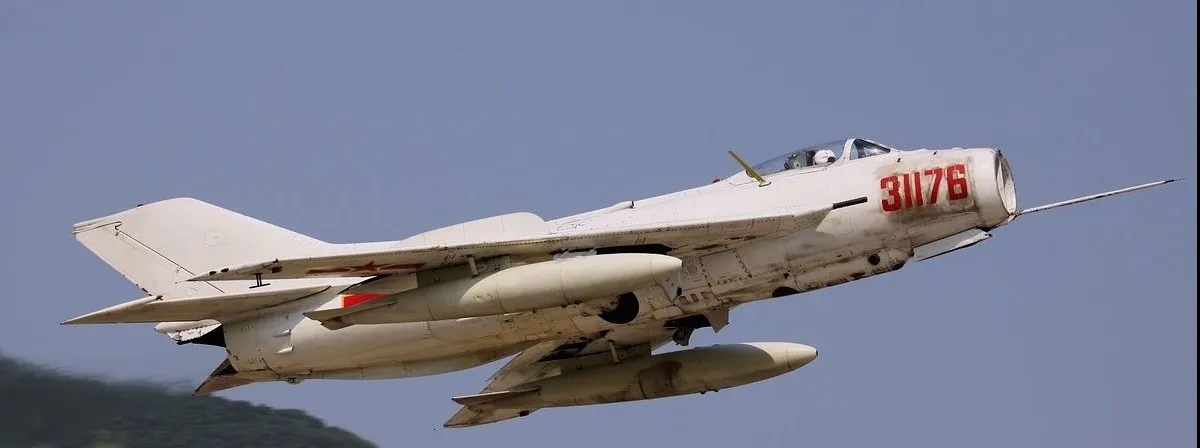
Following the armistice on the Korean Peninsula, the Soviet Union continued to supply jet fighters to China. In the 1950s, air battles between PLAAF and ROC Air Force jet fighters regularly occurred over the Formosa Strait, and there were also numerous incursions into Chinese airspace by Taiwan-based reconnaissance aircraft. In the mid-1950s, PLAAF pilots, following the Soviet-made MiG-15 and MiG-15bis jet fighters, mastered the MiG-17F, which received the local designation J-4 (Jiān-4).
In mid-1956, assembly of MiG-17F fighters, initially designated Type 56, began at the Shenyang plant. Fifteen assembly kits, along with parts for 10 aircraft, were delivered to China. In addition to the transfer of technical documentation, extensive training was undertaken for Chinese specialists. After full production was established in China, the Chinese equivalent of the MiG-17F received the designation J-5 (Jiān-5), and the VK-1F engine was designated the Wopen-5 (WP-5) in China.

Fighter J-5
In its basic characteristics, the J-5 fighter was no different from the Soviet MiG-17F. The aircraft, with a maximum takeoff weight of 6070 kg (13,500 lbs) with drop tanks, had a practical range of 1240 km (750 mi). The turbofan engine, with afterburning thrust of up to 3380 kgf (7,000 lbs), could accelerate to 1145 km/h (780 mph) at an altitude of 3000 m (9,800 ft). Cruising speed was approximately 500 mph (800 km/h). The service ceiling was 52,500 ft (16,600 m). The integrated armament consisted of a 37 mm Type 37-1 cannon (a copy of the H-37D) with 40 rounds and two 23 mm Type 23-1 cannons (a copy of the HP-23) with 80 rounds per cannon. Bombs weighing up to 220 lbs (220 lbs) or 400 liter (100 gal) drop tanks could be suspended under the wings on two boom racks.
In terms of their operational and combat characteristics, the MiG-17F and its Chinese counterpart were highly successful combat aircraft, ensuring their long service life. Due to their high reliability, simplicity, and low maintenance, these relatively simple aircraft were used for a long time alongside supersonic fighters and, in the final stages of their careers, were used primarily as attack aircraft.
In the late 1950s, documentation was received for the MiG-17PF interceptor, equipped with an Izumrud (RP-1) radar sight and armed with three NR-23 cannons. The radar sight was equipped with a separate antenna for target acquisition (in the central part of the air intake) and a separate antenna for target tracking (in the upper "lip" of the air intake), allowing for simultaneous surveillance and automatic tracking. The detection range was several kilometers. At night or in poor weather conditions, the interceptor was guided to the target by commands from the ground.
The Chinese version of the MiG-17PF was designated J-5A. Due to the end of Soviet support, construction of the prototype was delayed, and its testing only began in 1965.

J-5A interceptor
Due to the fact that the J-5A interceptor was already largely outdated at the time of testing, in the late 1960s, China created a version equipped with a radar capable of seeing a target at a distance of up to 10 km, and its armament included missiles PL-2 (a licensed version of the Soviet P-3S, which, in turn, was a copy of the American AIM-9B Sidewinder missile).

A modernized J-5A interceptor is on display at a museum.
Due to increased drag, the J-5A interceptor's maximum speed was lower than that of the radar-less J-5 frontline fighter, reaching 1130 km/h. Maximum takeoff weight also increased to 6135 kg.
A total of 767 J-5 and J-5A aircraft were built by the end of production in 1969. They served in the PLAAF until 1992, and in the latter part of their career, were primarily used for training purposes.
Before the souring of Soviet-Chinese relations, the PLA Air Force received MiG-15UTI trainers from the USSR, but after 1961 this opportunity disappeared, and for in-depth flight training and the execution of training flights, the JJ-5 (Jianjiji Jiaolianji – training fighter) was created in the PRC on the basis of the single-seat J-5 fighter for the purpose of creating a combat-training "twin" fighter.

JJ-5 combat training aircraft
This aircraft featured a two-seat cockpit borrowed from the MiG-15UTI and was powered by a Wopen-5D engine, a non-afterburning clone of the Soviet VK-1A with a takeoff thrust of 2700 kgf. The combat-trainer aircraft was armed with a single 23 mm Type 23-1 cannon. Two external bombs with a total weight of up to 500 kg or drop tanks could be suspended on two external pylons. The maximum takeoff weight was 6087 kg. The operational range with drop tanks was 1160 km. The maximum speed was 1048 km/h. The service ceiling was 14,300 m.

J-5 and JJ-5 aircraft at the Military Museum of the Chinese Revolution
The JJ-5 "Sparca" surpassed the Soviet MiG-15UTI trainer in performance and could be used as a light attack aircraft. A reconnaissance/spotter variant also existed, equipped with an additional radio that operated on ground unit frequencies. The aircraft, which entered serial production until 1986, had 1061 built, was popular with the military, and remained in service with the PLAAF until 2012. Until the early 1990s, the red-and-white, lightweight JJ-5 aircraft were flown by pilots of the Chinese aerobatic team, the "August 1st" aerobatic team.

The JJ-5 aircraft of the 1st of August aerobatic team
In the 21st century, most of the JJ-5s in storage were converted into remotely controlled targets capable of performing intense maneuvers, takeoffs, and landings.
The J-5 family of aircraft is notable for being the first Chinese jet aircraft to be exported. The export version of the frontline fighter was designated the F-5, the interceptor offered to foreign customers was called the F-5A, and the trainer/combat version was known as the FT-5.
The Indonesian Air Force operated twelve F-5 aircraft since 1960. In 1968, Major General Suharto seized power in Jakarta, which led to a reorientation toward American weapons, and all Chinese F-5s were decommissioned in 1970.
In December 1961, Albania received 12 F-5 and eight FT-5 fighters, which initially served in parallel with the Soviet MiG-17F.

A BBC Albanian J-5 fighter jet
The Albanian Air Force had a total of 58 F-5 fighters, which were in service until 2004, but had not been in flight condition since the early 1990s.
In 1965, China transferred ten F-5s to Cambodia. By 1970, six aircraft of this type remained in service. In January 1971, all Chinese MiG-17F clones in the Royal Khmer Air Force were destroyed on the ground in a Viet Cong attack.
In the second half of the 1960s, the Vietnam People's Army Air Force received 25 F-5 fighters, which, according to unconfirmed reports, were flown by North Korean pilots. Some of these aircraft were lost in aerial combat and destroyed in bombing raids. The Americans made no distinction between Soviet MiG-17Fs and Chinese F-5s, so there are no reliable statistics on the number of Chinese-made fighters lost in Vietnam. Several sources claim that in 1966, they attempted to use F-5A interceptors over North Vietnam. However, these attempts were unsuccessful, and the use of these obsolete interceptors at night was quickly abandoned.
Sudan acquired 16 F-5s and FT-5s in 1969. The aircraft continued to operate until the mid-1980s, and were used against separatists in the south of the country.
In 1973, Tanzania received 12 F-5 fighter jets and 22 FT-5 trainers. The aircraft have not been officially decommissioned, but after one FT-5 crashed in 2010, they have not flown.
The Pakistan Air Force operated approximately three dozen two-seat FT-5s since 1975. In 2012, the twin-seat trainers were retired and replaced by Pakistan-built K-8P Karakorum trainers.

Pakistan Air Force FT-5 combat trainer aircraft
Zambia received 12 F-5 and FT-5 aircraft in 1976. However, they did not serve for long and were decommissioned in the early 1980s.
In 1981, the Bangladesh Air Force pilots received 8 F-5 fighters and 3 FT-5 combat trainer aircraft, which were used for training flights.

FT-5 combat trainer aircraft of the Bangladesh Air Force
The active use of these machines ended in 1986, and they were officially decommissioned in the mid-1990s.
The only operator of the single-seat F-5 and two-seat FT-5 is currently North Korea.

North Korean F-5 fighter jet
Deliveries of F-5 and FT-5 fighters to North Korea began in the mid-1960s. The exact number of aircraft of this type donated by China as military aid was never officially disclosed, but US intelligence estimates put the number at no less than 240.

Google Earth satellite image of North Korean F-5 fighter jets at Kusong Air Base. This image was taken in February 2023.
Until recently, two-seat FT-5s served as training aircraft to maintain the flying skills of pilots in aviation regiments equipped with MiG-21, MiG-23, MiG-29 and J-7 fighters.

Google Earth satellite image of FT-5 and MiG-23 aircraft at Pukchan Air Base. The image was taken in June 2022.
According to reference data, in 2023, the number of North Korean F-5 and FT-5 fighters in active squadrons and storage exceeded 100. Western experts estimate that approximately half of these aircraft are capable of flight. However, even with a fully operational, highly skilled, and motivated pilot, engaging in aerial combat with a modern fighter or intercepting a cruise missile in an aircraft equipped with a primitive instrument suite and outdated communications and navigation systems is virtually impossible. Most F-5 fighters are used for training purposes, and they can also be deployed for air-to-air strikes. Approximately 15 years ago, reports emerged that some F-5 fighters in North Korea had been converted into manned cruise missiles, to be controlled by suicide pilots.
J-6 fighters and JJ-6 combat trainers
In the Soviet Union, MiG-19 fighters were produced for a relatively short period, which is why they are largely undervalued. In China, by contrast, these aircraft were mass-produced from 1963 to 1986, with a number of new modifications developed, and the total number of frontline fighters and specialized interceptors built Defense The production of combat-trainer aircraft exceeded 4000. Chinese engineers were able to refine the MiG-19, making it reliable and low-maintenance, and also developed the Q-5 attack aircraft based on it. These aircraft were widely exported, participated in many local conflicts, and earned a good reputation.
China received technical documentation for the MiG-19S frontline fighter, the MiG-19PM interceptor (with the RP-2U Izumrud-2 radar sight), and the RD-9B turbofan engine in the late 1950s. Shortly before Sino-Soviet relations soured, five disassembled MiG-19P interceptors were delivered to a factory in China. An aircraft factory in Nanchang was allocated for the production of the MiG-19P interceptors, designated J-6I, while mass production of the MiG-19S frontline fighter, designated J-6, began in Shenyang in 1963. However, the J-6I proved too complex for the Chinese aviation industry, and assembly was limited to aircraft delivered from the USSR.
Production of frontline fighters was a difficult proposition, and initially, production quality was very poor, with aircraft delivered to customers frequently crashing. The Soviet-licensed Wopen-6 (WP-6) engines, which had a limited service life and were prone to sudden stalls, were particularly problematic. Initially, production J-6 (Jiān-6) aircraft were virtually identical to Soviet MiG-19S aircraft, but over time, Chinese engineers incorporated a growing number of modifications and improvements into the frontline fighter's design, enhancing its operational and combat performance. They also significantly increased its service life compared to the original MiG-19S aircraft. Over time, the J-6 became a highly reliable and effective combat aircraft, serving as the workhorse of the Chinese Air Force for a long period of time.

PLA Air Force J-6 fighter
The early production J-6 fighter had a maximum takeoff weight of approximately 10,000 kg. Its operational range with two 760-liter drop tanks was 2200 km, and without drop tanks, 1390 km. Its combat radius was approximately 650 km. Two WP-6 turbofan engines, each producing 3250 kgf of afterburning thrust (the maximum thrust without the afterburner was 2600 kgf), accelerated it to 1450 km/h at high altitude. Maximum ground speed was 1340 km/h. Cruising speed was 900 km/h. Its service ceiling was 17,900 m.
Initially, the J-6 pilot could use three 30mm Type 30-1 (HP-30) cannons with a total of 195 rounds of ammunition and unguided rocket pods against aerial targets. Some fighters of this type in service with the PLAAF were reportedly armed with three 23mm or two 30mm cannons to reduce weight and improve performance. In the early 1970s, PL-2 homing missiles were added to the arsenal of Chinese frontline fighters, and in the late 1980s, PL-7 guided missiles (based on the French R.550 Magic) were added. The total weight of the combat load, carried on four underwing pods, reached 500 kg.
Because the subsonic J-5A interceptor no longer met modern requirements, China returned to the frozen all-weather interceptor project, and in the mid-1970s, production of the J-6II began. It was equipped with a radar sight and PL-1 (the Chinese equivalent of the RS-2US) and PL-2 missiles. The J-6II interceptors did not carry cannon armament.

A J-6II interceptor fighter on display at a museum.
Thanks to the use of upgraded WP-6A engines with an afterburning thrust of 3750 kgf, the acceleration characteristics of the J-6II interceptor were improved, and the maximum speed at high altitude exceeded 1490 km/h.

Another J-6II interceptor fighter on display at the museum.
Although the J-6's interceptor capabilities were improved compared to previous J-6 variants, by the time serial production began, the J-6II interceptors no longer fully met modern requirements, and relatively few were built. Nevertheless, of the approximately 60 aircraft produced, at least two J-6II interceptors remain in museum collections.
In August 1969, testing began on the J-6III fighter, which was equipped with a modified, larger wing and more powerful WP-6 engines, improving maneuverability and maximum speed. Guided missiles were added to the armament, and a radar sight expanded the aircraft's capabilities for engaging aerial targets at night and in poor weather conditions. In the early 1970s, without waiting for the completion of a full testing cycle, the J-6III entered serial production. However, service with combat units revealed numerous shortcomings, after which mass production was discontinued. By 1977, approximately 300 J-6III fighters had been returned to the factory for modifications, during which some were converted into a variant that differed from the standard J-6 frontline fighters in that it had engines and an expanded armament.
Since the second half of the 1960s, the PLAAF command began to view the J-6 fighter as its primary means of achieving air superiority and air defense, while the subsonic J-5 was reoriented toward strike missions. Supersonic J-6 fighters were repeatedly used to intercept violators of Chinese airspace, and from 1964 to 1971, they shot down more than three dozen American aircraft and jet reconnaissance aircraft. dronesDuring the deteriorating situation on the Soviet-Chinese border, J-6s repeatedly flew 1-1,5 km into Soviet territory. In January 1974, they provided air cover for the Chinese landing on the Paracel Islands. In March 1979, they were used sporadically during the PLA ground forces' invasion of northern Vietnam.
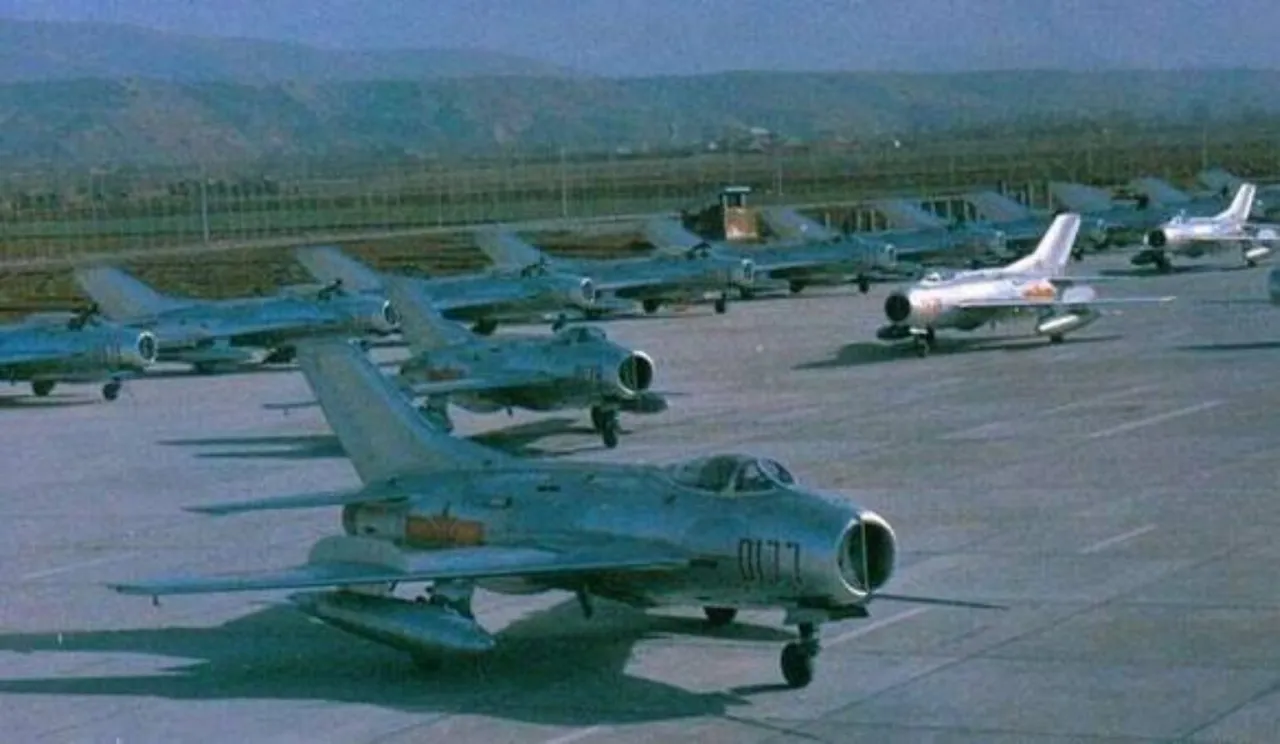
BBC: The PLAAF officially retired the J-6 fighter in 2010, after a sufficient number of fourth-generation J-11 fighters, based on the Russian Su-27SK, had entered service. However, some J-6s continued to be used for training purposes. Several dozen aircraft were operated at flight test centers, where they were used in research programs, preserving the service life of modern fighters. According to Western estimates, 700-800 J-6 fighters were mothballed.

Google Earth satellite image of J-6 fighter jets stored at Lushan Air Base. The image was taken in December 2022.
Subsequently, a significant portion of the stored fighters of this type were converted into radio-controlled aerial targets J-6W, used during exercises and tests of air-to-air missiles and SAMs, as well as into unmanned "air defense breachers" capable of carrying strike weapons.
Hengdogli Air Base, located in the sparsely populated northwestern part of China's Gansu Province, Inner Mongolia, is the PLAAF's combat operations center. A facility dedicated to converting obsolete aircraft into aerial target aircraft operates on the airbase's premises. Satellite imagery analysis shows that all of the J-5 aircraft parked at the facility have been decommissioned, and the facility is currently converting supersonic J-6 and J-7 aircraft.

Google Earth satellite image of J-6 and J-7 fighter jets converted into radio-controlled targets at the Henogli Aircraft Test Center. The image was taken in September 2023.
The area is also home to the Jiuquan Satellite Launch Center, China's largest aviation test site, Dingxing, and an air defense test center known as Site 72.
The Soviet Union never produced a two-seat version of the MiG-19, and pilot training for supersonic twin-engine fighters was conducted on the relatively light, subsonic, single-engine MiG-15UTI. Due to the MiG-19's more precise handling and significantly different takeoff and landing characteristics from the MiG-15UTI, pilot training was not always smooth.
Since the J-6 had long been the mainstay fighter of the PLAAF and naval aviation, China began developing a two-seat trainer. The aircraft, designated JJ-6 (Jianjiji Jiaolianji – 6)—a fighter trainer—made its first test flight on November 6, 1970.

JJ-6 combat training aircraft
To accommodate the second cockpit, the JJ-6 fuselage was extended by 84 cm in front of the wing, and additional ventral fins were added to the tail to improve directional stability. The integrated armament consisted of a single 30 mm cannon, but external mounts could carry the same ordnance load as the single-seat J-6. The maximum takeoff weight of the dual-seat version was slightly higher than that of the single-seat version, but its performance was significantly reduced. With the same powerplant, the maximum speed did not exceed 1360 km/h. Cruising speed was 810 km/h. The operational range without drop tanks was 940 km.

A JJ-6 combat trainer aircraft at the Military Museum of the Chinese Revolution.
From 1973 to 1986, 634 two-seat aircraft were built at the Shenyang Aircraft Manufacturing Plant. Operation of the twin-seat JJ-6 aircraft ceased in combat units by 2013, but two-seat JJ-6s, like single-seat J-6s, could still be seen parked at flight test centers until recently.

Google Earth satellite image of J-6 fighter jets, J-8 interceptors, and an H-6 bomber parked at the Xi'an Aircraft Manufacturing Company airfield. The image was taken in October 2021.
Single-seat J-6 fighters received the export designation F-6, while the two-seat combat trainers were known as FT-6s. These aircraft were in demand in Third World countries and became the hallmark of the Chinese aviation industry in the 1960s and 1970s.
The first country to receive the F-6 was Pakistan. The initial batch of 60 units arrived between December 1965 and March 1966.

Pakistani Air Force F-6 fighter jets
These fighters, which entered service with three squadrons, were used with great success in the 1971 war with India. They were used both in air-to-air combat and in strikes against Indian troops. According to official Pakistani data, F-6 pilots shot down one MiG-21, six Su-7Bs, and two Hunters, and damaged four more Indian Air Force aircraft. Four F-6s were acknowledged as lost: one in air-to-air combat and three to ground-based air defenses (one downed by its own anti-aircraft guns). India claimed the destruction of eight F-6s. In 1978, the Pakistani Air Force was reinforced with another 75 single-seat F-6 fighters and three dozen two-seat FT-6s. Of these aircraft, 40 were subsequently transferred to Bangladesh.
In the 1980s, a significant number of Chinese-made fighters operated by Pakistan were modernized, equipped with Western-made avionics and Martin-Baker PKD 10 ejection seats, and armed with American AIM-9P Sidewinder close-in missiles.
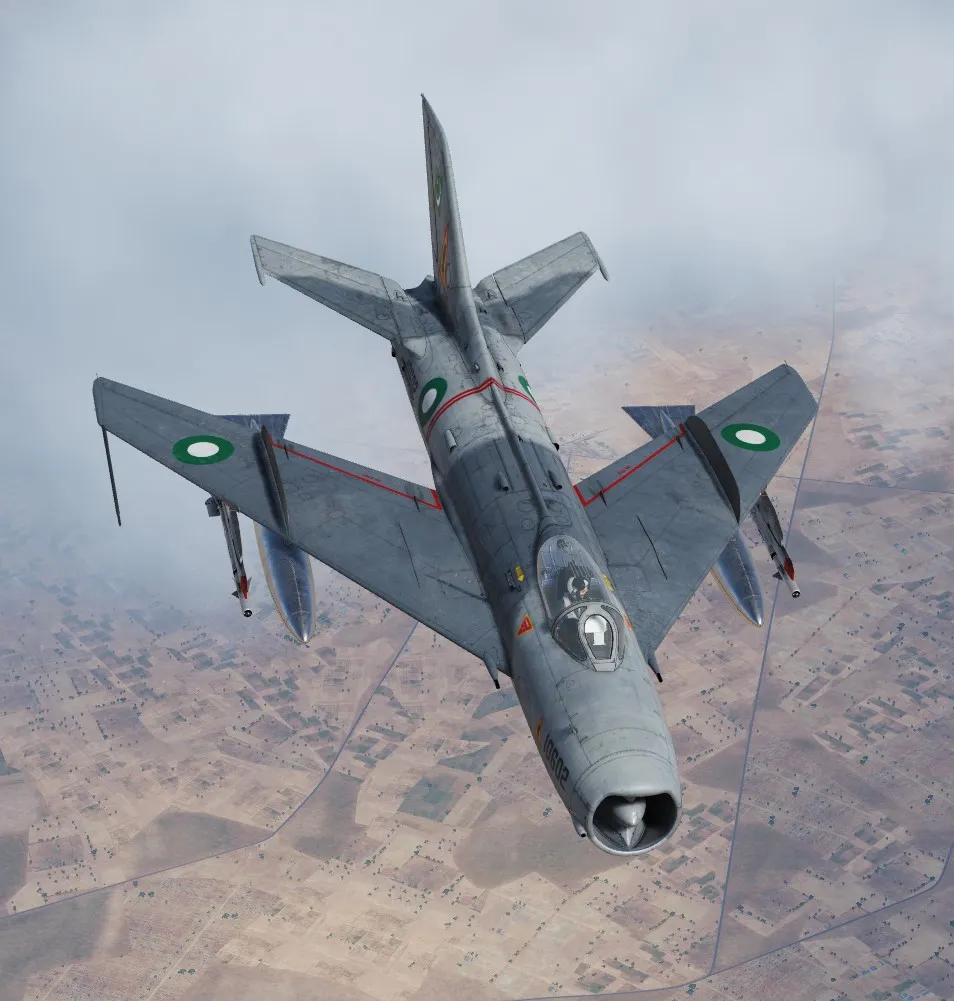
After the Soviet invasion of Afghanistan in 1979, F-6s were used to cover Pakistan's airspace from Afghan and Soviet aircraft. However, the aging F-6s found it difficult to compete with the faster MiG-21bis and MiG-23ML, and in the 1980s, they were replaced in this role by the F-16. Nevertheless, Pakistani F-6s operated alongside F-16s, Mirage IIIs, Mirage Vs, and F-7s until 2002. Two-seat FT-6s continued to serve in Pakistan until 2010.
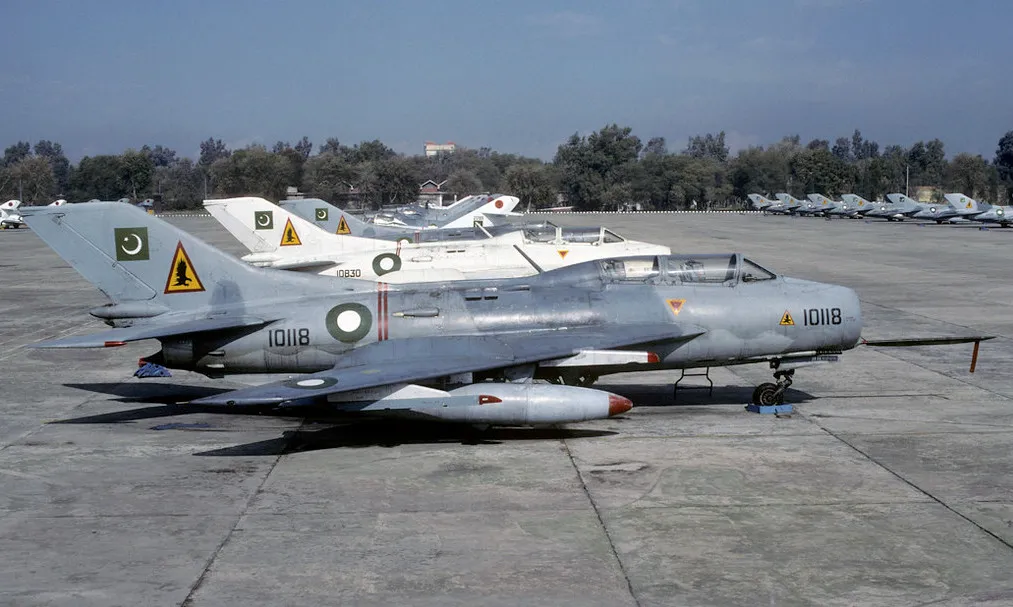
Pakistan Air Force FT-6 combat trainer aircraft
The F-6 performed well during combat operations in Vietnam. Compared to the MiG-17F, the supersonic F-6 had greater potential for intercepting American tactical and carrier-based strike aircraft. According to Western data, 54 F-6 fighters were deployed to Vietnam by January 1972. According to the memoirs of American pilots who participated in combat operations in Southeast Asia, the Chinese-made MiG-19s posed an even greater threat than the more modern Soviet MiG-21PFs, armed only with missiles. According to Vietnamese data, the J-6s shot down 13 enemy aircraft and helicopters, losing five J-6s (four shot down in aerial combat, and another lost to its own air defenses).
Deliveries of F-6s to Bangladesh began in 1977. The first batch included 12 single-seat and three two-seat aircraft. Later, in the late 1980s, Pakistan donated four dozen overhauled and modernized fighters.

Bangladesh Air Force F-6 fighter jet
The decommissioning ceremony of the last F-6 fighter jet in the Bangladesh Air Force took place on March 27, 2002.
In late 1975, China transferred 16 F-6 fighters to Cambodia. The Khmer Rouge attempted to use these aircraft to intercept Vietnamese aircraft and launch air strikes on Vietnamese territory. In 1979, the Cambodian F-6 fighters were captured by Vietnamese forces.

A Cambodian F-6 captured by Vietnamese forces is on display at a museum.
In 1965, Albania transferred its existing Soviet MiG-19PM interceptors to China in exchange for the first batch of 12 Chinese F-6 fighters. Between 1965 and 1971, the Albanian Air Force received over 70 single-seat F-6s and two-seat FT-6s. These aircraft formed the backbone of the Albanian fighter force until the mid-1990s, finally being decommissioned in 2005.

An F-6 fighter jet of the Albanian Air Force
After the end of Soviet-Egyptian military-technical cooperation, Cairo lost access to Soviet spare parts for its MiG-19s. To bolster its fighter fleet, Egypt acquired about a hundred F-6 and FT-6 fighters, which served for quite a long time. The single-seat fighters were decommissioned in the mid-1990s, while the twin-seat fighters remained in service until 2000.
In the early 1980s, Egypt transferred 40 aircraft to Iraq. Iran, in turn, acquired over 100 new F-6 and FT-6 aircraft from the manufacturer between 1980 and 1986. These aircraft were decommissioned in both Iraq and Iran in the mid-1990s.
Beginning in 1973, the Sudanese Air Force received twelve F-6 fighters and two FT-6 trainers. An additional twelve F-6s were delivered between 1981 and 1983. Another batch of twelve F-6s and two FT-6s was acquired in 1990. Sudanese F-6s participated in the civil war in the 1980s and 1990s. One F-6 was shot down by rebels in 1988, and two more in the fall of 1991.

An F-6 fighter jet of the Sudanese Air Force. This photo was taken in 2010.
In 2010, photographs were released showing that Sudanese fighters of this type remained operational.
In the second half of the 1970s, 12 F-6 fighters and two FT-6 twin-engine fighters arrived in Tanzania. Chinese specialists helped build Ngerengere Air Base, located approximately 120 kilometers west of Dar es Salaam, the country's administrative and industrial center, to house them.

Google Earth satellite image of F-6 and F-5 fighter jets at Ngerengere Air Base. This image was taken in July 2026.
The Chinese-made aircraft were used during the 1978-1979 war with Uganda and flew sporadically until 2012. These fighters, along with other decommissioned aircraft, are currently stored at Ngerengere Air Base.
The Somali Air Force received its first Chinese-made F-6 fighters in late 1978. Deliveries were made in batches of eight aircraft under a contract for 24 aircraft (including FT-6 trainers) signed by Somali President Siad Barre with China. The aircraft arrived after the active phase of the Ogaden War with Ethiopia had concluded, so the Chinese-made fighters did not have time to participate in that conflict. By 1982, Somalia had received another three dozen F-6s and FT-6s. These aircraft actively carried out airstrikes against Somali National Movement units in the north of the country in the late 1980s and early 1990s. Due to a shortage of qualified pilots in Somalia, Pakistani pilots were recruited to fly the F-6 fighters. In 1988, during fierce fighting in the area of the city of Hargeisa, rebels, using anti-aircraft artillery and MANPADS, shot down at least two F-6s, and by 1990 only three fighters of this type remained in airworthy condition.

A BBC Somali F-6 fighter jet. This photo was taken in the mid-1990s.
By the time Siad Barre was overthrown in January 1991, the Somali Air Force had completely ceased to exist. The remaining F-6 fighters were destroyed in armed clashes between clan factions or abandoned at airbases and turned into scrap metal.
Apparently, the only country that still operates F-6 fighters in combat squadrons is the DPRK.
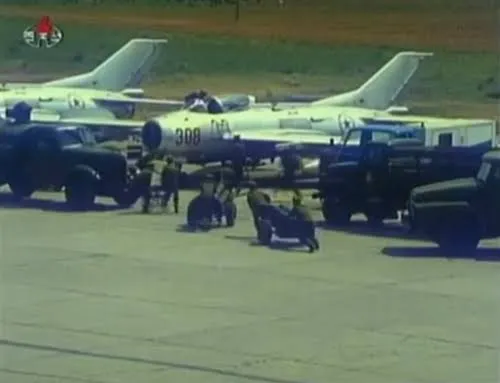
North Korea became the very first foreign customer for this aircraft, receiving eight units back in 1964. Subsequent large shipments arrived in 1971 (50 units) and 1972 (40 units). There were also at least three dozen two-seat FT-6s, which were delivered until the early 1980s.
On February 25, 1983, North Korean Air Force Captain Lee Un Pyong hijacked an F-6 fighter jet with tail number 529 to South Korea.

A North Korean Air Force F-6 fighter jet hijacked by South Korea
The pilot was on a routine training flight in an F-6 fighter jet, taking off from an airbase near Haeju. During the flight, he abruptly changed course, separated from the formation, and headed south at high speed across the Yellow Sea toward South Korea. On approach to Seoul, the defector's plane was intercepted by South Korean interceptors and escorted until landing at a military airbase south of the capital. The flight lasted approximately 18 minutes. In accordance with the practice of the time for defectors from the DPRK in South Korea, he received a large cash reward (approximately $800,000). The defector was accepted into the ROK Air Force, rose to the rank of colonel, and taught at the South Korean Air Force Academy until his death in 2002.
According to reference data, the North Korean Air Force currently has approximately 90 F-6 and FT-6 fighters. Most of these aircraft are apparently in storage, some in underground shelters. Even though, with Chinese support, the aircraft, which are over 50 years old, have been repeatedly repaired and modernized, and their average annual flight time does not exceed 10 hours, they are close to the end of their service life.
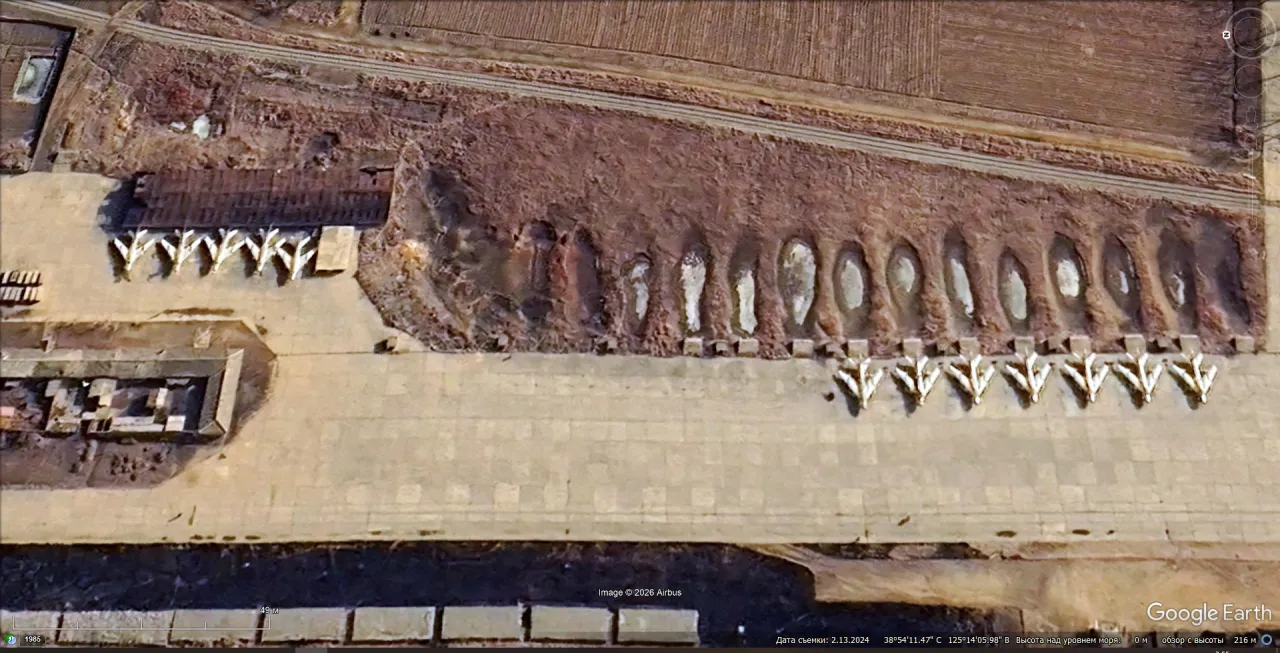
Google Earth satellite image of J-6 fighter jets at Oncheon Air Base. The image was taken in February 2024.
According to satellite imagery, in 2024, approximately two dozen operational J-6 fighters remained only at Oncheon Air Base, to which, according to information published in open sources, the 57th Fighter Regiment of the DPRK Air Force is assigned. At other airfields (for example, at Koksan Air Base), North Korean J-6s have been idle for approximately the past eight years. South Korean sources have reported that, following China's example, some of North Korea's aging fighters could be converted into attack UAVs, but whether this option will actually be realized is unknown.
Продолжение следует ...
Information