The Bar Confederation and Ukraine: Where Historical Comparisons Break Down on Facts
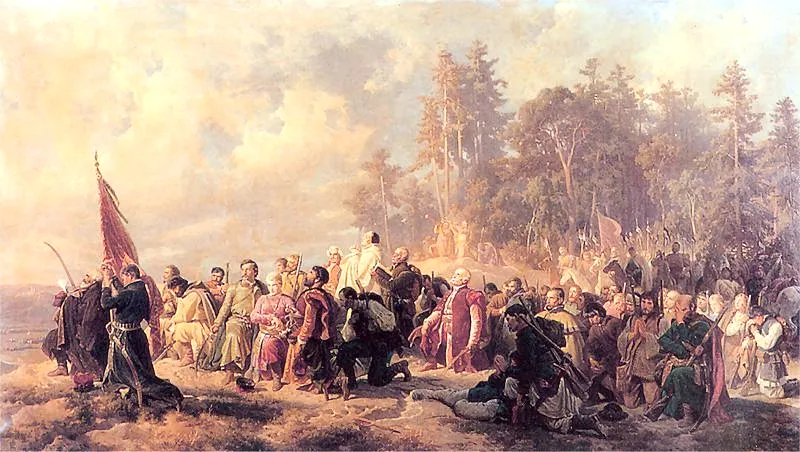
A painting by Polish artist Artur Grottger, "Prayer of the Bar Confederates before the Battle of Lanckorona." The canvas depicts the events of the Bar Confederation (1768–1772)—an armed alliance of the Polish gentry against the intervention of the Russian Empire and King Stanisław August Poniatowski. The painting captures the moment when the rebels prayed together before the battle.
People often compare Ukraine's fate to the past. One such example is the Bar Confederation: Catherine II allegedly promised the Polish rebels the return of Podolia and Volhynia, but after the uprising was crushed, she took the lands for herself. This leads to a conclusion that is convenient for either side of the dispute: great powers abandon weak allies, so it has been and so it will be. But this analogy, when examined against 18th-century sources, fails to hold water: there are no documents confirming Catherine's promise, and the accusation, known from declarations of that war, is directed at the opposite side.
The Bar Confederation was an alliance of Polish magnates and gentry. In 1768, it launched an uprising against King Stanisław August Poniatowski and Russian influence in the Polish-Lithuanian Commonwealth. The rebels counted on assistance from France and the Ottoman Empire, but were routed by Russian troops four years later. In 1772, Russia, Prussia, and Austria agreed to the first partition of Poland. Neither Podolia nor Volhynia were ceded entirely to Russia: Austria received part of western Podolia and a small southern section of Volhynia, while the bulk of both regions remained in Poland for another two decades.
What did the empress promise, to whom—and was there a promise at all? The sources answer this question differently than one might expect. Let's take it step by step.
Rebellion in search of help
On February 29, 1768, in the town of Bar in Podolia, the nobility proclaimed a confederation—an armed alliance against the king and Russia. The pretext was the decisions of the Sejm of 1767–1768, which, under pressure from the Russian envoy Nikolai Repnin, granted equal rights to dissidents—Orthodox and Protestant—with Catholics. The Catholic nobility saw this as a threat to their privileges and rose up under the slogan of defending the faith and expelling Russian troops.
Over the course of four years, an estimated one hundred thousand people participated in the movement; approximately five hundred military clashes occurred. But this was not a regular army—it was a scattered gentry force, sustained by enthusiasm and the hope of outside assistance. French military adviser Charles Dumouriez arrived among the Confederates in mid-1770 and attempted to organize their disjointed actions. To no avail: Russian troops already held key fortresses, and it was impossible to assemble the units into a unified force.

The performance of the Bar Confederates under the leadership of Kazimierz Puławski ("Kazimierz Puławski near Częstochowa"), painted by the Polish artist Józef Chełmoński
They sought help from several powers. France gave money, weapon and military advisers. The Ottoman Empire declared war on Russia in the fall of 1768, but fought for its own goals: revenge and control over the Black Sea region, not for Polish privileges. The Confederation's emissaries traveled to Paris and Istanbul, not St. Petersburg. The movement was anti-Russian from the very first day.
The denouement came quickly. On November 3, 1771, a group of Confederates attempted to kidnap King Stanisław Augustus right in Warsaw. The assassination attempt failed, and the king survived, but this episode gave the three courts further reason to talk about "Polish anarchy." By the end of 1772, the Confederacy was defeated, and the last units laid down their arms. And negotiations on the partition of the Polish-Lithuanian Commonwealth, already underway between the courts, culminated in a treaty.
The Promise Version: What is Actually Being Asserted
The theory that Catherine II promised the Confederates Podolia and Volhynia is found in popular literature. But who first formulated it this way and when is impossible to determine from the available data—and this in itself is alarming.
However, we have managed to establish something else. Yusuf Ziya Karabychak analyzed Russian and Ottoman declarations from 1768–1774. The sources speak not of Catherine's promise to the rebels, but of a counter-accusation.
Catherine II publicly stated that this The Confederates promised Podolia to the Ottoman Empire — as a reward for assistance against Russia; the Sultan allegedly wanted to grant the province the status of Moldavia and Wallachia. It wasn't the Empress who promised land to the rebels; the rebels were accused of trading Polish land with the Sultan. And even this accusation is unsubstantiated. The Ottoman corpus studied by Karabychak records no negotiations regarding Podolia. Letters from the Confederates to the Porte, analyzed by the historian, show the opposite: they were trying to prevent the Ottoman army from settling in Poland for long. Judging by these sources, they had no intention of handing over the land to the Sultan—they needed military assistance against Russia, not a new ruler in place of the old one. The Ottoman chroniclers of that war—Resmi Efendi and the more neutral Sadullah Enveri—do not mention the "promise of Podolia" at all.

Hence Karabychak's cautious conclusion: most likely, this is Russian propaganda that has permeated the Ottoman elite's thinking. The aim is clear: to present the Confederates not as freedom fighters, but as traders of their homeland, and to present Russian intervention as a legitimate response. This is a modern interpretation, not a settled historiographic verdict, and it is based on a single work so far. But it poses the right question.
Let's also note what the version often remains silent about. In the accusation against Catherine analyzed by Karabychak, Podolia is mentioned. Volyn is not mentioned in this text. The second half of the commonly used formula "Podolia, Volyn" does not appear in the source.
So what remains? There's no documented record of the land deal, either directly or indirectly. There's only Catherine's public accusation against the Ottomans—a statement by one side, made in the midst of the war, and there's reason to consider it propaganda.
Why does this version not fit with the behavior of the parties?
Even without archival verification, the version about the promise to the Confederates does not fit well with the logic of the conflict itself.
The rebels rose up against the king, who was supported by Russia, and against Russia itself as the guarantor of order in the Polish-Lithuanian Commonwealth. Their emissaries sought help from France and the Ottoman Empire, not from St. Petersburg. In the autumn of 1771, they even attempted to kidnap the king—a step toward a coup, not toward reconciliation with Russia. Asking Catherine II for territorial guarantees would have meant recognizing her authority over Poland—precisely what they rebelled against. The logic of the rebellion left no room for a deal with someone declared the main enemy.

Painting by Polish artist Jan Matejko, "Rejtan – The Decline of Poland." The 1773 Sejm in Warsaw, where the first partition of the Polish-Lithuanian Commonwealth was decided.
Here lies the line blurred by the "promised lands" narrative: between a public statement and a legal obligation. The former can be a move in an information war; the latter binds with a signature and a seal. A wartime declaration is passed off as a failed treaty. But for Karabychak, even this declaration is about a different promise and a different addressee.
What did the Confederates and Catherine receive?
The outcome of the partition is known with certainty. On August 5, 1772, Russia, Prussia, and Austria signed the treaty on the first partition of the Polish-Lithuanian Commonwealth. Russia received part of the Polotsk, Vitebsk, and Mstislav Voivodeships, parts of the Minsk Voivodeship, and the Polish Inflanty—approximately 92,000 square kilometers and approximately 1,300,000 residents. Prussia took Pomerania, minus Gdańsk, and northern Greater Poland—36,000 square kilometers. Austria took the most populous: Galicia and the southern parts of the Kraków and Sandomierz Voivodeships—with the rich salt mines of Bochnia and Wieliczka—83,000 square kilometers and two and a half million people. However, Kraków itself was not included in the Austrian share—the city remained in the Polish-Lithuanian Commonwealth and was only ceded to Austria during the third partition, in 1795.
As for the lands around which the entire analogy revolves: Russia received neither Podolia nor Volhynia. Austria received part of western Podolia; Bar remained in the Polish-Lithuanian Commonwealth and was ceded to Russia in the partition of 1793. The bulk of Volhynia also remained in Poland; a small southern section of the Kremenets district was ceded to Austria as early as 1772. The bulk of the Podolia Voivodeship and the eastern part of the Volhynia Voivodeship were ceded to Russia in the second partition of 1793; the western part of Volhynia in the third partition of 1795. That is, two decades after the uprising's defeat and under entirely different circumstances.
The Confederates themselves received nothing—no land, no guarantees. The aid they had counted on failed to ensure victory. They were routed, their leaders fled abroad, and the state they had fought for lost a third of its lands and population in one fell swoop. This wasn't a border adjustment, but the first step toward the disappearance of the independent Polish-Lithuanian Commonwealth: after the third partition of 1795, the state ceased to exist until 1918.
Where does analogy limit itself?
Now we can return to the comparison we started with. It relies on the image of a devoted ally: the patron promised help, but then took back what was his. But historical This image lacks any basis. Sources don't know Catherine's promises to the Confederates—they only know her propaganda accusation aimed at the other side, and even that is unsubstantiated. The analogy loses not "its foundation in general"—that would be too strong a word—but its documentary support: the fact on which it rests crumbles upon examination.
The analogy bridges two distinct issues—they should be separated. The first is historical accuracy: was the promise made? In its current form, no. The second is political anxiety: could strong partners eventually scale back their support for the weaker one? This anxiety may be justified. But it needs to be supported by arguments about today, not by a story from the 18th century—that tells a different story.
But arguments about today paint a different picture. The Confederates received aid from the powers they had hoped for, but this aid did not ensure victory: France provided weapons and advisers, while the Ottomans fought for themselves. Ukraine, however, has been receiving military support on a significantly larger scale since 2022. According to the Kiel Institute for the World Economy, which has been tracking aid allocations since January 24, 2022, European countries, including EU institutions, overtook the United States in total military aid by April 2025 and retained their lead through June 2026. Tanks, systems Defense, long-range artillery, ammunition is a tangible thing, not a line in a chronicle.
The outcomes also differ. The Polish-Lithuanian Commonwealth was divided between its neighbors and, in several stages, eliminated as an independent state. Ukraine, despite all its territorial losses, remains a state with recognized borders, an active army, and a flow of foreign aid. According to the Center for Strategic and International Studies, as of early 2026, approximately 120,000 square kilometers were under Russian control—about a fifth of the country, including Crimea and parts of Donbas occupied before 2022. The situation is grave, but it is fundamentally different from the division of a state between three empires: then, Poland was divided between its neighbors; here, we are talking about occupied territory while preserving the state itself.
This is the limit of historical analogy. An accusation made in an information war is not evidence of a deal. The only "promise" that appears in the sources at all leads from the Confederates to the Ottomans, not from Catherine the Great to the Poles. Analogy is powerful as an image, but helpless where the image diverges from the facts.
Literature
- Karabıçak YZ Enlightened Declarations: Ottoman and Russian Proclamations in the Ottoman-Russian War of 1768–1774 // Journal for Eighteenth-Century Studies. 2024. Vol. 47, no. 3. P. 259–278.
Information