Methods of protecting firearms: the experience of centuries

Wilmot Patent Expanding Muzzle Plug 1863
Precious weapon
In the armory stories two approaches to protection can be traced weapons From the harmful effects of the environment. One approach—let's call it "external"—involved placing a protective element over the barrel, enclosing it from the outside, like a case enclosing an object. In English, this was called a muzzle cover. The second approach—"internal"—involved inserting or pushing the element directly onto the bore, sometimes even partially inside it. The English word for this is "tompion," which derives from the French "tampon," meaning "plug" or "tampon." In Russian gunsmithing tradition, such devices were called muzzle plugs, barrel plugs, and sometimes muzzle caps or caps.
It's telling that the word "tampon" itself came to gunnery from a completely different context—the deck of a warship. There, gun muzzles were traditionally plugged with wooden plugs wrapped in oiled rags to prevent seawater and salt spray from seeping in, ruining the propellant with damp gunpowder, and corroding the metal. Naval practice gave land-based weapons not only the term but also the idea itself—and along with the idea, as would later become clear, its hidden flaw.
Both lines—external and internal—developed in parallel, each receiving its own embodiment among different peoples and in different eras. This is precisely why it is more logical to tell about them not strictly chronologically, but by tracing each one separately through the centuries, and then bringing both threads together at a common point—the era of the unitary cartridge and smokeless powder, when the rules of the game changed completely.
Before moving on, it's important to understand why this problem arose in the first place and why it only became more acute over the centuries. Early handguns used matchlocks—a device completely dependent on the vagaries of the weather. A smoldering fuse would go out in the rain, the wind would fan it at the wrong time, and powder spilled on an open shelf simply wouldn't ignite in the slightest dampness. The wheellock, which appeared around the beginning of the 16th century and resembled a miniature clockwork mechanism with a spring and a notched steel wheel, eliminated the need for open fire altogether—but it was incredibly expensive and practically only available to the aristocracy.
The flintlock became a truly mass-produced solution: a hammer with a flint-clamped trigger struck a steel flint, which also served as the cover for the powder pan. In the 17th and 18th centuries, this design became widespread and increased the rate of fire to two or three rounds per minute, and for skilled shooters using ready-made paper cartridges, up to five. It was also during this time, as early as the late 15th century, that gunsmiths began experimenting with helical rifling within the bore, seeking to twist the bullet in flight for greater range and accuracy.
By the early 16th century, the first rifles with an effective range of up to 400 meters appeared—but this accuracy came at the cost of high manufacturing costs and twice the loading time, as the round bullet had to be wrapped in oiled plaster and forcefully driven into the rifling with a cleaning rod. Therefore, rifled weapons remained for a long time reserved for hunting, and their owners treated them with particular reverence—which, in fact, spurred the development of all kinds of protective devices.
Let's start with the outer line of defense - with those solutions that covered the trunk from the outside, rather than penetrating inside.
On the American frontier of the 18th century, where the famous long-barreled Kentucky hunting rifle developed, colonists and hunters protected their flintlocks from rain and morning dew with a unique leather case with the almost comical name of "cow knee."


Leather gun case - "cow knee"
It was cut from the appropriate section of cattle hide, as the natural curvature of the leather in this area allowed for a minimum number of seams. This detail was far from decorative: in the era of the lack of reliable waterproof adhesives, every unnecessary seam became a direct route for moisture to penetrate. Leather straps were attached to the edges of the sheath, allowing it to be securely fastened to the weapon without the risk of it slipping while being carried through the forest or while riding.
Instead of leather, thick canvas or wool was sometimes used—but regardless of the material, the weapon was always impregnated inside and out with animal fat or beeswax, making it water-repellent. Practical hunters, who valued quick weapon readiness, often tied only the front strap, leaving the back one free—so they could easily pull off the sheath when game appeared.
The Russian military approached the issue of barrel protection systematically and, importantly, with scientific rigor, based on years of practical military experience. An order from Minister of War Dmitry Milyutin dated October 6, 1866, explicitly stated that the muzzle plugs previously used "they are more likely to promote the formation of rust in the bores of a gun barrel than to protect it from damage." — a conclusion that, looking ahead, the entire internal line of defense will also reach, as will be discussed below. It was this order that replaced the muzzle plugs for the 1856 model six-line rifles with leather "muzzle covers" made of black yuft leather with a felt bottom. These were placed on the outside of the barrel, with or without a bayonet, and they also protected the front sight from impacts.
Five years later, in 1871, similar covers were prescribed for Berdan rifles, but this time made of white Russian leather—glossy for guards units and plain for the line army. However, by 1885, these covers for 4,2-line rifles were ultimately abandoned altogether—the weapons were evolving, and so were the requirements.
Professional marksmen solved the same problem differently, commensurate with the value of their weapons. During the American Civil War, the elite "sharpshooter" units formed by Colonel Hiram Berdan, equipped with expensive match rifles with telescopic sights, transported them in rigid wooden cases, reliably protecting the expensive optics from impacts. Common Confederate soldiers, who lacked such luxury, made do with simple canvas cases with drawstrings—made by, among others, the CSA Arms Factory.
The outer line of defense continued into the 20th century, outlasting the rise of the chemical industry. The development of phenol-formaldehyde Bakelite in 1907, the first synthetic rubbers around 1909, and polyethylene in 1933 dramatically simplified and reduced the cost of producing moisture-resistant products for any purpose.


Mauser 98k safety
By World War II, American M1 Garand carbines were equipped with canvas dust covers, while the Germans used a removable steel device with a hinged cover on the front sight bracket for the Mauser 98k carbine. However, in severe frost, this cover would freeze to the barrel, and troops increasingly switched to simple plastic caps that had no moving metal parts prone to icing.

A barrel plug for the Japanese Arisaka Type 38 rifle.
Japan went its own way: the Arisaka Type 38 rifle received a rather rare brass muzzle plug, and the later Arisaka Type 99 was equipped with plugs made of Bakelite—a cheap and corrosion-resistant material, which was especially valuable in the humid tropical climate of the Pacific theater of war.
Why does a gun need a tampon?
Now let's turn to the inner line - the one that inherited its name from the ship's gun plugs.
During the American Civil War, simple wooden plugs were widely used: a cylindrical rod precisely adjusted to the caliber of a specific weapon, equipped with a stopper to prevent the plug from sinking too deeply, and a ball-shaped handle for easy removal. Two cross-cuts were made along the working surface of such a plug—these allowed the damp-swollen wood to more easily enter and exit the barrel without jamming. Similar wooden plugs were used on both the Springfield M1842 .69-caliber smoothbore caplock muskets and the Springfield M1861 .58-caliber rifled muskets.


Muzzle plug for a Thompson rifle
The British came up with a more complex design for their Enfield Pattern 1853 rifle: a metal stopper was placed on a cork rod, and a through-bolt screw, when tightened, expanded the cork from the inside, pressing it tightly against the bore walls—a more airtight solution than the simple wooden American design. An even more ingenious device featured an upper and lower section made of brass and connected by a threaded brass rod. Between the two brass ends was a central element made of Indian rubber, covered on the outside with coarse green wool.

When the upper part was screwed down relative to the lower, the rubber center expanded in diameter and tightly filled the entire barrel bore—a principle vaguely reminiscent of a modern expansion plug. The culmination of this design line was the invention of American George Wilmot of Connecticut, who in 1863 patented an even more technologically advanced version—an expanding plug on a brass washer with a screw-handle and a wide rubber gasket wrapped in fabric: tighten the screw, the plug swelled and sealed the barrel tightly; loosen it, and it was easily removed.


The Wilmot tompe-l'œil's unique design features a brass upper and lower section connected by a threaded brass rod. Between the two ends is a center of Indian rubber covered with coarse green wool. When the tompe-l'œil is "tightened" by screwing the upper section onto the lower section, the rubber center expands, filling the musket's muzzle.
All these designs shared one fundamental belief: the tighter and more airtight the bore, the better protected it was. But things weren't working as intended. The tight plug did indeed keep moisture out, but it also relentlessly trapped any moisture already inside. Condensation, formed during normal daily temperature fluctuations, along with the remnants of unburned powder deposits, created a veritable greenhouse effect inside the hermetically sealed barrel, and rust beneath the plug corroded the rifling even faster than on a barrel left completely open to the fresh air.
It was precisely this conclusion, as already mentioned above, that the Russian military department independently arrived at in an order in 1866 - both ends of the world, faced with the same physics of condensation, received the same disappointing result.
A separate, lesser-known chapter in this history concerns a device that only superficially resembles a muzzle plug, but is fundamentally different in its purpose: the "false muzzle." This was a screw-on component of a precision muzzle-loading rifle, whose internal rifling precisely followed the rifling of a specific, "original" barrel, and had a smooth, funnel-shaped expansion at the front. A bullet was inserted into this funnel without the slightest distortion, and then carefully driven further with a cleaning rod into the real rifling.

False barrel diagram

Morgan James sniper rifle with Chapman-James scope and false muzzle

The Ramsdell rifle and its false barrel
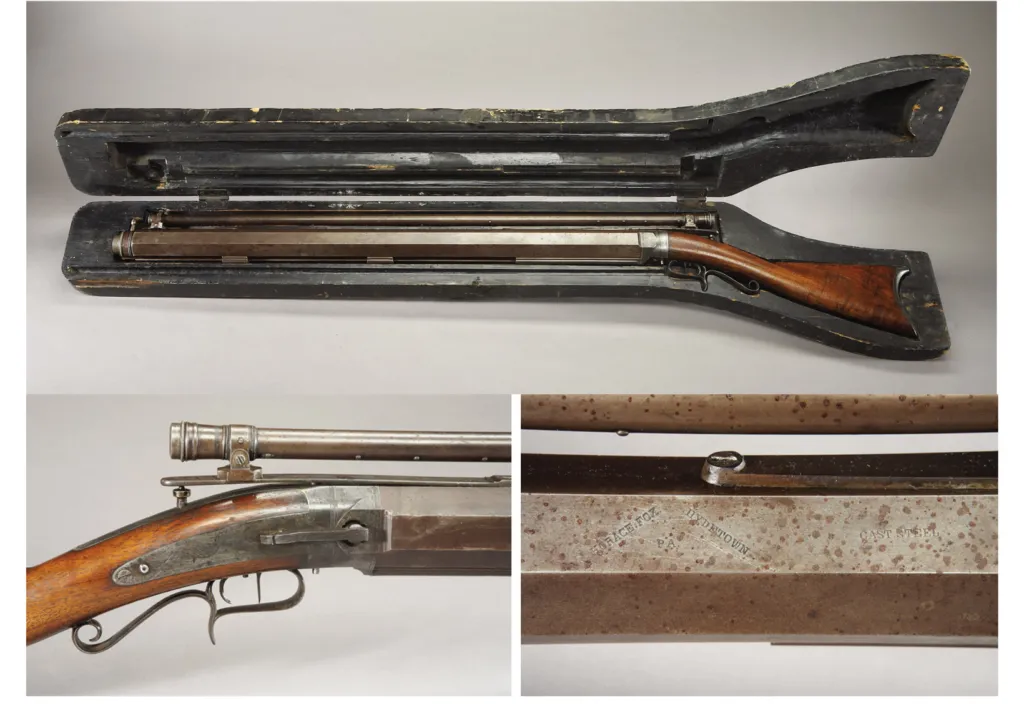
Horace Fox's sniper rifle with a telescopic sight. Note the wooden case—a weapon like this could have cost a fortune.
This detail also protected the bore from damage by a metal cleaning rod during routine gun cleaning, thus becoming a direct historical prototype of modern cleaning guides for high-precision sniper rifles. However, it still had a fatal resemblance to a real muzzle plug: if the shooter, in the heat of the moment, forgot to remove the plug before firing, the pressure of the propellant gases would inevitably wear away the plug itself, and, as a rule, damage the barrel itself. On expensive rifles with scopes, this danger was eliminated with an ingenious design trick: a special protruding disk was placed on the "false muzzle" that physically blocked the line of sight through the scope.
The history of both lines of defense took a sharp turn in the second half of the 19th century, when a true revolution in ammunition design occurred. In 1845, the Frenchman Louis Flobert created a primitive unitary cartridge for parlor shooting, and twelve years later, in 1857, the Americans Horace Smith and Daniel Wesson began producing the first truly mass-produced rimfire cartridge, the .22 Short, which for the first time combined gunpowder, primer, and bullet in a single metal case. Almost simultaneously, engineer George Morse patented reloadable cartridges with a brass centerfire case, and in 1866, the Berdan and Boxer primers appeared, forming the basis for all modern combat cartridges.
When fired, the metal cartridge case expanded and tightly sealed the breech, while the bolt reliably covered the barrel from behind—and the main problem of all previous eras, the dampening of the gunpowder scattered inside the barrel, was finally a thing of the past.
Meanwhile, another crucial technical achievement of the mid-century cannot be overlooked: the Minié bullet of 1848, named after the French captain Claude-Étienne Minié. It was a cylindrical-conical lead bullet with a hollow tail section, into which a small iron cap was inserted. When fired, the powder gases forced this cap inward, the bullet's skirt expanding and tightly embedded in the rifling, ensuring both reliable gas sealing and a significantly increased loading speed compared to the older method using oiled plaster. It was thanks to the Minié bullet that the range of rifled carbine guns approached the one-kilometer mark.
It would seem that with the advent of the unitary cartridge, the problem of damp propellant powder should have completely solved the issue of muzzle protection. But that wasn't the case: the barrel still required protection from sand, dirt, snow, and, as weapon accuracy increased, from purely mechanical damage. Even a small nick or dent on the muzzle edge distorted the bullet's exit pattern and significantly reduced accuracy.
Moreover, the smokeless nitrocellulose propellant invented by Paul Vieille in 1884 added a new dimension to the old problem. It produced virtually no smoke or carbon deposits, but burned significantly faster than black powder and developed pressure much more rapidly—meaning the muzzle energy of a shot increased exponentially. Firing with a hard plug left in the barrel now became even more dangerous: it was practically guaranteed to rupture the barrel. It's no coincidence that the 1938 Soviet Manual on Firearms included a direct and categorical warning regarding the Mosin-Nagant rifle of the 1891/30 model:
To prevent barrel rupture or swelling during firing, never plug the barrel bore.
This is precisely why gun plugs gradually fell into the background. During the 20th century, hard internal plugs were increasingly replaced by soft fabric covers placed on the outside of the barrel. The fundamental difference was that such a cover did not penetrate the barrel and, therefore, could not physically become a deadly obstacle in the path of a bullet.
A telling symbol of this transition was a rather prosaic American solution during World War II: ordinary rolls of cellulose adhesive tape, produced by Minnesota Mining and Manufacturing (the same company that would later become famous worldwide under the short name 3M), were simply applied directly to the muzzle of the M1 Garand carbine. This tape painlessly penetrated and flew away with the first shot, without damaging the weapon or distorting the bullet's trajectory—and at the same time, reliably protected the barrel from sand and dust during long marches and landings.
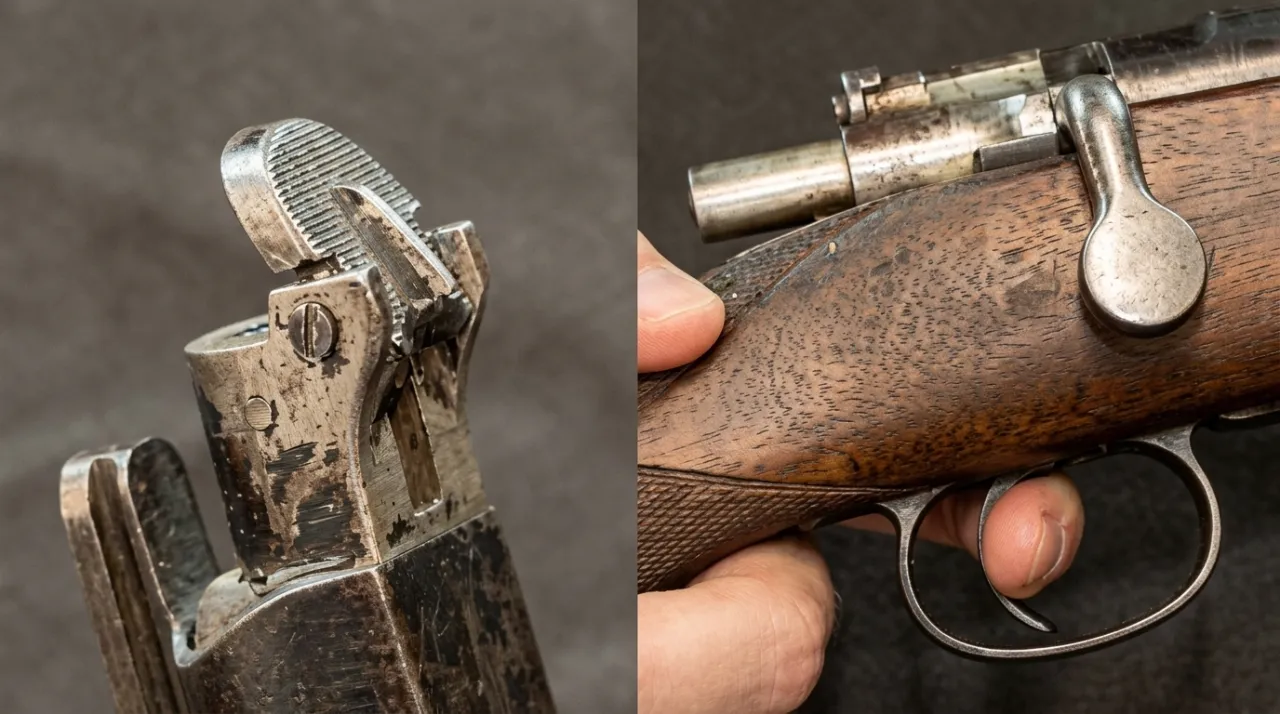
Automatically opening barrel cover of the Mauser Modelo 1893 rifle
One of the most daring experiments was the Spanish Mauser Modelo 1893 rifle, a prototype with a metal hinged cover on the muzzle, mechanically connected directly to the trigger by a rod. When the trigger was pulled, the cover was supposed to automatically swing open, clearing the bullet's path at the very last moment before firing. The concept was truly elegant, but the complexity and high cost of production ultimately doomed it—such an automatic system never entered mass production, and gunsmiths around the world ultimately relied on the simplicity and reliability of a simple fabric cover, removed by hand before firing.
Almost modern history
Since the mid-20th century, the primary solution adopted by the US and NATO armies has been thin-walled vinyl and polyethylene muzzle caps, often referred to in manuals with the frank military slang of "barrel condoms." These are disposable or semi-disposable translucent cups that fit over the muzzle and barrel. They don't extend inside the bore, but rather enclose it from the outside, so even if a soldier forgets to remove the cap, the bullet simply flies through the thin film when fired, encountering virtually no resistance and posing no threat to the barrel.
In the US Army, these caps have their own catalog number—NSN 1005-09-000-2008—and are produced in millions of units. They are included in the equipment kits for the M16, M4, and their variants. In the field, they serve three purposes: preventing rainwater from seeping into the barrel when the weapon is carried vertically, stopping sand and dust from entering while crawling, and, crucially, serving as a visual marker—the paratrooper loading the aircraft can see that the cap is in place, indicating the bore is clear and the weapon is ready for combat use after removing the film.
A separate, largely parallel solution developed in the Soviet and later Russian arms schools. The AK family's separate muzzle plug was less common in combat use, as Kalashnikov assault rifles have always featured a standard muzzle compensator. The AK-74 has the famous "zigzag" slotted muzzle compensator, which not only reduces muzzle rise during automatic fire but also covers the muzzle, absorbing impacts and dirt. Nevertheless, rubber and polymer muzzle plugs and caps have always been used in warehouses, arsenals, and by troops for the AK and its derivatives—inexpensive, frost-resistant, and placed on the barrel during preservation, transportation, and long-term storage.
A separate and very specific aspect of barrel protection is the blank firing adapter (BFA). They perform the opposite of the usual task: keeping out dirt while maintaining the necessary gas pressure, which is insufficient to reload the automatic rifle without a bullet. Without a BFA, the rifle or machine gun, like a living being, "chokes" on the blank cartridge and prevents the bolt from cycling.


The idea for the BFA itself originated not in the United States, but much earlier—during World War II, when mass-produced automatic weapons first required simulated combat without real bullets. The German Wehrmacht used a device known as the Platzpatronengerät (blank cartridge device) for the MG 34 and later MG 42 machine guns. It screwed onto the muzzle using a similar principle to deflect excess gases back into the short-stroke barrel of these machine guns.
The US Army uses a red muzzle adapter for the M16 rifle and a yellow one for the M4 carbine. They differ in their mounting method and design: they clamp or screw onto the muzzle, sealing it so that some gases are diverted back into the gas mechanism, while the excess is released through calibrated holes. Interestingly, the BFA also functions as a barrel shield: during blank-firing exercises, it absorbs the abrasive effects of hot gases and soot, protecting the barrel itself. This is why the weapon is especially thoroughly cleaned after blank-firing.
The widespread use of muzzle threads on combat weapons has given rise to a uniquely military-specific component class: thread protectors. Modern assault rifles and carbines, whether M4s with 1/2-28 threads for Surefire quick-detach flash suppressors or pistols threaded for moderators, are produced with standard threads that remain exposed and vulnerable when the muzzle is removed. Military and special forces solve this problem with screw-on steel or aluminum thread protectors, which cover the threads and simultaneously smooth out the barrel end from impacts with vehicle sides, concrete, and body armor.

A telling example is the American brand Surefire, whose flash suppressors are used on combat carbines worldwide: when the flash suppressor is removed for installation of another device, a lightweight protector is screwed onto the barrel, protecting both the threads and the bore edge. For military equipment, this isn't a fad, but a cost-effective measure: stripped threads or a dented muzzle can render an expensive barrel inoperable, while replacing a cheap ring takes seconds.
Muzzle protectors have evolved from simple wooden plugs to modern polymer caps and thread protectors, with shooter safety remaining the key criterion throughout. Today, this field continues to evolve alongside weapons materials and design, but the simple physical principles established centuries ago still guide engineering solutions.
Based on materials from the publication "VOENMEKH. Bulletin of the Baltic State Technical University."
Information