Such an unusual, multifaceted jambiya

"Ashik Kerib." M. Yu. Lermontov. Filmstrip, 1959. The dagger held in the hand of the beautiful Magul-Megeri is a jambiya.
Gold dazzles my dagger;
The blade is reliable, without defects;
His damask steel preserves a mysterious temper -
The legacy of the swearing east.
"The Poet" by M. Yu. Lermontov
The blade is reliable, without defects;
His damask steel preserves a mysterious temper -
The legacy of the swearing east.
"The Poet" by M. Yu. Lermontov
Armory gallery. The impetus for writing this article was a comment from one of our readers, Alexey Kartazaev, who posted a photograph of a jambiya dagger from his collection. I asked him to share more photos, and he sent them to me.
I looked at it—and the dagger was indeed very interesting. I turned to my sources, primarily the collections of the Metropolitan Museum in New York, and discovered that they have a simply astonishing number of similar daggers. Moreover, they are all called "jambiya," although many belong to completely different types. weapons With a "curved blade." But the Metropolitan museum staff called them all "jambiya," well, really... And only some had additional indications: southern Moroccan, Syrian, Turkish, Indian, and even... Wahhabi—something I couldn't even imagine. So I had to sort through their collection and, at the same time, write down in the captions under the photographs what was really there.
Interestingly, I saw this dagger way back in my distant childhood. We didn't have a television yet, but my mother always showed me filmstrips through a slide projector. Among them was a filmstrip based on M. Yu. Lermontov's fairy tale "Ashik Kerib." I didn't much like it, or rather, I didn't like its hero—he was forgetful and inconsistent. But I did notice the dagger. And now I remember that filmstrip, and that shot from it where Magul-Megeri sits with a dagger in one hand and a cup of poison in the other! And of course, I couldn't even imagine back then that one day I'd be writing about such daggers, and having photographs of them from overseas! Now then, let's begin our "tour" of our weapons gallery—and let's begin it with some general information about the jambiya and its many clones.

Dzambiya by Alexey Kartazaev. Blade and handle

Jambiya in its sheath

Scabbard and blade
So, the classic jambiya is an oriental dagger with a broad, curved blade like the beak of a bird of prey, and without a guard. It is an element of the national Yemeni male dress, meaning that in Yemen, men wear the jambiya everywhere. It is awarded to men after the circumcision ceremony.

Jambiya from Yemen
In both northern Yemen and southern Oman, you can always spot a man on the street carrying a huge curved dagger tucked into a special belt made of tanned leather or very thick fabric. It's worn on the belt, slightly to the side, which, incidentally, is where it gets its name, which comes from the Arabic word for "side."

Jambia from Medina with scabbard. Metropolitan Museum of Art, New York
This dagger is very ancient. Daggers with a wide, double-edged curved blade were widespread among the peoples of the Near and Middle East, Persia, the Arab world, and even India. They were usually richly decorated, but due to Islamic prohibitions, images of animals, birds, and people were not allowed on purely Arab daggers.
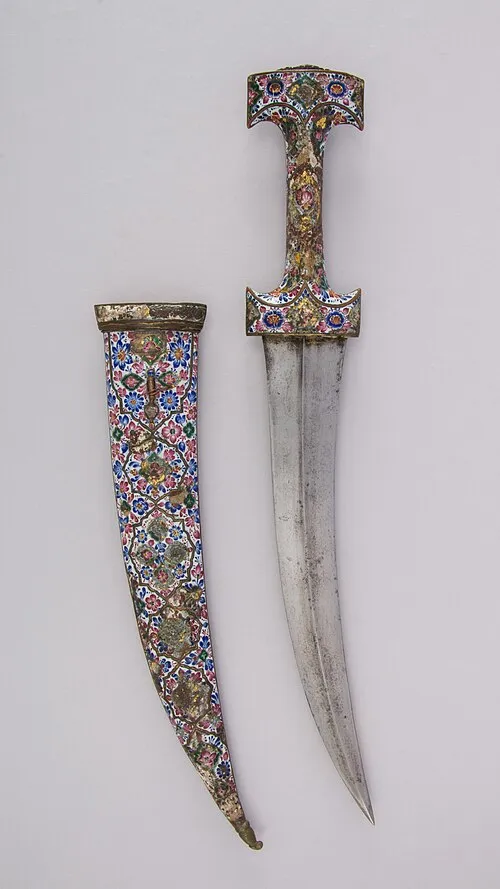
"Jambia" from Persia. Metropolitan Museum of Art, New York

Persia, dagger (jambiya) with scabbard and cord. A warrior figure is visible on the handle. Metropolitan Museum of Art, New York.
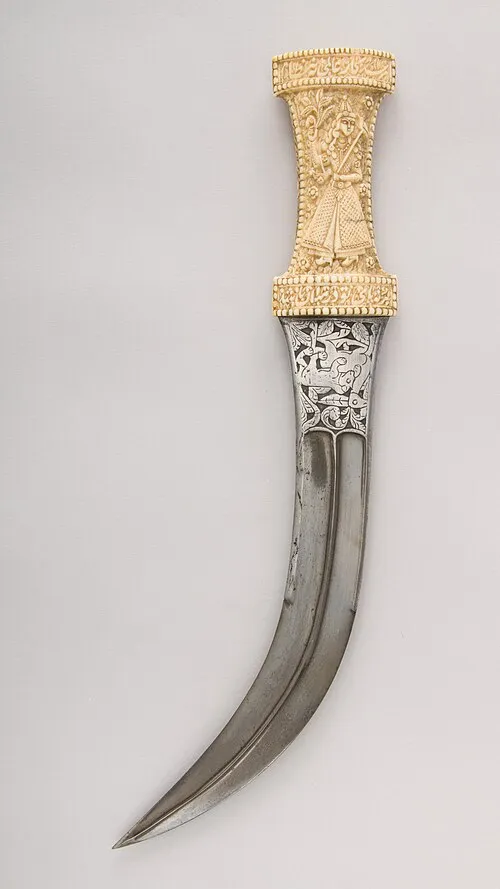
A Persian jambiya with an ivory handle and a figurine of a girl. Metropolitan Museum of Art, New York
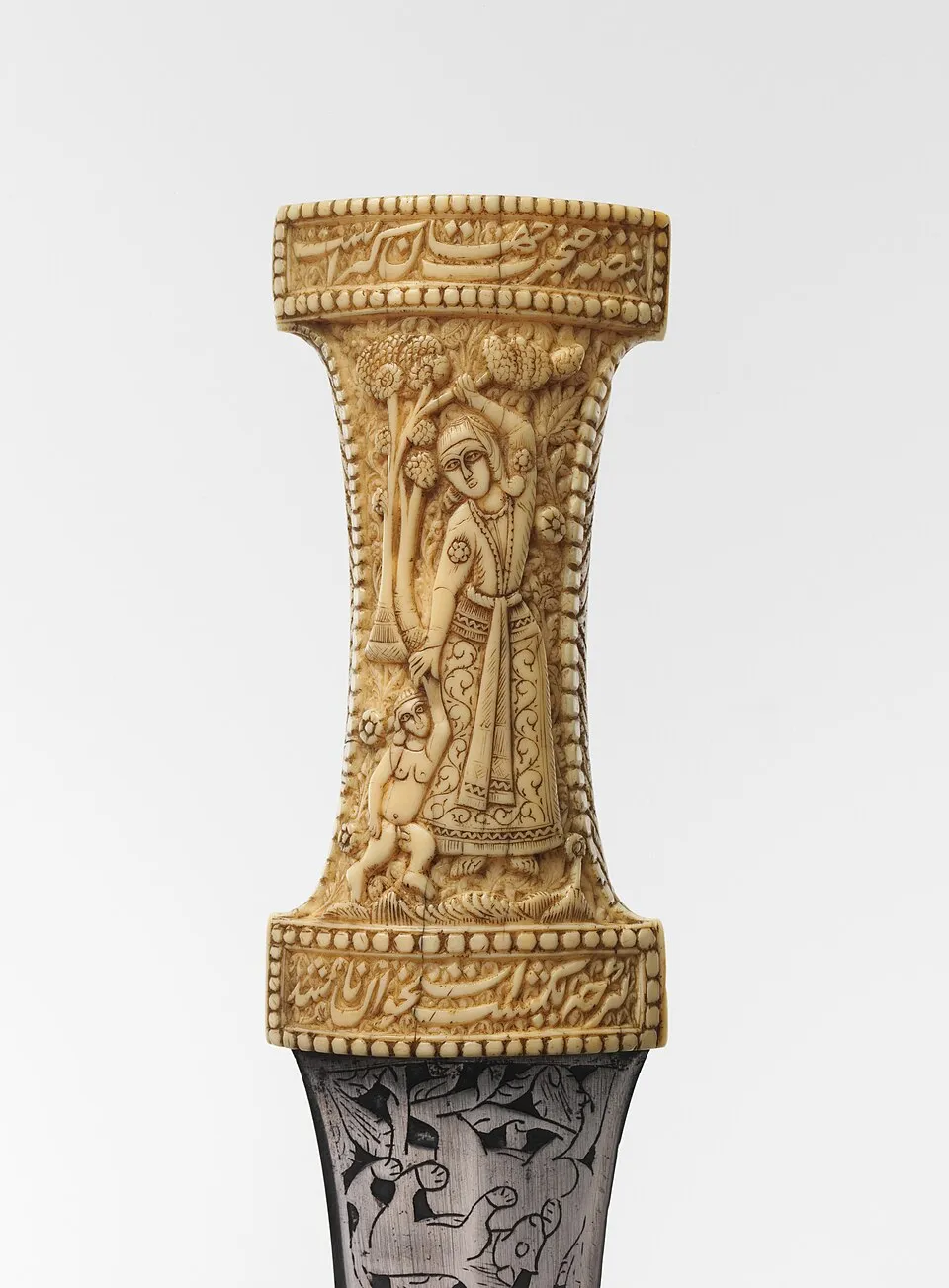
A fragment of the handle... But what about the ban on depictions of people?
Although the tradition of wearing such a dagger on the belt has not gone away even today, especially since the civil war between government forces and Shiites (supporters of the Ansar Allah group) has been ongoing in Yemen since 2014, so in the most extreme case, if the ammunition for the Kalashnikov suddenly runs out, a Yemeni will always have a jambiya dagger on hand.

Jambia. Syria. Metropolitan Museum of Art, New York

Turkish version? Metropolitan Museum of Art, New York
Daggers from the 18th and first half of the 19th centuries featured reinforcing ribs in the center of the blade to provide greater strength, and their cutting edges were clearly defined. However, by the 19th and 20th centuries, they were largely manufactured in a purely formal manner, so their blade shapes became much simpler.

Dagger from the island of Bali. Metropolitan Museum of Art, New York

Dagger from the island of Borneo. Metropolitan Museum of Art, New York

Wahhabi dagger (?), 18th–19th centuries. Length 55,6 cm, blade length 52,4 cm. Weight 433,7 g. Metropolitan Museum of Art, New York
The jambiya blade is double-edged and comes in various sizes, but it is never too large. Lengths ranging from 7–10 cm to up to 30–35 cm are all that a master swordsmith can afford. The handle is traditionally straight, similar in appearance to the handle of the Caucasian kama dagger—that is, it is widened at the front, narrowed in the middle, and has a massive pommel at the end. The blade is secured internally with a special resin and two rivets at the widening points, made of brass, copper, or silver. Sometimes these rivets are merely imitation, and the handles themselves are entirely decorated with embossed ornamentation.
Ancient heirlooms are passed down from the head of a clan to the eldest heir, often with a ritual transfer of seniority within the clan or family. The jambiya is also used in a number of local rites and rituals. In particular, it is used in a ritual Yemeni dance called bara. Ironically, according to experts in oriental blades, the best jambiya makers in the past were Jews. Wealthy Arabs paid them enormous sums for them. But in 1949, Yemenite Jews immigrated en masse to Israel, and with their departure, the tradition of creating genuine, "proper" jambiya daggers faded into oblivion.
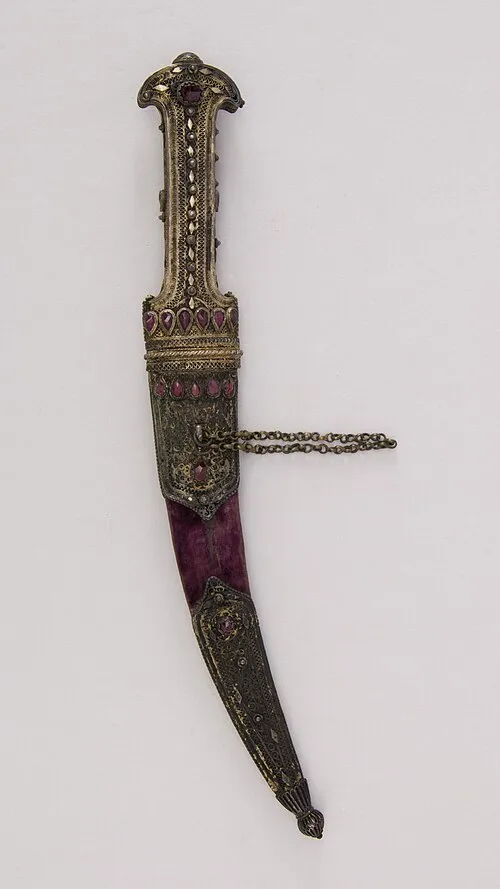
"Maltese Jambiya." Metropolitan Museum of Art, New York
The jambiya comes with a scabbard made of wood and leather. The scabbard differs from all other scabbards by its distinctive upward curve, which is hooked onto the belt when the dagger is drawn (the jambiya is always worn with the scabbard tucked into the belt—khizam). The scabbard and belt are also traditionally decorated. The more ornate and elaborate the scabbard and belt, the higher the status of the wearer. Therefore, the dagger also serves as an important social marker, directly indicating the owner's status. There is also a special technique for drawing this dagger from its scabbard: using only the right hand and with a reverse grip, with the thumb resting on the pommel.
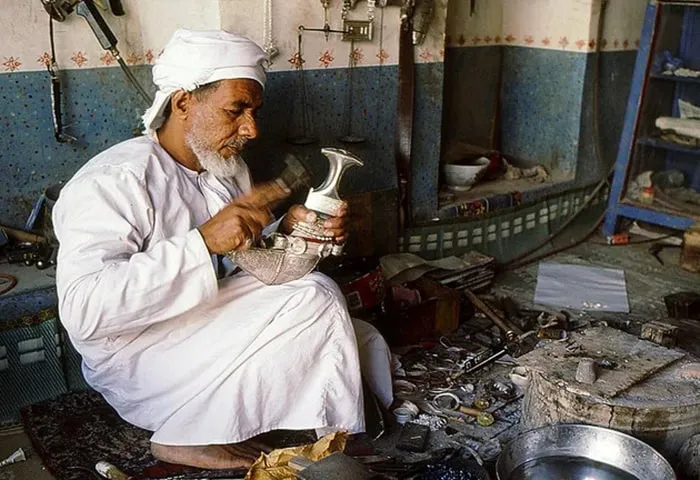
A jambiya master. A modern photo.
Today, jambiya production in Yemen is ubiquitous, handmade and, as they say, "home-made"—with a bare minimum of tools and equipment. These mini-workshops are numerous, often employing just one person, who is both the craftsman and the seller. Often, a dagger is practically created right before the buyer's eyes. This could range from a knife with a forged blade, richly embellished, a very sharp one, to a cheap craft suitable for nothing more than interior decoration.
The main consumers are occasional tourists, foreign military advisers, and... wholesale buyers who sell this product throughout the Arab East. However, some modern special forces units, including Jordanians, Yemenis, and... Brunei, also have daggers similar to the jambiya in their arsenals!
And here's something else interesting. Since humans are naturally imaginative and envious, it's no surprise that other nations began to borrow the jambiya from the Yemenis, sometimes copying it, sometimes modifying it to suit their own tastes. As a result, "curved daggers" began to be found from Morocco to China, as well as in the Balkans. Many are very similar to the jambiya, but have acquired their own local names and have distinctive differences.

Moroccan Kumiya dagger. Metropolitan Museum of Art, New York

A southern Moroccan koumia with a lush "peacock tail." Metropolitan Museum of Art, New York
Moroccans, for example, have the kumiya (koumya, kummiya)—a dagger similar to the jambiya, but thinner, more elegant, and refined, with a double-edged blade. The pommel has a characteristic peacock-tail shape. It is worn, however, not on the belt, but on a sling over the shoulder.

The Albanian version of the jambiya is unmistakable. They were the only ones to decorate both the scabbards and the handles of their revolvers with polished coral! Metropolitan Museum of Art, New York
Jordanian Bedouins possess the shabriya dagger (shibriya, shabariya, kangar), which is also considered their traditional Bedouin weapon. It is common in the Arabian Peninsula, Syria, Lebanon, and… Israel.

Jordanian Shabriya

And this is a traditional Omani khanjar!
The khanjar, a traditional Omani dagger, is very similar to the jambiya: it shares the same curved blade and J-shaped sheath. However, there are some notable differences. For example, the khanjar is worn on the belt rather than tucked into the waistband, for which purpose its sheath has a special harness made of straps and rings. It is smaller than the jambiya. The khanjar's sheath also has a special slot on the back for a small auxiliary knife, crafted in the same style as the larger blade.
P.S. The author and site administration express their gratitude to Alexey Kartazaev for his participation in the preparation of this material!
Information