Aluminum as anti-splinter protection in tanks

On the use of aluminum alloy as an anti-splinter liner on tank when it is hit by cumulative ammunition and fin-stabilized sub-caliber projectiles.
Instead of an introduction
It's no secret that when armor is penetrated, a huge number of fragments fly into the space behind the armor of a tank (or any other combat vehicle, for that matter). These fragments include fragments of the shell itself or the shaped-charge jet, as well as secondary fragments generated by the armor.
With a significant spread angle, they injure the crew, disable the tank's internal equipment, and can cause fires in the vehicle's fuel tanks and ammunition stowage. Therefore, armored vehicle manufacturers pay close attention to the spall protection of their products.
This primarily concerns the installation of spall liners (located behind the rear armor) made from aramid fabrics, fiberglass, and ultra-high molecular weight polyethylene. However, light alloys, such as aluminum, can also perform this task quite well.
One experiment proving this was conducted in the 1970s in the USSR using the aluminum alloy AMG-6. The test results were quite interesting.
"Pie" of steel and aluminum
The experiment utilized medium-hardness steel armor plates with thicknesses ranging from 100 mm to 150 mm, as well as AMG-6 aluminum alloy plates with thicknesses ranging from 40 mm to 60 mm. The plates were installed at various angles, both close together and with a small air gap.
This composite armor was fired at with two types of ammunition: the BM-2 subcaliber round and the BK-3 high-explosive round for the T-54/55 tank's 100mm gun. A "Sieve"-type interceptor screen was installed behind this barrier—an aluminum plate whose holes and dents, after the armor was penetrated, allowed one to estimate the quantity and angle of fragmentation.
To ensure the integrity of the experiment, not only composite armor barriers made of steel and aluminum were fired at, but also monolithic steel ones. A total of 25 experiments were conducted with dual-barrier armor, the results of which are summarized in the table below.
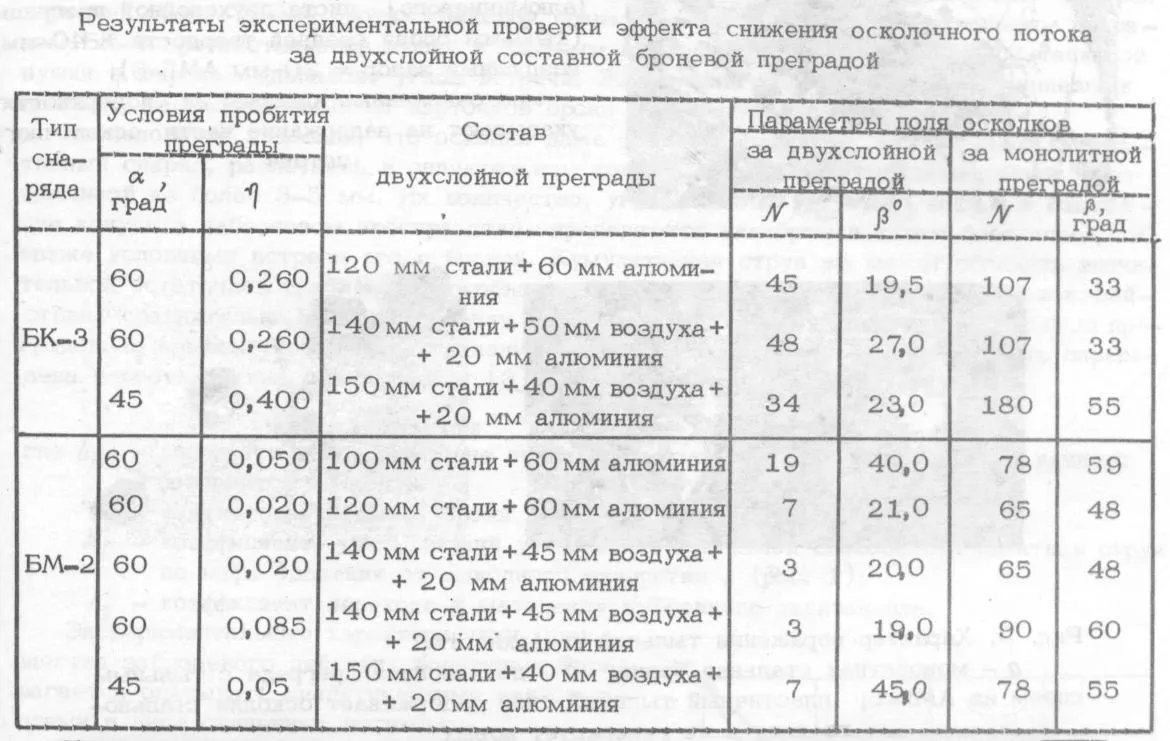
N is the number of lethal fragments capable of causing serious injury to the crew, damaging equipment, and causing a fire; B is the fragment scattering angle; a is the inclination angle of the armor plates, η is the projectile's penetration reserve, determined by the ratio η = (δₚₚ − δₚᵣ) / δₚₚ, where δₚₚ is the maximum penetration thickness, mm, and δₚᵣ is the reduced thickness of the barrier, characterizing the residual penetration ability of the projectile.
As the table shows, the use of an aluminum layer reduces the fragmentation angle of a subcaliber projectile by 1.5 to 3 times, and the number of fragments by 4 to 20 times, depending on the barrier configuration and residual penetration. For HEAT projectiles, the effect is a 1,2 to 2-fold reduction in fragmentation angle and a 2 to 5-fold reduction in fragmentation number.
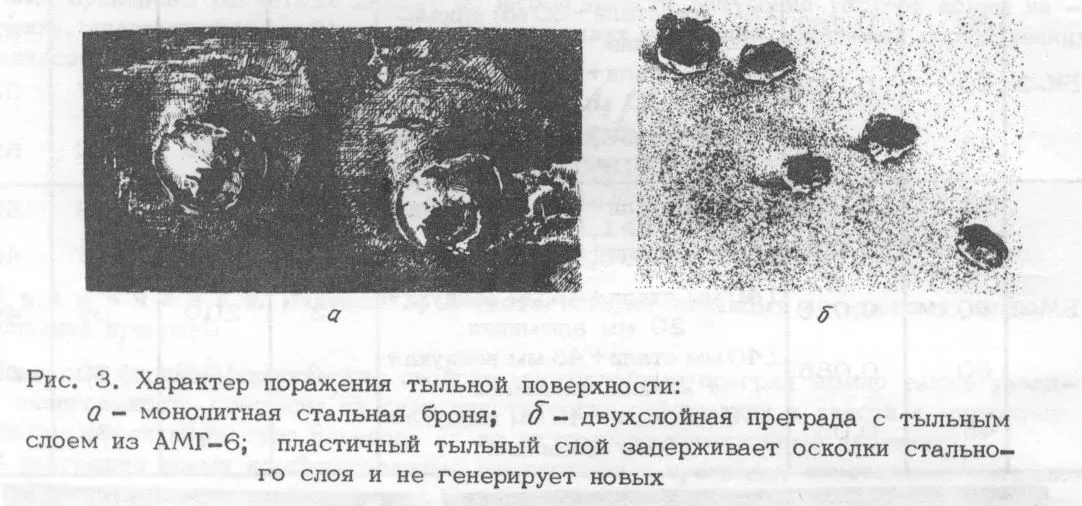
What is important is that the aluminum plates themselves did not generate fragments, but only held them away from the steel sheet.
Conclusions
The results for aluminum were quite impressive—experimenters even recommended looking into aluminum-based alloys for providing fragmentation protection for military vehicles. This is, in general, unsurprising, given the effectiveness, relative ease of manufacture at the time, and ease of use of aluminum.
However, no matter how you look at it, aluminum plates are also quite heavy and increase the tank's armor dimensions. Under current conditions, it's much simpler and cheaper to install a lightweight aramid liner or one combined with fiberglass. Nevertheless, aluminum can be useful as a "basic" spall protection component of a combat vehicle's composite armor.
The source of information:
"Protective Ability of an Armor Barrier with a Plastic Aluminum Layer." A. G. Komyazhenko, S. V. Lomov, Yu. A. Mikheev, et al. Scientific and Technical Collection "Problems of Defense Technology," Series XX, Issue No. 86.
Information