When "echelon" didn't mean train: General Tuchkov's military dictionary
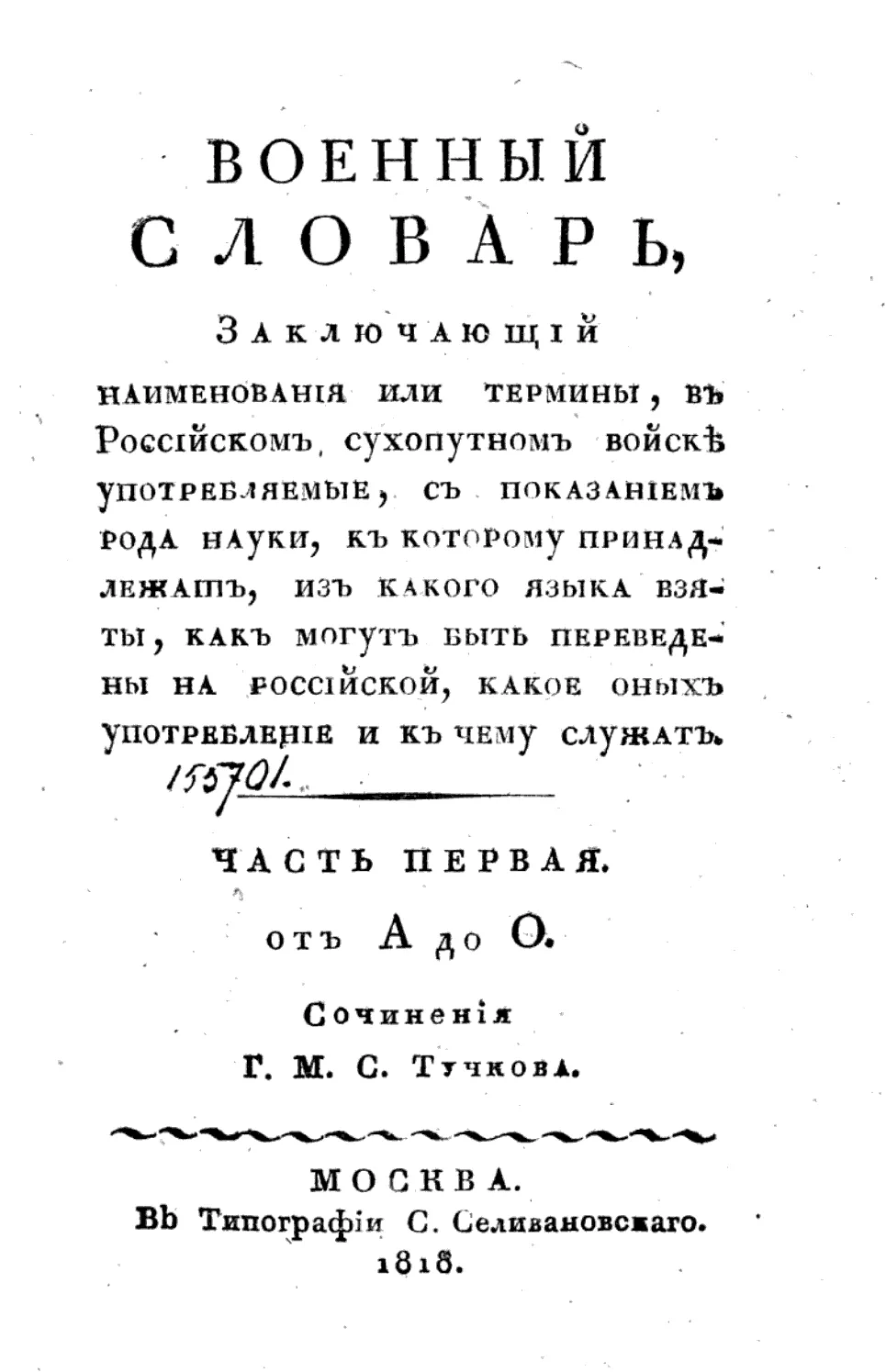
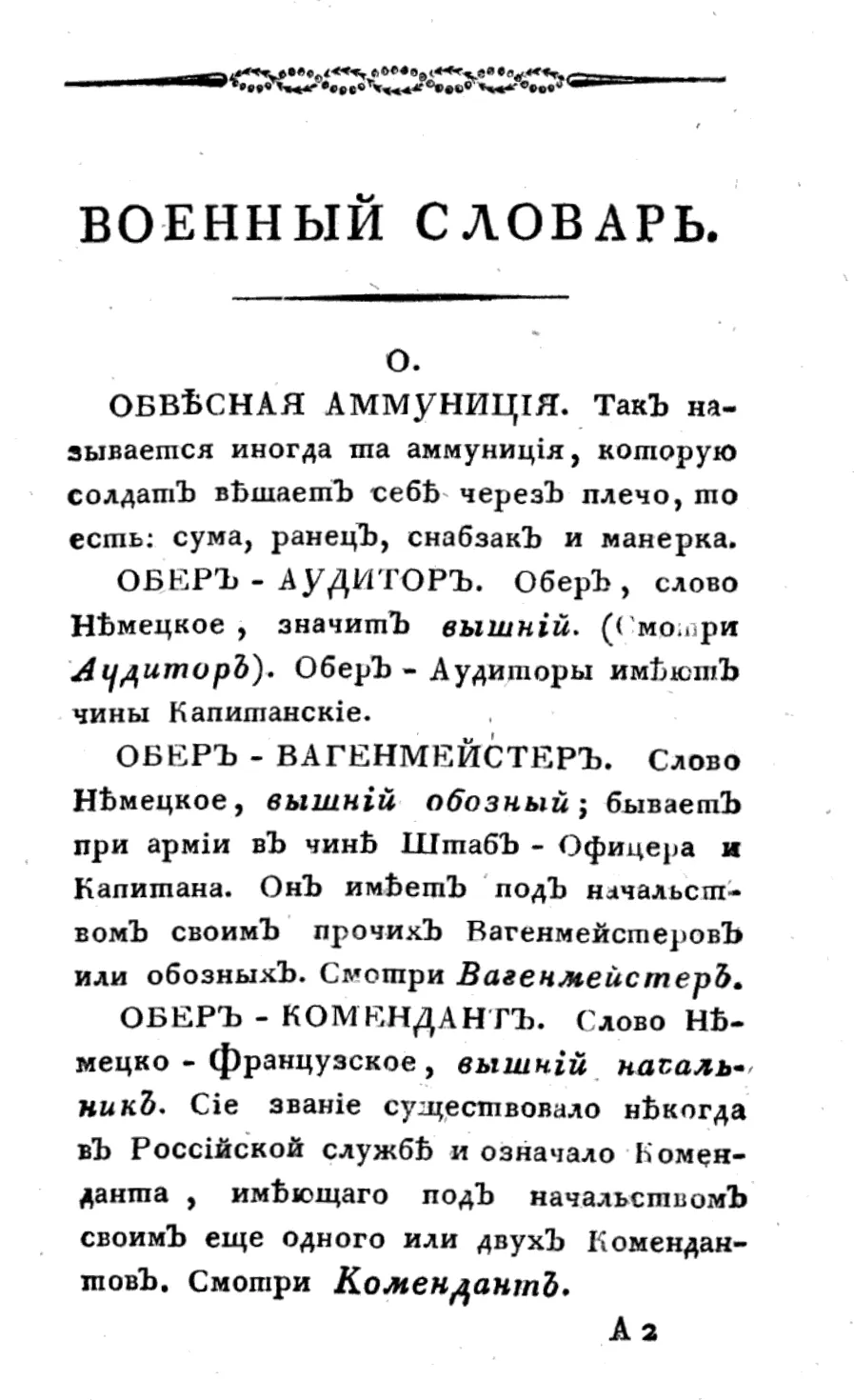
In 1818, a book was published in Moscow that was intended to save the Russian army from itself—from misunderstandings between officers of different branches of the military. It was the first independent dictionary of terms in Russia. land army, compiled by General Sergei Alekseevich Tuchkov after the Foreign Campaigns of 1813–1814.
The soldier can't aim.
According to Tuchkov's recollections, he once discovered that the imperial design for fastening the knapsack, greatcoat, and shoulder straps was inconvenient: the tight straps restricted the soldier's hands when aiming. After testing, he was tasked with finding a different fastening. This device was named "body kit" — it is with this term that the second part of the dictionary begins.
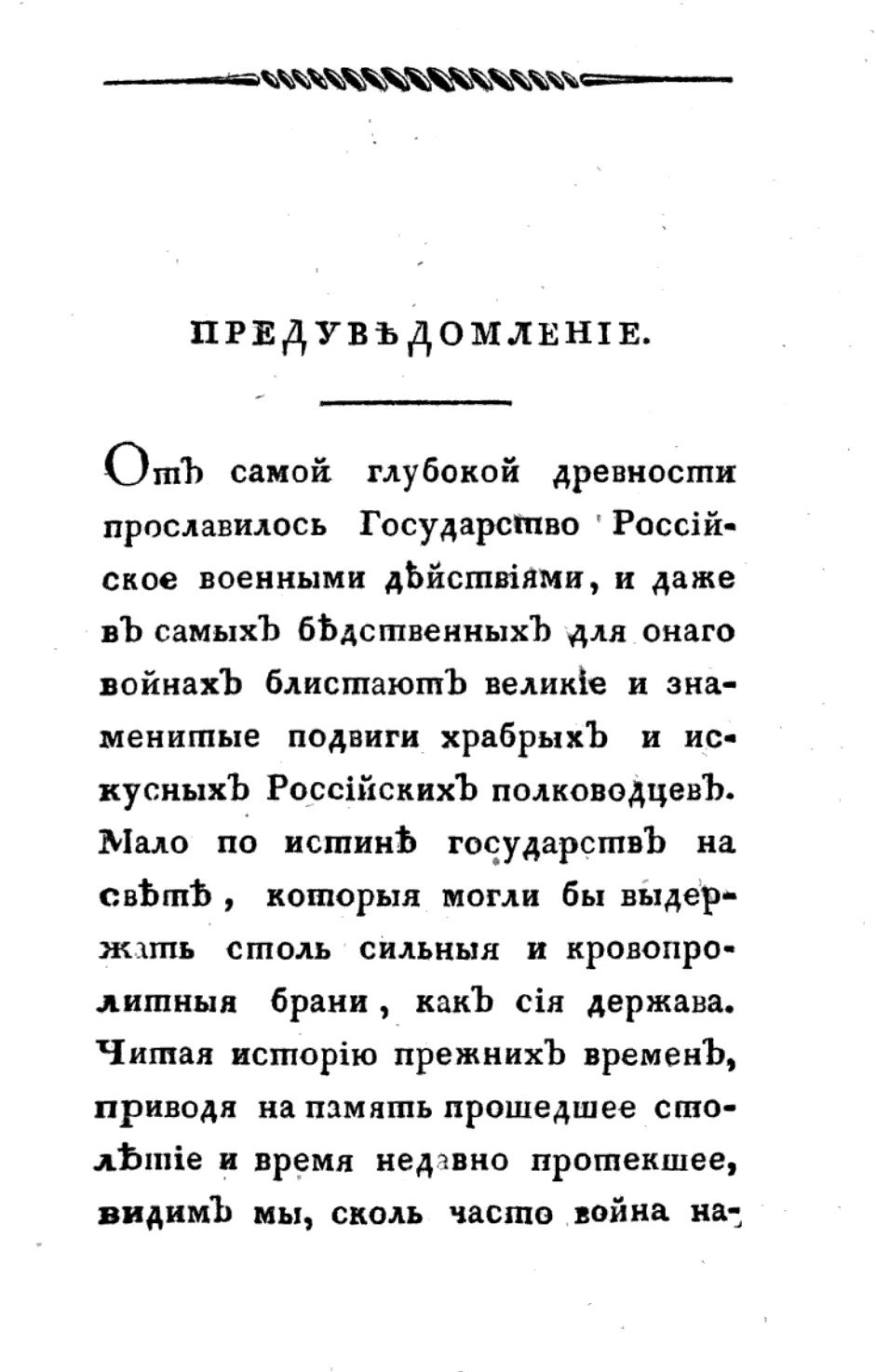
Such cases showed that officers from one branch of the military often didn't know the terminology and purpose of the other. In combat, especially in joint operations artillery, cavalry, and infantry, this led to errors in transmitting orders. Tuchkov wrote directly in the preface: "What a person does not understand, can he always convey to another with true accuracy?"
The cannon fired two hours earlier
In the same memoir, Tuchkov recounts an episode from the Danube campaign. When the army set out, it was ordered to sound the cannon signal at 4 a.m. General Rtishchev changed the order to 2 a.m., and Commander-in-Chief Prince Prozorovsky temporarily relieved him of command during the crossing.
The reason here isn't a translation error, but an arbitrary change to a clear order. But the scene is a reminder: in an army where generals spoke French and documents were written in three languages, a unified conceptual framework was vital.
"Plutong", "Point de Vu" and Forgotten Words
Count Arakcheev's military service certificate contains words that make the modern reader's eyes water: echelon, plutong, point-de-vu, point-d'appuisFor officers in 1818, this was working vocabulary.
Echelon — the position and movement of a formation after a certain rotation of the platoons; the modern meaning "railway train" appeared later. Plutong - multiple launch rocket unit. Point de Vu — direction reference, point d'appuis — turning point.
Tuchkov's Dictionary provided officers with a common language. Artillerymen and engineers, as the author himself noted, more often measured in feet and inches than in yards and inches. Cavalrymen used certain terms, infantrymen, others. For a young officer with no formal military education, the Dictionary was the only accessible reference.
Structure of the book
The dictionary was published in two parts by S. Selivanovsky:
- Part one (A-O): 269 pages, 18 pages of preface.
- Part two (O-Ya): 251 pages.
- Total: 1519 articles.
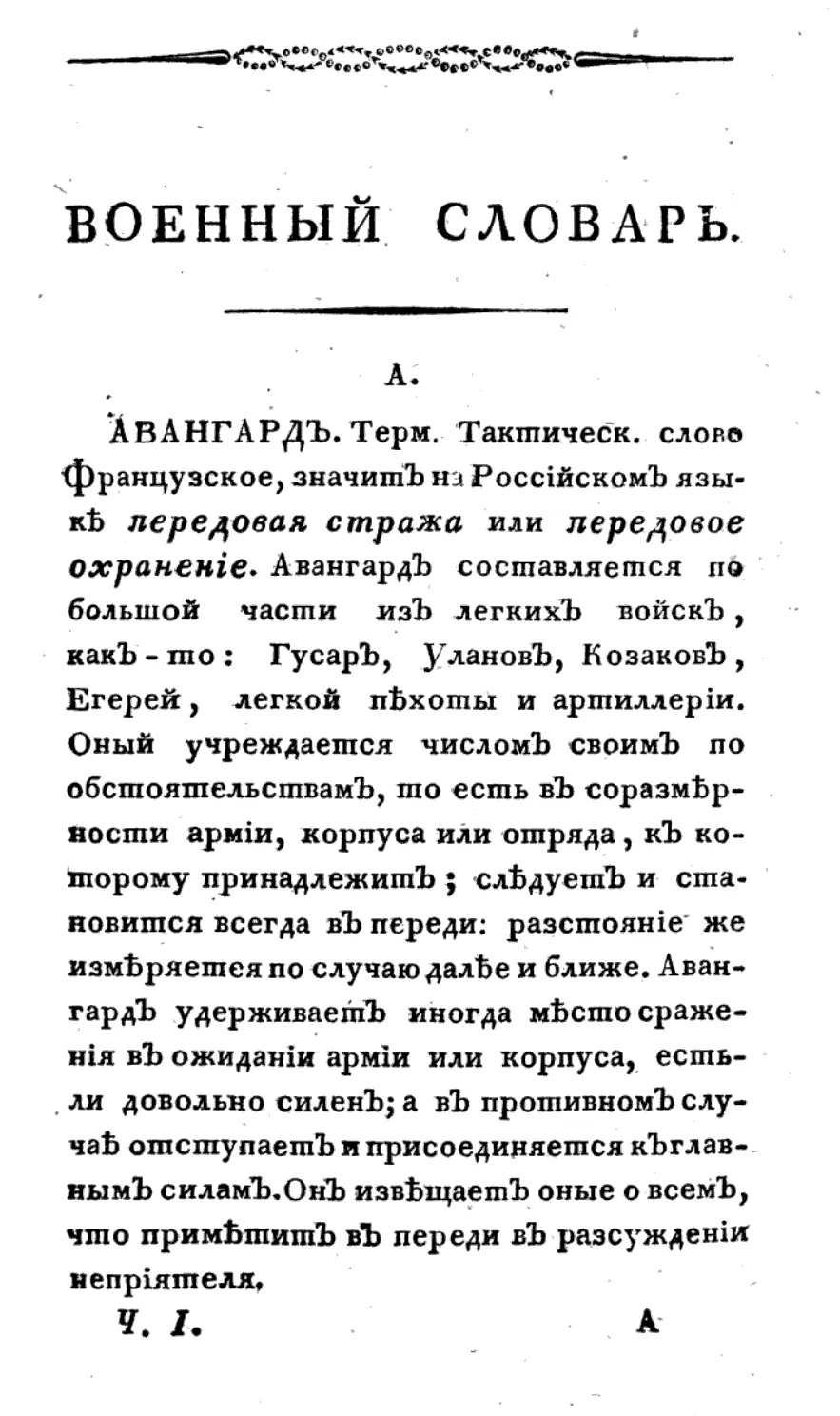
Most articles are compiled according to a single plan: the name of the term and its variants, etymology (from which language), affiliation with the type of science or service, translation and interpretation into Russian, practical use, references to related articles.
The terms covered:
artillery (ballistics, guns, carriages, limbers, ammunition, shooting);
engineering (siege structures, crossings, entrenching tools);
tactics (combat formations, maneuvers, interaction of military branches);
military service (movement, commands, rebuilding);
administration (positions, ranks, chain of command);
commissariat (supplies, ammunition, uniforms, food);
fortification (fortresses, defensive structures, siege).
Tuchkov paid great attention to equipment: descriptions of belts, backpacks, and cartridge belts fill dozens of articles.
The first - but not the only one
Tuchkov's dictionary is often called Russia's first military dictionary. This is true, if we clarify: it was the first independent dictionary of terms. ground forces.
Before him, the following were released in Russia:
application V. I. Suvorov to the book “The True Method of Fortifying Cities” (1724), about 350 terms.
application G. G. Kusheleva to the book on military courts (1788), 940 terms.
Independent “Dictionary of Mathematical and Military Sciences” by D. I. Velyashev-Volyntsov (1808), where about 1100 articles out of 5728 related to military affairs.
But Tuchkov’s work remained the only universal military reference book until the appearance of Zeddeler’s Military Encyclopedic Lexicon (1837–1852).
Who is Tuchkov?
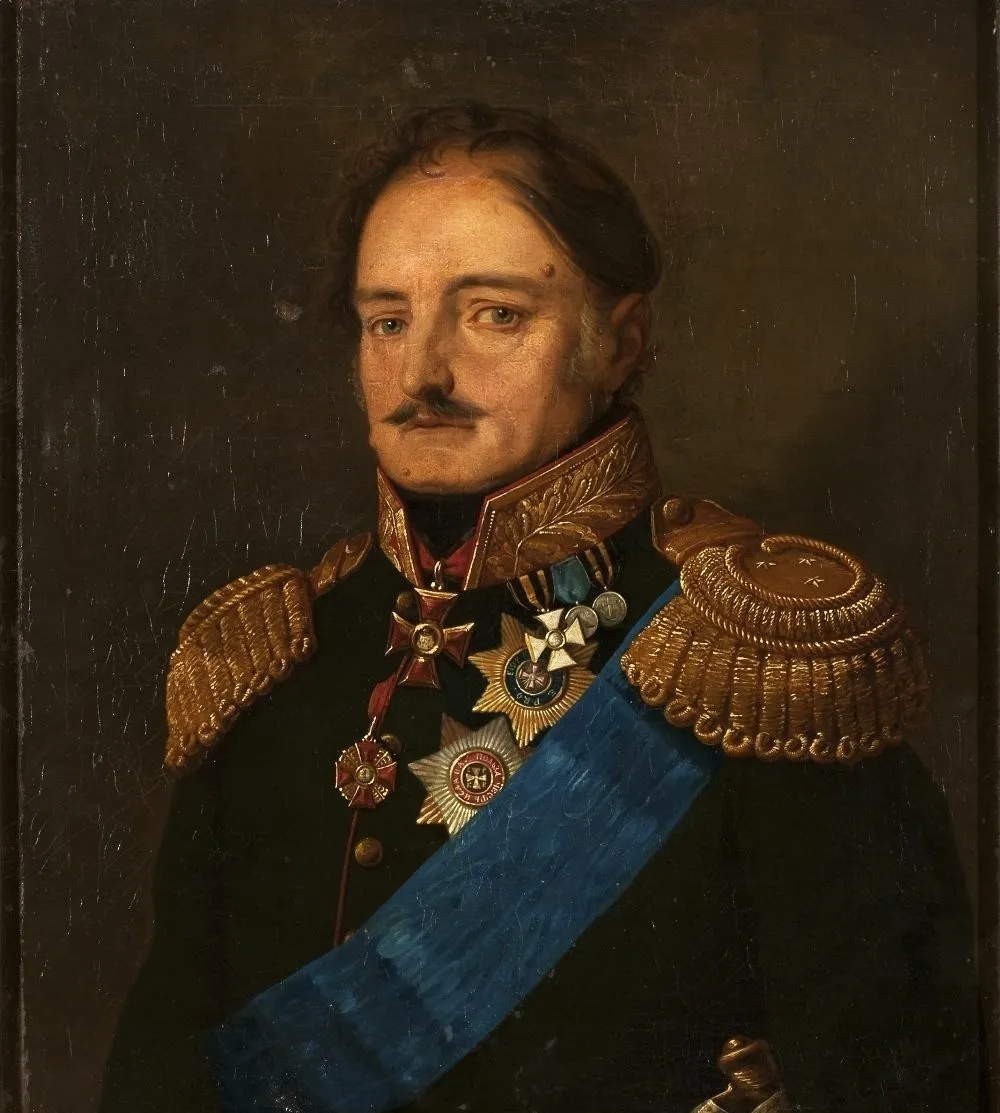
Sergei Alekseevich Tuchkov (1767–1839) was educated at home, worked as a translator, and served in the artillery. In 1794, according to a biographical reference, he withdrew 11 guns from Vilnius. This combined combat experience and a love of words in one man.
In his memoirs, he recounts how Field Marshal Prozorovsky responded in French to Napoleon's envoy, General Sebastiani, and then turned the conversation from artillery to Tuchkov. Multilingualism was the norm at headquarters, but universally understood terminology remained a challenge.
Why is this today?
The dictionary played a role in standardizing military language. Tuchkov recorded which version was considered correct: French, German, or Russian. He showed the origins of words, helping officers understand their meaning rather than memorize them mechanically. For a number of concepts, he selected Russian equivalents, contributing to the development of technical terminology.
The dictionary became one of the foundations for later charters and reference books.
The problem of a common language remains relevant. Today, the Russian military simultaneously uses "UAVs,"Drone"," "copter"—these are different words for the same concept. This could again hinder mutual understanding on the battlefield, just as the differences between artillerymen and infantrymen two centuries ago.
Tuchkov's dictionary remains a valuable source for historians studying the military organization, terminology, and everyday life of the Russian army in the early 19th century. And for the reader, it serves as a reminder that behind every "plutong" and "echelon" lay the concrete actions of a soldier and officer, whose life depended on whether they understood the order correctly.
Information