Three dates of one annexation: Astrakhan, 1554–1556

A miniature from the Illustrated Chronicle depicts the first capture of Astrakhan by Russian troops in 1554.
Why have historians still not agreed on exactly when the Russian state annexed the lower Volga?
There's no single anniversary for the annexation of Astrakhan. Scholarly monographs, memorial plaques, and calendars all cite different dates—July 2, August 26, September 25—and all are assigned to 1556. But a look at the chronicles and registers reveals that each date represents a distinct event, and one of them took place in a completely different year.
The explanation for the calendar discrepancy is simple, though offensive to those who appreciate jubilee precision. Astrakhan was annexed not all at once, but in two stages: in 1554, vassalage was established, and in 1556, the remnants of independence were eliminated. Muscovite tradition later stitched these chronologies together so carelessly that it shifted the date of the first capture to the second. To understand how this happened, we must begin with the khanate itself.
A fragment that could not defend itself
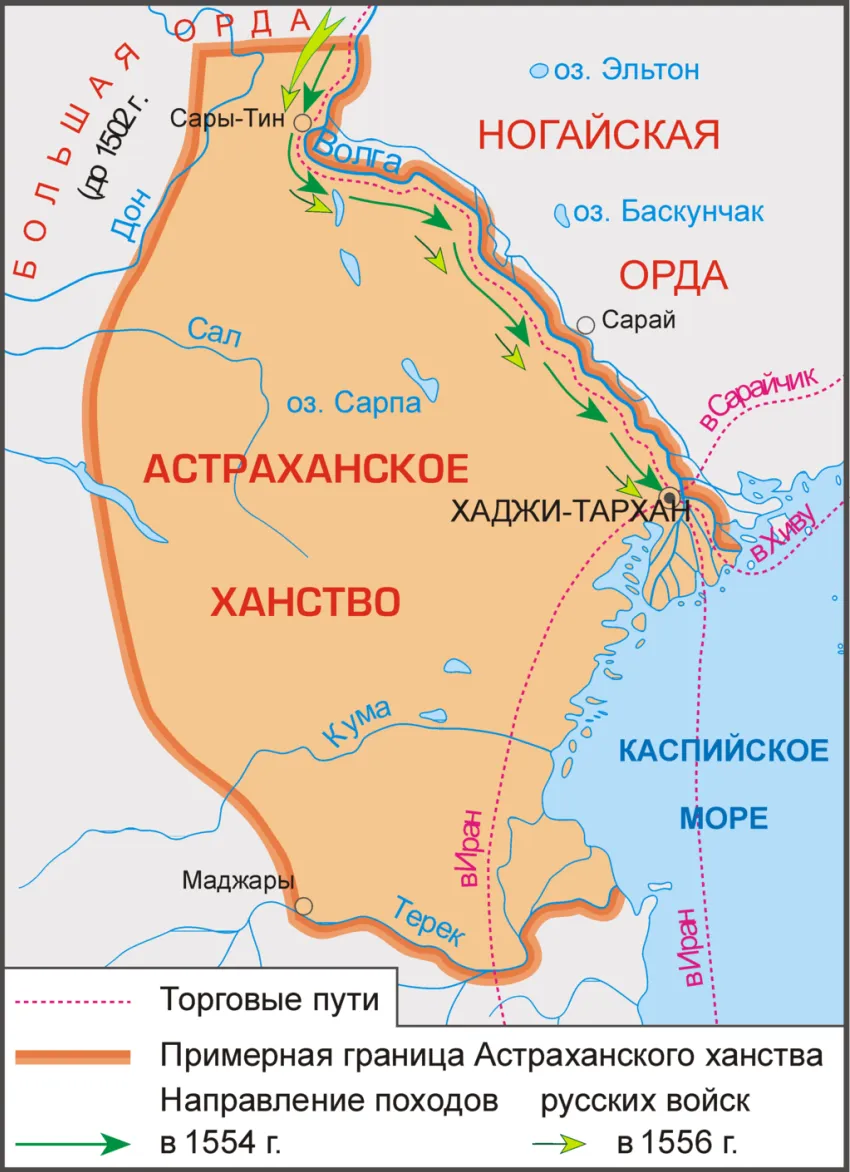
The Astrakhan Khanate emerged from the ruins of the Golden Horde in 1459–1460 and finally became independent after 1502, when the Crimean Khanate defeated the last khan of the Great Horde. In terms of territory and population, it was the smallest part of the Jochid Empire: approximately fifteen to twenty thousand people, with a mobilization ceiling of fifteen hundred to three thousand soldiers.
Haji-Tarkhan, the khanate's capital, stood in the Volga Delta at the junction of a trade route. Caravans departed from here for Khorezm, Bukhara, Kazan, and Rus'. A large slave market operated here, and salt was mined and shipped here. Even under Ivan III, Moscow merchants sailed along the Volga "for salt," and this long-standing Moscow trade presence in the region drew the khanate into its orbit long before its formal annexation.
Politically, the Khanate balanced between the Nogai Horde and the Crimean Khanate, periodically concluding treaties with Moscow (one well-known is the treaty of 1533), and maintaining a pro-Russian faction at court. After the fall of Kazan in 1552, the annexation of Astrakhan was a matter of time: the Khanate could not field an army capable of resisting the Muscovite armies, and diplomacy remained its only resource.
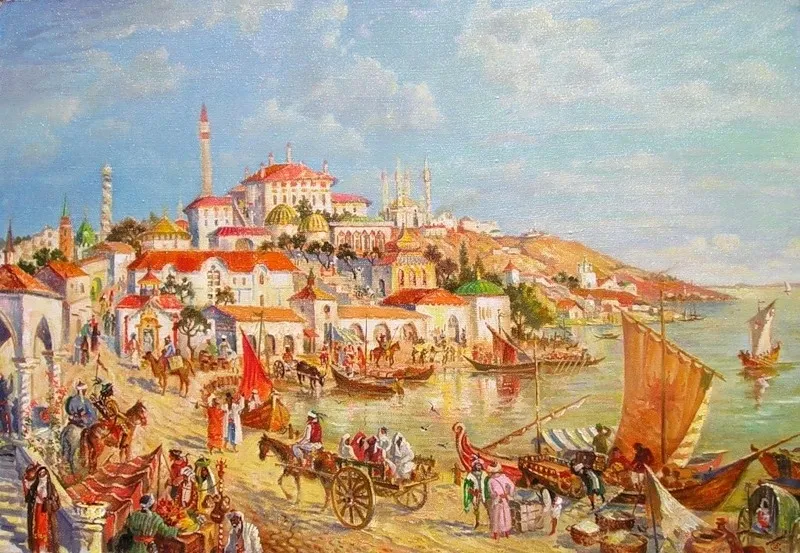
An illustration of medieval Astrakhan from the 15th–16th centuries on the banks of the Volga River
1554: Capture and Treaty
The pretext for the first campaign was provided by Khan Yamgurcha: in 1552, he plundered the Russian embassy and then attacked the uluses of the Nogai Mirzas, who were friendly to Moscow. Nogai Bey Ismail, who was at odds with Yamgurcha, proposed a candidate to Ivan IV: Dervish-Ali, a prince who had already been twice Khan of Astrakhan and twice deposed.
In the spring of 1554, an army of thirty thousand men—three regiments according to the military classification—moved down the Volga, led by Prince Yuri Ivanovich Pronsky-Shemyakin. The advance regiment was led by Princes Vyazemsky and Chulkov.
On June 29, at Perevoloka, Russian reconnaissance encountered Sakmak's detachment near Black Island, routed it, and captured its "tongues." On July 2, 1554, the army approached Hadji-Tarkhan. Yamgurchey, thinking that only the vanguard was approaching the city, fled to Azov; his harem and children were intercepted at the crossing. The city was occupied without resistance. The chronicle reports:
“And he came to Astarakhan on Peter’s Day, and took the city, and drove out the khan.”
.The treaty concluded with Dervish Ali established vassalage. As historian I. V. Zaitsev writes,
"The khan agreed to pay a tribute of 40,000 altyns (1200 silver rubles) and 3000 sturgeons a fathom long."
Russian merchants were guaranteed the right to trade duty-free from Kazan to Astrakhan. Governor Pyotr Turgenev was left in the city with a garrison. Moscow received not a territory, but a model of dependence: the local khan ruled in the name of the tsar and under the supervision of the tsar's governor.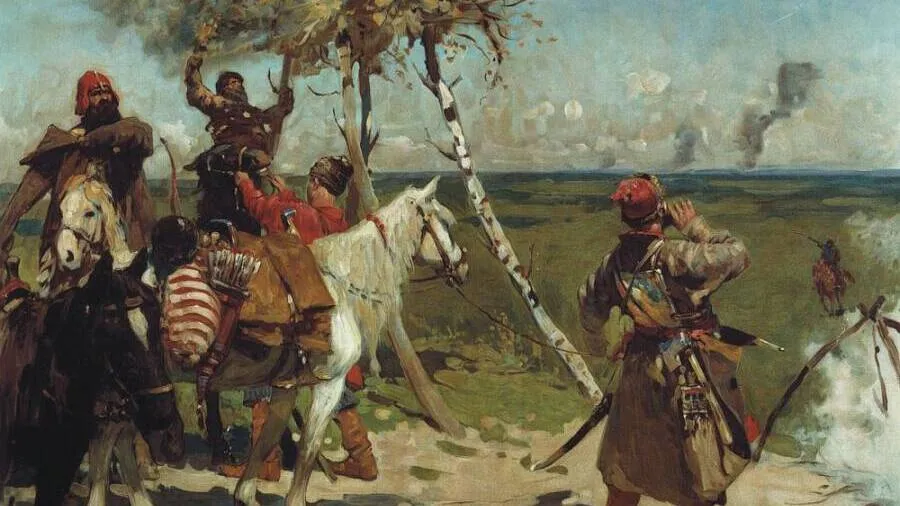
S. Ivanov. On the guard border of the Moscow State
The protégé who changed his mind twice
The vassalage lasted for a year. In 1555, Yamgurchi attacked Astrakhan twice with the support of Crimea and Turkish janissaries, but was repelled both times. Dervish Ali, who occupied the Astrakhan throne three times, changed his patron twice: he shifted his allegiance from Moscow to the Crimean Khan Devlet Giray and to that part of the Nogai people who were hostile to the biy Izmail.
In March 1556, Izmail reported treason to Ivan IV: Dervish Ali had received from Devlet Giray seven hundred Tatars and three hundred Janissaries—the guards on which the khan ultimately relied. Moscow realized the 1554 treaty was dead. The decision was punitive.
1556: punitive campaign with small forces
The second campaign was not a conquest—it was the liquidation of a vassal who had broken his oath. Voivode Ivan Cheremisinov, clerks Fyodor Pisemsky and Timofey Teterin, and atamans Kolupaev and Filimonov led detachments totaling approximately three thousand men. By comparison, thirty thousand had marched in 1554. Moscow knew the khanate's mobilization ceiling—no more than three thousand soldiers—and had not planned a siege.
The advance guard—the Cossacks of Ataman Lyapun Filimonov—was the first to suddenly approach the city. The Astrakhan garrison didn't have time to close the gates: the gates remained unlocked. Dervish Ali fled; the Nogai, seeing the outcome, betrayed him. Sources differ on the khan's subsequent fate: according to one version, he fled through Azov to Mecca, according to another, to Bukhara. Either way, the khanate ceased to exist. Historian M. G. Khudyakov summarizes:
"Astrakhan was occupied without any agreement, and the khan fled."
.
Where did the three dates come from?
Now let's return to the calendar discrepancy.
July 2, 1556 — the most common date for the annexation of Astrakhan in popular tradition. But it was precisely on July 2 that the Russian army captured Hadji Tarkhan in 1554, as confirmed by the chronicle entry and the military registers. For the second campaign of 1556, this date does not appear in any primary source—evidently, a transfer occurred: the event of the first capture was automatically assigned to the second, since it is the second that is considered the "true annexation."
26 August 1556 year — the date given by the most reliable sources for Cheremisinov's final operation. Khudyakov cites it as the day of the capture of Astrakhan; the Presidential Library and academic historiography agree on this date.
September 25 The origin of this date remains unclear. It appears in 20th-century regional studies and memorial traditions, but neither 16th-century chronicles nor Zaitsev's monograph (2006) record it. This is likely an attempt to tie the event to the church calendar; no documentary evidence has been found.
The discrepancy is no accident. The event has three chronologies: legal (the treaty of 1554), military (the punitive operation of 1556), and administrative. The latter extended until 1558—the voivodeship and the relocation of the city to Zayachiy Bugor.
Historical Tradition chose the second chronology—the moment of the final liquidation of the khanate—because it was from 1556 that the territory was governed directly by Moscow, not through a vassal khan. But in doing so, tradition confused the dates of the various campaigns and added a third, unsubstantiated one.
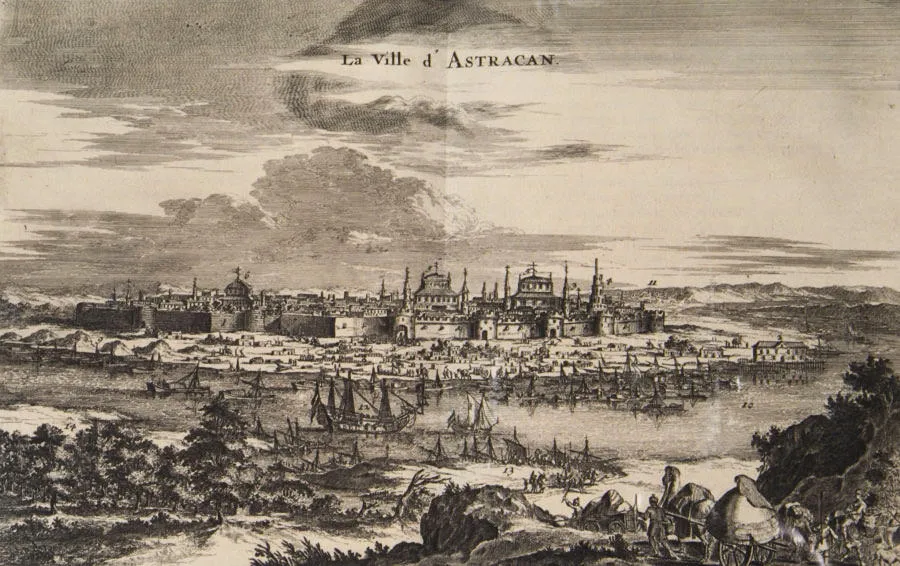
An antique 17th-century engraving of a view of the city of Astrakhan ("La Ville d'Astracan"), created by the Dutch master Koenraad Dekker (based on the travels of Jan Struys in the 1670s)
What remains after the Khanate
The Astrakhan Khanate disappeared. Direct voivodeship took the place of vassalage; the population swore allegiance to the tsar; the title "Tsar of Astrakhan" became part of Ivan IV's official titles in 1557. The consequences were far greater than the operation itself: the Nogai Horde recognized Moscow's supremacy, the Bashkir tribes submitted, and the Russian state gained access to the Caspian Sea and the Caucasus. In 1559, the Pyatigorsk and Circassian princes appealed to the tsar for protection against Crimea—this was the first result of control over the lower Volga.
The city of Khadzhi-Tarkhan itself was relocated in 1557–1558: Governor Ivan Cheremisinov chose Zayachy Bugor, the highest hill in the delta, washed by the Volga, Kutum, and Tsarev Canal, for the new fortress. Construction was supervised by Ivan Grigoryevich Vyrodkov, a renowned urban planner who arrived in Astrakhan as governor-general in 1557. The stone Kremlin would be built later, in the 1580s–1620s, under Mikhail Velyaminov and Deya Gubast.
The discrepancy in dates accurately reflects the three-year process of annexation—from the treaty to the elimination of the khan and the construction of a new fortress.
Sources and Literature
- Zaitsev I.V. Astrakhan Khanate. M., 2006.
- Khudyakov M. G. Essays on the History of the Kazan Khanate. 3rd ed. Kazan, 1991.
- Sharapov D. Yu. Astrakhan campaign of Ivan the Terrible in 1556 and its significance for Russia // History in detail. 2015. No. 11.
- Trepavlov V. V. History of the Nogai Horde. Moscow, 2002.
- Isin A. I. Astrakhan Khanate: Politics, Economics, Culture. Almaty, 2006.
- Akchurin M. M. Astrakhan Khanate: formation and demise // Golden Horde Review. 2019. Vol. 7, No. 2.
- Complete Collection of Russian Chronicles (CSRC). Vol. XIII. Chronicle collection, known as the Patriarchal or Nikon Chronicle. St. Petersburg, 1904.
- Karamzin N. M. History of the Russian State. Vol. VIII. St. Petersburg, 1817.
- Solovyov S. M. History of Russia from Ancient Times. Book III. Vol. 5–6. Moscow, 1960.
- Kostomarov N. I. Historical monographs and studies. Vol. 13. Stenka Razin's rebellion. St. Petersburg, 1872.
Information