Airborne Forces in the Battle of Moscow
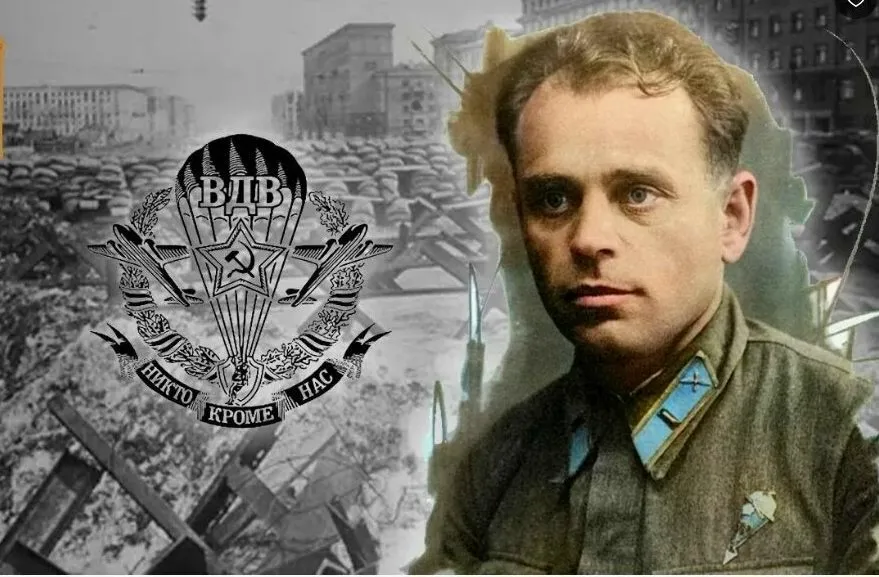
Pictured: Ivan Georgievich Starchak, a Soviet frontline reconnaissance officer and paratrooper. He was one of the leaders of the defense on the Warsaw Highway in October 1941. He commanded several airborne assaults in 1941–1942.
In August 1941, a parachute landing detachment for the Western Front began to form in a camp near Yukhnov. Captain Ivan Georgievich Starchak became its commander. The detachment was staffed by soldiers from frontline airfield units. In addition, it included several dozen well-trained paratroopers from the 214th Airborne Brigade. In total, the detachment numbered over 400 men.
The enemy was rapidly advancing east, and by October 4, Starchak's detachment was ordered to take up defensive positions along the Ugra River near Yukhnov. This line was located just 205 km from the capital. Apart from the paratroopers, no other military units were present at the time. The eastern bank of the Ugra River, where the detachment took up defensive positions, dominated the terrain ahead. The detachment's main efforts were focused on controlling a narrow strip of highway. On the morning of October 5, the detachment repelled the first enemy onslaught. Throughout the day, the paratroopers had to repel several more fierce attacks.
That same day, at dawn, a small group of paratroopers led by pilot Senior Lieutenant Balashov raided the airfield from which Soviet pilots had failed to ferry three TB-3 bombers. The paratroopers burned two of the aircraft and stole one. Balashov, who had never piloted a four-engine aircraft before, took off in it.
The fighting on October 6 and 7 was particularly severe. Leaving a small group of paratroopers on the riverbank near the Varshavskoye Highway to cover the detachment's exit from the battle, Captain Starchak led the company to an intermediate defensive line in the village of Strekalovo. A company of cadets and a battery of 76-mm guns from the Podolsk Military School arrived here, significantly strengthening the detachment. But even with these forces, it was difficult to count on a stable defense.
On October 8, the enemy committed new forces to the battle. The paratroopers, having repelled fierce enemy attacks, retreated to a new defensive line along the Izver River on the night of October 9. On the morning of October 9, the Nazis attempted to force their advance detachments and reconnaissance groups across the river in several places, but were unsuccessful.
The paratroopers held their bank. The artillerymen ran out of ammunition, and the detachment suffered significant losses. It now numbered less than a hundred men. The detachment commander was forced to concentrate all those capable of fighting at the crossing.
By the evening of October 9, the paratroopers were replaced by tank crews. While 410 paratroopers blocked the enemy's path at the 205th kilometer on October 4, only about 60 remained on October 9, at the 180th kilometer from Moscow. But the losses were not in vain. It took the Nazis five days to cover the 25 kilometers.
This is how courageously and steadfastly the paratroopers defended Moscow in the autumn of 1941 in this direction.
At dawn on December 5, 1941, Soviet troops launched the first powerful counterattacks against enemy troops near Moscow.
Formations of the 3rd and 4th German tank Having suffered defeat near Moscow, the German groups attempted to consolidate their positions along the Leningrad Highway. To this end, the enemy hastily reinforced its Klin group, launching a series of fierce counterattacks and counterattacks. However, troops from the 20th and 1st Shock Armies blocked the German forces in Klin and began to destroy them.
In this situation, the Nazis began to retreat to Volokolamsk, hoping to consolidate their position on the advantageous natural defensive line along the Lama and Ruza rivers, which had been prepared in advance. The enemy troops retreated along the only road leading to Teryaeva Sloboda, which had not yet been intercepted. It was here that Starchak's detachment was deployed.
On the night of December 15, Starchak's paratroopers intercepted the road, destroyed bridges, disrupted communication lines, and blocked the retreat of Nazi troops. The paratroopers not only cut the road from Klin to Teryaeva Sloboda. With decisive action, they intercepted all possible Nazi escape routes in this area and elsewhere to the west. Day after day, the paratroopers attacked troop columns, destroying small enemy garrisons and enemy equipment, especially fuel transports, without which all vehicles and tank companies would be reduced to rubble. Where the paratroopers operated, nighttime road traffic was completely paralyzed. As soon as dusk fell, everything came to a standstill until dawn. Even during the day, the Nazis accompanied their columns with tanks. But even tanks were of no help to the enemy.
The enemy was exhausted, trying in vain to destroy the brave paratroopers. Signs proclaiming "Russian Paratroopers" appeared on the roads, and arrows on these signs indicated dangerous areas.
Punitive detachments with tanks and armored vehicles were deployed against the landing force. To intimidate them, the Germans hung dead paratroopers on telegraph poles with placards declaring that the German command would punish anyone who resisted them in this manner. But all the measures taken by the Nazis only fueled the paratroopers' anger and hatred for the enemy, spurring them on to fight even more fiercely.
During 9 days of combat operations, the detachment blew up 29 bridges, burned 48 vehicles, 2 tanks, 2 staff cars, destroyed a lot of weapons and killed more than 400 enemy soldiers and officers.
From December 18th to 24th, Captain Starchak's detachment blocked the Klin-Volokolamsk, Lotoshino-Volokolamsk, and Novo-Petrovskoye-Klin roads, as well as the Shakhovskaya-Novopetrovskoye railway. Naturally, the relatively small detachment was unable to liberate the large settlements where significant Nazi forces were concentrated.
Operating in small groups on enemy communications in a vast area, the paratroopers contributed to the successful offensive of troops in the Volokolamsk-Klin direction.
In the winter of 1941-1942, Nazi German forces, defeated near Moscow, retreated under attack from Soviet troops, attempting to hold on to their prepared lines. Nazi resistance gradually increased as fresh forces were brought to the front. However, Soviet troops from the center and left flank of the Western Front continued their advance and by early January had reached the Naro-Fominsk-Kaluga line.
At this time, the enemy's Kondrovo-Yukhnov-Medyn group was the strongest for the Western Front's troops. Its rapid defeat was the most important task for the Western Front's left wing army. This task was assigned to the front's left wing army and the 1st Guards Cavalry Corps.
In this situation, the command of the Western Front decided to use airborne assault forces in the offensive zone of the 43rd Army.
The airborne assault force included two parachute battalions under the command of Major Starchak, and the landing group for this assault force included the 250th Airborne Regiment. Regimental Commander Major Soldatov was appointed commander of the airborne assault force.
On January 3, 1942, the airborne assault force was given the following mission: after landing behind enemy lines, cut the road from Medyn to Gzhatsk and all roads northwest of the Varshavskoye Highway; capture Myatlevo Station and disrupt rail traffic; and prevent a possible enemy retreat from Medyn to Yukhnov and from Yukhnov to Myatlevo Station.
Preparations for the airdrop and the development of an action plan to maintain surprise were completed before the airborne assault commander was assigned his mission. The plan called for Major Starchak's parachute battalion to be dropped onto the airfield near Bol'shoy Fot'yanovo to seize and secure the landing force, which was to be transported by TB-3 and PS-84 aircraft.
The 2nd Parachute Battalion, detached from the 201st Airborne Brigade, was tasked with the following: after landing in the area of Gusevo, Bordukovo and Isakovo (all points 12-15 km northwest of Medyn), part of the forces were to seize and firmly hold the bridge over the Shanya River and the Shansky Plant, capture and hold Kremenskoye, and the main forces were to reach the Yukhnov-Medyn highway, where they were to blow up the bridge over the Shanya River 1 km southwest of Kosovo and, having set up strong barriers, stop all movement on the highway.
After the paratroopers captured the airfield near Bol'shoy Fot'yanovo, the main airborne forces—the 250th Airborne Regiment (1300 men)—were to land there.
The number of aircraft allocated for the landing was limited, but it still allowed for the paratroopers to be dropped in one flight and the landing troops to be transported in two or three flights. From the morning of January 3, 1942, the plan called for reconnaissance of the airfields and aviation Enemy airborne forces in the areas adjacent to the landing site and airborne combat operations were to be monitored. An hour and a half before the parachute group's departure, a special aircraft was to be dispatched to conduct weather reconnaissance along the flight route and in the landing area, as the weather at that time of year was very unstable, and frequent blizzards and snowfalls created significant difficulties for aircraft flights and paratrooper drops.
Several hours before the paratroopers dropped, immediately before the landing, it was planned to carry out an air strike on the suspected garrisons and reserves of the enemy in the areas of Medyn, Aduyev, Govardova station, Yukhnov, in order to distract the enemy from the landing area and prevent its reserves from approaching this area to fight the paratroopers.
Due to significant air activity and intense enemy anti-aircraft fire, the decision was made to conduct the airdrop at night. Fighter aircraft from the Moscow zone were assigned to cover the initial landing area (Vnukovo airfield). Defense.
To capture the airfield, the parachute assault force was composed of capture teams, support teams, reserves, and launch teams. The capture team was tasked with suppressing the resistance of the garrison's flight and technical personnel and seizing the airfield, airfield materiel, structures, and communications equipment. The team was dropped directly onto the airfield.
The support group was dropped 1-2 kilometers from the airfield to capture defensive positions and prevent enemy reserves from approaching the airfield.
The parachute landing commander's reserve, as part of a platoon, was dropped together with the battalion commander over the center of the airfield.
The launch team parachuted in thirty minutes after the parachute drop, following the capture team, along with the radio and propulsion equipment. Launch equipment was prepared to mark the landing site, and a night launch designation system was practiced. The launch team also included sappers and demolition experts to reconnoiter the airfield and remove obstacles.
It was assumed that if the landing signal had not been issued by the time the aircraft carrying the takeoff crew arrived at the airfield, the aircraft were to wait in the air for half an hour near the airfield. After this time, if there were no signals clearing landing, the aircraft carrying the takeoff crew were to return to their airfield.
The parachute commander set up his command post at the site where he landed and directed the battle to capture the airfield. He subsequently moved it to a location more convenient for directing the landing of the paratroopers and his own units. Immediately after the paratroopers landed, reconnaissance groups and patrols were dispatched in various directions, up to 5-10 kilometers from the airfield.
In the event of an unsuccessful attempt to capture the airfield, the airborne commander was to report this to the senior staff, and lead his detachment to join up with the 1st Battalion of the 201st Airborne Brigade or, in accordance with the prevailing situation, act to disrupt the enemy's command and control and rear services in the interests of the troops of the 43rd Army.
The full plan for combat operations behind enemy lines was thoroughly reviewed by all officers, and the airfield capture plan was "played out" on maps. Furthermore, the paratroopers were familiarized with all the details of the airfield capture prior to departure, and in the event of disorientation or an unsuccessful landing, each unit's paratrooper was to act independently to accomplish the overall mission.
Starchak's parachute landing unit was dropped on the night of January 4, as planned, at the Bol'shoy Fot'yanovo airfield. After landing, approximately 15 percent of the group failed to report to the assembly point. Nevertheless, the airborne commander, without waiting for the entire group to assemble, launched an attack. However, they were only able to suppress enemy resistance and capture the airfield by the end of January 4. During the battle, the paratroopers destroyed twelve firing positions.
Having captured the airfield, the paratroopers began defending it and preparing it to receive transport aircraft carrying landing troops. But on the morning of January 5, the weather changed dramatically, and a severe snowstorm arose. The airfield was buried in snowdrifts.
Due to severe weather conditions on January 5 and 6 and the changing operational situation during this time, the airdrop and landing of the remaining airborne forces in the designated areas were cancelled, and Major Starchak's parachute force transitioned to independent sabotage operations behind enemy lines in the 43rd Army's offensive zone. On the night of January 8, a surprise attack by the detachment captured Myatlevo station, where two enemy trains carrying tanks and other combat vehicles were destroyed.
From January 8 to 18, the detachment conducted combat operations in the exceptionally difficult conditions of the harsh winter of 1941-1942 on the roads south of Medyn, in the area of Kondrovo, Polotnyany Zavod, and only on January 19, with the permission of the front command, Major Starchak's paratroopers joined up with units of the 43rd Army.
With their bold and decisive actions, Major Starchak's parachute detachment disrupted railway traffic for a while in the area of Myatlevo station and partially disrupted the work of the German rear troops in front of the Forty-Third Army, which significantly contributed to its successful offensive.
Due to the failure of the planned airborne assault in the Bol'shoy Fot'yanovo area, a new decision was made to use airborne assault forces.
The task of the troops of the left wing of the front remained the same - to encircle and defeat the Yukhnov-Myatlevo group of Nazis and to develop their success in the north-west direction to Vyazma.
The airborne assault force, consisting of the 250th Airborne Regiment and 2 battalions of the 201st Airborne Brigade, landed with the aim of facilitating the successful offensive of the 1st Guards Cavalry Corps and troops of the left wing of the Western Front in encircling and destroying the said enemy group.
The landing area was designated southeast of Vyazma, near the village of Zhelanya. As a result, airborne operations in this area intercepted the main supply routes for the enemy's Yukhnovo-Myatlevo group.
Significant Nazi forces were stationed in and near the landing zone: in the district center of Znamenka, there was a division headquarters, rear units, and up to a battalion of infantry; at the Godunovka siding, an ammunition depot and a guard force of about a battalion; in the village of Podsosonki, a large headquarters; at Klimov Zavod, Sidorovskoye, Sinikovo, and Gubino, up to a battalion of infantry each; at the Debryansky siding and at Ugra station, up to two battalions. However, due to heavy snowdrifts, these garrisons were almost isolated from one another. Only the most important roads were maintained. Therefore, the paratroopers, possessing excellent mobility while operating on skis, were able to strike at individual, even strong, garrisons and successfully disrupt enemy movement along the rare passable roads.
The use of airborne assault forces was planned to be carried out by a limited number of transport aircraft, crews well trained for night flights, in three stages:
the first stage is the dropping of parachute troops to capture and hold the landing site in order to ensure the landing of landing troops on it;
the second stage is the landing of the launch team two hours and thirty minutes after the parachute landing;
The third stage is the landing of the landing force 30 minutes after the landing of the launch team.
On the nights of January 18 and 19, 1942, paratroopers were dropped. The drop was successful, although due to unfavorable weather, some crews returned without completing their mission. However, once the weather improved, the crews of these aircraft, on follow-up sorties, dropped their paratroopers precisely at the designated location.
During the parachute group's landing, an amendment was made to the landing plan: between the first and second flights of this group, by the end of January 18, a launch team with a radio station and wired communication equipment was transferred on four aircraft.
By the morning of January 19, the parachute landing group, the launch team, and the local population had prepared a landing site, to which, over the next three nights, the landing force was transferred – the 250th Airborne Regiment, consisting of 1600 men, along with 100 heavy and light machine guns, 90 mortars, and anti-tank guns.
Enemy aircraft, having discovered the airborne landing area, began bombing and machine-gunning it from the very first day. However, thanks to the paratroopers' swift action, losses throughout the entire landing were insignificant.
The paratroopers had to not only prepare the landing site for the landing force, but also, without waiting for it to land, begin carrying out the combat mission.
On January 20, the airborne commander was given a clarified combat mission: units of the 1st Guards Cavalry Corps were attacking from the south in the direction of Vyazma with the aim of breaking through the Nazi defenses along the Warsaw Highway and subsequent actions in the rear west of Vyazma.
Front Commander Zhukov ordered a portion of the airborne forces to capture the enemy stronghold of Klyuchi by the morning of January 26 and to attack toward Lyudkovo to assist the 1st Guards Cavalry Corps in breaking through the defenses. Two parachute battalions under the command of Captain Surzhik were dispatched to accomplish this task.
The landing forces held the line Luga - Zhelanye - Znamenka.
Separate detachments from the 250th Airborne Regiment operated along the Yukhnov-Vyazma road, impeding enemy troop movements. Carrying out their assigned mission, the combined paratrooper detachment immediately captured several settlements, destroying enemy garrisons. By the morning of January 22, they had captured Petrishchevo, and the following day, near the village of Tynovka, they linked up with the 1st Guards Cavalry Corps and came under the operational control of its commander.
On January 30, in the Glukhovo area, the landing force established contact with units of this corps, and on February 4, it came under the command of the commander of the 239th Rifle Division, which was part of General Belov’s cavalry corps.
Subsequently, the battalions of the 201st Airborne Brigade and the 250th Airborne Regiment operated behind enemy lines until joining up with the front troops at the end of June 1942.
The airborne assault force accomplished a crucial mission: it intercepted and held the enemy's most important routes in the rear of its Yukhnov group for several days, hampering the maneuver of its forces and assets, disrupting the work of its rear, thereby facilitating the offensive operations of the left wing troops of the Western Front.
Information