The Escape of the Cavalry Maiden: What We Celebrate on September 29
3 379 23
The Escape of the Cavalry Maiden: What We Celebrate on September 29


220 years ago, Nadezhda Durova left her parents' home. Let's figure out where this is a document, where a local history find, and where a memoirist's work on her own image.


Let's start with the arithmetic, because it's the only thing here that doesn't contradict itself. September 17, 1806, Old Style, is September 29, New Style: in the 19th century, the difference between the calendars was 12 days. From 1806 to 2026, that's exactly 220 years. A round date is a real one, no exaggeration.

And then things get interesting. There are several stories behind this escape. One was told by the heroine herself, in a book that became famous. The other was pieced together by biographers and archivists. They don't agree on everything.

Memoir versus documents


"Notes of a Cavalry Maiden" was published in 1836 in the second issue of Pushkin's Sovremennik, with a preface by Pushkin himself, who found them original and predicted their success. Success indeed came. Since then, a coherent narrative has been repeated from book to book: the young heroine, burdened by her female lot, flees home to face military service. In this narrative, it's immediately important to distinguish between testimony and its literary form, especially since "Notes" were conceived not as a report, but as fiction.

There's a second line of inquiry alongside the memoir. Durova's first biographer, the Sarapul priest and local historian Nikolai Blinov, worked from local documents and parish registers back in 1887–1888. Official papers—service lists, registers from the Ascension Cathedral, and her father's later petitions to the royal court—have survived and are verifiable. From these, a biography emerges that Durova herself kept silent about: at eighteen, she was married to the official Chernov; in 1803, her son Ivan was born; and before her escape, she and her child left her husband and returned to her father. By September 1806, she was no longer a young woman on the threshold of life, but a married woman who had abandoned her family.

This is the first discrepancy between the memoir and the documents. And, as we shall see, not the last.

Seventeen or twenty-three


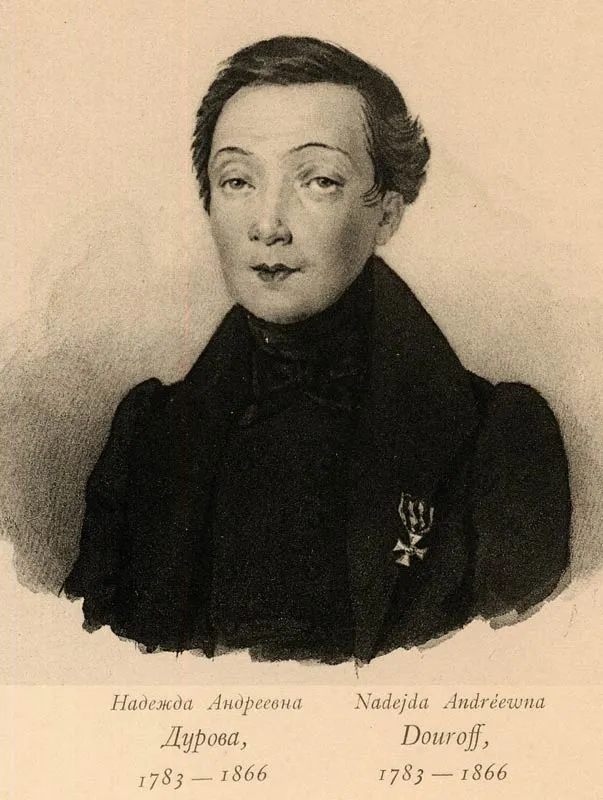
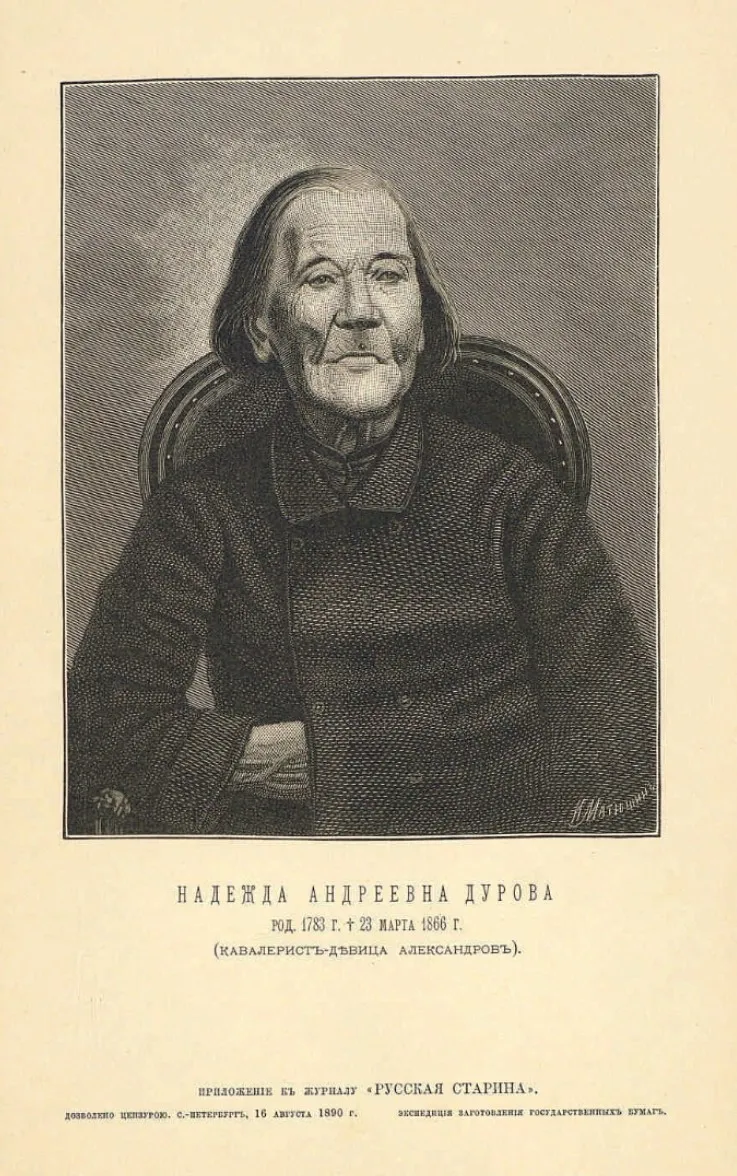
Age is revealing. The birth certificate records the year 1783. Durova herself, however, covered her tracks masterfully. She let slip a startling remark to her biographer: she herself doesn't know her birthday, and her father hasn't recorded it anywhere—"You can set the day you like." Her autobiography states, "I was born in September 1788," while the famous "seventeen years old when I escaped" points to 1789: then, by September 1806, she would have been exactly seventeen. A six-year discrepancy, and it all stems from the heroine herself. The birth certificate, however, is trustworthy: in the autumn of 1806, Durova was twenty-three.

Why shave years off your years? For the same reason a writer edits a draft. She was eliminating unnecessary details from her biography—years of marriage and motherhood that didn't fit the character. According to the memoirs, her elopement occurred on her birthday, her seventeenth birthday: the old life ends on the very day it began. A beautiful plot twist. But take a closer look at the calendar, and therein lies a subtlety. Both her birthday and her elopement fall on the same date—September 17th, Old Style. But they are translated into the New Style differently because the centuries are different: the 1783 birth is September 28th (in the 18th century, the difference was 11 days), while the 1806 elopement is the 29th. Even the two dates, which tradition has merged into one, are a day apart.

So this isn't deception for the sake of deception. This is an author who is crafting a coherent narrative out of her life, and the twenty-three-year-old mother of a family who left her husband didn't fit into that mold.

Why did she leave? Three answers


Now to the most controversial issue—the motive. It's not the dates that diverge, but entire theories, and none can be declared the winner.

The first was offered by Durova herself: a thirst for freedom. This version is stronger than the others simply because it is spoken in the first person and brilliantly written. "I took what was mine, my freedom," says the heroine on the night of her escape. Her explanation is not adventure or romantic feeling, but the right to control her own destiny. Pushkin, listing the possible reasons in the preface, seems to leave this, the main one, to the reader to complete. This version is backed by the authority of the author and the text.

The second was suggested by a Don legend, recorded by the same Blinov: one of the regiment's officers could have been behind the escape. The Don Cossack Regiment of Major Stepan Fyodorovich Balabin II is a very real unit, known not from a memoir, but from service lists from 1803–1806. The regiment had been stationed in Sarapul since 1802 and left for the Don in mid-September 1806. And Durova didn't leave with a faceless column: the commander himself took the "nobleman's son Alexander Sokolov" to his village of Razdorskaya, settled her in his house under the care of his wife, and then helped her reach the regular regiments. The major was overly concerned about someone else's fugitive, hence the speculation. But it's just that: a speculation; there's no document to support it.

The third answer is the most honest: the archive is silent. Forms record her service, birth certificates her marriage and birth, her father's petitions document the search for the fugitive, but not a single document explains what was going on in her mind. The motive remained entirely in the hands of the memoirist. And here we must simply admit: we know the "freedom version" from her own words, the "officer's version" from others, but there is no definitive answer.

Where does the document end?


But where there's a document, it's solid, and that's worth mentioning. Her real service didn't begin with the Cossacks. Only Cossacks by birth were accepted into the Cossack army; a noblewoman from outside the army was not allowed. On March 9, 1807, in Grodno, she enlisted in the Konno-Polish Uhlan Regiment as a private with the noble rank of "comrade." The service record from November 1807 preserves both her name and description: "Comrade Alexander Vasiliev, son of Sokolov," seventeen years old, "two arshins five vershoks" (about 165 cm) tall, "dark complexion, pockmarked, light brown hair, brown eyes," "did not present proof of nobility." The record also lists her battles in Prussia—Gutstadt, Heilsberg, Friedland. This is the formal beginning of her military biography.

That she was indeed the one hiding behind "Sokolov" is confirmed not only by her book. Her own father, through her brother in St. Petersburg, petitioned the Tsar to find "his daughter Nadezhda, married Chernova," who had registered "under the name of Alexander Vasiliev, son of Sokolov." This external document, independent of the memoir, settles the question of who this new recruit was.

But what relies on a single narrator deserves special treatment. The dialogue about the beard, the horse Alcides as a gift from her father, the nocturnal escape with a final glance at the sleeping house—these are scenes, not testimonies.

There's also a telling detail about how the words of the era are replaced by later ones. A monument erected by the Uhlans in 1901 states that Durova was "awarded the St. George Cross." But this was the official name for this medal only in 1913. During her lifetime, it was called something else—the Badge of Distinction of the Military Order, the Soldier's St. George Cross. Even her tombstone speaks the language of a time other than hers.

As for fashionable labels, Durova is sometimes considered a forerunner of some ideas, sometimes a symbol of others. It's worth remembering: any modern concept applied to 1806 is our optics, not its language.

So what are we celebrating?


September 29, 2026, is a noble anniversary, but it doesn't quite mark what's usually associated with it. It doesn't mark her entry into military service: that began a year later, in the Uhlans, not the Cossacks. It doesn't mark the biography of a seventeen-year-old girl: the woman was twenty-three, with a husband and son behind her. And it doesn't even mark her indisputable motive: whether she yearned for freedom or whether she was leaving for a man—on this point, memoir and tradition diverge, and the document remains silent.

We celebrate the act itself, the fact that stands firm: in the autumn of 1806, a grown woman left her home, her family, and her assigned role to join her regiment, only to don the uniform of the regular cavalry six months later and serve throughout the war against Napoleon. And how it all happened on that September day and what motivated her, she later told the story she saw fit. And she handled her legend masterfully—it's no wonder we remember her own "version of freedom" better than all the documents combined.

Literature
  • Durova N. A. The Cavalry Maiden. An Incident in Russia // Sovremennik. - 1836. - Vol. 2. (First publication, with a preface by A. S. Pushkin.)
  • Blinov N. N. The Cavalry Maiden and the Durovs (From the Sarapul Chronicle) // Historical messenger - 1888. - No. 1.
  • Sax A. Cavalry maiden staff captain A. A. Alexandrov (Nadezhda Andreevna Durova). - St. Petersburg, 1912.
  • Begunova A.I. Nadezhda Durova. - M., 2001.
23 comments
Information
Dear reader, to leave comments on the publication, you must sign in.
  1. VLR
    +2
    29 September 2026 07: 50
    A very shady story and a very shady woman (not a virgin at all). Concealing one's true gender in that harsh, all-male environment and under those conditions—and for three days—is quite problematic. This is real life on the march, not some theatrical vaudeville. So it seems someone knew full well she was a woman, and was perfectly fine with it. From all the other similar stories about "masquerade" women in a male environment, one can conclude that such a thing is only possible if the woman in question is the unit commander's or ship's captain's mistress. As for combat accomplishments, by her own admission, during her entire service, her saber only harmed one living creature—a goose she slaughtered. In other words, she was of no use as a soldier. But she did receive a salary.
    1. +1
      29 September 2026 08: 49
      Why?

      For example, she could well have claimed to have fled from the Skoptsy, and then the "injury" and shyness of the cavalryman Sokolov would have been perceived, at the very least, with understanding.
      The commander might have considered this a sign of rebellion—in the reign of the bald dandy, the eunuch filth flourished. But under Nicholas II, they were suppressed, and this version of the "cover story" became absolutely unacceptable, including for censorship reasons.
    2. +3
      29 September 2026 09: 03
      That is, there is no benefit from being a military service member.
      You can't apply such standards to military personnel. The same could be said about most soldiers and officers who fought in the war.
      1. 0
        30 September 2026 18: 45
        About the majority of those who fought? How could that be? Especially at that time. The attacking cavalry either fell entirely to artillery and infantry fire, or reached the enemy and resorted to cold steel. Simulating combat just wouldn't cut it. The same could be said of an absolute minority of the lower ranks, like the wagon drivers. It's possible with officers. Staff officers and the like, but they were few and far between.
        1. +1
          30 September 2026 19: 10
          The attacking cavalry either fell entirely under artillery and infantry fire
          - No comments. request
          About the majority of those who fought? What do you mean?
          Let me explain it in simple terms: two armies of 1000 men each meet. If every soldier kills at least one enemy, the war will end with the complete annihilation of one of the opponents. This doesn't happen in real life. In real life, most soldiers don't kill A SINGLE enemy soldier during the entire fighting. But they fight and contribute to victory. And according to your thesis,
          there is no benefit as a military woman
          1. 0
            30 September 2026 19: 47
            That's not what I'm talking about. If you're fighting, you're inevitably influencing the enemy with weapons. Or you're supporting them. Both are undoubtedly beneficial, but we're talking specifically about the combatants, and there are many more of them. Kills are always on the front lines. Especially in a line of battle. At the very least, they inflict wounds on the enemy.
            The thesis is not mine, I do not agree with your “majority of soldiers and officers”.

            And what's wrong with the idea of ​​cavalry perishing during an attack, say, against infantry squares supported by artillery. Waterloo, for example.
            1. +1
              30 September 2026 22: 20
              Regarding Waterloo, the French cavalry fought on the plateau against the English squares for approximately two hours. During this time, the French managed to disperse almost half of the squares. The French cavalry's losses amounted to much less than half of the original number.
              numbers.
              At the very least, the enemy is wounded
              Not necessarily. During WWII, 75% of the warring parties' casualties came from artillery fire. Then calculate for yourself: what percentage of soldiers served in artillery, how many enemy soldiers were killed on average per artilleryman, what percentage of soldiers served directly in the trenches, and how many enemy soldiers they were able to kill. And you'll find that, in reality, the majority of soldiers who fought in the war didn't kill or wound a single person.
              The same is true for other wars. At Waterloo, Napoleon had about 70,000 men fighting. The British had about the same number, plus about 40,000 Prussians. Losses were roughly equal on both sides—25,000 men each. So, consider how many people in this battle, as you put it, "were of no use."
              1. 0
                1 October 2026 08: 20
                Once again, this is not my expression.
                For high-tech warfare, your statement is partially correct. But a "combatant" and a survivor cannot avoid inflicting damage on the enemy. Otherwise, they will be defeated. Try charging into a dense formation with a bayonet and not stabbing anyone. And do this over and over again. In hand-to-hand combat, simulating combat, surviving, and winning is impossible.
                So what good was a soldier in a line of battle who didn't kill or wound a single enemy? Unless the enemy got scared and immediately ran, he's just as useless for achieving victory.
                1. +1
                  1 October 2026 08: 45
                  For high-tech warfare
                  War can be neither high-tech nor low-tech. "High-tech" is a manufacturing term denoting ease of production and, consequently, low cost. That's all!
                  But the one who “fought” and survived cannot help but cause damage to the enemy.
                  I have already given the example of Waterloo, and this has been the case with any battle of all times.
                  Try going into a bayonet charge against a tight formation and not stabbing anyone. And try this many times. In hand-to-hand combat, you can't simulate combat, survive, and win.
                  It's easy, read about battles in the pre-firearms era, especially the Middle Ages.
                  So what benefit did a soldier bring in a linear battle who did not kill or wound a single enemy?
                  with my presence. I won't repeat myself, but if you don't understand, I'm very sorry. I don't have the gift of persuasion. Farewell.
                  1. 0
                    1 October 2026 10: 13
                    Presence in a bayonet fight? Hmm. All the best.
    3. +5
      29 September 2026 09: 04
      Only Cossacks by birth were accepted into the Cossack army; it was impossible to take an outside noblewoman there.

      Not just by birth—it's enough to live in a village that defines a hundred. So why didn't Durova remain in Balabin II's Don Cossack Regiment, even though he "registered" the "nobleman's son Alexander Sokolov" in his house in the Razdorskaya village under the guise of a relative? So it seems there were no obstacles to Durova serving in Balabin II's Don Cossack Regiment. So why didn't she stay with Balabin, but enlist in the Konno-Polish Uhlan Regiment? It's all prosaic and easily explained—in Cossack regiments of the time, beards and moustaches were mandatory, but in Uhlan regiments, they weren't! And so, to sum it up:
      On March 9, 1807, in Grodno, she enlisted in the Konno-Polish Uhlan Regiment as a private with the noble rank of “comrade.”
    4. +3
      29 September 2026 09: 09
      Only Cossacks by birth were accepted into the Cossack army; it was impossible to take an outside noblewoman there.

      Not just by birth—it's enough to be considered a Cossack and reside in a village that defines a hundred. So why didn't Durova remain in Balabin II's Don Cossack Regiment, even though he had "registered" the "nobleman's son Alexander Sokolov" in his house in the Razdorskaya village under the guise of a relative? So it seems there were no obstacles to Durova serving in Balabin II's Don Cossack Regiment. So why didn't she stay with Balabin and enlist in the Konno-Polish Uhlan Regiment instead? It's all prosaic and easily explained—in Cossack regiments of the time, beards and moustaches were mandatory, but in Uhlan regiments, they weren't!
      Well, as a result:
      On March 9, 1807, in Grodno, she enlisted in the Konno-Polish Uhlan Regiment as a private with the noble rank of “comrade.”
      1. +4
        29 September 2026 17: 41
        Only Cossacks by origin were accepted into the Cossack army.

        Here the author is mistaken.
        For example, Ivan Dmitrievich Volzhensky, a legend of the Terek Cossacks, was not a Cossack by birth—he was the son of a cantonist who settled in the village of Chervlenaya after 25 years of service in the Caucasus. The Cossacks always eagerly accepted former cantonists into their ranks. They were right on that occasion—the son of a newly minted Cossack, a Jewish cantonist, would become a colonel and ataman of the Greben line of the Terek Cossack Front, a recipient of numerous awards. And his heroic death during the relief of Gudermes from the ten-thousand-strong horde of Kazy-Mulla would be celebrated in the Greben Cossack anthem:
        "Dust swirls across the road in a thin white strip. A regiment rushes from Chervlenaya to Grebenskaya on alert."

        Neither were the honorary Cossack of the Verkhneudinsk Transbaikal Cossack Host, the centurion of the Argun Cossack Regiment, Baron P.N. Wrangel (for services in the Yamalo-Nenets Autonomous Region), nor the "cavalry maiden" of the White movement, the honorary Cossack of the Shkurinsk KKV, the commander of the cavalry squadron of General Erdeli, Baroness S.N. De Bode.
        So it was not at all necessary to have pure Cossack origins to serve in the RIA Cossack troops.
    5. +2
      29 September 2026 13: 37
      Quote: VlR
      A very "murky" story and a very "murky" lady (not a virgin at all).

      But it's just right for some Hollywood blockbuster. laughing
  2. +4
    29 September 2026 09: 47
    So what are we celebrating on September 29, 2026?
    Memoir Day Yes
  3. +3
    29 September 2026 10: 20
    The St. George Cross isn't given out lightly, so she had combat merit. In the first battle, she charged several times, out of turn, for which she received a dressing-down from a non-commissioned officer. Then she saved an officer by rushing with a spear at enemy horsemen who had surrounded him and were trying to take him prisoner. The enemy fled, and the officer asked her for her horse but didn't return it, instead selling it to gypsies in the rear. She was forced to leave the battlefield on foot and set out in search of her horse, which she was able to retrieve. That night, while she was sleeping in the hay, the horse galloped away, and the Cossacks, having caught it in the forest, advised the unfortunate uhlan to tie the reins to his hand while sleeping on the ground. For saving an officer in battle, St. George was awarded the Cross, and the Tsar, upon learning of the heroic deed of the female cavalrywoman, personally presented her with a cross and gave her the award money, which she spent on paying a Jewish tailor for a hussar's uniform with silver cords.
    1. +2
      29 September 2026 19: 06
      Why a hussar uniform? Wasn't it a lancer regiment?
      1. +6
        29 September 2026 19: 23
        Why a hussar's uniform?
        Mariupol Hussar Regiment. She managed to serve in it as well. hi
  4. The comment was deleted.
  5. +3
    29 September 2026 20: 30
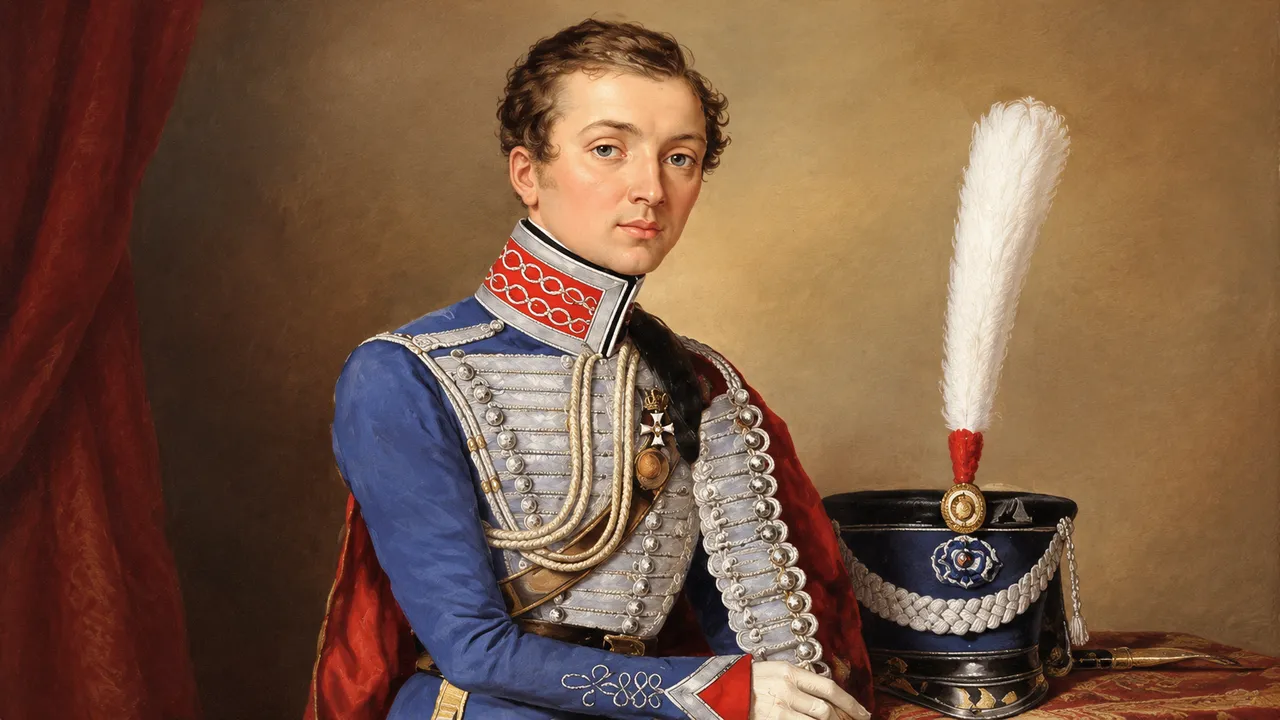
    The origin of Durova's portrait at the beginning of this article is very interesting. Durova served in the Mariupol Hussar Regiment from 1808 to 1811. Shakos of this type were introduced in November 1809, but the plume at the bottom of the shako was never monotonous in any hussar regiment. The shako's peak clearly features gold embroidery, which was never used before. The questions and cockade are not of the standard type. The collar and buttons in the Mariupol Regiment were yellow, and the pelisse was blue. A red collar was typical of the Sumy Hussar Regiment. The blue dolman and red pelisse, as in the portrait, were typical of the Izyum Hussar Regiment. As an additional detail, a hussar in a vice uniform is shown.
    1. +4
      29 September 2026 20: 39
      I forgot - the St. George's Cross is also hanging out of shape, pay attention to the second portrait, it's correct there.
    2. +4
      29 September 2026 21: 19
      Wonderful additions from our esteemed colleague Sergei good
  6. 0
    29 September 2026 20: 41
    As for combat accomplishments, by her own admission, during her entire service, her saber only harmed one living creature—a goose she slaughtered. So, as a soldier, she was of no use. But she did receive a salary.
    And what use was this soldier?
    “And it must be said that in battle
    Once in a real rapture
    He distinguished himself by boldly going into the mud
    Having fallen from his Kalmyk horse,
    Like a drunk Zyuzya, and to the French
    "Captured: precious collateral!.." ?
    There is no need to reduce all the benefits to the corpses of enemies...
  7. +3
    30 September 2026 14: 58
    Durova was "awarded the St. George Cross." But this was the official name for the badge only in 1913. During her lifetime, it was called something else: the Military Order of Distinction, the Soldier's St. George Cross. Even her tombstone speaks the language of a time before hers.

    Nothing of the sort. In society, the award was still called the "St. George's Cross."
    P.S. I'm increasingly noticing a similar writing style, and from different authors. Here on Topware, on Zen, and elsewhere. Isn't it AI writing like this?