Vietnam: Easter Offensive - A B-minus Attempt

Fire Support Base Mary Ann
On March 28, 1971, at 2:40 a.m., several dozen (usually reported as fifty) Vietnamese engineers from the 409th Engineer Battalion of the VPA, dressed only in shorts and rubbed with a mixture of grease and charcoal powder, crawled to the "Bruno Spiral"—the first row of the defensive perimeter of the American base Mary Ann—and quickly made four passages through it. The spiral was supposed to be equipped with signal mines, but they were often triggered by the rotors of landing helicopters, and McNamara's idiots forgot about the North American stainless steel bolt. The base was manned by GIs from Charlie Company, 1st Battalion, 46th Infantry Regiment, 23rd American Division—231 Americans. The word "were" is most appropriate here, since, as was later shown, the words "guarded" or "defended" did not capture the realities of this stage of the Vietnam War. The Americans were "sitting on their suitcases," preparing to hand over the base to the Arven fighters, who were also there, numbering 21, and even accepted one from the Americans. artillery the battery.

The coat of arms of the 46th Infantry Regiment, whose 1st Battalion "became famous" at the Mary Ann base
The GIs were so indifferent to everything that they often didn't even fire on the VNA guerrillas they spotted (sensors were installed in the jungle to detect the approach of anyone uninvited). As Captain Paul Spielberg later recalled: "The company was in chaos... The soldiers were hanging around, reading newspapers, playing cards... Most of the time they didn't even carry anything with them." weapons" It wasn't as if the company officers were enjoying it... But no one wanted to catch a couple of grenades from their beloved personnel in their sleep, so... The base was commanded by the battalion commander, Lieutenant Colonel William Doyle, an Irishman, and, as befits an Irishman, a reckless brave man and an equally reckless drunkard. Captain Richard Knight, a good officer but young and therefore not particularly authoritative, was in charge of the base's defense.

A bird's eye view of the Mary Ann Air Force Base
The base was an irregular rectangle, measuring 500 by 200 meters, and was guarded by 22 fortified outposts (sometimes referred to as bunkers, so most likely they were something like pillboxes). In short, at least a quarter of the personnel had to be on guard duty every day. They had to—but they weren't required to! The GIs preferred mixing beer with whiskey and polishing their hair with that herb that wasn't Herbalife. Having also surmounted the remaining two barbed wire fences undetected, the Vietnamese lay down and waited for the signal to attack. The signal was supposed to be a mortar barrage.

Structure of the 409th VNA battalion
All in all, things were soon a merry time at the base: mortar shells exploded playfully between the trailers, sappers tossed homemade grenades, cobbled together from Coca-Cola cans ("Holidays are coming!"), used satchel charges to destroy infrastructure, and tear gas grenades, forcing survivors to run out into the fresh air—under fire from AK-47s. Captain Knight, in charge of the base's defense, was killed in his own bed, Lieutenant Colonel Doyle was shell-shocked, and the Americans often couldn't reach their rifles and radios and either hid or fired back with pistols. The outcome of the battle? Hmm... Usually, the attacking side suffers significantly more casualties than the defending side. However, "McNamara's idiots" managed to disprove this rule: in 45 minutes of combat, the Vietnamese admitted to losing 14 men killed and 21 wounded comrades, the Americans admitted to 33 killed and 82 wounded, and the Southerners suffered no losses, prompting rumors of Allied betrayal to spread throughout the base. Moreover, the majority of the Vietnamese casualties were inflicted by a Huey with an infrared sight, which struck the sappers who were already retreating through the Bruno spiral.
The attack on Mary Ann was a typical local battle, but it reinforced the Nixon administration's desire to withdraw from Vietnam as quickly as possible: all other American units were at roughly the same level of combat readiness. The main question that plagued Kissinger was the "decent pause" that would allow the United States to save face. That is, the NVA would not destroy the Saigon regime immediately after the American withdrawal, but would pause for at least a couple of years, making it more difficult to connect the fall of Saigon with the American withdrawal.

A heroic VNA anti-aircraft crew poses for a war correspondent. Somewhere, an S-75 crew hides unheroically...
In May 1971, Weyand admitted: “Our aviation "—the only glue that keeps it all from falling apart." But what conditions it operated under! Air forces were striking the Ho Chi Minh Trail in Laos and Cambodia, but at the same time they were reporting that they were bombing targets in South Vietnam. But they also needed to bomb positions. Defense DRV, but the "Rules of Engagement" clearly allowed this to be done only in response to shelling from the ground, and radars - if they were guiding Vietnamese (yeah, pilot Lee Si Qing!) MiGs.
To somehow get out of the situation, the American command began deliberately sending reconnaissance aircraft into Vietnamese airspace, provoking shelling, followed by bombing raids. But for these raids, American pilots were fleeced like pigs! In short, the war was extremely strange: Nixon demanded decisive action from the Air Force. The Air Force command asked for changes to the "Rules of Engagement." Nixon refused, demanding decisive action within the limits of its existing authority. The command resorted to cunning, provoking shelling of North Vietnamese air defenses, and then bombing Vietnamese territory. Afterwards, the pilots received flights from Washington. And then the president demanded more decisive action again... In short, when you read this, you begin to understand the American military, who drank hard liquor and smoked all sorts of obscene things!

Nguyen Van Thieu: If you don't vote for yourself, no one will vote for you!
Creighton Abrams, the man and танкHe didn't limit himself to alcohol abuse (and he was a heavy drinker: according to contemporaries, he bought bourbon in six-packs!). He even decided to convert from Methodism to Catholicism because of this lifestyle. Actually, he had good reason to: Washington was announcing to the world the defense of democracy in South Vietnam. Meanwhile, presidential elections were held there in October 1971. Well, not elections... They chose President Nguyen Van Thieu from a pool of candidates limited by Nguyen Van Thieu. It was a disgrace: the US always laughed at the USSR for its elections without choice, but the question arises: how was puppet South Vietnam any better?
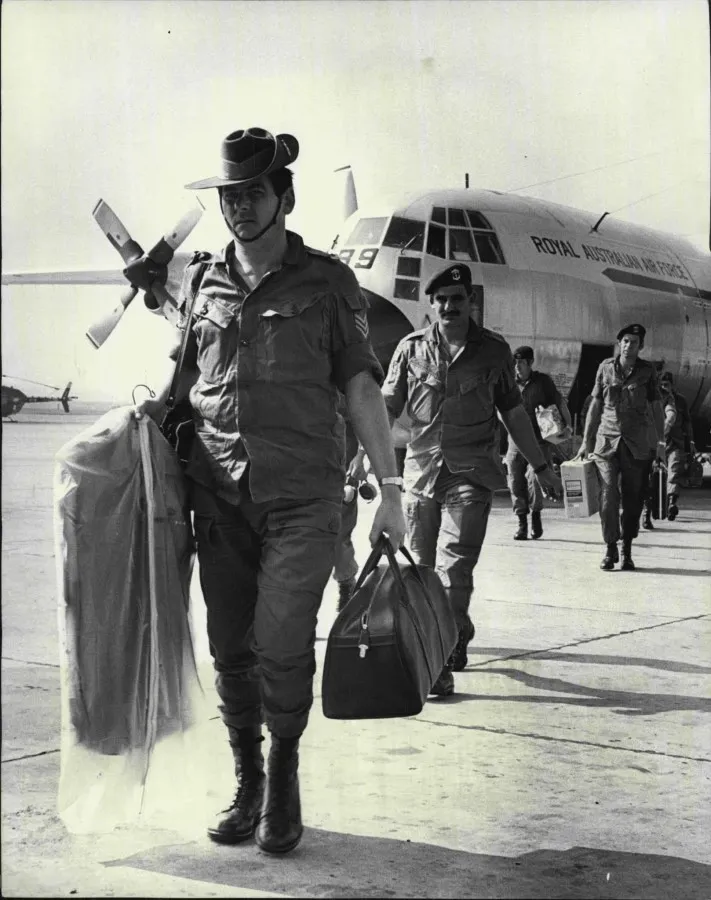
Australians are leaving Vietnam
By the end of 1971, 175 American troops remained in Vietnam. However, they were already being avoided in combat, as it was fraught with danger. The war had even worn down the Australian contingent; as Lieutenant Rob Franklin noted, Dundee's compatriots, nicknamed "Crocodile," had switched from a "search and destroy" strategy to a "search and avoid" one—there were frankly few willing to die just before the contingent's withdrawal.

Nixon and Zhou Enlai drink to world peace!
Le Duan decided to take advantage of the enemy's weakness and launch a full-scale offensive with ten divisions and support units. Admittedly, the VPA command had no experience with such large-scale operations, although they did have experience with the disastrous Tet Offensive, but the Vietnamese generals decided to take the risk. The operation was named "Operation Nguyen Hue"—named after the 18th-century emperor who defeated the Chinese. Since such a large-scale undertaking was difficult to conceal, the Americans began to suspect something was wrong. Abrams openly stated that the VPA's goal was "to strike at the weakest point in this whole scheme, at the behest of the American people..." How did the North Koreans achieve surprise under such circumstances? story It's silent. Most likely, the point is that Washington simply had other things on its mind: relations with China were about to be restored. On February 21, 1972, Nixon arrived in Beijing, and this was such a major victory for American diplomacy (or so it seemed to American diplomats at the time) that they simply stopped paying attention to the war somewhere in China's underbelly, which they were just about to emerge from. Moreover, the honeymoon with China spared the Americans from the nightmare of the Korean War: the arrival of a million "Chinese People's Volunteers." It became clear: the Chinese had no intention of intervening in Vietnam.

Burned out or not, but fit for defense! Probably
In short, with the major VNA offensive underway, the Arwen units were left on their own. Morale was lower than a city sewer. Thoughts on how to boost it did surface, they were rather convoluted: for example, a system of field brothels was proposed. More traditional methods were also employed. Major Walter Boomer, a future four-star general, described the Vietnamese Marines as follows: "The major enforced discipline by beating everyone left and right with his cane. I knew that when we got into a tough situation, this would cause big problems. I was lonely—I read a lot, trained a lot. Frankly, I felt uncomfortable with them. They didn't want to fight anymore; they were burned out." Nevertheless, as further developments showed, it was not worth writing off the South Vietnamese completely: at least some of the Saigon regime's military personnel understood that they, specifically, had no chance of winning if the North won, and Uncle Ho, whose popularity was high in both the North and the South, died in 1969, and Le Duan and company did not have even a fraction of his authority...

VNA fighters prepare their T-54 tanks for an offensive.
The VPA offensive began on March 30, 1972. It was the Catholic "Good Friday," so the offensive was dubbed "Easter" in American historiography and "Summer of Fire" in South Vietnamese. However, South Vietnamese historiography still had three years to live. Attacks were launched from several directions simultaneously: from the north, through the demilitarized zone; in the center, from Laos to Kontum and Pleiku; and in the south, from Cambodia to Saigon through An Loc and Loc Kinh.
At the same time, guerrilla forces became more active in the Mekong Delta. The number of advancing forces... Typically, 300 men and 600 tanks are cited, 400 of which are T-34-85 and T-54 medium tanks (both Soviet-made and Chinese Type 59s), and 200 PT-76 amphibious tanks. However, some estimates of the VPA's strength are much more modest—125 men. Furthermore, the advancing units were provided with air defense by Strela man-portable air defense systems (MANPADS), a new development in the Soviet defense industry, and Malyutka antitank guided missiles (ATGMs) were used against armored vehicles. 25 Vietnamese troops underwent training in the USSR, where they learned to operate the vehicles, and a contingent of Soviet military advisers also arrived in the DRV. The problem was that the Arwen force at that moment was 758 thousand people (true, the tanks were mostly light M41, but there was also a battalion of medium M48A3 Patton - 42 combat-ready tanks at the start of the offensive), plus the remnants of the Americans, but most importantly - American aviation.

"Centurion" (in my opinion...) is sad...
The VPA achieved operational surprise. The Americans understood that an offensive was being prepared, but they couldn't believe they were launching a direct attack across the demilitarized zone, a direct violation of the Geneva Accords. Therefore, the attack by the 304th and 308th VPA Divisions, supported by 100 tanks, came as a surprise. The Northern strike force attacked I "Arwen" Corps, which defended the "Ring of Steel"—several Saigon regime army bases south of the demilitarized zone. The Southerners were flanked by the 312th Division from Laos, advancing along the very same "Colonial Highway 9" that inspired the name of Operation Lam Son 719.

Lieutenant General Hong San Lam: With such cool glasses, you don't need to learn real military skills! And you don't need to learn any other way either!
As early as April 1, the South Vietnamese command ordered a withdrawal: the 2nd Regiment of the 3rd Division and the 11th Cavalry Regiment were well armed and trained, but all the other units of the corps were staffed by captured deserters and criminals from prisons, so they did not demonstrate high combat qualities. And the I Corps was commanded by that same General Hoang Xuan Lam: the embodiment of the Saigon regime's unprofessionalism and corruption. As subordinates later recounted, he did not want to report bad news to the capital. newsMoreover, the Northern Command didn't just pick the start date of the offensive out of thin air: March 30th coincided with the start of the rainy season, which hindered American air operations.

Arwen's men are dragging their dead comrade. Incidentally, it's not the worst sign—they're carrying him out, not abandoning him...
On April 2, a column of VNA tanks was already moving toward the bridge over the Kiaviet River. The 3rd "Arven" Division broke into action, with the division commander and his American military advisor being the first to grease their heels. It was necessary to quickly appoint US Marine Lieutenant Colonel Gerald Turley, who was on a familiarization tour of northern Vietnam, as division commander.
The divisional headquarters officers and their subordinates simply stood up, grabbed their personal belongings, and fled the command bunker. The senior officers fled first. Maps and classified documents remained lying on the tables; radios were abandoned. Gradually, chaos engulfed the entire base; frightened men, no longer soldiers, rushed about in search of transport. American soldiers, radios and stereos in hand, hurried to the helicopter landing zone; fear and despair were written on their faces. It was a tragic day.
— he later wrote in his book “Easter Offensive.”
Abrams explains on the radio in a popular way: what, to whom and where he is going to pull...
Turley reported the situation to Abrams' headquarters, but they didn't believe him, explaining to the commander that the lieutenant colonel was panicking and mistaken. Abrams began to rant and rave: "I get the feeling the weed smoke is clouding their minds... I don't know what needs to be done to stop this crap, but... I want this over with once and for all!" he screamed. But "this crap" was just beginning. Arven's command had lost control of the troops. Or rather, it hadn't had time to regain it: South Vietnamese units had only recently taken the place of the 70 Americans who had withdrawn and hadn't had time to fully fill the void left by their departure.

If a downed pilot wasn't found by his own people, someone else would be...
At the beginning of the offensive, the VNA received significant assistance from the US Air Force. An EB-66 aircraft was shot down over the demilitarized zone. EW, and the Air Force command secured a ban on artillery fire within a 25-kilometer radius around the pilot's landing point. The pilot was found and rescued on April 12, 1972. By this time, approximately 70 Americans remained in the Republic of Vietnam, 6 of whom were in combat units. The VNA was stopped by South Vietnamese fighters with the support of American airpower, although the level of cooperation with the latter was significantly lower than that of American units.

A fighter with a LAW RPG in Vietnam
When Lieutenant Colonel Turley attempted to call for air support for "his" division, it turned out that the air liaison officer had disappeared along with the rest of the staff. The advance of a North Vietnamese tank column toward the bridge at Dong Ha needed to be slowed. Destroying the bridge failed—Arven's command opposed it—but three antitank teams with LAW RPGs were deployed on the southern side. A stream of refugees and stragglers from their retreating units moved across the bridge. The 57th Regiment abandoned its positions and fled, and Saigon officers made a point of shooting their fleeing soldiers, but to little avail. Then Captain John Ripley, the American adviser to the battalion commander, called for naval artillery support, which halted the column's advance and knocked out one tank. Under fire from NVA tanks, Ripley planted explosives under the bridge beams and blew it up at 16:30 PM. This was an action that determined the fate of the battle - the northerners' advance was delayed for several days.

Cobras in Vietnam: An Antidote to the T-54
The Confederates surrendered Camp Carroll without a fight, and some officers were recruited into the NVA. The garrison at Fire Support Base Sodge retreated under fire from a nearby hill, abandoning their wounded and weapons. On April 6, Base Delta was attacked; the Union forces broke through the perimeter and captured half the base, but were driven out by morning. Base Charlie, garrisoned by the 11th Airborne Battalion, withstood both shelling and assaults on April 9 and 10, before B-52s arrived and inflicted heavy losses on the besiegers. The base held out until April 14, when the remnants of the garrison, 167 men, retreated under cover of airstrikes, having expended all their ammunition and supplies. As the retreating force marched, a VPA column caught up with them, and a rearguard action ensued. The outcome was decided by two Cobra attack helicopters, which allowed Huey transports to pick up the survivors. Of the 471 paratroopers at the start of the battle, only 37 survived. Delta and Metro soon fell, and on April 24, the VPA entered Thanh Kan. Tank battles unfolded north of Quang Tri: M48A3s versus T-54s...

The Malyutka ATGM and the Vietnamese fighter are made for each other!
While the Pattons dealt with the PT-76s like they were on a firing range, the T-54 proved a tough nut to crack for their 90mm guns. By May 2, not a single M48A3 remained in the Arven fleet; tank crews reported the destruction of 90 VNA tanks, but most of them were light amphibious tanks. "They don't lack tanks because they're losing them in combat! Their damn tank crews just abandon their vehicles and run! Even if you gave them hundreds of IS-3s, it wouldn't help them!" Abrams fumed. But, starting on May 4, C-5 Galaxy transport aircraft delivered another 120 of these vehicles to the Southerners. An unpleasant surprise for the Patton crews were the Malyutka ATGMs, which the Northerners used during the offensive not only to destroy armored vehicles but also to dismantle a communications bunker, thereby depriving the Southerners of command and control of the 22nd Infantry Division. The best VNA missileman to operate this ATGM was Dao Van Tien, who launched 134 missiles during the war. missiles, knocking out 23 tanks and armored personnel carriers, 12 guns, 27 bunkers, and 17 ammunition depots. He managed to strike while perched in trees or climbing sheer cliffs, where no one expected a missile...

Ngo Quang Truong was the most intelligent general in South Vietnam.
The VNA offensive was no walk in the park: after taking Tankan, the North Koreans paused for three weeks to regroup. But the enemy used this pause to deploy attack helicopters equipped with TOW missile systems, which had proven effective against T-54s, and to reinforce the garrison of Kontum, the capital of Quan Chi Ju Province. However, the high losses for the VNA also came as an unpleasant surprise. Desertions and self-inflicted injuries began, military tribunals operated in three shifts, but morale was visibly declining. The Checkmate and Bastogne bases held out for a long time and fell only after a bloody siege (the besieged were subjected to constant airstrikes). The Dong Ha Line was only breached in late April. Arven and the Americans withdrew from Kontum on May 1, and the VNA entered the city on May 2. The commander of the 1st Corps, General Hoang Sun Lam, was removed from his post and replaced by Lieutenant General Ngo Quang Truong, Arven's most capable military leader.

Arven fighters watch as US aircraft fire napalm at VNA positions.
Arven fought back, but retreated. Often, her soldiers actually abandoned their tanks and guns to break away from the advancing Northerners. This outraged Abrams, who cried out that the Southern army had enough weapons but lacked the will to fight. The American media had already buried the Saigon regime, which, in principle, was not wrong, but, let's say, they were a bit hasty in their conclusions. After taking Quang Tri and Tankan, Arven managed to form a defensive line that the battered VNA divisions were unable to breach. And in the summer, the Southerners launched a counteroffensive. Kontum returned to the control of the Saigon regime: on June 5-6, the VNA front headquarters ordered a withdrawal from the city and the end of the campaign in the Central Highlands.

South Vietnamese soldiers on a captured Chinese Type 59 tank.
The campaign in Laos and Cambodia proceeded in much the same way: initial success followed by bloody battles for An Loc, in which the North Koreans managed to cling to the outskirts but were unable to reach the center. The besieging divisions were decimated by gunships and bombers, and reinforcements gradually arrived to the garrison, allowing the defenders to counterattack and break the siege. Arven fought in a variety of ways: the Rangers, Marines, and paratroopers were quite capable; the line units, while not exactly stellar, were able to hold out even under heavy attack with air support. Units of the Southern Army suffered from desertion, but those who did not flee fought on. Still, the Easter Offensive can be considered a success for the Vietnamese Army.

Kissinger and Le Duc Tho in Paris: they have their own war...
The fact is, the negotiations in Paris were raging with their own battles! Kissinger demanded that Le Duc Tho withdraw his troops from the South. In response, Le Duc Tho contacted the VPA command via direct line and demanded that they intensify the offensive. The generals didn't like this approach: from the trenches on the front lines, the situation looks a little different than from a Paris hotel. But the goal of the "Easter Offensive" was strictly political: no one had set the VPA any galactic-scale military goals; they needed to present arguments in their dispute with the Americans and create a good image for the media. The Northerners accomplished both tasks quite well.

Americans in front of a destroyed T-54. Despite Arwen's best efforts, they would have withered much faster without American help.
The initial conclusion of the Easter Offensive was comforting to those in the Nixon administration who pushed for the "Vietnamization" of the Vietnam War: the South had prevailed, Arven had halted the VNA advance. But for Abrams and the American advisers directly within the Saigon regime's ranks, it was clear: without American air power, the North, despite fierce resistance from South Vietnamese units and the lack of a global mission, had a fairly good chance of reaching Saigon. The VNA had learned from its own mistakes: tanks rolled into cities without infantry support and were burned by grenade launchers and anti-tank guided missiles, attacks sometimes poorly coordinated. But compared to the utterly incompetent command of the Army of the Republic of Vietnam, these were deliberate and persistent actions. The war was heading toward its inevitable end, although most of the participants did not yet realize it...
Information