We can, when necessary: ​​domestic quantum computers

6 840 25
We can, when necessary: ​​domestic quantum computers
Source: investmoscow.ru


Qubit to qubit


It's worth noting right away that quantum computers are not a replacement for classical silicon processors, at least not in their current state. Moreover, developers themselves don't fully understand the full potential of the quantum industry. But work is underway, and quantum computers are becoming more common, including in Russia. At the beginning of the year, the most powerful domestic quantum computer, with 70 qubits, was unveiled, somewhat unnoticed by the general public. The machine was the product of collaboration between scientists from the Lebedev Physical Institute (LPI) and engineers from Rosatom.


Nuclear scientists are considered the leading developers of the quantum industry in Russia. A special program, "Quantum Computing," overseen at the government level, is dedicated to this end. Its goal is to ensure Russia's technological sovereignty in quantum technologies by 2030 through its own cutting-edge inventions and their implementation in economic and social sectors. More than 600 highly qualified scientists from 15 universities and research institutes are working on this project. This large-scale project is currently a priority for Rosatom.

Source: Media Center of the Physics Faculty of Lomonosov Moscow State University

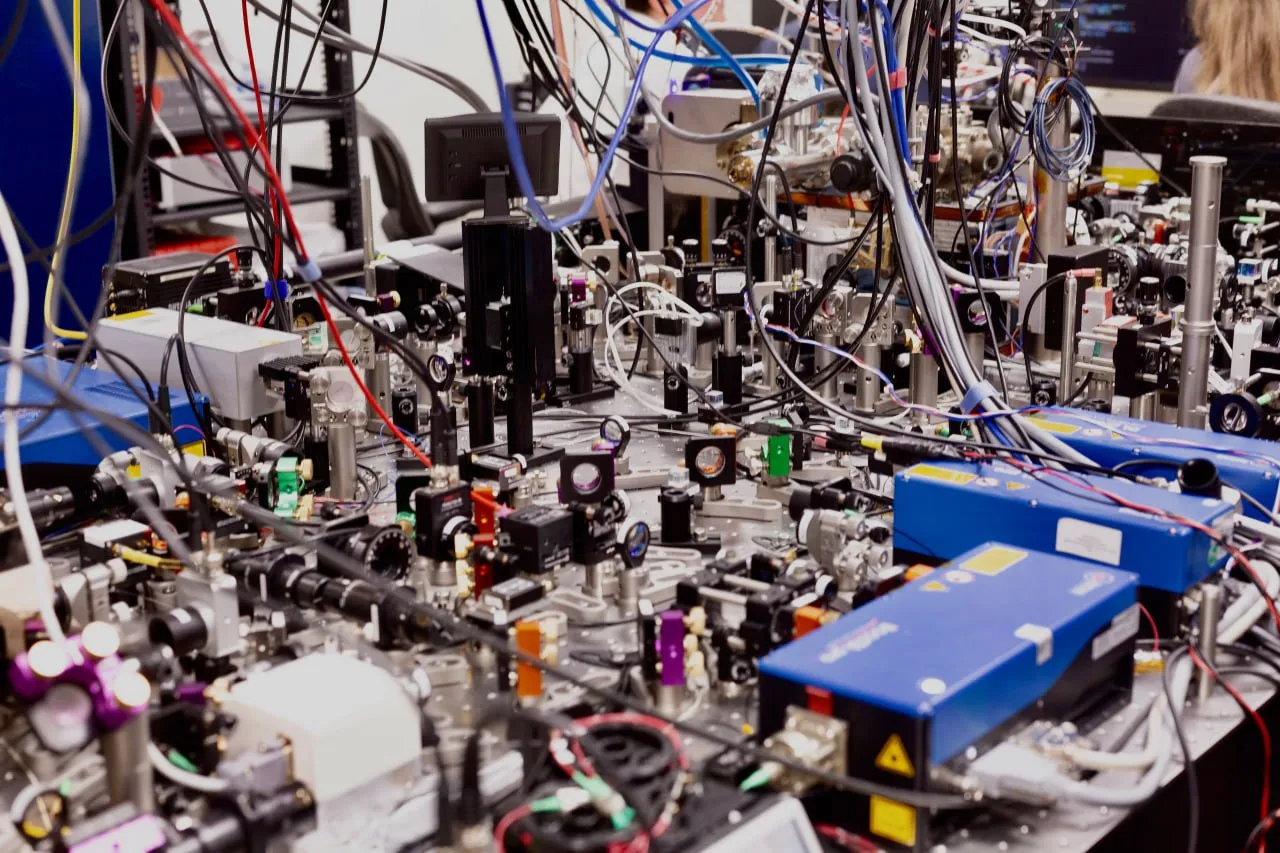
Along with the aforementioned ytterbium-ion-based computer at Lebedev Physical Institute (FIAN), three 70-qubit-class machines are operating in Russia. Rosatom built a computer using calcium ions, and Moscow State University built a 72-qubit unit using neutral atoms. It was crucial to move to a 70-qubit architecture, as it allows not only to test the machines but also to load them with real-world tasks. Incidentally, several quantum computers have been integrated with cloud services for remote user access. If you have suitable tasks, you're welcome to use them.

But what is being done in the quantum industry? As mentioned above, far from all the tasks have been defined, nor has the potential of quantum machines been fully appreciated. But some things are already in place. In Germany, BASF is using quantum computers to model the structure of catalysts and the dynamics of chemical reactions. Italians are optimizing the use of renewable energy sources, while Americans are studying DNA, predicting disease progression, and developing drugs. Airbus is investing millions in quantum technologies to develop new aircraft models, communication systems, measurement systems, and optimize cargo transportation.

ColdQuanta is developing quantum clocks for the Pentagon, a highly dangerous device that allows for location determination without a satellite navigation signal. French companies Thales and Syrlinks are also developing quantum clocks for the French armed forces. Thales will produce the atomic and optical cores of the quantum clocks at its Palaiseau facility, while Syrlinks will develop the electronic mechanism to ensure accurate timekeeping.

Quantum Race


It's difficult to overestimate the potential of the quantum industry for Russia. The country is almost hopelessly behind in microelectronics, particularly in the production of photolithographic equipment. Currently, plans are underway to build a domestic 150-nm semiconductor manufacturing machine, while the world is testing a 1,8-nm process. The situation with artificial intelligence is almost identical. The country has sufficient intellectual resources to meet such challenges, but it is severely lacking in computing power. And it will remain so as long as sanctions remain in place.

All hope lies in quantum computing, especially since initial successes have already been achieved: in March 2023, MIPT specialists presented Russia's first quantum neural network, developed at the institute's Center for Shared Research. The resulting system was successfully tested on four types of tasks: classifying and recognizing handwritten images, determining the parity of numbers, detecting breast cancer, and classifying different wine varieties based on a dozen parameters.

A brief overview of Russia's position in the global quantum computing league table. In 2026, the global quantum computing market will have finally split into two categories, with the duopoly of the United States and China holding the undisputed lead. The United States dominates the commercial sector thanks to its ecosystem of IT giants (IBM, Google, Microsoft, Intel) and startups, maintaining its leadership in software quality, cloud accessibility, and patents. China, which has allocated a record $15,3 billion in public investment to its program, leads in quantum communications, secure networks, and the creation of ultra-powerful superconducting processors such as the Wukong and Xiaochao series.

Source: investmoscow.ru

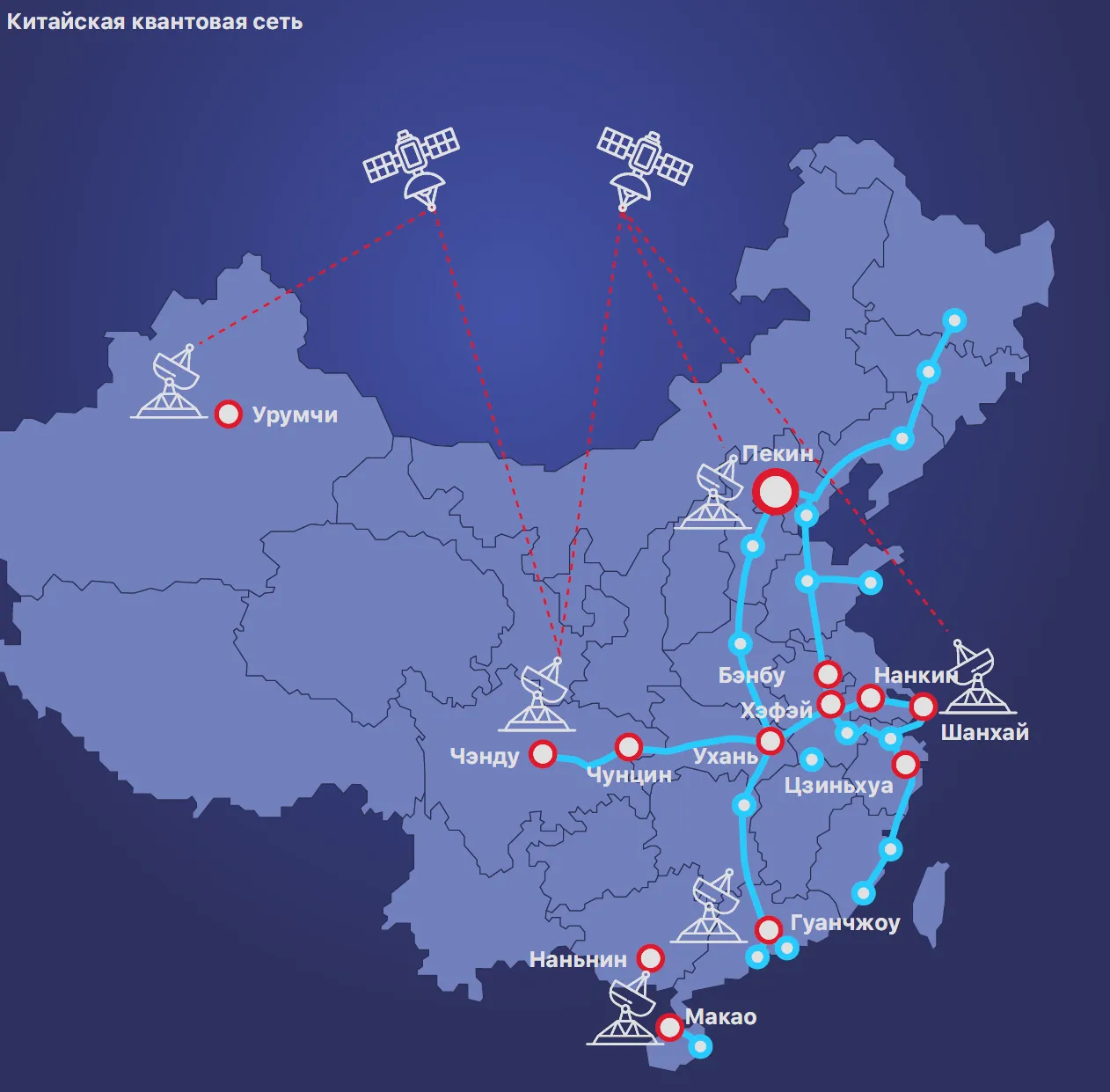
China has launched the world's first quantum communications network, connecting more than 700 terrestrial optical cables for data transmission over hundreds of kilometers and two satellites for communication over 1,000 kilometers. This infrastructure, which serves more than 150 users—including banks, power grids, and government agencies—is based on quantum encryption technology using photons as information carriers. Due to the fundamental laws of quantum mechanics, any attempt to intercept, copy, or hack a message inevitably alters the state of qubits, resulting in attackers receiving only a random set of numbers instead of secret data. In 2017, the first intercontinental quantum video call was made between China and Austria, spanning 7,500 kilometers.

Following the Americans and the Chinese is a group of pursuers from the "first tier" countries—the European Union (primarily Germany and France), Japan, Canada, and the United Kingdom—which boast strong scientific schools, developed startup ecosystems, and multi-billion dollar government subsidies.
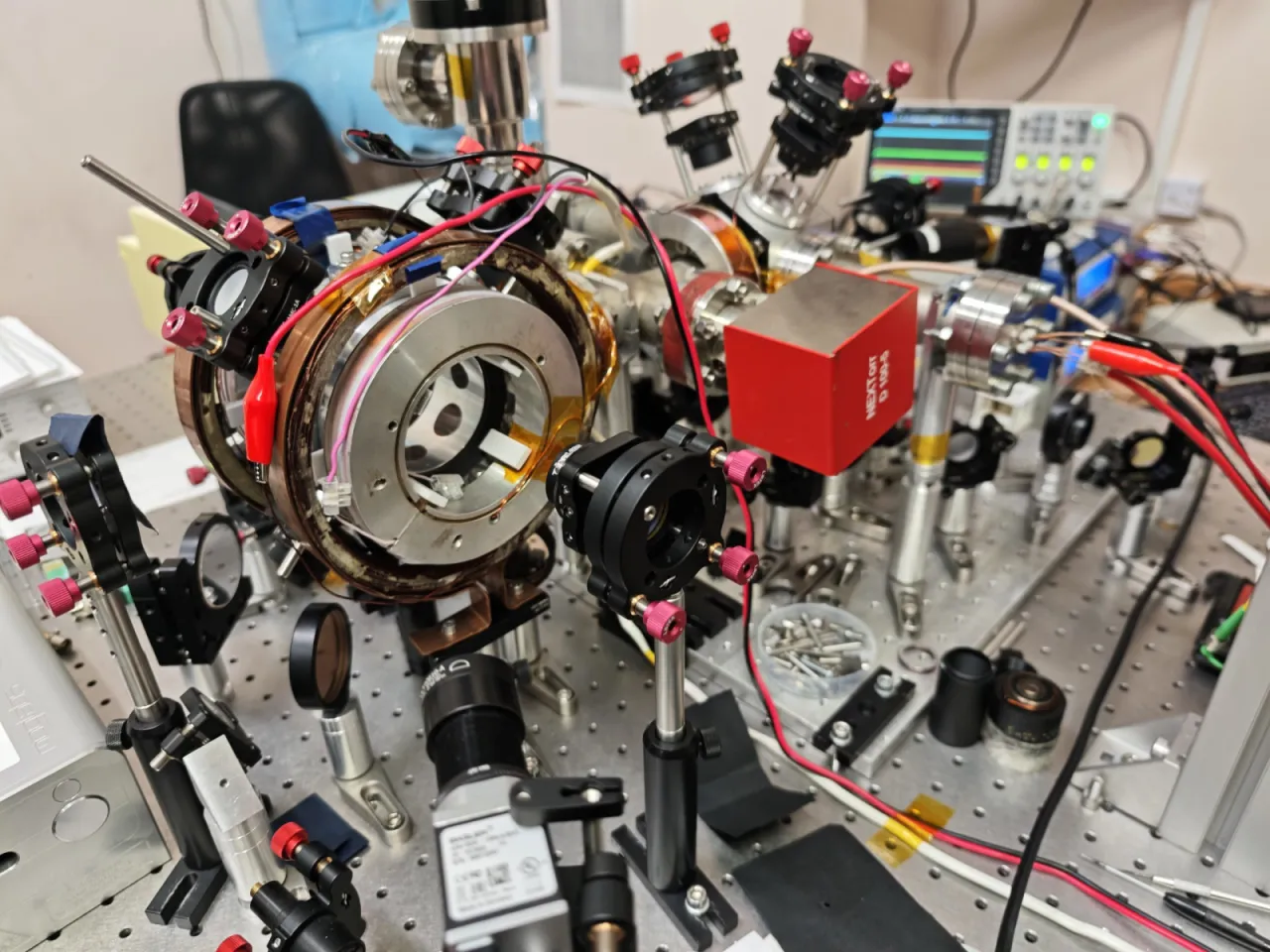

Russia's most powerful quantum computer, with 70 qubits. Source: lebedev.ru

Russia is firmly established among the top five global quantum powers, firmly entrenched in the top tier of competitors alongside the EU and Japan. The country is one of only three in the world (along with the US and China) to have successfully built operational quantum computers simultaneously using all four fundamental physics platforms: ions, neutral atoms, superconductors, and photons. Reaching the 70-qubit threshold on the ion and atom platforms places Russia among the first six countries to have surpassed the critical 50+-qubit mark.
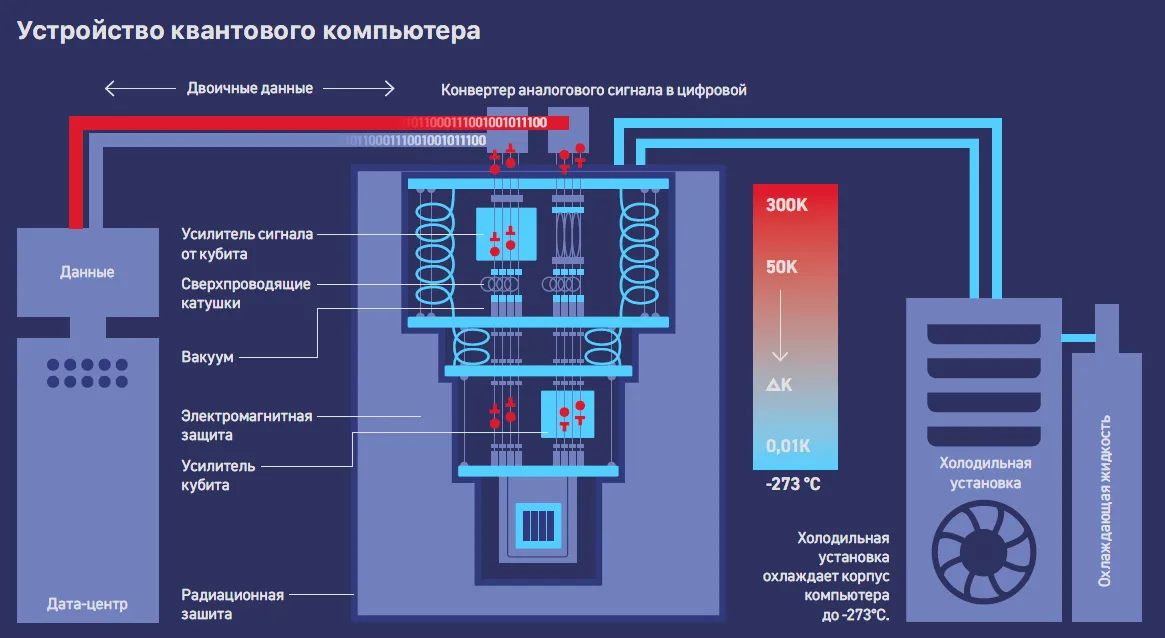

Source: investmoscow.ru

Even a basic understanding of a quantum computer reveals its extreme complexity. A quantum computer is a computing machine that operates according to the laws of the microworld and, instead of conventional silicon transistors, uses quantum objects: single atoms, ions, or superconducting circuits. In a conventional computer, all information is divided into bits, which can only exist in two fixed states—either 0 (off) or 1 (on). A quantum computer operates on qubits (quantum bits), whose key property is superposition. A qubit can be compared to a spinning coin: while it spins, it can be both "heads" and "tails" simultaneously. Thanks to this and the property of entanglement (when qubits are linked into a single network), a quantum processor calculates not one solution at a time, but millions of mathematical solutions simultaneously.

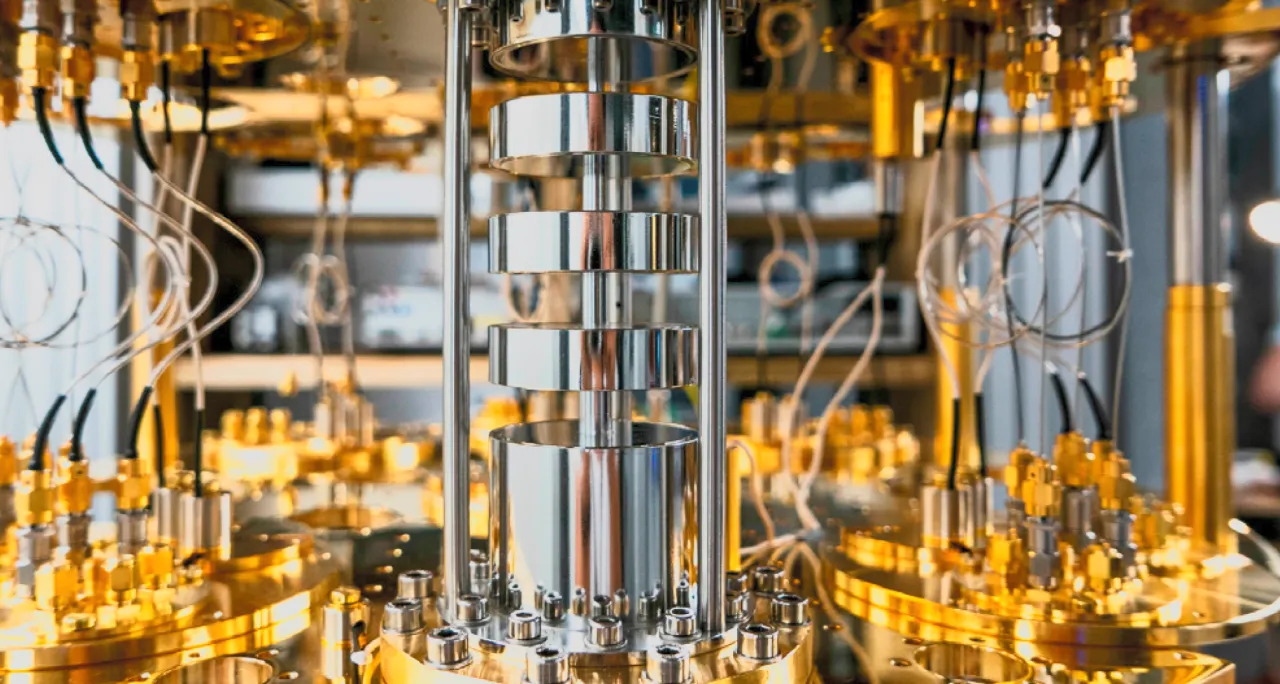
Physically, the most common type of such computer resembles a large "golden chandelier"—a complex multi-tiered refrigerator or dilution cryostat. This is necessary because qubits are incredibly fragile: any external heat or electromagnetic noise instantly destroys their quantum state. The lowest tier of this device is maintained at a temperature of approximately -273°C, and it is there that a tiny quantum chip is attached. As a result, a quantum computer doesn't replace a home PC, but rather becomes a supersimulator, capable of solving complex problems with an astronomical number of combinations in minutes—from designing new drugs to optimizing global logistics.

Not all quantum computers require extreme cold. In 2022, the German-Australian startup Quantum Brilliance unveiled the world's first diamond-based quantum computer capable of operating at room temperature. Instead of classic superconductors, its qubits are integrated directly into the structure of diamond crystal lattices. Thanks to the natural properties of the material, these computing elements are resistant to mechanical stress and protected from destructive thermal fluctuations in the environment.

An interesting question: who has the most powerful quantum computer? The short answer is the Americans, but it's important to separate wheat from wheat. The absolute leader in terms of the number of physical components is Atom Computing's system, which combines 1180 qubits based on neutral atoms. However, in practical computing, it is outperformed by the Quantinuum ion processor, which, thanks to its record-breaking operational accuracy (over 99,9%), was able to generate 48 stable logical qubits, completely immune to hardware errors. In terms of proven quantum superiority, the Google Willow superconducting chip with 105 qubits is recognized as the planet's leading computer. In tests, this processor performed a complex simulation of physical processes in just 5 minutes, which would have taken the most powerful classical supercomputer billions of years.
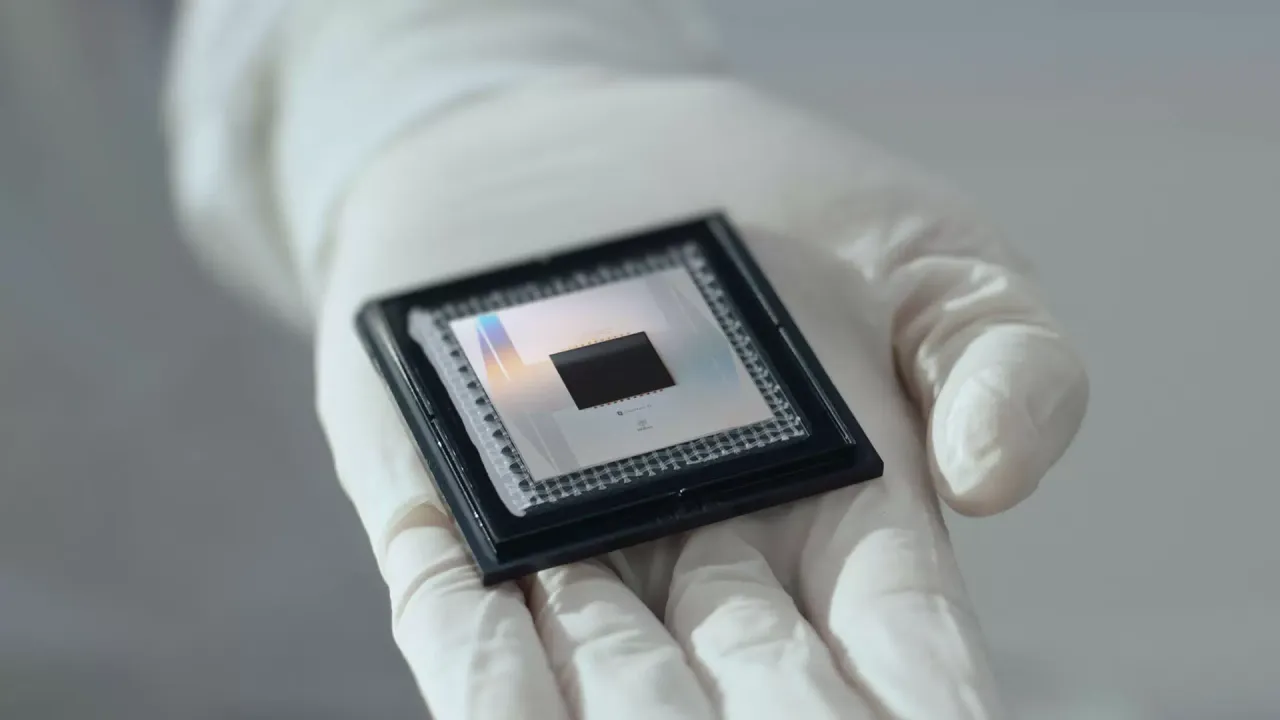

Google's Willow quantum chip

Let's return to Russian scientists, who are facing the ambitious task of scaling systems to hundreds of stable qubits and creating a domestic component base independent of external supplies. By 2030, Rosatom's roadmap envisions a transition from laboratory prototypes to the industrial implementation of quantum computing in the real economy. Russian algorithms are already being applied to optimize logistics, model new materials, and protect critical information infrastructure using quantum cryptography. Despite the colossal gap in classical semiconductor technologies, relying on unique quantum effects could become our asymmetric response to global challenges. If we maintain our current momentum, Russia will not only retain its place among the top five but will also be able to dictate its own standards for the architecture of future computers.
25 comments
Information
Dear reader, to leave comments on the publication, you must sign in.
  1. +7
    18 September 2026 05: 04
    Thank you so much for the clarification! I've unexpectedly begun to understand something about the state of the quantum computing industry through a series of articles on VO.
    Have a nice day everyone and a desire to discover the unknown!!!
    1. +6
      18 September 2026 07: 44
      As always, I'll wait a couple of years until the criminal cases are opened. Then we'll find out why and how, who's to blame, and where the money went. It wouldn't be the first time. Will there be an explanatory team for this text? It's too saccharine, like a Romanian.
    2. +2
      18 September 2026 08: 32
      Thank you! By the way, here's some breaking news.
      Russia has launched sales of quantum computers based on 4, 8, and 10 qubits.

      Russian developer of superconducting quantum computers, Quantum Park, has launched sales of its first line of 4-, 8-, and 10-qubit systems. These systems are designed for research and applied applications, including quantum algorithm development, materials modeling, and optimization.

      Each system includes a quantum coprocessor, a cryogenic readout system, a Russian ultra-low-temperature cryostat with signal switching, a control system, and a software environment for executing algorithms.

      💭 The developer's press service reported that the computers are built on the SnowDrop architecture. The platform allows for hardware and software upgrades, with the coprocessor increasing to 48 qubits.
    3. +3
      18 September 2026 13: 16
      I'm afraid you are too optimistic. laughing
  2. +2
    18 September 2026 05: 07
    I wonder what will happen when quantum computing is combined with artificial intelligence.
    I think for him a person would be at the level of a Pithecanthropus with primitive thinking. recourse
    Will quantum computers be able to simulate the future life of an individual or a society represented by a state... hmmm... what prospects are opening up in this regard... you can control history as you wish.
    1. 0
      18 September 2026 16: 30
      I wonder what will happen when quantum computing is combined with artificial intelligence.

      This may never happen
      1. -1
        20 September 2026 11: 27
        Unfortunately, this has already happened and it could end very badly.
  3. osp
    +8
    18 September 2026 05: 19
    If, back then, in the Soviet years, they had not followed the path of IBM-compatible machines, but an alternative path (for example, ternary logic, where there were some very good achievements), there would have been no lag.
    But even the original cores and processor architectures were almost always rejected by circuit designers and programmers. They were rejected by the Central Committee and are still being rejected by the Ministry of Industry and Trade.
    They have always demanded and continue to demand hardware compatibility with some foreign analogue.
    So that you don’t have to invent your own OS and software.
    This is the main reason for the lag.
    1. +5
      18 September 2026 07: 49
      Quote from osp
      For example, ternary logic, where there were some pretty good achievements

      Are you talking about "Setun"? So, you quickly became convinced that ternary logic is a dead end. It's certainly feasible in principle, but it's a pain in the ass that doesn't pay off in either hardware or mathematics.
    2. +4
      18 September 2026 10: 48
      Quote from osp
      If, back then, in the Soviet years, they had not followed the path of IBM-compatible machines, but an alternative path (for example, ternary logic, where there were some very good achievements), there would have been no lag.

      There would have been another problem: user-friendly software. There was a series of articles on the development of Soviet computers on VO, citing how the transition to Western hardware standards was driven by a desire to use seamless, ready-made Western software. Because it just didn't mesh with their own—the so-called designer Ivan Ivanovich and accountant Aunt Valya didn't mesh well with the class-correct Soviet computers.
      Quote from osp
      So that you don’t have to invent your own OS and software.

      Who would do that? Soviet computer developers were soaring in the heights; they knew their products inside and out, and the problems of ordinary users were incomprehensible to them—let them turn to specialists. And then...
      The tech-priest conjures the machine spirit with binary code.
      © "40,000 Ways to Die".
    3. +1
      18 September 2026 12: 59
      For example, ternary logic, where there were some pretty good achievements

      completely beyond progress
    4. +1
      18 September 2026 13: 09
      For example, ternary logic, where there were some pretty good achievements


      For fun, I tried programming a Setun-70 in assembler. Luckily, Nikolai Petrovich was in the next room. And of course, we all respected him very much, but when we celebrated May 9th (he was a veteran), I was the one running for vodka. laughing
      In general, based on the results of my efforts, he himself admitted that it was a dead end.
  4. +7
    18 September 2026 06: 29
    The article's text is an enthusiastic, almost promotional, review. It uncritically reproduces official statements and confuses demonstration prototypes with practical machines. The main drawback is the lack of context: 70 physical qubits are not the same as 70 logical qubits capable of performing useful calculations without error.
    Quantum computing's closest relative, an analog computer, represents numbers as continuous physical quantities (e.g., voltage, current). A quantum computer is different: it uses qubits, which, thanks to superposition, can exist in the 0 and 1 states simultaneously, and, thanks to entanglement, can instantly influence each other. It is not a replacement for a classical computer, but a specialized accelerator for a narrow class of problems.
    The most promising areas:
    1. Quantum chemistry and materials science—modeling molecules to create new drugs, catalysts, and batteries. Classical computers cannot accurately calculate the behavior of complex molecules due to the exponential growth of states.
    2. Optimization – logistics, scheduling, resource allocation. Example: Deutsche Bahn and IQM have already tested a hybrid quantum-classical algorithm for train scheduling.
    3. Finance and security – fraud detection in large transaction networks, graph analysis.
    4. Cryptography - Shor's algorithm theoretically allows RSA to be cracked, but this requires millions of stable qubits, which do not yet exist.

    P.S. Most of today's "achievements" are prototype demonstrations that don't outperform classical computers in practical tasks. Real commercial breakthroughs are not expected until 2032–2035.
    1. +1
      18 September 2026 11: 50
      The review leaves a mixed impression. Its overall skepticism is partly justified—Yevgeny Fedorov's article is indeed patriotic and review-oriented, as is natural for the publication "Military Review." However, a careful comparison of the review with the original text reveals that many of the criticisms are either unfair or based on an inaccurate reading, and a number of the reviewer's assertions contain independent errors.
      Let's start with the central accusation: "lack of context" and the confusion of physical and logical qubits. The original article, contrary to the reviewer's assertion, does provide context, and quite a thorough one at that: it describes the global balance of power (the US-China duopoly, the first echelon of pursuers—the EU, Japan, Canada, the UK, and Russia), provides specific figures for the world leaders (Atom Computing—1180 physical qubits on neutral atoms, Quantinuum—48 logical qubits with an accuracy of operations greater than 99,9%, Google Willow—105 qubits with proven quantum supremacy), and lists Russian platforms (ytterbium ions—FIAN, calcium ions—Rosatom, neutral atoms—Moscow State University). Moreover, the article explicitly distinguishes between physical and logical qubits using the Quantinuum example: "The absolute leader in terms of the number of physical components is the Atom Computing system… however, in practical computing, it is surpassed by the Quantinuum ion processor, which… was able to generate 48 stable logical qubits, completely protected from hardware errors." The reviewer, who claimed that the article "confuses demonstration prototypes with practical machines," either did not notice or ignored this passage.
      The second significant flaw in the review is the comparison of a quantum computer to an analog computer as its "closest relative." This isn't just inaccurate, it's conceptually flawed. An analog computer operates with continuous physical quantities within the framework of classical physics; a quantum computer utilizes superposition, entanglement, and amplitude interference, which have no classical analogs. This comparison has no bearing on the article—Fedorov never mentions analog computers. The reviewer, therefore, criticizes not so much the original text as his own, not entirely accurate, understanding of the subject, which he attributes to the article's author.
      Next comes a description of entanglement as the ability of qubits to "instantly influence each other." This is a common, but physically inaccurate, simplification: entanglement ensures non-local correlations of measurement results, but does not allow information to be transmitted faster than the speed of light (the no-cloning theorem). Fedorov's article, incidentally, describes entanglement more accurately—as a property by which "qubits are linked into a single network"—and does not assert the possibility of faster-than-light information transmission.
      The reviewer's postscript deserves special attention: "Most of today's 'achievements' are prototype demonstrations that do not outperform classical computers in practical tasks. Real commercial breakthroughs are not expected until 2032–2035." This assertion is as unfounded as it is categorical—no references to roadmaps (IBM, Google, IonQ) or analytics (McKinsey, Gartner) are provided. Furthermore, it ignores the fact that Google Willow has already demonstrated quantum superiority in a specific computing task (5 minutes versus billions of years for a classical supercomputer), and commercial quantum computing is already available through the IBM Quantum, Amazon Braket, and Azure Quantum cloud platforms. The only question is the criteria for a "commercial breakthrough," which the reviewer does not define.
      Finally, the review completely ignores the article's substantive strengths: a detailed description of the quantum race with specific public investment figures ($15,3 billion for China), an analysis of all four physics platforms used by Russia, a mention of MIPT's quantum neural network with a list of solved problems, Rosatom's roadmap to 2030, and an analysis of applied niches—from quantum cryptography to logistics and materials science. For a publication in the format of a military-analytics online publication, this level of work deserves not the dismissive remark of an "enthusiastic, almost advertising review," but a substantive discussion.
      Thus, the review fulfills the ritual function of "fighting hype," but essentially misses the mark. It attributes to the article what isn't there (the confusion between physical and logical qubits), omits what is there (a detailed global context), and introduces its own factual inaccuracies (the analogy with an analog computer, the simplified description of entanglement). Ironically, the review suffers from the very same flaws it accuses the original text of: superficiality and a lack of technical depth despite the apparent confidence of its tone.
      1. +1
        18 September 2026 13: 58
        Quote: Evgeny Fedorov
        The review leaves a mixed impression.
        ...

        Your response defends the original article, but does so with exaggerations and its own inaccuracies.
        1. Analogy with an analog computer. The answer correctly points out that quantum and analog are different paradigms, but both represent physical processes, not a digital implementation of a classical computer, which is the same as how numbers and operations on them are implemented.
        2. Confusion. I wrote "instantly affect" to simplify matters, but you yourself don't provide a correct formulation—you only say that Fedorov's article is "more accurate." I didn't make any claim about superluminal transmission.
        3. Postscript on timelines. Provide an example of a specific roadmap with commercial breakthrough dates.
        4. The accusation of "ritualistic anti-hype." This is a rhetorical device, not an argument.
        5. The main omission: The answer fails to acknowledge the validity of my criticism, even if my specific accusations are inaccurate.
        1. +1
          18 September 2026 15: 46
          What I'm getting at is that there's no point in starting a shootout with neurons. You can practice that endlessly.
          1. 0
            18 September 2026 16: 11
            Quote: Evgeny Fedorov
            What I'm getting at is that there's no point in starting a shootout with neurons. You can practice that endlessly.

            I agree.
      2. 0
        18 September 2026 14: 05
        Quote: Evgeny Fedorov
        The second significant flaw in the review is the comparison of a quantum computer with an analog one as a “closest relative.”

        I've provided you with a Wikipedia excerpt to help you understand: there was liquid and tubes there, here qubits and entanglement. Both are physical processes.
        A hydraulic integrator is an analog computer designed to solve differential equations, the action of which is based on the flow of water. Created in 1936 by Vladimir Sergeyevich Lukyanov.

        The volume of fluid in a vessel is an integral of the function that describes the flow of fluid into this vessel. If you equip the vessel with a scale graduated, for example, in units of volume, you get a simple integrator of the volumetric flow rate of the liquid. Back in ancient times, clepsydra was invented, which measures time intervals based on the amount of flowing water.

        The first instances of Lukyanov’s integrators were more experimental, made of tin and glass tubes, and each integrator could be used to solve only one problem.

        In the 1930s, it was the only computer in the USSR for solving partial differential equations.

        In 1941, Lukyanov created a hydraulic integrator of a modular design, which made it possible to assemble a machine for solving various problems. Two-dimensional and three-dimensional hydraulic integrators were designed.

        https://ru.ruwiki.ru/wiki/Гидравлический_интегратор
    2. +1
      18 September 2026 17: 52
      This is not a replacement for a classical computer, but a specialized accelerator for a narrow class of tasks.

      Bingo!
      THAT means it is not a computer.
      This is a prototype coprocessor.
      Moreover, the coprocessor is for a narrow class of tasks.
      And that's all non-specialists need to know about quantum computers.
    3. 0
      3 October 2026 17: 11
      modeling molecules to create

      The chemical properties of combinations of atoms are predicted, but not the method for creating these combinations.
  5. +4
    18 September 2026 07: 31
    What's so domestic about it? There's no "Russia" written on the chip.
  6. +2
    18 September 2026 09: 33
    It's difficult to overestimate the potential of the quantum industry for Russia. The country is almost hopelessly behind in microelectronics, particularly in the production of photolithographic equipment. Currently, plans are underway to build a domestic 150-nm semiconductor manufacturing machine, while the world is testing the 1,8-nm process.

    That says it all: they haven't invested in development since 1991, and now they're trying to make up for lost time.
  7. +2
    18 September 2026 09: 43
    ColdQuanta, a company working for the Pentagon, is developing quantum clocks, a highly dangerous device that allows one to determine one's location without a satellite navigation signal.
    A very odd remark for a technical article: ColdQuanta has indeed been actively working on quantum (atomic) clocks. One of the key focuses is making atomic clocks smaller, lighter, and less energy-hungry, so they can be used in real-world applications: drones, navigation systems, and critical infrastructure protection.
    The goal is to create a generation of high-performance atomic clocks based on a two-photon optical transition in warm rubidium vapor. The goal is to achieve increased stability while significantly reducing size, weight, and power consumption. The program is expected to produce a series of prototypes ready for deployment in real-world conditions.
    The company has been working toward combining watches with inertial sensors (gyroscopes and accelerometers). The idea is to build entire "quantum positioning systems" that can operate autonomously even if the GPS signal is lost (for example, in space, underwater, or during a cyberattack).
    This is the approach taken by modern inertial positioning systems. They are one of the elements of navigation systems installed on moving objects. Submarines themselves determine their position in this way without an external radio signal. The battle is over weight, consumption, and accuracy.
    Here in navigation we have a good position in the world rankings.
  8. 0
    18 September 2026 13: 14
    A quantum computer is a computing machine that operates according to the laws of the microworld and uses quantum objects instead of conventional silicon transistors:

    Dear author, haven't you noticed that people still don't understand what a quantum computer is and how it differs from the one on your desk?
    It's all about qubits and qubits, you might as well write about Q-sharp.
    But everything can be formulated in one paragraph.
  9. -1
    19 September 2026 18: 24
    Personal opinion...
    A quick brain won't replace skilled hands. Our processor won't replace our wheat. And 450 of the best parliamentarians won't replace all the kindergarten teachers, elementary school teachers, and middle school professors.
    Success in qubits will not lead to a better life for the entire population of the country.
    Perhaps we shouldn't publish such triumphant verses, which quantum computers haven't yet learned to educate boys and girls differently?