How Mikoyan and Sukhoi Design Bureaus Achieved Variable-Sweep Wings

7 907 72
How Mikoyan and Sukhoi Design Bureaus Achieved Variable-Sweep Wings


Continued. Part one: The Origins of the Soviet Tilt-Wing: From the Bell X-5 to the Su-7IG


The MiG-23 and Su-24 addressed fundamentally different challenges. But both emerged after their design bureaus encountered the similar engineering costs of a different solution.

By the mid-1960s, the Soviet frontline aviation faced a problem with no obvious answer. A fixed swept wing worked well at supersonic speeds, but it required long runways. In real-world conditions, dispersed across unpaved and damaged airfields, this became a serious limitation. Given the requirements of the 1960s, a fixed wing forced an unacceptable compromise between short takeoff and speed.

Several solutions were proposed. One was lift engines: separate engines in the fuselage that generated vertical thrust during takeoff and landing. Another was variable sweep: reducing the wing's sweep angle during takeoff and landing and increasing it during cruise. Both design bureaus tried the former, and both found the cost higher than it appeared on paper.

"23-01" and "23-11": an experimental fork of the Mikoyan Design Bureau


The prototype, "23-01," was built using a seemingly logical design: a fixed wing, a single cruise engine, and two RD-36-35 lift engines in the fuselage for short takeoff and landing (STOL). At the time, TsAGI was actively researching the potential of vertical takeoff and landing (VTOL) for combat aircraft; interest in VTOL aircraft wasn't limited to the Soviet Union—the Hawker Siddeley Kestrel, the Harrier's predecessor, was already flying in Great Britain. The Harrier, however, used a fundamentally different architecture: a single cruise and lift engine with rotating nozzles, rather than separate lift engines.
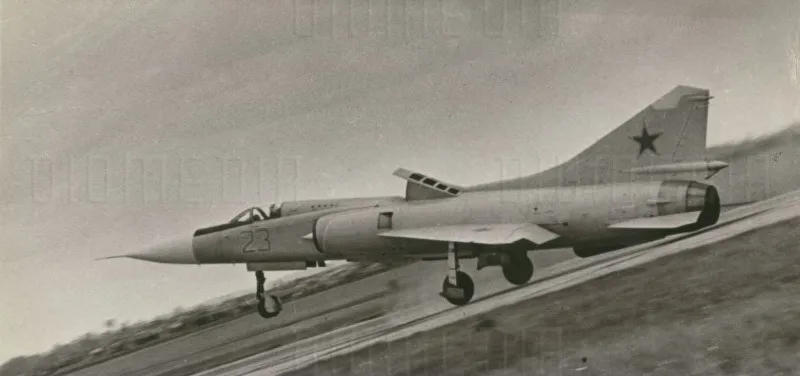

The Soviet experimental short takeoff and landing fighter MiG-23PD (also known as the "23-01" or the NATO reporting name Faithless)

The engineering challenge of separate lift engines proved the same regardless of the design bureau: they took up fuselage space, required air intakes, fuel, and structural weight, and provided no useful benefit beyond takeoff. In level flight, they were dead weight. Further shortening the takeoff run required increasing the lift thrust, which led to increased weight and complexity—in a mode where neither was needed.

At the Mikoyan Design Bureau, the "23-01" and the alternative "23-11" with a tilt-wing design were developed in parallel; the variant with the KIS went into production. On June 10, 1967, the "23-11" took to the air. The wing could assume three positions: 16°, 45°, and 72° along the leading edge, depending on the flight mode. The crew made the choice; automatic sweep selection based on flight mode, similar to the F-14 system, was not available.
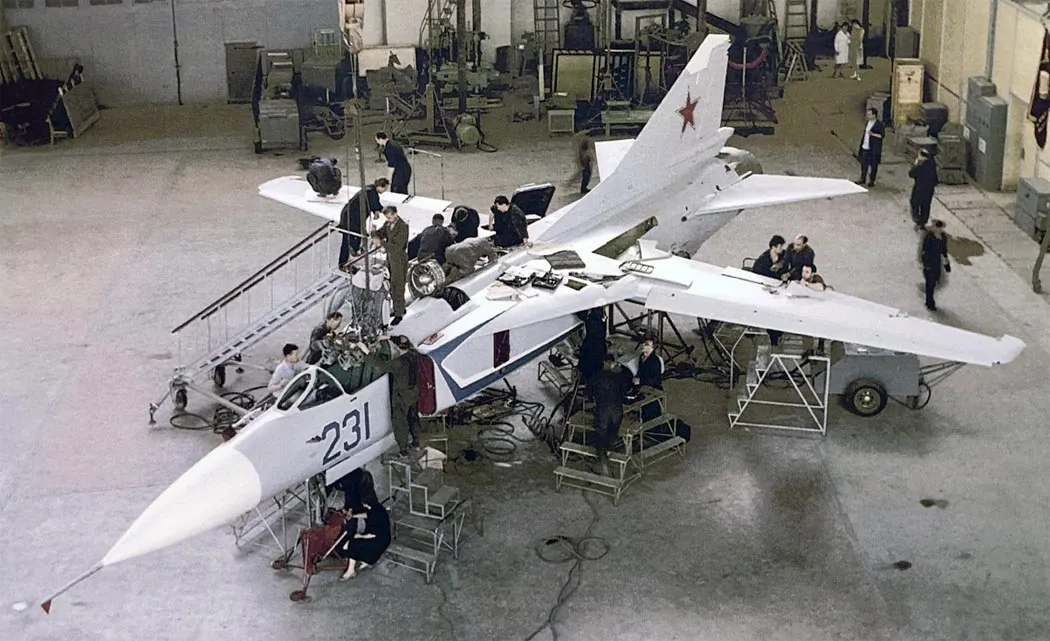

MiG-23 (factory code "product 23-11") in the Mikoyan Design Bureau workshop)

This reflected a difference not only in technology but also in control approaches. The American F-14 carrier-based interceptor was designed around the same time: its sweep angle changed automatically—the control system automatically adjusted the wing geometry depending on speed and maneuverability. The MiG-23's three stepped positions reflected a different principle: the pilot independently selected the mode for a specific task. The stepped system was less complex architecturally, although comparing the reliability of two fundamentally different approaches is incorrect—each had its own limitations.

On the MiG-23, the primary hardpoints were located under the fixed wing and fuselage sections; fixed pylons under the movable consoles were used for external fuel tanks only at a sweep angle of 16°. This is a design compromise faced by any combat system with external hardpoints: a pylon on a rotating console must either rotate synchronously with the console, or it limits the available sweep range.

The MiG-23 evolved into a family: fighter versions with different targeting systems and attack derivatives—the MiG-23B and MiG-27—with a redesigned nose and targeting equipment optimized for ground attack. The MiG-23B and MiG-27 retained the same three primary manual wing positions: 16°, 45°, and 72°.

T-6-1 and T-6-2I: Same Dead End, Different Task


The Sukhoi Design Bureau has a similar one story The task was different. What was needed was not a multi-mode fighter, but an all-weather frontline bomber: crew-on-crew, automated low-altitude penetration, operations in all weather conditions and from short airstrips.
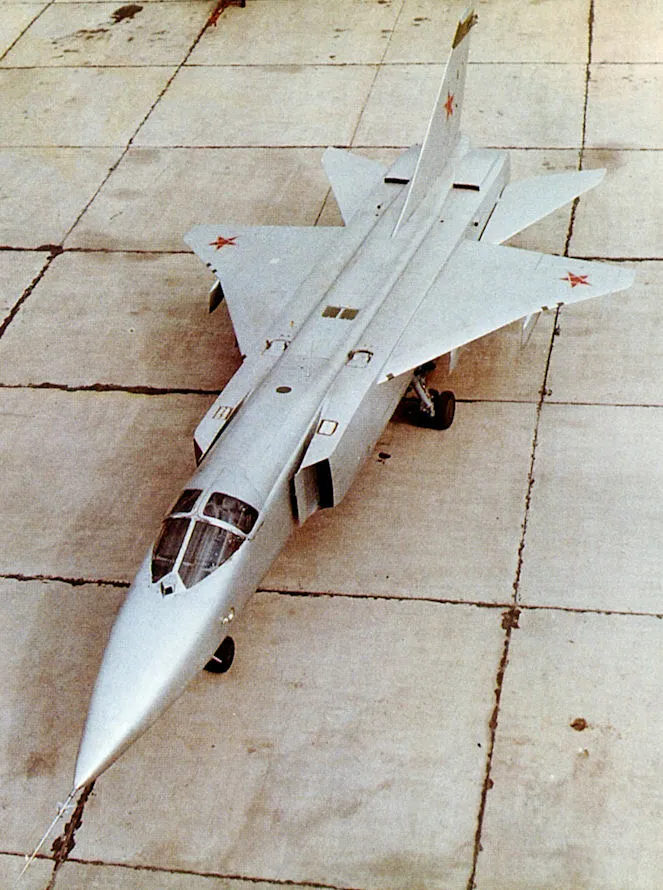

The first prototype of the Soviet experimental vertical/short takeoff and landing aircraft T-6-1 (the prototype of the Su-24 frontline bomber)

The first configuration, the T-6-1, included four RD-36-35 lift engines. The engineering logic was the same: to give the aircraft the ability to take off from damaged airfields while maintaining its speed in normal flight mode. And the impasse was the same: four lift engines took up space needed for equipment and fuel, and a strike aircraft with a comprehensive targeting and navigation system had little spare space.
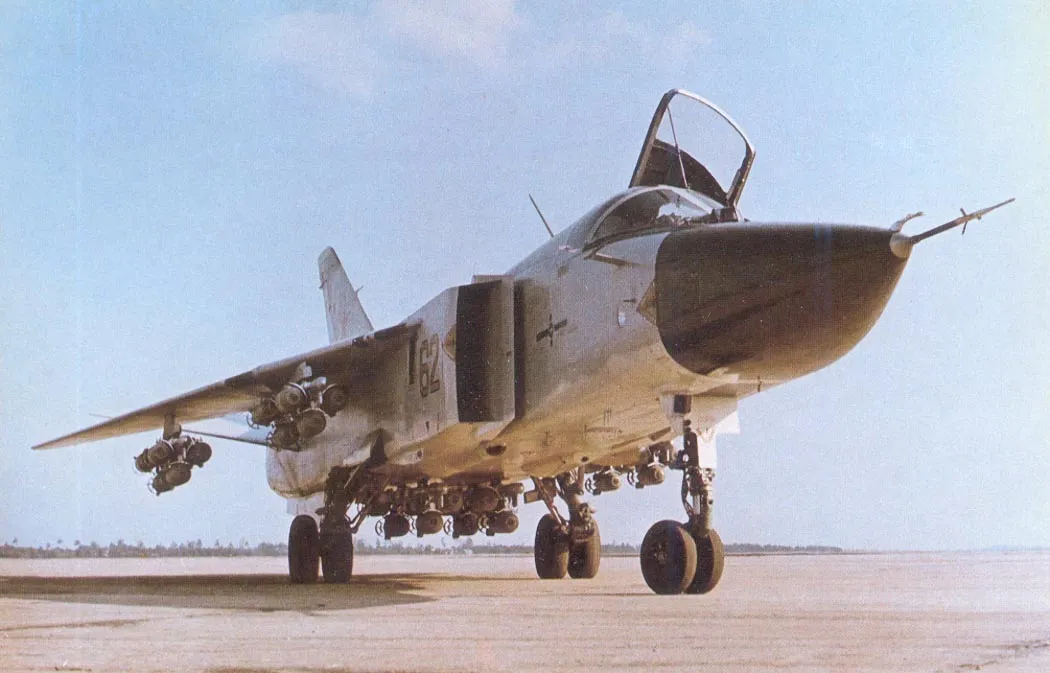

Su-24 (experimental version with variable-sweep wing T6-2I)

The transition to the T-6-2I wasn't a "wing redesign"—it was a change in aerodynamic design. The lift engines disappeared; the aircraft received rotating consoles with four operational positions: 16°, 35°, 45°, and 69°. On January 17, 1970, the T-6-2I took to the air. On February 4, 1975, the Su-24 was accepted into service.

Functionally, the Su-24 was closest to the American F-111—it also had two engines, a crew-on-crew configuration, a control system, and automated low-altitude flight. But the similarities stemmed from identical physical limitations and a similar mission, not from copying.
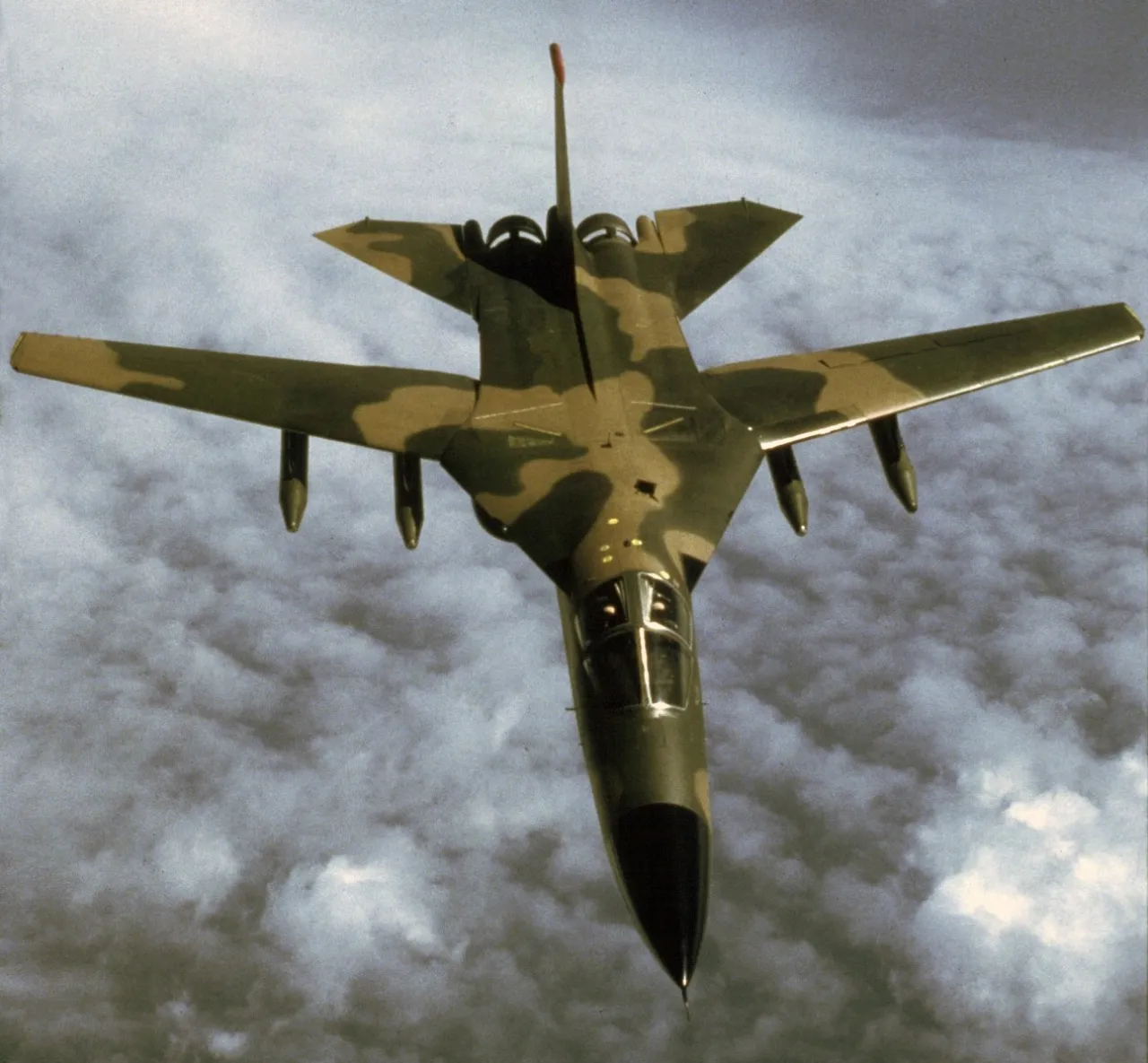

The General Dynamics F-111 Aardvark is an American long-range tactical bomber.

The Su-24's low-altitude breakthrough mission was accomplished not by automatic sweep control, but by automated navigation and terrain tracking. The KIS provided the required operational envelope; the rest was handled by the navigation systems.

General lesson, different cars


The MiG-23 and Su-24 are not structurally related: TsAGI provided the scientific background for both projects, but this did not mean the transfer of the mechanism or layout from one design bureau to the other. The Mikoyan Design Bureau built a fighter with a radar and rockets Air-to-air; Sukhoi Design Bureau – strike bomber with a targeting and navigation system. Different missions, different design bureaus, different configurations.

The common thread wasn't the mechanism, but the lesson. The lift engines didn't lose out because the idea was bad: the Harrier proved the concept's viability in a different architecture. The specific design with separate lift engines, whose cost in normal flight proved too high, lost out. The integrated control system isn't free either: hinges, actuators, synchronization, and a reinforced center section all add up to weight and maintenance. But the rotating console continues to generate lift en route; the lift engine doesn't in level flight.

The MiG-23 has been decommissioned in Russia. The Su-24 suffered significant losses during combat and is gradually being replaced by the Su-34; some aircraft remain in service. The type evolved from the experimental T-6-2I to operational service, retaining its aerodynamic configuration essentially unchanged throughout its career.

On heavy aircraft—the Tu-22M and Tu-160—the same tilt-wing design operates under fundamentally different conditions: different takeoff weights, different ranges, and a different ratio between the efficiency and cost of the airframe. Part three explains why this design has not only been retained but is also used on new and upgraded Tu-160M ​​aircraft.
72 comments
Information
Dear reader, to leave comments on the publication, you must sign in.
  1. + 10
    12 September 2026 05: 51
    Beautiful machine MiG-23.
  2. +6
    12 September 2026 08: 09
    I can't understand on the F-14 and Su-24, when the wing sweep changes, the pylons for hanging weapons always remain parallel to the fuselage?
    If they remain parallel, then by what mechanism is the parallelism of the pylons relative to the fuselage achieved?
    1. +8
      12 September 2026 08: 35
      Quote from: mad-max78
      I can't understand on the F-14 and Su-24, when the wing sweep changes, the pylons for hanging weapons always remain parallel to the fuselage?
      On the Su-24, the main hardpoints are located under the fuselage and on the fixed part of the wing. The moving part of the wing is equipped with movable pylons with a special synchronization mechanism. F-14It seems all the hardpoints are located under the fuselage. In an era when no one was particularly concerned with stealth, no one paid much attention to the hardpoints...
      1. +5
        12 September 2026 13: 03
        Quote: Luminman
        On the F-14, it appears that all of the hardpoints are located under the fuselage.
        It looks like that's the case (outer missiles on the fixed part of the wing)
    2. 0
      13 September 2026 12: 47
      I think the F-14's weapons are mounted on fixed pylons on the center section, like the MiG-23. On the Su-24, they rotate. On the F-111, pylons 3-6 rotate; the rest are for drop tanks.
      1. 0
        13 September 2026 18: 07
        It's scary to even think about the problems the designers and manufacturers had to solve with the rotating pylons. Somehow, I think pilots wouldn't have been too fond of hanging things up there either. After all, you can't jettison the pylon yourself.
  3. +4
    12 September 2026 08: 27
    About why the design has not only been preserved there, but is also used on new and modernized aircraft of the Tu-160M ​​program...
    None of the leading aviation powers have been designing new bombers or new fighters with variable sweep for a long time, but the old bombers are still alive only because they have a large resource.

    Now, in defiance of the variable-sweep wing, new fly-by-wire technologies have emerged, under the sensitive guidance of a computer. This design provides aircraft stability during low-speed flights, and because modern fighters are designed with inherent instability in mind, these fly-by-wire systems must make a large number of micro-adjustments per second to the control surfaces to keep the aircraft flying steadily...

    Thus, by solving aerodynamic problems using computers rather than the previously rudimentary mechanics, designers were able to eliminate heavy, maintenance-intensive wing pivot mechanisms, creating lightweight, maneuverable, and stealthy aircraft. And, more importantly, moving parts incompatible with modern stealth requirements, because all those hinges, seals, and gaps needed to rotate the wing act as reflectors for enemy radar. And finally, the wing sweep mechanism. takes up very valuable internal space, which can be used as a compartment for weapons or fuel. P.S. For a more complete understanding of the process, Google the keywords "EDSU" or, on the bourgeois internet, "FBW"...
    1. +3
      12 September 2026 12: 41
      1. The Tu-160 also has "fly-by-wire" flight control, meaning it has an EFB or FBW system.
      2. No one is designing supersonic bombers now, so there is no need for a CIS.
      3. Do you even understand what an unstable circuit is?
      1. 0
        12 September 2026 15: 46
        Quote: Eugene_4
        1. The Tu-160 also has "fly-by-wire" flight control, meaning it has a fly-by-wire system or FBW.
        I'm well aware of this. What's unclear is why the modernized version of this aircraft, with its advanced fly-by-wire system, needs a variable sweep system, given its weight, dimensions, and the space it takes up...
        Quote: Eugene_4
        2. No one is designing supersonic bombers now, so there is no need for a CIS.
        I'll tell you more - no one has been designing fighters with KIS for a long time now...
        Quote: Eugene_4
        3. Do you even understand what an unstable circuit is?
        I suspect it's much more than yours, because the Tu-160 uses precisely this aerodynamic design that makes the aircraft statically unstable...

        P.S. And finally, I find it difficult to maintain a conversation when people speak to me in that tone—my tongue itches to tell them off. Maybe we should try changing our tone?
        1. +5
          12 September 2026 17: 35
          Quote: Luminman
          It's just unclear why the modernized version of this machine with its advanced fly-by-wire system needs a variable sweep, given its weight, dimensions, and the space it occupies...

          Well, this aircraft, with its maximum takeoff weight, maximum speed, and operational range, despite being equipped with arguably the most powerful engines in the world, has a takeoff thrust-to-weight ratio of about 0,36 (with afterburner). If it doesn't have its 20° sweepback at takeoff, it won't have enough runway space, and no advanced fly-by-wire system, at its maximum takeoff weight, will be able to lift it at 370 km/h (I don't understand how you think a fly-by-wire system can affect lift at insufficient speeds. Stability—yes, but climbing steadily is one thing, falling steadily is another).
          The second issue is the need for variable sweep. If you leave the airframe with a sweep angle of 20, which is necessary for takeoff, you can forget about the Tu-160's combat range—it will simply consume fuel overcoming aerodynamic drag. And supersonic flight is completely out of the question. So, no matter how you modernize the fly-by-wire system, variable geometry is a necessity for this aircraft and its missions.
          Quote: Luminman
          The Tu-160 uses exactly this aerodynamic design, which makes the aircraft statically unstable

          Yes, but it should be added that this glider is statically unstable only in pitch. This was done precisely because of the variable wing geometry; otherwise, at supersonic speeds, the powerful pitching moment would have to be compensated for, leading to increased glider mass and increased aerodynamic drag on the control surfaces at supersonic speeds.
          1. +1
            12 September 2026 17: 48
            Quote: faridg7
            If it doesn't have its 20° sweep at takeoff, it won't have enough runway to take off, and no advanced fly-by-wire system at its maximum takeoff weight will be able to get it into the air at 370 km/h.
            I agree with you. But the Tu-160 was designed in the early 1980s, and all of this was solved by variable geometry. Designing a new aircraft or changing the wing shape, making it fixed, is quite expensive, so they settled on a simple modernization, primarily of the electronics...
            Quote: faridg7
            I don't understand how, in your opinion, the EMF can affect lift at insufficient speeds.
            I've already answered this question below—due to precise control of the elevators, multi-slotted flaps, and four-section slats, where there's plenty of room for the fly-by-wire system to operate. This is precisely the kind of precision control that a pilot simply can't achieve. But in the case of the Tu-160, due to the inherent design features, this isn't possible. It helps, yes, but it doesn't solve the problem...
            1. +3
              12 September 2026 17: 58
              Quote: Luminman
              I've already answered this question below—due to precise control of the elevators, multi-slotted flaps, and four-section slats, where there's plenty of room for the fly-by-wire system to operate. This is precisely the kind of precision control that a pilot can't achieve. But in the case of the Tu-160, due to the specifics of its design, this isn't possible. It helps, yes, but it doesn't solve the problem.

              You talk about developing wing high-lift devices to increase lift and control them to maintain stability, but you forget that with the development of wing high-lift devices, their aerodynamic drag increases. The aircraft's thrust-to-weight ratio simply won't allow for any fuss with the high-lift devices. With a takeoff weight of 250 tons, it already requires at least 2,5 kilometers of runway.
            2. 0
              12 September 2026 23: 03
              1. Excuse me, but where are the elevators on the Tu-160?
              If it has a full-rotation stabilizer!
              2. The EBS does not control the wing mechanization. This is a different system.
            3. 0
              13 September 2026 17: 02
              In addition, the Tu-160 was designed with the B-1 in mind.
              Yes, and not long ago, the Americans weren't hiding the fact that when they discussed shutting down the B-1 program, they didn't do it for one reason: they said we'd already built the plane, and now the Russians would start doing the same and spend a lot of money.
        2. 0
          12 September 2026 23: 20
          1. Because the aircraft is multi-mode. It has a wide range of speeds.
          2. New generation bombers B-21 or our Izd-80 have subsonic speeds. They do not require a control system.
          3. No, you don’t understand.
          The Tu-160 has a classic, stable design.
          The center of pressure is located behind the center of gravity. Such a stable aerodynamic design balances itself.
          Here, on fighters like the Su-27 and MiG-29, the design is unstable. The center of gravity is located behind the center of pressure.
          4. You may be an expert, but your expertise on the Tu-160 is weak. Sorry.
          1. +1
            13 September 2026 06: 07
            Quote: Eugene_4
            1. Excuse me, but where are the elevators on the Tu-160?
            If it has a full-rotation stabilizer!
            The all-moving stabilizer performs the same tasks as the elevator, only at supersonic speeds, controlling both pitch and roll...
            2. The EBS does not control the wing mechanization. This is a different system.
            The EDSU also includes flap control, processing the pilot's commands and calculating the required flap section deflection angles...
            Quote: Eugene_4
            The Tu-160 has a classic, stable design.
            The center of pressure is located behind the center of gravity. Such a stable aerodynamic design balances itself.
            It's exactly the opposite! This is an unstable configuration (in pitch) precisely because of the center of pressure, and without pilot intervention (assisted by the fly-by-wire system), the aircraft tends to nose-dive or nose-up...
            Quote: Eugene_4
            But your expertise on the Tu-160 is weak.
            From everything you have written, I suggest you take up agriculture.Perhaps things will go better for you there. I'm not interested in you as an interlocutor, and I'm ending the discussion (if that's what it's called) with you...
            1. 0
              13 September 2026 07: 43
              Pardon the intrusion. Could you please clarify whether the aerodynamic focal point ("center of pressure") is located behind the center of mass?
              1. 0
                13 September 2026 15: 11
                Yes, on the right.
                The stable design creates a pitching moment. To compensate for this moment, the stabilizer creates a pitching moment. That is, the leading edge of the stabilizer points "down." The stabilizer has a negative pitch angle.
                1. 0
                  14 September 2026 11: 32
                  Thank you, but the question wasn't addressed to you. And judging by the response below, this discussion needs to be closed.
              2. 0
                13 September 2026 16: 50
                In a stable configuration, it's in front of the CM, in an unstable configuration, it's behind the CM. In a stable configuration, the horizontal tail creates negative lift, in an unstable configuration, it creates positive lift. And there's also a canard configuration. And so on and so forth.
                1. +1
                  13 September 2026 17: 27
                  On the contrary.
                  You are confused.
                  1. -1
                    13 September 2026 17: 28
                    Draw the forces on a piece of paper. The center of gravity is the axis around which the plane must be balanced.
                    1. +2
                      13 September 2026 17: 35
                      I'm not even going to draw it. It's good that I can just take a ready-made one.
                      If you look at the diagram, the center of pressure is behind the CM.
                      This scheme is stable.
                      Having balanced the aircraft in the longitudinal channel, the aircraft will tend to return to its original position in response to the pilot's pitch disturbance.
                      1. 0
                        13 September 2026 17: 40
                        I reread it. I'm completely confused. I think one thing, but write another. I don't even understand why. It's just ingrained in my head.
                        It happens.
                      2. +1
                        13 September 2026 17: 46
                        Exactly.
                        And they added a minus on top of that:-)
                        That's why I'm writing that the Tu-160 has a stable design at subsonic speeds.
                        Moreover, if the fly-by-wire control system fails, on the emergency mechanical control channel, when the pilot directly controls the stabilizer, the aircraft barely flies.
                      3. +1
                        13 September 2026 17: 48
                        I don't downvote anyone I'm talking to. Until they start being malicious. I'll upvote them now to balance things out.
                        I didn’t notice any minuses, so I gave it 2 pluses)).
                      4. 0
                        13 September 2026 17: 52
                        The most interesting thing is that I was going to draw both diagrams on paper, take a photo, and send them. But I would have drawn them correctly.
                      5. 0
                        13 September 2026 17: 52
                        Do you know how the fly-by-wire system works on Tupolevs?
                      6. 0
                        13 September 2026 18: 02
                        In this case, I don't know at all. Yeah, and if you have specific systems, you have to be an expert on them to know anything for sure. Well, there are a ton of sensors and systems. Based on their readings, the system makes a decision on surface interactions. On Sukhois, it's even more complex. The stabilizers rotate separately there, and then there's the horizontal stabilizer. So, think about what the system is deciding. And then there are the flaperons... I'm looking at the Su-57. There, the bulge tips are aerodynamic surfaces. The new F-15 has deflectable air intakes. Too many things. Let's just say it's there and it works. Satan.
                        And, to be honest, I'm not that interested in the Tu-160. I'm interested in planes that I can see "undressed." Seeing the insides gives me more food for thought.
                2. 0
                  14 September 2026 11: 30
                  "On a stable scheme in front of the central master, on an unstable one behind the central master." Exactly the opposite! I will no longer engage in this discussion. Please refrain from such scribbling!
                  1. 0
                    14 September 2026 14: 41
                    Read the correspondence. I admitted my mistake. I just made a 180-degree mistake.
            2. 0
              13 September 2026 15: 04
              1. In your words - "due to precise control of the elevators."
              That's where you screwed up too. Because you don't know the technical details. You should have just written down that the 70 has a stabilizer.
              Next.
              In your words: "The all-moving stabilizer performs the same tasks as the elevator, only at supersonic speeds, controlling both pitch and roll..."
              Excuse me, but how does this stabilizer control the roll? :-)
              After all, the right and left consoles are rigidly connected to each other, in the area of ​​the zero rib!
              Next.
              And not a word from you that the stabilizer performs longitudinal balancing...
              2. I deliberately wrote to you with a trick, saying that the fly-by-wire system doesn't control the mechanization. I thought you'd correct me. Remember the spoilers and flaperons:-) Which are also related to the mechanization.
              The flaps and slats are controlled by the QMS using signals from the ABSU. There's no need for any kind of EFB, as the flaps are controlled by a hydraulic motor that transmits torque to the transmission lines. That's what the QMS is for.
              3.Again.
              The Tu-160 has a classic stable aerodynamic design. The center of pressure is located behind the center of gravity. The aircraft balances itself in the longitudinal control channel. This is a stable design.

              Output.
              You are clearly floating around with the design of the Tu-160.
              Study the aircraft's technical details.
              1. +1
                13 September 2026 15: 12
                The stable design creates a pitching moment. To compensate for this moment, the stabilizer creates a pitching moment. That is, the leading edge of the stabilizer points "down." The stabilizer has a negative pitch angle.
            3. +1
              13 September 2026 17: 31
              I suggest you do it.
              And don't write nonsense.
              The stabilizer works according to roll on the Tu-160. This is a real gem from you.
      2. 0
        13 September 2026 16: 47
        Interesting. What does point 3 have to do with this?
        The fact that the plane's focus changes with the CIS? This is a case of evil being presented as virtue.
        1. +2
          13 September 2026 17: 19
          So, comrade, who is luminman, is foaming at the mouth, proving that the plane has an unstable design.
          But the comrade is mistaken. The Tu-160's stabilizer creates a pitching moment to compensate for the nose-down moment caused by forces when the center of pressure is behind the center of gravity.
          This is the sign of a stable scheme.
      3. 0
        13 September 2026 16: 54
        I'm no expert on the Tu-160, but I think building a bomber with an unstable design is a bit odd. And the presence of a control system is, ultimately, just a convenience.
    2. +2
      12 September 2026 15: 49
      Quote: Luminman
      About why the design has not only been preserved there, but is also used on new and modernized aircraft of the Tu-160M ​​program...
      None of the leading aviation powers have been designing new bombers or new fighters with variable sweep for a long time, but the old bombers are still alive only because they have a large resource.

      Now, in defiance of the variable-sweep wing, new fly-by-wire technologies have emerged, under the sensitive guidance of a computer. This design provides aircraft stability during low-speed flights, and because modern fighters are designed with inherent instability in mind, these fly-by-wire systems must make a large number of micro-adjustments per second to the control surfaces to keep the aircraft flying steadily...

      Thus, by solving aerodynamic problems using computers rather than the previously rudimentary mechanics, designers were able to eliminate heavy, maintenance-intensive wing pivot mechanisms, creating lightweight, maneuverable, and stealthy aircraft. And, more importantly, moving parts incompatible with modern stealth requirements, because all those hinges, seals, and gaps needed to rotate the wing act as reflectors for enemy radar. And finally, the wing sweep mechanism. takes up very valuable internal space, which can be used as a compartment for weapons or fuel. P.S. For a more complete understanding of the process, Google the keywords "EDSU" or, on the bourgeois internet, "FBW"...

      Well, the fact that the EBD and the abandonment of variable geometry improved the aircraft's performance is debatable.
      Take the American B-1B and B-2.
      The empty weight of the aircraft is 86 tons and 73 tons. The latter is almost 6 tons lighter.
      The takeoff weight is 216 tons and the B-1B 152 tons, meaning the B-1B can lift 60 tons more. The corresponding payload weights are 56 tons and 27 tons, meaning the aircraft, thanks to its variable geometry (both aircraft have fly-by-wire systems), can lift twice the payload and carry more fuel, despite having virtually the same structural weight.
      And also, I almost forgot - the cruising speed for the B-1B is 0.95 Mach, while for the B-2 it is maximum.
      1. +2
        12 September 2026 17: 32
        Quote: faridg7
        Well, the fact that the EBS and the abandonment of variable geometry improved the aircraft's performance is debatable.
        The main characteristics are none. However, the fly-by-wire system compensates for the shortcomings of an unstable aerodynamic design, ensuring stable and maneuverable control of the aircraft. The fly-by-wire system allows for a more precise response of the wing's high-lift devices, significantly improving its performance. It's a bit of a stretch, but it can be considered a type of variable geometry, only in this specific case it's a variable wing angle (if we're talking about multi-slotted flaps and four-section slats, then there's a whole new field for fly-by-wire systems).
        Quote: faridg7
        Take the American B-1B and B-2
        Well, these are completely different machines, built to perform completely different tasks, and the differences between them are due to design philosophy and compromises regarding stealth and payload. Now, a machine like this B-1B No one built it because the speed advantage today is not as great as it was in the 1970s and 1980s. The same can be said about In-2, since it's possible to launch a missile from a safe distance, without entering the enemy's air defense zone, without any invisible gadgets (I'm not talking about stupid bombing - that's long since become a thing of the past)...
        1. 0
          13 September 2026 07: 50
          I don't understand at all how the fly-by-wire system is connected to the "unstable aerodynamic design"! One doesn't imply the other. Even with the fly-by-wire system failing, the Su-27, which was undoubtedly unstable in its roll channel, remained perfectly controllable.
          1. 0
            13 September 2026 16: 59
            An unstable aircraft is extremely difficult to control manually, if at all possible. On Sukhoi jets, a failure of the control system means ejection and the plane will crash. It's hard to find footage of Sukhoi jets without canards these days. But with canards, it's perfectly clear that they're simply flapping their canards in flight.
            1. 0
              14 September 2026 11: 38
              There have been failures. There have been quite successful landings with a failed fly-by-wire system. And by the way, the helicopter is unstable in all directions.
          2. 0
            14 September 2026 14: 42
            Su-30s with PGOs have crashed. Apparently, things are much more complicated there.
    3. +2
      12 September 2026 19: 18
      Quote: Luminman
      Thus, by solving aerodynamic problems with the help of a computer, rather than the blunt mechanics that had been used previously, designers were able to abandon heavy, maintenance-intensive wing rotating mechanisms, and began to create light, maneuverable, and stealthy machines.
      Here you are right
      Now, in defiance of the variable-sweep wing, new fly-by-wire technologies have emerged, under the sensitive guidance of a computer. This design ensures aircraft stability during low-speed flight.
      But not here.
      Sweepback wasn't used to ensure stability. But the problem was indeed solved with the help of computers—they calculated the integrated center section, and variable wing geometry became obsolete.
      1. +2
        13 September 2026 06: 00
        Quote: bk0010
        The sweep was not used to provide stability.
        The fly-by-wire system ensures stability. I never said that wing sweep can provide stability to an aircraft...
      2. 0
        13 September 2026 07: 51
        "Variable wing geometry is no longer relevant." It depends on the tasks.
    4. +2
      12 September 2026 21: 39
      You're mistaken. The KIS is a crutch for multi-mode aircraft with a low relative thrust-to-weight ratio, and the longitudinal stability margin has nothing to do with it.
      In fighter aircraft, the KIS disappeared primarily due to new, more powerful and fuel-efficient engines, which provided high thrust-to-weight ratios (up to 12000 ...
      1. +1
        13 September 2026 06: 03
        Quote: srelock
        The KIS disappeared from fighter aircraft, first of all, thanks to new, more powerful and economical engines, which provided a high (up to one and more) thrust-to-weight ratio
        The KIS system left fighter aircraft due to the developers' love for the delta-wing shape and the more advanced EDSU system from the early 1990s...
        1. 0
          13 September 2026 07: 53
          Sorry, this is some kind of gibberish.
        2. +1
          13 September 2026 14: 55
          The wing type and the introduction of a fly-by-wire system have no effect on the flight characteristics or subsonic cruise capability. That's your mistake.
          They depend only on the ratio of the overall quality of the aircraft and the thrust in these modes.
  4. +2
    12 September 2026 11: 04
    The latest modifications of the MiG-23 had an air-to-air combat mode at a sweep angle of 35 degrees, which provided greater maneuverability.
    The T-6 was also offered to the military as an interceptor. Some of the intended characteristics were unnecessary for a strike aircraft and were not achieved during testing and operation.
    1. +4
      12 September 2026 11: 25
      Regarding the 23-18, that's not quite true. The switch still had three positions. But the pilot could set the handle to an intermediate position. This was officially banned fairly quickly, but some pilots used it. However, they sometimes used it on earlier models, starting with the 23-11M.
      1. +4
        12 September 2026 12: 57
        You can't trust anything in this world))))

        The choice of a specific mode depended on the nature of the battle, the speed and the required maneuver.
        1. 33° Position – Combat Maneuvering (only on the MiG-23MLD) This position was the main innovation of the final modification of the MLD. The designers added it specifically to improve performance in close-in maneuverable air combat (CAC) against American fourth-generation fighters (F-15 and F-16).
        When it was used: In close-range horizontal and vertical dogfights at low and medium speeds. What it provided: The maximum possible turn rate for the MiG-23 and a minimal turn radius. Combined with the vortex-generating "fangs" on the center section (a feature of the MLD), this position significantly increased the aircraft's stability at critical angles of attack, protecting it from a spin.
        Limitation: Increased drag at high speeds.
        2. Position 45° - Universal air combat.
        The classic maneuvering position, present on all versions of the MiG-23. On the ML and MLA modifications, it remained the only one used during combat at medium and high speeds (transonic), as well as during interception and dynamic pursuit.
        What it provided: An optimal balance between aerodynamic efficiency, maneuverability, and acceleration. It allowed for the efficient storage and retention of kinetic energy in combat.
        1. +3
          12 September 2026 13: 14
          They introduced it, and they removed it. There were several cases of people leaving the control room, and the management (I don't know who exactly) decided it was easier to ban it than to investigate. Moreover, an air traffic control manual in Polish was posted online, which mentioned a wing-mounted airborne device (WVB) on wing 16. Although pilots wrote that this was possible within a very narrow range of altitudes and speeds and at the limits of the pilot's ergonomic capabilities. Simply put, if you overtighten it even slightly, you'll spin.
          By the way, the speed of the transfer was, if sclerosis does not change, 4 degrees/sec and the permissible overload was limited.
  5. 0
    12 September 2026 17: 31
    Let's compare the Su-24 and Mirage-4 bombers with approximately the same weight and dimensions:
    Su-24:
    Empty weight: 21200 kg
    Curb weight: 22300 kg
    Normal takeoff weight: 32 300 kg
    Maximum takeoff weight: 39700 kg
    Mirage-4:
    Weight empty: 14 500 kg
    Weight normal takeoff: 31 600 kg
    Maximum takeoff weight: 33 475 kg
    Landing speed:
    Su-24 285-310 km/h
    Mirage-4 260 km/h
    the run length:
    Su-24 1150-1250 m (at normal takeoff weight)
    Mirage-4 1700 m (at maximum takeoff weight)
    path length:
    Su-24 950-1000 m (at normal takeoff weight and with a brake parachute)
    Mirage-4 700 m (at maximum landing weight)
    Combat radius:
    Su-24 560 km (at an altitude of 200 m with drop tanks and normal combat load)
    Mirage-4 1240 km
    Service ceiling:
    Su-24 - 11,000 m
    Mirage-4 - 18,000 m
    Maximum speed:
    Su-24 - 1700 km/h (M=1,6)
    Mirage-4 - 2350 km/h (M=2,2)
    It turns out that the Mirage-4, with its tailless aerodynamic design, has better characteristics in all respects except takeoff length, plus its empty weight is as much as 7 tons less!
    1. 0
      12 September 2026 18: 02
      The Su-24's flight and tactical characteristics don't match what you've stated. I can't say anything about the Mirage, I just have a vague idea. The problem is that all this publicly available data on these aircraft isn't accurate; it's simply being deliberately distorted. The Su-24 never had such a service ceiling; at 6000 meters, it starts to shake slightly, and at 7000 meters, it starts to nosedive; it's best not to fly higher. The combat radius is also stated to be too large; with a payload and at an altitude of 200 meters, it's about 200 km.
      1. 0
        12 September 2026 19: 03
        Well, excuse me, I got the data from airwar.ru - I haven't had the chance to fly on either one.
        1. +1
          12 September 2026 19: 10
          There's no need to apologize, it's just that all these characteristics and figures are completely inflated. Both ours and theirs.
    2. +1
      12 September 2026 22: 57
      The Mirage IV should be compared more closely to the FB-111 or Tu-22M—they're not tactical bombers. The Tornado is the closest thing to the Su-24.
      The Su-24 was designed for Mach 2,2, but in reality, it flew no faster than Mach 1,4. The military failed to improve its performance to meet all the technical specifications.
      There was a Su-24 project with a letter (I don’t remember which one), which was close to the FB-111, but it didn’t work out.
      1. 0
        13 September 2026 13: 03
        The Mirage IV should rather be compared with the FB-111 or Tu-22M - these are not tactical bombers.

        We called the Mirage-4 and FB-111 strategic bombers so as not to embarrass ourselves by comparing them to the Su-24. But they're simply nuclear-capable bombers, in the same class as the Su-24: all three have identical weight and dimensions. Comparing the Mirage-4, with its maximum takeoff weight of 33,475 kg, to the Tu-22M3, with its 126,000 kg, seems somehow wrong. Unless we admit that Tupolev had to make it much larger and four times heavier to achieve the Mirage-4's performance!
        1. +1
          13 September 2026 13: 15
          Essentially, that's true: they're in the same range. But the Americans themselves considered the FB-111A (not the F-111) a medium-range strategic bomber; it was stationed in SAC.
          The Mirage IV was also considered a strategist, albeit according to French standards.
    3. 0
      13 September 2026 17: 20
      The tailless design is considered the most perfect. But it has plenty of other problems. The French spent a long time trying to figure it out. They tried and tried, and eventually gave up. Or maybe some old man died.
      1. 0
        13 September 2026 20: 30
        Oh, come on! The Swedes got the Draken right the first time, the Americans the F-102, F-106, B-58, Valkyrie, and SR-71, the British the Vulcan, and the USSR the T-4, MiG-21 "Analog," and Tu-144. While this design is problematic for a fighter, it's practically ideal for a bomber or reconnaissance aircraft.
        1. +1
          14 September 2026 00: 46
          Both SAAB and Convair initially played with prototype aircraft.
          The Tu-144 was eventually converted into a canard, like the T-100, to simplify control during takeoff and landing.
          The Tu-144's analogue could have become a good attack aircraft, but the MiG-23B won.
          And we must not forget that the West inherited all of Lippisch's research on tailless animals, as did Lippisch himself.
        2. 0
          14 September 2026 02: 57
          They worked. Sort of. But there's been zero development. And the standard negative-lift stabilizer design continues to be widely used.
  6. 0
    12 September 2026 17: 51
    I don't understand what losses the Su-24 suffered. If you build the tactics of use correctly, there shouldn't be any losses. But if you fly over Ukraine in search of targets, then it's suicide. The Su-24M with Hephaestus showed itself perfectly in Syria and in Ukraine it could easily overcome air defenses during WWI in automatic mode. There, the navigator has to enter the route, and the pilot only has to press the button - launch. This is nonsense, not an article, but I gave it a plus. am
    And I read that in Syria, Fu-15s tried to chase MiG-23Ms, but their wings only flapped from the vibration during WWI, while our Falcon easily evaded them at supersonic speeds at low altitude. And the topic of the 23 and 27Ms was in vain closed, there is a serious shortage of them now, there is no mass-produced single-engine aircraft. am
    1. 0
      12 September 2026 19: 16
      I gave you a thumbs up, no offense intended, but your comment is completely absurd... the navigator should have entered the route... In short, checkmate and queens, and I broke through the air defense in automatic mode during WWI.
      1. -1
        12 September 2026 19: 55
        Are you a pilot? I'm lucky to be one, and I don't care about your +, I feel bad for the country. am
    2. 0
      12 September 2026 21: 14
      If the Aerospace Forces had been used effectively, Ukraine's air defense and air force should have ceased to exist, as in Iraq or Venezuela, for example. But the lessons of the war with Georgia were not learned and instead they decided to conduct a police operation with the same outcome.

      With Western assistance, Ukraine has equipped its air defense systems with MANPADS and short-range SAM systems, linking them all via a single information network, ensuring relatively high-quality protection against targets at extremely low altitudes.
  7. +1
    12 September 2026 19: 19
    The Harrier proved the concept's viability in a different architecture.
    The Harrier showed that this shouldn't be done: it turns out poorly.
  8. 0
    13 September 2026 12: 36
    Eldorado Canyon showed what the F-111 was capable of. The Su-24 couldn't handle it.
  9. 0
    14 September 2026 13: 42
    Why not the Tu-22, Tu-160? They also solved different problems.