The Origins of the Soviet Tilt-Wing: From the Bell X-5 to the Su-7IG
10 953 66
The Origins of the Soviet Tilt-Wing: From the Bell X-5 to the Su-7IG
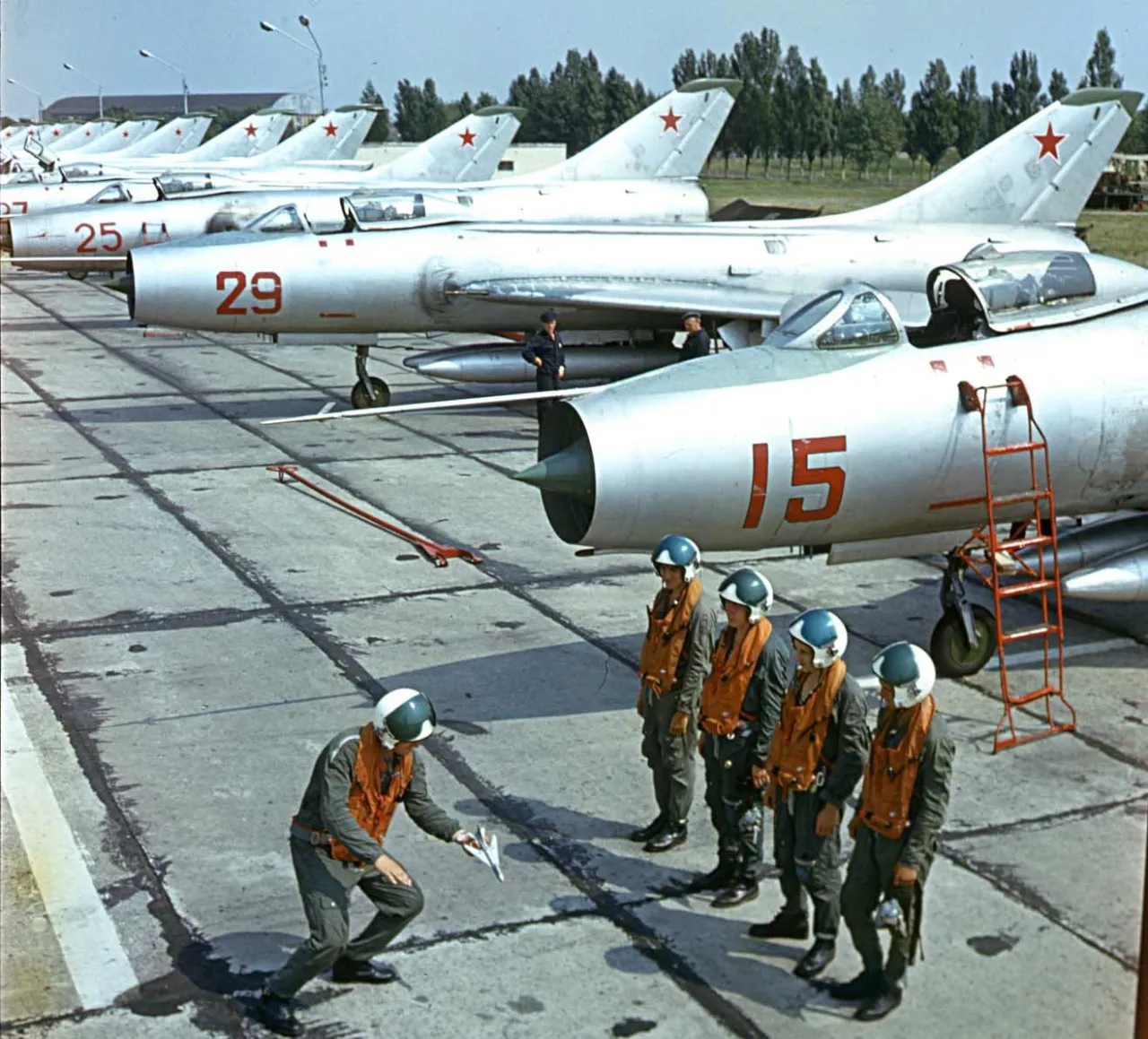
Soviet Su-7BM fighter-bombers parked at an airfield, while pilots practice the "foot-to-fly" maneuver.


Test pilot Sergei Ilyushin took to the skies a machine that would usher in the Soviet era of variable-sweep wings. The S-22I, or Su-7IG, looked almost like the familiar Su-7B frontline fighter-bomber, but its wing could do something no other Soviet combat aircraft had ever done: change its sweep in flight. A fixed, highly swept wing offered advantages at high speeds, but compromised takeoff, landing, and maneuverability at low speeds. A rotating wing allowed for fast flight and short landings—if it could be made light and reliable enough.


The Bell X-5 and the American School: Why the Wing Can't Move Forward and Backward


The American experimental Bell X-5 was the first to demonstrate the possibility of changing sweep in flight. In the early 1950s, it varied the wing angle between 20 and 60 degrees—while also moving it along the fuselage. NASA notes that changing the sweep shifted the center of pressure and center of gravity, so the entire wing assembly simultaneously moved forward along its guides to maintain stability.
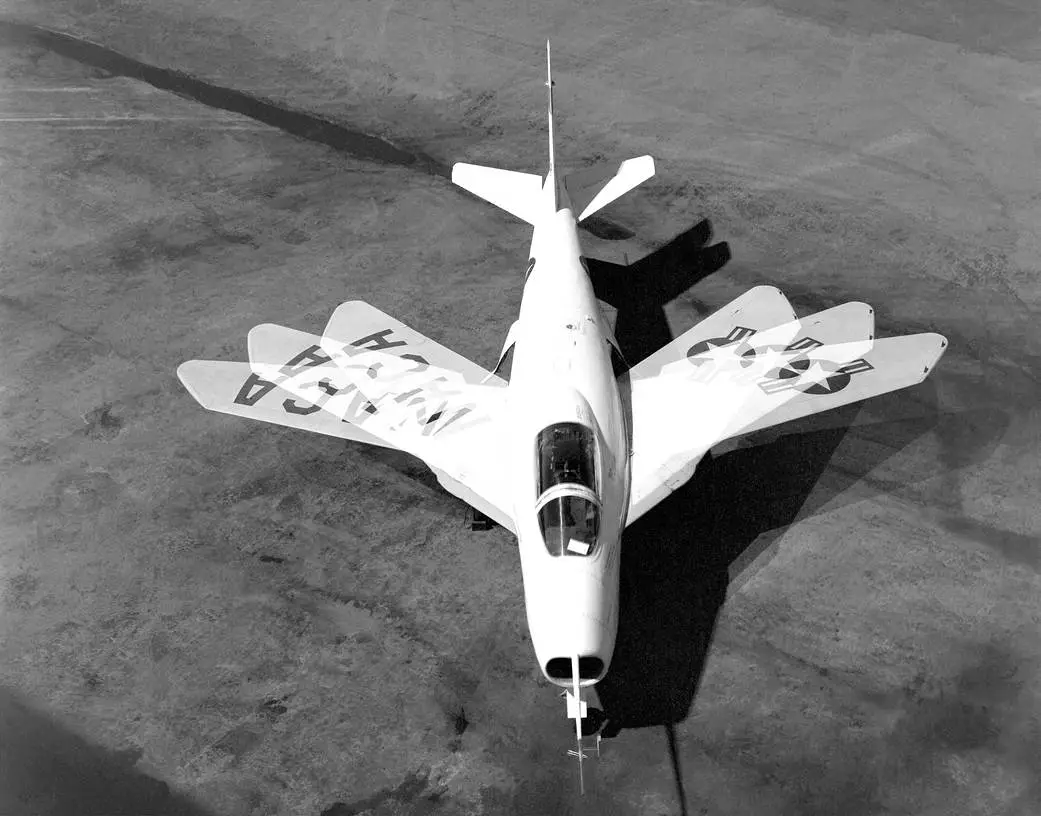

A multiple display of the American experimental aircraft Bell X-5, illustrating its ability to change wing sweep in flight.

The X-5 mechanism confirmed that the aircraft's performance did indeed change—drag was reduced, and handling improved in various flight modes. However, the design itself proved impractical: moving the entire wing forward and backward was technically difficult, heavy, and unreliable. NASA also recorded that the aircraft could not land safely at sweep angles exceeding 40 degrees.

The solution came from research NACABy moving the hinges outward from the fuselage, the wing doesn't need to move longitudinally—only the outer panels rotate, while the central section remains stationary. This became the basis for many subsequent practical variable-sweep aircraft, including Soviet ones.
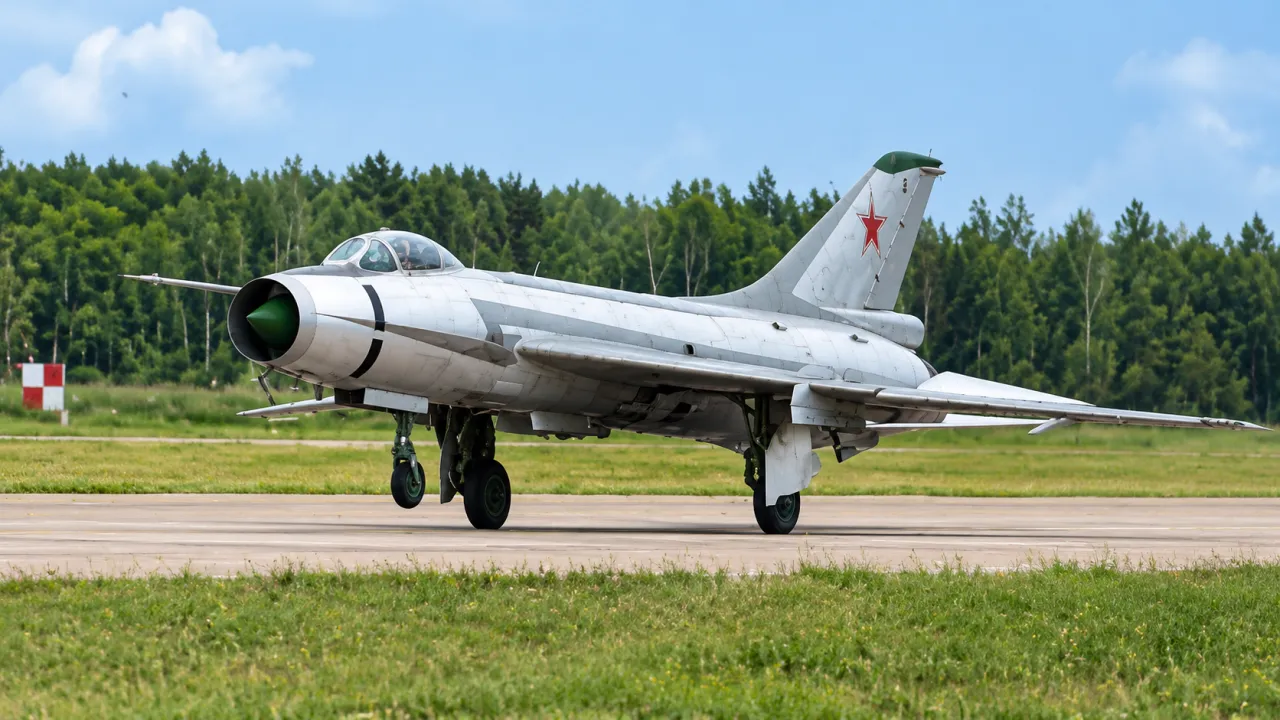

Soviet experimental aircraft S-22I

The Su-7B's problem and the Sukhoi Design Bureau's solution: rotating part of the wing


By the mid-1960s, the Su-7B frontline fighter-bomber was in service, but its highly swept wing created an unsatisfactory balance. While it achieved high-speed flight, its takeoff run was long, landing speed high, and range and payload limited. Building a new aircraft would be time-consuming and risky. Pavel Sukhoi's design bureau chose a different approach: retaining the basic aircraft and making only the outer wing sections pivotable.

Thus, the S-22I, or Su-7IG, was born. The "I" stood for "variable geometry." Nikolai Zyrin led the development; the work was carried out jointly with TsAGI. From the basic Su-7B, the new aircraft inherited the fuselage, powerplant, a significant number of systems, fixed wing roots, and the layout of the main landing gear. New features included the external rotating consoles, hinges and power units, the synchronizing shaft, and modified mechanization.

Approximately two-thirds of the wingspan—the portions located behind the main landing gear—rotated. The range was from 30 to 63 degrees along the leading edge. Why not the entire wing? The main landing gear was attached to a fixed root section; if the entire wing had rotated, the landing gear would have had to be relocated, which would have meant a complete redesign of the fuselage structure. Partial rotation reduced the movement of the aerodynamic center and allowed the proven design of the donor aircraft to be preserved.

On August 2, 1966, test pilot Sergei Ilyushin, the son of the famous aviation The designer lifted the S-22I into the air. The aircraft became the first Soviet aircraft with a variable wing sweep in flight. In November 1967, the decision was made to develop a production version, designated the Su-17.

Su-17: Serial development of modernization logic


The experimental S-32-1 first flew on July 1, 1969. Serial production began in 1970 at the Komsomolsk-on-Amur plant and continued until 1990. The Su-17 retained a sweep range of 30–63 degrees, a partially pivoting wing design, and production continuity with the Su-7B.
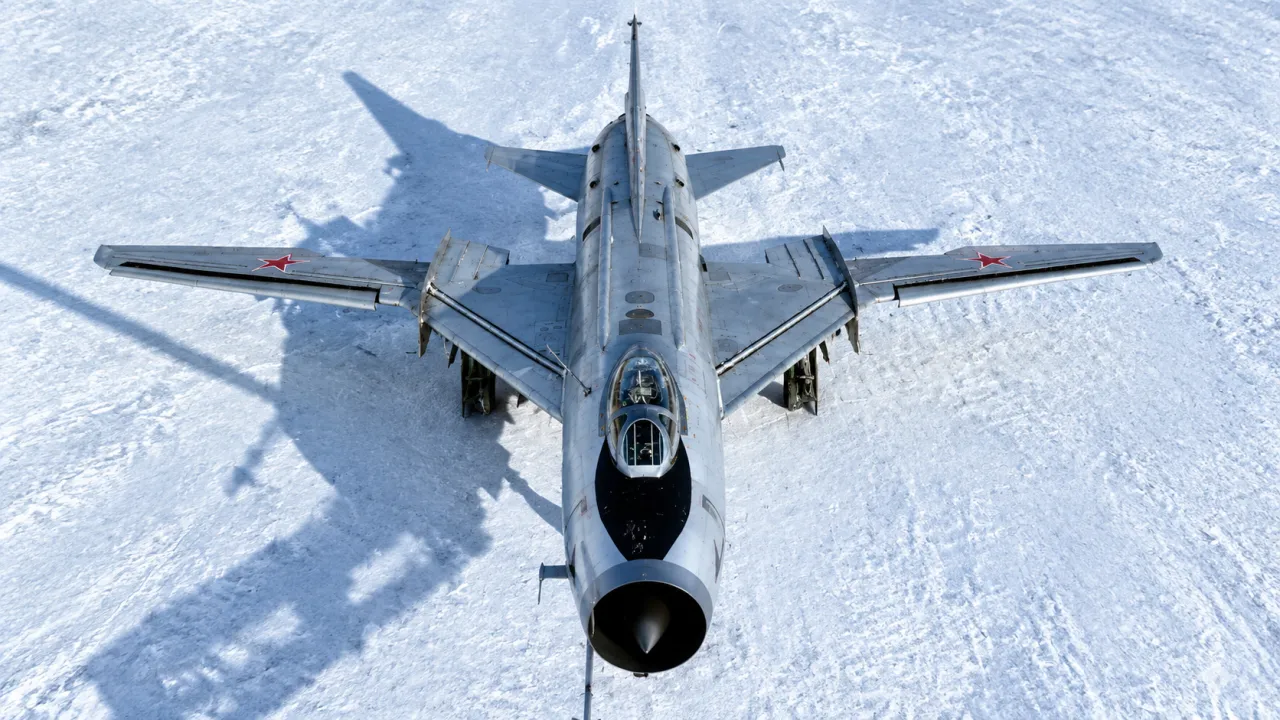

Soviet fighter-bomber Su-17

Sources cite production figures ranging from 1200 (the museum's data on the basic Su-17) to 2867 aircraft (the entire family, including the export Su-20 and Su-22); there are no publicly available factory statistics. The series evolved sequentially—Su-17M, M2, M3, M4—with changes to the engine, avionics, nose, and armament, but retaining the basic wing configuration.

The partially pivoting wing proved to be a production-friendly solution, but an aerodynamic compromise. The fixed root restricted flow, a stepped geometry emerged, and the potential for further increases in payload and volume was limited by the original Su-7 fuselage. But it was the S-22I that paved the way, proving that Soviet industry could create a wing that could adapt to the task at hand while in the air.

Serial production ended in 1990. Russia decommissioned the type; Poland conducted a farewell flight in September 2025—one of the last in Europe. The partially tilting wing survived for two decades—not because it was perfect, but because the design proved viable.

By the late 1960s, the Mikoyan Design Bureau was already building aircraft with fully articulated wings. On June 10, 1967—ten months after the S-22I—the experimental MiG-23 "23-11" took to the air. Unlike the Su-17, its wing articulated entirely, and the aircraft itself was created not as a modernization, but as a response to a different requirement—a multi-mode frontline fighter with radar and rockets air-to-air class. More on that in part two: How Mikoyan and Sukhoi Design Bureaus Achieved Variable-Sweep Wings.
66 comments
Information
Dear reader, to leave comments on the publication, you must sign in.
  1. +8
    8 September 2026 06: 56
    Variable geometry wings were just a fad in the 1960s, but they never lived up to their promise due to the heavy and complex drive mechanism. And no matter what the aerodynamic improvements, such wings never justified the increase in weight.Moreover, variable wing sweep is only justified if the aircraft will be flying at both subsonic and supersonic speeds for extended periods, but experience has shown that most of the flight time spent at supersonic speeds is much shorter than expected. Furthermore, variable-sweep wings also limit the ability to carry external weapons...

    A variable-geometry wing is certainly an interesting engineering solution, making it a valuable asset for any design bureau, but I can't imagine why the Soviet Air Force, based at conventional airfields, needed such complex aircraft. Carrier-based aircraft, where runway space is significantly limited, are a different matter. I'm talking about the American F-14, which had variable geometry wings, which allowed them to get a good carrier-based fighter capable of close combat, having a decent top speed with a relative range...
    1. +6
      8 September 2026 07: 14
      Apparently, it was necessary to go through this path too.
    2. + 11
      8 September 2026 07: 30
      Quote: Luminman
      I can't imagine why the Soviet Air Force, based at classic airfields, needed such complex machines.

      Various options were explored. The engineering school must not stand still.
      The article mentions that the Su-7B had a long takeoff roll and high landing speed, and with variable sweep, both the takeoff roll and landing speed were reduced. Not all airfields had long runways at the time. What if an Su-7B pilot needed to make an emergency landing on a short runway?
      And finally, the Soviet aviation school was constantly evolving. Therefore, the USSR had a wide variety of aircraft, both civilian and military, for various purposes.
      1. +3
        8 September 2026 10: 27
        Quote: your vsr 66-67
        The article mentions that the SU-7B had a long takeoff run and a high landing speed.
        The design complexity and weight completely negate any advantages of a variable-geometry wing. Consider how heavily loaded components like the wing root are, and then add to that all sorts of electrical and hydromechanical components. And let's not forget the suspension...
        Quote: your vsr 66-67
        Various options were being developed. The Soviet aviation school did not stand still.
        I agree with this...
        1. +4
          8 September 2026 11: 27
          They said that a state prize was awarded for the landing gear release/retraction system on the MiG-23.
          The factory struggled with these wings: deformations after welding, cracks during operation. The service life of the consoles. It was a fine act of sabotage against the people of the USSR.
          How many types of aircraft: The US has the F-111, F-14, B-1. The USSR has the Su-17/22, MiG-23/27, Tu-160, Su-24. Europe has the Tornado. The Americans are the smartest. They quickly dropped the subject.
          1. +3
            8 September 2026 15: 54
            The MiG-23P/ML/MLD was already a fully developed aircraft, but its time had passed. Carrying an extra 5% of weight was wasteful.
            As for the Su-24, the aircraft was a success, but it wasn't built to the military's initial specifications. Ultimately, the aircraft was left as is, and bringing it up to specification would have required another two years of testing. The military stopped there. If they had moderated their expectations from the start, the aircraft would have been simpler and cheaper. However, Sukhoi also played a role here, as it wanted to push the T-6 into interceptor roles.
            1. 0
              9 September 2026 04: 23
              You're talking about airplanes. I'm talking about their production and operation. It's a madhouse, both technologically and operationally. Cracks in the center section are constantly being welded. It's always crooked after welding. Do you know how they straighten it? And what sounds does the structure make when it does this? Low service life of the pivot assembly = replacement of the console.
              What does the pilot care? He flew and then left.
              1. +1
                11 September 2026 06: 16
                "What's a worker gotta do? Just hammer a bolt in with a sledgehammer and go!" I won't apologize. For you, politeness is a no-brainer. Keep in mind that this whole "aviation fuss" is precisely about ensuring the pilot completes the assigned task. You're obviously a "deep pocket." Intolerance, peremptoriness, and rudeness.
                1. +1
                  11 September 2026 09: 13
                  That's exactly what he accomplished. And he didn't crash on takeoff or anywhere else.
                  I don't need an apology. I'll manage.
                  Characterizing a person without knowing him is simply stupid.
          2. +3
            8 September 2026 15: 55
            Quote: MCmaximus
            It was a good act of sabotage against the people of the USSR.
            How many types of aircraft: The US has F-111, F-14, B-1. The USSR has Su-17/22, MiG-23/27, Tu-160, Su-24. Europe has Tornado.

            What does sabotage have to do with it? It was a perfectly acceptable solution at that stage of aviation development. Especially since the Americans wanted the F-111 to replace virtually every aircraft type, from fighter-interceptors to carrier-based multirole aircraft. But... they didn't quite achieve that, and they used it primarily as a frontline bomber. Just like our Su-24/24M, which was also initially developed as a major upgrade of the Su-15... I wouldn't say the MiG-23/27 family was a failure. There were problems early in their flight operations, yes, but they were eventually resolved. The Americans' quick abandonment of the project was due to the aircraft's cost, as they realized they couldn't handle it even with their budget. So they shut down some programs. They really believed their F-111 would be as popular as the Phantom II, but there were no buyers outside of Australia... The B-1B, 100 aircraft produced... the Tornado. It was also supposed to be the first unified European jack-of-all-trades aircraft. But it also had its pitfalls. The French wanted the Dassault Mirage G to be such an aircraft, while the Americans tried to shoehorn in their F-111...
            1. +1
              8 September 2026 16: 37
              The Su-15 was also a modernized version of the Su-19, featuring an ogival wing. It would have been perfect not only as an interceptor but also as a frontline bomber, but it wasn't meant to be...
              1. 0
                8 September 2026 16: 40
                Quote: Melior
                The Su-15 was also a modernization of the Su-19, with an ogival wing.

                Not a modernization, but a project that remained just a project.
                1. 0
                  8 September 2026 16: 45
                  Yes, that could have made a great plane!
                  1. 0
                    8 September 2026 16: 53
                    Quote: Melior
                    Yes, that could have made a great plane!

                    But it might not work out.
                    1. +1
                      8 September 2026 16: 55
                      But it would definitely be better than the Su-24.
                      1. +2
                        8 September 2026 16: 57
                        Quote: Melior
                        But it would definitely be better than the Su-24.

                        What didn't go beyond thought is always better than what was actually done.
            2. 0
              9 September 2026 04: 25
              I know why the Americans quickly abandoned such aircraft. I wrote about it in one of my comments.
              1. 0
                9 September 2026 12: 55
                Quote: MCmaximus
                And I know why the Americans quickly abandoned such aircraft.

                This has been written about by various authors in various publications. The main reason is that their NATO allies, who enjoyed some independence at the time, refused to purchase F/FB-111s and F-14s. Therefore, having delivered a certain number of these aircraft to their Air Forces and Navy, the manufacturer was forced to cease production. With the F-14, furthermore, a nuanced contract implementation on the manufacturer's part, regarding production and modernization conditions, led to bankruptcy. With the B-1B, they thought 100 aircraft would be sufficient, and that's what they received.
                1. 0
                  9 September 2026 13: 08
                  There was no need to guess here. The F-111 was a huge bomber that was never destined to become a fighter. Any sensible aviator understands this. It was a good bomber. But it had a two-man crew.
                  The F-14 is a carrier-based aircraft. Some things need to be stowed away on land. But the plane is also quite large, a two-seater with two engines. Considering the folding wings, it's clearly expensive to operate. The Europeans clearly couldn't afford it. Only Iran bought it. Back then, the Shah had as much money as a fool has tobacco. The F-15, too, wasn't sold very well. The F-18, I think, only served in Canada.
                  The Europeans saved money by making the Tornado. A fine aircraft on paper, completely useless in war.
                  It's all about money. But who hasn't bought an F-16?
          3. +3
            8 September 2026 19: 44
            Quote: MCmaximus
            It was a good act of sabotage against the people of the USSR.
            This wasn't sabotage. It was a normal stage of development before the advent of proper computers capable of computing integrated circuits.
            1. 0
              9 September 2026 04: 26
              As a stage, this was inevitable. But given all the technological and operational shortcomings, rushing production of these aircraft would be sabotage.
              There is no need to connect one with the other.
          4. +1
            10 September 2026 16: 40
            Quote: MCmaximus
            They said that a state prize was awarded for the landing gear release/retraction system on the MiG-23.
            The factory struggled with these wings: deformations after welding, cracks during operation. The service life of the consoles. It was a fine act of sabotage against the people of the USSR.
            How many types of aircraft: The US has the F-111, F-14, B-1. The USSR has the Su-17/22, MiG-23/27, Tu-160, Su-24. Europe has the Tornado. The Americans are the smartest. They quickly dropped the subject.

            Leaked? The B-1B is flying and there's no word yet on a leak.
            1. 0
              10 September 2026 16: 43
              What to do with them? They were just sitting there. They wanted to write them off. They left them. Now they have the same status as the Tu-160. A wonder weapon. Nobody has one, but we have them. A prestige weapon. Nothing more. Fleet in bean. So much money was wasted on them that writing them off would be a bummer.
              But in reality, they need the B-52 more. Just like we need the Tu-95.
          5. +1
            10 September 2026 17: 17
            Quote: MCmaximus
            It was a good act of sabotage against the people of the USSR.

            Sabotage? For some reason, you haven't considered why the decision was made to use variable geometry. The reason lies in the engines, or rather, their thrust-to-weight ratio. Just look. All IS-equipped aircraft, both ours and American, have a thrust-to-weight ratio of just over 0,5 at maximum takeoff weight.
            But the following machines, for example the FU16, have a thrust-to-weight ratio at full weight of more than 0.8.
            It's just that at that time, aircraft designers didn't have the ability to achieve the required characteristics using engine thrust, so they resorted to ingenuity and looked for other options.
        2. +1
          9 September 2026 05: 14
          I forgot about the Tu-22M. That plane is no gift either.
          1. +2
            9 September 2026 16: 28
            Quote: MCmaximus
            I forgot about the Tu-22M. That plane isn't exactly a gift either.
            Transitional link...
      2. +1
        8 September 2026 15: 25
        Quote: your vsr 66-67
        Not all airfields had long runways back then. What if a Su-7B pilot needed to make an emergency landing on a short runway?

        Another option was the Su-7BKL, which could land on unpaved runways. However, there was a limitation on the hardness of the ground.
        1. 0
          8 September 2026 15: 58
          Quote: Fitter65
          Quote: your vsr 66-67
          Not all airfields had long runways back then. What if a Su-7B pilot needed to make an emergency landing on a short runway?

          Another option was the Su-7BKL, which could land on unpaved runways. However, there was a limitation on the hardness of the ground.

          Well, soil is soil.
          He served as an aerial gunner on the AN 12.
          During the events at Damanskoye, our regiment was redeployed to the Kolibri reserve airfield, a dirt one. Two regiments arrived at ours, Razdolny, from the west – from Krivoy Rog and from somewhere else, I can't remember.
          So, what I'm getting at is this. Takeoffs and landings on unpaved roads were always accompanied by strong vibrations! And then one day, during landing, while the plane was already in its final landing run, the engine caught fire! Well, it really caught fire. It started smoking. They put it out quickly, and they didn't even have to replace the engine. Upon inspection, it turned out that the vibration had caused some kind of pipe to break off, and the high temperature had caused the smoke.
          Upon further inspection of this particular unit on all the aircraft, it turned out that this unit had also become loose on them!
          1. 0
            8 September 2026 16: 14
            Quote: your vsr 66-67
            So what I'm getting at is that takeoffs and landings on unpaved roads were always accompanied by strong vibrations!

            Incidentally, the An-12 was designed for landing on unpaved airfields.
            The aircraft's chassis has high cross-country ability, allowing it to take off from unpaved, snow-covered, and ice-covered airfields.
            As did its passenger version, the An-10. Such landings and, of course, takeoffs occurred more than once during operation. And in Africa, according to our pilots, the An-12 landed on unpaved airfields almost constantly. And there were no failures. The literature on An-12 operation describes virtually all the various failures that occur when operating from unpaved airfields. The incident you described—a massive weakening of "some component" in all the aircraft in the regiment (unit) during landings on unpaved airfields—has never been encountered anywhere.
            1. 0
              8 September 2026 16: 32
              Quote: Fitter65
              the case you described,

              Do you think I just came up with this?
              I told it exactly as it happened. Believe me or believe literature.
              And our squadron engineer, Captain Orlov, (he was quite the guy, he screwed everyone, regardless of rank and position laughing ) I crawled through all the engines myself and pestered all the flight engineers! There was no ground crew with us. It was all up to the crew.
              1. 0
                8 September 2026 16: 55
                Quote: your vsr 66-67
                Do you think I just came up with this?

                I do not know.
    3. +2
      8 September 2026 15: 01
      There was also a "concept for penetrating air defenses at transonic and supersonic speeds at extremely low altitudes." It was invented by "evil friends," and we also "joined in." Changing the sweep angle changes the "specific wing loading." The aircraft is less susceptible to aerodynamic loads on the airframe in a turbulent atmosphere (turbulence, thermals). This is very important when flying at extremely low altitudes. And the shock wave at supersonic speeds is a very significant damaging factor! For "humans," a pressure difference of 0.2 Pa is fatal, and it is much greater behind the "shock wave."
    4. +1
      9 September 2026 00: 26
      Quote: Luminman
      And no matter what the aerodynamic improvements, such wings never justified the increase in weight.
      What about the Tu-160, which has been returned to production? With a maximum takeoff weight of 275 tons, it has variable-geometry wings. All those additional wing mechanics weigh, I imagine, quite a bit, yet they're still there, on an aircraft where every kilogram counts.
      1. 0
        9 September 2026 05: 12
        Here it's somehow justified by the purpose. But still, it's a dead end. All the problems remain.
      2. +1
        9 September 2026 16: 25
        Quote: Bad_gr
        What about the Tu-160, which has been returned to production?
        Absolutely not! There's an exception everywhere, and the Tu-160 is just that. It's a strategic missile carrier, whose mission is to reach its starting point and launch a missile. In this case, one can turn a blind eye to the shortcomings of the IS wingAnd this aircraft doesn't meet modern stealth requirements, as the slots in the fuselage needed to accommodate the wings create their own reflections. Remember, this is an aircraft from the early 1980s...
  2. +2
    8 September 2026 08: 49
    The IG did not live up to expectations on the MiG-27, although the Su-24M had a fairly large load.
    1. +4
      8 September 2026 09: 28
      Quote: dragon772
      ISIS failed to live up to expectations

      It seems to me that this is not entirely true; for its time, it was a real engineering breakthrough.
      Our paths diverged with the Americans; they refused, but we didn’t.
      It's hard to say whether this is good or bad.
      In the Soviet Air Force, by the way, there was a tiny monetary bonus for "flapping" wings.
      1. -2
        9 September 2026 09: 03
        Then it was a breakthrough, now it’s an anachronism.
  3. +1
    8 September 2026 09: 34
    Serial production ended in 1990. Russia decommissioned the type.

    The Su-24M is still flying.
    1. +4
      8 September 2026 11: 58
      Quote: figvam
      Serial production ended in 1990. Russia decommissioned the type.

      The Su-24M is still flying.

      Tu-160 and T-22M3 too.
      Abroad, the B1 with variable wing geometry has begun to be returned to service.
  4. +3
    8 September 2026 11: 07
    The development of a variable geometry wing provided: 1) invaluable design skills 2) a technological breakthrough for industry 3) scientific developments 4) unique aviation technology, the likes of which are not expected (Su24, Tu160).
    1. +5
      8 September 2026 11: 33
      Quote: Severok
      unique aviation equipment

      The Su-24 is the fastest aircraft, although with a caveat - close to the ground, it has no equal to this day, even the MiG-25 couldn't catch it, and no one will catch it now.
      At low and extremely low altitudes, the wing pitched at 45-60 degrees, and it flew very steadily and reliably. Failures during wing repositioning were minimal, and the wing mechanization system itself was very reliable.
      But, it should be noted that there were cases when crews attempted to take off or land without the wing in the takeoff and landing configuration, that is, due to personal carelessness (let's call it that), they did not control the wing position of 16 degrees, which resulted in not the most pleasant consequences.
  5. +2
    8 September 2026 11: 22
    In the USSR, the variable-geometry wing was the most popular, with five production aircraft and a dozen unrealized projects. Even when aerodynamicists proposed new, efficient wings, the military refused to abandon variable-geometry.
    1. +3
      8 September 2026 14: 26
      Today it is probably possible to make a straight rotating wing (with a variable angle of attack); if this works out, then we can completely abandon flaps and other mechanization.
      1. +1
        9 September 2026 05: 28
        "Yes, but why?"
        Mechanization solves many problems. A rotating wing only creates them.
        There's a stabilizer. It pivots. Or maybe it's deflectable. The planes rotate separately. There are rotation axes that lead into the spar—titanium. Complex parts. Hydraulics. Control of these hydraulics. Now we need to attach almost the same thing to the console. It's completely unclear what the strength of that is. The plane has a single wing. The center section is in the fuselage. This problem was solved long ago. It's a little different on modern Sukhois and MiGs, but that's beside the point. And this axis—where is it and how?
        High-lift devices solve the problem of changing the wing profile when needed. But what about changing the angle of attack? Unless the plane can move parallel to the flight path. How about replacing the ailerons and such? Rotating the wing panels separately? Where to put the mechanisms in the fuselage? The Su-27 and the like are flat as a flounder, because the center section is the fuselage. But here? Build a fuselage just to hide the mechanism? There's no way without experimentation. Increase maneuverability? That's beyond human capabilities.
        1. +1
          9 September 2026 07: 05
          "Yes, but why?" Flying at extremely low speeds at high speeds. With modern technology and materials, it's entirely possible to return to "breaking through air defenses at extremely low speeds." "I just like that." smile
          1. +1
            9 September 2026 08: 47
            An aircraft has many interconnected characteristics. Should we degrade them all to improve one? Why can't we fly at extremely low and high speeds on modern aircraft? Just install a unit similar to those installed on missiles. And install a terrain recognition system. Load the entire terrain into memory in 3D and predict the flight path several seconds in advance. No need for any dubious technological solutions. For missiles, this is both realistic and promising.
            They made the F-7 like that. The Americans didn't do it anymore, and even ours didn't replicate it. Although the variable sweep was replicated many times.
            Again, on passenger planes, stabilizers have several installation angles. They rotate. No miracles were observed. Everything is within the calculated limits of necessity.
            1. +1
              9 September 2026 09: 21
              Okay, so there's a parameter called the specific load on the lifting surface (wing). The higher it is, the more stable the flight in turbulent conditions. An aircraft is less susceptible to alternating loads (due to turbulence at extremely low and low altitudes), which at HIGH speeds can lead to damage (destruction) of the airframe. "Modern aircraft" have a lower specific load than, say, the Su-24 with maximum sweep; they are more agile, consume less kerosene, and are more maneuverable. At the same time, they are much less suited to flying at "criminally low" and transonic (supersonic) speeds. Penetrating air defenses with this method (in my opinion) is a perfectly viable strategy. "Modern aircraft" can't do that.
              1. 0
                9 September 2026 12: 40
                Are you talking about the Su-27 and its derivatives and the MiG-29? I've seen the MiG-23 compared to even the Su-25, it's a real beast. It would barely be able to stay in the air compared to those planes. I've seen videos of Tu-22M3s fighting. They land at high speed. And it's easy to exceed that speed. If you exceed it, the plane will just fall off the runway.
                That's enough for me. If the MiG-23 was considered a good aircraft, it's scary to even imagine what came before it.
                1. +1
                  9 September 2026 14: 20
                  I don't understand you. You used the term "modern aircraft." Apparently referring to the Su-35 and 34, I'm comparing them to the Su-24, MiG-23, and 27. You obviously have no connection to aviation. Sorry.
                  1. 0
                    9 September 2026 14: 59
                    Modern ones are those that are flying right now.
                    And according to your fantasies, you are even further from aviation.
                    At work I look at airplanes every single day.
                    Why should I compare something to something else? You take one parameter and start imagining things. How wonderful. Well, your beloved Su-24 flew well at low altitude. But do you know how it was made? I know from those who worked in Novosibirsk. If I described it in words, they'd ban me. And how many people were drowned in it?
                    And I've seen a MiG-23 in flight more than once, alongside other aircraft. An outstanding aircraft. What's so unique about a design that exhausted its technical, aerodynamic, and operational potential 30 years ago? Tell me, I'm a simpleton. When those MiG's consoles were piled high and dry for repairs? And what do you do with that wing loading if the plane flies straight and level? Will it outrun a Patriot or not?
                    1. +1
                      9 September 2026 18: 16
                      The Su-24 did see many a flight, but when it entered service in 1975, it wasn't just an airplane, but a new aviation complex, as the term was fashionable at the time. The aircraft was, as they say, crude, boasting too many innovations unheard of in our industry. By the late 70s and early 80s, the aircraft had been refined, and the accident rate dropped significantly. Then came the Su-24M, and the aircraft became almost peerless—its targeting and navigation system was unreliable, and its engines were fuel-guzzling. While the number of accidents and disasters during that period was off the charts due to equipment failure, later—as they say, human error—came into play. The Su-24, as is typical, was used for low-altitude flights in close formations and ground operations, which inevitably increased the accident rate.
                    2. +1
                      11 September 2026 06: 31
                      In military aviation (as in other areas of government activity and elsewhere), the mission is paramount! Tools are developed to accomplish this, and then, of course, various nuances arise. While we can discuss complexity, operating costs, and rationality, the most important thing is the ability of the tool to accomplish the assigned mission with acceptable losses and costs. The languid life of the aviation service is not a priority. laughing
                      1. 0
                        11 September 2026 09: 19
                        I'd be honest, the F-16's flight interval is almost 20 minutes. Is this the languid life of the IAS or combat readiness? Or the welding of cracks in the MiG-23's center wing by factory specialists? No. This is precisely the languid service of the flight crew. True, with the risk of being overwhelmed at any moment. But that's heroism. We lack heroism. Why do we need normal execution? We need heroism! Or stay on the ground.
                      2. +1
                        11 September 2026 09: 41
                        I swore I'd never answer, but don't be so hard on the flight crew! Or is it just an inferiority complex? You don't even look like a "dark force"! My deepest respect to the IAS specialists!
                  2. +1
                    9 September 2026 15: 12
                    Or are you suggesting we go back to wing loading? F-104. MiG-21. Would anyone want to fly those now?
                    Not long ago, I was surprised to learn that the MiG-21 had just as much of an accident rate as the F-104 flying coffin. And it's not surprising, really, if you look at it from the outside.
                    Have you noticed that the top speed of modern aircraft (those in service) is LESS than that of older ones? And they're more focused on supersonic cruising? And top speed doesn't seem to matter to anyone. Are you suggesting a return to basics? No problem. Only now, the Su-24 will be priced so high that you could buy two Su-35s. At least those don't just fall out of the sky.
                    1. -2
                      11 September 2026 06: 34
                      You seem to belong to the "Chukchi is not a reader, Chukchi is a writer" category. Arguing with you is getting boring. All the best.
  6. +1
    9 September 2026 12: 52
    Quote: Melior
    Yes, that could have made a great plane!

    The Su-19 was late – it had new engines and a T-10-style wing. And now the Su-27 (T-10) is on its way, with superior performance. It would have been logical not to make the Su-19.
  7. 0
    9 September 2026 12: 55
    Quote: MCmaximus
    If the MiG-23 was considered a good aircraft, it's scary to even imagine what came before it.

    The MiG-23ML/P was a very good aircraft, but it was time for a new generation of aircraft. It was a mistake not to make a single-engine fighter.
    1. 0
      9 September 2026 15: 00
      Following a series of accidents and disasters in the 90s, the Ministry of Defense decided not to order single-engine aircraft and to decommission them. It's hard to say whether this was right or wrong, but that's the reality.
  8. 0
    9 September 2026 12: 58
    Quote: MCmaximus
    I've seen videos of Tu-22M3s crashing. They land at high speed. And it's easy to exceed that speed. If you do, the plane will run away from the runway.

    You're confusing the Tu-22M with the original Tu-22. It had a high accident rate, that's a fact.
    1. 0
      9 September 2026 15: 03
      What's the point of confusing your head? How many Tu-22M3s have been lost in recent years? Yes, a lot. There are plenty of videos. Just look up the accident rate on Wikipedia. It's not that much inferior to the Tu-22. A very reliable aircraft.
      1. 0
        9 September 2026 21: 30
        That's right, there's no need to confuse people without proof and figures.

        During the entire period of operation, about 70 Tu-22 aircraft of basic modifications and at least 15-20 Tu-22M aircraft (various modifications M2/M3) were lost as a result of accidents and disasters.
        1. 0
          10 September 2026 09: 04
          Anyone can look it up. No need to search. Wikipedia and Ruwiki are all identical. You'd never guess how many planes were produced there. I counted 33 lost. Those were non-combat losses. Some—two or three—were lost on the ground.
        2. +1
          10 September 2026 09: 17
          Tu-22M2 and M3 - 211 and 268. Something was left there with the non-brothers.
          Tu-22 - see here
          https://russianplanes.net/planelist/tupolev/tu-22?ysclid=mtv4rdlald544127632
          I'm too lazy to count. Not much was lost in accidents and disasters.
          What's there to argue about? It would be pure speculation, but the figures are no longer secret. Clearly, the modification output is only available to those who had access to the factory's figures. All the accidents have been discussed. The causes have been described, and even the names of the crew members have been established.
  9. +1
    12 September 2026 10: 00
    Quote: MCmaximus

    "Yes, but why?"
    Mechanization solves many problems.
    And the rotating wing only creates them.
    And this axis, where is it and how?
    Mechanization solves the problem of changing the wing profile when necessary.
    And what will changing the angle of attack solve?

    A straight, rotating wing can significantly reduce the takeoff run (especially if the engine thrust is equal to or greater than the aircraft's weight) and then change the wing's angle of attack without resorting to pitch, which is convenient.
    Typically, an airplane's wing contains a wing beam. If this beam is made into a supporting axis, then a wing can be mounted on it. Of course, we are talking about a small subsonic aircraft or even a drone.
    A rotary wing does not require mechanization, so it must have increased aerodynamic quality.
    If the axis of the rotating wing (for example, on a drone) is supplemented with a hinge, then the wings can be folded when parked, pressing them against the physique