UR-100: a liquid-fueled missile with a solid-fuel system—and the limits of the original platform

1963–1987: Technical Genealogy of the Soviet Intercontinental missiles
How did a liquid-fueled missile with toxic fuel become widespread when the Americans were relying on the solid-fueled Minuteman? The answer wasn't in its range or payload—the UR-100 was inferior to heavy ICBMs in both respects. Its main achievement was operating system: the rocket was assembled and installed in a sealed transport and launch container at the factory, the container was mounted in the silo, then refueling was carried out through the container connectors, after which the rocket was transferred to an ampulized state and could remain in the silo for years without any operations directly involving the fuel.
This operational architecture became the primary technical requirement for mass production; the sheer number of deployed missiles was also determined by industrial cooperation, the pace of silo construction, and military-political decisions. Open sources cite an estimate of 1030 units of the family by 1974. However, the initial size proved to be limited: when a fully functional multiple independently targetable reentry vehicle and a significantly higher throw-weight were required, the platform's rational upgrade potential was exhausted. Subsequent UR-100s retained the same name but effectively became new missiles.
Minuteman Challenge: A Thousand Mines in Five Years
The first American Minuteman solid-fuel ICBM complex entered combat duty on October 26, 1962; the fleet grew gradually, reaching 1000 deployed missiles by 1967, according to the U.S. National Park Service. Minuteman was designed for long, unattended missions: its solid fuel required no cryogenic infrastructure, its autonomous inertial guidance system operated without ground preparation, and remote launch took about a minute. A large number of dispersed, single silos, constant readiness, a small operational staff, and centralized control—a model the Soviet Union would later replicate by other means.
The Soviet R-7/R-7A were too bulky to be a numerical solution. The R-16 and R-9A were closer to practicality, but still heavier and more complex to operate than required for a large-scale silo deployment. The R-16U cemented the transition to protected fixed basing and used unsymmetrical dimethylhydrazine (UDMH) as fuel and the AK-27I nitric acid oxidizer—a long-lasting, self-igniting vapor. The R-9A provided experience with single-launch silos and remote control, but used liquid oxygen, a barrier to long-term autonomous operation. The task was simple: create a lightweight ICBM capable of remaining in a silo for extended periods at high readiness and being launched remotely. The solution proved challenging.
In February 1963, the Defense Council reviewed light ICBM designs: the R-37 by Mikhail Yangel from OKB-586 and the UR-100 by Vladimir Chelomey from OKB-52. Both programs were based on the same goal: a mass-produced, ampulized light ICBM. No direct transfer of the airframe, engines, or control system from the R-37 to the UR-100 has been confirmed by primary sources; indirect continuity lies in the technical specifications themselves. On March 30, 1963, the CPSU Central Committee and the USSR Council of Ministers issued a decree on the development of the 8K84—the designation under which the UR-100 was included in the documentation. Work on the R-37 ceased. To attribute the result of the competition solely to Nikita Khrushchev's personal patronage is to fail to explain either the successful testing or the operational properties of the complex, which required the work of dozens of organizations: Nikolai Pilyugin's NIIAP created the control system, Vladimir Barmin's General Machine-Building Design Bureau created the launch complex, Viktor Baryshev's OKB-52 branch No. 2 created the transport and launch container, and factories in Moscow (Khrunichev Center's Plant and Equipment Division), Omsk (Plant No. 166 / PO Polyot), and Orenburg (Plant No. 47 / PO Strela) carried out serial production.
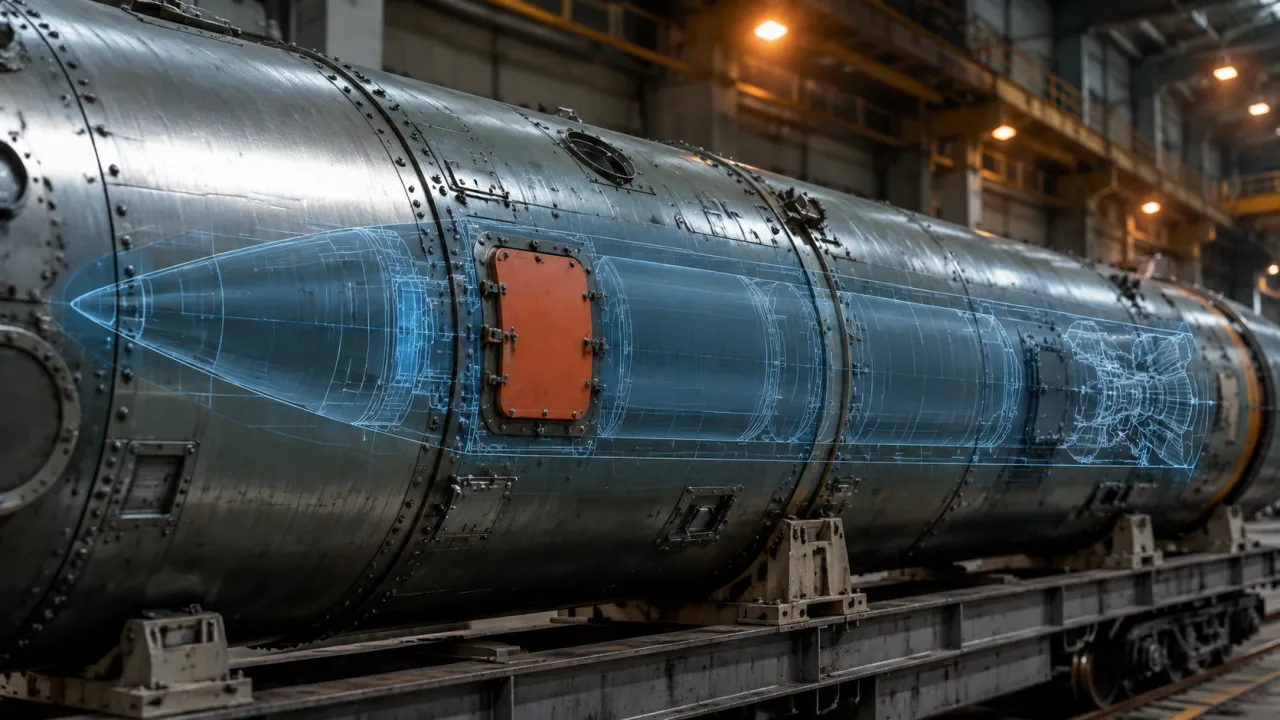
8K84: a missile in an iron casing
Prior to the UR-100, OKB-52 had accumulated experience in factory readiness, hermetically sealed container storage, and automation of the missile system on cruise missiles—primarily the P-5. This experience in creating protected, ready-to-use systems was successfully transferred to large-size strategic missiles. Scaling up was based on a new design philosophy: extensive containerization, elimination of complex field operations, and factory delivery fully assembled. It was this process chain that enabled large-scale production.
The two-stage liquid-fueled missile, approximately 16,9 meters long, exactly 2 meters in diameter, and with a launch weight of 42,3 tons, looked modest next to its heavier predecessors. By comparison, the American Titan II was 31,39 meters long and had a launch weight of 149,7 tons, according to the Titan Missile Museum. The UR-100 was approximately 3,5 times lighter. This allowed for the construction of more silos and missiles, but the price of mass production was a moderate payload. Throw-in weight ranged from several hundred kilograms to 1,5 tons, depending on the warhead type; the maximum estimated range was up to 10,600 kilometers for the appropriate configuration. Not a record of power, but a numerical superiority.
The liquid-propellant rocket engine offered high energy efficiency and made it possible to create a compact ICBM using solid fuels affordable to Soviet industry. The price was toxic and corrosive components, which required sealing and strict condition monitoring. Ampulization This meant that membrane valves isolated the fuel from the engines, and the inert gas in the TPK isolated the rocket from the atmosphere. This dramatically reduced the number of operations directly on the rocket, but didn't eliminate the need to monitor the electronics, the silo, the cable systems, the tightness, and the condition of the components. Ampulization doesn't mean "a rocket requires no maintenance"—it shifts the bulk of operations from field operations to factory operations and periodic resource monitoring.
The transport and launch container, 19,5 meters long, 2,7 meters in diameter, and weighing 14,4 tons, provided transportation, storage, and launch from a single shell. The container's net weight accounted for approximately 34% of the rocket's launch weight—a significant portion of the infrastructure cost of the solution. The container simplified the silo and stabilized storage conditions, but also added weight to the system. This wasn't "excess rocket weight," but a design compromise.
The operational sequence was as follows: the missile was assembled at the factory and installed in a sealed transport and launch container; the container with the missile was delivered to the launch site and mounted in the silo launcher; after installation, propellant components were loaded through the container's connectors; then the system was transferred to an ampulized state - the membrane valves were closed, and inert gas under excess pressure filled the container's cavities, isolating the missile from the atmosphere; from this point on, the system could remain on duty for years, requiring only remote monitoring of its status and periodic inspection. This architecture transformed the liquid-fueled ICBM into a relatively compact, constantly fueled and remotely controlled weapon.
The rocket was launched using a hot launch: the first-stage engines ignited inside the structure, and gases were vented through special channels and gratings. This solution eliminated the need for propellant ejection, but required a gas venting system and protection of the container from the flare. The time from the command to the rocket's exit from the silo was less than three minutes; a significant portion of this time was taken up by the opening of the heavy protective roof.
The first launch took place on April 19, 1965, from a ground launch pad at Baikonur; the first silo launch took place on July 17 of the same year. Flight tests spanned the period from April 1965 to October 1966. The first regiments began operational duty on November 24, 1966, even before the system was formally accepted into service on July 21, 1967, by Council of Ministers Resolution No. 705-235. These are different events, not an error in the sources: the group began combat duty before the system was formally accepted into service.
Ampulization—the UR-100's key advantage—proved to be the main technical challenge during its initial operational period. Ensuring the hermetic integrity of the fueled missile for five to seven years proved more difficult than expected: fuel component leaks began to occur in the field. Unreliable pressure control units in the second-stage pneumatic-hydraulic system for oxidizer and fuel, mounted on the container and functionally linked to the rocket's component-filled cavities, were leaking toxic fuel.
The sources of the leaks were eliminated after two design upgrades—replacing detachable joints with welded ones. The first modifications were made in 1967, after the first regiments had already been deployed. Work to ensure reliable ampulization was carried out under the supervision of the USSR Military-Industrial Complex; according to research by Y. Dalian (2019), by the time of the disasters in the summer of 1967, far from everything had been completed. This is the price of transitioning from theory to mass production: the promise of "a missile requiring no maintenance for years" necessitated field modifications to an already deployed group.
Publicly available test data differs: some sources cite 60 launches under the LKI program, while others cite 54 launches and 11 accidents during 1965–1966. Complete statistics on on-duty failures have not been published.
The similarities with the Minuteman were functional, not design. Both systems addressed the problem of mass, dispersed standby. The Minuteman used solid propellant; the UR-100 used an ampulized liquid propellant system. The Soviet design replicated the operational results, but not the American engine technology. The Soviet response was not technologically symmetrical: the US achieved continuous readiness through the properties of solid propellant, while the USSR achieved it through encapsulation of the liquid rocket and its storage in a transport and launch vehicle. This was a strong engineering solution, but it also compensated for the weaknesses of Soviet solid propellants of the period.
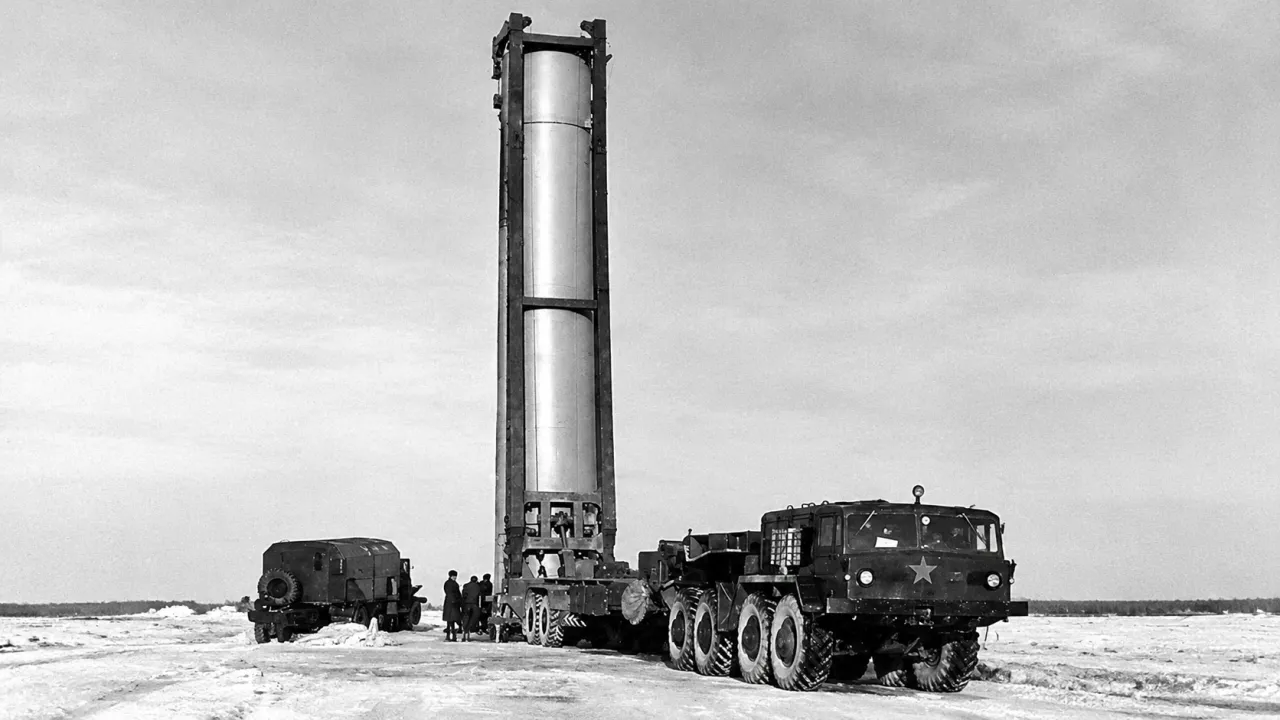
The process of installing a transport and launch container (TLC) with an intercontinental ballistic missile of the UR-100 system (GRAU index - 8K84, according to NATO classification - SS-11 Sego) into a silo launcher using a loading unit (installer 15U26)
From 8K84M to 15A20U: Upgrades within the dimension
Modernization of the original 8K84 began as early as the late 1960s. The first stage was to improve the control system and enhance operational and technical characteristics without changing the hull dimensions. The modernized UR-100M (8K84M) completed testing in 1971 after 12 launches under the program and was accepted into service on October 3, 1972. The modifications were carried out directly in the existing silos: the hull dimensions, liquid system, TPK, hot start, silo infrastructure, and overall layout remained unchanged.
The next step was the UR-100K (index 15A20), the design of which began in 1967. The missile had increased length and fuel capacity, improved accuracy, reliability, and range. Flight tests were completed in 1971, and acceptance into service occurred in late 1971 or early 1972, according to various sources. The two-meter diameter, basic principles of ampulization, container storage, and silo launch were carried over from the original 8K84; changes included a longer missile, a new or significantly redesigned guidance system, increased range, and an expanded set of warheads. The original 8K84 had a launch weight of 42,3 tons, while the 15A20 and 15A20U, with the same two-meter diameter, reached approximately 50–51 tons.
By the late 1960s, it became clear that the two-meter dimension was limited by the requirements of a new generation of combat equipment—but designers attempted to squeeze out another step without switching to a new platform. The UR-100U (15A20U) was this attempt: a development of the 15A20, featuring a multiple warhead of the dispersion type with three warheads. The warheads did not have full individual guidance: the impact points were determined by a common dispersion pattern. This increased the number of targets hit in a limited area and complicated anti-missile defense, but did not provide independent guidance of each warhead to widely spaced targets. The increased weight of the warhead reduced the maximum range compared to the single-warhead version. Almost the entire 15A20 launch vehicle remained unchanged; multiple warheads and missile defense penetration systems were added.
A fully-fledged multiple independently targetable reentry vehicle requires not only the mass of the warheads themselves, but also the deployment system—an autonomous stage with a propulsion system capable of sequentially launching the warheads onto different trajectories—as well as an onboard computer that controls maneuvering and an additional energy reserve. All this increases the overall weight of the warhead by 1.5 to 2 times compared to a simple dispersive reentry vehicle. With a two-meter diameter and a launch weight of approximately 50 tons, further strengthening the warhead, integrating missile defense penetration systems, and maintaining an acceptable range required a new, larger platform. The dimensions established in 1963 defined the limits of what was possible for two decades to come.
Generation gap: UR-100N and MR UR-100
On August 19, 1970, a government decision was issued to develop the UR-100N (15A30). Despite the similarity in name, this missile weighed approximately 103–106 tons and was 2,5 meters in diameter—more than twice the weight of the original 8K84. Its launch weight increased by approximately 2,45 times. Calling the 15A30 a simple modification of the 8K84 is technically inaccurate. The UR-100N was designed with a multiple independently targetable reentry vehicle and a significantly greater throw-weight. The UR-100N UTTKh (15A35) was a redesign of the 15A30 with improved accuracy, reliability, and stability.
What has been carried over from the original UR-100: the TsKBM design, the ampulized liquid-propellant design, factory readiness, silo-based deployment, containerization, and some of the infrastructural logic. What hasn't been carried over literally: the missile's diameter, launch weight, and basic design. Therefore, the UR-100N is not a "UR-100 with a new warhead," but a new system named within the successor line. The name retained the brand and core principles of Chelomey's design, but concealed the generational gap.
The UR-100 (15A15) missile, a project of Mikhail Yangel's Yuzhnoye Design Bureau, was developed in parallel. The missile was designed as a competitor to the UR-100N, replacing the 8K84, and was adapted to some of the silo infrastructure of the UR-100 family. Its purpose, launch sites, and the ability to use existing silos remained unchanged; the missile, propulsion system, control system, launch system, and combat equipment were new. The UR-100 received a mortar launch system and independently targetable MIRVs. The two schools of thought—Chelomey's and Yangel's—were faced with the same dilemma: further development of light ICBMs required larger dimensions. Chelomey had exhausted the service life of the two-meter UR-100, while Yangel was developing a new missile to meet the same requirements and objectives after work on the R-37 ceased.
Other countries sought mass production or survivability in other ways. The Chinese DF-5 was a heavy, two-stage, liquid-propellant silo-based missile—closer in size to heavy ICBMs than to the mass-produced, light UR-100. A comparison shows that a liquid-propellant design alone does not ensure compactness; the decisive factors were the target throw weight, the technology of the tanks, the transport launcher, and the operational organization. The United States simultaneously built up both its silo-based Minuteman force and its naval component—the solid-fuel Polaris A3 SLBM on nuclear submarines. In its UR-100 program, the USSR relied on a large number of widely spaced silos; the United States diversified its basing, reducing the force's vulnerability to a first strike in other ways.
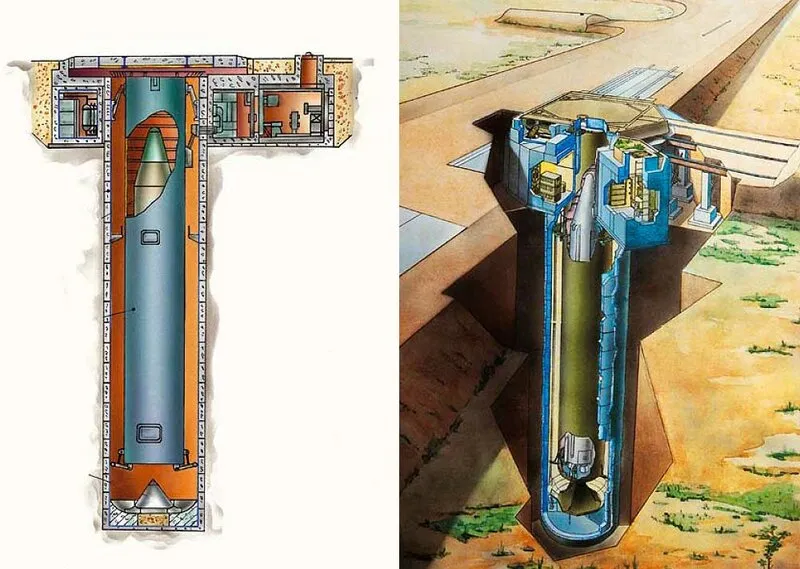
Schematic diagram of the silo launcher of the Soviet strategic missile system UR-100
The price of mass production
Open sources estimate the number of UR-100 missiles by 1974—the highest figure for Soviet ICBMs according to open data. An earlier Western estimate is 990 by 1972; both figures refer to different dates and compositions of the force, which included not only the original 8K84 but also modernized variants. This is confirmed by two formally independent sources—the Missilery industry catalog and the RKV veteran organization, although they may derive from general Strategic Missile Forces statistics. The number of deployed missiles was determined not only by engineering excellence but also by military-political decisions: how quickly cooperation could produce the missiles and how urgently the American numerical advantage needed to be offset.
The high readiness of the system did not mean high protection against a precision first strike. Dispersed individual silos increased the likelihood of survival of part of the force, but the increasing accuracy of American warheads gradually diminished the value of the early silos. Hence the need for protection upgrades and the transition to new systems. The TPK did not eliminate the risks of liquid propellant: it isolated the missile from the external environment and personnel from some operations, but toxic components remained inside. Seal aging, corrosion, and leak testing did not disappear, but were instead transferred to the system of factory manufacturing and periodic service life monitoring.
The original 8K84 was decommissioned in 1974 following the transition to modernized variants. The last UR-100 missiles of the main line were removed from combat duty in 1987. The 8K84 missile is on display at the branch of the Central Museum of the Strategic Missile Forces at the training center of the Military Academy of the Strategic Missile Forces in Balabanovo; the availability of this specific exhibit for public viewing as of September 2026 has not been documented.
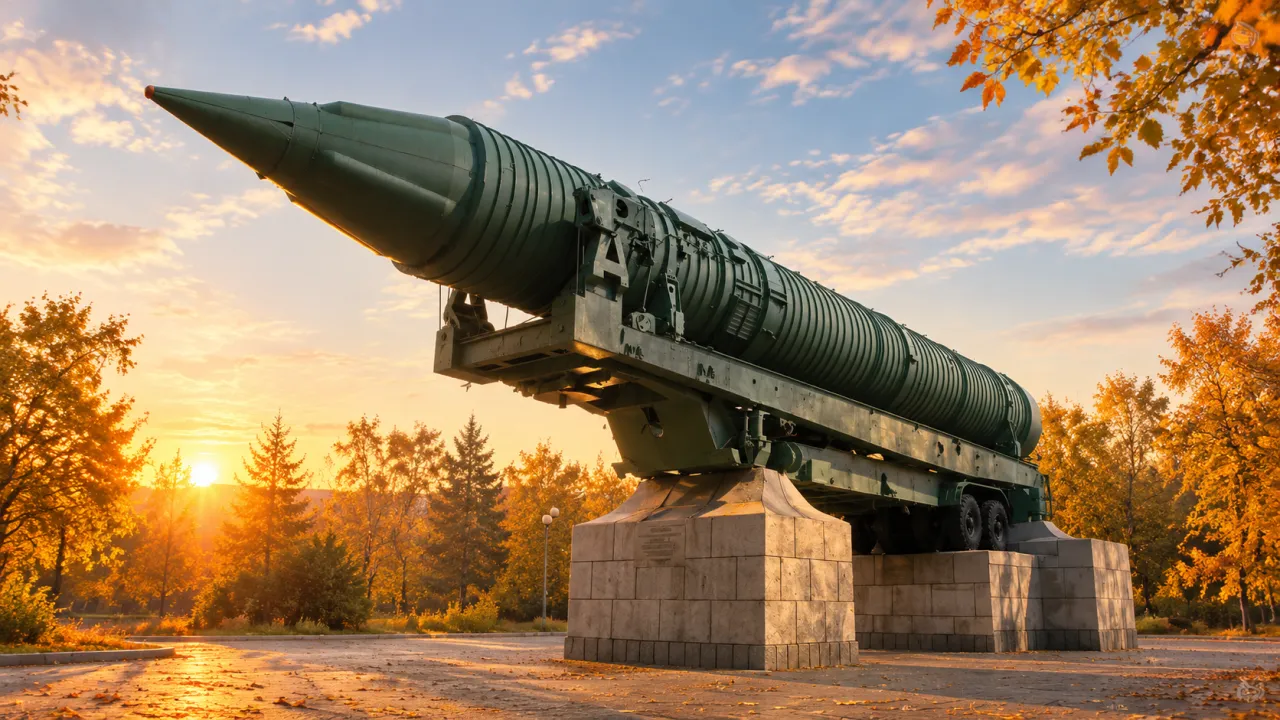
The Fate of the Product: From the Museum to Avant-garde
The original 8K84 was moved to a museum—the missile is on display at a branch of the Central Museum of the Strategic Missile Forces at the training center of the Military Academy of the Strategic Missile Forces in Balabanovo. The UR-100N UTTKh, essentially a new system weighing over 100 tons, remains in service, according to RIA Novosti. News In January 2026, NPO Mashinostroyeniya continues to support its operation, with some missiles being used as launch vehicles for the Avangard hypersonic system. The OKB-52 design school applied the containerization and factory readiness experience gained on cruise missiles to the intercontinental scale—and achieved the point where the UR-100 name was inherited by a missile twice the weight of the original. The dimensions established in 1963 defined the limits of what was possible for two decades to come—a design lesson worth remembering: mass production is not bought by range records, but by the operational system, and every initial platform has its limits.
Information