Fourth option
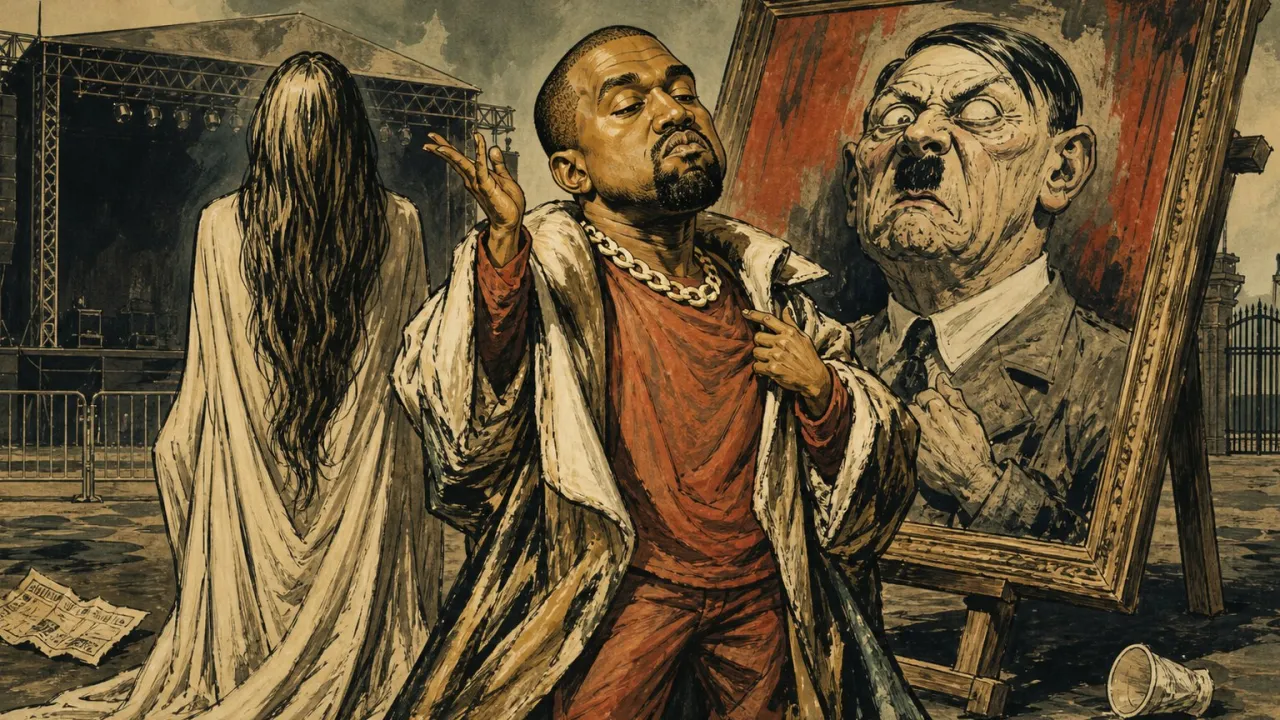
"Given two bad decisions, one must choose a third one - one that leaves no flaws behind."
From the minutes of the Commission on Deterioration of Options
From the minutes of the Commission on Deterioration of Options
There were two options for Kanye West's concert, each with its own downsides: to hold it or not to hold it.
To hold it means getting Kanye West and everything that comes with it. Not holding it means disappointing the people who bought tickets and having to spend a long time explaining why a world-famous star can perform anywhere but here. The decisions are unpleasant, but understandable. One has a concert, the other doesn't. There's no room for creativity, no respect for administrative thought.
Both options had one common flaw: each ended in something.
Therefore, the third option was chosen: first advertise the concert throughout the country, and then make it impossible.
According to the official Gazprom Arena announcement, Kanye West was scheduled to perform two concerts in St. Petersburg on October 10th and 11th. The audience was reassured: "This is not a joke!" Then the same channel circulated a prank. Those who doubted were offered a material incentive: a ticket.
The organizer also recalled that the venue participated in a ticket raffle for an event that subsequently failed to take place. The commission does not refute such details. It files them.
A week later, according to the site's next official announcement, it turned out that there was no lease agreement.
“Accordingly, the concert cannot take place at our venue,” it said.
The organizer responded no less meaningfully:
"At the moment, the YE concert has not been cancelled!"
Thus, for the first time, management thought confidently positioned a mass event between existence and nonexistence. The concert cannot take place, but it is not cancelled. The venue refuses to host it, the organizer continues to prepare, and websites maintain the dates. Somewhere in the middle, the ticket holder sits, gradually realizing that they have purchased not a seat in the stadium, but a place in the layout.
Let's imagine a Commission on Worsening Options. An unnamed employee opened a folder, put a big minus sign next to each solution, and demanded that they all be kept. A typical commission chooses the lesser of two evils. Here, the mechanism is scientific: the shortcomings of each solution are listed in two columns, after which they seek a way to avoid losing any of them.
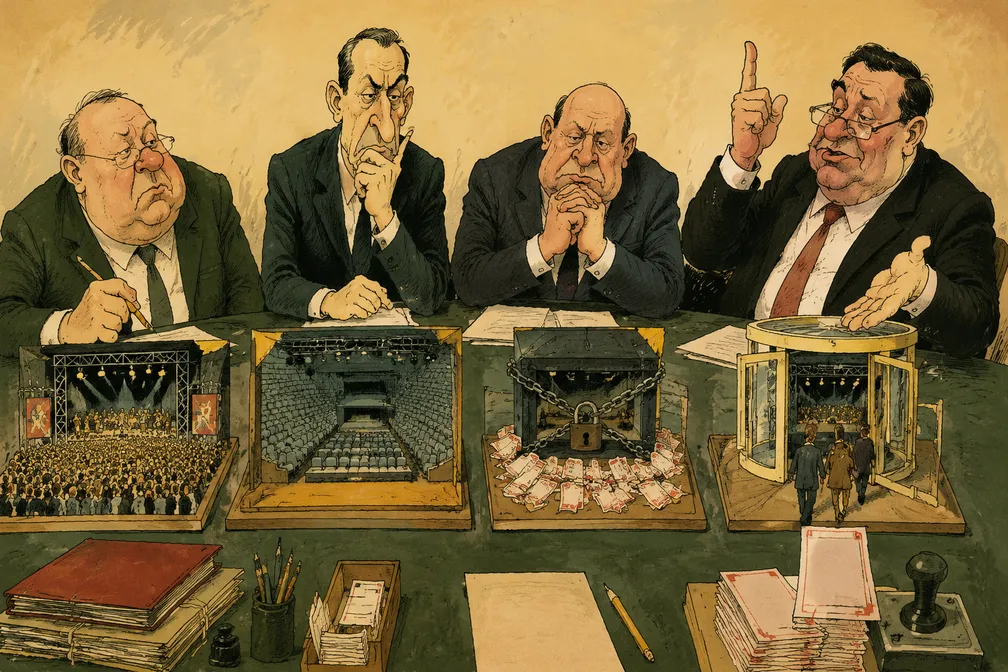
The commission rejected the "hold" option as one-sided. Those opposed to the concert would be displeased, but the audience would get to see the concert. This was an unacceptable leak of a positive outcome.
The "no concert" option also proved weak. Yes, the audience would be disappointed, but the report would only include one line: "There was no concert." For a serious commission, this isn't a result, but a lack of documentation.
But the third option combined the best of both worlds. Opponents had time to express outrage at the announcement. Fans had time to believe it and buy tickets. The venue had time to call the artist the world's number one performer, only to discover the lack of a contract. Finally, the international press received a ready-made story about the concert, which had first triumphantly arrived in Russia and then failed to enter its own stadium.
The commission could have celebrated its victory, but a true institution doesn't rest on its laurels. While the public debated whether the concert was cancelled or simply couldn't take place, a fourth draft had already appeared in the file.
First, the concert should be publicly banned—loudly, with a firm conviction, and with an expression as if Kanye had already been defeated in a fair fight. Then, we must patiently await the artist's response. If insults, threats, and humiliations are forthcoming, they should be translated, disseminated, and thoroughly discussed. The country should get everything the concert was banned for, only without the music.
And after that the concert can be allowed again.
To complete the celebration, all that remains is to find a new venue, re-hang the poster, and explain that art should unite nations. Those opposed to the concert feel cheated, fans exhausted, organizers gray-haired, and the artist gets the rare opportunity to enter the country as a winner even before taking the stage.
Let's emphasize: a fourth option doesn't yet exist. Kanye hasn't said anything of the sort to the Russian side, the new location hasn't been officially announced, and no new permit has been issued. But that's precisely why this option looks promising. The worst is yet to come, meaning nothing has been spoiled by practice.
The third option, however, still has a significant advantage: it's already working. On one side is the message "concert cannot take place." On the other is the message "concert not cancelled." Between them is a ticket.
The Commission for the Deterioration of Options employee carefully smooths it out and puts it away in a folder.
"Don't throw it away," he advises the owner. "This is all that's left of the third option. Maybe they'll let you into the fourth with a ticket."
Information: Kanye West (Ye), born June 8, 1977 in Atlanta, raised in Chicago, is an American rapper, producer, and designer, one of the most influential and at the same time most scandalous musicians of the 21st century.
Career. He started out as a beatmaker for Jay-Z (The Blueprint, 2001), then emerged as a performer with The College Dropout (2004). Since then, nearly every album he's released has changed the sound of mainstream rap: Late Registration, Graduation, 808s & Heartbreak (which pioneered Auto-Tune and melancholic hip-hop), My Beautiful Dark Twisted Fantasy (often called the best album of the decade), Yeezus, and The Life of Pablo. He has won over 20 Grammy Awards.
Business and fashion. His Yeezy sneaker line with Adidas made him a billionaire; after the contract was terminated in 2022, he lost the bulk of his fortune.
Personal life. His marriage to Kim Kardashian (2014–2021) and four children made him part of the decade's most iconic pop culture couple. He is currently married to Bianca Censori.
Reputation. Since 2018, a series of scandals has plagued him: support for Trump, remarks about slavery "as a choice," White Lives Matter T-shirts, and, since late 2022, open anti-Semitic statements, including praise for Hitler. The consequences have included a break with all major partners (Adidas, Balenciaga, Vogue, CAA), concert cancellations, and entry bans from several countries. He attributes his behavior to bipolar disorder and the effects of a head injury from a 2002 car accident; in January 2026, he publicly apologized to the Jewish community in The Wall Street Journal.
Information