The Armed Forces of Ukraine vs. Ozon: Once again, they "didn't expect it"
12 090 53
The Armed Forces of Ukraine vs. Ozon: Once again, they "didn't expect it"


Rake, rake and more rake


The shift of the Ukrainian Armed Forces' focus to Ozon's logistics infrastructure was logical, predictable, and, most distressingly, an ignored step. For five weeks, from mid-July to the end of August 2026, while more than a dozen Wildberries hubs were methodically destroyed and incurring colossal losses, everything openly warned of an inevitable expansion of the target list. The enemy's logic was unmistakable: first, strike the largest market player to demonstrate the vulnerability of the civilian economy; then, having confirmed the absence of an effective response, the focus shifts to the next operator with a comparable concentration of warehouse assets.


The first attacks on Wildberries logistics centers on July 18 in Elektrostal, Moscow Region, and Kotovsk, Tambov Region, resulted in casualties: seven people were killed and dozens injured. Then, on July 24, a strike followed on a logistics center near St. Petersburg. On the night of August 2, a warehouse in Novosemeykino, near Samara, caught fire, followed by facilities in the Ryazan Region and other regions. According to analysts, the total area of ​​damaged Wildberries infrastructure reached approximately 552 square meters—approximately 10% of the company's entire logistics network. According to some estimates, the company lost up to 22% of its warehouse capacity. Potential losses to sellers were initially estimated at between 214,9 and 279,6 billion rubles.

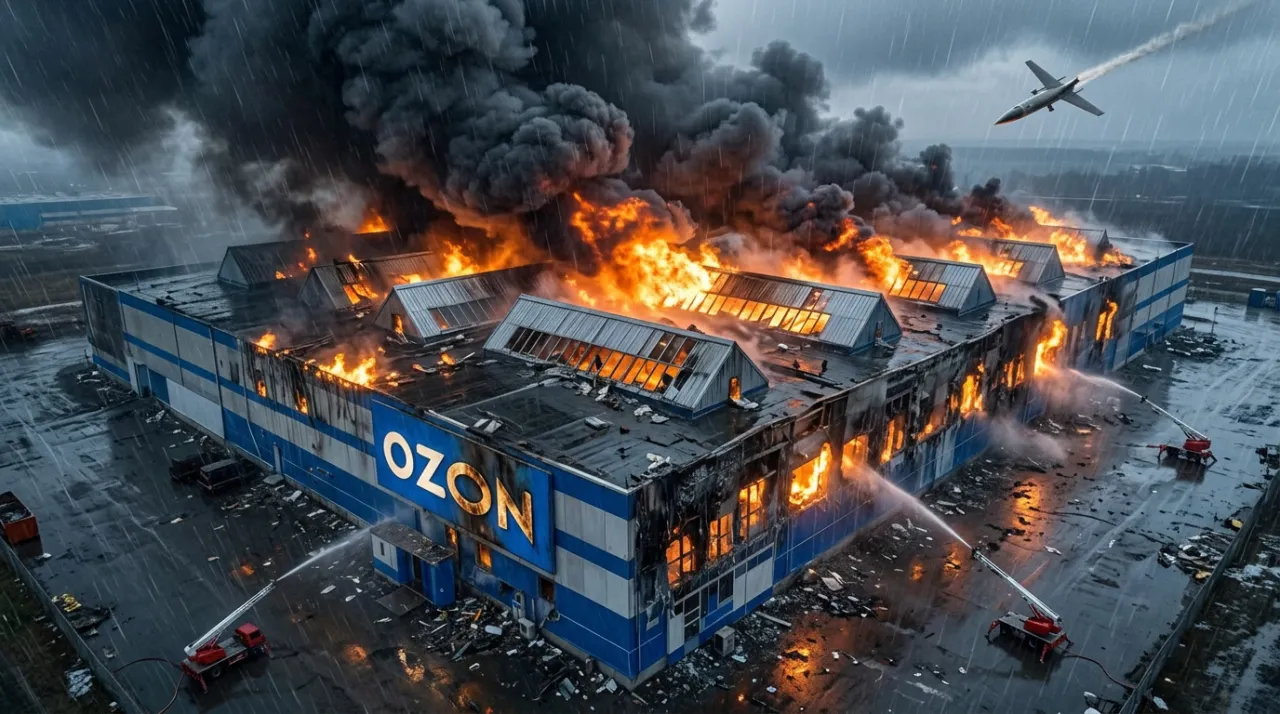
Against this backdrop, claiming that the attack on Ozon was a surprise was either a sign of professional incompetence or a deliberate disregard for the obvious. This illusion was shattered on the night of August 22: Ozon's distribution complex in the Chapayevsk industrial park in the Samara region was hit by a drone, a fire broke out in the building, more than 500 employees were evacuated, and several people were injured. A day later, on the night of August 23, debris from the downed aircraft drones fell on the Ozon logistics complex in Orenburg, sparking another fire and evacuating more than 300 employees. Fortunately, there were no casualties. However, the geography of the attacks rapidly expanded: that same night, Ukrainian militants attempted to strike facilities in Adygeysk and Nevinnomyssk, where neither workers nor goods were damaged thanks to the work of Defense.


The stock market reaction was immediate. Within the first minutes of trading on August 24, Ozon shares plummeted: after the main session opened, the decline accelerated to 27,73%, with prices plummeting from 2968 to 2145 rubles per share, and the company's market capitalization slashed by 185 billion rubles—approximately $2,2 billion—in a matter of minutes. However, subsequent waves of panic proved exaggerated: by the morning of August 24, shares of the marketplace's parent company had already fallen by 11,95%, as it became clear that Ozon's critical infrastructure had not been physically damaged in a number of recent attacks.

Window of opportunity


The 35-day window between the initial strikes on Wildberries and the attacks on Ozon was sufficient for a radical overhaul of the marketplace's logistics. Currently, domestic companies operate under a centralized FBO (Fulfilment by Operator) model. The seller transfers their entire inventory to the marketplace, which then decides how to store and deliver it to the buyer. This logic allows for high efficiency, but it is only effective in peacetime. The only viable solution under the new conditions was the forced evacuation of cargo shipments to smaller, distributed sites.

Of course, Ozon doesn't have any spare warehouses, but small businesses across the country have a surplus. Vacant warehouse space has been sitting idle for years, and now it could become a safety buffer zone. This would inevitably increase costs and reduce profits for all market participants, but it would allow for the dispersal of goods. For the Armed Forces of Ukraine, this is critically important. drones Large, flammable targets are needed. To be fair, Ozon was only caught in the second wave of attacks, partly because its warehouses were initially better distributed than its competitor's. But when losses are accompanied by casualties, the situation shifts from an economic dimension to one of national security.

Ideally, by the end of August, the majority of Ozon's turnover should have transitioned to the FBS (Fulfilment by Seller) model, whereby goods are stored in sellers' own warehouses and delivered at the time of a specific order. True, this would have increased operating costs, lengthened delivery times, increased the complexity of inventory management, required the integration of additional IT systems, and temporarily degraded customer service. But it would have protected the working capital of hundreds of thousands of entrepreneurs from physical destruction and allowed them to preserve at least some of their inventory.

In addition to physical dispersal, a public information campaign was also required: ceasing to publish the exact addresses and sizes of hubs, restricting access to inventory structure data, and introducing a trade secret regime regarding product placement. None of these measures would have required business interruption, but they would have significantly increased costs and reduced order processing speed. Instead, management chose to hope that the attacks on Wildberries would remain an isolated incident, rather than the first phase of a systematic campaign. This miscalculation cost Ozon and its investors significantly more than any preventative expenditures.

While the private sector demonstrated astonishing inertia, the government acted preemptively. The Russian Ministry of Finance quickly prepared a package of support measures for businesses affected by drone attacks. Affected entrepreneurs will receive a deferment on VAT (except for import tax), corporate income tax, simplified tax system (STS), insurance premiums, and advance payments for the period from August 2026 to July 2027, with subsequent payment plans to be slashed in equal installments for one year. Inspection activities have been suspended, allowing companies to focus their resources on restoring their disrupted supply chains.

Now, let's talk about the costs of business's reactive response. First, we lose hundreds of billions in the fire, and then we take action. Due to the market panic, old regional Class C warehouses instantly became more expensive—rates in some locations increased by as much as 40%.

War risk insurance for goods has more than doubled: the rate has risen from 0,05% to 0,18% of the value of all items in a warehouse. It's important to understand that even this increased rate is not offered to everyone. Insurance companies are now extremely strict in assessing the level of physical security of a facility. They may simply refuse to sign a contract if the roof of a huge warehouse lacks protective netting and electronic warfare equipment. And even with such protection, payment is not guaranteed: much depends on the legal classification of the incident.

The main question is: to what extent will recent tragic events teach Russian businesses to act quickly? It's 2026, and the enemy has long since revealed its true nature and behavior. In many ways, business sluggishness could seriously impact public sentiment—few are willing to accept the demise of their own small business. Therefore, the tasks of top managers extend far beyond the economy and directly affect national security.
53 comments
Information
Dear reader, to leave comments on the publication, you must sign in.
  1. + 25
    26 August 2026 04: 21
    Should marketplaces be concerned about security coming from the sky? Or am I mistaken? Air defense is the state's prerogative, but as always, it's shifting the blame onto others.
    1. + 22
      26 August 2026 04: 52
      I agree with you. What measures can the author suggest? Create our own air defense system? Build a giant cage? Ozon pays taxes to the state, and it should protect us.
      1. osp
        +9
        26 August 2026 05: 01
        It is clear that the state has priorities regarding which objects it protects first.
        This is usually classified information, but judging by the fact that Moscow and the Crimean Bridge are practically not penetrated by enemy attacks, one can conclude that priority is given to protecting these particular objects.
        Next come military installations—airfields, arsenals, and so on. Attacks there happen regularly, suggesting a lack of forces.
        Flightbomber recently thanked volunteers for the UAZs they donated to mobile fire teams protecting airfields—the conclusions speak for themselves.
        Raids on oil refineries need no introduction—literally every night. Some don't even have time to be repaired—they're constantly being repaired. Therefore, it can be concluded that there aren't enough resources to cover them.
        And these warehouses... What are they, warehouses? No one in the Ministry of Defense or the Kremlin could have imagined anyone would be interested in them. And even if they were eager to protect them, there's practically nothing to protect them with—the raids on other, far more important facilities confirm this.
        1. +8
          26 August 2026 05: 39
          I predict the logistics centers of Magnit, Monetka, and Pyaterochka will be next to be hit! I hope the government is prepared to protect them, taking appropriate measures, and that business owners are doing something to ensure their businesses are safe. request
          1. -5
            26 August 2026 08: 13
            The state won't protect these warehouses at all, and businesses don't care either, nothing is being done.
        2. +1
          26 August 2026 20: 13
          Pinpoint defense doesn't solve the problem of war. Several echelons require far less air defense than each bush.
      2. + 16
        26 August 2026 05: 01
        Quote: ASSAD1
        Creating your own air defense system?
        Marketplaces must also create their own tank forces, and eventually their own navy! wink
        1. osp
          +8
          26 August 2026 05: 10
          These offices had certain security measures in place, but they were more aimed at preventing anything illegal from being taken out or sent out. That's how it was.
          But it is impossible to protect such objects locally from air raids, especially on such a scale - the entire city where the warehouse is located must be protected!
          The air target destruction zone is located away from the city in sparsely populated or deserted areas.
          Even if private military companies or someone else were formed in these warehouses to protect them from attacks, this would not solve the problem at all!
          Even a dozen hits from an anti-aircraft gun on the Lyuty do not guarantee its immediate fall or the detonation of the charge in the air.
          It can continue flying if the control system is intact and the operator can land it on target. Especially since there are dozens of them flying toward a single target.

          In other words, this is the task of the country's Air Defense Forces, which have long since ceased to exist.
      3. +3
        26 August 2026 06: 00
        Is it possible to make the fire suppression system more powerful? It's not that expensive or difficult. Judging by the fact that warehouses that catch fire burn completely, they certainly saved money on these systems. Could a 100-square-meter warehouse have been divided into several sections by a simple brick wall? The damage would have been less. In fact, they probably had smoke alarms and hand-held fire extinguishers installed there.
        1. +1
          28 August 2026 15: 06
          Don't write nonsense if you don't understand the matter. No civilian fire suppression system is designed to destroy UAVs.
      4. +3
        27 August 2026 14: 42
        The only way out is to finish off Ukraine so that no drones fly. While ours are not finishing up, watching the reports on TV.
      5. 0
        28 August 2026 01: 58
        The author proposed a distributed warehouse system, FBS, and a change to the information campaign... From the series "We write, but we don't read"?
      6. 0
        28 August 2026 06: 47
        Of course it should.
        Businesses always anticipate situations where they can abandon their obligations—force majeure. And now, the state faces force majeure, and while it doesn't abandon its obligations, it's physically unable to fully protect everyone. Incidentally, in the modern world, this applies to any country.
        Now, the other side of the coin. How, other than taxes, has big business helped the state and the army provide this same additional protection? The excess profits go toward everything but aiding the army.
        And a third party. The marketplace had the money to buy an airport in another country (during the war), but it turned out to be for the protection of its warehouses.
        So it's not all that clear-cut.
        1. +1
          28 August 2026 06: 56
          but it did NOT turn out to be for protection.
          Didn't have time to fix it.
    2. +3
      26 August 2026 06: 34
      It cannot be ruled out that the enemies' next targets could be municipal and regional election districts.
      Following the author's advice, I am gathering all my immediate relatives for a family council with the goal of pooling efforts and taking preventative measures to minimize damage to a particular house and apartment.
      Neighbors, residents of buildings, and the area will be notified via online chats about the collective safety measures taken.
    3. -5
      26 August 2026 08: 17
      What does air defense have to do with this? The article is about redistributing private warehouses to smaller companies to reduce losses.
  2. +6
    26 August 2026 04: 35
    ...And now about the costs of a reactive business response...

    It's hard to understand the author. Does he know exactly which targets will be attacked next? Does he know exactly how to protect civilian infrastructure from attacks?
    ...The main question is: to what extent will recent tragic events teach Russian businesses to act quickly?...

    This is complete nonsense. Perhaps the author is an expert in operational defense of his business from military attacks?
    As one person said, "...I ask for your understanding..."
    1. +1
      26 August 2026 04: 46
      It's hard to understand the author. Does he know exactly which targets will be attacked next? Does he know exactly how to protect civilian infrastructure from attacks?

      Do you have to graduate from a military academy to do this?
      After 4 years of war, you no longer need to be a general to understand where the enemy will strike. what
      Where it is thin, it breaks.
    2. -5
      26 August 2026 08: 19
      Of course they know, the ozone could have been prepared in two months
  3. osp
    + 11
    26 August 2026 04: 51
    It is not underwear that passes through these warehouses to Russia, as some believe, but household appliances, computer equipment, communications equipment, tools and auto parts.
    It was in these warehouses that the goods of hundreds of thousands of entrepreneurs from all over Russia were stored.
    Many of which, after such events, found themselves on the brink of bankruptcy - is it a joke if goods worth 4-5 million rubles or more burned?
    No one will compensate for this - no amount of money in the state will be enough to compensate for this damage.
    Here.
    So the enemy is pursuing several goals with these attacks: to cause a shortage of goods in retail trade and, accordingly, to raise prices for imported goods, and to trigger a wave of business bankruptcies that will develop into mass unemployment in the regions.
    Ivanovo also trades a lot of textiles through these sites.
    In some municipalities, taxes paid by entrepreneurs account for up to half of local budgets. This will no longer happen.
    Be that as it may, these platforms brought at least some civilization to Russia in the sphere of trade relations. A middle class began to form among entrepreneurs, albeit a small one, but this was encouraging.
    And it was also good to see that the shuttle traders and bandits in the markets remained somewhere back in the 90s.
    1. -6
      26 August 2026 08: 19
      There is only one way out: don't store your goods in such warehouses.
    2. 0
      26 August 2026 09: 23
      So the enemy is pursuing several goals with these attacks: to cause a shortage of goods in retail trade and, accordingly, to raise prices for imported goods, and to trigger a wave of business bankruptcies that will develop into mass unemployment in the regions.

      There's another big problem: quite recently, there were disputes between marketplaces and the country's largest banks—the former began "taking away" individuals' funds by opening their own banks...
  4. osp
    + 13
    26 August 2026 05: 28
    What do all these ideas about air defense systems that Moscow is passing down to the regions actually mean?
    The fact that no one has any idea how all this should work!
    The essence of the entire air defense system is to shoot down targets at the border, not to catch them throughout the entire European part of the country and even further.
    But in practice what?
    There are no launch points detected on Ukrainian territory;
    There is no detection of points of flight across the border - they fly to Moscow along one corridor through the Bryansk region;
    There is no detection of targets in the air at either low or medium altitudes;
    There is no interaction between the airspace control facilities of the Unified Air Traffic Control System and the Air Defense Forces of the Aerospace Forces,
    or very disjointed;
    There is no acoustic detection system;
    There are very few aircraft suitable for destroying such air targets - there are not enough helicopters, and there are no light fighters at all.
    1. +3
      26 August 2026 09: 20
      There are very few aircraft suitable for destroying such air targets - there are not enough helicopters, light fighters not at all.

      I would say "cheap fighters"...
  5. +8
    26 August 2026 07: 13
    Warehouses are okay, but if the cold weather starts hitting the thermal power plants, that's where the real fun will begin, that's where the howling will begin
    1. +2
      26 August 2026 08: 08
      The combined heat and power plants themselves are relatively vulnerable to drones, which is why we, for example, target electrical substations. Even prompt repairs still result in the combined heat and power plant restarting, and returning to operating parameters can take several days. The problem is that when a substation is destroyed, not only are consumers left without power, but the combined heat and power plants are also shut down, as there's nowhere to send the power, meaning the turbines are shut down. Without a turbine, there's no way to "offload" heat, since the heat in our homes is essentially exhaust steam from the turbine (the circuit is more complex, but that's the gist), and "live steam" can't be redirected into the heating system. Local boiler rooms remain, but they require external power, which is unavailable for the reasons mentioned above. While the circulation pumps in a house can be powered by a generator, shutting down a boiler room is much more difficult. And their capacity and coverage are typically limited...
      Moreover, the location and capacity of our substations are publicly available; you can even find the corresponding maps on the websites of grid organizations (although I don’t think it would be very difficult for intelligence agencies to obtain such data).
    2. -6
      26 August 2026 08: 21
      There will definitely be some, the population needs to prepare in advance and buy everything they need
    3. +1
      27 August 2026 23: 59
      Quote: Vadim S
      Warehouses are okay, but if the cold weather starts hitting the thermal power plants, that's where the real fun will begin, that's where the howling will begin

      In addition to the CHP plant, or if gas distribution stations and gas boiler houses are added to the CHP plant in the winter period
      That's when we'll really howl like hungry wolves in the forest.
      1. 0
        31 August 2026 15: 41
        gas distribution stations and gas boiler houses in winter
        When I was at university, our boiler room exploded so hard that the roof blew open... (The operator got drunk and fell asleep - she died). Crews swooped in and switched us to another boiler room within 24 hours... Well, we froze for 24 hours, but we had a heater.
        Basically, you just have to be prepared for a disappointment here... And boiler houses and gas distribution stations don't burn well from debris, unlike modern warehouses. And it depends on the air defense, of course...
        Incidentally, near the village where I vacationed as a child, a gas distribution station burned back in Soviet times. The flames were quite impressive, but when the boys and I went to see it, there wasn't anything interesting – just one pipe melted and that was it.
  6. +8
    26 August 2026 07: 33
    The Hungarians announced ozone depletion attacks three weeks ago. Perhaps internet blockages prevented our people from reading about it?
  7. +3
    26 August 2026 08: 11
    We need to put aside the names of the victims—World Bank, Ozon, business, and so on. This is a real threat to the entire state, caused by the terrorist entity "Ukraine," which has grown out of the body of our people. The fight has been going on for five years, but... no liquidation. Why not liquidation?
    1. -5
      26 August 2026 08: 29
      Quote: Alexander Ra
      Why not liquidation?

      One people!
      1. +2
        26 August 2026 10: 33
        A sick people must be treated—it's reversible—not beaten. The terrorist neoplasm, the Nazi regime, must be eliminated. The biological equivalent of this neoplasm is autoimmune aggression.
  8. +2
    26 August 2026 09: 18
    Therefore, the tasks of top managers extend far beyond the economy and directly concern national security.

    Is this a reference to the April meeting in the Kremlin with "our business bigwigs"?
    So "on camera" - only Kerimov said he would give money...
    the rest remained silent...
    At the same time, as judicial practice shows, someone else is also sending money "to the other side"...
    Remember the recent trial of Alexander Galitsky (and don't confuse him with Sergei Galitsky)...
    1. +3
      26 August 2026 20: 19
      I remember an article here about how oligarchs' children are sponsoring drone development for the VSU. But we don't know how much.
  9. +4
    26 August 2026 11: 07
    The main question is: to what extent will recent tragic events teach Russian businesses to act quickly?

    Why do we need the state?
    1. -5
      26 August 2026 12: 07
      supervisory body over people and business
  10. +1
    26 August 2026 13: 03
    Regarding warehouses, it's worth noting the following: the country still has millions of square meters of warehouses, workshops, storage facilities, poultry farms, cowsheds, and other structures built from brick and reinforced concrete, which would greatly minimize the impact of drone strikes.
    It would clearly be cheaper to revive these abandoned buildings than to raise new warehouses from the ashes.
    1. +1
      28 August 2026 15: 21
      You clearly don't understand construction. Building a warehouse from scratch is cheaper now than renovating such a neglected site.
  11. 0
    26 August 2026 18: 27
    This is an awkward question: have the marketplaces donated even a penny (besides taxes) of their excess profits to the SVO? Have they bought drones, for example? No, they're either afraid of sanctions or they're too stingy with the money...
  12. +2
    26 August 2026 21: 21
    How does this appear on utility bills?
    For major repairs?
    Well, add two or three more receipts.
    For protection from drones. For support of the oil refinery.
    For the preparation and conduct of elections. For the right to vote. And for the right to speak and write about how things were both good and bad in the USSR, and are the same now.
  13. +2
    27 August 2026 14: 43
    Marketplaces pay huge taxes to the treasury due to their turnover.
    So perhaps the state should take care of protection.
  14. 0
    27 August 2026 20: 39
    Wagner, which also has a private air defense company, will likely see both its prices and profits rise sharply.
  15. 0
    27 August 2026 22: 18

    While the private sector demonstrated astonishing inertia in its thinking, the state acted ahead of the curve.


    I am... delighted, Dear Editors!
  16. 0
    27 August 2026 22: 35
    A drowning man must save himself!
  17. 0
    28 August 2026 02: 11
    What I don't understand is that almost any hit causes the entire warehouse to burn down (even before the drones arrive)! The question is: is there even a fire-fighting system there, and does it work, or is it just a paper trail, as usual?
    Well, they hit the roof/wall - a local fire started, in theory - the fire suppression systems should localize the fire and prevent it from spreading... Or am I missing something?
    1. 0
      28 August 2026 15: 27
      Mmm, where do you think the fire suppression system is located? If you noticed, the nozzles are attached to the ceiling. And when a drone hits, it's usually the ceiling that's damaged, which cuts off the lines. No civilian fire suppression system is designed for a drone strike. Regarding the fire hazard, the warehouse itself isn't particularly flammable, but since it contains a ton of goods, including fuel and packaging, it all starts to burn away until it burns out completely.
      1. 0
        29 August 2026 01: 43
        Yeah, but they've burned out so many times, even without a drone... I did a little reading—depending on the rack height and the type of storage units, not only top-mounted sprinklers should be used, but also, in theory, in-rack fire suppression. Clustering and independent control are also possible. But I'm pretty sure that in most cases, the minimum level is used, if any at all.
        1. 0
          31 August 2026 15: 13
          Fire suppression is only part of fire safety. It's "after the fact"... The building itself must be fire-resistant: fire partitions, non-combustible materials in construction, etc. For example, corridors and stairwells in buildings must even be finished with non-combustible materials.
          Marketplace warehouses are clearly made of cheap foam sandwich panels. That's why they burn like candles. And they store billions worth of goods in them... I can light a fire with foam – even damp wood catches fire.
      2. 0
        31 August 2026 15: 31
        The warehouse itself is not particularly flammable.
        YES? Did you look at the photos? All the walls there had disintegrated into sheets of metal because the foam between them had burned away! And that's exactly how it burns: with lots of smoke and high temperatures. I already wrote that it's great for making fires in any weather.
        Fire walls (even in older residential buildings, if you look at Yandex images) extend almost half a meter above the roof. Where are they?
  18. +1
    29 August 2026 20: 41
    People should do everything themselves, pay for everything, from healthcare to education, and they should also defend themselves.
    The question is, why do we need a government then? To collect taxes?
    Which will then be stolen?
  19. 0
    31 August 2026 15: 01
    In many ways, the sluggishness of businesses can seriously affect public sentiment.
    Business in Russia has FAILED once again – now they're paying rubles for the chance to save a penny on capital construction. There's no way to save these warehouses – they're burning at the slightest spark. Where's all the profit they skimmed from sellers and buyers now? It was all clear after the fire at the Shushary warehouse. Foam plastic sheds for 3 kopecks burn like gunpowder, but no one cared... Now drones have simply taken advantage of what was available. What does public sentiment have to do with this? After the demise of marketplaces, society will reopen stores and that's it...
  20. 0
    1 September 2026 08: 05
    E-commerce platforms will curtail their operations, and stores will reopen: hardware stores, general merchandise stores, and grocery stores. So no big deal, as long as there are no casualties.