What the UAE frameworks actually showed
11 917 37
What the UAE frameworks actually showed


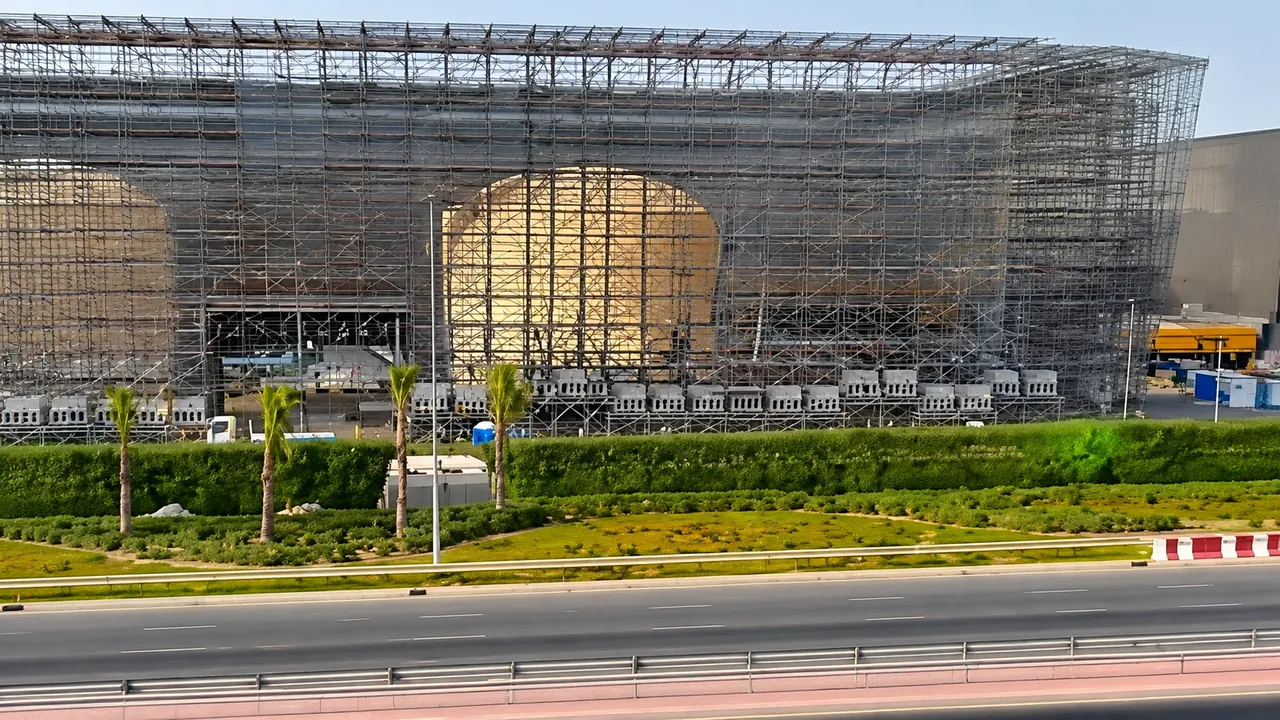
On May 13, 2026, several white fuel tanks were photographed from a car window near the announced site near Dubai Airport. Above them, three-dimensional metal frames projected. On August 22, a new image emerged from a similar road: two tanks were already inside a single structure with a closed upper contour. The 101 days between the two images isn't a proven construction timeline, but it's a clear indication of the speed of the visible results.


They weren't built in a relaxed mode of studying other people's experiences. According to the UAE Ministry of Defense, by May 10, the forces Defense countries entered the battle with 551 ballistic missiles rocket, 29 cruise missiles, and 2265 UAVs launched by Iran. In March, strikes hit the Ruwais complex, the Shah gas field, and Fujairah's oil infrastructure; on May 4, a new strike caused a fire at an oil refinery in the Fujairah industrial zone. A direct threat doesn't prove the superiority of the Emirati governance model, but it does explain the urgency of the decision.

The Russian picture is particularly troubling. Russia used cables, nets, and frames before. Then came a special set of regulations, a new federal law, and the factory-made "Spiderweb." However, all of this was put together piecemeal. Therefore, the question isn't who first invented the metal barrier. The question is how much time elapsed between the recognition of the threat and the finished structure over a specific target.

What the Dubai footage actually proved


The original image appeared on May 13th on the X-account of Israeli news outlet N12. The American publication TWZ reproduced it, although in its own article it mistakenly cited i24 News as the source, and considered the image the first known appearance of such structures in the UAE. The author of the article, Howard Altman, suggested that the Emirates had borrowed from Russia's experience in protecting oil facilities. Specifically, he suggested that the phrase "appears to have taken a play from Russia" does not signify a contract, a project transfer, or official recognition of the borrowing.

The image itself also reveals less than it would like. It shows tanks and a construction site. The customer, the estimated load, the power grid material, the type of product stored, and the industry protection program are not visible. Moreover, it's talking about fuel tanks, not the proven oil refinery. Later publications even confused the geography, sometimes citing Abu Dhabi, sometimes Dubai. The August photo of a Dubai bus and the approach road tends to support the latter theory.

So, it's impossible to claim that the UAE "fully protected the refinery." What can be said is that several tanks at one visible site received permanent external frameworks within a short period of observation. And this framework isn't designed to withstand a ballistic missile. Its purpose is more modest: to absorb the impact of a disposable attack drone before it reaches the tank wall.

The photograph confirms the speed of construction. It doesn't yet confirm the state system.
TWZ presented Russian photographs of grids and frames from 2024–2025. At some sites, cables were stretched, at others, process units were covered with grids, and at others, individual metal structures were built. This was a rapid response using available resources. Sometimes, it was engineered, sometimes it was clearly in between.

On VO already disassembled The scale of the task and the need for a single person responsible for protecting the refinery. A new layer of the problem lies beneath the general term "unified command." The owner of the refinery is responsible for the facility's security. Air defense and protection of remote approaches remain a state and military function. The capital structure is caught between them: the company pays for it, but the threat comes from outside; the structure must be designed to withstand military operations, and it must be built next to a hazardous production facility.

This explains the unevenness. One company installs the mesh. Another is waiting for technical requirements. A third believes it's more cost-effective to maintain an emergency reserve and a repair crew. A fourth can't decide who will approve changes to fire escape routes, lightning protection, access to reinforcement, and foundation loads. The underlying physics is the same, but legal and corporate routes are varied.

The popular figure of 100 billion rubles doesn't correct this. In October 2024, Forbes, retelling Vedomosti, cited the assessment of NTI Aeronet expert Iosif Nurgaliev: the Russian cybersecurity market drones could reach 100 billion rubles per year, including equipment, software, and maintenance. In August 2025, Vedomosti reported Maxim Shaposhnikov's calculation of the total security costs. until 100 billion rubles. In May 2026, the Carnegie Endowment for International Peace (an organization deemed undesirable in Russia) reported that companies spent approximately 100 billion rubles on counter-drone defense in 2024 and likely twice that amount in 2025. Thus, the market forecast turned first into an estimate of expenses, and then into the actual amount spent. There is no transparent calculation at any stage; the share of refineries, oil depots, and capital structures is unknown.

There is no fund. The state still remains in the chain.


On June 4, Finance Minister Anton Siluanov indeed rejected the creation of a separate fund. His words, broadcast on Interfax, were crystal clear:

"There are no plans for a fund... They have the money. They're ready to make their own purchases."

It's a convenient place to end this quote and declare that the state has shifted air security responsibility to the oil industry. But Siluanov continued. According to him, the costs of active and passive defense are included in company expenses and reduce the tax base. The government, together with companies, determines the equipment requirements, and the product range is developed with the participation of the Ministry of Defense and industry.

A strong business model is also more complex than simply asking for money. The Russian Union of Industrialists and Entrepreneurs pointed out that a single plant can afford the basic infrastructure, but it cannot independently build a mobile defense system and cover distant approaches. A system that works across enterprises and regions is needed. Therefore, the dispute was not only about the source of funds but also about who would assemble the defense system into a single system.

A company can buy a frame, but it can't buy airspace.

Federal Law 192 shortened the route and created a new issue.


Federal Law No. 192-FZ, published on June 26, is entitled "On Amendments to the Federal Law 'On Defense.'" Its special regime is intended for urgent measures necessary to assist the Russian Armed Forces in countering air attack threats. The law has indeed changed the legal framework for urgent defense. Specific works and facilities included in the list of urgent measures are exempt from the aforementioned oversight and control measures. Procurement without competitive procurement is permitted. Budget subsidies and grants are available. Expenses and lost profits are recognized as justified for tax purposes, reporting, and investment programs.

This is much more than a minor amendment to construction procedures. The law eliminates the usual process of documentation, expert assessments, and approvals. It also eliminates corporate delays: implementation of the decision is now the sole responsibility of the organization's director, without the mandatory approval of the board of directors or general meeting.

However, the regime is not included at the discretion of the refinery director. A specific facility and specific operations must be included on a special list. It can be approved by the Unified National Center, the federal task force, or the regional headquarters. The law does not establish a public deadline for submission and review. A military assessment can confirm the threat and the reasonableness of the decision, but it does not, in itself, replace inclusion on the list.

This creates a familiar administrative paradox. The law has removed most of the old barriers. Speed ​​now depends on a single operation, which public documents barely describe: how quickly an object is added to the list.

The "Web" already exists, but it's too early to put an end to it.


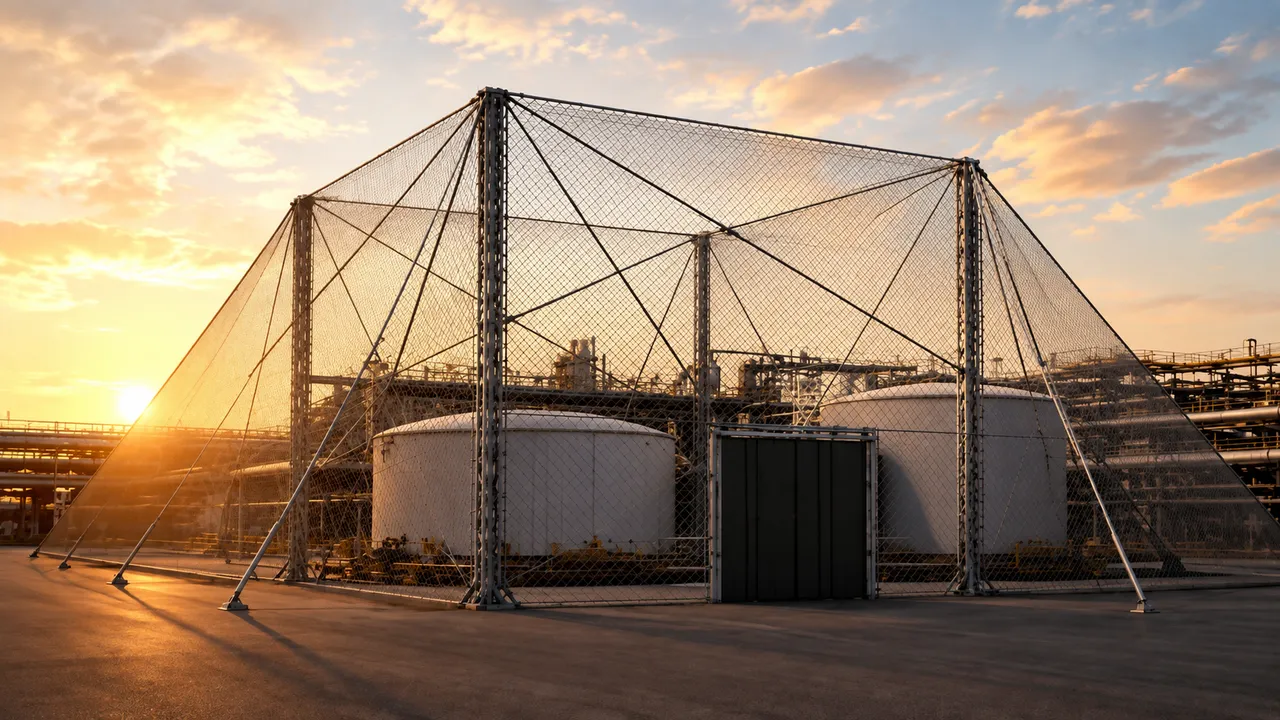
On July 15, Rostec unveiled the "Spiderweb" system for the first time. It was developed by RT-Project Technologies in collaboration with Standard Electric. The structure consists of load-bearing columns, a power grid, and supports. It is assembled on-site with bolts, without welding: for a fire-hazardous facility, this is a practical advantage, not a marketing gimmick.

Rostec claims the basic configuration is capable of stopping UAVs weighing up to 200 kg at speeds of up to 250 km/h. However, there is no publicly available independent test protocol for this. The official statement states that tests of resistance to various types of UAVs are ongoing. The product status is trial operation at an unspecified number of fuel and energy facilities. It is not intended for serial deployment nationwide, and protection against any aircraft of this weight has not been confirmed.

Nevertheless, the transition is important. The early object-based response looked like a collection of various meshes and cables. "Web" offers modularity, factory coating, design documentation, and the elimination of welding during installation. Russia has approached a standard industrial product. It's just that it arrived two years after the start of mass inspections of oil refineries using long-range strikes.

Scale is an explanation, not an indulgence.


According to EIA data, five refineries, concentrated in three clusters, were operating in the UAE as of January 2026. According to the "World Refinery Capacity by Country" table in the "OPEC Annual Statistical Bulletin 2025," Russia's nameplate refining capacity in 2024 was approximately 5,8 times higher. An open-ended breakdown of the number of major Russian sites yields a roughly sevenfold difference. These include oil depots, terminals, pumping stations, and a trunk network extending thousands of kilometers.

Even the UAE isn't a single operator. The largest, Ruwais, is controlled by ADNOC, Jebel Ali by Dubai's ENOC, and VTTI and Ecomar operate in Fujairah. But the majority of the UAE's refining is concentrated in a single, super-large complex. A standardized solution within a single corporate group is easier to implement than one across several Russian companies, regions, and dozens of legacy systems.

There's a downside, too. Concentration speeds construction, but increases the cost of a successful strike. Russia's distributed nature complicates defense, but provides redundancy and the ability to reroute flows. Therefore, comparing countries based on photographs of frameworks is insufficient. Similar indicators are needed: the proportion of sealed tanks of the same type, cost per unit area, number of fires prevented, discharge volume preserved, and recovery time.

The UAE hasn't proven that it protects the entire oil infrastructure better than Russia. They've demonstrated something else: a single site can quickly go from visible construction to a visually completed framework. Russia discovered the physical principle earlier, but spent more time assembling the legal and industrial route. In the summer of 2026, the legal and industrial basis for the accelerated route was finalized. Its actual speed is still unknown. The cost of the previous delay was the time it took each company to reassemble the chain. Now, two metrics are needed. The first is the number of days from the site's inclusion in the list to the acceptance of the protection. The second is the consequences of an actual hit: did the framework prevent a fire and shutdown, and how long did it take to restore it. Speed ​​without results proves little.
37 comments
Information
Dear reader, to leave comments on the publication, you must sign in.
  1. + 23
    25 August 2026 04: 08
    I'm more than sure the oil companies have the means to build something like this, but our main/mortal enemy is working at 100 percent - the CIA's sabotage manual, dating back to 1944, works like clockwork without fail:
    - Assign the most important work to underperforming employees. (Hello, ChF)
    - Demand perfection for minor tasks, be picky about details. (Hello, drone localization requirements)
    - Give incentives and raises to the worst performers, and discriminate against the good ones. (Shoutout to the old man who shot at a passing enemy drone and was fined and had his gun confiscated.)
    - Convene endless meetings and committees on every minor issue. (Hello, drone technology councils, of which there are three a week)
    - Work as slowly as possible, relying on awkward tools or outdated equipment.
    - Require approval for every little detail through formal channels and a long chain of command. (Hello everyone!)
    - Ask again and clarify obvious things, slowing down the work process.
    - Pretend not to understand the task or create confusion in the documentation.
    1. -2
      25 August 2026 07: 01
      It turns out that, as always, the salvation of the drowning is the work of the drowning themselves.
      Your gasoline - our ideas.
      1. +3
        25 August 2026 13: 49
        Quote: ZovSailor
        It turns out that, as always, the salvation of the drowning is the work of the drowning themselves.

        No, now the work of the drowning people themselves is regulated by the State and the slightest violation becomes a criminal offense.
    2. -6
      25 August 2026 09: 48
      Does the CIA appoint incompetent people (including the Black Sea Fleet)?
      Has the CIA introduced drone localization requirements?
      Is the CIA suppressing those who show initiative and courage?
      Is the CIA holding endless meetings and planning sessions here?
      I won't even mention the fact that... The CIA gave the order to launch the SVO? The CIA decided that Ukraine's military potential was nonexistent and that Russian forces were capable of quickly restoring a loyal government to Ukraine?
      1. + 16
        25 August 2026 10: 09
        not the CIA, but an agent of influence loyal to the CIA.
        Are there any incompetent, all sorts of ******** like Sukhrab Akhmedov?
        Do we have heavy copters? No.
        Do we have unmanned boats? No.
        Are there any meetings declaring that back-up and heavy-duty copters are needed?
        Do these meetings produce results? No.
        Are we striking bridges? There was a strike recently, but insiders say it was an accident. Apologies and promises that it won't happen again are flying across the front to the West, so no.
        1. 2al
          +1
          25 August 2026 15: 54
          Specifically, there were two strikes on the bridge in Zaporizhzhia, with an interval of two weeks, but only the second strike hit.
        2. -1
          25 August 2026 22: 45
          Quote from iommy
          Are we striking bridges? There was a strike recently, but insiders say it was an accident. Apologies and promises that it won't happen again are flying across the front to the West, so no.

          The apology part is certainly a serious argument. Were the apologies sent by pigeon post? Did you intercept them?
          How many times has the bridge in Zatoka Odeska been breached? They recently breached it on August 1st, and a span collapsed. Doesn't that count?
          On August 9, in the same place in Odessa, an important bridge was built in the area of ​​the village of Mayaki.
    3. 0
      25 August 2026 10: 59
      Russia has had two eternal problems, both under the Tsars and since. This is the first. The second has, for better or worse, been addressed; the roads are much better than they were 20 years ago, even with the first problem.
  2. -4
    25 August 2026 05: 31
    The question is, how will these defensive structures help against a ballistic missile attack? Given the infusion of "Western partners," Ukraine's offensive capabilities are growing every day. Strikes on our cities in 2022 were considered a fantasy, but now they've become commonplace. I have no doubt that if things continue as they are, ballistic missile strikes are just around the corner! Those who defend are at a disadvantage compared to the attacker, so we won't win the war by defending!
    We need to finally stop coddling the Ukrainians. It's time to thin their ranks—create a field of controlled anarchy, and let them vie for power! The Ukrainian political landscape is far from homogeneous, so the principle of "divide and conquer" is entirely applicable!
    1. + 13
      25 August 2026 07: 13
      How will a helmet and body armor protect against a 120mm mortar round? So let's not hand out helmets; they won't save anyone anyway.
    2. 0
      25 August 2026 17: 39
      Quote: ANIMAL
      It's time to thin out their numbers - creating a field of controlled anarchy, let them gnaw at each other for power!

      Let them not gnaw at each other – whoever the US appoints to oversee the money will be the one in charge. Everyone else will get a small share – and that's it...
      The mayor of Kyiv has been in office since Maidan (12 years!!) - and practically none of those people remain in politics.
      Sashko Bily opened the presidential doors with his feet - but barely touched the financial flows and immediately committed suicide with a shot to the temple and back of the head - from an automatic rifle lol
    3. 0
      25 August 2026 22: 51
      Quote: ANIMAL
      The question is, how will these defensive structures help in the event of a ballistic missile strike?

      There's only one passive defense against ballistics: building facilities deep underground. Existing facilities can only be protected with defensive structures against UAVs and possibly cruise missiles, and even then, only with active air defense coverage. Incidentally, Rostec's "Spiderweb" system might not stop a winged Flamingo, but it will certainly alleviate the problem of the notorious UAV "debris."
      Ballistic missiles are already the domain of missile defense.
    4. +1
      26 August 2026 07: 41
      And it’s high time to start working on the adjacent areas, from whom it comes.
  3. -4
    25 August 2026 06: 15
    Yes, everything is fine... "There" it is bad and miserable... But for me, "there" is so-so, but here it is... Looking for excuses, shifting the blame onto the neighbors, in order to justify a complete failure... Well, that's just not so good sad
  4. +9
    25 August 2026 07: 29
    The customer, estimated load, power grid material, type of stored product, and industry protection program are not visible.

    And also what to hit them with. Had a good laugh.
    Federal Law No. 192-FZ, published on June 26

    That's the thing. And it took people 100 days. We live in a highly bureaucratic country, and as practice shows, all these regulatory bodies are fictitious. Well, more than 50% for sure.
  5. 0
    25 August 2026 08: 18
    Building hangars and drone shelters doesn't solve the main problem: the vulnerability of these facilities. A comprehensive set of protective measures is needed, including a layered air defense system. Furthermore, it would probably be useful to recall the experience of WWII, when decoy facilities were built and real facilities were camouflaged.
    1. +2
      25 August 2026 10: 02
      During WWII, there was no 24/7 online satellite surveillance from various angles and under cloud cover. Now, all facilities are available on Google Maps, and new construction can be monitored in real time.
      1. +2
        25 August 2026 10: 22
        During WWII, aerial reconnaissance was also conducted regularly, but this didn't prevent camouflage efforts. Yes, we have satellite reconnaissance now, but camouflage hasn't been abolished, and it's still used.
        It is possible to monitor the construction of new ones in real time.
        For such a case, it is possible to use quickly erected models of buildings and structures that can be deployed on site while the enemy satellite is either blinded by electronic warfare equipment or the area is out of its visibility zone. hi
        1. +4
          25 August 2026 10: 47
          Yes, it's possible. Which official (including the military) would undertake such a task in Russia's current reality? My compact acoustic radar, based on the principle of reducing the speed of sound in a horn, hasn't interested anyone. Absolutely no one.
          1. -1
            25 August 2026 11: 17
            Which specific officials (including military ones) will undertake this in the current realities of Russia?
            Your project is probably a pittance in terms of cost, but our oligarchs need scale to harness billions of budget funds.
            1. +1
              25 August 2026 13: 47
              Not quite. The retail cost of materials is in the range of 15-30 rubles. Assembly and labor will cost about the same. Therefore, the "selling price" of the product is in the range of 150-300 rubles, taking into account taxes, margins, and the salaries of management and other administrative and economic staff. This roughly corresponds to a cost-to-price ratio of 1:10 on average in Russia; otherwise, it's impossible to survive.
              Considering that this is a radar for the long-range detection of UAVs with internal combustion engines (Lyuty, Bobr, etc.) at a range of 8-10 km in calm conditions and/or during atmospheric inversion, with an outer hemisphere size of up to 1.5 m (essentially a WWII-era acoustic detection station, only with electronics), the production volume can be estimated at thousands of units for the target and frontline zones with a 5-6 km increment in a checkerboard pattern.
              P.S. I actually came here hoping to find someone who could build a prototype and verify the calculations, as I couldn't do it myself, despite all the parts being readily available at retail.
              The PPS can be recalculated for UAVs with BLDC (quad, hexa, and other copters), but I don't have any data on them: noise spectrum, frequencies, harmonics, and radiation power. It's easier with internal combustion engines; their brands are well known. The dimensions might even be 1.5 times smaller.
              The math is typical for DSP processing; it's even available in ready-made C/C++ packages for microcontrollers. You can code it in a day, no problem. Debugging it on a breadboard takes about a week, I don't think more.
              1. 0
                26 August 2026 12: 08
                Quote: Arhat109
                P.S. I actually came here hoping to find someone who could build a prototype and verify the calculations, as I couldn't do it myself, despite all the parts being readily available at retail.

                Maybe that's why you're failing to interest anyone? You need a working example.
          2. 0
            26 August 2026 11: 56
            Quote: Arhat109
            My compact acoustic radar, based on the principle of reducing the speed of sound in a horn, attracted no interest. No one at all.

            Sadly, not every specialist understands the need for such devices. After all, it's crucial to understand how they fit into the overall air defense system. For a single, unprotected air defense facility, such as a warehouse, the device is essentially useless, as a drone's 2-3-minute flight time wouldn't even allow for evacuation, while it would give a mobile task force crew the time to prepare and shoot down the drone.
            Have you tried contacting your regional ONF or the unmanned systems operator training center? Sometimes you'll find understanding and interested people there who have worked with promoting the production of certain devices.
  6. +5
    25 August 2026 10: 49
    Let me give you an example: I work in a company with state participation, under Federal Laws 223 and 44. So, in order to purchase any service or product ranging from 20,000 to 500,000 rubles, you have to hold a tender among suppliers with a ton of supporting documents, then go through ten circles of hell getting approval from higher-ups, and finally, when everything is settled, the supplier says, "My prices have changed"—this happens quite often. And then it all starts over again... That's how the bureaucratic machine works. fool
    1. +1
      25 August 2026 11: 02
      Let me give you an example: I work in a company with state participation, under Federal Laws 223 and 44. This applies to purchasing any service or product ranging from 20,000 rubles to 500,000 rubles.

      everything is so...
      And for 223 - for purchases of 20 thousand rubles, do you also conduct competitive procurement?
      1. -1
        25 August 2026 13: 53
        Quote: Dedok
        And for 223 - for purchases of 20 thousand rubles, do you also conduct competitive procurement?

        Naturally. Everyone does. You didn't know about this?
        1. +2
          25 August 2026 14: 38
          Naturally. Everyone does. You didn't know about this?

          No, I didn't know...
          Federal Law No. 223-FZ itself does not establish a fixed limit of 100,000 rubles or a list of cases for direct contracts—the customer specifies all parameters locally.
          - According to Part 4 of Article 4 of Federal Law No. 223-FZ, information on purchases worth up to 100,000 rubles (or up to 500,000 rubles For large customers) it is not necessary to post it in the Unified Information System if this is stipulated in your Procurement Regulations.
          - Competitive procedures are not required for such amounts; the contract is concluded directly.
      2. 0
        25 August 2026 15: 08
        And for 223 - for purchases of 20 thousand rubles, do you also conduct competitive procurement?

        YES ! am
        1. +1
          25 August 2026 15: 09
          YES ! am

          You have a strong bureaucracy, as I see...
          1. 0
            25 August 2026 15: 14
            Not that word...
            The text of your comment is too short and in the opinion of the site administration does not carry useful information.
  7. +5
    25 August 2026 11: 58
    It seems to me that all these federal laws and tenders are a gold mine for any intelligence agency in the world. A simple analytical analysis, and everyone knows everything about what will be built and where. It feels like they've deliberately hooked us on this so they can know everything about us.
    1. 0
      25 August 2026 15: 11
      It seems to me that all these federal laws and tenders are a Klondike for any intelligence agency in the world. A simple analytical analysis, and everyone knows everything about what will be built and where. It feels like they've deliberately hooked us on this so they can know everything about us.

      And that's not all: who, until recently, conducted audits of companies not only of our oligarchs, but also of the so-called sovereign's?
      and how long ago did you refuse their services?
  8. 0
    25 August 2026 13: 33
    — Number of objects, percentage coverage, tonnage of structures?
    — Precise engineering and statistical data on the large-scale construction of protective structures in the UAE are highly classified military information. Official Emirati agencies (including the Ministry of Defense and ADNOC) do not publish detailed estimates.
    However, based on analysis by OSINT researchers, Maxar/Planet Labs satellite images, and leaked footage, experts provide the following calculated and verified figures.

    1. Number of objects (Locations)
    2. Percentage coverage
    Among attacked and high-risk objects: ~80–90%. All key nodes
    3. Tonnage of structures (Engineering estimates) laughing
    4. Using structures as blanks for gunning
    The idea of ​​using the constructed anti-drone frames as reinforcing bases (prefabricated structures) for shotcreting (the application of concrete under pressure) is technically sound. Heavy-duty mesh "cages" can quickly be used to form full-fledged reinforced concrete bunkers or permanent caponiers.
    The use of this construction technology radically changes the level of protection of objects.
    1. 0
      26 August 2026 10: 02
      smile Compared to the scale of Dubai construction, the entire project to strengthen anti-drone frames with shotcrete is equal in volume to concrete about 1/4 of the Burj Khalifa or two medium skyscrapers with 50–60 floors.

  9. +4
    26 August 2026 07: 48
    Officials must be punished for successfully damaging targets. Funds will be found immediately, no one will interfere with construction, and the legal framework will be quickly amended.
  10. +1
    26 August 2026 10: 46
    Quote: Pankrat25
    Officials must be punished for successfully damaging targets. Funds will be found immediately, no one will interfere with construction, and the legal framework will be quickly amended.

    Place them on the roofs of objects with double-barreled guns and tie them to a chain by the leg.
  11. 0
    31 August 2026 18: 32
    In fact, everyone forgot that the nets appeared in Iran, in factories producing drones.