A little about scramasax
5 757 24
A little about scramasax
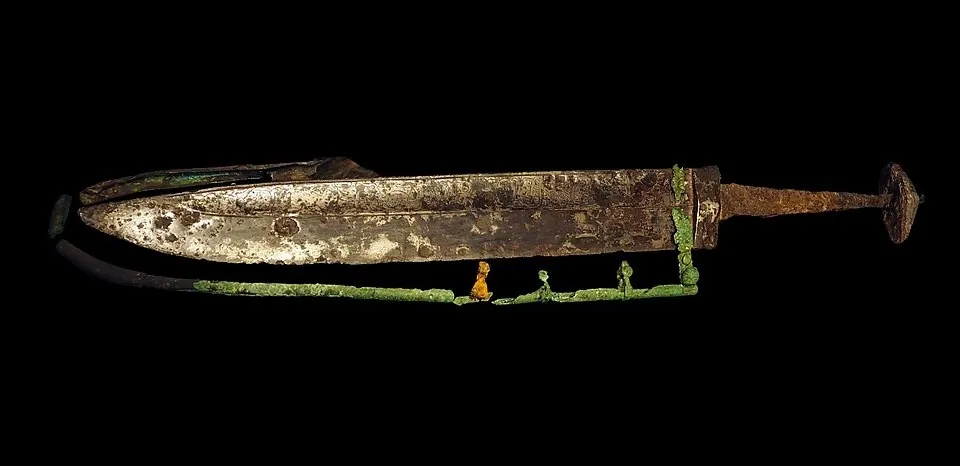
Scramasax. Around 560 to 630. Cantonal Museum of Archaeology and storiesLausanne


"When the Saxons rebelled this year, King Chlothar sent troops against them and destroyed most of them. He marched through Thuringia and devastated it because it had provided aid to the Saxons."
History of the Franks. Book IV. Gregory of Tours, Bishop

History weapons. Since a number of VO readers have asked me questions about the scramasax, it makes sense to answer them first and then return to "sword notches." Incidentally, I have a very amusing memory associated with this ancient weapon.


It so happened that at one time I had a very good, friendly relationship with Mikhail Gorelik—a renowned historian, art critic, and an exceptionally knowledgeable man (may he rest in peace!). So one day, I was visiting him, and he was showing me the new gun replicas he'd made and telling me that not long ago, a Moscow reenactors' club had invited him to tell them about his work. He arrived and saw a notice on the wall: "Scramasax test tomorrow at..." He asked how that could be, since nothing was known about it except that it existed. "But we... reconstructed how it was used..." He turned to these "experts" and left.

Since then, the topic of scramasax has intrigued me immensely. Has history really preserved nothing about it for us except its name? And now, it turns out, there is something!

The name itself was born thanks to the historian Gregory of Tours: in the 6th century he wrote that the Frankish king Sigebert was attacked with the help of "powerful knives, commonly called scramasaxes"But it's clear that he left us no description of the appearance of these "powerful knives." But if it was a knife, that means it had a single-edged blade. Several similar blades were found and later identified with the scramasax. The most famous example of this type of bladed weapon was discovered, quite by chance.

This is the so-called Thames Scramasax (also known as the "Beagnot Sax"). Dating back to the 9th-10th centuries, it is decorated with an intricate pattern of copper, bronze, and silver wire inlay, and its blade bears a runic inscription with the name of its owner or smith. And it was discovered entirely by chance...


The Thames Scramasax. British Museum

It so happened that Henry Briggs, a laborer who worked cleaning the banks of the River Thames near Battersea (a residential area in south London), repeatedly found various artifacts in the mud and silt, which the British Museum eagerly purchased from him. So, despite his unskilled work, Briggs was a man of intelligence and at least some understanding of his finds, and most importantly, he knew who to offer them to! It's ironic that between 1843 and 1867, he sold no fewer than 43 different finds to the museum, meaning he contributed to science as much as some qualified archaeologists!

So, in early 1857, Briggs made his next discovery—he found a short, but clearly very old, sword in the mud, which he promptly sold to the museum. On May 21, 1857, it was put on display at the Society of Antiquaries of London for appraisal. It was decided that it was a blade. "resembling the Frankish scramasaxes, examples of which are very rare in England, and having a number of runic characters inlaid with gold"It was then that it began to be called the "Thames Scramasax," although the term "scramasax" itself appears only once in the works of the Frankish historian Gregory of Tours and is not described in any way. However, since the true meaning of the "scrama" part of the word was unknown, most researchers began to call the sword simply a "long seax."

The artifact found in the Thames was an iron blade with a single cutting edge. It measured 721 mm in length, of which the blade itself measured 551 mm from tip to heel, and the tang 170 mm. The blade had a maximum width of 38,7 mm and a thickness of 8,2 mm. It weighed 985 grams. This makes it a fairly heavy weapon—and would have been even heavier had it included a hilt and pommel. However, the hilt was missing. It was likely made of wood.

On both sides of the blade, a deep fuller could be seen, above which was a rectangular band with copper inlays. On the other side, this band was filled with a pattern of asymmetrically arranged diamonds made of silver and copper wire.


Inlay with runic symbols ᛒᛠᚷᚾᚩᚦ

On the opposite side of the blade, symmetrically to the patterned band, were two runic inscriptions, inlaid with brass and silver. The left inscription contained twenty-eight letters of the Anglo-Saxon runic alphabet. The right inscription, separated from it by a diamond pattern, was none other than a proper name: ᛒᛠᚷᚾᚩᚦ (Beagnoþ or Beagnoth, Russian ≈ Beagnot). This is why he became known as "Sax Beagnot." Australian-British professor Ralph Elliott, an expert on ancient British runes, suggested that this blade was wielded by a noble warrior from the Kingdom of Kent, since the runic alphabet there contained exactly 28 symbols, while the Northumbrian runic alphabet had three more.

Furthermore, two individuals named Beagnoþ or Beagnoth are recorded in Kent. One is mentioned in the Anglo-Saxon Chronicle during the reign of King Eardwulf of Kent (748–767), who granted him grazing rights near Rochester. The second was a monk mentioned in the Chronicle of King Æthelwulf of Wessex as a participant in one of the Synods of 803. Interestingly, in Old English, the word beag means "ring, bracelet, wreath," while nōþ means "courage, prowess." Together, they can be translated as "ring" or "wreath of good fortune."

The scramasax is a medieval bladed weapon, often referred to as a "great sax." Essentially, it's a cross between a large fighting knife and a short sword: long and massive enough to be effective in close combat, yet not as bulky as a full-sized sword.

In general, the scramasax was a fairly narrow blade (about 2–3 cm wide), but very thick at the spine. Its thickness at the spine could reach 1 cm or more. From tip to spine, there was a noticeable bevel (false edge), which clearly increased its penetrating power and allowed for powerful thrusting blows, possibly even penetrating chainmail or leather armor. The blade could have a fuller—a longitudinal groove that increased its rigidity and somewhat reduced its weight.

The scramasax handle could be either straight or slightly curved, and it had no guard. The handle was at least 10 cm long, ensuring a secure grip. The handle was most likely made of wood, but materials such as bone and horn could also be used. And why not? It was mounted on the tang of the blade, after which the end of the tang was riveted or bent to secure it. The handle could be decorated with decorative elements, such as carved animal heads, which also had a sacred meaning for the Scandinavians.

The scabbard was made from a piece of thick cowhide, folded around the blade and then stitched together. Metal plates (either bronze or silver-plated) could be placed along the seam, to which rings were attached, allowing the scabbard to be hung from a belt.

The scramasax became widespread during the Migration Period and the early Middle Ages (roughly from the 5th to the 11th centuries) in Northern and Central Europe, among the Baltic peoples, and in Ancient Rus' (in the 10th century). It was carried as a secondary weapon, often alongside a sword (such as a spatha), and in some cases, it could replace it. It was especially prized in close, chaotic encounters—in narrow corridors, in crowds of combatants, and among shields, where a long sword would have been a hindrance.

Besides combat, the scramasax was widely used in everyday life: it was used to butcher game, chop branches for shelter, and perform various household tasks. In some cultures (for example, the Anglo-Saxons), owning such a knife was considered a sign of freedom.

Based on blade size, there are two main types: long (langsaxes, 38–63 cm) and short (kurzsaxes, the majority of finds are no longer than 25 cm). Longer blades likely originated in the Byzantine-Sassanid zone, while shorter blades evolved from late Roman and possibly Germanic combat knives.

Over time, as armor developed and became more widespread, such as chain mail, the effectiveness of the scramasax as a primary weapon significantly decreased—the heavy blade could no longer effectively penetrate their defenses.
24 comments
Information
Dear reader, to leave comments on the publication, you must sign in.
  1. +5
    4 September 2026 07: 07
    I greet everyone hi And so we come to what's called a scramosax! Having owned one, I can say it's a working tool. I certainly wouldn't risk using it for butchering animals, but as a utility tool, it's excellent. I haven't tested its combat capabilities (it's a bit too large and doesn't fit into the concept of modern knife fighting), so I basically use it as a small machete. It was widely used in Rus'. Here's the "Ushkuynik" knife from my collection!
    Thanks to Vyacheslav for the article. It's a complex topic—we'll read the comments!
  2. +2
    4 September 2026 07: 45
    The material is interesting. Perhaps scramasaxes were a cheaper tool made of raw iron, while swords were forged from specially smelted steel or using Damascus forging. That explains the centimeter-thickness.
    1. +2
      4 September 2026 07: 52
      Quote: novel xnumx
      and the swords were forged from specially smelted steel

      Steel smelting began in the late 18th century, using crucible smelting. At that time, steel was produced by forging sponge iron.
    2. +3
      4 September 2026 08: 17
      A blade with a single cutting edge is much easier to forge than one with two. Especially a straight one. Any village blacksmith can handle it. Hence its affordability. Besides, it was used primarily for thrusting, meaning the demands on the quality of the material are much lower. Those Roman legionary gladii were also, for the most part, complete junk. Unlike the spatha. What's the point of using good, expensive steel for such a weapon?

      No, scramasaxes of good quality and luxury are also found, but these were apparently made for nobles as traditional weapons, following the dictates of their ancestors. The vast majority simply haven't survived, precisely because of the quality of the material. It deteriorates very quickly, and it's not a shame to reforge it into something useful. A combat blade became a knife or a work axe. The same applies to swords, though. And it was the same everywhere—the overhyped katanas are also, for the most part, complete rubbish, with the exception of rare blades from famous craftsmen that cost as much as a modern aircraft carrier. These are the ones that sit in museums and collections, creating a legend of superb quality.
      1. +4
        4 September 2026 08: 54
        Quote: paul3390
        These are the ones that lie in museums and collections, creating a legend of super quality.

        Moreover, they are located mainly in the USA and Europe, taken as trophies from the Japanese. Example:
        A tachi sword that belonged to the daimyo Fukushima Masanori (1561–1624) is currently in Ukraine. The right to dispose of this unique sword (valued at approximately $100 million) has been granted to the Tamoikin Art Fund Museum.
        Sword story
        The blade came to its current owner as a trophy: it was found and taken as a gift by the grandfather of S. Trepshin's wife during the Great Patriotic War in the Far East. Since 1945, the sword remained in Poland for a long time, from where it was "traveled" several times to be shown to collectors and specialists in England, Russia, and Ukraine. According to some reports, it has also been in Lithuania since the late 1990s.
        1. +5
          4 September 2026 10: 20
          Quote: Hunter 2
          mainly in the USA

          In Japan, the Tokyo National Museum also has plenty of them!!!
      2. +4
        4 September 2026 10: 19
        Quote: paul3390
        creating a legend

        Very good comment, Pavel! It's nice to read such things.
      3. +3
        4 September 2026 10: 29
        Quote: paul3390
        The hyped-up katanas are also, in the overwhelming majority, complete rubbish, with the exception of rare blades from famous masters

        Here I'll allow myself to disagree entirely... the question is rather what is considered not "crap" - a katana is primarily a "cutting" weapon and, being overheated, without tempering the surface layer, it breaks relatively easily, but does not bend "over the knee" like swords made of raw iron
        P.S. It's also worth considering that this was a mass-produced weapon (an army of 100 samurai was nothing exceptional), and such a quantity, in principle, cannot have the quality of a single-piece weapon.
        1. +2
          4 September 2026 15: 11
          The samurai's primary weapon is a bow. In a pinch, a spear in any form.
          1. +5
            4 September 2026 16: 54
            Quote: paul3390
            This is actually an onion.

            "Bow and arrow! They alone are the stronghold of our country" - Japanese haiku
          2. +4
            4 September 2026 17: 40
            hi
            "Don't strive for every warrior to have an expensive sword. For the same amount of money, you can buy many spears—and then your flank will be invincible." (c) Asakura Toshikage

            "You shouldn't be overly eager to acquire swords forged by outstanding masters. The reason is that even if you have a sword worth 10,000 Ryo, it won't be able to defeat a hundred spears (it can be defeated by a hundred spears whose value is insignificant compared to its price).
            If you spend these 10,000 Ryo to buy a hundred copies and distribute them to a hundred people, you will be able to protect an entire flank."
            (c) Asakura Soteki
  3. +2
    4 September 2026 10: 33
    The blade could have a fuller - a longitudinal groove that increased its rigidity and at the same time somewhat reduced its weight.

    weight - yes, but I beg to differ that the material selection increases rigidity... it might also help to pull it out of the body (bleeding), but still, nothing more

    P.S. And for the new details - thanks and respect!
    1. +5
      4 September 2026 11: 26
      A fuller doesn't increase rigidity, as you've correctly noted. But if you take two blades of the same mass (or, equivalently, the same cross-sectional area), one with a fuller and the other solid, the bending moment of the fuller will be higher. This is why I-beams are used in construction rather than solid steel beams. An I-beam can be called a fuller beam. wink
      1. +2
        4 September 2026 12: 36
        Quote from Andy_nsk
        If you take two blades of the same mass (or, equivalently, the same cross-sectional area), one with a fuller and the other solid, then the moment of resistance to bending for the blade with the fuller will be greater

        So I (like the author) noted - to reduce weight... something that has minimal damage to rigidity, I assumed as self-evident, i.e. there is damage, but it is minimal with a noticeable reduction in weight... just "in simple terms" - a solid blade of the same dimensions (width x thickness, not to be confused with equal cross-sectional area) will still be somewhat stiffer, but also heavier
        P.S. This is the point of an I-beam: with the same cross-sectional dimensions (load resistance arm), its area (mass) in this case is much smaller - the point is a noticeable reduction in material consumption and mass with a slight weakening of load resistance
      2. -1
        4 September 2026 14: 44
        If one is fuller and the other is solid, the bending moment of the fuller will be higher. This is why I-beams are used in construction rather than solid steel beams. An I-beam can be called a fuller beam.

        Cool logic. If the bending moment of a fullered blade is greater than that of a solid blade, then, following this logic, to maximize the bending moment, we need to maximize the fuller. By bringing the fuller size up to the blade's dimensions, we'll get the most rigid weapon possible. Yay!
        1. +2
          4 September 2026 16: 29
          Read the whole phrase and you will see normal logic, the condition is stated there: THE SAME CROSS-SECTIONAL AREA.
          1. 0
            4 September 2026 16: 41
            Read the whole phrase and you will see normal logic, the condition is stated there: THE SAME CROSS-SECTIONAL AREA.

            It was a blacksmith's joke—sarcasm, in case you didn't get it. Knife customers regularly swoon at the word "bleed," and the conversation with them goes something like this: they, too, believe that a fuller makes a blade stronger.
            1. +1
              4 September 2026 16: 52
              If you're a blacksmith, you probably know that the term "blood flow" is heavily mythologized and has no basis in reality. Blood from a slaughtered animal flows perfectly well without a fuller. The purpose of a fuller is to lighten the blade and enhance aesthetics—what would we do without it? 😉
              1. 0
                4 September 2026 17: 04
                If you are a blacksmith,

                From time to time.
                But I was talking precisely about the established "knowledge" of most customers. There are many myths, absorbed somewhere, besides the "blood drainer"—the "mercury knife," the "super knife" made from a bloomery, and so on.
                1. 0
                  7 September 2026 06: 08
                  I would also add to this list the Cossack knife of the Plastuns, the knife from the valve, the Serbian knife, the karambit, etc.😃
  4. 0
    4 September 2026 12: 39
    So, no one really knows who the Saxons were. "Sax" in Anglo-Saxon simply means "knife." It's Anglo-Saxon because the Saxons always fought alongside the Jutlandic Angles, who had once arrived there with the Dacians (Danes). The Angles were a Slavic people; their descendants in Rus' were called Uglichs, while in Western Europe they were known as Shlezyaks, and they inhabited Danish Schleswig and southern Poland. The Saxons, in turn, became Germanized in Europe. During the conquest of Britain, their primary weapons were the battle axe and war hammer, while the Saxon knives were merely ceremonial weapons—the Sax for the common people, the Scramasax for the nobles.
  5. 0
    4 September 2026 14: 19
    This name for the combat knife "sax" is, in my opinion, very similar to another name, "shashik"—also a knife that gave its name to the long sabre knife we ​​know as the shashka. Perhaps the ancient peoples were more closely related, and the influence of Northern European knifemakers on the Caucasus, or vice versa, was significant.
  6. 0
    5 September 2026 00: 26
    When the Saxons rebelled this year, King Chlothar sent troops against them and destroyed most of them. He marched through Thuringia and devastated it because it had provided aid to the Saxons.
    ».
    King Chlothar was a wise statesman. He understood how things worked. Not all these SVOs.
  7. 0
    29 September 2026 13: 10
    "...made it possible to deliver powerful piercing blows, possibly even penetrating chain mail or leather armor."
    How can you deliver such blows without a guard without the risk of damaging your hand?!