"Vikhr" vs. drones: an anti-tank missile as an anti-aircraft missile
8 704 44
"Vikhr" vs. drones: an anti-tank missile as an anti-aircraft missile
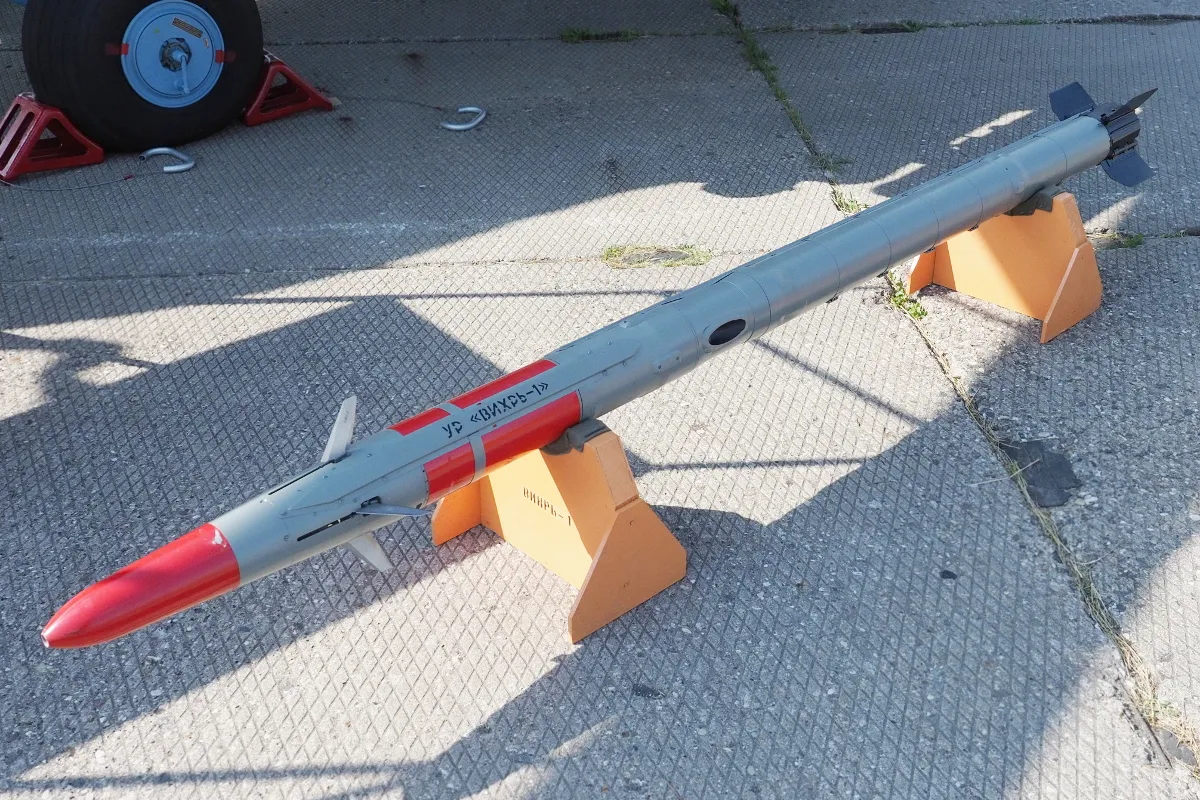
Rocket Vikhr-1. Photo: Wikimedia Commons


Nomenclature of domestic means of combating drones is constantly expanding. It was recently revealed that the 9K121 Vikhr anti-tank missile system has also been deployed for these missions. After minor modifications, the missile gained new capabilities and is now used to protect Russian airspace.


From an interview with the CEO of Kalashnikov


On August 10, the TASS news agency published a lengthy interview with Alan Lushnikov, CEO of the Kalashnikov Concern. The company's CEO discussed its key recent developments, their applications, and future development paths. He also discussed UAVs and counter-UAV operations.

Of particular interest is A. Lushnikov’s story about the expansion of tasks aviation The 9K121 "Vikhr" anti-tank missile system. According to him, due to the changing tactical situation, the system has been upgraded and is now used to intercept air targets.

The Vikhr and its missile were actively used during the special operation to destroy Ukrainian armored vehicles. As an example, the Kalashnikov CEO cited the events of 2023, when the 9K121 system made a significant contribution to countering the enemy's counteroffensive. Then the battlefield situation changed: according to Lushnikov, the widespread use of attack UAVs—along with combat losses and a change in tactics—resulted in a reduction in the enemy's armored vehicle numbers.

The concern responded to this in its own way. They voluntarily modernized the Vikhr missile, adapting it to attack drones in the role weapons "air - air".


Working with a missile in a transport and launch vehicle. Photo by the Russian Ministry of Defense.

According to the concern's CEO, the new modification of the Vikhr has already been deployed to the Army Aviation and is being used to defend Russian airspace. It boasts high combat performance and effectiveness. The anti-tank missile is claimed to be cheaper than specialized anti-aircraft munitions, although this claim requires clarification (see below).

The helicopter carrier itself also offers advantages. It is capable of searching for, pursuing, and attacking aerial targets. There are no plans to expand the range of carriers, for example by adding heavy drones: according to the concern, the helicopters are fully capable of fulfilling their intended missions.

The interview doesn't mention this, but the limitations of the chosen design are obvious. Laser beam guidance requires the carrier to continuously keep the target in its sights and "illuminate" the trajectory until impact. At maximum range, this locks the helicopter to the target for the entire duration of the missile's flight and keeps the vehicle within range of possible return fire. The issue of capturing small and slow-moving aircraft also remains open. drones the Shkval system, originally designed for high-contrast ground and relatively high-speed air targets.

The "cheapness" aspect isn't so simple either. The missile itself is indeed cheaper than an anti-aircraft missile, but when assessing the cost of interception, one must factor in the cost per flight hour of the carrier helicopter and the risk of losing the expensive aircraft. These factors can significantly reduce the savings on the munition.

So far, the Kalashnikov Concern has only announced the new modification; neither the missile itself nor its use have been demonstrated. New materials will likely emerge over time.

The complex and its modernization


The 9K121 "Vikhr" anti-tank missile system was developed since 1980 at the Tula Instrument-Making Design Bureau. It was intended for Su-25 attack aircraft and army aviation helicopters. The guided missiles were intended to engage various classes of armored vehicles, as well as airborne targets with limited flight speeds. In other words, the ability to engage airborne targets was built into the design from the very beginning—though at the time, "airborne targets" meant aircraft and helicopters, not drones.

The first version of the system was accepted into service in 1985. Almost simultaneously, development of the modernized 9K121M Vikhr-M began, officially entering service in 1990. However, economic and organizational difficulties in the early 1990s prevented its widespread implementation.


Ammunition on a Ka-52 helicopter. Photo by the Russian Ministry of Defense.

As has now become known, another modernization project was launched no earlier than 2023–2024. It has now been completed, and the upgraded missile has entered service with the Army Aviation. Whether this version of the system has its own designation remains unknown.

Products and components


All modifications of the Vikhr complex have the same composition of components:
  • guided missile 9M127 or 9M127-1;
  • launcher APU-6 or APU-8;
  • I-251 Shkval guidance and control system;
  • a set of tools for storage, maintenance, etc.


The missile is housed in a cylindrical body with a conical nose cone. The nose contains rudders, and the tail contains a stabilizer. These stabilizers fold inside the container for transport. The nose cone houses the warhead, followed by a solid-fuel motor; the tail contains the control equipment. The missile's key parameters are as follows:
  • length - 2,75 m;
  • case diameter - 130 mm;
  • rudder span - 240 mm;
  • stabilizer span - 380 mm;
  • starting weight - 45 kg.


The 9M127 is supplied in a 2,8-meter-long, 140-mm-diameter transport and launch container. The munition and container weigh 59 kg. Six or eight transport and launch containers (TLCs) are mounted on standard APU-6/8 launchers.

The solid-fuel engine provides flight characteristics suitable for combat missions. Below are reference data for the Vikhr-M:
  • maximum flight speed is about 600 m/s;
  • maximum range - up to 10 km;
  • launch altitude – up to 4000 m;
  • Flight time at maximum range is 26–28 sec.

The basic version has a shorter range - about 8 km.


Launch of a Vikhr missile. Photo by the Russian Ministry of Defense.

The Vikhr system uses laser beam guidance. A laser receiver is located in the missile's tail, and the autopilot processes the data from it.

The target is searched and tracked by the helicopter's instruments. Upon launch, a laser beam is directed at the target; the munition moves along the beam and automatically adjusts its course. This method ensures high accuracy and makes it difficult to jam the control channel, but requires the carrier to maintain constant target acquisition.

Depending on the modification, the 9M127 missile carries a warhead weighing between 8 and 12 kg. This tandem shaped charge is designed to defeat armored vehicles with explosive reactive armor; it can penetrate up to 1000 mm of homogeneous armor behind explosive reactive armor. A contact fuse is used for combat against armored vehicles.

Engaging air targets at subsonic speeds—up to 800 km/h, that is, enemy tactical aircraft—was envisioned in the original design. For this purpose, the missile was equipped with a proximity fuse. Officially, the details of the recent modification were not disclosed; it can be assumed that the proximity fuse was specifically affected—updated or replaced. This fuse detonates the warhead as it passes close to the target, compensating for a miss on a high-speed maneuvering target and damaging it with fragments.

The 9K121 Vikhr system is used on several platforms. It is carried by late-model Su-25 attack aircraft, as well as Mi-28 and Ka-52 attack helicopters. These platforms are equipped with Shkval systems and associated equipment as standard, and the required number of launchers are mounted under the wings.

New role


The Vikhr complex was created primarily for the destruction of tanksAnti-aircraft capability was also envisaged, but by this, they meant tactical aircraft and helicopters. The novelty of the current application is that this capability has been extended to combat UAVs, which are significantly slower than previous aerial targets.


The Vikhr system's use through the eyes of a pilot operator. Photo courtesy of Kalashnikov Concern.

The situation above the battlefield and in the rear has changed. Enemy aircraft are being successfully intercepted by anti-aircraft systems and fighter jets during the special operation. However, the threat from attack UAVs, including long-range ones, has increased.

Experience has shown that attack helicopters are highly effective against UAVs. They have suitable flight characteristics, a variety of detection systems, cannons, and air-to-air missiles. Alone or in combination with other assets, helicopters are capable of searching for and destroying UAVs in flight.

In addition to specialized weapons, the standard Vikhr anti-tank missile was also tested against drones. According to available reports, it generally performed well, but required further modifications to achieve better results.

The 9M127's performance in this new role is facilitated by several factors: its superior flight performance, proximity detonation capability, and a sufficiently powerful warhead. The guidance system itself also helps—all the complex electronics remain on the helicopter, not the missile.

History The "Vikhr" is an isolated but illustrative case: something already in the arsenal was adapted to address a new threat, rather than waiting for a specialized product. Independent combat data will reveal how effective this solution will be against mass-produced UAVs. These are not yet available.
44 comments
Information
Dear reader, to leave comments on the publication, you must sign in.
  1. +4
    13 August 2026 04: 58
    It's remarkable how Soviet designers always looked years ahead and developed weapons for a wide range of tasks.
  2. +2
    13 August 2026 05: 24
    All that remains is to install a small radar on the helicopter that could detect UAVs at least 100 km away, and we can say that the problem of guiding and destroying UAVs has been solved.
    1. +1
      13 August 2026 06: 34
      Quote: Vitaly_pvo
      The problem with targeting and destroying UAVs has been solved

      Not so. ATGMs are designed to engage stationary or slow-moving targets. A UAV target, compared to a tank, is fast and maneuvers in three dimensions, unlike a tank. Therefore, ATGMs lack developed aerodynamic surfaces, and their maneuverability is limited because it wasn't needed in the first place. ATGMs even miss tanks, as you can see in the videos.
      1. +1
        13 August 2026 07: 59
        The ATGM has another drawback: it lacks a remote detonation system and has a shaped-charge warhead, which isn't ideal for use against aerial targets, as accurately hitting the target is difficult even for the homing system, and a nightmare for the operator, given that the UAV doesn't stay stationary but constantly moves in three planes under the influence of the air. The ATGM's speed is too high, which basically prevents it from making any sudden maneuvers or taking into account all the target's movement parameters. Incidentally, the Pantsir surface-to-air missile doesn't have any super-maneuverability, resembling an ATGM, but its remote detonation allows it to hit the target.
        1. +5
          13 August 2026 09: 38
          Quote: Victor Sergeev
          The ATGM has another drawback: this missile does not have a remote detonation system, and its warhead is cumulative, which is not ideal for use against aerial targets, since accurately hitting the target is difficult even for the homing system, and for the operator it is a complete nightmare, considering that the UAV does not remain stationary, but constantly moves in three planes under the influence of the air.


          You probably didn't even read the article. Because it mentioned several times that the missile was originally developed to destroy airborne targets (helicopters and airplanes). So, it has ample maneuverability for destroying UAVs.
          The proximity fuse was also developed decades ago. It is designed to detonate the missile near the target and cause damage from the missile fragments.
          1. -1
            14 August 2026 23: 07
            Enough, these technologies were long lost with the collapse of the Soviet Union. The USSR even had anti-aircraft artillery with remote detonation, but where is all that now? The ability to produce large quantities at low cost—the key to military victory—has been lost. It's not profitable for businesses to produce large quantities cheaply. They want things like in the West: small quantities and very expensive ones, because Bentleys, yachts, and villas abroad are very expensive, and people want everything at once.
          2. +1
            15 August 2026 21: 47
            Quote: SergeyB
            You probably didn't even read the article. Because it mentioned several times that the missile was originally developed to destroy airborne targets (helicopters and airplanes). So, it has ample maneuverability for destroying UAVs.


            The Vikhr was never developed as an air-to-air missile. It has always been, and remains, an ATGM. It was developed as part of a competition for an attack helicopter to equip the Kamov helicopter. Furthermore, until recently, it was a refined ATGM, without even the range of warheads available to the Shturm, Kokoon, and Ataka. Because of this, this ATGM has not seen widespread use in the army. Our troops have plenty of ATGMs of various designs.

            As a UAV fighter, it has no future. A three-meter-long fool that requires constant target acquisition, moving, incidentally, at 100-200 km/h in three planes. And it's not really needed for that role. The Mi-28 and Ka-52 already have an air-to-air missile system. The Luchnik-V also has Igla and Verba MANPADS missiles. As a reminder, these missiles are homing and are already in mass production. Therefore, the described modernization is nothing more than Kalashnikov's attempt to somehow sell a rapidly aging product to the troops.
            1. +1
              17 August 2026 13: 05
              Quote: abc_alex
              Therefore, the described modernization is nothing more than an attempt by Kalashnikov to somehow palm off a rapidly obsolete product on the troops.

              I agree with you! They're trying to sell an obsolete product... just like the Kornet-BLA! Incidentally, the 9M227, a "continuation" of the 9M127 Vikhr-1, was once in development! This missile has a higher speed and range than the 9M127 (up to 12-14 km)... and is available in versions with a passive radar seeker (anti-radar version) and an IR seeker!
              1. 0
                19 August 2026 14: 51
                Quote: Nikolaevich I
                I agree with you! They're trying to sell an obsolete product... just like the Kornet-BLA! Incidentally, the 9M227, a "continuation" of the 9M127 Vikhr-1, was once in development! This missile has a higher speed and range than the 9M127 (up to 12-14 km)... and is available in versions with a passive radar seeker (anti-radar version) and an IR seeker!

                High speed = greater missile mass. And an infrared seeker with a range of 12-14 km is a completely different class of product: it requires an autopilot with an INS, a new guidance system, and target selection by the missile's seeker. The result would be an analogue of the Kh-39 LMUR.
                And you're wrong to think that about the outdated Kornet-UVA. I think the Kornet-UVA is the best means for destroying unmanned aerial vehicles in the Black Sea.
                On the contrary, we need to equip our troops and aircraft with precision-guided munitions with passive laser seekers and target illumination systems. Currently, we lack the precision to destroy a bridge with a single UMPK bomb, but if we equip the bomb with a passive laser seeker and illuminate the bridge support with a laser from a drone, the task of destroying bridges would be simplified.
                1. +1
                  20 August 2026 19: 27
                  Quote: Cympak
                  I think the Kornet-BLA is the best means for destroying unmanned aerial vehicles in the Black Sea.

                  I meant that the Kornet-UAV in air-to-air mode is a poor option!
            2. 0
              19 August 2026 14: 41
              Quote: abc_alex
              As a UAV fighter, it has no prospects. A three-meter-long fool that requires constant target acquisition, moving, incidentally, at 100-200 km/h in three planes.

              The US military and its allies would disagree. They praised the APKWS's ability to shoot down drones. While the APKWS has a slightly different guidance system (a semi-active seeker), the principle is the same: the carrier tracks the target and guides the missile to its target until the moment of impact.

              The Mi-28 and Ka-52 already have the Luchnik-V air-to-air missile system with Igla and Verba MANPADS missiles.

              Again, this is debatable. The US military and its allies also have MANPADS, but they prefer to use AR-WAS against fixed-wing attack UAVs. There could be several reasons:
              - MANPADS are objectively more expensive
              - It is difficult for MANPADS IR seekers to capture UAV emissions, especially with electric motors
              - MANPADS require precise positioning and target acquisition before launch so that the IR seeker can lock onto the target.
              1. 0
                23 August 2026 02: 24
                Quote: Cympak
                The US military and its allies would disagree. They praised the APKWS's ability to shoot down drones. While the APKWS has a slightly different guidance system (a semi-active seeker), the principle is the same: the carrier tracks the target and guides the missile to its target until the moment of impact.


                Sorry, but I don't give a damn about the Americans and their inventions. Who knows what they dreamed up with a trillion-dollar budget. They were mass-producing million-dollar armored rakes in Afghanistan, but they turned out to be worthless crap, and everyone abandoned them there.
                A semi-active seeker, if I understand correctly, doesn't require manual guidance; it only requires "illumination" from the carrier. For example, a radio signal. The missile's seeker detects the reflected signal and guides itself. I don't understand what's so good about that?
                MANPADS are a proven and relatively inexpensive option. They have minimal electronics, completely passive guidance (the carrier doesn't illuminate), and are readily available for mass production. If we want to develop a system here and now, this is the only available option. If we have to do it later, we could try again to build it "like the Americans." In 10 years, it will become clear that it doesn't work. Just like with the modular ships.
                My opinion is that in the years since the collapse of the USSR, the US military industry has done so much nonsense with a monstrous budget, and has failed so badly in all areas, that relying on its decisions is utter stupidity.

                Quote: Cympak
                Again, this is debatable. The US military and its allies also have MANPADS, but they prefer to use AR-WAS against fixed-wing attack UAVs. There could be several reasons:


                They're not in use yet. They've just tested them. And I repeat, we already have a system for MANPADS. It's fully integrated. The Luchnik [Luchnik] is already in use on helicopters and is available in prototypes for ships and ground vehicles. But laser-guided NURSes still need to be developed and tested, just as the aiming and guidance system needs to be developed and tested. And here I'd strongly argue which will ultimately be more expensive: the mass-produced Verba MANPADS or the newly developed NURSes with homing heads.
                Why don't the Americans use MANPADS? Because they don't know how. They don't have such systems; they haven't made them. They either didn't think of it or didn't have to. Ours also thought about an automatic launch system for MANPADS out of necessity, and initially developed the Dzhigit. And then they/it evolved into the Archer. But we have one. Why should we abandon our own ready-made systems and, like foolish children, imitate the Americans? What have they demonstrated that's outstanding in the fight against drones?

                Quote: Cympak
                - It is difficult for MANPADS IR seekers to capture UAV emissions, especially with electric motors

                No. The process is automated, and the capture is performed by the OLS. It also accompanies the drone until launch.
                Quote: Cympak
                - MANPADS require precise positioning and target acquisition before launch so that the IR seeker can lock onto the target.

                The Archer isn't a frame for a MANPADS. It's an integrated targeting and launching system. It includes a powerful optical sighting system, a computer, and a missile preparation system.
                The Gibka-S variant is supplemented with a radar for primary target acquisition. This makes the system highly automated. The radar provides initial spatial monitoring, OLS guidance, and tracking until the missiles lock on to the target. The Mi-28M and Ka-52 already have radars, and the Luchnik is already integrated into their PNK. There's no need to reinvent the wheel. And there's certainly no need to convert an ATGM into an air-to-air missile.

                By the way, the Americans, while notorious for their slightly inadequate projects of recent years, don't fire ATGMs at UAVs. The APKWS you're promoting is, after all, a NURS equipped with a guidance unit. A NURS, not an ATGM. That's why the price is so low. They've made a ton of these NURSes and are simply taking them out of storage. Kalashnikov, on the other hand, is proposing to turn an obsolete, unnecessary ATGM into a drone missile. And the Vikhr is really of no use to anyone in the army. In the years since its development, no one has shown any interest in it, except for Kamov and the Ka-52, but they had it in their plans from the very beginning.

                Last but not least, don't compare the price of an interceptor missile and a drone. That's a flawed practice. The price of the missile and the facility it protects should be compared. A bullet costs pennies, a bulletproof vest is orders of magnitude more expensive, but no one would think of saying that a bulletproof vest is too expensive. A drone interceptor protects (say) an oil refinery costing millions of dollars; by comparison, the price of a 10-dollar missile is insignificant.
        2. +1
          13 August 2026 10: 13
          Quote: Victor Sergeev
          The ATGM has another drawback: this missile does not have a remote detonation system.

          The path to further development of the Vikhr is clear. What's needed is a universal shaped-charge fragmentation warhead, a multi-mode fuse, a target sensor for remote detonation, and the ability to program the fuse: a contact fuse for engaging armored targets with a shaped-charge jet, and a proximity fuse for engaging airborne targets and infantry.
        3. +6
          13 August 2026 11: 03
          Quote: Victor Sergeev
          that the UAV does not stand still, but constantly moves in 3 planes under the influence of air

          I've only seen actively maneuvering drones in videos when they were approaching a target. The drones I saw with my own eyes (several dozen) flew straight ahead without changing altitude, ranging from a few dozen meters (most often) to about a kilometer (one incident).

          Quote: Victor Sergeev
          The Pantsir doesn't have any super maneuverability, it resembles an ATGM, but remote detonation allows it to hit the target.

          The Pantsir missile flies very fast. At night, it resembles a flash of lightning. And its accuracy is very high; there was an incident in our area where it hit an ATAKMS directly, which is a difficult, high-speed target.
      2. +1
        13 August 2026 09: 27
        Quote: Puncher
        Not so. ATGMs are designed to engage stationary or slow-moving targets. A UAV target, compared to a tank, is fast and maneuvers in three dimensions, unlike a tank. Therefore, ATGMs lack developed aerodynamic surfaces, and their maneuverability is limited because it wasn't needed in the first place. ATGMs even miss tanks, as you can see in the videos.


        You probably didn't read the article properly. Here's a quote from the article:
        The Vikhr system was designed primarily to destroy tanks. It was also designed to engage aerial targets, but by that, they meant tactical aircraft and helicopters. The novelty of its current use is that this capability has been extended to combat UAVs, which are significantly slower than previous aerial targets.

        So, on the contrary, a UAV is a very easy target for a missile.
      3. 0
        13 August 2026 10: 19
        Quote: Puncher
        Therefore, ATGMs lack developed aerodynamic surfaces and their maneuverability is limited because it was not initially needed. ATGMs even miss tanks, as there are plenty of videos.

        The key here is the target's parameter. Targets with a large parameter are difficult to intercept when using the LLKU and three-point method.
    2. 0
      13 August 2026 07: 54
      Are you kidding? A stationary radar, like the S300, is unlikely to detect a drone at 100 km; the target is too small and made of plastic. Furthermore, any helicopter-mounted radar will have a narrow scanning sector and a narrow guidance beam, meaning the helicopter works in conjunction with a ground-based reconnaissance system that detects the UAV and transmits the information to the helicopter. What's more, we need detection systems like those used in WWII: sound reconnaissance stations, or better yet, simply sound sensors scattered every 100 meters, preferably in 2-3 echelons with a depth of 5-10 km. This would allow us to determine the direction of movement and ensure interception even at the border. And similar systems are needed around important facilities.
      1. +1
        13 August 2026 10: 49
        Rather, we need detection systems similar to those used in WWII: sound reconnaissance stations, or better yet, just sound sensors scattered every 100 meters, preferably in 2-3 echelons with a depth of 5-10 km, this would allow us to determine the direction of movement and ensure interception at the border.
        .
        Yes, detection is necessary, then target designation (direction of movement), and then destruction...
        and not for one hunter, but for a group of hunters on the target, then the results will be different than now
      2. +2
        13 August 2026 12: 15
        Quote: Victor Sergeev
        Yes, a stationary radar, for example the S300, is unlikely to detect a drone at 100 km; the target is too small and made of plastic.

        All S-300 air defense missile system radars of the RLO, NVO and 96L6 types easily detect such targets if the terrain is suitable (no closing angle) and the target's movement parameters are not zero, especially when it comes to detection against the background of the earth's surface.
        For helicopter-type radars, closing angles are irrelevant, and satisfactory performance issues are resolved by changing course. Helicopter radars have a different problem: airframe vibration. Therefore, the radar is usually mounted on a pylon, like the Ka-31. Although it was developed using Soviet components, it could detect aircraft at ranges of 100-150 km. If we assume that the UAV's radar cross-section is approximately 100 times smaller than that of a standard MiG-19, the range decreases by the fourth power, or approximately three times.
        But these are very old radars. Modern detection systems with synthetic aperture antennas perform much better. For them, detecting any UAV, whether wooden or plastic, at a range of 100 km is no problem at all. Reflections from the engine, electronic circuit boards, battery, and wiring are more than sufficient. The main thing here is not to confuse them with birds, which are also automatically tracked.
    3. 0
      13 August 2026 09: 03
      Exactly. It's not entirely clear how the current helicopter is supposed to detect low-flying, small-sized targets.
      1. 2al
        -1
        13 August 2026 09: 26
        The Ka-52 is equipped with the Arbalet-52 X-band radar as standard, while the Ka-52M has received an advanced radar system.
        1. 0
          13 August 2026 09: 38
          This is understandable, but the question is at what distance are they able to detect UAVs?
    4. 0
      13 August 2026 10: 07
      The Ka-52 is equipped with the Arbalet-52 radar. This is a Ka-band radar (8 mm wavelength) with a wide 31,5-inch (80 cm) mechanically scanned antenna in the helicopter's nose.
      The Ka-52M is most likely equipped with the V006 Rezets radar. The V006, or RZ-001 Rezets, has a fixed active phased array antenna with 640 transmitting and receiving modules. The radar operates in the X-band and, according to the manufacturer, can detect a group of tanks at a range of 25 miles (40 km) or a fighter at a range of up to 31 miles (50 km). For UAVs, the detection range will, of course, be significantly shorter. Therefore, the helicopter must first be positioned on the target and assigned a sector to search for the UAV.
    5. +3
      13 August 2026 10: 51
      Quote: Vitaly_pvo
      All that remains is to install a small radar on the helicopter that could detect UAVs at least 100 km away, and we can say that the problem of guiding and destroying UAVs has been solved.

      It is easier to provide the helicopter with competent guidance from the ground - as in the air defense IA.
      1. 0
        13 August 2026 11: 21
        It is easier to provide the helicopter with competent guidance from the ground - as in the air defense IA.

        exactly
        We need to somehow revive what was...
    6. +1
      15 August 2026 22: 07
      Quote: Vitaly_pvo
      All that remains is to install a small radar on the helicopter that could detect UAVs at least 100 km away, and we can say that the problem of guiding and destroying UAVs has been solved.


      Yes. The Ka-52 has a Phazotron radar in its nose (an adapted Phazotron fighter radar design), while the Mi-28 has a specially designed, over-the-hull radar. 100-kilometer detection range is a fantasy. And it's completely unnecessary. And it's also difficult to achieve for a helicopter. Ground-based radars with large antennas should be able to detect UAVs at that range. Helicopters, however, should reach the interception zone, where a range of 15-20 kilometers is sufficient. This is already challenging in terms of energy consumption.
      What's truly essential for Kamov aircraft is the integration of the radar into the guidance system. Currently, they have a separate radar and a separate weapon system, with guidance based on OLS data. The Mi-28M has a fully integrated system. It doesn't need the Vikhr missile as a V-V missile.

      In general, the Ka-52 isn't the best choice for a UAV fighter. It's too expensive and difficult to produce. And its performance characteristics are redundant. If we're talking about Kamov aircraft, the Ka-226, or the combat version of the Ansat...
  3. +2
    13 August 2026 07: 46
    Too expensive. We need something really cheap with a range of about 500 meters.
    1. -2
      13 August 2026 10: 00
      Quote: Victor Sergeev
      Too expensive. We need something really cheap with a range of about 500 meters.

      Ukraine's long-range UAVs cost around $100. A missile, in any case, costs several times less.
      1. 0
        13 August 2026 10: 52
        Ukraine's long-range UAVs cost around $100. A missile, in any case, costs several times less.

        According to the numbers, it may be so, but the size of our military-industrial complex and NATO’s is incomparable...
        and therefore, they are sucking out our air defense with plywood UAVs - easily...
        1. 0
          13 August 2026 11: 08
          Quote: Dedok
          but the size of our military-industrial complex and NATO's is incomparable...

          Why then isn't NATO supplying Ukraine with the required number of air defense missiles?
          Quote: Dedok
          They're using plywood UAVs to easily drain our air defense

          For a long time now, most UAVs have been shot down by MTFs.
          1. 0
            13 August 2026 11: 20
            For a long time now, most UAVs have been shot down by MTFs.

            Are you sure about this?
            I don't - because such collisions sometimes happen very close by and there are no MTFs there.
            1. +1
              13 August 2026 11: 28
              Quote: Dedok
              Are you sure about this?

              Mobile task forces are starting to operate from the border itself. Previously, they shot down drones with machine guns. Machine gun emplacements were set up every kilometer along the most dangerous routes. Now they shoot down drones more often with "Christmas trees." More than half of the launched drones are shot down in border areas.
      2. -1
        13 August 2026 13: 11
        The Vikhr missile is expensive and costs about the same as a drone, and even more so after modifications. In other countries, fools are trying to create simple, multiple missiles against drones, but here we've decided to build one based on the most expensive anti-tank guided missile.
  4. 0
    13 August 2026 08: 19
    The Achilles' heel of the "Whirlwind" is its laser target illumination; the helicopter has limited maneuverability and is therefore extremely vulnerable.
    We need to create our own detection system: from radar and acoustic reconnaissance, so that the pilot knows where the target is and its direction for interception.
  5. +1
    13 August 2026 09: 07
    How do we figure out the markings on the Vikhr variants? It turns out the Vikhr was originally from the USSR. Then the Vikhr-M appeared in the early 1990s. Now here's the Vikhr-1. The Vikhr-M is a system, while the Vikhr-1 is a missile. They appeared in the early 1990s... and it took 20 years for them to go into production? Logically, they should have been modified to accommodate the new component base... 20 years, after all... and based on production using Russian components. It's like the R-77 missile from the USSR, which was redesigned in Russia and became the R-77-1. And the modernized version is now the R-77M. It's the same with the Vikhr. In 2015, an adapted version went into production under the old name. And after the start of the Second Military Operation, it was modernized again by 2024. And now its anti-aircraft capabilities have been expanded. It's not clear whether the 2024 and 2026 versions are the same (they were still in the development phase) or different versions. There are two names, and given the development stages of the system and the missile, it's already the 4th or 5th iteration, under the same name. They should have assigned letters to the modifications, otherwise it's hard to tell which version is being discussed.
  6. 0
    13 August 2026 09: 14
    The task of combating BEKs remains. The Ka-52 could handle that too.
    1. 0
      13 August 2026 10: 55
      Quote: Pavel57
      The task of combating BEKs remains. The Ka-52 could handle that too.

      These days, unmanned combat aircraft carriers (UCAVs) are more powerful – armed with anti-aircraft missiles. It's easier to implement a UAV-based system: patrol reconnaissance UAVs detect and track targets, and after confirmation, the coastal defense center issues target designation to one of the UAV attack units (which operate like conventional anti-ship missiles).
  7. +1
    13 August 2026 11: 03
    What's so great about the Vikhr? It costs several million rubles. In my day, it cost the same as a Volga, which is 15 rubles, given my salary of 200 rubles a month. We urgently need to develop an electric-powered missile with machine vision and thermal imaging, priced at up to 200 rubles. I have the specifications, but I'll leave them in my thoughts, because we're not at war, we're fighting the SVO, and mercenaries are fighting...
  8. 0
    13 August 2026 11: 49
    They adapted what they already had in their arsenals to deal with the new threat, instead of waiting for a specialized product.
    It's unclear from the article whether these missiles are currently being produced, or whether they'll be emptying the arsenals. If they're only in warehouses, and specialized parts are still waiting, then the news isn't great.
    1. +1
      13 August 2026 14: 55
      Quote: VasAndr
      Is there production of these missiles now, or will they empty the arsenals?

      Production exists. Previously, Vortex missiles were actively used against enemy vehicles. Now, due to the proliferation of drones, helicopters have no use on the front lines. So helicopters have become drone hunters. So their missiles have been redesigned for drone hunting. It all makes sense.
  9. 0
    13 August 2026 15: 04
    I look at projects like these and don't understand—they'll drive production and the country's military economy into the red. Such a missile, guidance system, and launch platform will cost more than a drone, which the missile will never hit with 100% accuracy. And even if it misses two or three times, the drone might still manage to hit a ground target and destroy an economic asset, causing losses of at least tens of millions of rubles. Ultimately, we'll spend a ton of money trying to shoot down a drone, and the result is still not guaranteed. This is because 90% of the weapons being developed are designed to operate precisely near potential targets, resulting in passive dynamics. We wait for the drones to arrive, and once we see them approaching, we begin shooting them down. The maximum dynamic is to deploy air defense units ALONG the drones' flight path, but this can be avoided or flown around.
    A suitable and inexpensive way to combat such debts has already been devised: using light fighters. They take a single-engine trainer aircraft with an internal combustion engine or turboprop, mount machine guns or autocannons, and replace the pilot-instructor with an additional fuel tank or target detection and tracking equipment. Even if the drones begin to defend themselves with their own air-to-air missiles, the aircraft and its pilot can respond by maneuvering and deploying flares. Furthermore, the aircraft can intercept and destroy several drones simultaneously, changing targets as long as fuel or ammunition reserves allow.
    1. +2
      13 August 2026 16: 43
      Quote: Mustachioed Kok
      An adequate and inexpensive way to combat such debts has already been devised: the use of light fighter aircraft.

      Where can we get light fighters? The government's regulations have consistently killed light aircraft. The main problem is that there's no mass-produced engine for light aircraft.
      Attack UAVs carry explosives that often detonate upon impact (there are numerous videos of detonations), meaning it's necessary to maintain distance between the attacking aircraft and the target. This requires autocannons with high ballistics and, consequently, recoil, which not every light aircraft can withstand.
      Among the available assets, Su-25 attack aircraft could be used to intercept UAVs, deploying them from temporary unpaved airfields located along the UAV flight path. However, they would require external guidance, as the Su-25 lacks a radar or surveillance radar to detect UAVs. Alternatively, the pilot could be provided with a tablet in the cockpit, connected to the air defense network via a standard cellular connection using a secure protocol.
      1. +1
        14 August 2026 11: 03
        The fact that our production of light aircraft and their engines has been destroyed is a separate issue on the conscience of our leadership. And this shouldn't be hushed up; at the very least, we should constantly remind people that this serious problem exists. The Grach, while a good aircraft, still comes at a high cost when used against drones. And our attack aircraft, while subsonic, are still much faster than drones, so hitting a drone with their cannons would be a challenge. And light aircraft are still needed. The Brazilian Super Tucano, for example, found a second life after it was used as an interceptor for drones. Brazil is now accepting orders for this aircraft from various countries. Many are using it not only as a trainer, but also as an air defense aircraft for intercepting drones. And if our leadership is truly concerned about this, then let them order at least 10 of these aircraft from Brazil (which, by the way, is a member of BRICS) and start using them in the most dangerous drone areas. Our guys are trying their best to create shady schemes to SELL oil and gas. But when it comes to BUYING something they really need, sanctions, you see, are getting in the way.
  10. 0
    13 September 2026 16: 07
    A dead-end development in the "best" traditions of this company. The helicopter carrier itself is extremely vulnerable to drones. Low speed, no maneuverability—it's clearly a dead end. And the cost per mission is at least half a million. A Yak-152 would be well suited for fighting regular drones. Its speed and maneuverability are excellent. Missiles aren't even necessary. Two 12,7mm or even two 7,62mm canisters are all you need. Incidentally, the missile promoted by Kalashnikov costs several million rubles, so you won't get much use out of it.