Trench knives of the First World War

In a second-floor apartment, amidst a crowd, a man lay face down in a pool of blood, wearing only a shirt and patent leather boots with accordion-style tops. A knife protruded from his back, beneath his left shoulder blade, buried deep. I'd never seen a knife like that: a large, oddly shaped, shiny copper handle protruded from his body.
Gilyarovsky V.A., Moscow and Muscovites, 1926
Gilyarovsky V.A., Moscow and Muscovites, 1926
History weapons. In the previous material on the topic of combat knives (Combat knives of the Middle Ages) We were just about to enter the First World War. And it was there, adapting on the fly (as they do today, by the way!), that the army had to arm itself with a weapon never seen before – trench knives. They were needed specifically for fighting in the trenches, where long Lebel-type rifles with long rapier bayonets were completely useless. So today we'll be visiting another exhibition, not of paintings, but of knives of a very specific design and purpose. The exhibition will be illustrated with photographs of exhibits from the collection of the Royal Armouries in Leeds, England.

This is a brass knuckle knife, a 1917 trench knife. It was the first brass knuckle knife adopted by the American Army and was inspired by privately owned combination weapons. It features a thrusting blade and a knuckle for both attack and defense. The lack of a cutting edge and its bulk somewhat limited its usefulness, and it was scheduled for replacement in December 1918. The handle is made of a single piece of walnut with three shallow finger grooves.

The scabbard features a round leather body with a steel tip and hanger, secured with blind rivets. A hollow rod is soldered to the top of the hanger, into which a double hanging loop, similar to that used in US military equipment, is inserted. Length: 250,0 mm.

A trench dagger, model 1916, made in France. This is no ordinary weapon, but one with a "subtext." Some of these daggers bear the inscription "Le Vengeur de 1870," a reference to the fall of Paris and France's defeat in the Franco-Prussian War. Although various daggers were issued to French troops during the war, only this one received an official designation. Length: 190 mm. Royal Armouries, Leeds.
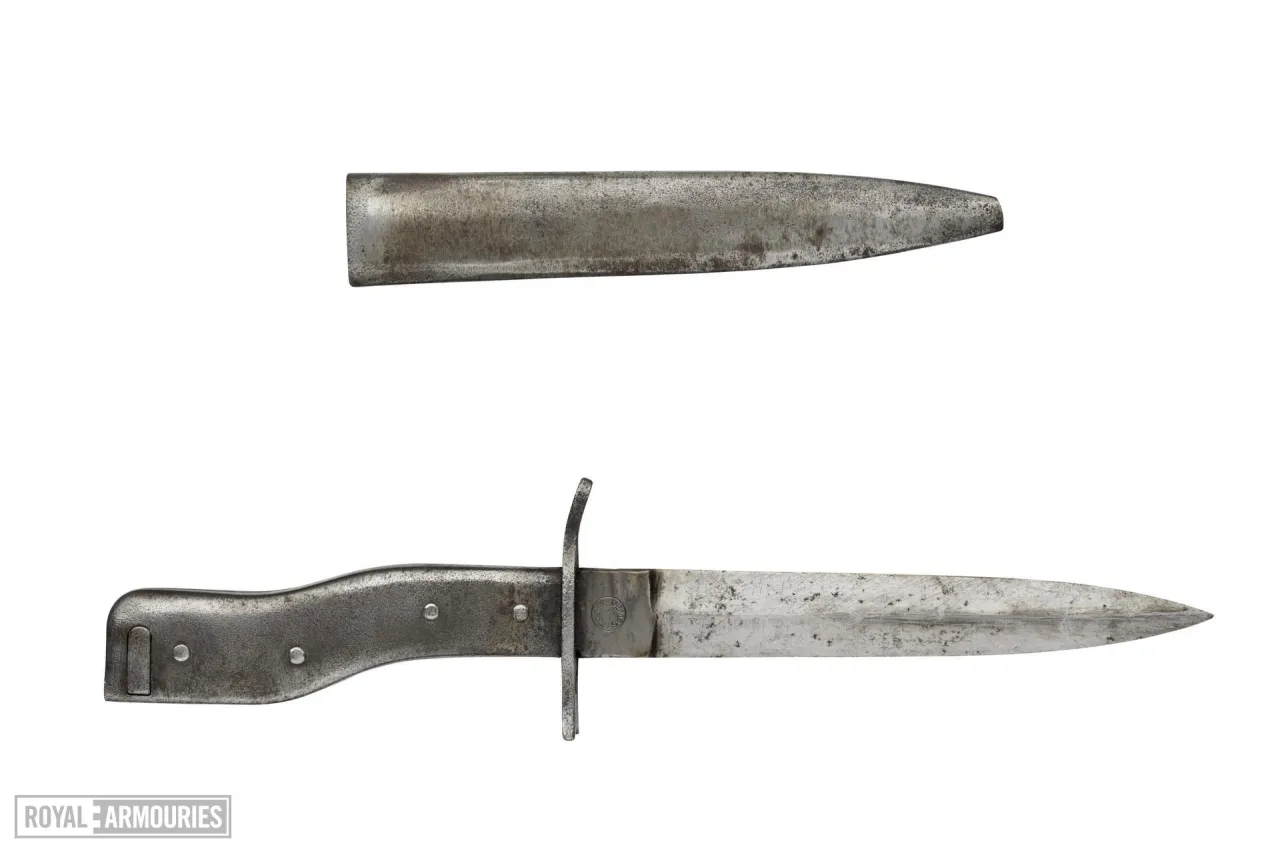
Germany was the first country to produce trench daggers of a special design. Although the daggers were produced by different companies, the blade and handle remained the same, while the guard styles varied. Although the scabbard had a belt loop, soldiers often carried these daggers tucked into their boots.

Trench knife — 1900-1930, Germany, Solingen. The blade is steel, double-edged, with a flattened diamond cross-section. The guard and tang are also steel. The guard is short, oval, and protrudes lower than the knife. The handle consists of two varnished wooden scales, each of which has eight ribs in the central part and is fastened with two nails on each side. The scabbard is made of steel and painted black, inside it is a spring lever that holds the blade in place. A leather strap is riveted twice to the back edge of the scabbard, to which another leather strap is riveted, passing around the handle and secured with a rivet. Length - 152,0 mm. Scabbard - length 226,0 mm. Total length - 285,0 mm. Weight - 193,0 g.

Trench knife - 1910-1925, Germany. Overall length: 270,0 mm. Blade: 140,0 mm. Weight: 216,0 g.
The thrifty Germans decided that having a separate knife and bayonet wasn't very cost-effective. Produced between 1914 and 1918, they developed a shortened bayonet-knife for their Gewehr 98 rifle. This all-metal bayonet-knife was called the "Demag."
Here it is, this bayonet-knife with a scabbard. Total length – 261 mm. Blade – 150 mm. Take it off the rifle and... stab the enemies in the trench to your heart's content!
Interestingly, the British had been using the so-called "boarding cleaver" since 1833. It was an interesting weapon that could easily have been used as a trench knife. The guard was made of copper alloy, rectangular, and the blade was triangular in cross-section. The sheath was iron.

"Boarding cleaver." Overall length: 304 mm. Blade length: 171 mm. Weight: 154,6 g (blade), sheath: 60 g.

It's also with a scabbard. Rear view.

A Bowie trench knife, converted from an M10 Ross rifle bayonet. The bayonet's original flat blade was filed down, transforming the weapon into a Bowie-style fighting knife. Such field modifications were popular across the entire bayonet range, as troops on both sides found themselves embroiled in a war that was very different from what they had expected. Made in Canada, circa 1917. Blade length: 258,0 mm.
The French were the lucky ones with the material for trench knives—the steel for them also needed to be found, and their production itself had to be streamlined. The thing is, they had a huge stockpile of rapier bayonets for the Gras Model 1874 rifles in their warehouses.

And the Lebel rifle of 1886 was equipped with practically the same bayonet.
The French began cutting these bayonets into three pieces, welding the tang to the handle. The T-shaped blade proved very convenient. The knife was very durable, although it came in three sizes: thinner, medium, and thickest (near the bayonet handle). Although this feature didn't affect their combat effectiveness! Then their supplies ran out: the "serious war" began, and the French were forced to make trench knives from garden fence rods...

French "nail knife" 1918

Knuckle knife from Sutherland & Rhoden. OK. 1915
The British Empire didn't produce specialized trench daggers, so cutlery manufacturers offered a wide range for private customers. This compact model was one of the most popular. It served as the prototype for the BC 41 knuckle duster used by British commandos during World War II, until it was superseded by the Fairbairn-Sykes fighting knife.
US Army Model 1918 Knuckle Duster Knife. This World War I-era combat knife features a double-edged diamond-shaped blade ending in a point and a cast brass guard that can be used as a knuckle duster. The knife features a pyramid-shaped pommel that can also be used as a weapon or tool. A leather sheath with a belt loop is included. Length: 285 mm. Blade length: 160 mm. Weight: 492,5 g.

A very original knife, the HALADIE KNIFE, circa 1900-1999, features three blades. It consists of two straight, double-edged blades with a flat diamond cross-section, sharing a common tang and facing in opposite directions. The handle consists of two wooden plates, secured on either side of the tang with five rivets. It has a bow sharpened along the outer edge. Its prototype was most likely the Indian kuttar dagger, some examples of which had three blades protruding in different directions. In this case, the middle blade was replaced with a sharpened crescent blade.

British combination knuckle-knife model 1939. Used until 1945.
So, there were a vast number of combat knives that emerged during the First World War. Almost as many as trench batons. However, those fell into oblivion after the war, were never developed, and weren't used during the Second World War. Trench knives, however, survived. And not only survived, but spawned numerous offspring. So today, there are a vast number of them. But that will be the topic of a future article...
Information