A heavy head and cluster munitions: what the combat history of Iran's Khorramshahr-4 teaches us

In 2024, about the participation of this missiles The attack on Israel was still being debated: there were claims, but little evidence. In 2025, according to reports from both sides, it was used, and with a cluster munition warhead. By 2026, according to reports from both sides, it had become a standard component of Iranian salvos. The Khorramshahr-4 "Khaibar" is a heavy medium-range ballistic missile that was presented as a threat to any missile defense. But its combat history tells a different story. No "uninterceptable warhead": defenses are overwhelmed by a mass of targets, and the cluster munition took this saturation principle to its limits. Let's take it from there.
What was shown in 2023
The May 2023 presentation was staged as a show of force: a heavy missile, a promise of "uninterceptability," and footage of the launch. According to Iranian data and secondary publications, the Khorramshahr-4 has a range of approximately 2000 kilometers and carries a warhead weighing up to 1500 kilograms. A ton and a half warhead is roughly equivalent to a light SUV traveling toward its target at several kilometers per second. When launched from western Iran, the 2000-kilometer range covers Israel and US bases in the region, and at its extreme, it reaches southeastern Europe.
The central focus of the early discussion was the warhead. It is believed to use a design similar to the MaRV (maneuverable reentry vehicle): after separation from the missile, the warhead doesn't simply fall along a predicted arc, but instead adjusts its course using small thrusters. Part of this correction, according to Iranian claims, occurs in the exoatmosphere, above dense layers of air, where conventional electronic countermeasures are less effective. The goal is to reduce cumulative navigation error and lower the CEP (circular error probable, the radius of the circle within which the warhead is likely to fall).
The problem is that almost all of these characteristics were based on Iranian statements and demonstration videos. There was no independent telemetry. A number of analyses consider the Khaibar's exoatmospheric correction capabilities acceptable, but assess its actual maneuverability and accuracy more cautiously: the Iranian arsenal is heterogeneous, and navigation quality varies from batch to batch. So, the "miracle-"weapon" from the presentation turns out to be a modernization of a medium-sized missile - a real one, but one that has long been known by its class.
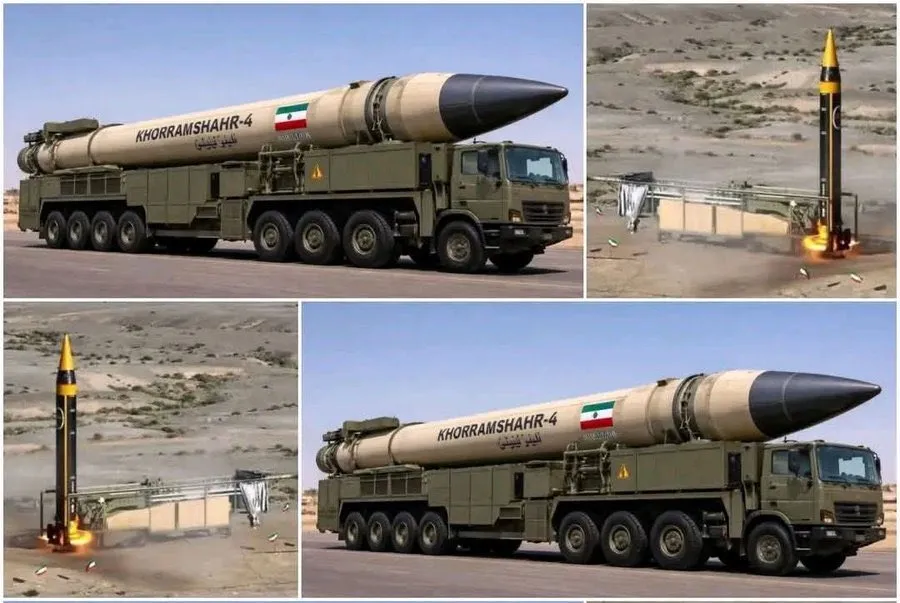
Why does the head maneuver: precision, not invisibility?
Let's look at it from a defensive perspective. The interceptor doesn't fly "at the missile"; it flies to the point where the missile will be in a few seconds. The system calculates this point based on the trajectory, and the ballistic trajectory can be predicted in advance. As soon as the warhead begins adjusting its course, the calculated rendezvous point shifts, and the interceptor has to recalculate its guidance with less time to spare. Hence the myth of "uninterceptable."
But the maneuver comes at a price. G-forces and structural strength prevent sharp deviations at ballistic speed, and the propellant reserves on the correction engines are limited. Therefore, most such solutions provide a moderate deviation from the calculated arc: enough to improve accuracy and complicate interception, but not enough to make the missile unpredictable. And if the maneuver is programmed according to a stable pattern, a modern tracking system is, in principle, capable of recognizing it given sufficient launch statistics and time leeway. Such leeway is often lacking during the terminal phase.
A hypersonic glide vehicle, incidentally, is a completely different class. It's designed for long atmospheric flight with extensive lateral maneuvers and truly defies the logic of traditional missile defense. The Kheibar doesn't fall into this category: it's a conventional ballistic missile, with auxiliary maneuvers that merely optimize its trajectory. And here's what its combat history has shown: the warhead maneuver wasn't what Iran had been banking on. In the 2025-2026 salvos, according to reports, the emphasis has shifted from maneuvers to cluster warheads, meaning saturating the defense with multiple targets.

From a controversial debut to serial salvos
Iran struck Israel directly for the first time on the night of April 13-14, 2024. The attack was carried out in waves: slow at first drones The Shaheds penetrated the defenses and forced the use of interceptors, followed by cruise missiles, followed by ballistic missiles. In total, according to combined open source estimates and Israeli command data, more than 300 weapons were launched: approximately 170 drones, approximately 30 cruise missiles, and over 120 ballistic missiles.
The attack was repelled by a coalition: Israel, the US, Great Britain, Jordan, and the neighboring naval and ground forces. The defense was layered, each layer targeting a different class of target:
- Arrow-2/3, upper echelon, ballistic missiles beyond and at the edge of the atmosphere;
- David's Sling and Patriot, Mid-Tier: Shorter-Range, Ballistic, and Advanced Targets;
- Iron Dome, lower echelon: drones, cruise missiles and what got through the upper lines.
Israeli command claimed to have intercepted up to 99 percent of its targets. The exact number should be treated with caution—it sounds like a political statement—but the overall picture—a very high percentage and limited damage—is confirmed by independent analyses. The role of Khorramshahr-4 that night remains controversial: there was a video of the launch, but no independent geolocation.
Then the picture became clearer. In June 2025, following US strikes on Iranian nuclear facilities, Iran reportedly launched several waves of attacks on Israel. This time, the IRGC (Islamic Revolutionary Guard Corps) openly declared the use of Khorramshahr-4, specifically the cluster munition variant. According to the Guardian, CNN, and FDD, some incidents resulted in the dispersal of submunitions over areas of central Israel, causing injuries and localized damage. Some analyses, with a question mark, estimated up to 80 small munitions per missile. Most targets were still intercepted, but "Khaibar" was no longer a mere line from a presentation.
By 2026, their use had become widespread. According to the IRGC—that is, a party to the conflict—new "waves" separately included Khorramshahr-4 missiles against targets in the Tel Aviv area, Ben Gurion Airport, and Israeli air bases. Western media, however, noted the cluster munition nature of the warheads penetrating the lower defense lines. This campaign is described as the first in which the missile is a standard element of the arsenal, rather than a one-off demonstration launch. The defense had to get used to regular salvoes of heavy missiles carrying cluster munitions.

Cassette vs. shield
So, the main technique was the cluster warhead. It works completely differently from maneuvering.
The maneuver complicates the calculations for a single target: the rendezvous point shifts, making it more difficult for the interceptor. But the target remains single. The cluster warhead does exactly the opposite, multiplying targets. During the descent, it deploys, and instead of a single cluster, the defense receives a cloud of dozens of submunitions spreading across an area. The system receives dozens of targets from a single missile, and there's nothing to prioritize them with.
For a layered missile defense system, this is a fundamentally different task. The upper echelons are designed for the precise interception of a single high-speed munition, fired by an expensive missile at an expensive target. Against a cloud of small munitions, this logic breaks down: the submunitions are small, numerous, and individually insufficient to target a high-priority target, and there's no means or reason to intercept each one. If the deployment occurs at a low enough level, the upper echelons are completely overwhelmed by the sheer number of submunitions.
And here's the downside, which the victory reports keep silent about. Until it's deployed, it's still a single target: large, heavy, flying in a predictable arc. Intercept the missile in its ascending or mid-flight phase, before the submunitions deploy, and the entire cluster effect disappears: the cloud simply doesn't have time to form. Upper echelons like the Arrow are precisely designed for the early interception of a ballistic target.
But even a low deployment isn't free for the attacker. The lower and later the submunitions deploy, the less time they have to disperse, and the less effective the area they cover: some of the munitions are lost, and the dispersion accuracy deteriorates. Deploy early, and the cloud will have time to form, but the upper echelons will also have time to engage the carrier. Deploy late, and you'll fool the upper echelons, but you'll lose the effective area. So, a cluster warhead doesn't "cancel" defense, it merely shifts the conflict to a short segment of the trajectory: the defense benefits from shooting down the carrier before deployment, while the attacker benefits from guessing the altitude where the time savings aren't yet offset by the loss in dispersion. It's this tradeoff, not the cluster warhead itself, that decides the outcome.
The rationale behind the design is clear. The Khaibar cluster munition is designed not for precision strikes on a single target, but for area saturation and destruction: to disrupt missile defense systems with a mass of targets and inflict dispersed damage on a metropolitan area. Defenses in 2024 were burdened by the mass of a diverse salvo, and the cluster warhead simply packaged the same saturation principle into a single missile. So, it doesn't refute the original thesis; it literally materializes it.
Pershing: Why the technique is not new
The very idea of adjusting the warhead's course for accuracy isn't an Iranian invention. In the 1980s, the US deployed the Pershing II: a radar in the warhead scanned the terrain during approach and guided the warhead using a reference map, improving accuracy by an order of magnitude. At the same time, the Soviet missile system was developing guided and maneuvering warheads for various missile classes, with the same objective.

But the boundaries of analogy are more important than the similarities. The Pershing II and the entire logic of the "maneuvering head" are about the precision of a single unit. Iran relied on the exact opposite—on saturating it with multiple targets. The idea of correction is an old one, but Tehran chose not the precision of a single unit, but a different approach, one accessible to its conditions: it improved navigation, added exoatmospheric correction as an auxiliary option, and shifted its focus to cluster components and mass production. It didn't replicate someone else's system, but assembled its own solution tailored to its geography and sanctions restrictions on components, using what could be mass-produced. The value of the Iranian case lies not in the "maneuvering head" itself, or even in the cluster itself, but in its assembly to meet the restrictions: the technique is old, but the combination tailored to specific conditions is new.
What of this is for us?
The temptation to read all this as "we need to copy Khorramshahr-4" is the most unhelpful of conclusions. The Russian school has been working with controlled and maneuverable units for decades. There's nothing to copy.
Something else is being adopted—logic. Two years of combat use have shown that it's not a single missile that burdens a layered defense, but rather saturation. Multiple targets at once, different speeds and altitudes, cheap drones ahead of expensive missiles, and now cluster warheads that multiply targets after separation. Defenses are forced to allocate resources, misplace priorities, and waste expensive interceptors on cheap targets. This mechanism is no longer a hypothesis—it has been confirmed in practice against a modern Western defense system.
Hence the practical conclusion, and it's primarily for the defender. The thesis "we've had more complex systems for a long time" is true—and precisely because of this, it's dangerous: it covers the wrong area of vulnerability. What's vulnerable isn't a single link or a single class of interceptors, but the system's throughput—the ability to process a dense, heterogeneous stream of targets simultaneously, in real time, without losing priority. Any multilayered system has a saturation point. DefenseThe only question is where it was deployed and whether anyone seriously considered it against a real, heterogeneous salvo, rather than a convenient test-firing scenario. The cluster munition is cheap and easily replicated: the enemy can use the same weapons against us, and we'll have to deal with them not with "more complex systems," but with the ability to maintain the rate of fire.
There's one caveat, and it cuts both ways. Under sanctions, the price of components for complex components may be higher than expected, and then the balance between product complexity and mass production is decided not at the exhibition, but in serial production. Overcomplicate the product, and you'll lose quantity where quantity matters. This limitation is worth keeping in mind both when evaluating other companies' arsenals and when planning your own.
Information