On the effectiveness of "sand" filler for the turrets of domestic tanks

On the effectiveness of the "sand" armor filling used in the turrets of Soviet T-72A tanks, which are still in service and actively modernized in Russia.
Introduction
As is well known, composite armor, which has been used in tank design for over half a century, can incorporate a wide variety of metallic and non-metallic elements. These include armor ceramics, various light alloys, semi-active elements such as NERA, uranium- and tungsten-based components, and the like. Generally speaking, when it comes to global tank design, it's a matter of personal preference.
However, despite the abundance and diversity of composite armor fillers, one in particular stands out due to its uniqueness and limited use, as it was used only in Soviet-era tanks. This component has several names: in our country, it's popularly known as "sand rods," while in the West, it's known as "quartz armor" or simply "quartz."
It was standard equipment on the turrets of T-72A tanks (and transitional models), as well as export variants like the T-72M1. These vehicles are still in service and are being actively modernized—recently, the T-72As have begun to be withdrawn from storage and brought up to the T-72B3M standard. This, of course, not only raises concerns historical, but also of practical interest in terms of the effectiveness of this armor.
What is composite armor for?
Before we continue, we need to clarify why we need combined armor at all, since without this definition, further discussion of “sand” will not make any sense.
We know that composite tank armor was a response to the crisis of pure steel armor, which had already begun to lose ground due to the increasing penetration of HEAT and sub-caliber projectiles in the mid-20th century. To counter these, tank designers would have had to increase the steel thickness to prohibitive levels, which would have turned tanks into heavy, unwieldy, and bulky vehicles.
Therefore, first the USSR, and then all other tank-producing countries, began mass-producing tanks with multilayer armor, combining steel and other materials. However, composite armor is not simply a random assortment of fillers. Its composition and properties must meet at least one of the following conditions.
The first is light weight. If composite armor is equivalent in weight to, say, 500 millimeters of solid steel, but offers resistance to 600 millimeters of HEAT and/or subcaliber projectiles in steel equivalent, then it's already good armor.
The second is dimensions. Ideally, the actual thickness of composite armor should be less than its steel equivalent in terms of resistance to destructive weapons. For example, armor is 300 millimeters thick, but its resistance is equivalent to 500 mm in steel. But in practice, this is far from always possible, and designers must balance (and sacrifice) between the armor's weight and dimensions.
As an example of all these contradictions, we will cite the armor of the T-64A tank with fiberglass in the frontal armor of the hull and corundum (ceramics) in the turret, in comparison with the “all-metal” T-62.

Source: "Tank Theory and Design." Volume 10, Book 2. Moscow, Mashinostroenie, 1990.
With a horizontal thickness of the upper frontal plate of 547 mm, taking into account the angle of inclination, its resistance to sub-caliber projectiles is only 305 mm in steel equivalent, and to cumulative projectiles - 450 mm.
Moreover, the weight of the upper glacis plate, taking into account the slope, is equivalent to 335 mm of solid steel armor. This means that the advantage is noticeable for HEAT rounds (the armor weight/equivalent ratio), but not so much for subcaliber rounds.
The T-64A's turret performs even better. With a horizontal thickness equivalent to 410 millimeters of solid steel, it offers resistance to 400 millimeters of sub-caliber projectiles and 450 millimeters of HEAT projectiles.
All this will help us in assessing the T-72A's "sand" armor.
How "sand cores" were produced
We won't delve into the history and underhanded dealings of Soviet design bureaus and factories in this article, but it's worth noting that "sand rods" became a kind of cheap alternative to the corundum ceramics used in the turrets of T-64A/B/BV tanks. They themselves are, to some extent, somewhat similar to ceramics.

A cutout in the frontal armor of a T-72M1 turret. The sand filler sandwiched between the rear and outer layers of steel is visible.
These "sand rods" were made in the form of blocks from quartz sand, which was sintered in special furnaces under high pressure and at temperatures of approximately 1200 degrees Celsius. The resulting product can be seen in the photograph below.

According to Polish sources (Poland actively produced tanks with such turrets), the composition of the sintered mixture included 70% quartz sand and a large amount of aluminum oxide and titanium dioxide, diluted with binders, including clay and graphite.
The finished quartz blocks were held in the tower mold on special rods (three for each chine), after which the tower was filled with molten steel. The rods holding the quartz blocks were then cut flush with the roof of the chines of the cast tower. This can be seen in the photograph below.


The light beige color shows the location of the "sand" filler in the front of the turret. Armor thicknesses are also indicated. Image by: Wiedzmin. Forum: otvaga2004.mybb.ru
Stability of a tower with "sand" filler
Let's be clear right away that the "sand" filler is practically ineffective against kinetic-action munitions, such as sub-caliber projectiles. In this case, the entire load is borne by the steel turret. The "sand" filler's primary role is to counter shaped-charge (HEAT) weapons.
Sand blocks sandwiched between the turret's steel walls act on the shaped-charge jet not only as a low-density filler, a layer of which simply extends its path through the armor, causing ruptures and destabilization. They also operate on a principle similar to that of armor ceramics.
As the cumulative jet penetrates, a shock wave propagates in the sand block ahead of it, breaking the sintered quartz into small and large fragments and causing them to compress. Meanwhile, the pressure behind the shock wave front begins to decrease, and the previously compressed fragments collapse the breach channel, disrupting the jet.
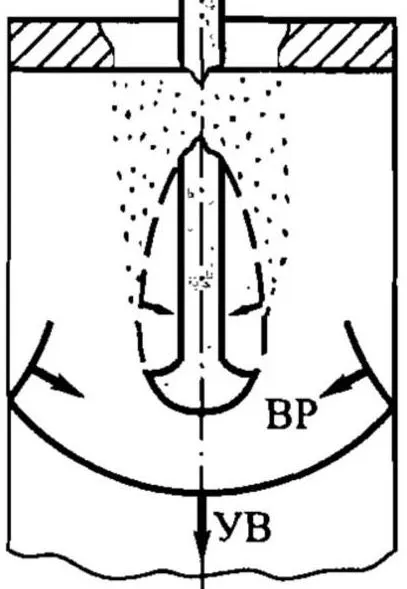
An example of a shaped-charge jet collapsing between layers of destroyed ceramics. SW – shock wave, RW – rarefaction wave. Source: "Special Issues in Terminal Ballistics." Bauman Moscow State Technical University Publishing House
Now let's move on to resistance. The steel equivalent of the T-72A's "sand" turret armor and its modifications may vary depending on the source. However, the most realistic figures are 400-410 mm against sub-caliber rounds and 500 mm against shaped-charge rounds.
They are consistent with both the data of experts on Soviet military equipment and the book "Uralvagonzavod Combat Vehicles. The T-72 Tank," which states that the turret's resistance is 410 mm against sub-caliber rounds and 500 mm against shaped-charge rounds. There's no reason to doubt this book, as it was produced with the participation of Uralvagonzavod itself, the manufacturer of these tanks.
Next, let's look at the T-72M1 tank turret drawings. They show in considerable detail the steel and "sand" thicknesses in various turret sections.


You can see that the thickness of the cast turret's frontal section varies, which is understandable. However, in most sections, they are generally nearly identical, so for our purposes, we'll use the thickest section, shown in section 3-3. Taking into account the angle, it has the largest steel mass at 426 millimeters (142 mm for the outer section and 284 mm for the rear). The greatest thickness of the "sand" layer is 115 millimeters, giving a total horizontal armor thickness of 541 mm.
The estimated density of the "sand" in the armor is approximately 1,8 grams per cubic centimeter. This means that a 115-millimeter-thick layer of it will be equivalent in mass to 26,335 millimeters of steel armor. In other words, a square meter of turret armor will weigh as much as 452,3 mm of steel armor.
The turret armor offers no significant weight advantage against armor-piercing subcaliber projectiles, as its resistance against them is 400-410 mm, yet it weighs as much as 452.3 mm of steel. Furthermore, the "sand" contributes virtually nothing to the protection against these projectiles—the armor's resistance is roughly equal to the combined thickness of the steel masses of the outer and rear cheekbones.
There's a weight advantage against shaped-charge munitions. With a square meter of armor equivalent to 452,3 mm of steel, its resistance, as noted above, is equal to 500 mm of steel armor. Simple calculations show that the "sand" makes a significant contribution here: it saves armor weight equal to almost 50 mm of steel.
In terms of dimensions (horizontal armor thickness), there is no advantage against either sub-caliber or cumulative projectiles.
Of course, these figures aren't the final word—they're all very, very superficial. And it's important to understand that the sand-filled armor's resistance can't be considered separately from the turret's steel armor—both work together. Nevertheless, this will serve as a general guide to the effectiveness of sand-filled armor.
Today, "sand" turrets have completely lost their relevance. They are not protected against more or less modern (and even late Soviet) sub-caliber projectiles. They also offer no guarantee of protection against hits from anti-tank guided missiles. missilesThe only thing they can become an insurmountable obstacle to is cumulative shells from tank guns with a caliber of up to 125 mm.
Incidentally, "sand" filler is also used in the turrets of T-80B/BV tanks, which are currently being upgraded to the T-80BVM standard. The distribution of steel and "sand" thicknesses is somewhat different, but the turret's resistance to projectile weapons is roughly equal to that of the T-72A.
Information