Two "esks" that fired missiles
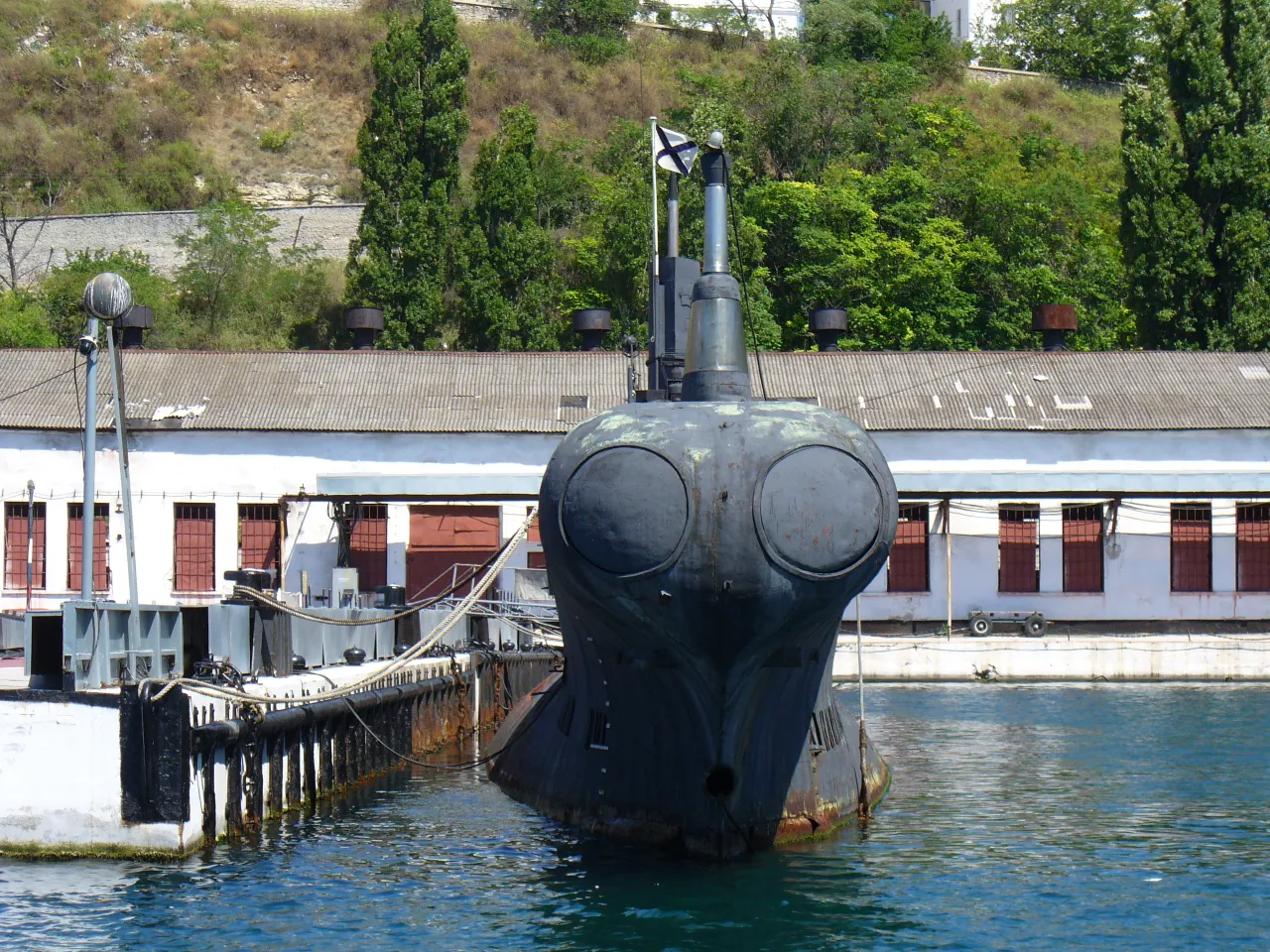
Soviet and Russian diesel-electric submarine S-49 of Project 633
How the diesel submarines S-49 and S-11 became a testing ground for the Vodopad and Vetra missile torpedoes, and why they couldn't be immediately deployed to combat fleet.
A typical diesel submarine, the kind that served in the Black Sea by the dozens in the 1960s. Six torpedo tubes in the bow, two in the stern, diesel-electric propulsion, and a working depth of over two hundred meters. Now attach a humpbacked superstructure to its bow and make it fire not torpedoes, but... rockets: they emerge from underwater, fly through the air, and dive back into the sea tens of kilometers away from the submarine. Why would a combat navy deface a working "eska" for such a trick? Because weaponThe fuel that would later be used on nuclear-powered submarines first had to be transported somewhere. To achieve this, two old diesel engines were taken and converted into underwater laboratories.
The gap between hearing and reaching
By the early 1970s, an unsettling asymmetry had developed in anti-submarine warfare. Sonar systems had learned to detect and track submarines at ranges of tens of kilometers. But a torpedo, the primary means of destroying one, had a range of ten to twenty kilometers, and even that was subject to travel time: while the torpedo was traveling toward its target, the target had time to escape. A gaping chasm existed between the zone where the enemy could be heard and the zone where it could be reached.
The missile-torpedo was supposed to close the gap: a device that launches from a torpedo tube like a torpedo and transforms into a missile with a detachable warhead in flight. The USSR began developing the water-to-air-to-water system in the mid-1960s on the RPK-2 Vyuga (according to Western classification) system. SS-N-15 Starfish). Project 613RV diesel submarines were converted for testing: from 1965 to 1967, they carried out 21 launches of mock-ups and prototypes. It was there that they determined how such a missile behaved during underwater launch, airborne exit, and re-entry into the water.
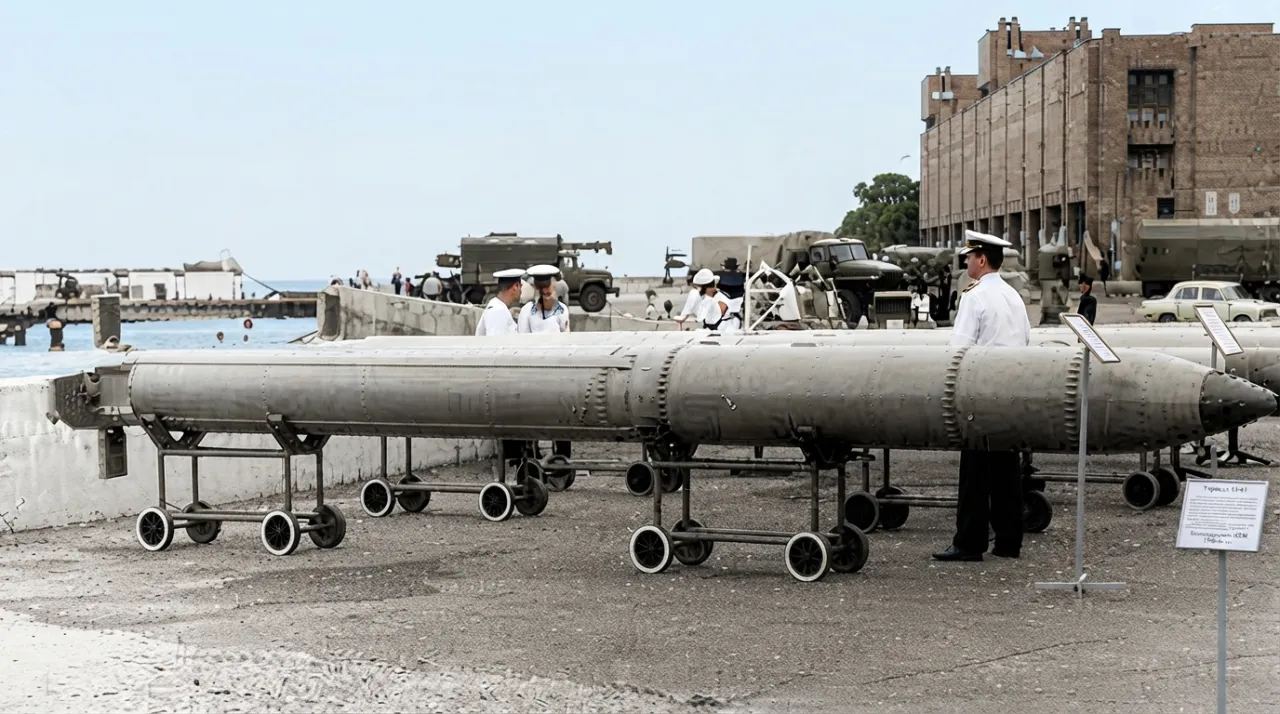
The 81R anti-submarine missile from the RPK-2 Vyuga system
By that time, the United States already had two similar systems in service: SUBROC for submarines and ASROC for surface ships. The direction in which maritime anti-submarine warfare (ASW) was moving was quite clear.
"Waterfall" and "Wind": one family, two calibers
The next step was the development of two systems, the RPK-6 Vodopad and the RPK-7 Veter. They are closely related: in the West, both were given the same designation. SS-N-16 StallionThey differ primarily in caliber and the range of carriers. Open reference books consistently assign the indexes "RPK-6 — 'Vodopad', RPK-7 — 'Veter'," although popular retellings sometimes confuse this with calibers and modifications within the same line.

The Vodopad is designed for a standard 533mm torpedo tube, the same one found on most submarines and a number of large surface ships. This accounts for its key feature, versatility: no separate deck launcher is required; the missile launches from the standard tube. The warhead is a choice of either the compact 400mm UMGT-1 torpedo (according to open sources, it has a range of about 8 km, a depth of up to 500 m, and a speed of up to 41 knots) or a nuclear depth charge. It's important to distinguish two things here: 400mm refers to the caliber of the torpedo warhead itself, not the launch tube; it launches from the same 533mm tube anyway. A naval version, the Vodopad-NK, is also available.
The Veter missile operates on the same principle, but is larger: 650 mm caliber, approximately 11 meters long (figures from open sources), and is launched underwater. Due to its more powerful stage, according to open sources, it has a range of approximately twice that of the Vodopad missile and launches from a greater depth. The operating logic for both is the same. The missile exits the vehicle, coasts underwater, ignites its solid-fuel propulsion motor, and takes off. It then follows an inertial trajectory to the target point, separates the warhead, deploys a parachute, and splashes down at a reduced velocity.
Range estimates, however, should be treated with caution. Estimates in open sources vary significantly. Reference books on submarines tested in the Black Sea cite a range of approximately 37 km for the Vodopad system. Russian military-technical reviews state "up to 50 km." Western analysts, analyzing the launch from the cruiser Pyotr Velikiy, cite a range of over 60 nautical miles, or over 110 kilometers. The discrepancy is apparently explained by differences between early and later modifications and different methods for calculating "effective" range. There are no uniform official performance characteristics publicly available, and it's more accurate to provide any specific figure with a caveat.
How a stand was made from an “eska”: project 633РВ
Two Project 633 diesel-electric submarines, the S-49 (laid down in 1961) and the S-11, were chosen as testbeds for the Vodopad and Vetr trials. They served in the Black Sea Fleet and, prior to their conversion, were standard torpedo boats of their generation. The S-49 was built at the Krasnoye Sormovo shipyard in Gorky; publicly available information on the S-11 varies widely, to the point of confusing it with other hulls in the series. Both had a standard armament configuration: the same six bow and two stern 533-mm tubes, and the operational depth of the S-11, according to references, reached 270 meters, compared to 240 meters for the S-49.

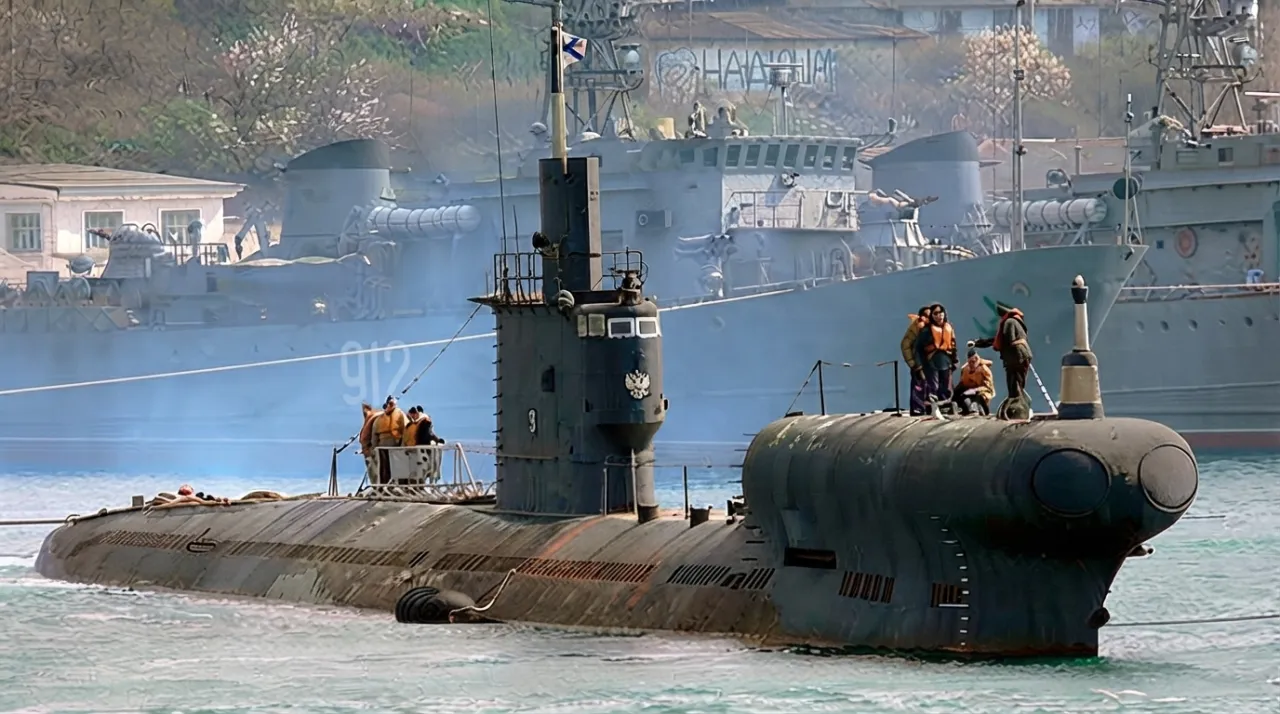
Under Project 633RV, both submarines became universal launch platforms for both systems. A large superstructure with two 650mm tubes configured as launchers for Vetra missile-torpedoes was installed on the heavily modified bow. The standard 533mm tubes were modified for the Vodopad system, including hydraulics, automation, and pre-launch systems. Thus, the diesel-powered "eska," built for traditional torpedo warfare, was transformed into a weapon carrier that launches from underwater and continues its journey through the air.
The submarines' status also changed. They were effectively withdrawn from full combat service and reassigned to the testing program. Open sources don't reveal the precise details of how they were formally assigned to specific research institutes and design bureaus, nor how their hydroacoustics and navigation systems were reworked, so the details of the test rig's internals remain a reconstruction based on program logic, not confirmed fact. One thing is clear: the submarines' schedule was no longer subordinated to combat service, but to launches.
Why not a combat boat?
A reasonable question arises: why build special launch vehicles if the missile was going to be installed on combat boats anyway? It would have been simpler from the start.
Simpler, but more dangerous. A missile-launched torpedo launched from an underwater vehicle is a system with a high failure rate. An abnormal launch early in development threatens not just a miss, but rather flooding of the compartment or detonation of the warhead dangerously close to the launch vehicle. Exposing a nuclear submarine, an expensive and strategically important unit, to such a risk while the product is still in its infancy is hardly reasonable. There are no direct regulatory documents on this matter publicly available—this rationale must be reconstituted based on the common sense of the program itself.
There's a second, purely practical reason. A test platform requires cable routes, sensors, recording equipment, and industry personnel on board. This is difficult to accommodate on a combat submarine, where every cubic meter and every crew member is counted, and the combat mission environment is poorly compatible with the constant presence of research institute representatives. A test rig, however, can be equipped with measuring equipment and staffed with a stable team of testers, tied to specific design bureaus.
The S-49 and S-11 missile launch tests involved more than just the actual launch of the missile. They also tested the vehicle's tightness and the operation of the automatic controls under high sea pressure; the missile's behavior underwater, where a deviation from course due to uneven thrust or currents could result in impact with its own hull; the acoustic pattern of a launch, which momentarily jams the missile's own sonar system; and finally, how the launch vehicle's hull handles repeated launches of heavy payloads. All of this cannot be reduced to a rig experiment on shore: it requires a real sea, a real depth, and a trained crew.
Doctrine: Long-range strike and nuclear option
Doctrinally, the Vodopad and Veter systems filled the very niche for which they were designed: they bridged the gap between the range of hydroacoustics and the range of torpedoes. In the conventional version, the system carried the compact UMGT-1 torpedo to the target area in minutes, rather than tens of minutes under its own power. The torpedo then engaged its homing system and sought out the target itself, leaving the enemy much less time to evade.
The nuclear option changed the logic. What mattered here was no longer the precision of targeting, but the radius of the underwater explosion: it covered the area where a maneuvering nuclear submarine could be located, thereby forgiving targeting errors. The specific yields of the charges and the destruction radii remain confidential, but the principle itself is clear. However, even the "forgiving" nuclear option did not eliminate the main difficulty: while the missile was being prepared, launched, and guided through the underwater and aerial sectors, the target had time to shift. Therefore, the sonar and combat information and control system (CICS) required precise work—all this time had to be factored into the aiming point calculation.
For the submarine, stealth remained its main advantage. The strike was carried out from underwater, without surfacing or raising its antennas, if its sonar provided target designation, and immediately after launch, the submarine could change course and depth. For a surface ship, the Vodopad-NK modification enabled long-range anti-submarine strikes without a helicopter and aviation, which is especially valuable in poor weather. In 2018, the Ministry of Defense demonstrated the launch of the Vodopad system from the heavy nuclear cruiser Pyotr Velikiy in the Barents Sea: the system, originally deployed on Black Sea submarines, was still operational at the time.
What's Left Behind: SUBROC, ASROC, and Closed Statistics
The American SUBROC and ASROC systems solved the same problem of long-range strikes against underwater targets—but each approached it differently, and in their own way, they were right. The SUBROC (UUM-44A) was launched from a submarine's torpedo tube and carried only a nuclear depth charge: it wasn't intended for routine anti-submarine warfare, but rather as a deterrent for an autonomous nuclear submarine, and by the late 1980s, it was decommissioned. The ASROC (RUR-5) took a different approach: a deck-based launcher launched the missile directly into the air and then parachuted the torpedo to the target. The system proved so successful that it survived until vertical launch and remains in service to this day.
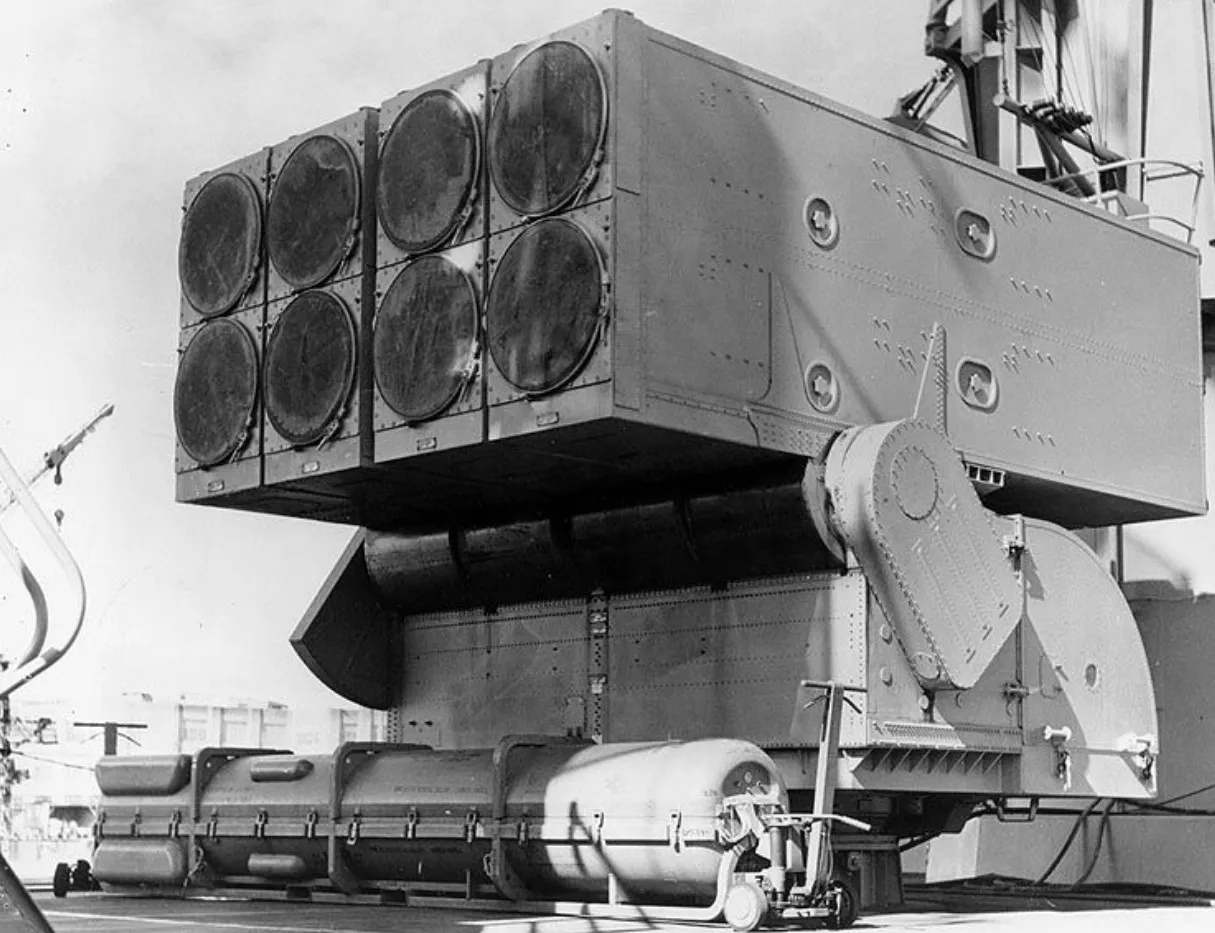
An eight-round Mk 112 launcher (also known as a "pepper box") of the American RUR-5 ASROC anti-submarine missile system, installed aboard the U.S. Navy guided-missile cruiser USS Columbus (CG-12) in 1962. The missile shipping container is visible on the deck in the foreground.
These decisions are based on different doctrines. ASROC was created as an element of a multilayered ASW system based on naval forces, in conjunction with helicopters, patrol aircraft, and a sonar network, where the missile system covers the short-to-medium range with a rapid response. The Soviet Union, however, relied primarily on the submarine as the primary launch vehicle, operating covertly and largely autonomously. Hence the emphasis on underwater launch, rather than deck-based launch. In this sense, the Vodopad and Vetrov systems combined features of both American systems: underwater launch, like SUBROC, and a choice between torpedo and nuclear warheads, with the torpedo variant being closer to the ASROC ideology. This isn't to say that a more versatile system is automatically superior—it's simply a different response to a different balance of power.
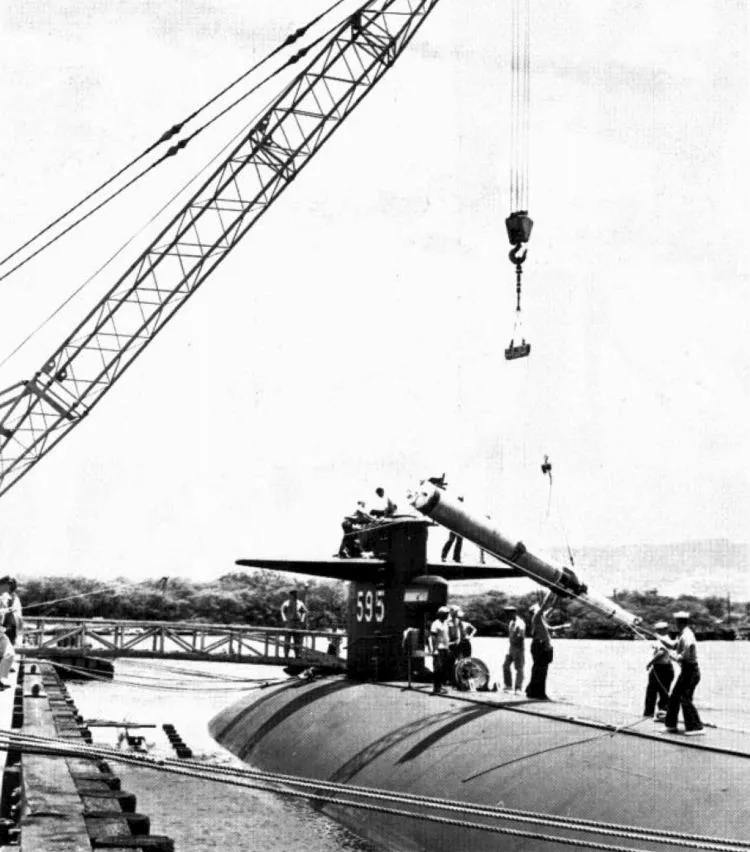
A UUM-44 SUBROC anti-submarine missile (or torpedo) being loaded onto the Thresher/Permit-class nuclear attack submarine USS Plunger (SSN-595) using a shore crane in the 1960s.
But when it comes to reliability, we're running into a dead end: there are no publicly available failure statistics for either Soviet or, for that matter, American systems. The only thing known is a fragment for the early Vyuga—21 launches on 613RV submarines; for the Vodopad and Vetr, popular literature only mentions "series of successful launches" without reference to depth, range, or warhead type. This leaves the main questions hanging in the air: how much did reliability drop during launches at extreme depths, and what was the failure rate of the cruise engine or control systems. The confusion surrounding the designations also adds to the confusion: SS-N-15 is usually assigned to the Vyuga, SS-N-16 to the Vodopad and Vetr, but in popular sources, this distinction is sometimes blurred.
The water-to-air-to-water configuration outlived its testers. According to several sources, the S-49 was used as a charging station—an auxiliary floating craft for charging the batteries of other submarines—in the final stages of its service life; details of this period are scant in publicly available sources. And the systems developed on it and the S-11 continued to operate into the 21st century: the 2018 launch confirms this. The missile-torpedo class has not disappeared.
Information