From Brown's Helicopter to 'Energy Domes': The Beam Drone and Its Limits
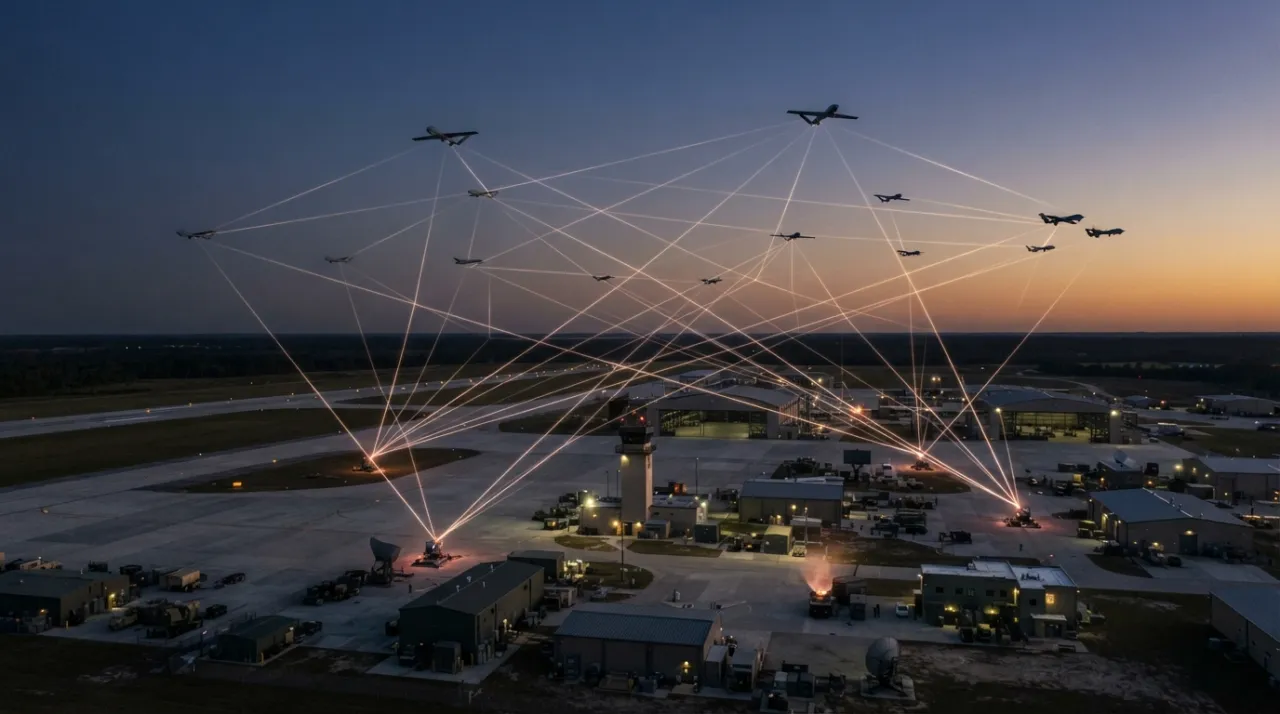
Wireless power transmission promises hours in the air, but only where there's room for it.
In October 1964, a model helicopter was launched for the press at a Raytheon laboratory near Boston. Nothing unusual, except that it had no fuel tank or battery on board. A microwave beam kept the machine aloft: a ground transmitter hit a receiving antenna under the fuselage, which then powered the rotor's electric motor. Engineer William Brown showed journalists something no one had ever shown before: a heavier-than-air craft powered by pure energy transmitted through the air. More than sixty years have passed since then, and the idea has reached the military test site—and they've hit the same wall as Brown: it's still not suitable for everyone. drones right away.
Energy ceiling
Any aircraft is a compromise between its mission and its flight capabilities. The larger the battery or fuel capacity, the longer the aircraft can fly, but the less time is available for sensors, communications, and weapons. This tradeoff is especially stark for small electric drones. A typical multicopter has an airtime of twenty to thirty minutes, limited not by aerodynamics but by the specific energy of its lithium-ion battery: doubling its flight time means making the aircraft so heavy that the extra battery would be used to support its own weight.
The first obvious solution was conceived long ago: remove power from the aircraft and leave it on the ground. This is how tethered drones came into being. The device hangs from a power cable and can remain in the air for days. Stationary video surveillance and communications relay using such systems has long been a popular option. The price for this is the cable itself: it tethers the drone to a point, limits its altitude, and makes maneuvering a sham. A tethered drone is essentially a camera on a very long and very expensive mast.
This gave rise to an idea that, on paper, seems almost like cheating: leave the power source on the ground but remove the power cable. Let the power flow to the drone through the air, via a beam. This would give the drone both the freedom to maneuver and the long flight time previously achieved by using a cable. It sounds like a cheat code. In practice, however, it involves a long list of engineering compromises, each of which must be addressed individually.
Microwave helicopter
This idea predates most of its current enthusiasts. It was conceived by that same William Brown of Raytheon. In 1961, he published a paper explicitly proposing transmitting electrical energy via a microwave beam and capturing it with a rectifying antenna, a rectenna, which converts the high-frequency field back into direct current. Three years later, he built that very same helicopter.
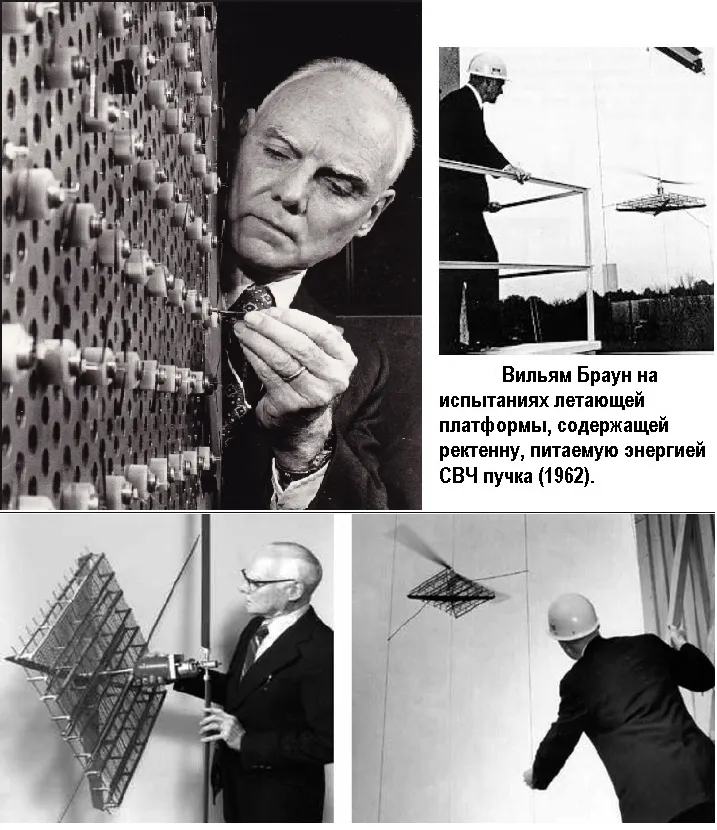
In October 1964, the device was shown to the public and national television; a story about it even aired on Walter Cronkite's evening show. A beam of 2,45 gigahertz struck a rectenna made of several thousand silicon diodes—a panel the size of a small table, about a third of a square meter. It generated about two hundred watts of power on board, enough to hold the two-kilogram model several dozen feet (fifteen to twenty meters) above the transmitting antenna. The figures vary slightly according to different accounts, but the essence is the same: for the first time in stories The aircraft was kept in the air by pure beam. No fuel tank, no battery.
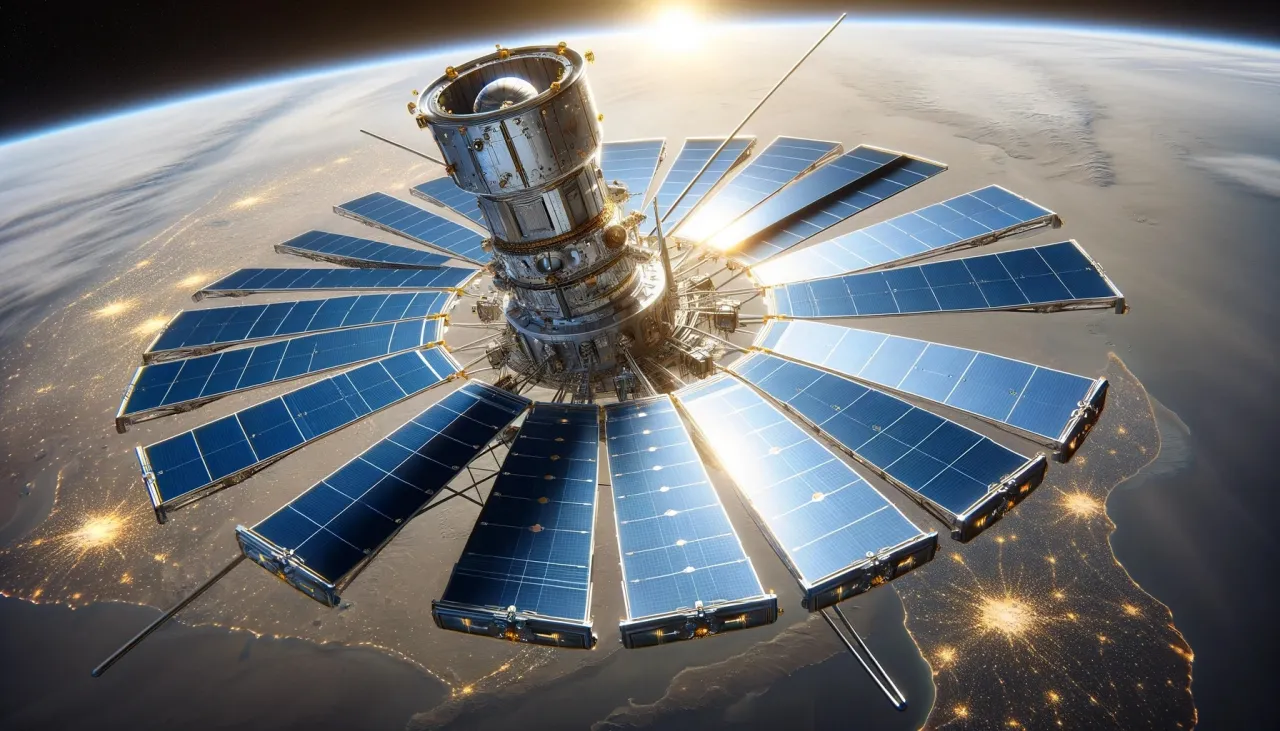
The idea quickly evolved from a laboratory toy into an infrastructure project. In 1968, engineer Peter Glaser published a concept for an orbital solar power station in Science: a giant satellite in geostationary orbit would collect sunlight and beam down megawatts, also via microwave beam, to a ground-based rectenna. In the late 1970s, the idea received serious consideration: from 1977 to 1980, NASA and the US Department of Energy ran calculations as part of a special evaluation program. The conclusion was cautious. Physics allowed it, but the economics and technology at the time did not: it was too expensive to launch such masses into orbit, and the materials and microwave systems were too immature. With that, "energy from space" was shelved, but the technology of beaming energy remained.
It returned in a different frequency range. At the turn of the 2000s and 2010s, the private company LaserMotive replaced microwaves with lasers and perfected the old concept for a spectacular spectacle: a small quadcopter hovered under a laser beam for as long as the ground installation could withstand. This was marketed to the press as "practically unlimited" flight. What's being demonstrated at test sites today isn't a breakthrough, but the latest iteration of the same idea. The very formulation of the question has changed: before, the question was "is it even possible?" now it's "how far, how reliably, and under what kind of fire?"
Beam instead of wire
Methods for transmitting energy wirelessly form three families, but only two of them are relevant for beam flight.
- Induction and resonance. Energy flows through a magnetic field between two coils. Efficiency is high and everything is safe, but it works over a distance roughly the size of the coils themselves. For a drone, this means contactless charging on a landing pad or while hovering close to the transmitter. This type of connector-free charging for UAVs was researched back in the mid-2010s, and today it's reaching commercial solutions like weatherproof stations where the drone lands automatically. It's convenient, but there's no real flight involved—it's just an automatic power outlet.
- Radio frequencies and microwaves. The energy is carried by electromagnetic waves generated by an antenna array and captured by an onboard rectenna. The range is from meters to tens of meters, and with careful geometry, even more. A direct descendant of Brown's experiments.
- Optics, laser. An infrared beam is focused onto a receiver, where a photoelectric converter, a relative of a solar panel, converts the light back into electricity. Lasers have an advantage that radio waves lack: they collect power in a small area even over long distances. For a drone, where every square decimeter of its wing counts, this is a decisive advantage.
These last two—microwaves and optics—have been embraced by modern military programs. Optics was chosen over Braun's microwaves for its compactness: where a microwave beam requires a rectenna measuring a square meter, a laser can accommodate a palm-sized photovoltaic panel. The price for compactness comes in the form of capriciousness, but more on that later.
Infrared light leash
The most notable demonstration of laser energy transfer (in English this field is called power beaming, “beam pumping”) took place in the summer of 2026. The company PowerLight Technologies conducted a series of tests at the Poinsett range at Shaw Air Force Base: a kilowatt-class ground-based laser installation detected, tracked and powered a large object in flight. UAV fixed wing, K1000ULE Manufactured by Kraus Hamdani Aerospace, the system maintained the aircraft at altitudes of up to approximately one and a half kilometers and, according to the developers, provided sufficient power for several hours of non-stop flight. The tests were conducted with the support of the US Central Command, so this was no longer a laboratory trick, but a practical test.
DARPA's POWER program went even further in range. In tests in New Mexico, a laser transmitted over 800 watts over a distance of 8,6 kilometers, with over a megajoule of energy passing through the beam during the campaign. The receiver is elegantly designed: a compact input window and an internal parabolic mirror that collects the captured light and focuses it onto an array of photocells. DARPA also noted the high efficiency of the chain, from the electricity fed to the laser to the electricity collected by the receiver: over short distances, it reached approximately 20%. This is a significant amount for wireless transmission.
And here's where a caveat is needed, without which the image becomes a sales pitch. These percentages apply to short-range missions, not record-breaking kilometers. As the distance increases, the beam diverges, the atmosphere disperses it, and efficiency drops. A laser requires a clear line of sight: clouds, smoke, and dense aerosols weaken or disrupt transmission. The fine words about "practically unlimited" flight are true right up to the first cloud and as long as the ground transmitter remains intact. The device hasn't become autonomous—it's simply swapped its tether to the tank for a tether to the beam. It has more freedom, but no independence.
Microwaves and radio frequency web
The laser isn't the only answer, and adjacent solutions have their own logic. The microwave branch, where it all began, is also still here.
In China, this very system was reportedly publicly tested. In one demonstration, a mobile microwave system on a wheeled chassis powered a fixed-wing drone through an antenna array under the fuselage, keeping it aloft at an altitude of about 15 meters for several hours straight. The most interesting thing here isn't even the altitude or the time, but the fact that the beam was locked onto a moving target, with both the drone and the transmitter itself able to move. Precise targeting was ensured by satellite navigation data, real-time tracking, and onboard algorithms that synchronously adjusted both the drone's position and the beam's direction. The tradeoff here is meaningful: microwaves are almost immune to weather conditions, which a laser is so adept at, but the tradeoff is range and antenna size—that Braun rectenna, which needs to be fitted somewhere on the vehicle.
Reach demonstrated a different approach in its work under a DARPA contract. Instead of a single powerful transmitter, it used a network of four coordinated transmitters operating as a single unit. According to demonstration data, they delivered approximately 256 watts to the quadcopter, of which approximately 50 watts reached the receiver at a distance of several meters. The range is modest, but the more important factor is the principle itself: multiple transmitters combine their power and back each other up. If one fails, the others compensate. There is no single point of failure, and for a system that operates under fire, this is perhaps the most important feature.
A fair tradeoff emerges. Lasers offer range and power density with a tiny receiver, but are sensitive to weather and require precise aiming. Microwaves and radio waves are forgiving of clouds and smoke, but are limited by range and the size of the rectenna, which still needs to be placed somewhere on the vehicle, where the wing and fuselage are already occupied by aerodynamics and sensors. There's no universal winner; there are various niches.
Where the beam is meaningless
Amidst all these impressive records, it's easy to forget a simple question: for which drones does this even make sense?
Beam power transmission is most beneficial where the drone must hover over a single area for extended periods. Small reconnaissance aircraft, base perimeter security, a hovering sensor, or a communications relay above a facility—these are all areas where beam power is most useful. The Army's laser power program for small drones explicitly aims to at least double their flight time by transmitting at least 100 watts over a range of 500 meters during a typical reconnaissance mission. For a drone that only stays in the air for half an hour, this is a complete regime change: instead of a carousel of several drones taking turns flying and landing to charge, one or two drones can patrol the area almost continuously.
But beyond that, the limits begin. A beam won't help a strike drone that penetrates deep behind the front lines: its power grid won't reach there, and a transmitter on its side will severely limit both its range and maneuverability. Building a complex receiver for a disposable kamikaze drone is economically pointless—it's cheaper to fill it with a battery or fuel for the few hours it lasts. Physics is a barrier for high-speed vehicles: thermal and aerodynamic loads are poorly compatible with a delicate power receiver, and maintaining a narrow beam on such a target is nearly impossible. For this class, the familiar engines and fuel tanks will remain in place.
There's a downside to this, too. Once the drone lands on the beam, the transmitter itself becomes the target. A powerful laser or microwave installation glows in the air and through optical sights, making it visible and therefore guiding. weaponDestroy a node, and everything in the air powered by it suddenly goes dark. A separate battle emerges: not just for the sky and the airwaves, but also for energy sources. And here, in my opinion, lies the main catch of the whole idea. The wire they're so eager to throw away honestly runs to each drone individually; the beam, however, converges the entire link on a single bright spot on the ground—making it a juicy target. We're not so much eliminating a vulnerability as consolidating it into a single node and illuminating it with a spotlight. Whether this node can withstand a real battlefield is a question no one has yet honestly answered, and the cheerful press releases studiously avoid it.
Hybrid Sky
It's indicative of how long a laser energy channel can operate. A US Navy experiment SWELL Aboard the ISS, it maintained transmission for over a hundred days straight—albeit at a mere 1.5 watts, 1.5 meters, and an efficiency of about 11%. The power was nominal, but what was being tested was that the channel could operate for months without interruption in a harsh environment. This is precisely the capability required for 24/7 operation.
The future of drone power supply will likely be hybrid. Fuel and batteries will remain reserved for strike and long-range missions, while beam power transmission will occupy its niche—a constant presence over critical areas. By the early 2030s, "energy domes" over bases and ports and corridors along maritime borders, where small reconnaissance aircraft are kept aloft by beam power for days at a time, are quite realistic. Essentially, this is the same idea that elevated Brown's helicopter in 1964, only it has evolved from a laboratory setup to a combat infrastructure component. And it's vulnerable in exactly the same place it was before: as long as the transmitter beaming into the sky is intact.
Information