Finnish Submarines in War: The Development of the Finnish Submarine Fleet
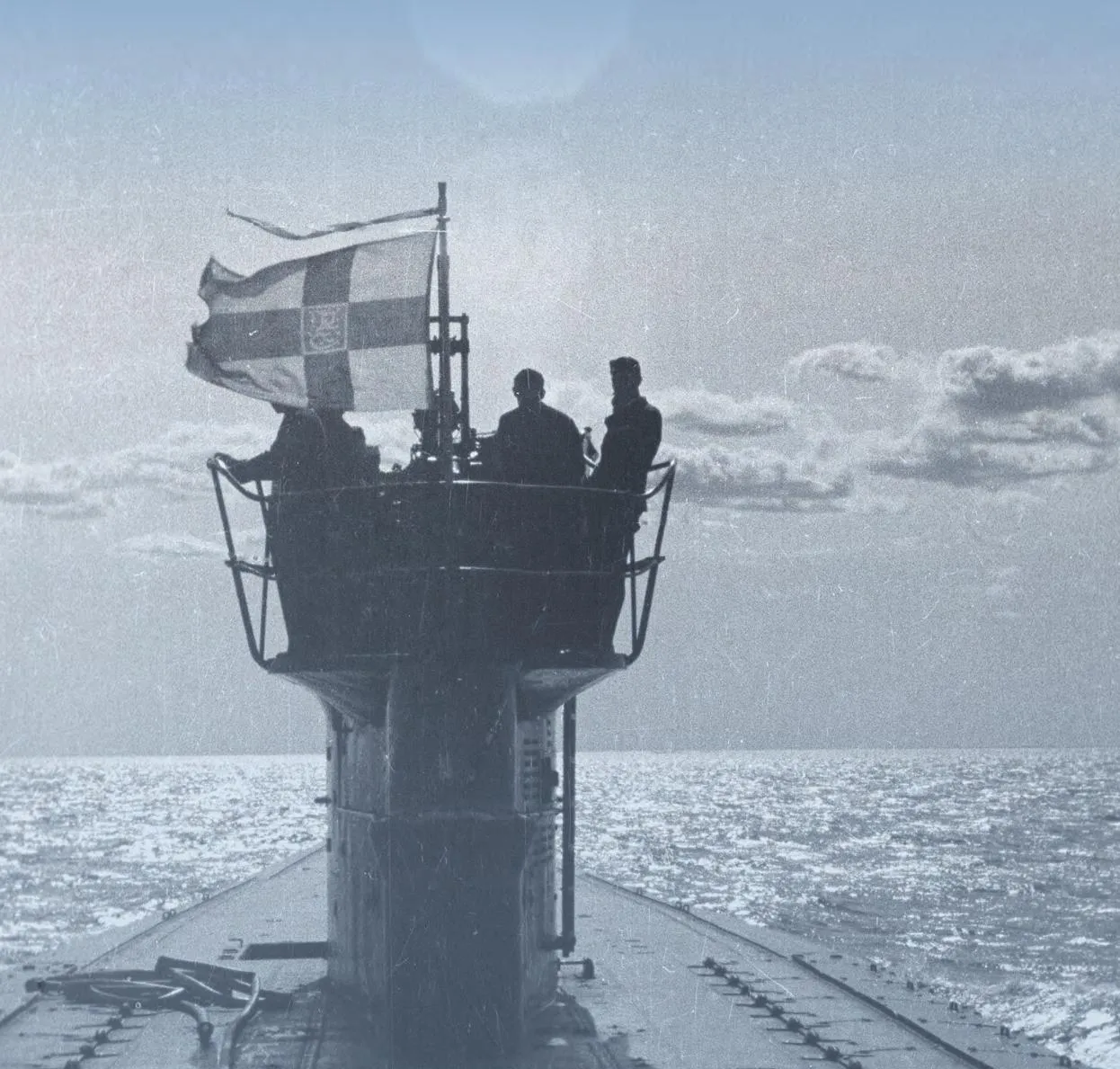
In the first years of its existence, the Navy of the independent Finnish Republic consisted of a small number of small warships and auxiliary vessels that had previously been part of the Russian fleet and captured by the Germans in April 1918. In May of that year, the Germans returned the most valuable ships to the RSFSR, and the Finns were left with only ships of little combat value, some of which were transferred to the RSFSR under the Treaty of Yuryev in 1920.
Beginning in 1919, the Finnish government began developing plans to strengthen its navy. These included the construction of submarines. The first naval shipbuilding plan, developed by the Commander-in-Chief of the Navy, Captain 1st Rank Hjalmar von Bongsdorff, a former Russian naval officer, proposed the construction of four submarines (300 tons, 15/10 knots, 6 torpedo tubes) and a large number of surface ships. The plan was clearly unrealistic and was rejected by the government. In 1920, a naval commission was formed, headed by Captain 1st Rank G. von Schoultz, also a former Russian officer. It proposed a new naval development plan, which also called for the construction of four submarines (750/900 tons, 18 knots, 1x75 mm gun, 4 torpedo tubes) and a floating base for them. And this plan was rejected.
In March 1921, a new commission headed by General O. Enckell began its work. In 1921-1923, it reviewed a number of military shipbuilding programs, according to which it was also proposed to build submarines: the first option - 4 large (345/400 tons, 15/9 knots, 1x75-mm gun, 4 TA) and 2 small (100/127 tons, 10/7 knots, 1x47-mm gun, 1 TA); The second - 9 large submarines (400/525 tons, 14,5/8 knots, 1x100-mm gun, 2 machine guns, 4x533-mm TA), 3 underwater minelayers (400/525 tons, 1x100-mm, 2 machine guns, 3x533-mm TA, 12 mines) and 4 small submarines (99/120 tons, 10/7 knots, 2 machine guns, 1x450-mm TA). In May 1923, the commission developed a shortened version of the program, which included three large and one small submarine.
Subsequently, various committees and commissions reviewed the Finnish Navy's development programs until, finally, on December 22, 1927, the Parliament adopted the "Law on the Foundations of the Coastal Defense Fleet." Specifically, it proposed the construction of three large 400-ton submarines, at a total cost of 90 million Finnish marks, and one 100-ton small boat (8 million marks).
In addition to building new submarines, the Finns attempted to bolster their fleet by sank four Russian AG-class (American Holland) submarines near Gange (Hanko) on April 3, 1918, before the German invasion. Two of the submarines (AG-12 and AG-16) were raised in 1924. AG-16 was deemed fit for restoration, but funds were never allocated, and it was decommissioned in 1929.
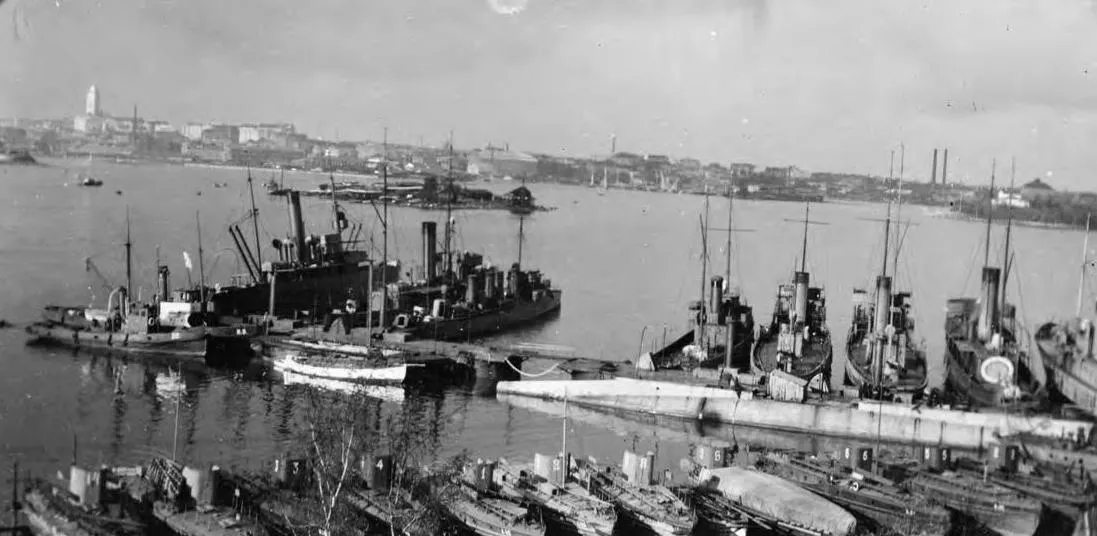
Submarine AG-16 in the Katajanokka naval harbor, early 1920s
In late 1925, the Finnish government invited several British, Dutch, French, Danish, Swedish, and Finnish shipyards to participate in a competition to design and build submarines for the Finnish Navy. These submarines were required to meet the following requirements:
1. Large submarines.
Double-hulled vessels with a surface displacement of 350-400 tons. The hull must be reinforced for ice navigation. Maximum diving depth is 75 meters. Surface speed is 13,5-14,0 knots, submerged – 8-9 knots. Surface range is 1500 miles, submerged – 75 miles at four knots. Emergency diving time is no more than 30 seconds, and surfacing from a depth of 9 meters takes two minutes.
Armament: two bow and two stern TA, a 75 mm gun and a 12,7 mm machine gun, 18–20 mines with an explosive charge of 200 kg and the ability to lay them from an underwater position.
2. Small submarine.
A single-hulled submarine with a surface displacement of no more than 99 tons. This restriction was due to the submarine's intended use on Lake Ladoga, where the Treaty of Yuryev prohibited the possession of warships with a displacement exceeding 100 tons. For rail transport, the submarine had to be disassembled into three parts. Maximum diving depth was 75 meters. Speed 8-9/6 knots. Surface range 700 miles, submerged 50 miles at four knots. Emergency diving time was no more than 15 seconds, and surfacing from a depth of 5 meters was no more than two minutes.
Armament: one bow 450 mm TA, one 12,7 mm machine gun or 25 mm cannon, 8-10 mines with a charge of 80 kg and the ability to be deployed from an underwater position.
Twenty-two companies submitted proposals, including four Finnish ones, as well as such renowned submarine builders as the American Electric Boat Co. and the Swedish Kockums Mekaniska Verkstad. All Finnish shipyards cooperated with foreign firms. Hietalahden Laivatelakka, together with Electric Boat Co., submitted designs for both submarine types, Crichton-Vulcan with IvS only for the large submarine, Kone ja Silta Oy with IvS only for the small submarine, and Viipurin Höyryvene Oy, together with the Estonian Peetri Tehas, for the large submarine.
Articles 181 and 191 of the Treaty of Versailles categorically prohibited the German Navy from maintaining, building, or acquiring any type of submarine, including merchant ships. However, German shipbuilding firms and naval leadership tried by any means necessary to circumvent this treaty, preserving and developing submarine design and construction expertise and being prepared to resume submarine delivery to the fleet if necessary.
For this purpose, in July 1922, the companies Vulcan, Krupp, GW and AG Weser established a joint company in Holland, NV Ingenieurskaantor voor Scheepsbouw (IvS), to design, assist in the construction and conduct testing of submarines.
After reviewing the submitted designs, the technical committee signed contracts for the construction of large boats with Crichton-Vulcan (1926), and for small boats with Kone ja Silta Oy (1928), which transferred this right to Hietalahti Laivatelakka, in which it had owned a controlling stake since December 1926. Undoubtedly, an important role in this choice was played by the Finnish Navy advisor, Captain 3rd Rank Karl Bartenbach (Korvettenkapitän Karl Bartenbach), who during the First World War commanded the flotilla of German submarines in Flanders, persistently pushing the IVS designs
The keel of the first Finnish submarine, Vetehinen (construction number CV702), was laid down at the Crichton-Vulcan shipyard in Turku in September 1926. The design of this submarine was based on the Pu89 design developed by IvS, which in turn was based on the UBIII type minelayer submarines designed during World War I. In early 1927, IvS sent three German specialists in shipbuilding and torpedo engineering to Turku to assist with the construction of the submarines. weapons (Georg Behrmann, Hugo Peine, Edgar Rickmeyer, and Wilhelm Ertzbach). Soon after, two more similar boats were laid down at the same shipyard: Vesihiisi (CV703) and Iku-Turso (CV704). The boats' names derive from the names of the fairy-tale water spirits—heroes of the Finnish epic poem Kalevala.
Construction of these submarines progressed slowly, taking approximately three and a half years, due to a number of factors: the inexperience of the shipyard workers, long and cold winters, delays in the delivery of components, and a nine-month strike. Vetehinen entered service on October 13, 1930, Vesihiisi on December 2, and Iku-Turso on October 13 of the following year.
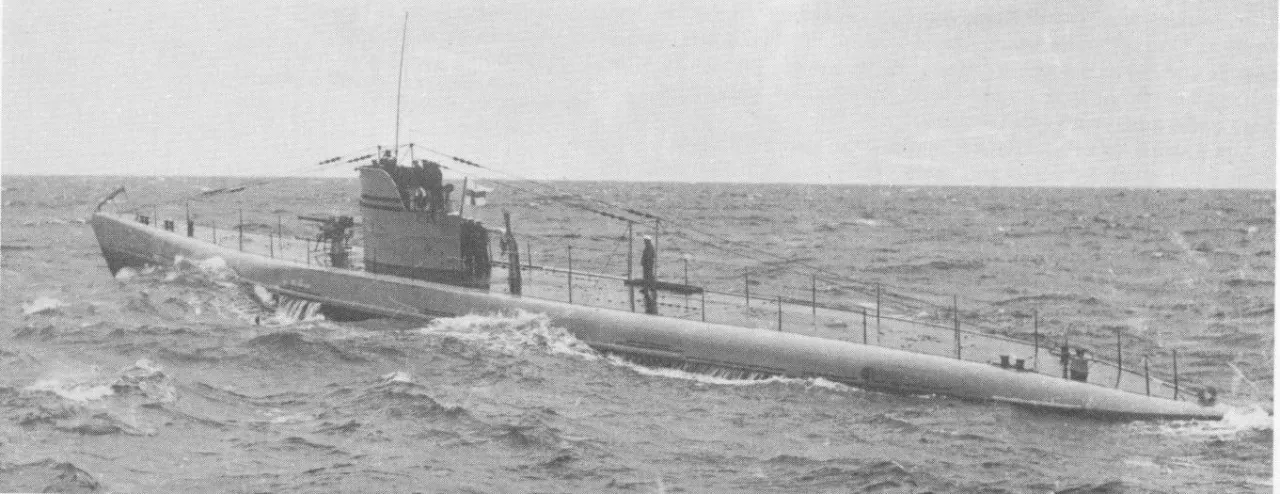
PL "Vesihiisi"
Main tactical and technical characteristics of the Vetehinen-class submarine
The greatest length, m - 63,5
Length of the strong hull, m - 47,1
Width is the greatest, m - 6,2
Draft, m - 3,2
Thickness of the hull plating, mm - 10-15
Light hull plating thickness, mm - 3,5-4,0
Ice belt thickness, mm - 6
Surface displacement, t - 493
Submerged displacement, t - 715
The main power plant is a diesel-electric, two-shaft
Surface engines - 2 x 580 hp / 515 rpm, six-cylinder, four-stroke Polar-Atlas diesel engines (Sweden)
Underwater electric motors - 2 x 360 hp / 420 rpm, Brown-Boveri (Switzerland)
Batteries - 2 groups of 62 elements, 6350 Ah.
Surface speed, knots - 14 (12,6*)
Underwater speed, knots - 8 (8,5*)
Surface cruising range, miles / at speed, knots - 1500 / 10
Submerged cruising range, miles / at speed, knots - 75 / 3
Fuel capacity, t - 20 (16*)
Operating immersion depth, m - 75
Armament:
Torpedo - 4 x 533-mm TA (2 bow, 2 stern), 6 torpedoes
Artillery - 1 x 76 mm/48 Bofors, 1 x 20 mm/60 Madsen, 1 x 12,7 mm
Mine - 20 mines in shafts (five per side)
Crew, persons - 30 (3 officers, 14 petty officers, 13 sailors)
*-according to other data.
Almost all the equipment, steel profiles and sheets for the boat hulls were purchased abroad.
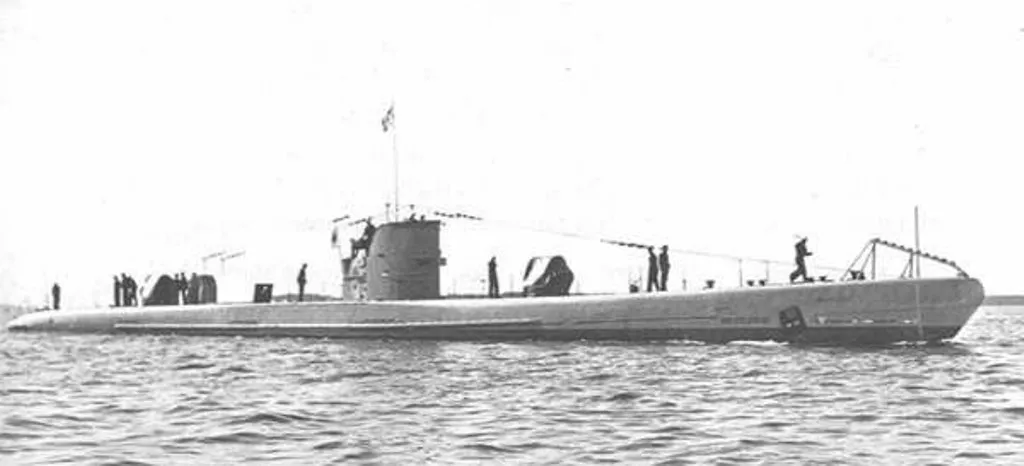
PL "Vetehinen"
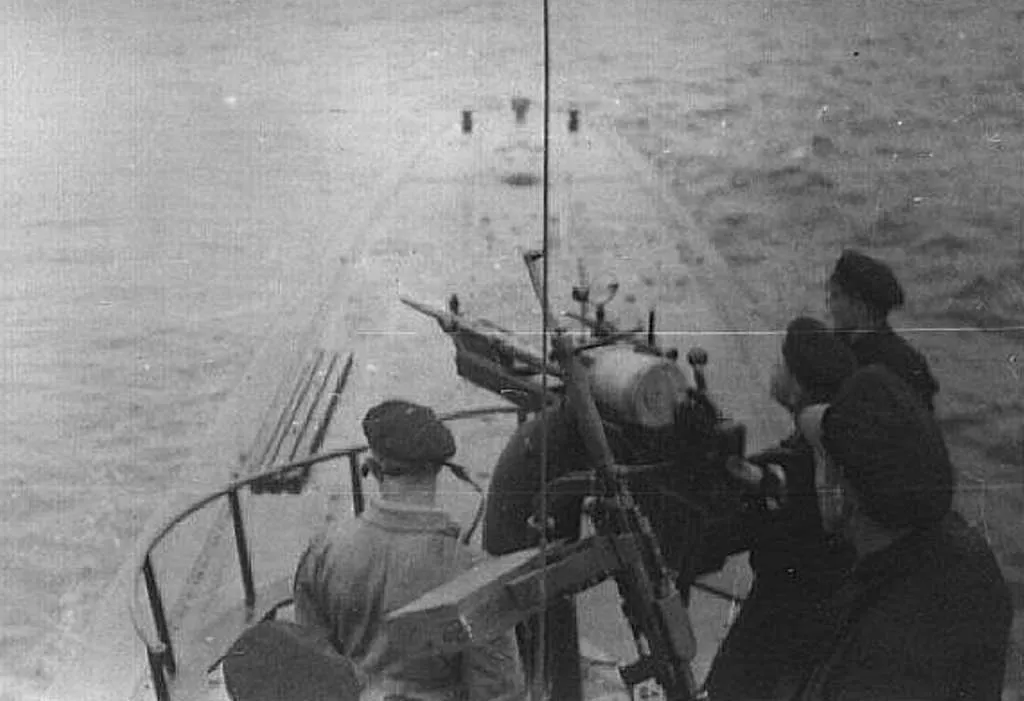
A 20mm Madsen gun and a machine gun aboard the Finnish Vetehinen-class submarine.
Since Finnish shipyards lacked the necessary specialists to conduct the submarine acceptance trials, the trials were organized by IvS with the assistance of the German Navy. The trials were led by retired Oberleutnant zur See Hans Schottky. Also participating were active-duty Reichsmarine officers Kapitänleutnant Karl Topp (later commander of the battleship Tirpitz), Kapitänleutnant (Ing.) Heinrich Papenberg, Kapitänleutnant (Ing.) Karl Thannemann, Oberleutnant zur See Hans Rudolf Rösing (later one of the most famous U-boat aces), Oberleutnant (Ing.) Bartels, as well as retired officers Leutnant zur See Plaas and Leutnant (Ing.) Lorek, and IvS designer Watje. The crews also included German shipbuilders and sailors from the Finnish Navy. By this time, a group of Finnish officers had received training in Italy, France, Denmark, the United States, and Great Britain. In 1929, submarine training courses were also organized in Finland.
Testing of the lead boat lasted about a month and a half and was completed on September 6, 1930. In his test report, H. Schottky wrote:
Taking into account the diving ability, seaworthiness and combat qualities relative to displacement, Captain 1st Rank Bartenbach and I came to the conclusion that these qualities are higher than those of any of the foreign boats.
The remaining submarines were tested in a similar manner. Surface trials of the last submarine in the Iku-Turso series were conducted in the summer of 1931 by an entirely Finnish team, although German specialists were again involved in the underwater trials.
The construction of the small monohull submarine "Saukko" (SA-241) at the Hietalahden Laivatelakka shipyard in Helsinki also encountered significant difficulties until German workers were hired. This submarine, designed for Lake Ladoga (the "Saukko" never made it there), was developed by IvS under the designation Pu-109/110. The plan was to transport it to Landenpohja by rail, for which purpose the submarine's hull could be disassembled into two sections, and the conning tower removed.
In 1926, this same project was secretly considered by the German military leadership as a prototype for submarines built under the so-called "mobilization plan," but was rejected. The main reason was its poor seaworthiness and endurance (only 48 hours). Saukko was launched on July 2, 1930, and its trials were conducted until December of that year by a German team led by H. Schottky. The trials were delayed, in part due to frequent breakdowns of the diesel engine, which was a prototype. The engine was never fully developed.
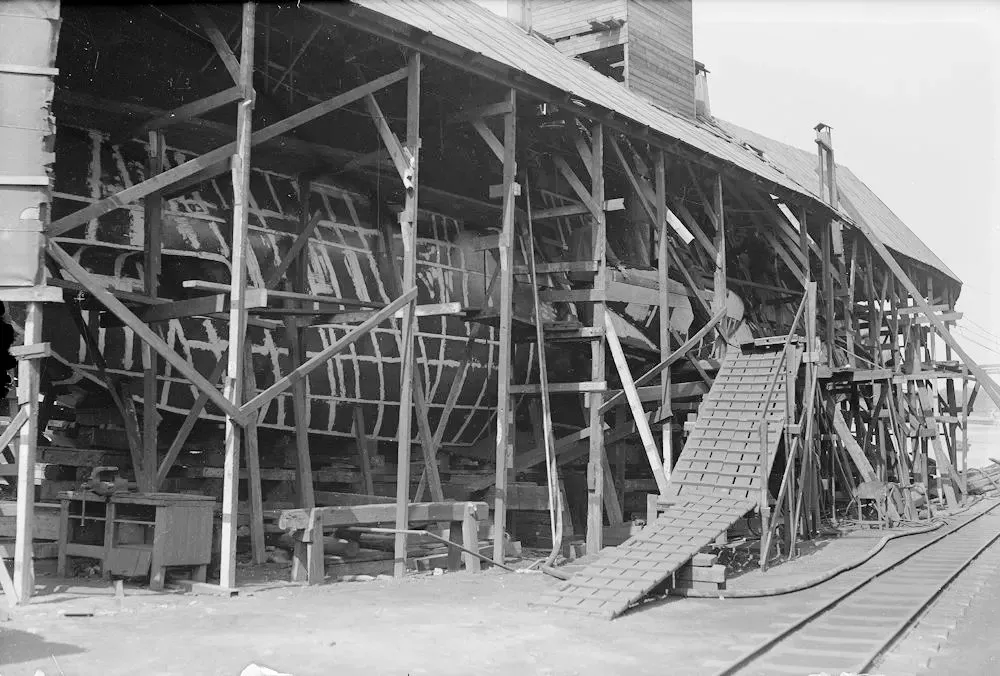
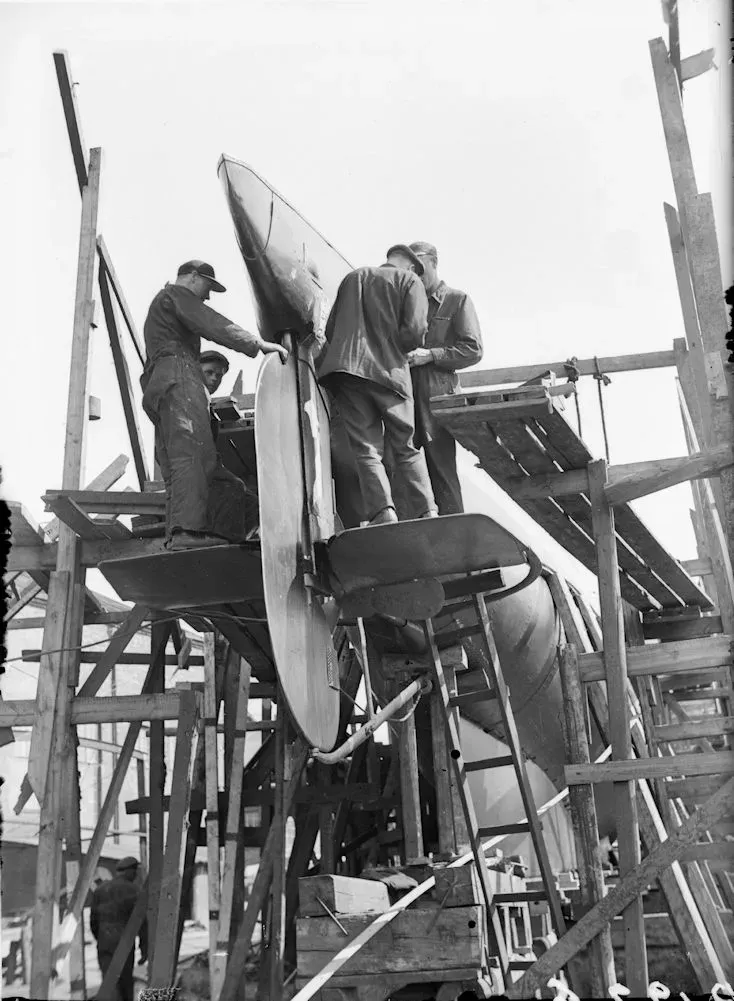
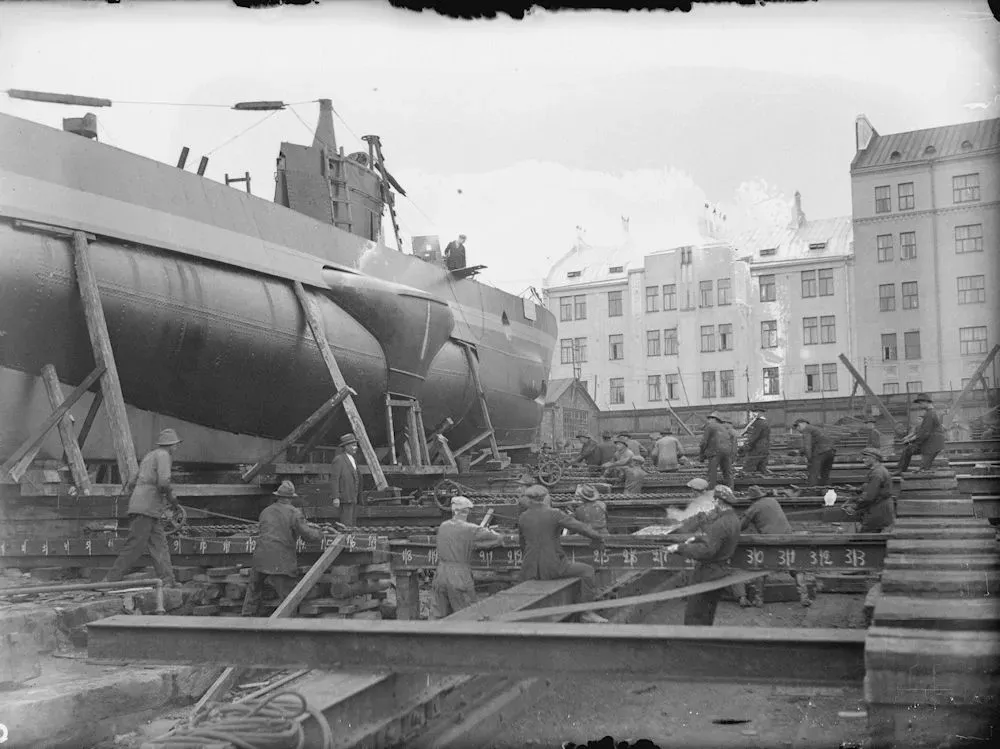
Construction of the submarine "Saukko"
Main tactical and technical characteristics of the submarine "Saukko"
The greatest length, m - 32,4
Width is the greatest, m - 4,1
Draft, m - 3,1
Thickness of the hull plating, mm - 8,5-10
Light hull plating thickness, mm - 5,5
Ice belt thickness, mm - 6
Surface displacement, t - 114
Submerged displacement, t - 142
Immersion depth, m - 75
Surface speed, knots - 10
Underwater speed, knots - 6,25
The main power plant is diesel-electric, single-shaft
Surface engine - 1 x 200 hp diesel Krupp-Germaniawerft
Underwater electric motor - 1 x 120 hp
Battery pack - 1 group of 32 elements
Fuel capacity, t - 1,8
Surface cruising range, miles/at speed, knots - 500 (375*) / 8
Underwater cruising range, miles/knots - 50 (45*) / 4
Torpedo armament: 2 bow 450-mm TA, 2 torpedoes
Mine armament - 3 bow mines, 9 x 650 kg or 3 x 850 kg and 3 x 650 kg mines
Crew, persons - 15 (2 officers, 5 petty officers, 7 sailors)
There were two mounting positions for a 12,7mm machine gun (in front and behind the wheelhouse fence), but the machine gun was not installed.
* - according to other data.
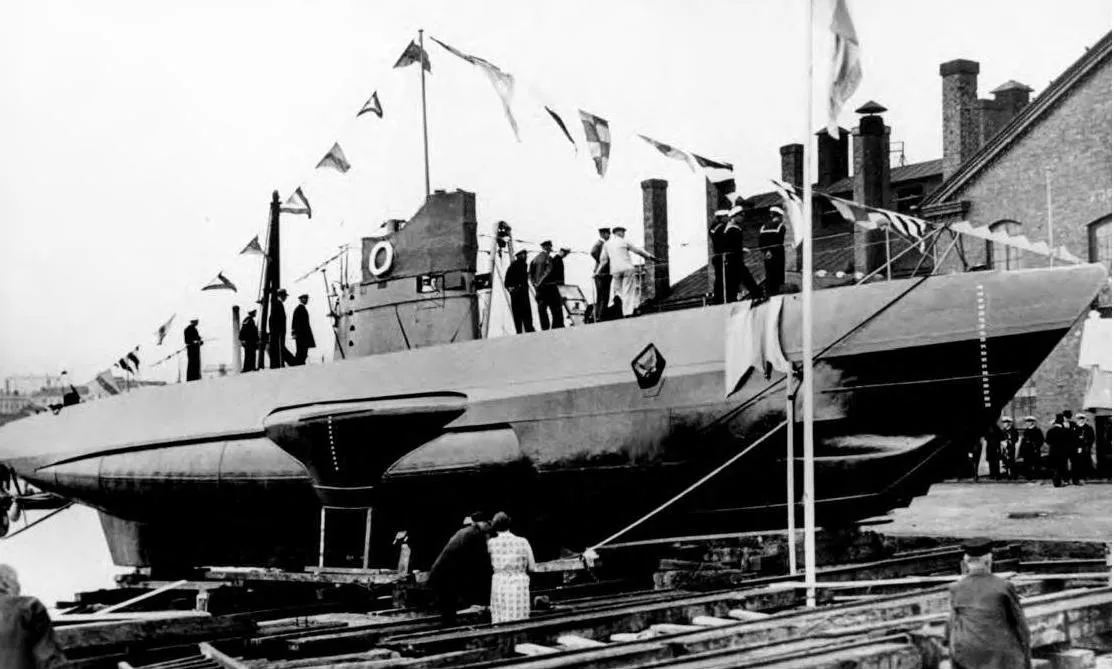
Launching ceremony of the Saukko
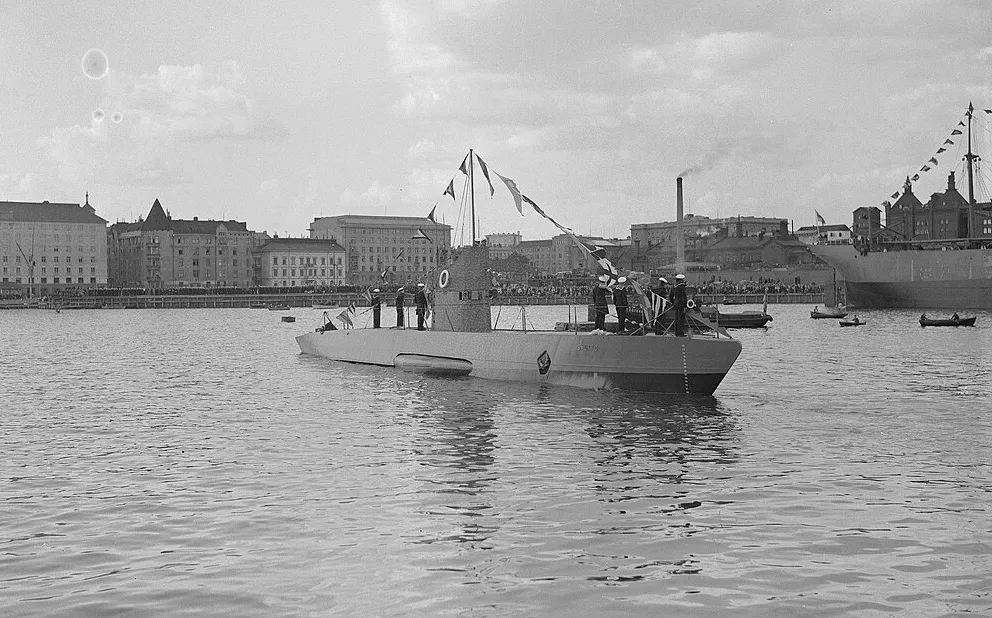
Saukko after launching
Meanwhile, discussions continued in Germany about the optimal design for a "mobilization" boat. A secret memorandum (spring 1926) stated:
"K" (the naval design bureau – author's note) will develop a preliminary design, which will be submitted to IvS for final design. A major advantage would be to have a similar submarine built in a friendly country according to IvS's design, which would allow for the necessary experience to be gained and a full set of working drawings to be developed.
On February 20, 1930, H. Schottky, who by then headed Department A IIu (this abbreviation was used to describe the German Navy department responsible for developing submarines), wrote:
The most important task is to develop a design for a small, simple, and time-efficient submarine. We are proposing a single-hull submarine with a displacement of approximately 200 tons, a surface speed of 12 knots, and a torpedo armament of three 533mm bow torpedo tubes. We need to design, build, and test such a submarine abroad as quickly as possible. The creation of an experimental 200-ton submarine will allow IvS designers to gain invaluable experience. The submarine's construction will enable us to train both active-duty and reservist submariners and provide us with significant experience in this area of shipbuilding. It will also enable us to conduct sea trials, which will be crucial when we begin building similar submarines for ourselves, helping us avoid associated difficulties, accidents, and crew errors.
On October 9, 1930, IvS signed a contract with Crichton-Vulkan for the construction of a new type of submarine (codenamed "Lilliput") at the Turku shipyard, costing 1,5 million German marks. Unlike previous submarines ordered by the Finnish government, this submarine was considered a commercial order from the shipyard. However, in March of the following year, an agreement was reached between the Finnish Ministry of Defense and Crichton-Vulkan, granting the Finnish government the right to purchase this submarine until the end of 1937.
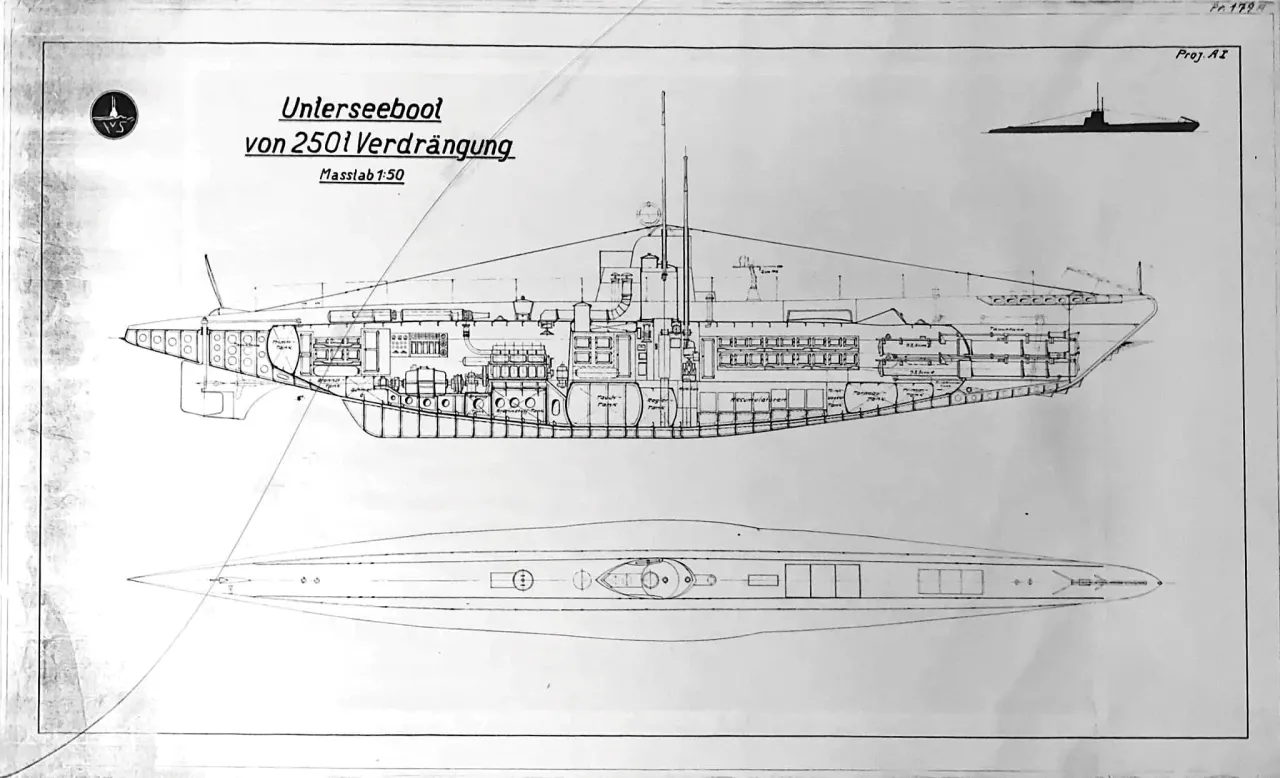
The 250-ton submarine project – the Vesikko prototype
Construction of the submarine (construction number CV707) began on August 1, 1931. It was the prototype for the German Type II submarines, also known by the nickname "Einbäume" ("boat"). The submarine was launched on May 10, 1933, and trials began in June.
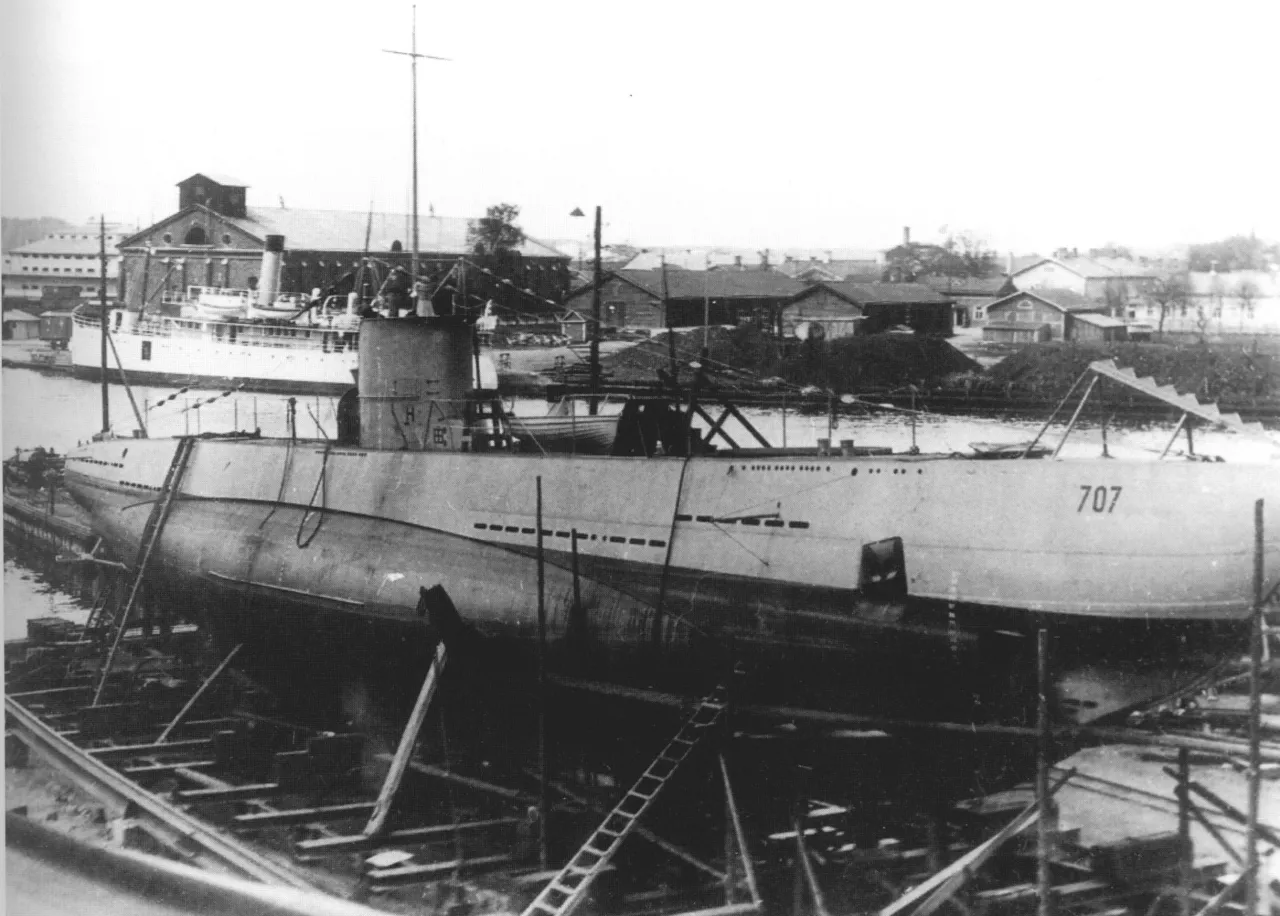
CV707 (Vesikko) under construction
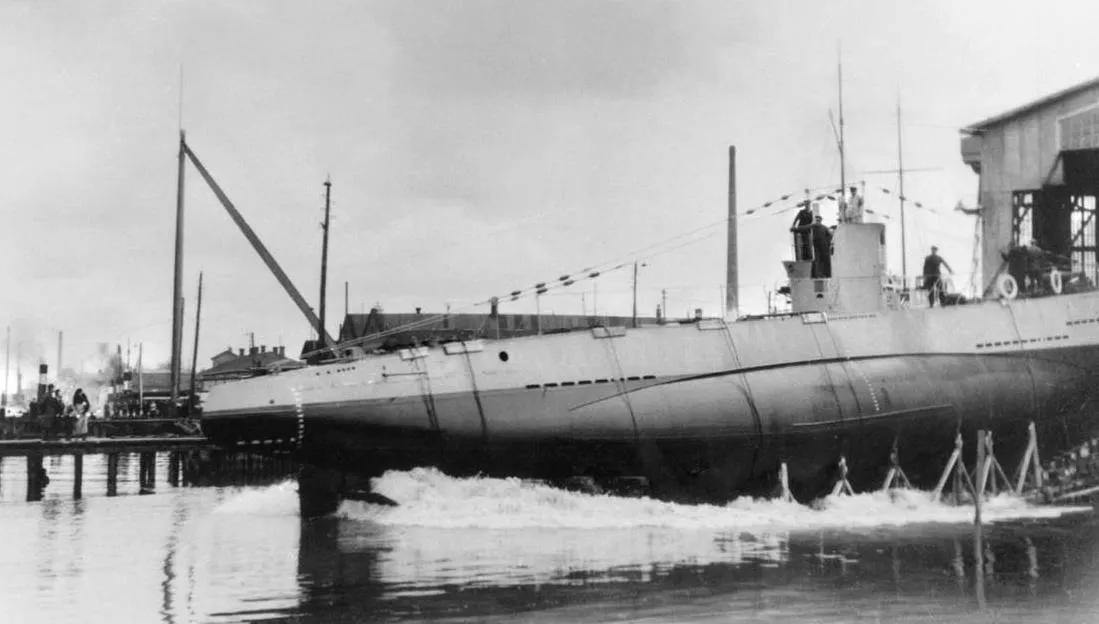
Launching of Vesikko on 10 May 1933
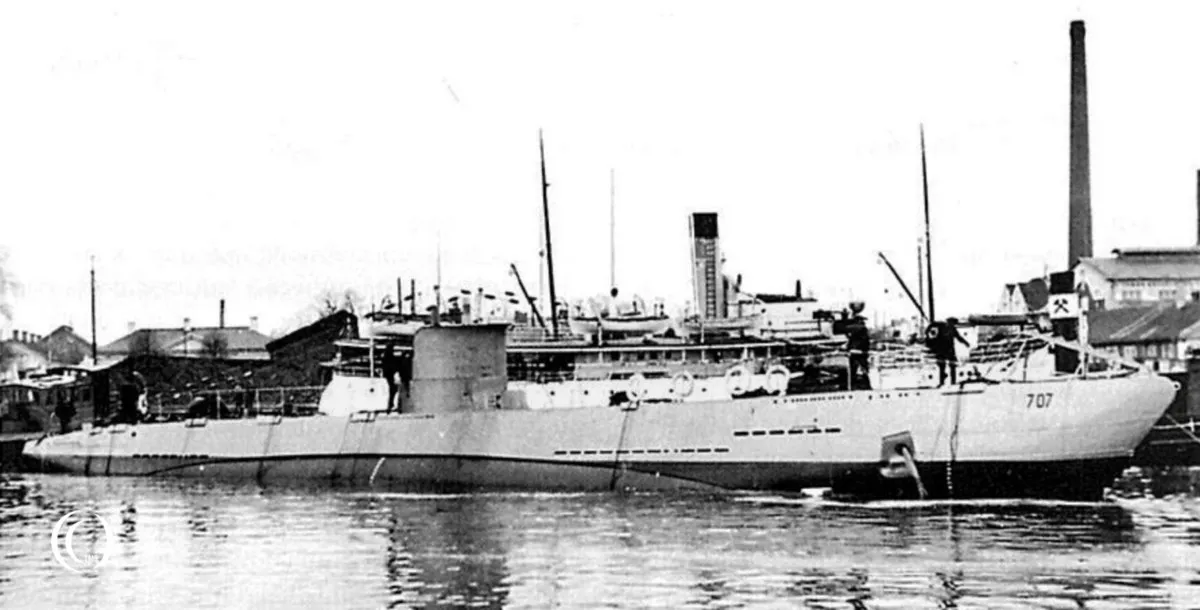
Submarine CV707 at the Crichton-Vulkan shipyard in Turku, 1933.
Although the designs for late World War I submarines (UB-II and UF) were used as prototypes, a number of technical innovations were also incorporated. For example, the use of new St 52 steel allowed for an increased diving depth of 100 meters, while the use of high-speed (1000 rpm) diesel engines from MWM (Motoren-Werke Mannheim) allowed for the integration of higher-power engines in a limited space.
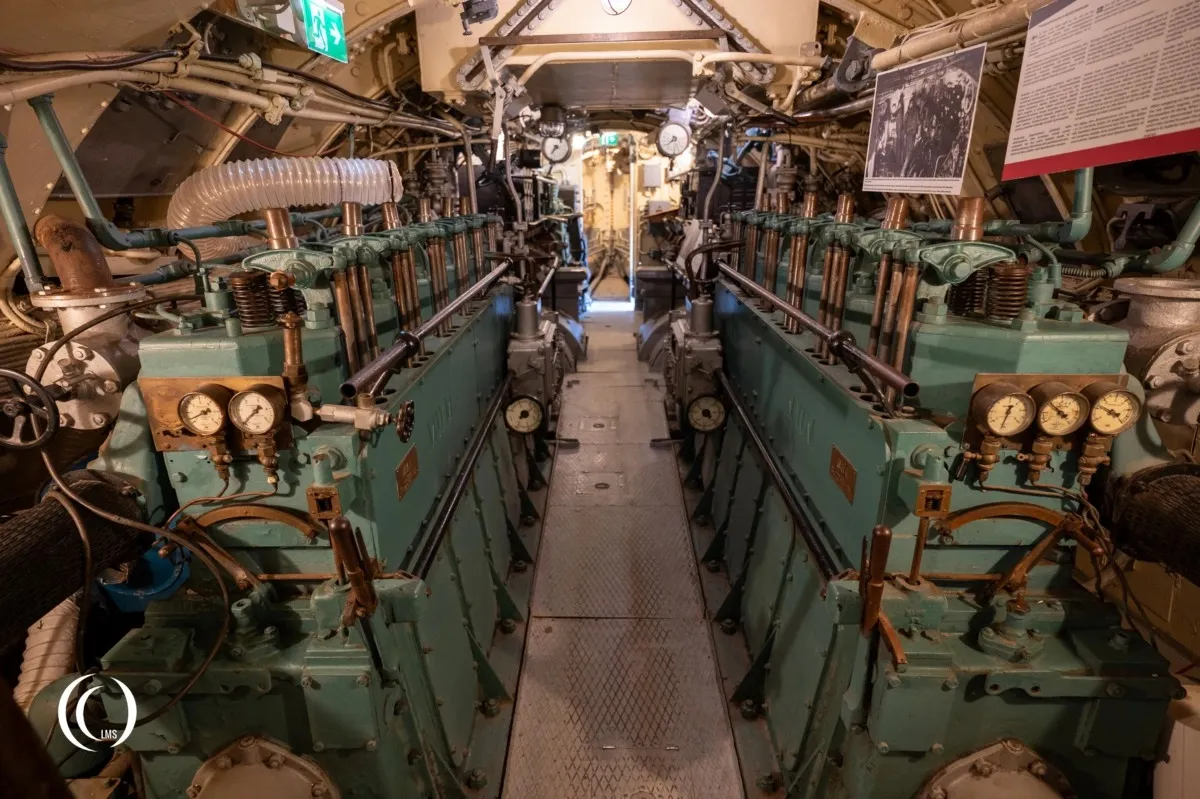
Vesikko submarine diesel engines
The acceptance trials were conducted by a 14-man German team under the command of Lieutenant Commander Werner Fürbringer (later replaced by Lieutenant Commander Robert Bräutigam), which included both active-duty sailors and retired officers. Ten of the crew members were graduates of the three-month submarine course opened in Flensburg-Mürwik in January 1933—the first in post-war Germany.
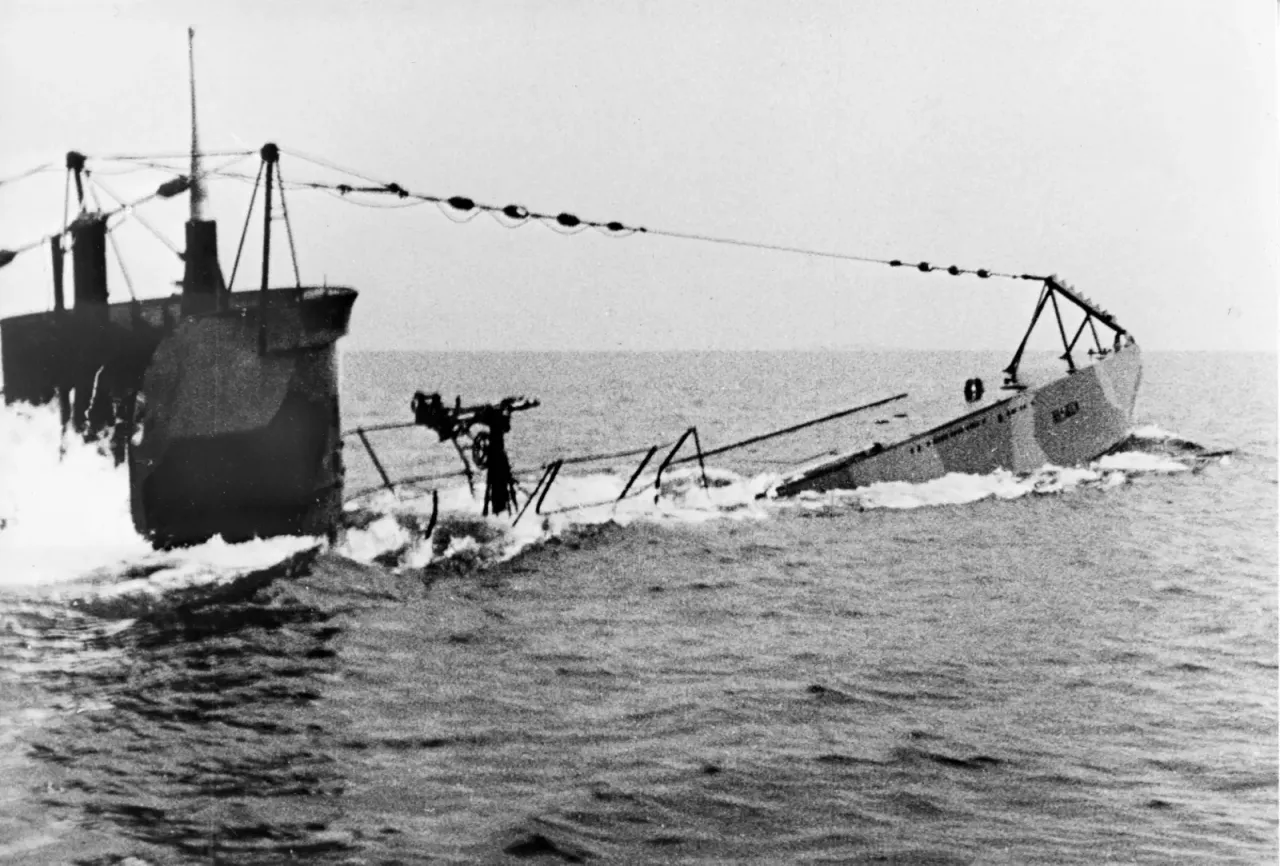
Surfacing of the submarine "Vesikko"
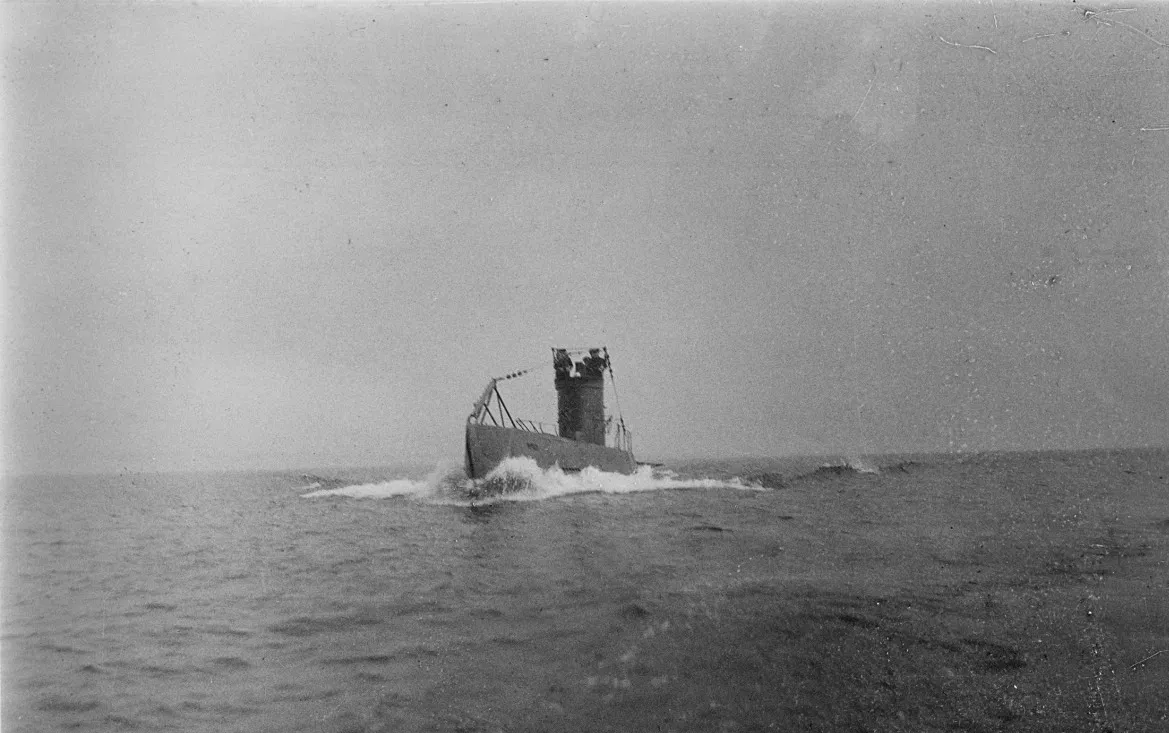
Vesikko is in surface position
The submarine's trials dragged on until January 1936—the Germans were using the opportunity to train personnel for their nascent submarine fleet, as well as to test torpedo armament (including the new G7e electric torpedoes) and hydroacoustic equipment. The trials revealed a number of design flaws: a long dive time (45 seconds at a depth of 9,3 meters), a short surface range, and the high noise levels of the high-speed diesel engines. The submarine was then sold to Finland for 19,4 million Finnish marks and entered service with the Finnish Navy on January 13. On May 1, she was renamed "Vesikko."
Main performance characteristics of the submarine "Vesikko"
The greatest length, m - 40,9
Width is the greatest, m - 4,1
Draft, m - 4,2
Diameter of the pressure hull, m - 3,9
Thickness of the hull plating, mm - 12-15
Light hull plating thickness, mm - 3
Operating immersion depth, m - 100
Maximum diving depth, m - 150
Surface displacement, t - 254
Submerged displacement, t - 303
Power plant type: diesel-electric, two-shaft
Diesel power, hp/rotation speed, rpm/type - 2 x 350/1000/ four-stroke MWM type RS 127S
Power of main electric motors, hp/rotation speed, rpm/ 2 x 180/360 / Siemens type PGVV 322/326
Battery pack, number of groups x number of elements - 1 x 62 type MAD 580
Battery discharge current, Ah / discharge time - 5850 / 10, 6350 / 20
Fuel capacity, m³ - 11,15
Surface speed, knots - 13
Underwater speed, knots - 7 (8*)
Surface cruising range, miles / speed, knots - 1050/12, 1500/10, 1960/8
Submerged cruising range, miles / speed, knots - 122,6/2, 61,1 (50*) /4, 15,5/7
Torpedo armament: 3 x 533 mm bow TA, 5 torpedoes
Artillery armament - 1 x 20-mm/60 Madsen
Crew size: 20 people
*-according to other data
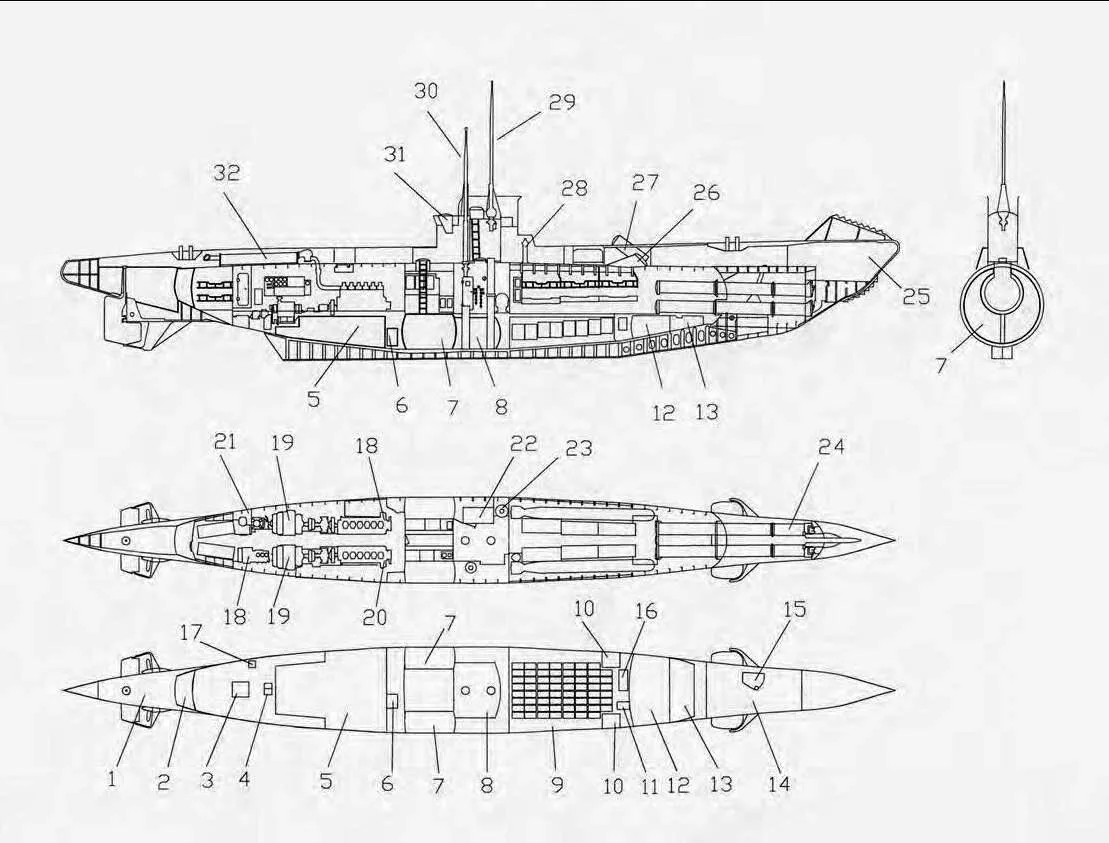
General location of the submarine "Vesikko"
1. Main ballast tank No. 1
2. Aft trim tank
3. Lubricating oil tank
4. Distilled water tank
5. Diesel fuel tank
6. Lubricating oil supply tank
7. Main ballast tank No. 2
8. Surge tank
9. Batteries
10. Drinking water tank
11. Torpedo fuse storage room
12. Torpedo replacement tank
13. Forward trim tank
14. Main ballast tank No. 3
15. Chain box
16. Ammunition storage room
17. Emergency drinking water supply tank
18. Air compressor
19. Propelling electric motor
20. Diesel
21. Toilet
22. Radio room
23. Gyrocompass
24. Torpedo tubes
25. Forehead buoyancy tank
26. Torpedo overload hatch
27. Ammunition storage for the gun
28. Magnetic compass
29. Commander's periscope (attack periscope)
30. Anti-aircraft periscope
31. Emergency buoy
32. Diesel exhaust pipe.
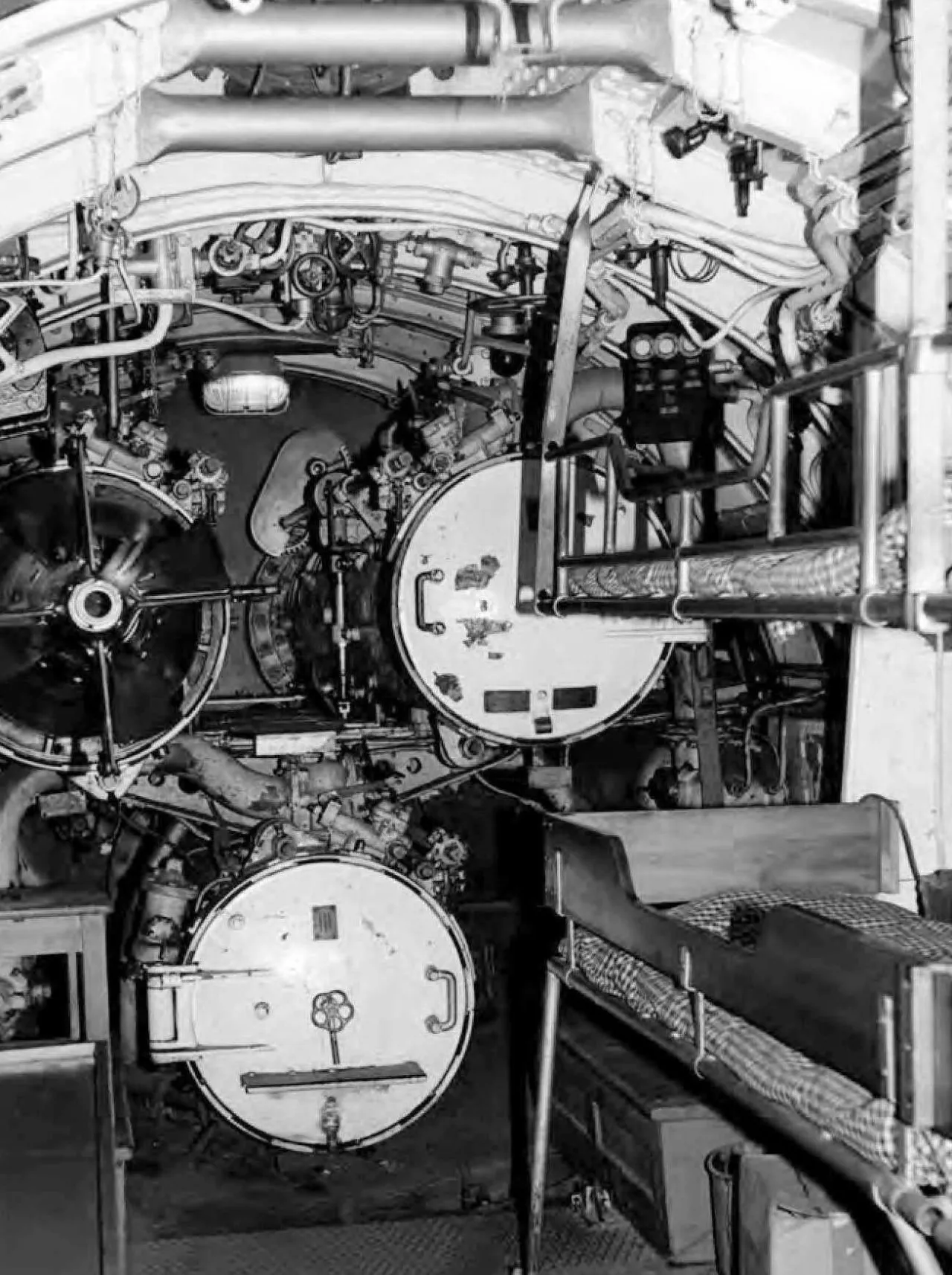
Torpedo room of the Vesikko
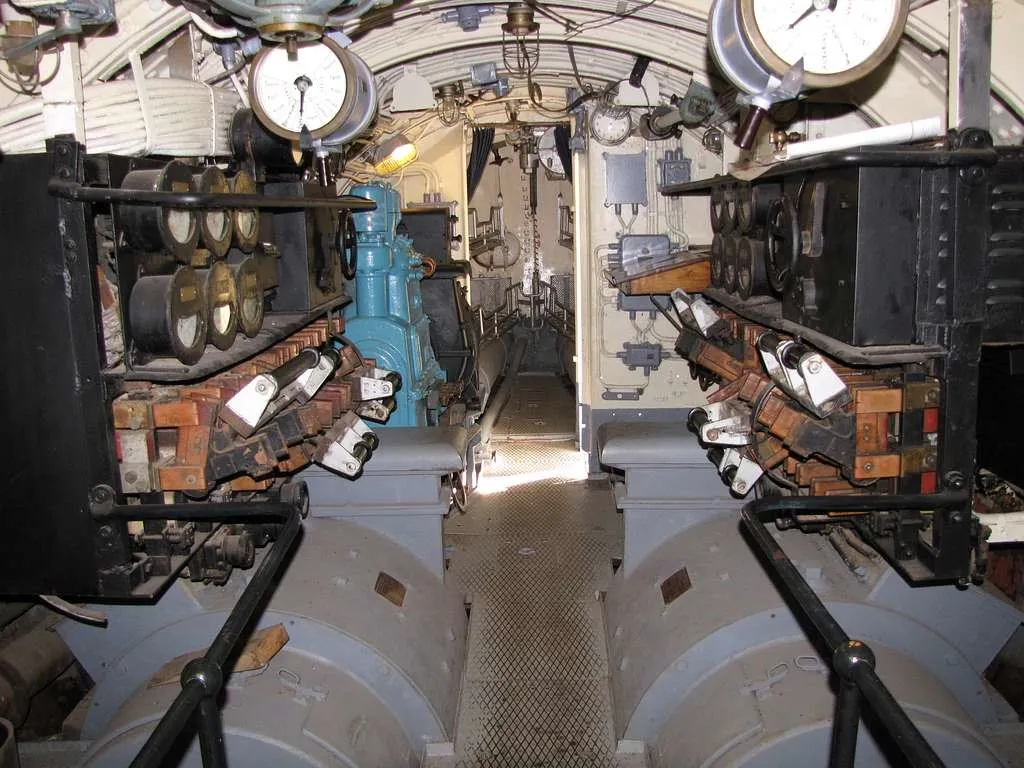
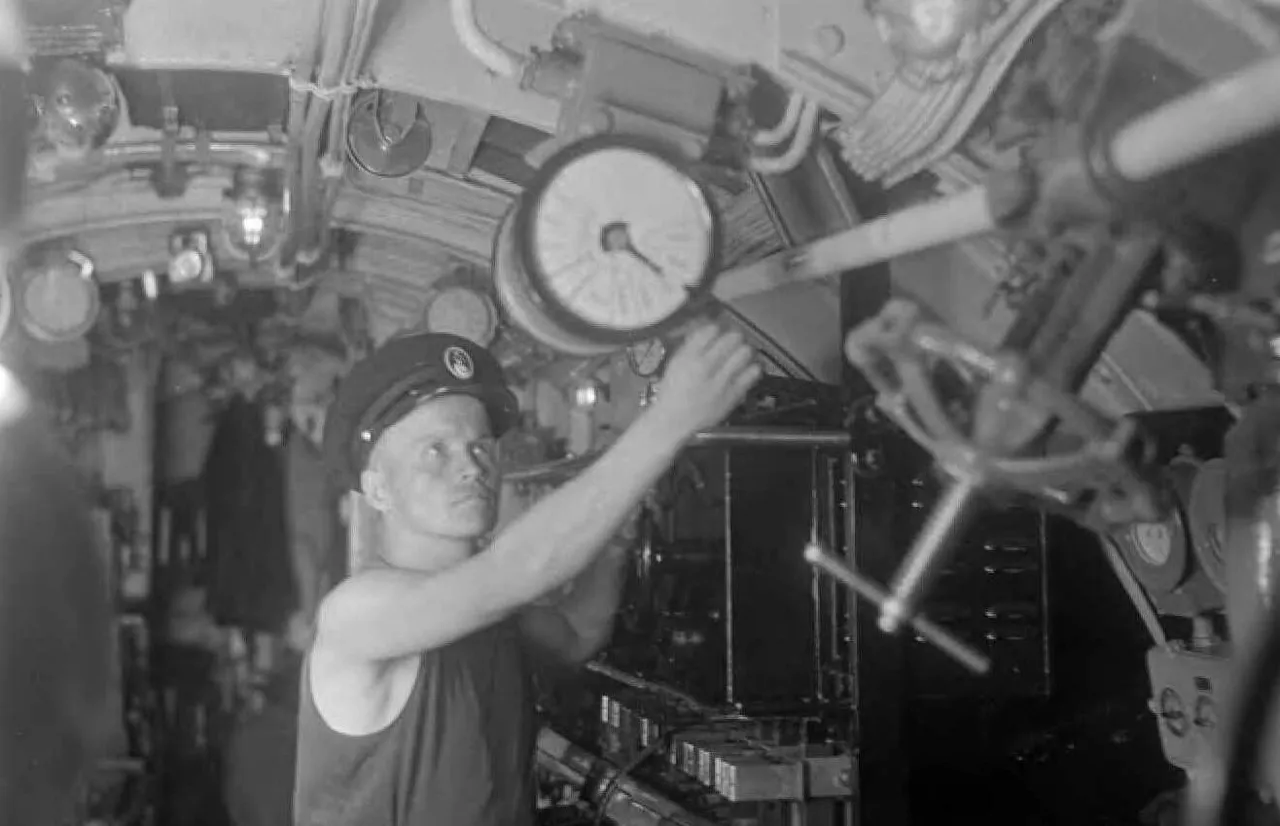
In the electric motor compartment
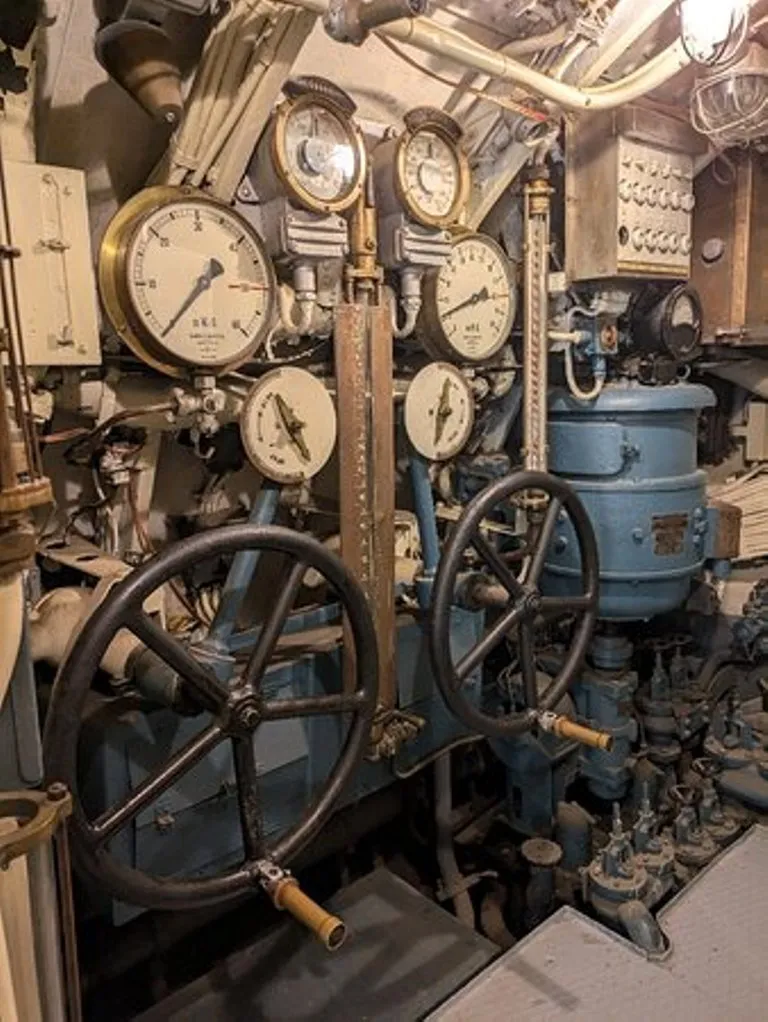
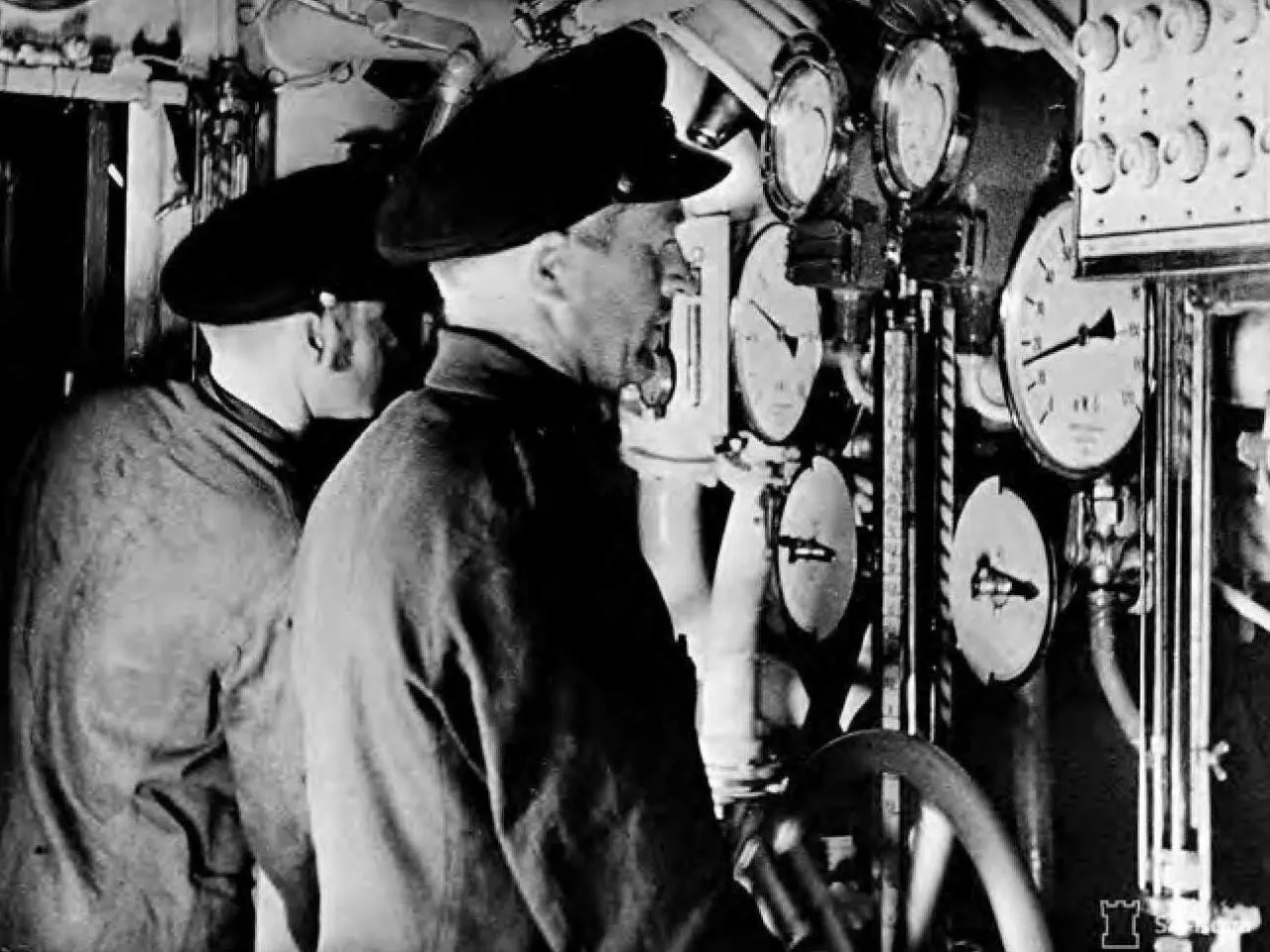
Vesikko horizontal rudder control posts
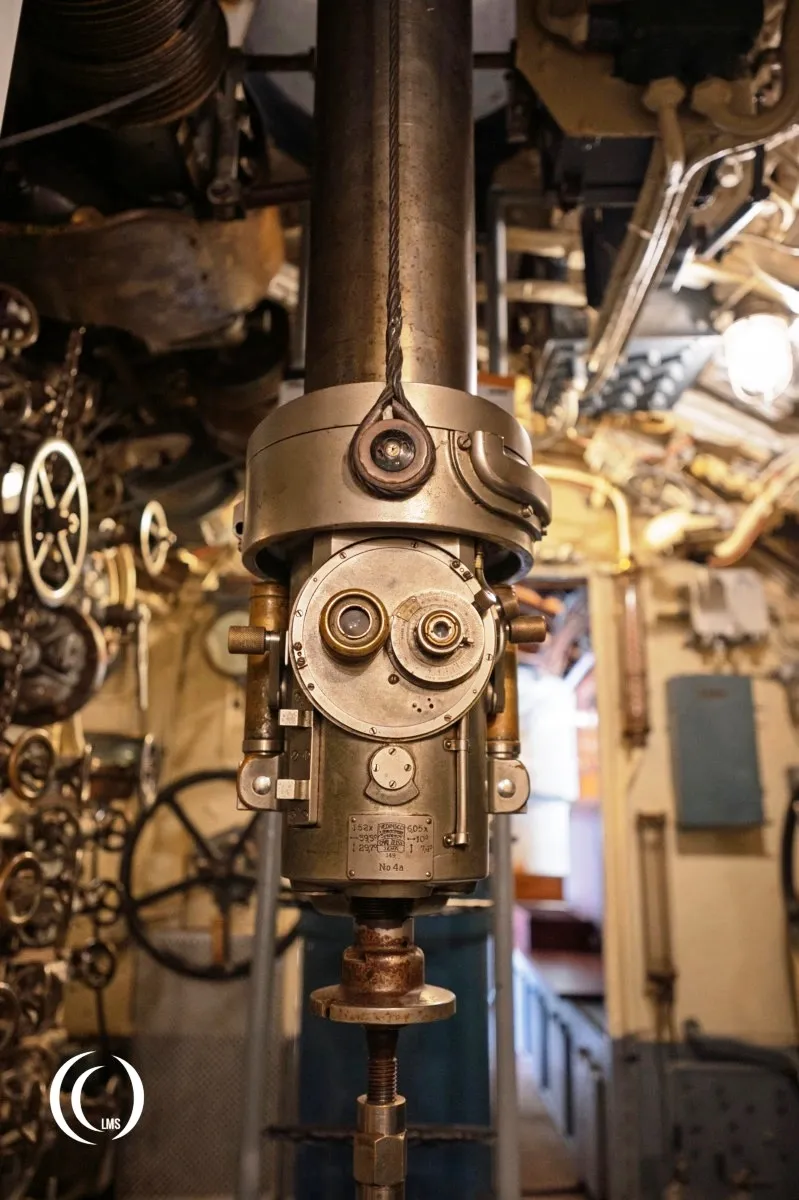
Anti-aircraft (navigation) periscope "Vesikko"
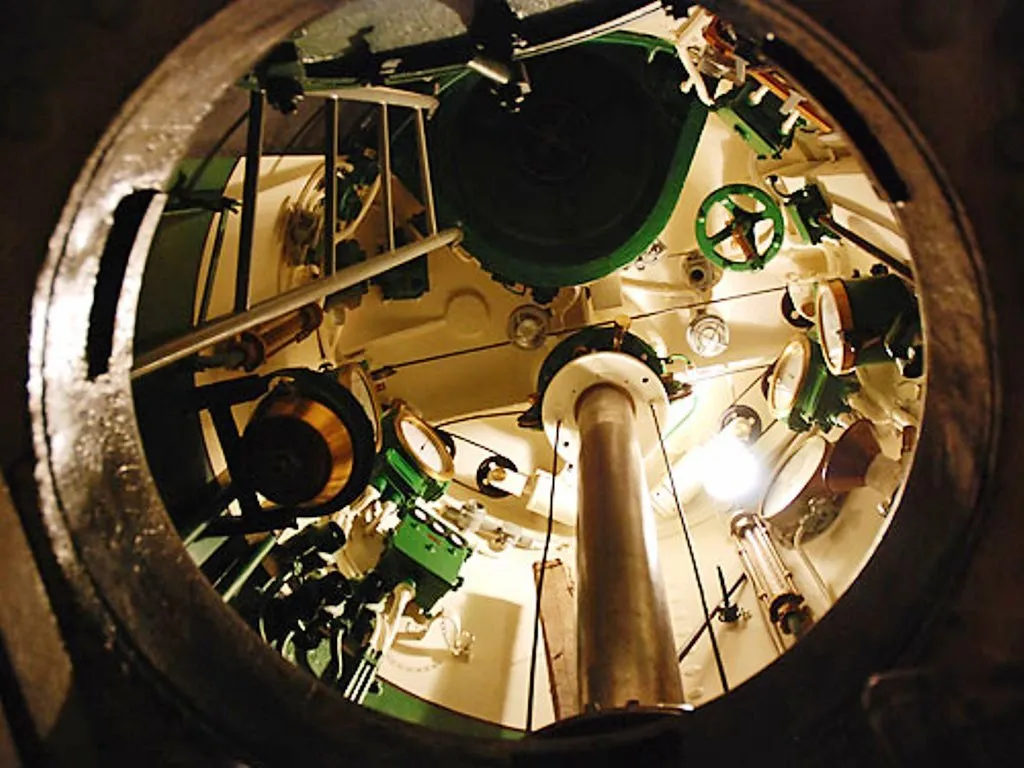
Conning tower of the Vesikko
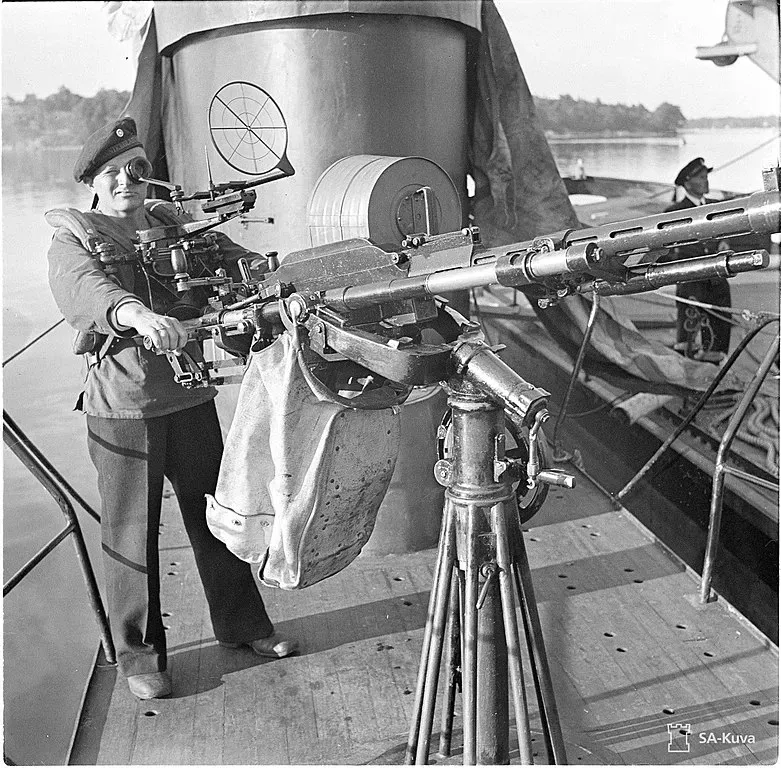
20mm Madsen gun on board Vesikko, 19 July 1941.
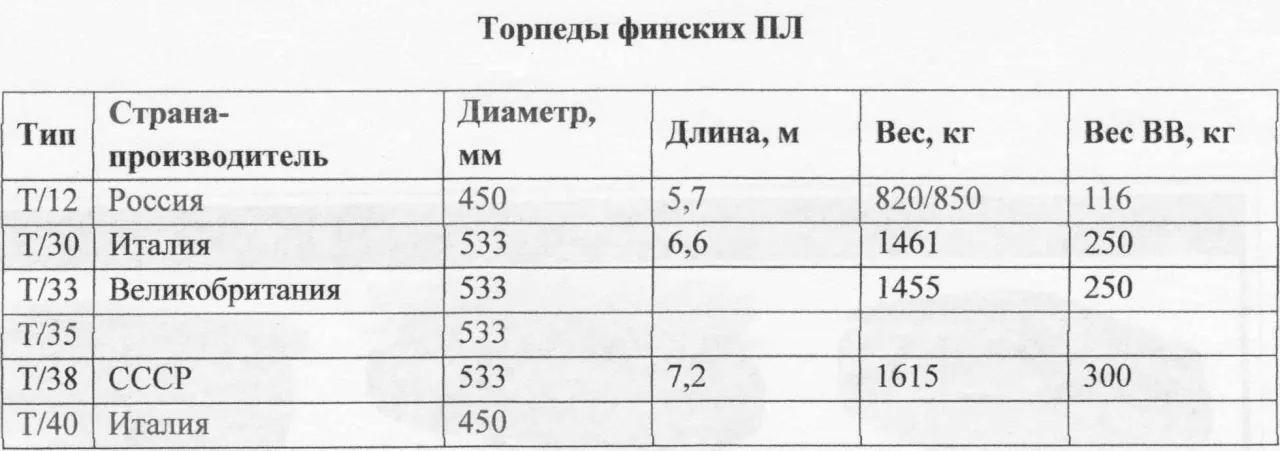
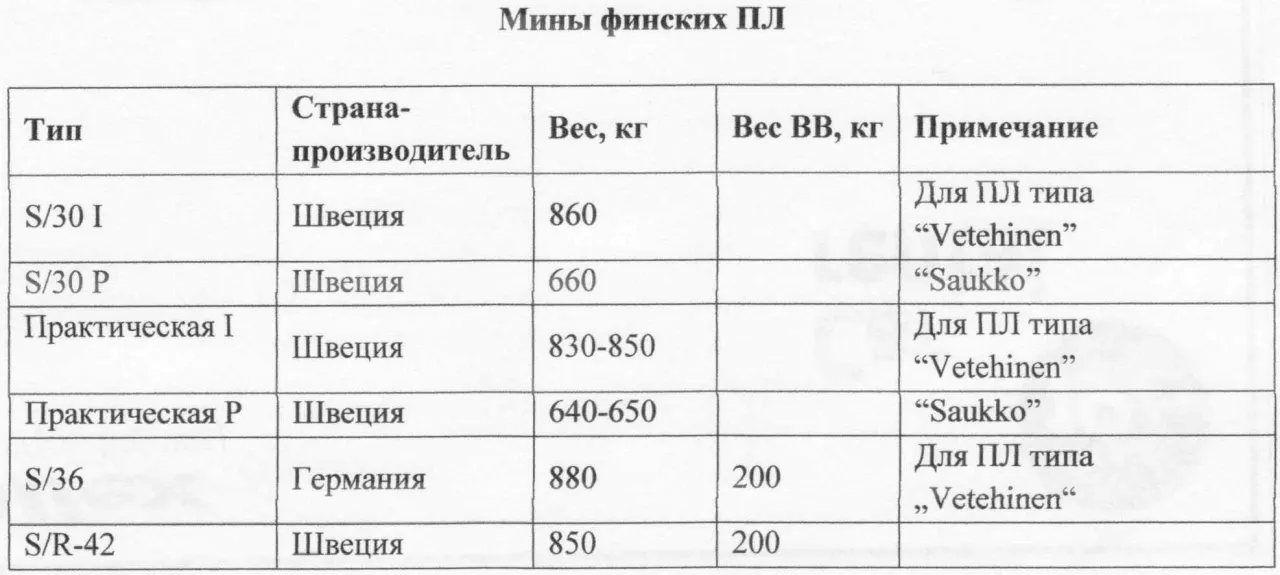
In 1929, the Finnish parliament allocated a modest sum of 5 million marks for the purchase of the first batch of torpedoes and mines for submarines under construction. In 1930-1931, the Italian company Silurifocio Whitehead (Fiume) supplied four 533-mm torpedoes (type T/30), and the Swedes (AB Lindholmen-Motala) supplied 130 mines without warheads. Furthermore, in 1918, the Finns inherited a significant number of 450-mm Whitehead torpedoes (type T/12) from the Russian Navy. In 1933, a batch of 533-mm torpedoes (T/33) was purchased from Great Britain, and during the Soviet-Finnish War, Italian 450-mm torpedoes (T/40) were purchased. In 1942, the Germans transferred captured 533-mm Soviet torpedoes to the Finnish Navy, which they designated T/38. However, Suomi submariners were only able to use them in 1944, as this required increasing the length of the torpedo tubes. In 1936, 220 S/36 mines were acquired from Germany.
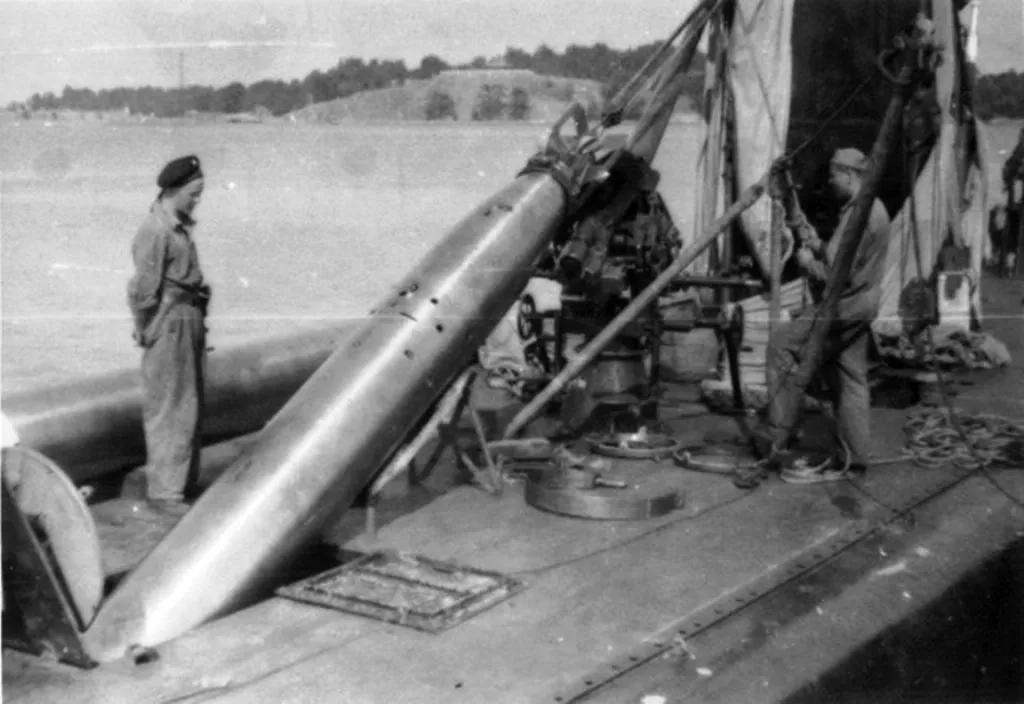
Loading a torpedo onto the submarine Vesikko
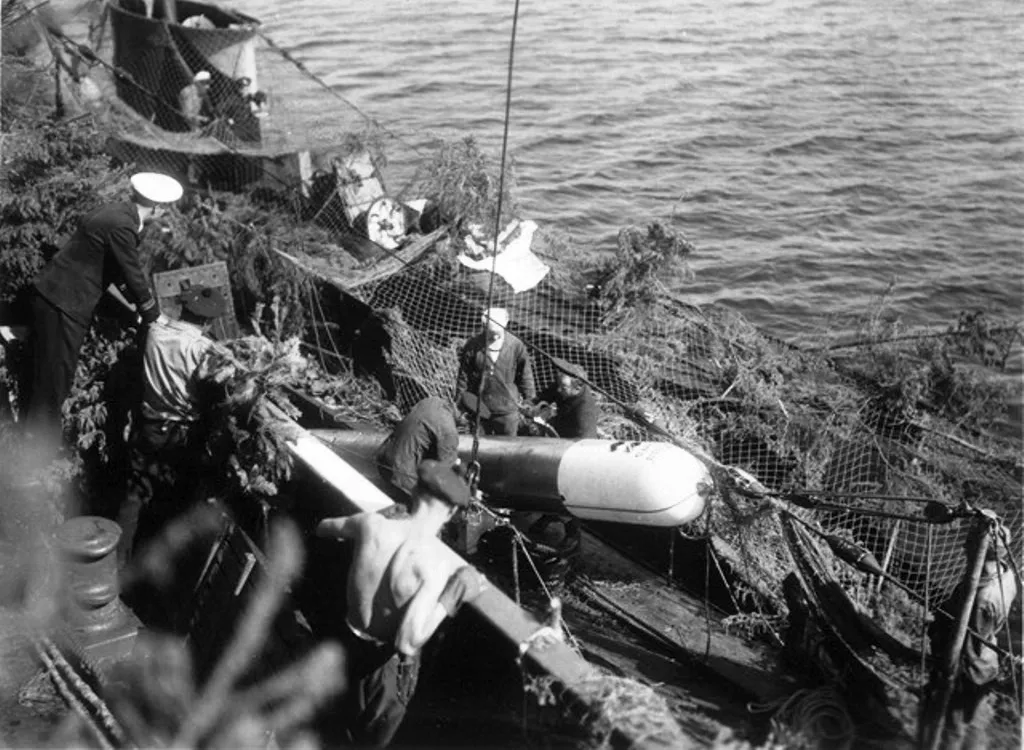
Loading a T-33 torpedo from the floating base "Sisu" onto the "Vesikko", July 1941.
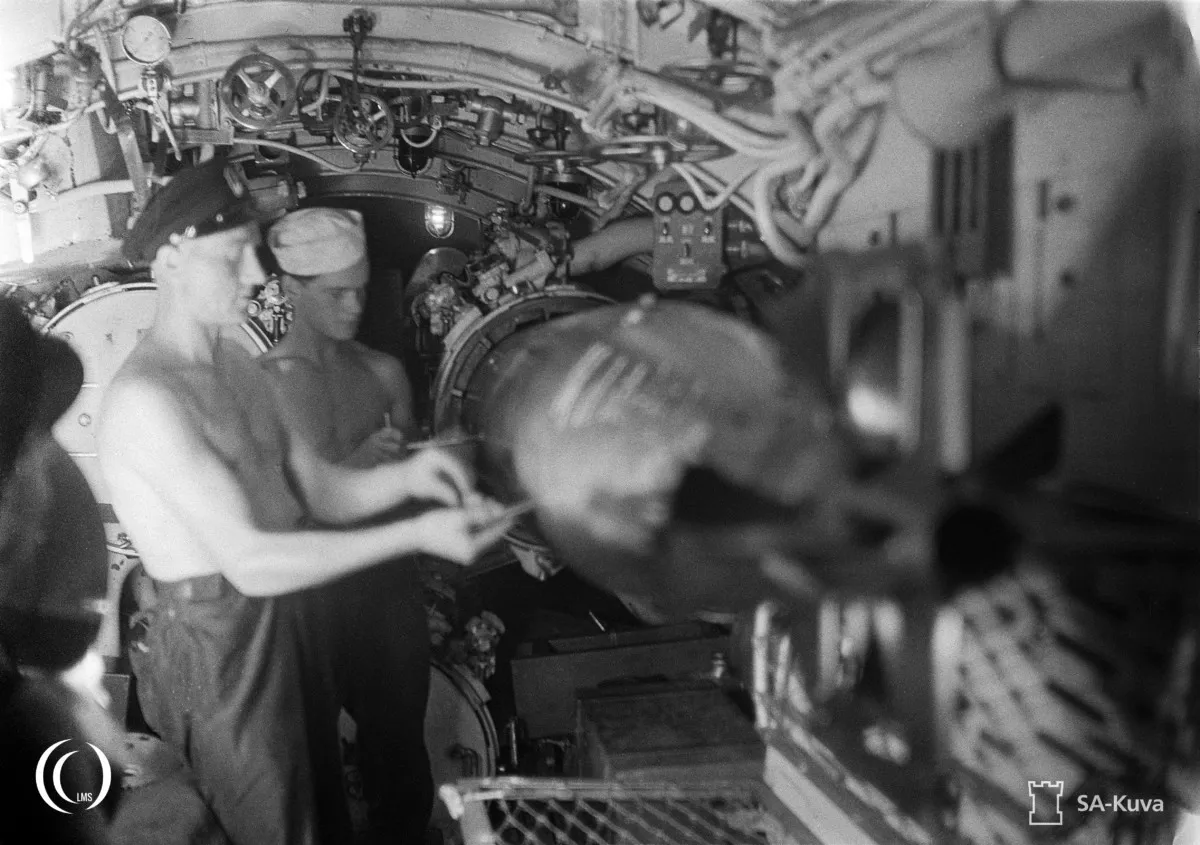
Servicing a torpedo on the submarine Vesikko, 1941.
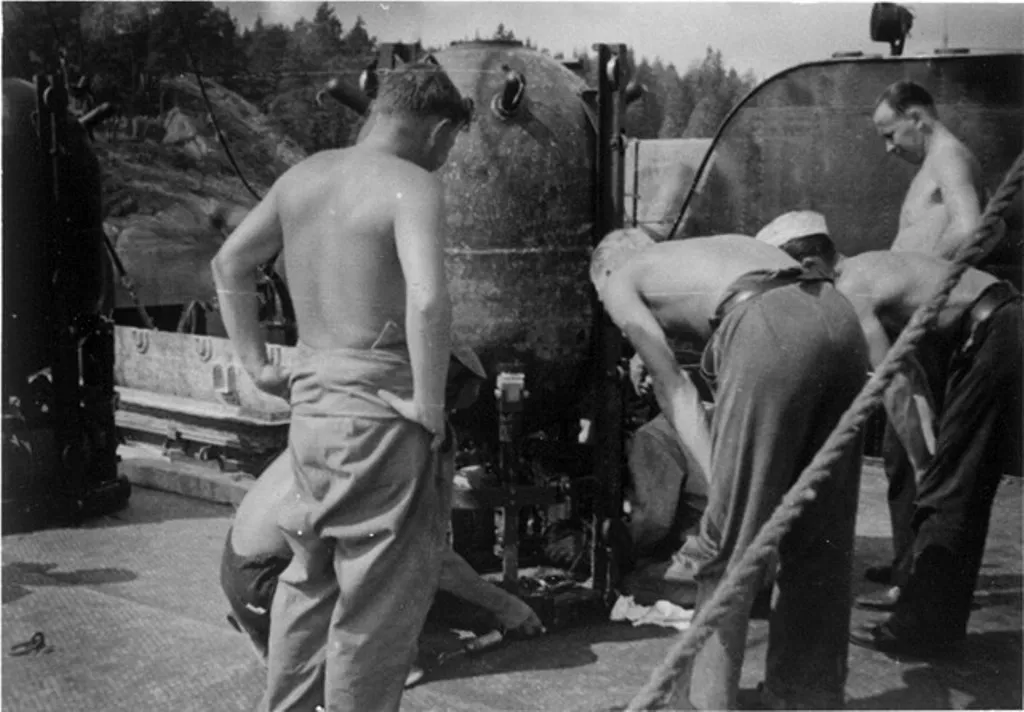
Loading a mine onto the Saukko
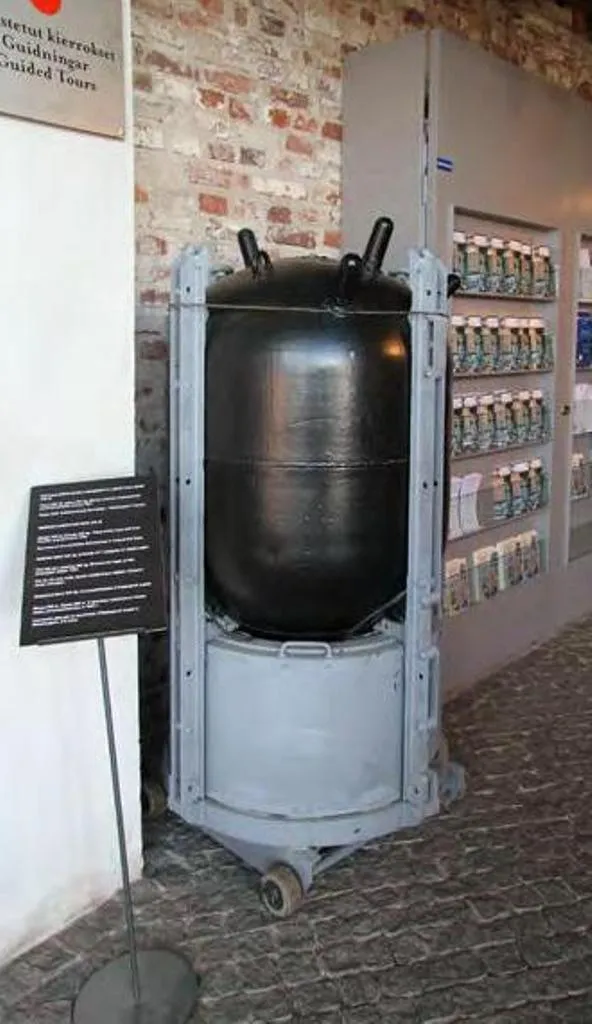
A Swedish-made S/R 42 naval mine designed for deployment by submarines. It weighs 850 kg and has a 200 kg charge. These mines were laid by Finnish submarines in 1944.
To support submarine operations, the gunboat Klas Horn and the minelayer M 1 (the former Russian Voin, renamed Louhi in 1936) were initially used as floating bases. In 1939, the diesel-electric icebreaker Sisu (64,2 x 14,3 x 5,1 m, 2070 tons, 4000 hp, 15,8 knots, 2 x 102 mm guns) was commissioned. It was also intended for use as a floating base, for which purpose it had specialized workshops and accommodations for submarine crews.
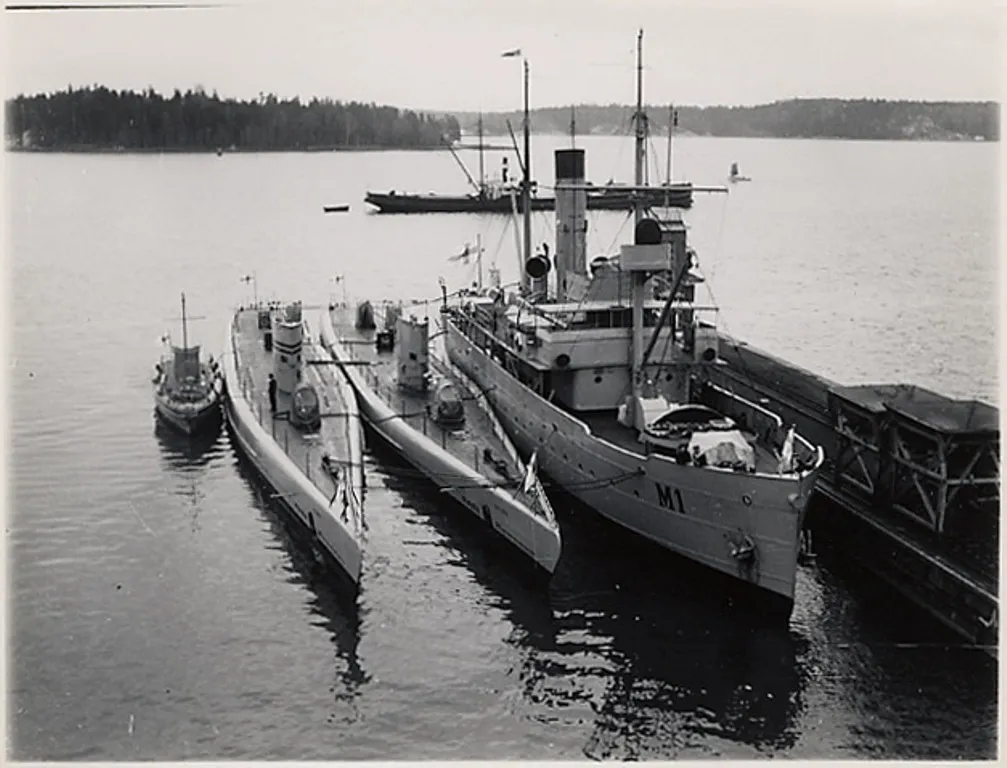
A Vetehinen-class submarine alongside the minelayer M 1
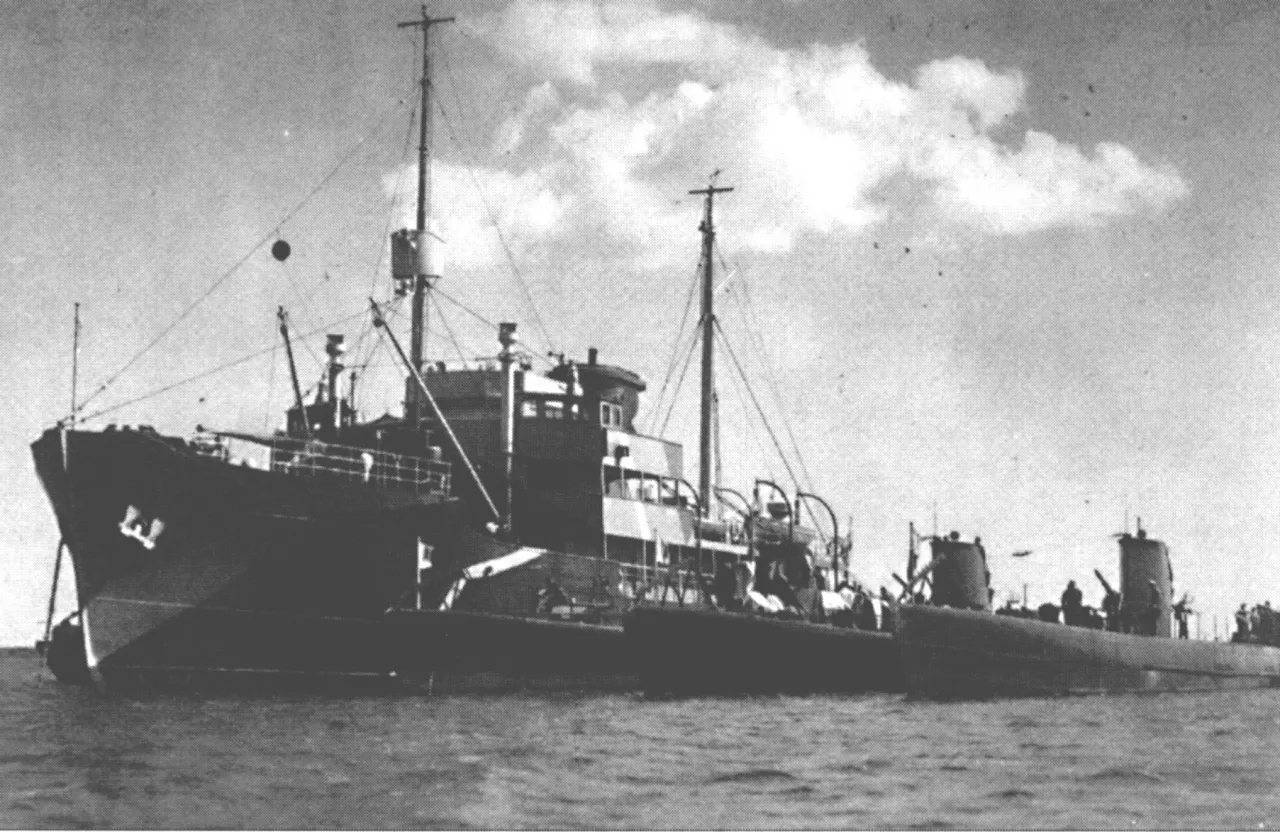
Vetehinen-class submarines alongside the icebreaker Sisu
The submarines' primary mission was to work with coastal artillery and surface forces to counter enemy landings or shelling on the Finnish coast, as well as to conduct reconnaissance in the Gulf of Finland and its approaches. To this end, Finnish submariners conducted active combat training, including torpedo firing exercises and minelaying, as well as joint exercises with coastal defense battleships, which served as training targets.
There is evidence that during the 1930s, the Finnish and Estonian military commands developed a joint plan to blockade the Red Banner Baltic Fleet in the Gulf of Finland in the event of military action. This would have secured Finnish maritime communications in the Baltic. It was envisioned that Finnish and Estonian 203-305mm coastal batteries and the Naissaar-Makiluoto minefield would prevent Soviet ships from breaking through. Five Finnish and two Estonian submarines were planned to support the mine-artillery position. For this purpose, joint Finnish-Estonian exercises were regularly held from 1933 to 1939. However, by the late 1930s, due to funding shortages, one or two Finnish submarines were annually placed in reserve or placed in for repairs and modernization.
To be continued ...
Information