World's first: domestic connecting rod-less engines
16 436 28
World's first: domestic connecting rod-less engines
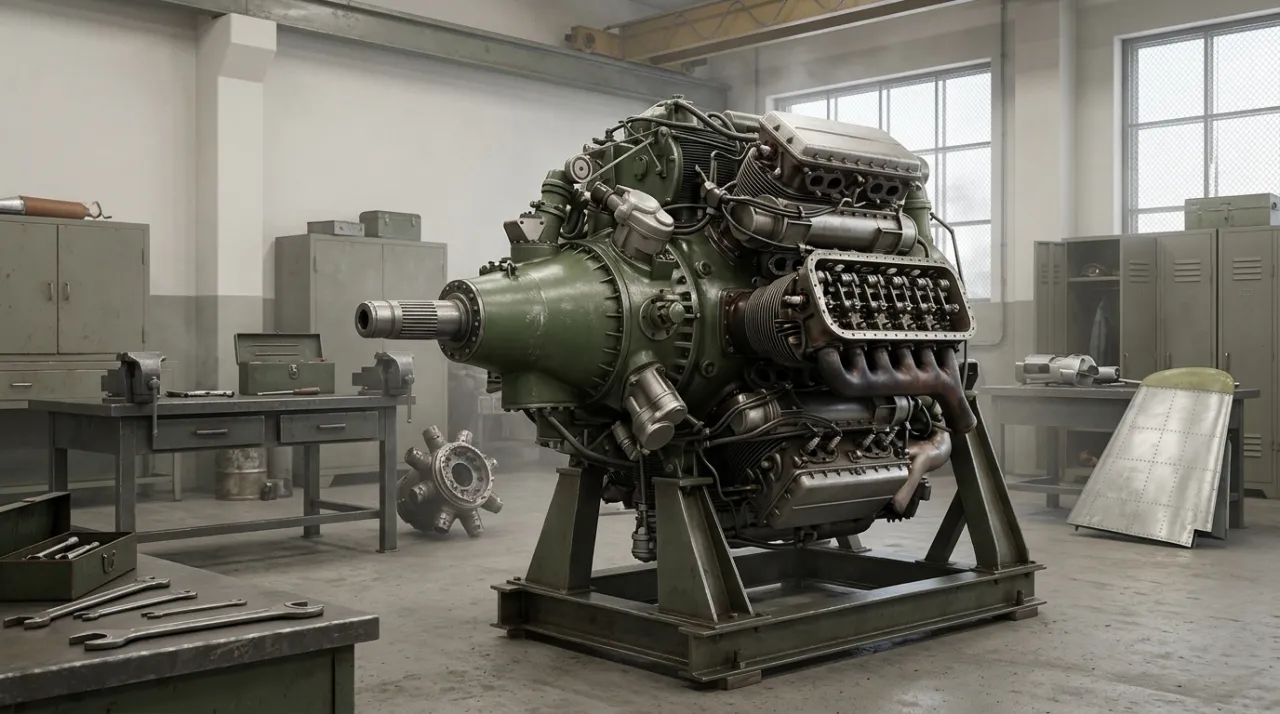
Computer concept of the OM-127RN connecting rodless motor


A masterpiece of mechanics


Why remove the connecting rod from the engine, exactly? The internal combustion engine in its current form is over 160 years old, and no one is planning to interfere with its established design. But it wasn't always this way. Soviet engineer Sergei Stepanovich Balandin from OKB No. 2 of the People's Commissariat aviation In the 30s, the industry made a small technical revolution and deprived the engine of connecting rods.


The crank mechanism itself is good in every way, but it has its drawbacks. For example, the lateral tilt of the connecting rod during operation presses the piston into the cylinder wall. This leads to increased wear—everyone is familiar with the elliptical shape of the cylinder at high mileage, which compromises the combustion chamber's seal. The mechanical movement of the connecting rod causes parasitic vibrations, which require special balance shafts to compensate. An engine with connecting rods and a crankshaft is large and heavy. Due to the high inertial loads from the heavy connecting rods and pistons, when changing direction at top and bottom dead centers, colossal tensile loads occur, limiting maximum RPM. Removing the connecting rod eliminates most of these problems.

The author of the development, Sergei Balandin, writes in his book:

The connecting rod-less mechanism allows for a simple design, even with small dimensions and high-speed engines, to carry out a two-way working process in the cylinders, thereby obtaining almost double the liter and overall power.


Sergei Stepanovich Balandin
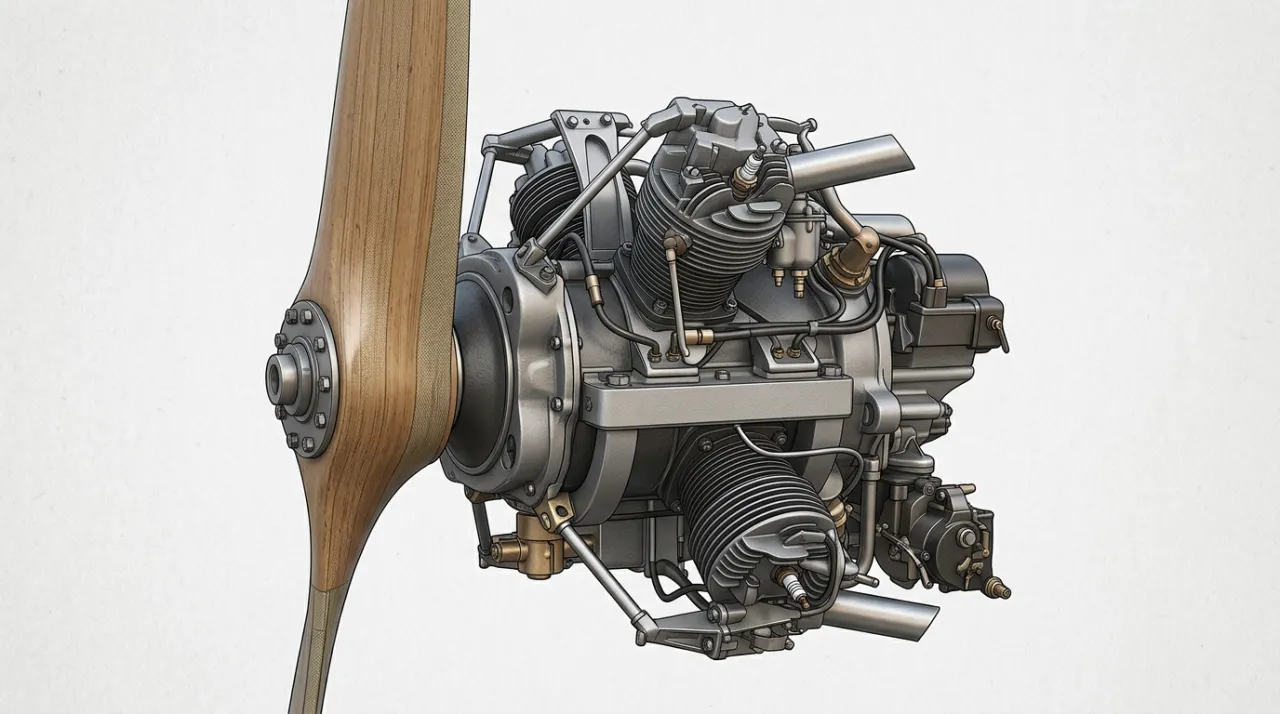

Balandin OMB connecting rodless engine with a power of 80-140 hp depending on the version

What is a Balandin engine, or a connecting rod-less internal combustion engine? On the one hand, it's simple: two opposing pistons are rigidly connected by a piston rod. The engine can be configured either as a boxer or a radial engine. No V- or in-line engines with a connecting rod design are possible. The absence of connecting rods significantly lightens the engine's design, reduces lateral forces acting on the piston to zero, and therefore virtually eliminates wear on the cylinder skirt and cylinder wall. Total power losses due to friction are reduced severalfold, efficiency increases, and fuel consumption is more efficient. All other things being equal, a connecting rod-less engine has a higher power per liter and the potential for increased revs. A clear advantage of a connecting rod-less engine is the ability to organize a bidirectional combustion process in the cylinders.
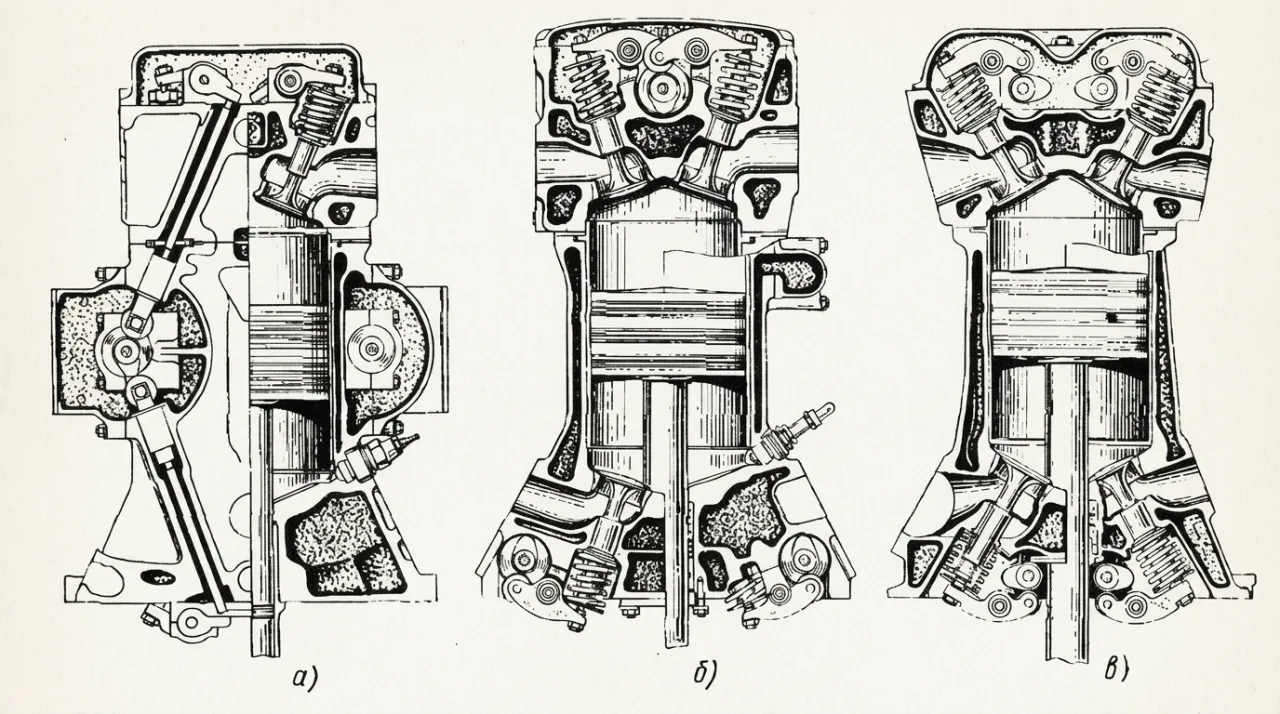

Designs of connecting rodless motors with a two-way working process

What is this? It shouldn't be confused with the two-stroke process. Double-acting combustion in internal combustion engines (or the use of double-acting cylinders) is an operating principle in which the combustion of the fuel-air mixture and the expansion of gases occur on both sides of the piston, rather than just on one (the top), as in conventional engines. This is a very significant engine improvement, providing a dramatic increase in power per liter, all other things being equal. For example, the experimental OM-127RN 8-cylinder, connecting rodless, double-acting combustion engine produced 3200–3500 hp. The unit's displacement was only 22 liters, and its weight was 2,1 tons. For the 1940s, these were record-breaking figures.

Motors of the (no)future


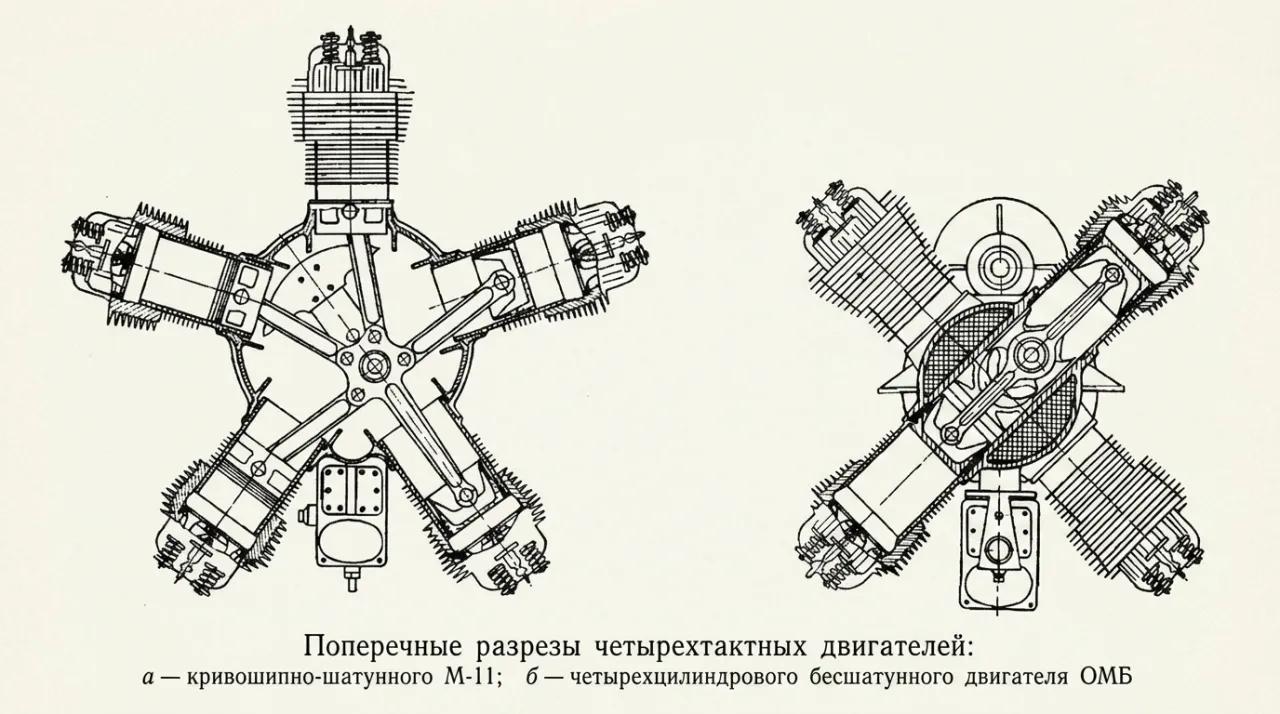
As with any technical innovation, connecting rodless designs presented challenges. For example, the mechanism for transmitting torque from the pistons to the shaft is very complex to manufacture. Currently, three design options are known: planetary gear, eccentric assembly, and sliders. Unlike a traditional crankshaft, these mechanisms require the highest level of manufacturing excellence. Manufacturing tolerances are minimal, which creates the problem of thermal expansion—with uneven heating, the connecting rodless mechanism could easily seize. Organizing lubrication for the highly loaded crankshaft bearings, eccentrics, and planetary gear was challenging.

Connecting rodless engines were extremely difficult to maintain for their time—balancing equipment was required for adjustment. Operating experience showed that the lateral force, which in a classic crank mechanism is transmitted by the piston to the cylinder wall, does not physically disappear in a connecting rodless engine—it is transferred to the sliders, piston rod guides, or gear teeth. These components have a smaller contact area and experience enormous contact stress, causing rapid wear. Repairing such complex components required a much higher level of technical expertise from mechanics.
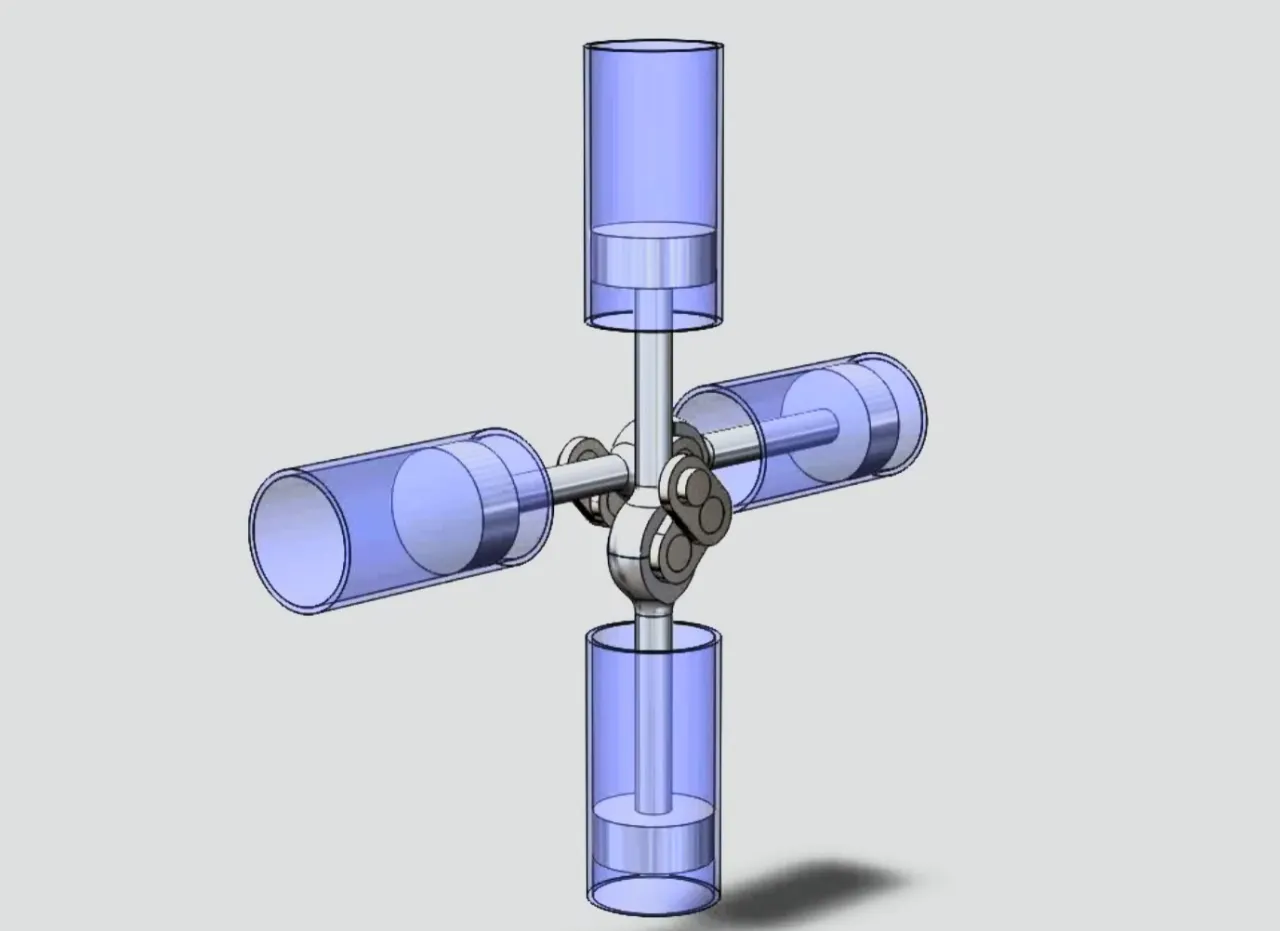
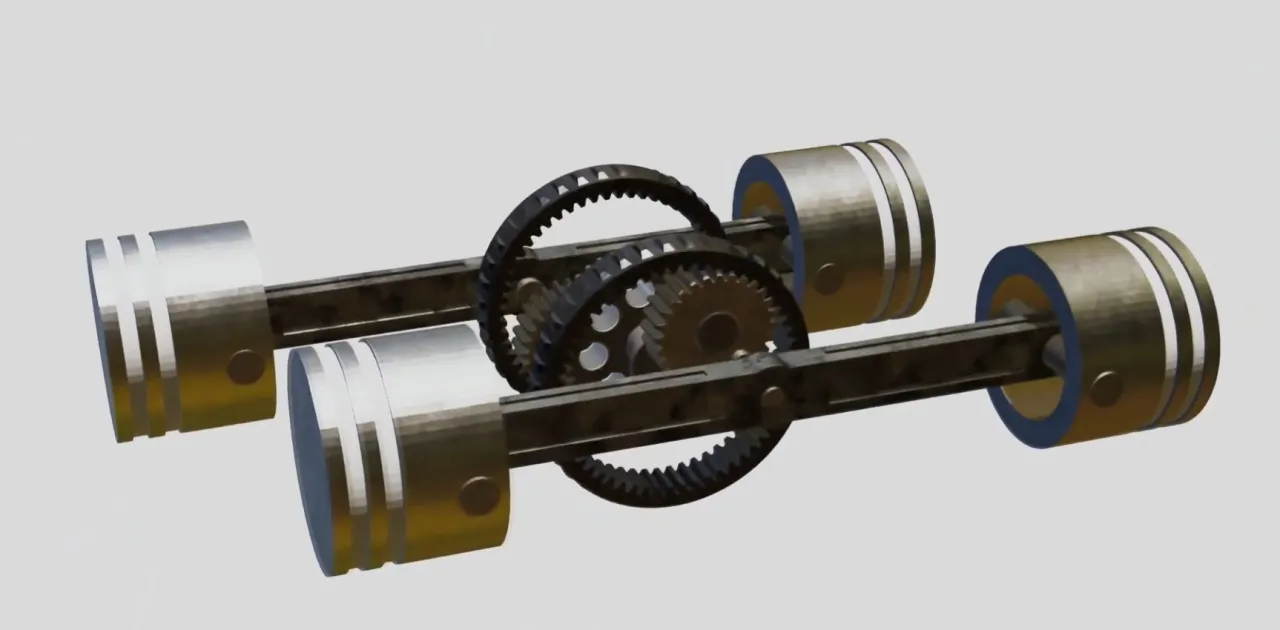


Fundamental options for transmitting torque from the pistons to the shaft in a connecting rodless internal combustion engine

It's safe to say that Balandin's idea was significantly ahead of its time. But the prospects for a connecting rod-less engine were undeniable. In the relatively short period from 1938 to 1948, under Balandin's leadership, a number of experimental connecting rod-less engines were developed, built, and tested: the OMB, MB-4, MB-4b, MB-8, MB-8b, OM-127, and OM-127RN, varying in design and power output. Aviation was intended to be the primary application—only here could the high cost and complexity of connecting rod-less engines be tolerated. But jet propulsion systems entered the picture, and Balandin's design remained a technological curiosity.
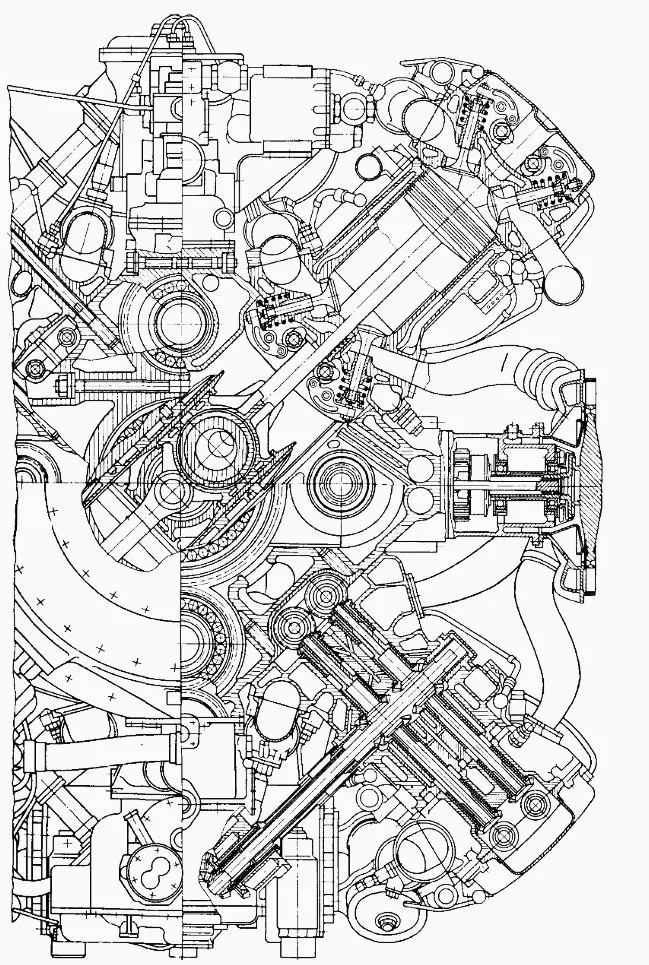

Cross-section of the MK-127K engine

The pinnacle of "connecting-rodless creativity" can be considered the gigantic M-127K, created in the late 1940s. If not for the jet age, it would have become the primary engine of Soviet aviation. The full name of the machine is the M-127K X-shaped supercharged, twenty-four-cylinder, double-acting, connecting-rodless engine with 10,000 hp. It makes you want to say: they really knew how to make something like that back then! Its displacement is 82 liters, and its weight is remarkably light for such power—just 3450 kg. An even bigger monster was built on the basis of this engine: a connecting-rodless diesel engine with 14,000 hp.

Although the connecting rod-less aircraft engine proved unviable, this did not spell the end of the development. A unique exhibit—the ZIL-BD-1800 engine—can be seen at the Special Purpose Garage Museum at VDNKh. Naturally, this engine was created based on Sergei Balandin's ideas. The idea arose in late 1979, when engineer V.G. Tishakov proposed to the designers of the Moscow Automobile Plant's diesel design bureau that they create a fundamentally new type of power plant. The concept attracted significant interest from management: leading specialists from ZIL's Design and Experimental Work Department (DEDW)—chief designer V.K. Koshkin and his deputy A.V. Bragin—personally oversaw the development.
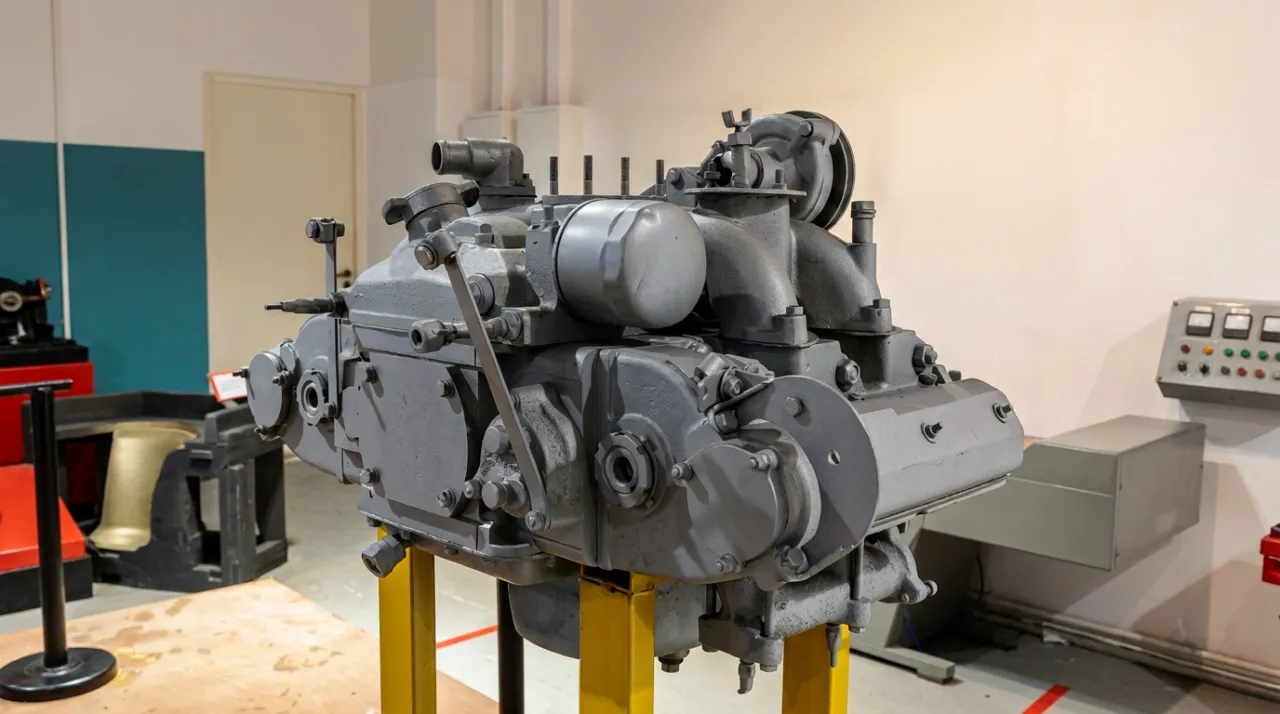

ZIL-BD-1800

The journey from theoretical calculations to actual metal construction took several years: first, in 1985, an experimental two-cylinder opposed engine model was built to test the mechanism's viability. The accumulated experience allowed for the assembly of two full-scale ZIL-BD-1800 prototypes with four cylinders by 1989. Reportedly, the second prototype ran on diesel fuel. The engine featured a compact opposed engine architecture and unique kinematics: the crankshaft performed a complex double rotation (around its own axis and around the crankshaft axis). The piston-rod assembly's motion followed a strict sinusoidal motion, eliminating parasitic higher-order inertial forces, and the use of linear plain bearings completely eliminated lateral friction forces on the cylinders and pistons, guaranteeing high efficiency and smooth operation.

Precise engine data is not publicly available, so we can only speculate. If we extrapolate Balandin's engine specifications to the ZIL development, the 1,8-liter engine could have produced over 110–120 hp. The engine weighed no more than 70–80 kg. Even for today's engine technology, these are remarkable specifications, let alone for the late 80s. However, the ZIL-BD-1800 remained an experimental design, eventually finding its place in a museum. The 90s in the new Russia spared no one, and the connecting rod-less engine was no exception.
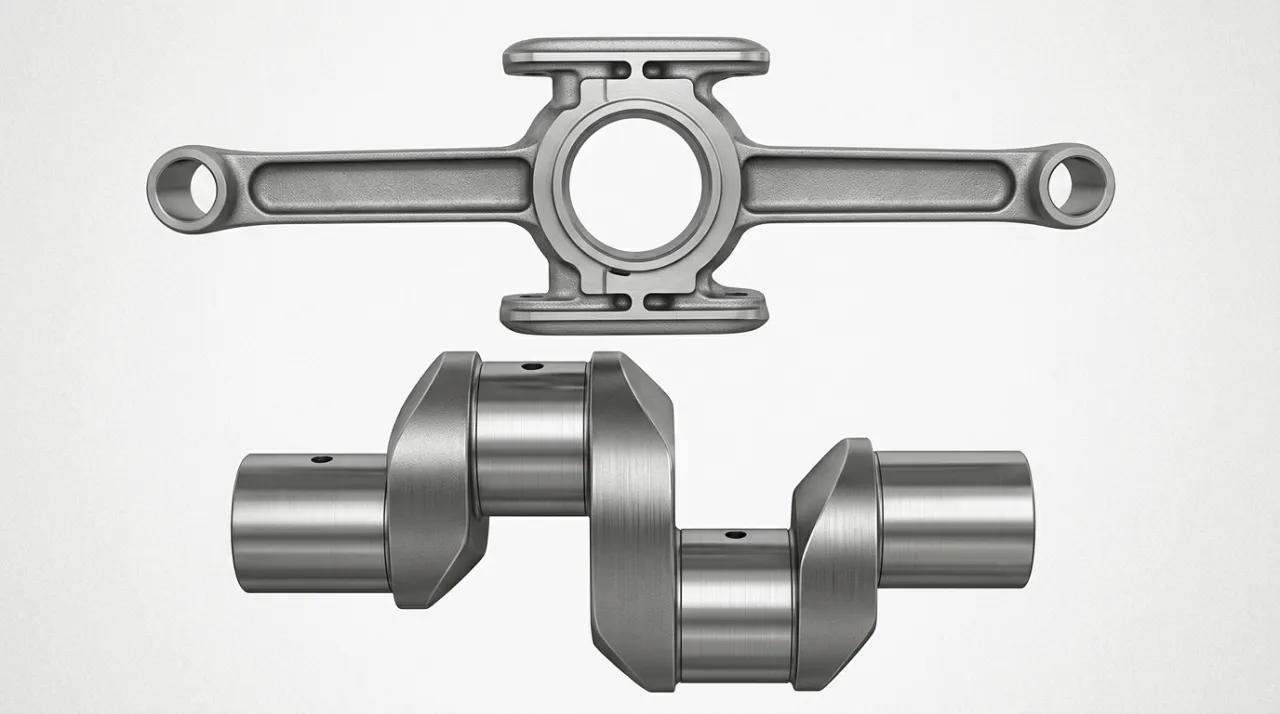

Piston rod and crankshaft of a connecting rodless OMB

A rebirth of Balandin's idea in mass production is out of the question. The costs of converting automobiles and piston aircraft to connecting rod-less internal combustion engines are too high, and the dividends don't inspire investors. Meanwhile, modern manufacturing practices allow for the production of engines with acceptable levels of quality and reliability. Domestic engine enthusiasts, working in their garages, rarely, but methodically demonstrate working versions of connecting rod-less engines. Balandin's engine concept has gained unexpected relevance in unmanned aircraft. A compact connecting rod-less engine is almost ideal as a power plant for medium- and long-range UAVs. Sergey Stepanovich described the nuances of engine development in great detail, and this is clearly worth taking advantage of—or at least conducting an expert assessment of the feasibility of introducing connecting rod-less engines into unmanned aircraft.
28 comments
Information
Dear reader, to leave comments on the publication, you must sign in.
  1. + 11
    24 July 2026 04: 56
    There's no miracle in sight. With a crankshaft, wobble is bound to occur somewhere, either immediately behind the piston or somewhere later, but it won't eliminate it. Fundamentally, wobble can be avoided by removing the crankshaft.
    1. + 14
      24 July 2026 05: 13
      Quote: Ed Mack
      In principle, you can avoid wobbling if you get rid of the crankshaft.

      Peter van Blarigan's Free Piston Linear Generator (FPLA)
    2. +3
      24 July 2026 09: 41
      Quote: Ed Mack
      In principle, you can avoid wobbling if you get rid of the crankshaft.

      The Wankel engine is an example where nothing wobbles, everything is balanced.
      1. +4
        24 July 2026 10: 58
        It consumes a lot of oil. Therefore, it is difficult to comply with fuel economy standards.
        1. +2
          24 July 2026 11: 46
          Quote: Yevgeny Fedorov
          It consumes a lot of oil. Therefore, it is difficult to comply with fuel economy standards.

          Environmental standards are irrelevant for war. It seems they might come up with something with new materials now:
          In 2019, Russian scientists from the P.I. Baranov Central Institute of Aviation Motors and the Advanced Research Foundation solved the problem of rapid engine wear by creating a rotary piston piston (RPP) based on next-generation materials—interceramic matrix and metal-ceramic matrix composites. Test results showed that wear on these components is negligible.
          https://ru.wikipedia.org/wiki/%D0%A0%D0%BE%D1%82%D0%BE%D1%80%D0%BD%D0%BE-%D0%BF%D0%BE%D1%80%D1%88%D0%BD%D0%B5%D0%B2%D0%BE%D0%B9_%D0%B4%D0%B2%D0%B8%D0%B3%D0%B0%D1%82%D0%B5%D0%BB%D1%8C#:~:text=%D0%92%202019%C2%A0%D0%B3%D0%BE%D0%B4%D1%83,%D1%8D%D0%BB%D0%B5%D0%BC%D0%B5%D0%BD%D1%82%D0%BE%D0%B2%20%D0%BF%D1%80%D0%B5%D0%BD%D0%B5%D0%B1%D1%80%D0%B5%D0%B6%D0%B8%D1%82%D0%B5%D0%BB%D1%8C%D0%BD%D0%BE%20%D0%BC%D0%B0%D0%BB.
          1. 0
            24 July 2026 16: 02
            In 2019, Russian scientists from the Central Institute of Aviation Motors named after
            P. I. Baranov and the Foundation for Advanced Research have solved the problem of rapid engine wear by creating a rotary piston engine (RPM) based on next-generation materials—interceramic matrix and metal-ceramic matrix composites. According to test results, wear on these components is negligible.

            Nevertheless, Mazda seems to have stopped producing cars with Wankel engines - after so many years...
            I don't think they're familiar with "composites" - they're not familiar with them...
            1. 0
              24 July 2026 17: 11
              Quote: Dedok

              Nevertheless, Mazda seems to have stopped producing cars with Wankel engines - after so many years...
              I don't think they're familiar with "composites" - they're not familiar with them...

              Composites are a growing field, perhaps they're not ready to invest in research and development right now, and the old engine was scrapped for environmental reasons. They're like a Procrustean bed for a car right now.
            2. +3
              24 July 2026 18: 22
              Mazda will resume production of rotary engines in 2024.
        2. +1
          24 July 2026 15: 56
          It eats a lot of oil.

          So here we have the same problem: how to reliably seal the piston rod in the "reverse" combustion chamber?
          how?
      2. +4
        24 July 2026 12: 07
        Quote from cpls22
        Wankel is an example

        When Nikolai and Alexander Shkolnik filed a patent for their "X-Engine" (Cycloid Rotor Engine), the US Patent and Trademark Office (USPTO) did indeed challenge them with an older patent from 1909 (the Cooley/Ward patent). That historic document described a similar "inside-out" geometry: an oval rotor in a triangular chamber. However, the Shkolniks were able to prove the uniqueness of their design and obtain a patent because there were fundamental differences between their engine and the 1909 concept that transformed an unworkable theoretical design into an effective combat motor. 1 (https://liquidpiston.com/), 2 (https://patents.google.com/patent/US20120294747A1/zh-CN)
        U.S. Patent No. 914,627, issued March 9, 1909, to J.S. Alcorn, describes a rotary steam engine. 1 (https://www.datamp.org/qsDate.php?year=1909&month=03&day=09)
        1. +2
          24 July 2026 14: 23
          Yes, there were many options, but only now, with the capabilities of modern technologies, including additive ones, can they sparkle with new colors.
    3. 0
      24 July 2026 23: 19
      it must be loose somewhere
      the idea of ​​such an engine is not to prevent something from wobbling, but
      The connecting rod-less mechanism allows for simple design with small dimensions and high speed engines two-way working process in the cylinders and as a result obtain almost double the liter and overall power

      To eliminate cylinder-piston group wear, crosshead engines have long been used, which are very common on ships. However, they are large in height, and I haven't seen designs with a double-sided combustion chamber. Apparently, the piston rod sealing issue hasn't been addressed satisfactorily.
  2. +3
    24 July 2026 05: 04
    A compact, rodless internal combustion engine is almost ideal as a power plant for medium- and long-range UAVs.

    The problem of converting linear motion into rotary motion remains. It's easier to install a free-piston generator, also known as a "linear DC generator driven by a free-piston internal combustion engine."
    1. +1
      24 July 2026 06: 16
      Quote: Puncher
      The problem of converting translational motion into rotational motion will not go away.

      If weight is a concern, so be it! Some drones are disposable, the rest are very limited in their reusability. A motor won't last 10 years.
      But weight - and perhaps price - is important.
      1. +1
        24 July 2026 07: 27
        Quote from tsvetahaki
        The motor won't last 10 years.

        Well, the author was concerned specifically with durability, saying that classic internal combustion engines are prone to wear and tear.
      2. +2
        24 July 2026 09: 39
        An engineer's thought: WAIT, what if we abandon the direct conversion of reciprocating to rotary motion? What if we attach a magnet (permanent or coil) to the piston rod, and surround it with a coil? That is, we get a linear motor-generator unencumbered by complex mechanics. There's a question about valve control, but I think it's solvable. So, the output is a spark that can be used for anything...
    2. 0
      24 July 2026 07: 59
      Development of a free-piston gas generator.
    3. +1
      24 July 2026 22: 20
      Connecting rodless with hydraulic transmission
  3. +5
    24 July 2026 05: 30
    The history of this idea goes back to the 1930s and 1940s, when many companies tried to implement it, but none ever reached the production stage. About ten years ago, a Japanese Toyota I also suggested something similar, but it never got to practical implementation. This is usually a sign of a fundamental flaw...
  4. -1
    24 July 2026 06: 17
    Balandin's engines have gained unexpected relevance in unmanned aircraft. As a power plant for medium- and long-range UAVs, a compact, rod-less internal combustion engine is almost ideal.
    If it costs significantly more to produce than a conventional crankshaft engine, then it's not the best idea for a one-way trip.
    But as a tank engine, it could be an interesting option. It seems that conventional diesel engines have reached the limits of their performance with the available materials. Furthermore, in a tank, they aren't expected to last 5 years/20000 miles (the standard warranty for a consumer-grade car engine); the expected engine life is probably a few hundred hours. And the price of a tank is viewed somewhat differently than that of a family car.
    1. +1
      24 July 2026 07: 42
      Quote: Nagan
      It seems that conventional diesel engines have reached the limits of boosting with the available materials.

      Therefore, the only prospect is an electromechanical transmission with a gas turbine unit.
  5. +1
    24 July 2026 09: 46
    What about the Wankel engine, is it already dead?
    1. +3
      24 July 2026 10: 41
      Quote: andrewkor
      What about the Wankel engine, is it already dead?

      It lives on Geranium, the British have it on drones, the Chinese do it too:
      There's a British-made 38-horsepower AR731 engine, designed specifically for kamikaze drones and other strike or short-lived drones. The engine is a Chinese copy of the MDR-208, which was in turn copied in Iran under the name Shahed-783. This engine is used in the Shahed-131 drone, known in Russia as the Geran-1. From Wikipedia
  6. The comment was deleted.
  7. +1
    24 July 2026 11: 29
    The Persian scholar Nasir ad-Din at-Tusi described this mechanism in the 13th century.
    The Tusi mechanism (Tusi couple) is a mathematical and mechanical construction in which a small circle rolls without slipping inside a larger circle whose diameter is exactly twice its size. Any point on the circumference of the small circle moves in a perfectly straight line.

    English engineer Matthew Murray created the Murray's Hypocycloidal Engine between 1802 and 1805. It is one of the most important technological ancestors of the connecting rod-less internal combustion engine. Murray used the mathematical mechanism of the hypocycloid (Tusey's rectilinear engine).

    In the 1870s and 1880s, Sir Charles Parsons, the inventor of the multistage steam turbine, adapted Murray's hypocycloidal principle for high-speed steam engines (the so-called Parsons gear). Instead of the cumbersome gears of Murray's era, Parsons improved the meshing accuracy.

    Balandin replaced Murray's vulnerable toothed pinions with powerful eccentric bearing assemblies and rigid power rods. This allowed Murray's design to withstand the colossal loads of explosive combustion of gasoline and diesel fuel.
  8. +3
    24 July 2026 12: 30
    Quote: Dmitriy22
    An engineer's thought: WAIT, what if we abandon the direct conversion of reciprocating to rotary motion? What if we attach a magnet (permanent or coil) to the piston rod, and surround it with a coil? That is, we get a linear motor-generator unencumbered by complex mechanics. There's a question about valve control, but I think it's solvable. So, the output is a spark that can be used for anything...


    In the 1960s, there were also projects for connecting rod-less diesel engines, where pistons pushed individual plungers of a hydrostatic transmission pump.
    The pilot plant achieved a capacity of 1103-1471 kW/m3, but then ran into the unreliability of the high-pressure hydraulic lines between the motor and the wheel drive and their connections.
  9. +2
    24 July 2026 18: 52
    Quote: andrewkor
    What about the Wankel engine, is it already dead?

    The Mazda MX-30 Rotary-EV crossover hybrid lives on.
    1. +2
      25 July 2026 11: 19
      And more. The AR731 rotary piston engine, producing 38 hp, is designed specifically for kamikaze drones. The engine is a Chinese copy of the MDR-208, which, in turn, was copied in Iran under the name Shahed-783. This engine is used in the Shahed-131 drone.
  10. +1
    25 July 2026 11: 15
    The idea itself is interesting, but not new. Take, for example, the so-called "Parsons mechanism." Back in the 1880s, Charles Parsons adapted the hypocycloidal principle (which had previously been used for a steam engine by the English engineer Matthew Murray between 1802 and 1805) to high-speed steam engines. Later, engineers in various countries tried to adapt this idea to internal combustion engines. For example, the Bourlet engine appeared in France in 1912. Later work (including research in the UK in the 1970s) proposed modifications to the Parsons mechanism—for example, offsetting the cylinder axes relative to the crankshaft to further reduce friction and vibration losses.