Britain's RapidDestroyer microwave cannon undergoing testing.
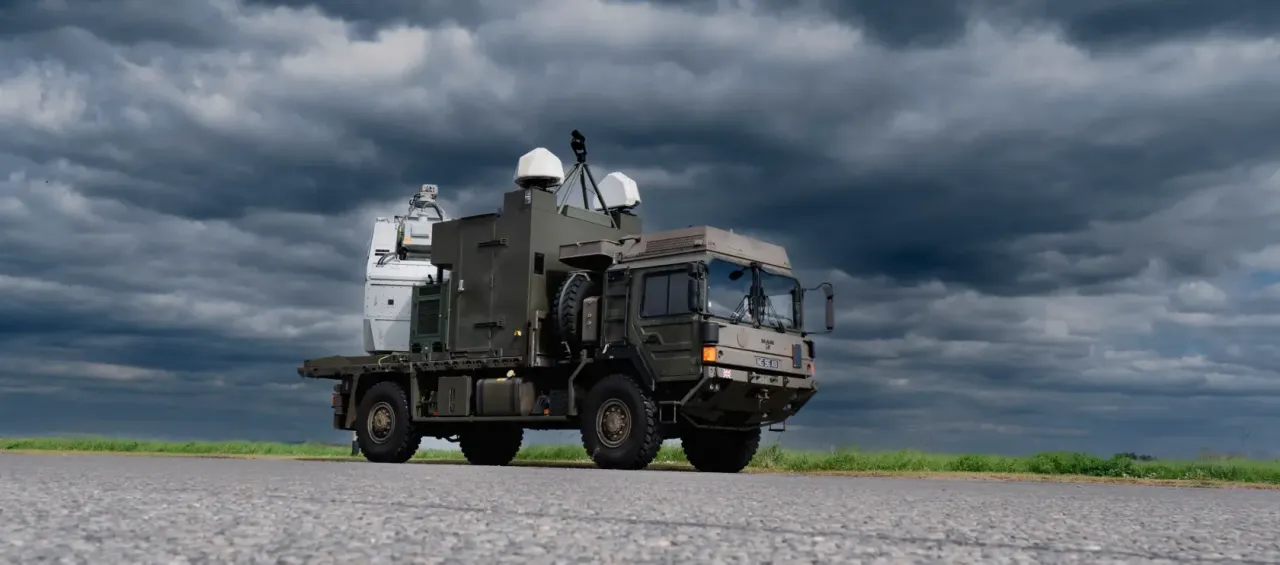
RapidDestroyer pilot system
The British branch of Thales Group is developing and testing several promising systems for combating unmanned aerial vehicles. aviationOne of the most interesting examples of this type is the RapidDestroyer microwave suppression system. It has already been tested at ranges, demonstrating its basic operational and combat capabilities. During the tests, one combat vehicle intercepted "swarms." drones, and in another series it successively hit dozens of targets one by one.
Promising direction
Having studied the experience of recent conflicts, the UK Defence Ministry is exploring ways to combat UAVs, including mass attacks and "swarms." Over the past few years, it has been developing various such systems in collaboration with a number of contractors. Some of these have already reached the test site.
One promising solution is considered to be radiofrequency directed energy weapons (RF DEWs). The leading project of this type is being developed by Thales UK with the participation of several government and commercial organizations as part of the Team Hersa government program, a joint Ministry of Defense initiative. arms directional energy.
According to available information, Thales UK began developing the RF DEW system several years ago, but the exact date is not disclosed. Design work was completed and the system's technical design was finalized no later than 2023–2024. The first prototype was likely built and preliminary factory testing was conducted around this time, although this has not been officially confirmed.
In the conditions of the landfill
In April 2025, the Ministry of Defence and the developer reported for the first time on the work completed and the successes achieved. The occasion was the latest stage of testing. It was also then revealed that the Thales UK system had the working designation RapidDestroyer.
These tests took place at the testing ground Defense Manorbier in West Wales. The combat vehicle operated in a stationary position, simulating combat duty; the crew consisted of British Army personnel. The simulated enemy was represented by "swarms" of small UAVs, with two swarms launched simultaneously in some instances. According to the Ministry of Defence, in one instance, the system simultaneously repelled two swarms of small UAVs, and over the entire series of tests, more than 100 were tracked and destroyed. drones.
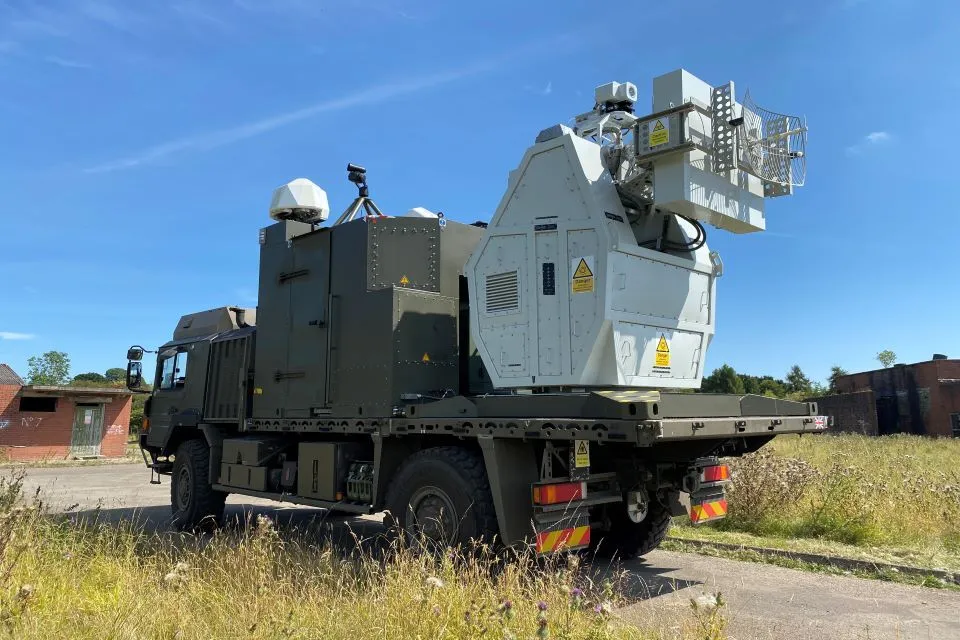
In combat position. The "gun" antenna is not equipped with a casing.
According to reports from both parties, RapidDestroyer identified threats and suppressed the drones. At a range of up to 1 km, the system's emissions disrupted the target's electronics, and both swarms in that incident were suppressed. The developer and customer reported high operational and combat performance and an acceptable operating cost, but did not specify how close the actual results were to the target values.
In early June 2026, a new phase, which had already taken place in April, was announced, though details of it were only disclosed several weeks later. The reasons for the delay were not specified.
The latest stage took place at a test site in Pershore, Gloucestershire. Unlike the Welsh stage, this involved engineering tests of an updated version of the system, conducted by Thales in collaboration with Teledyne e2v, a microwave electronics supplier. A new four-panel emitter with more precise energy focusing was tested. Swarms were not launched; the system destroyed 80 quadcopters (weighing approximately 1 kg) sequentially and individually. The individual mode was deliberately chosen to allow for detailed recording and analysis of each individual hit.
Technical features
RapidDestroyer is a mobile "electromagnetic cannon" for combating UAVs. Unlike EW In addition to soft-kill modes that suppress communications and navigation, it operates in hard-kill mode and generates a powerful, directed microwave beam (High-Power Microwave), which disables the aircraft's internal electronics. According to the developer, at a range of up to 1 km, the UAV not only loses communication but also loses power to its electronics and crashes.
All components of the system are mounted on a production-model truck chassis. The front of the platform houses the equipment casing, and the combat module with the emitter is located behind it. RF DEW project documentation mentions the possibility of using different chassis.
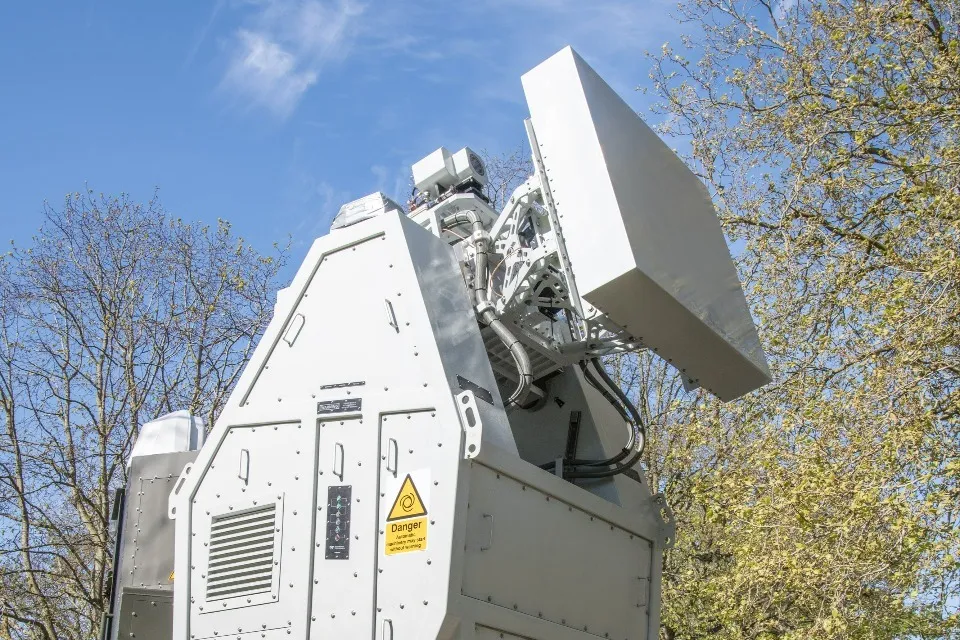
The system's main components are a microwave generator and an antenna, integrated into a combat module. The combat module's design allows for antenna aiming over a wide range of horizontal and vertical angles. Variable beam width is also possible, allowing for a choice between pinpoint targeting and swarm coverage.
The exact characteristics of the emitter are not disclosed. It is known that its power at the standard range is sufficient to disable a typical small UAV. Tests in April 2026 tested a modification with a four-panel antenna, which, according to the developer, increases the engagement range (presumably over 1 km; the exact value is not disclosed). The external radar integrated with the system (according to available data, the QinetiQ OBSIDIAN) detects targets significantly beyond the engagement range, at a distance of up to 3,5 km.
In addition to the external radar, the RapidDestroyer also has its own compact station for situational awareness, target acquisition, and guidance. It enables autonomous operation when external targeting is unavailable. The automated control system independently processes data, assesses threats, and guides the emitter.
The complex is designed to operate as part of a layered air defense system and can receive data on air targets from other radars or command posts.
The system has a built-in generator to power the electronics; it can also operate from existing power grids. High efficiency is claimed: according to calculations by Thales and the Ministry of Defence, the energy for one "shot" costs approximately 10 pence. It is important to understand that this is only the cost of electricity per pulse, not the cost of the system itself, the generator, and maintenance. This figure is impressive and is cited as the main argument against the use of expensive anti-aircraft systems. missiles for cheap drones, but it is methodologically narrow and does not reflect the full cost of operation.
The complex is not in service.
In 2025 and 2026, the UK Ministry of Defence and Thales UK conducted two major trials of the RapidDestroyer system. Both tests, according to both parties, demonstrated its high performance and ability to engage multiple targets; they were noted to be the largest trials of their kind. In official press releases, the customer and developer asserted that the system is capable of solving complex missions and could find a role in the armed forces.
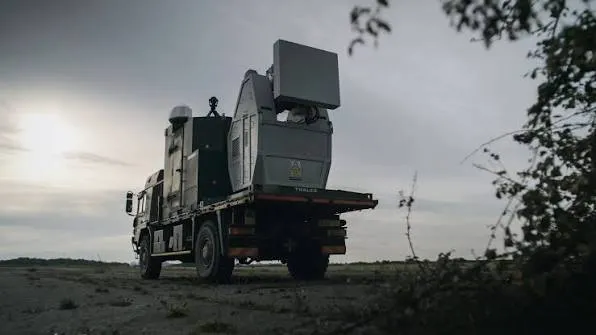
However, the system has not yet been accepted into service, and its deployment to units is mentioned without a specific timeframe. This indicates that testing is incomplete rather than the project's abandonment, despite the progress made.
Meanwhile, the British Army already understands the role the new product will play. The RF DEW system from Thales UK is being developed as a specialized short-range air defense system, with a range of approximately 1 km. It is designed to suppress small unmanned aerial targets that have penetrated other layers of defense. This role requires high performance at all stages, from detection to suppression, the ability to process a large number of targets, and minimal operating costs.
According to Thales, radio frequency systems fill the vacant niche of close-quarters combat against mass threats. The company compares the RapidDestroyer to anti-aircraft missiles (such as its own LMM/Martlet) and laser weapons (DragonFire). Lasers have a longer range and are more accurate, but they only hit one target at a time, requiring time to maintain the beam; missiles are effective but expensive against cheap drones; radio frequency systems, on the other hand, hit targets almost instantly and, thanks to their wide beam, can decimate swarms with a single pulse. All this, according to Thales, makes it a cost-effective and tactically balanced element of layered air defense.
However, it's important to consider the known limitations of microwave directed-energy weapons: short range, sensitivity to weather conditions, difficulty in target selection, and the potential risk of affecting their own electronics. For this reason, such systems are considered a "last resort" rather than a universal replacement for other air defense systems. It's also worth remembering that the field results were obtained in controlled scenarios against similar small UAVs and are not equivalent to their effectiveness against a real-world, diverse "swarm."
The ongoing tests show that Thales UK has largely met the RF DEW project's objectives: a working prototype of the "electromagnetic gun" has been created with the stated characteristics. However, the product has not yet undergone the full range of tests and has not yet been accepted into service. These issues may be resolved soon, assuming the project does not encounter significant challenges.
Information