Application of Rayleigh scattering to detect low-flying targets by acoustic emission
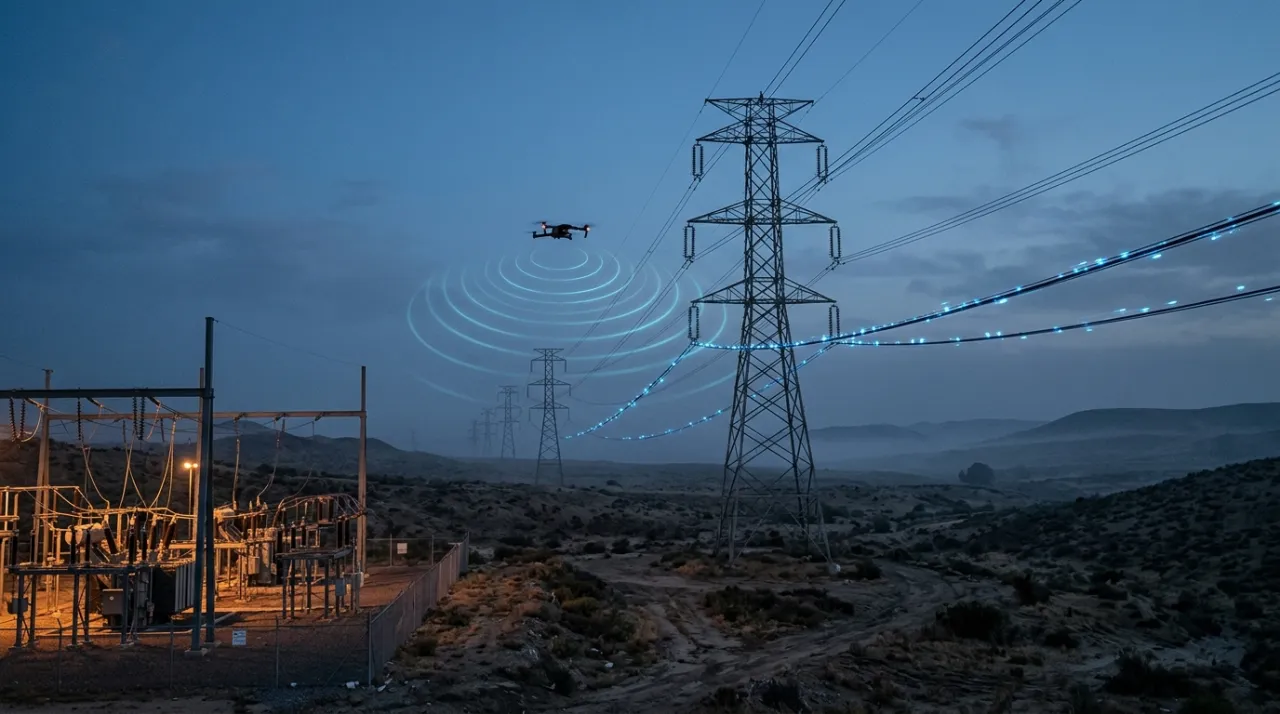
Acoustic detection of low-flying UAVs based on existing fiber-optic lines.
The concept of the low-flying aircraft detection system is described below. drones, using existing optical fibers as a distributed network of acoustic sensors. The method is based on Rayleigh scattering of light in the fiber.
Rayleigh scattering is the coherent (elastic) scattering of light without changing its wavelength by particles, inhomogeneities, or other objects smaller than the wavelength of the incident light. When applied to fiber-optic cables (FOCs), Rayleigh scattering enables the detection of laser radiation scattered by tiny inhomogeneities in the fiber structure (microcracks, bubbles, compactions), as well as, through changes in the phase of the backscattered signal, the detection of fiber deformations caused by acoustic vibrations (including the movement of individual sections of the FOC). This essentially transforms the fiber into a distributed acoustic sensor—a continuous chain of "virtual microphones."
In the Russian Federation, optical fibers have been laid along overhead power lines (hereinafter referred to as OPL) and along railway tracks to provide departmental and backbone communications. This means that the infrastructure necessary for creating a low-flying UAV acoustic detection system has already been established. To transform the OPL into a chain of virtual microphones, continuous-wave reflectometers must be connected to the communication nodes. According to the author, this does not disrupt the operation of the communication systems (this requires independent verification: distributed acoustic systems typically operate over dedicated fiber). In some cases, upgrading the communication systems may be necessary; this has the side effect of increasing the bandwidth of data transmission channels, but the upgrade itself entails additional costs and time.
According to calculations, a fiber-optic cable installed along overhead power line supports is capable of detecting acoustic vibrations along the entire line's length at a distance of up to 50 km from the reflectometer's connection point (this characteristic has only been confirmed in laboratory conditions, see below). The reflectometer itself is located at the substation where the overhead power line terminates and can operate on multiple lines extending from the substation, covering a transmission line of up to 100 km. To cover an overhead power line longer than 50 km, two reflectometers must be connected at both ends of the line.
The optical fiber's sensitivity was confirmed in laboratory conditions. The specialized scientific organization that evaluated the system recommended testing it in real-world conditions. Furthermore, the experts raised two questions.
1. Line swing, which can affect the operation of the virtual microphone in the FOC. The approaching or receding sound source is determined by the Doppler effect—that is, by changes in the frequency of the detected radiation. According to the author, this effect has already been observed in practice using a recording of the sound of a flying UAV (the location, the type of fiber—laboratory or linear—and the recording provider are not specified in the source data). It is assumed that rotation of the fiber optic cable or its displacement within two to three meters does not significantly affect the quality of the measurements. It should be noted, however, that fiber optic sway itself generates a parasitic Doppler shift, which is added to the UAV's target signal, and reliable separation of these signals remains subject to field testing. It should also be taken into account that vibration dampers are suspended on overhead power lines, and significant sway of the cable requires wind. The wind thresholds for swaying the cable and preventing flight of a light UAV vary and depend on the type of vehicle—this requires separate assessment.
2. Intentional destruction of power lines. The very fact of such damage should draw attention to the protected perimeter section: the reflectometer will not only show the location of the damage (according to the author, with an accuracy of up to a meter), but will also retain detection capabilities at least to the nearest intact support tower. With a two-way connection (from both ends of the overhead line), complete monitoring of the section will be maintained, since damage to a single span will not provide the minimum distance to the nearest intact supports necessary for reliable sound attenuation (the specific value of this distance is not provided in the material).
As for attacks on substations, they are already subject to attack, and these facilities require dedicated protection. Moreover, the infrastructure for deploying additional detection equipment (radars, directional microphones, etc.) and interception systems can be established near the substation, given the availability of power, communications, and access roads.
The equipment, including reflectometers and communication systems, according to the author, is mass-produced by Russian enterprises (it is advisable to check the nomenclature separately).
The main advantage of the proposed system is its rapid deployment compared to installing individual microphones, thanks to the availability of existing infrastructure, especially in hard-to-reach areas lacking roads, power, or communications systems. There is also no need for construction work to install towers, and installing the reflectometers does not require taking the power lines offline.
The proposed system, of course, is not a universal solution. It is primarily a means of covering various hard-to-reach areas used by the enemy to bypass key nodes with a detection system. Defense, complementing and expanding the capabilities of existing air reconnaissance systems.
Information