Order No. 1: Death sentence for the army or a symptom?
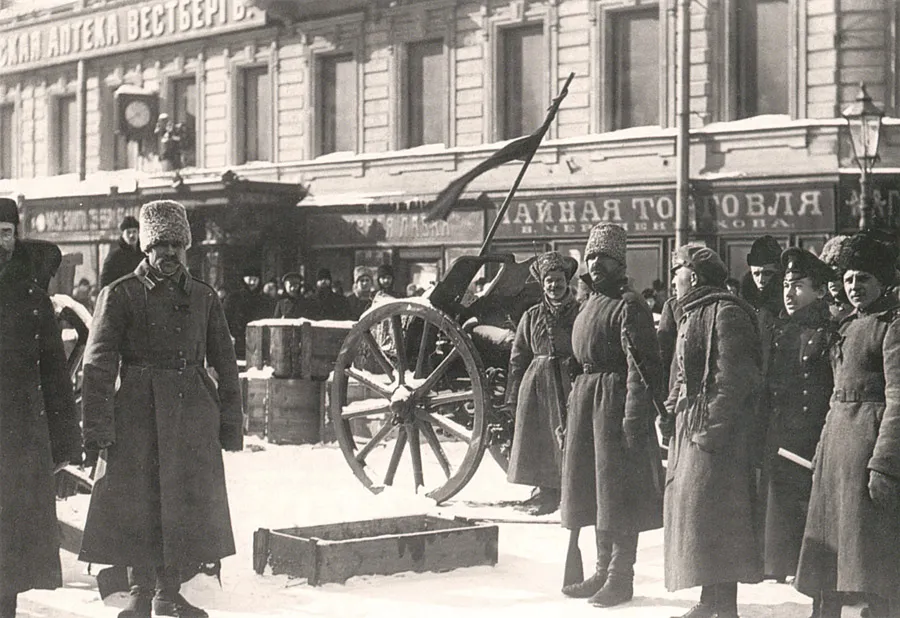
Barricades on Liteiny Prospekt in Petrograd during the February Revolution of 1917
On March 1, 1917, the Petrograd Soviet issued a document for the capital's garrison. A week later, it was read across the entire front. Since then, debate has raged over whether this order killed the old army or merely sealed the deal with its already-underway disintegration.
В previous article The discussion focused on the state of the Russian army as it approached 1917: a depleted officer corps, a mass of peasants in greatcoats, trench fatigue, and a profound distrust of the command. This was the basis for Order No. 1—a short document composed in the Tauride Palace for a very specific purpose and interpreted by the army quite differently from its authors' intentions.
Where did he come from?
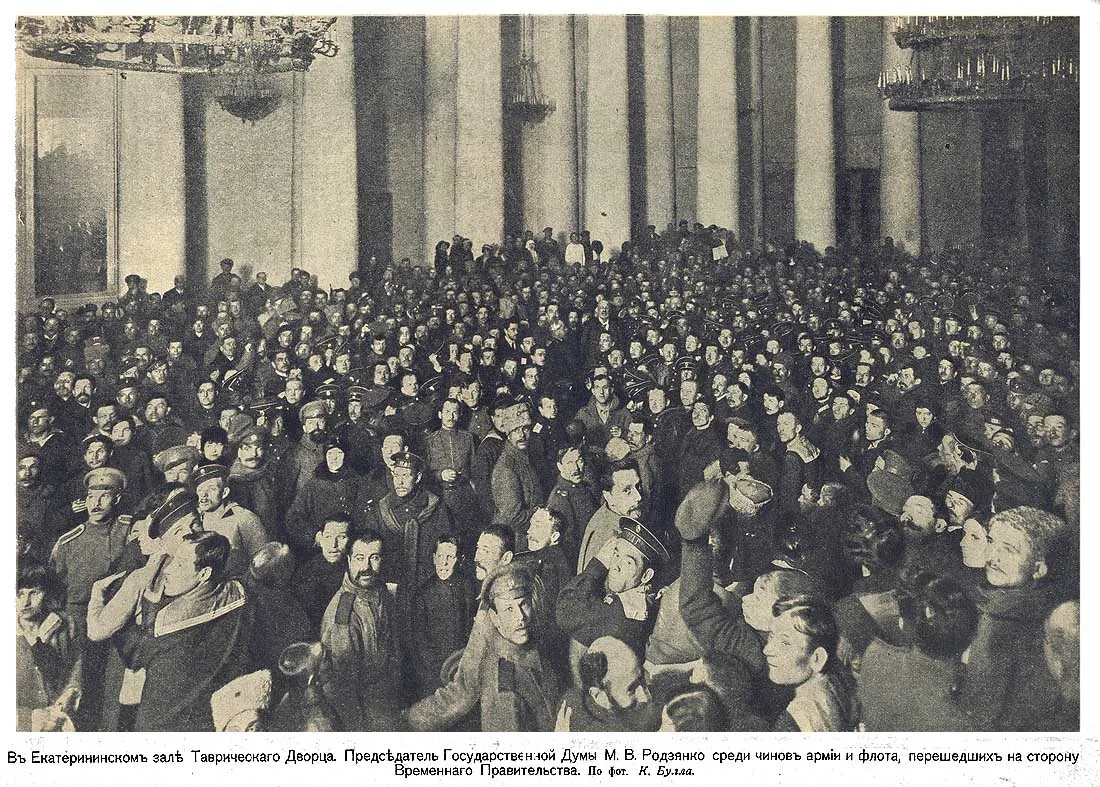
The February days in Petrograd passed with the direct participation of the capital's garrison. Reserve battalions, several thousand men each, defected to the uprising and sacked police stations. By March 1, the old regime in the capital had collapsed, but the soldiers knew better: similar uprisings (like the one in 1905) had often ended in courts-martial and executions. Rumors of a possible withdrawal of units from the city and an investigation circulated in the barracks from the very first days.
It was precisely from this fear that the initiative arose. The soldiers' deputies of the Petrograd Soviet took up the task of drafting a document that would protect the participants in the uprising from reprisals and establish a new order in the capital's military units. The leading role in editing is usually attributed to N. D. Sokolov, a lawyer and member of the Soviet's executive committee. Sources differ as to which of the other participants (for example, Yu. M. Steklov (Nakhamkis) or ordinary delegates of the soldiers' section) introduced which clause; there is no unified picture of authorship.
What is written in it?
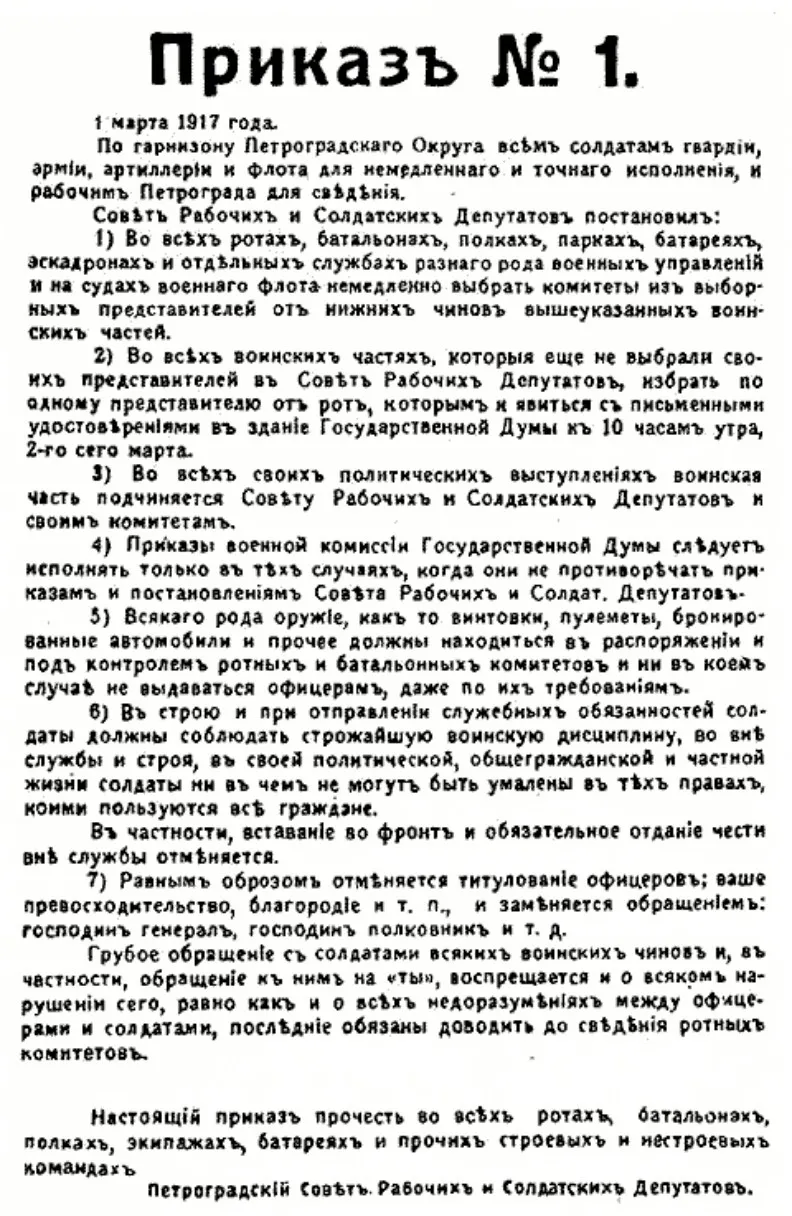
The text of the order is short, just a few points. The main point: the establishment of elected soldiers' committees in companies, battalions, regiments, and other units of the garrison. These committees were in charge weaponsRifles and machine guns remained under their control and were not issued to officers even upon direct request. In political actions, units were subordinate to the Council, and orders from the previous command were carried out only to the extent that they did not contradict the Council's decrees.
The document abolished off-duty insignia of class subordination. Officers were forbidden from addressing soldiers informally. The use of titles such as "Your Excellency" and "Your Honor" was abolished. Soldiers off-duty received full civil rights equal to everyone else.
Moreover, and this is often forgotten, the order explicitly stipulated that strict military discipline would be maintained in formation and during the performance of official duties. Legally, the document did not abolish either regulations or hierarchy. But the stipulation regarding subordination to the Council also undermined combat discipline: soldiers were given formal grounds to question whether an order contradicted the will of the Council. So, while formal discipline remained intact, in practice it no longer did.
Addressed to one, read by all
The text itself clearly identifies the addressee: the garrison of the Petrograd Military District. The document was intended to regulate relations specifically within the capital's units. Moreover, it was intended as a memorandum of agreement on decisions already made by the Council, not as an appeal to the entire army. The Council lacked the authority to extend it to the active army, and its authors apparently had no intention of doing so.
Things turned out differently. The order was printed in large print runs, posted throughout Petrograd, and distributed to garrisons—and the text spread across the country far more widely than its compilers had anticipated. Vacationers, Soviet delegations, and agitators carried it to the front. By mid-March, the order was lying on the desks of company clerks near Dvinsk, on the Southwestern Front, and in the Caucasus. Chief of Staff of the Supreme Commander-in-Chief M.V. Alekseyev attempted to blunt its impact with clarifications: the order applied only to Petrograd; the old regulations remained in effect in the active army. Minister of War A.I. Guchkov also joined in these efforts. The effect was limited.
What he did and what he didn't do
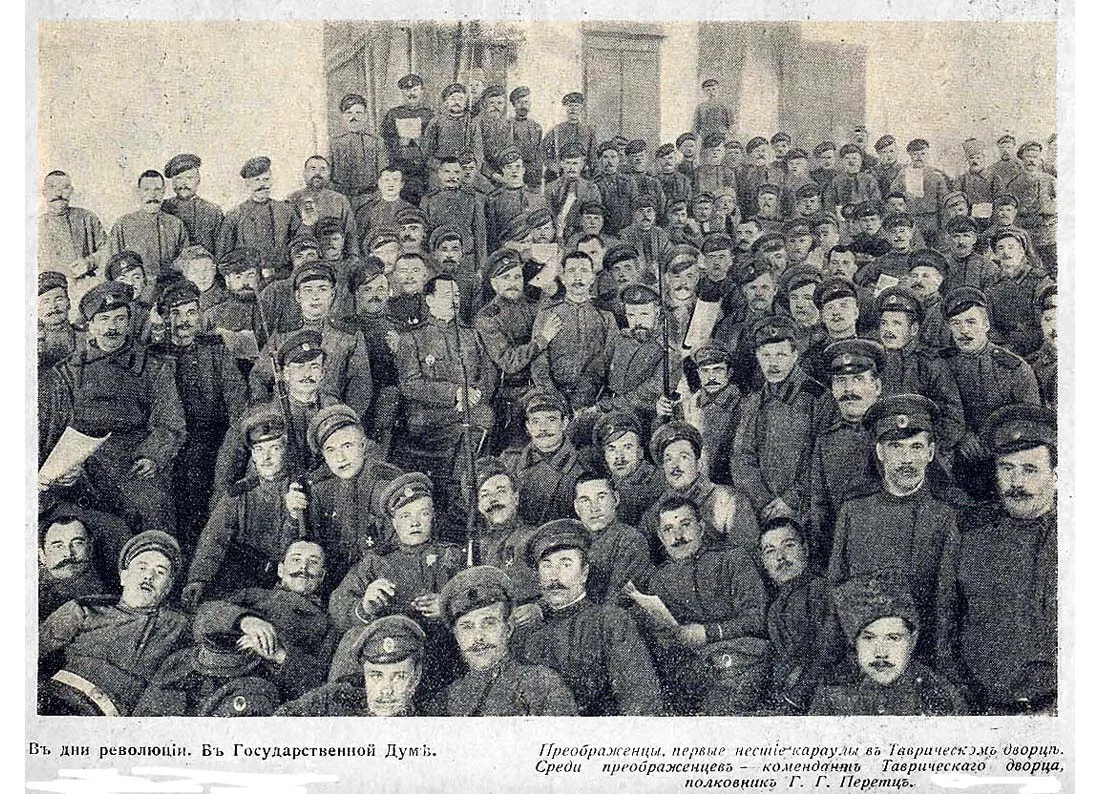
Legally, the order imposed almost nothing on the front. Committees in the active army were established later by separate orders from the Ministry of War, often under pressure from below, following the example of those in Moscow. Titles at the front died out naturally long before formal decisions were made: statutory politeness held up poorly in the trenches of the third winter of the war.
What it did was legalize what was happening. Before Order No. 1, a soldier who refused to obey an order or who convened a company committee risked court-martial. Afterward, the risk was much less: formally, the order applied only to the capital, but it publicly declared such actions to be the norm of revolutionary power, and punishing them against the backdrop of general anarchy became increasingly difficult. The document functioned not as an order in the military sense, but as a permit: what was already being done without prior approval received the stamp of revolutionary power.
Historians debate the significance of this document. Some consider Order No. 1 a trigger, hastening the army's disintegration by six months. Others see it as a fait accompli, merely formalizing an already ongoing process and adding little in itself. The truth, as usual in such stories, depends on which section of the front and which regiment you examine.
Why did it work that way?
The army that received the order was described in the previous article in this series. A career officer on the front lines is a rarity. A wartime ensign is the same age as his soldiers, without the authority of tradition. A private is an older peasant, for whom land and family weigh more than any lofty goals. Trust in the command has been undermined by three years of defeats.
In such a system, the formal abolition of titles or the establishment of a company committee were trivial matters. But they altered the psychological balance. An officer who, even without orders, could barely keep his unit under control lost even his formal support after receiving one: now the soldier had permission to object, to stand still, to disobey unquestioningly. Every individual instance of insubordination ceased to be an emergency and became routine.
Commanders quickly realized this. Officers' diaries and letters from the spring of 1917 are full of complaints about "disintegration," "committee rule," and "soldiers' laxity." There's some truth to these complaints, but there's also truth to the objection that the disintegration didn't begin with the order, but much earlier. But it was from March 1917 onward that officers found themselves confronted by soldiers without the usual state support—and this changed the entire structure of daily service.
What will happen next
By April, committees were operating almost everywhere at the front: sometimes without prior notice, sometimes by order of the new military department. Soldiers' political rights were no longer a subject of dispute. The right to discuss orders (not formally introduced, but effectively a practice) became part of everyday life.
In three months, this army was to go on the offensive. The command was preparing a major summer offensive on the Southwestern Front—something that would be part of history like the June offensive, hoping that the revolutionary impulse would urge the soldier to attack better than the previous discipline. What this hope turned out to be near Tarnopol will be discussed in the next article in the series.
Information